Newsletter Subscribe
Enter your email address below and subscribe to our newsletter

HVAC made simple
By Savvy Mavi | The Furnace Outlet
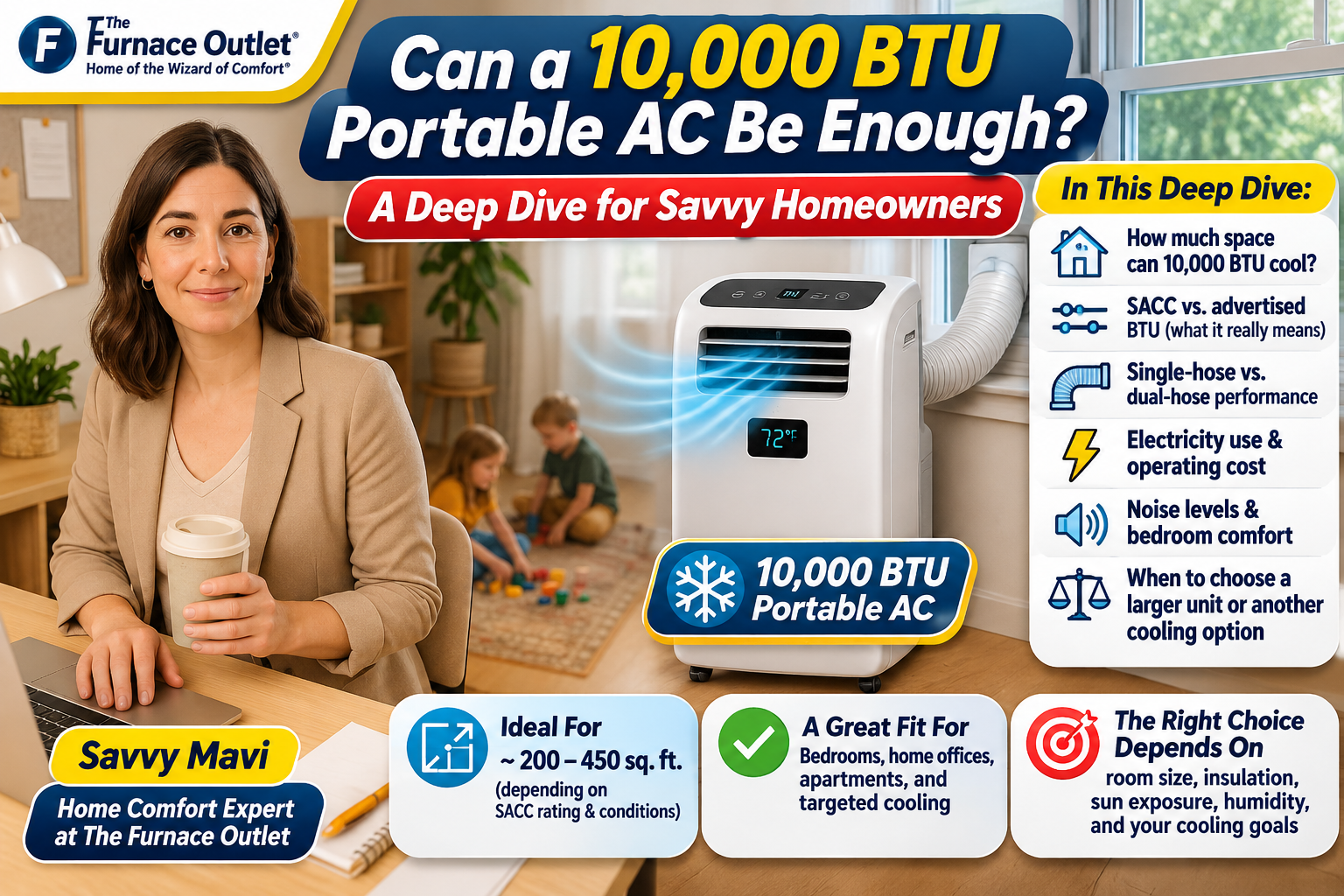
A 10,000 BTU portable air conditioner sounds like a practical solution for cooling a bedroom, home office, apartment, or other small living space. It offers flexibility, generally requires less installation work than a traditional window unit, and can be moved between rooms. However, one of the biggest mistakes homeowners make is assuming that every portable AC advertised as 10,000 BTU delivers the same cooling performance.
The reality is more complicated. Portable air conditioners are affected by room size, insulation, outdoor temperatures, humidity, exhaust hose design, and the difference between manufacturer-advertised cooling capacity and federally standardized testing ratings. A unit that performs comfortably in a shaded bedroom may struggle in a sunny living room of similar size.
In this guide, I’ll explain what a 10,000 BTU portable AC can realistically accomplish, how to understand its cooling ratings, what it costs to operate, and when upgrading to a larger or more efficient cooling system makes better financial sense.
BTU stands for British Thermal Unit, a measurement of heat energy. When an air conditioner is rated at 10,000 BTU per hour, that number describes a cooling capacity under a specified testing method. It does not mean the appliance consumes 10,000 BTUs of electricity or that it can cool every room of a particular size equally well.
For portable air conditioners, the testing standard matters enormously. Many models advertise cooling capacity using the older ASHRAE rating, while the U.S. Department of Energy uses a metric called Seasonally Adjusted Cooling Capacity, or SACC. SACC accounts for operating conditions that better reflect some of the practical challenges of portable AC performance.
A portable unit advertised as 10,000 BTU under an ASHRAE rating might have a substantially lower DOE SACC rating. The exact difference varies by model, so homeowners should never assume a fixed conversion. When comparing portable AC units, I recommend checking the DOE SACC figure rather than relying entirely on the largest BTU number displayed on the packaging.
The U.S. Department of Energy provides useful information about air-conditioning efficiency, cooling performance, and factors affecting household energy consumption.
A 10,000 BTU portable AC may be suitable for a small or moderately sized room, but the realistic coverage area depends on its DOE SACC rating and the room’s cooling load. Some manufacturers market models with this advertised capacity for approximately 200–450 square feet, although those figures are product-specific estimates rather than guarantees.
For a well-insulated bedroom measuring approximately 150–250 square feet, a properly selected unit may deliver comfortable cooling. A larger room with direct afternoon sunlight, tall ceilings, or poor insulation can demand considerably more capacity, even when its floor area falls within the manufacturer’s advertised coverage.
Homeowners should also remember that portable air conditioners are generally intended to cool individual rooms rather than entire homes. A 10,000 BTU model is unlikely to provide dependable whole-home cooling, particularly in properties with multiple rooms, hallways, and significant heat gain.
Square footage is a convenient starting point, but it does not tell the whole story. Two rooms measuring 250 square feet can have dramatically different cooling requirements depending on their construction and location.
A north-facing bedroom with insulated walls and double-pane windows may require relatively little cooling. A west-facing home office with large windows, several computers, and limited insulation may experience much greater heat gain during the afternoon.
Ceiling height also matters because rooms with higher ceilings contain more air and may have additional heat gain through their building envelope. Occupancy, lighting, cooking equipment, and electronic devices can further increase the cooling load.
For homeowners trying to estimate capacity more accurately, a room-specific cooling calculation is more useful than relying on floor area alone. The ENERGY STAR room air conditioner guidance offers helpful information about selecting appropriately sized cooling equipment.
One of the most important differences between portable air conditioners is their exhaust design. Single-hose models use indoor air to cool the condenser and then discharge that heated air outdoors through an exhaust hose. This process can create negative pressure inside the room, allowing warmer outdoor air or air from adjoining spaces to enter through gaps and openings.
That incoming air adds to the cooling load and can reduce the system’s effective performance. The effect becomes especially noticeable during hot weather, when the temperature difference between indoors and outdoors is substantial.
Dual-hose portable air conditioners generally use one hose to draw outdoor air into the condenser section and another to exhaust heated air outside. This design can reduce the negative-pressure problem associated with many single-hose units, although actual efficiency depends on the model and installation.
When choosing between similarly priced portable AC units, I generally favor a well-designed dual-hose system with a strong DOE SACC rating, particularly for rooms exposed to intense summer heat.
Portable air conditioners often face their greatest challenges during heat waves. When outdoor temperatures climb above 95°F, cooling demand increases, and the appliance may have difficulty maintaining a low indoor temperature, especially in poorly insulated rooms.
A portable AC can still provide meaningful relief during extreme weather, but homeowners should have realistic expectations. A unit may reduce indoor temperatures without necessarily maintaining 68°F or 70°F throughout the hottest part of the day.
Properly sealing the window exhaust kit, closing curtains during peak sunlight, and reducing unnecessary heat-producing activities can improve performance. These measures do not increase the appliance’s rated cooling capacity, but they reduce the amount of heat the system must remove.
Electricity consumption depends on the appliance’s input wattage, compressor operating time, fan speed, and efficiency. A portable air conditioner advertised as 10,000 BTU might consume approximately 900–1,300 watts while actively cooling, although individual products can fall outside this illustrative range.
Consider a model consuming 1,100 watts. If it operates at that power level for eight hours, it uses approximately 8.8 kilowatt-hours of electricity. At an electricity rate of $0.18 per kilowatt-hour, the estimated daily cost would be $1.58, or approximately $47.50 over 30 days.
Actual expenses may be lower if the compressor cycles off frequently or the unit modulates its output. They may also be higher when the system runs continuously during hot weather or electricity rates exceed the example used here.
When evaluating efficiency, homeowners should compare the model’s standardized energy performance and estimated annual energy consumption rather than assuming that two appliances with the same advertised BTU rating have identical operating costs.
Traditional window air conditioners often provide better cooling efficiency than comparable portable units because their condenser sections are located outdoors, and they generally avoid the exhaust-air challenges associated with single-hose portable systems.
A window AC can also be quieter inside the room because much of its mechanical equipment sits outside the living space. Portable units contain their compressor and condenser components indoors, which can increase perceived operating noise.
However, portable air conditioners offer advantages when window installation is prohibited, impractical, or inconvenient. Renters, homeowners with unusual window designs, and people who need occasional cooling in different rooms may find portable models more practical.
The Department of Energy’s room air conditioner guidance explains the importance of proper sizing, installation, and energy-efficient operation.
For the 2026–2027 buying period, homeowners may encounter advertised 10,000 BTU portable air conditioners priced approximately between $250 and $550, depending on features, efficiency, brand, and retail promotions. Premium dual-hose or inverter-driven models can cost more, while basic single-hose units may be available at lower prices.
Purchase price should not be the only consideration. A less expensive portable AC with lower effective cooling capacity may need to operate longer to maintain comfort, increasing electricity consumption.
I recommend comparing the DOE SACC rating, energy consumption, noise level, warranty coverage, and exhaust configuration before deciding whether a particular model represents good value.
Noise is one of the most frequently overlooked factors when purchasing a portable air conditioner. Because the compressor and fan operate inside the room, portable AC units may be more noticeable than window-mounted or split-system alternatives.
Many portable models advertise sound levels somewhere around 45–60 decibels under specified operating conditions, although actual figures vary considerably. Manufacturer measurements may be taken at particular fan speeds or distances, making direct comparisons difficult.
For bedrooms, I recommend prioritizing models with documented low-noise operation, sleep settings, and adjustable fan speeds. An inverter-driven portable AC may offer quieter operation at reduced loads, but buyers should verify the specific model’s specifications rather than assuming every inverter unit is quiet.
Portable air conditioners remove moisture as part of the cooling process, which can improve comfort in humid climates. However, the amount of moisture removed depends on the appliance design, indoor conditions, and compressor operation.
Some units automatically evaporate much of the collected condensate and discharge it through the exhaust system. Others require occasional tank emptying or support continuous drainage.
In particularly humid environments, drainage requirements deserve careful attention. A unit that frequently shuts down because its condensate tank is full may provide inconsistent cooling.
The U.S. Environmental Protection Agency’s indoor air quality guidance provides additional information about moisture management and maintaining healthy indoor conditions.
One common mistake is installing the exhaust hose incorrectly. A loose window adapter or poorly sealed opening allows hot outdoor air to enter the room, reducing cooling performance. Excessively long, sharply bent, or restricted exhaust hoses can also interfere with airflow and should be avoided unless explicitly permitted by the manufacturer.
Another mistake is placing the appliance too close to furniture or walls. Portable air conditioners require adequate clearance around their intake and discharge openings to operate properly.
Dirty air filters can also restrict airflow, reduce cooling performance, and increase operating time. Regular filter cleaning, following the manufacturer’s instructions, helps maintain efficient operation.
Finally, homeowners sometimes expect a portable AC to cool several adjoining rooms simultaneously. Unless airflow is carefully managed and the cooling load is modest, a single-room portable system generally performs best when used in a defined, enclosed space.
A larger unit may be appropriate when the room has substantial heat gain, high ceilings, poor insulation, or frequent occupancy. However, choosing the largest available portable air conditioner is not always the best solution.
Oversizing can increase purchase cost and may create comfort problems if the system cycles frequently without adequate humidity removal. The correct approach is to estimate the room’s cooling load and compare it with the appliance’s DOE SACC rating.
For rooms requiring significantly more cooling than a portable system can reasonably deliver, a window air conditioner, ductless mini-split, or appropriately sized central cooling system may provide better long-term performance.
Is a 10,000 BTU portable AC enough for a 300-square-foot room?
It may be, depending on the unit’s DOE SACC rating and the room’s cooling requirements. A shaded, well-insulated 300-square-foot room may be manageable for certain models, while a sunny room with high ceilings or poor insulation may need more capacity. Always compare the standardized cooling rating with the room’s actual conditions.
Can a 10,000 BTU portable AC cool a living room?
A 10,000 BTU portable unit can potentially cool a small, enclosed living room, but performance becomes less predictable in open-plan spaces connected to kitchens, hallways, or other rooms. Larger spaces and additional heat sources increase cooling demand, making a higher-capacity or different type of cooling system worth considering.
Should I buy a single-hose or dual-hose portable AC?
A dual-hose model is often preferable because it can reduce the negative pressure created by single-hose exhaust designs. However, performance varies by product, and a well-designed single-hose model may still be suitable for a smaller room. Compare DOE SACC ratings, efficiency, installation requirements, and total cost before deciding.
Is a portable AC worth buying instead of a mini-split?
A portable AC may be worthwhile for renters, temporary cooling needs, or rooms where permanent installation is not possible. A properly installed ductless mini-split generally offers better long-term efficiency, quieter operation, and greater comfort, but it requires a larger upfront investment and professional installation.
A 10,000 BTU portable air conditioner can be a sensible investment when matched to the right room and operating conditions. It is particularly useful for targeted cooling, rental properties, and spaces where installing a window unit or permanent cooling system is difficult.
However, I would never recommend choosing a portable AC based solely on the advertised BTU number. The DOE SACC rating, room insulation, sunlight exposure, exhaust configuration, humidity, and electricity consumption all influence how well the system performs.
For homeowners comparing portable air conditioners in 2026–2027, my recommendation is to prioritize effective cooling capacity, a properly sealed installation, reasonable operating costs, and dependable warranty coverage. The best portable AC is not necessarily the most powerful-looking model on the shelf; it is the one that delivers comfortable, efficient cooling in the room where you actually need it.
This article provides general educational guidance about portable air conditioner selection, sizing, and energy consumption. Actual cooling performance, operating costs, and coverage areas vary by model, room conditions, climate, and installation. Always consult manufacturer specifications and applicable electrical safety instructions before purchasing or operating portable cooling equipment.