Newsletter Subscribe
Enter your email address below and subscribe to our newsletter

HVAC made simple
By Jake Lawson | Jake the HVAC Specialist | The Furnace Outlet
Cold-climate heat pumps have changed the way homeowners heat their houses during winter. Modern inverter-driven systems can deliver useful heating even when outdoor temperatures drop well below freezing. However, one important question remains: How much supplemental electric heat does a home actually need?
Electric heat strips, also called auxiliary or backup resistance heaters, provide additional warmth when the heat pump cannot satisfy the home’s heating demand. Choosing the correct heat strip capacity is important because undersized backup heating can leave a home uncomfortable during extreme weather, while oversized or poorly controlled electric resistance heating can increase installation costs and electricity bills.
I’ve always believed that heat strip sizing should be based on the home’s actual heating requirements rather than automatically matching a large heater kit to the heat pump’s nominal tonnage. This guide explains how supplemental heating works, how to calculate the required capacity, and how to avoid common mistakes when installing or upgrading a cold-climate heat pump.
A heat pump transfers heat from outdoor air into the home instead of generating all its heat through electrical resistance. Even cold outdoor air contains thermal energy, and modern refrigeration systems can extract that energy at temperatures far below freezing.
However, the amount of heating a heat pump can deliver depends on the equipment design and outdoor conditions. As temperatures fall, the home’s heating demand generally increases. At the same time, some heat pumps experience reduced heating capacity, creating a potential gap between available heat and the amount required to maintain the indoor temperature.
Electric heat strips help cover that difference. They are commonly installed inside compatible ducted air handlers and operate when additional heating is required. The U.S. Department of Energy’s cold-climate heat pump sizing guidance explains how heat pump capacity and backup heating should be evaluated together.
Electric heat strips use resistance heating elements to convert electricity directly into heat. They operate much like an electric furnace, with a blower moving air across the heating elements before distributing the warmed air through the ductwork.
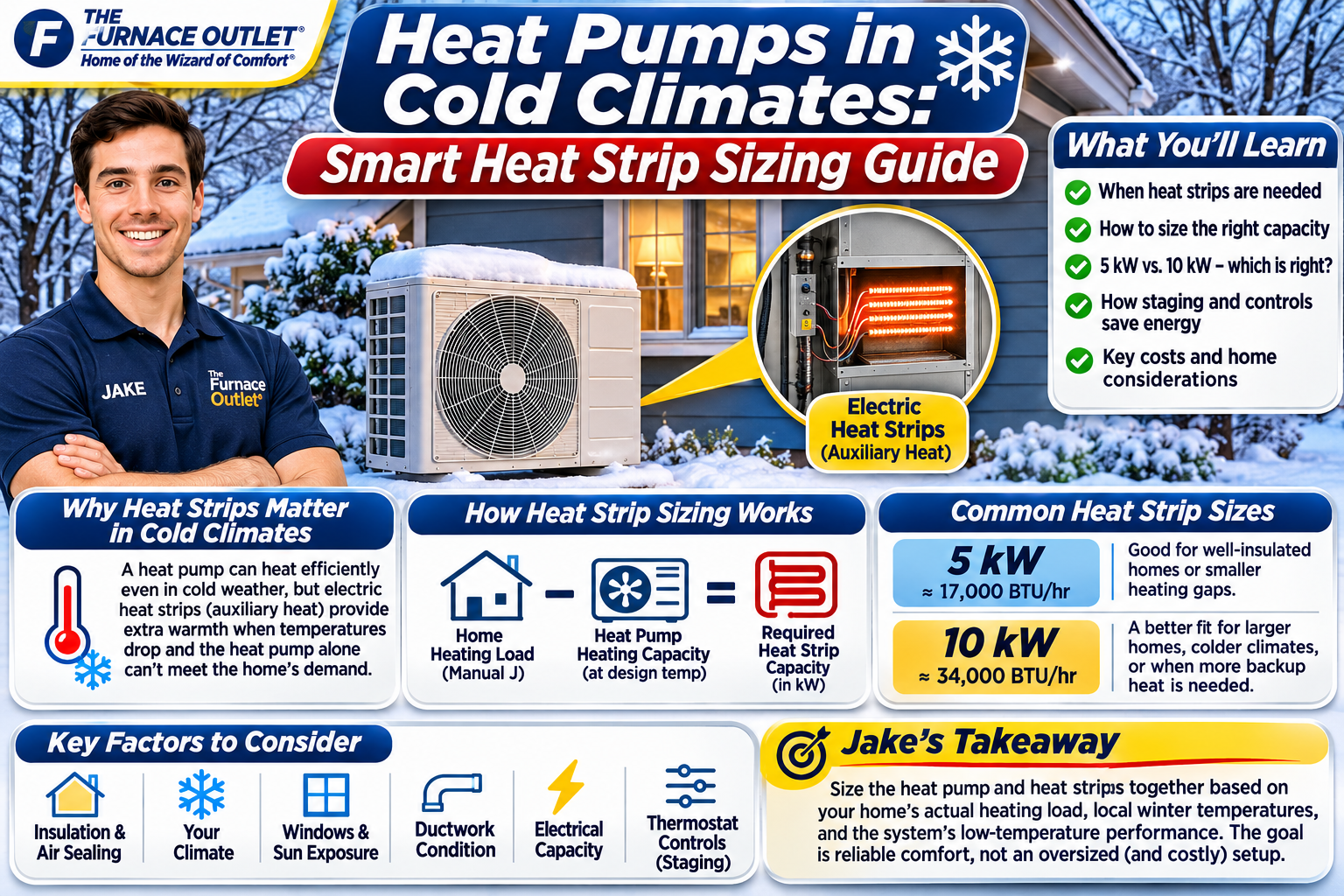
Their output is measured in kilowatts rather than tons. One kilowatt of electric resistance heating produces approximately 3,412 BTU per hour. Therefore, a 5 kW heat strip kit provides about 17,060 BTU per hour, while a 10 kW kit produces approximately 34,120 BTU per hour at its rated voltage.
Electric resistance heating is dependable but generally less efficient than heat pump operation. A resistance heater has a coefficient of performance of approximately 1, meaning it delivers about one unit of heat for every unit of electrical energy consumed. A heat pump can often deliver substantially more heat per unit of electricity, although its efficiency varies with operating conditions.
For this reason, heat strips should normally supplement the heat pump when necessary rather than operate unnecessarily throughout the winter.
Auxiliary heat and emergency heat are often confused, but they serve different purposes. Auxiliary heat supplements the heat pump when additional heating capacity is required. Depending on the system design, both the compressor and electric resistance elements may operate simultaneously.
Emergency heat is a control mode intended to provide heating when the heat pump is unavailable or intentionally disabled. In a conventional electric-backup system, selecting emergency heat typically prevents normal compressor operation and relies on the electric resistance heaters.
Homeowners should not routinely select emergency heat simply because the outdoor temperature is below freezing. Modern cold-climate heat pumps are designed to operate in low temperatures, and unnecessary emergency heat operation can substantially increase electricity consumption.
The actual control sequence depends on the thermostat, air handler, and heat pump configuration. Proper commissioning ensures that auxiliary and emergency heating operate according to the manufacturer’s requirements.
In colder climates, heat strips must provide enough supplemental capacity to maintain acceptable indoor temperatures when the heat pump cannot meet the entire heating load. However, selecting the largest available heater kit is not necessarily the best solution.
An oversized heater kit can require larger electrical circuits, additional wiring, and increased service capacity. If controls activate too much resistance heating unnecessarily, operating costs may rise significantly.
An undersized backup system can also create problems. During extreme cold or compressor failure, the available resistance heating may not provide sufficient output to maintain the desired indoor temperature.
The objective is to select a backup heating system that meets the home’s requirements under the intended operating scenarios without creating unnecessary electrical demand.
The starting point is a professional heating load calculation using ACCA Manual J. This determines the approximate heating capacity the home requires at the local winter design temperature, accounting for insulation, windows, air leakage, construction, and other building characteristics.
The contractor must then determine the selected heat pump’s actual heating capacity at that temperature. This information comes from the manufacturer’s extended performance tables, not simply the nominal tonnage printed on the equipment.
For a system designed to operate the compressor and electric backup simultaneously, the supplemental heating requirement can be estimated by subtracting the heat pump’s available heating output from the calculated home heating load. The resulting capacity gap can then be converted from BTU per hour into kilowatts.
For example, suppose a home’s calculated heating requirement is 42,000 BTU per hour at its winter design temperature, while the selected heat pump can provide 27,000 BTU per hour under those conditions. The supplemental heating requirement would be approximately 15,000 BTU per hour, equivalent to about 4.4 kW. A compatible 5 kW heater kit might cover this calculated gap, subject to equipment ratings, electrical limitations, staging, and the intended backup-heating strategy.
This calculation does not establish whether the same heater kit could maintain the home during a complete compressor failure. If full emergency heating is required, the contractor must evaluate the backup system against the home’s heating load without counting heat pump output.
A 5 kW heater kit provides approximately 17,060 BTU per hour at its rated voltage. It may be sufficient for a well-insulated home with a modest heating-capacity shortfall or for a modern cold-climate heat pump that maintains substantial output during low outdoor temperatures.
However, 5 kW is not automatically sufficient for every 2-ton or 3-ton heat pump. A larger home with significant heat loss may require more supplemental heating, especially if the system is expected to maintain indoor comfort during a compressor failure.
I recommend evaluating both the calculated heating deficit and the homeowner’s expectations for emergency heating. These two requirements can lead to different heater-kit selections.
A 10 kW electric heater kit provides approximately 34,120 BTU per hour at its rated voltage. This capacity may be appropriate for homes with greater heating loads, heat pumps that experience significant capacity reductions during extreme cold, or systems designed to provide substantial emergency heating.
However, a 10 kW heater kit also represents a significant electrical load. At 240 volts, 10,000 watts corresponds to approximately 41.7 amperes before accounting for equipment-specific electrical design requirements. The actual circuit configuration, conductor sizing, overcurrent protection, and installation requirements must follow the listed equipment specifications and applicable electrical codes.
Some air handlers use staged heating elements, allowing only part of the total resistance capacity to operate when needed. Proper staging can reduce unnecessary electrical demand and improve operating efficiency.
Not necessarily. Some modern cold-climate heat pumps can meet the entire calculated heating load at the local winter design temperature without supplemental resistance heating. This is particularly possible when the home is well insulated and the heat pump is selected specifically for low-temperature heating performance.
According to ENERGY STAR’s heat pump criteria, qualifying cold-climate equipment must demonstrate specified heating performance at 5°F, including a minimum coefficient of performance and retained heating capacity relative to its rated output at 47°F.
However, meeting a cold-climate certification standard does not automatically mean a particular system can heat every home without backup. Actual performance must be compared with the building’s heating load at the local design temperature.
Some homeowners also prefer a separate backup heating source for resilience during equipment failures. That decision should consider comfort expectations, installation cost, electrical capacity, and the likelihood of extreme weather.
Homeowners frequently encounter recommendations suggesting that a particular heat pump tonnage should always be paired with a specific heater-kit capacity. Although equipment manufacturers offer common heater-kit sizes for different air handlers, these combinations are not universal sizing rules.
A 2-ton cold-climate heat pump installed in a highly insulated home may require little or no supplemental heating. Meanwhile, a 3-ton system serving an older home in a very cold region may need considerably more backup capacity.
A 4-ton heat pump does not automatically require 15 kW or 20 kW of electric resistance heating. The correct selection depends on the calculated heating load, actual low-temperature compressor output, air-handler compatibility, and whether the heater kit must support partial or full emergency heating.
The Department of Energy’s guide to sizing and selecting air-source heat pumps emphasizes using manufacturer performance data and recognized equipment-selection methods rather than relying exclusively on nominal equipment capacity.
Staged electric resistance heating allows the system to activate only the heating capacity required at a particular moment. Instead of energizing a large heater kit immediately, the controls may activate a smaller stage first and bring additional elements online only when necessary.
For example, a 10 kW heater kit configured with two 5 kW stages may operate the first stage when modest supplemental heating is needed. The second stage may activate during more demanding conditions, depending on the thermostat and air-handler control logic.
Staging does not change the fundamental efficiency of electric resistance heating. However, it can help avoid unnecessary operation of additional heating elements when the heat pump and a smaller auxiliary stage can satisfy demand.
Correct thermostat configuration is essential because aggressive temperature recovery settings or poorly configured auxiliary-heat controls may activate resistance heating more frequently than necessary.
The thermal balance point is the outdoor temperature at which the heat pump’s available heating capacity equals the home’s heating requirement. Above this temperature, the heat pump may be able to maintain comfort without supplemental heat. Below it, additional heating may be necessary.
For example, a heat pump might satisfy the entire home heating load down to 10°F. Below that temperature, the available heat pump capacity may fall short, requiring auxiliary heating.
However, the balance point varies with the equipment and building. Some modern cold-climate systems can meet the full heating load at temperatures below 0°F, while other installations require backup heating at considerably warmer temperatures.
The thermostat should be configured around the actual system design rather than an arbitrary outdoor temperature. A heat pump should not automatically be disabled at 30°F or 35°F simply because those settings were common with older equipment.
Electric resistance heating can significantly increase electricity consumption when operated for extended periods. A 5 kW heater operating continuously for one hour uses approximately 5 kilowatt-hours of electricity, while a 10 kW heater uses approximately 10 kilowatt-hours during the same period.
At an illustrative electricity rate of $0.18 per kilowatt-hour, operating a 5 kW heater for one hour costs approximately $0.90. A 10 kW heater operating at full capacity for the same duration costs approximately $1.80.
If a 10 kW heater operates for four equivalent full-load hours per day, it consumes approximately 40 kWh, costing about $7.20 daily at that electricity rate. Actual consumption varies with staging, thermostat settings, outdoor temperature, and the amount of heating supplied by the compressor.
These calculations demonstrate why proper sizing and control configuration matter. The objective is not necessarily to eliminate heat strips but to ensure they operate only when needed.
Before selecting an electric heater kit, the installer must confirm that the air handler and electrical system can safely accommodate the proposed capacity. Electric resistance heating can create substantial electrical demand, particularly when combined with other major household appliances.
Some installations require dedicated circuits, appropriately rated breakers, larger conductors, or electrical panel modifications. The manufacturer’s installation instructions identify the approved heater-kit combinations and electrical requirements for the specific equipment.
Electrical work must comply with applicable codes and should be performed by qualified professionals. Installing an oversized heater kit without evaluating electrical capacity can create serious safety hazards and expensive corrective work.
One common mistake is selecting backup heating based solely on the outdoor heat pump’s tonnage. This approach ignores the home’s actual heating load and the heat pump’s performance at low outdoor temperatures.
Another mistake is assuming that every cold-climate heat pump needs a large electric heater kit. Modern variable-capacity equipment may deliver enough heating output to reduce or eliminate supplemental heating under normal design conditions.
Poor thermostat configuration can also create unnecessary operating expenses. If the controls activate resistance heating too early or disable the compressor at an unnecessarily high outdoor temperature, the homeowner may lose much of the efficiency advantage of the heat pump.
Finally, homeowners sometimes overlook the distinction between supplemental heating and full emergency backup. A heater kit sized only to cover a small capacity deficit may not be large enough to maintain the home independently if the compressor fails.
How many kilowatts of heat strips does a 3-ton heat pump need?
A 3-ton heat pump does not have one universally correct heat strip size. Some installations may require no supplemental heating, while others may use 5 kW, 10 kW, or another manufacturer-approved configuration. The correct selection depends on the home’s calculated heating load, the heat pump’s actual low-temperature capacity, and the desired emergency-heating capability.
Can a heat pump and electric heat strips operate together?
Yes, many conventional ducted heat pump systems are designed to operate the compressor and auxiliary electric resistance heating simultaneously. This allows the heat pump to continue providing efficient heating while the strips supply the additional capacity required. The exact operating sequence depends on the equipment and control system.
Are heat strips expensive to operate?
Electric heat strips can be more expensive to operate than a functioning heat pump because resistance heating generally delivers less heat per unit of electricity. However, short periods of auxiliary operation during extreme weather may be reasonable and necessary. Correct sizing, staging, and thermostat configuration help limit unnecessary operating costs.
Can I install larger heat strips for extra heating capacity?
Larger heat strips should only be installed when they are compatible with the air handler and justified by the heating design. Increasing capacity may require electrical upgrades and could exceed the equipment’s approved configuration. A qualified HVAC contractor and electrician should evaluate the proposed change before installation.
When evaluating a heat pump for a cold-climate home, I recommend treating the compressor and supplemental heating system as parts of one complete heating design. The heat pump should provide as much efficient heating as practical, while the backup system should cover the remaining load under the intended operating conditions.
Start with a professional Manual J heating load calculation, verify the heat pump’s actual capacity at the local winter design temperature, and determine whether the homeowner wants supplemental heating only or full emergency backup. Then select an approved heater kit with appropriate staging, electrical capacity, and thermostat controls.
The goal is not to install the largest heat strip kit available. It is to create a heating system that maintains comfort during extreme weather without wasting electricity during normal winter operation.
The U.S. Department of Energy’s Building America Solution Center provides detailed guidance on cold-climate heat pump sizing, heating loads, and supplemental heating strategies. ENERGY STAR explains the performance criteria used to identify qualifying cold-climate heat pumps, while the Department of Energy’s sizing and selection guide discusses manufacturer performance data and appropriate equipment selection. Additional research from the Electric Power Research Institute examines heat pump performance and supplemental heating considerations in cold climates.
This article is intended for general educational purposes and does not replace professional HVAC design, electrical load calculations, or manufacturer installation instructions. Heat strip sizing must account for the home’s calculated heating load, equipment compatibility, electrical capacity, and applicable codes. Always consult qualified HVAC and electrical professionals before installing or modifying supplemental electric heating equipment.