Newsletter Subscribe
Enter your email address below and subscribe to our newsletter

HVAC made simple
By Tony Marino | HVAC Technician & Cooling Specialist | The Furnace Outlet | Updated November 2026
When homeowners invest in a new air-conditioning system, they naturally focus on cooling performance, energy efficiency, and installation costs. But there’s another important consideration that often gets overlooked until something goes wrong: the manufacturer’s warranty.
I’ve worked with enough HVAC equipment to know that even a properly installed air conditioner can occasionally experience a component failure. A compressor might develop a problem, a condenser fan motor could stop operating, or an electrical component may need replacement. When that happens, understanding your warranty can make a substantial difference in the cost of getting your system running again.
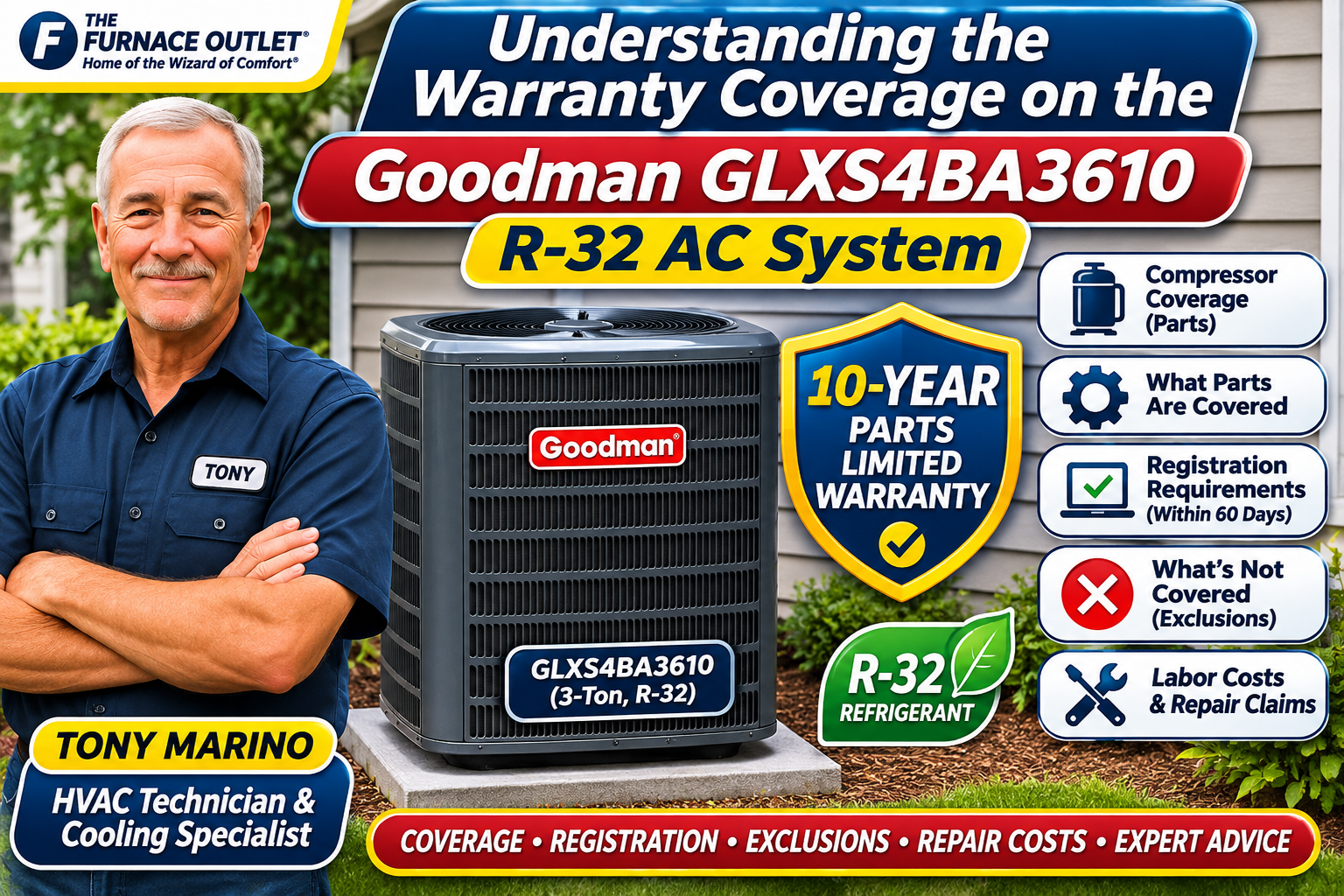
The Goodman GLXS4BA3610 is a 3-ton residential air conditioner designed for R-32 refrigerant. It belongs to Goodman’s GLXS4B product family, which offers straightforward cooling technology and a registered 10-year parts limited warranty. However, that coverage comes with conditions, exclusions, and responsibilities that every homeowner should understand.
In this guide, I’ll explain what Goodman’s warranty covers, how registration works, what happens when a compressor fails, and how to protect your investment throughout the equipment’s service life.
The Goodman GLXS4BA3610 is a nominal 36,000-BTU-per-hour, or 3-ton, split-system air-conditioning condenser. It uses R-32 refrigerant and incorporates a conventional compressor, copper-tube and aluminum-fin condenser coil, factory-installed filter drier, and accessible service components.
The GLXS4B family offers efficiency ratings reaching approximately 15.2 SEER2 in qualifying matched configurations. The actual efficiency of a GLXS4BA3610 installation depends on the compatible indoor coil or air handler and the certified equipment combination. One advantage of this model is its relatively conventional design. While premium inverter-driven air conditioners offer advanced capacity modulation, the GLXS4BA3610 emphasizes familiar cooling technology and straightforward serviceability.
You can review the manufacturer’s specifications through the Goodman product literature library, which includes technical information and warranty certificates for the GLXS4B series.
Yes. The Goodman GLXS4BA3610 is eligible for a 10-year parts limited warranty when the applicable registration and warranty requirements are satisfied. For qualifying installations, Goodman requires online registration within 60 days of installation to obtain the extended registered coverage. Certain jurisdictions, including California, Florida, and Quebec, have registration exceptions, and additional state-specific provisions may apply. Without qualifying registration or an applicable exception, the standard parts coverage is generally five years.
This distinction is important because a homeowner who assumes the system automatically carries ten years of coverage may discover that the shorter standard warranty applies. My recommendation is to confirm registration immediately after installation and retain the confirmation with your purchase documents. Don’t assume that the contractor completed registration unless you have proof.
The manufacturer’s parts limited warranty generally applies to covered functional components that fail because of qualifying defects in materials or workmanship during the applicable warranty period. For the GLXS4BA3610 outdoor condenser, potentially covered components include the compressor, condenser fan motor, electrical controls, capacitors, contactors, and other factory-installed functional parts.
However, coverage isn’t simply a promise that Goodman will replace any component that stops working. The manufacturer must determine that the failure qualifies under the warranty’s terms. Damage resulting from improper installation, external electrical problems, neglect, environmental conditions, or unauthorized modifications may fall outside coverage.
It’s also important to understand that the outdoor condenser warranty doesn’t automatically cover every component in the complete HVAC system. A separately installed Goodman air handler, evaporator coil, or furnace may have its own warranty certificate and registration requirements.
The compressor is among the major functional components covered by the GLXS4B parts limited warranty when the applicable conditions are met. For a qualifying registered GLXS4BA3610 system, a compressor failure caused by a covered manufacturing defect may therefore qualify for a replacement compressor during the 10-year coverage period.
However, this doesn’t mean that Goodman automatically replaces the entire outdoor condenser when the compressor fails. The distinction matters because compressor replacement can involve substantial labor, refrigerant recovery, brazing, evacuation, testing, and system commissioning. Even if Goodman supplies a covered replacement compressor, the homeowner may still face significant service expenses.
Before authorizing a major repair, I recommend requesting a written explanation of the diagnosis, warranty eligibility, labor charges, and alternative replacement options.
Goodman offers whole-unit replacement protection on certain premium air-conditioning models, but the GLXS4B series is not listed as eligible for the 10-year unit replacement limited warranty in the manufacturer’s product warranty overview. For the GLXS4BA3610, homeowners should therefore plan around the applicable parts limited warranty rather than assuming that a compressor failure will result in a complete new condenser.
This is one of the most important differences between Goodman’s value-oriented and premium product families. A parts warranty can still provide meaningful financial protection, especially when an expensive compressor or motor fails. However, homeowners should understand that receiving a replacement component is different from receiving a complete replacement air conditioner.
The standard Goodman parts limited warranty generally does not cover the labor required to diagnose, remove, or replace a failed component. For example, suppose a condenser fan motor fails during the fourth year of ownership because of a covered manufacturing defect. Goodman may provide the eligible replacement motor, but the homeowner could still be responsible for the technician’s diagnostic visit and installation labor.
Compressor failures can be more expensive because the repair may require refrigerant handling, specialized equipment, and additional system testing. Some HVAC contractors offer separate labor warranties, while extended service agreements may provide additional protection. These arrangements are distinct from the standard manufacturer warranty and should be reviewed individually.
When comparing installation quotations, I always recommend asking how long the contractor guarantees workmanship and whether optional labor protection is available.
A warranty claim may be rejected when the failure doesn’t meet the manufacturer’s definition of a covered defect or when applicable warranty conditions haven’t been satisfied. Improper refrigerant charging, inadequate airflow, incorrect electrical connections, installation damage, or operation outside approved specifications can contribute to equipment problems that aren’t necessarily manufacturing defects.
Neglected maintenance may also become relevant when it causes or contributes to the failure. For example, severely restricted airflow or an obstructed condenser coil can place unnecessary stress on system components. Using a third-party replacement part doesn’t automatically invalidate the entire warranty, but damage caused by an incompatible or improperly installed component may not be covered.
I recommend following the manufacturer’s installation and maintenance instructions and retaining service documentation. These records can help establish that the equipment was operated and maintained appropriately.
The registration process should begin shortly after installation. Homeowners can use Goodman’s official product registration portal or ask their installing dealer to complete the registration. You’ll generally need the outdoor unit’s model number, serial number, installation date, and information about the installation. If your system includes a Goodman air handler or other separately warranted equipment, confirm whether those components also require registration.
The serial number is typically found on the manufacturer’s identification label attached to the outdoor condenser. After completing registration, retain the confirmation and a copy of the applicable warranty certificate. These documents should be stored with the installation invoice and equipment specifications.
I recommend verifying registration well before the 60-day deadline rather than waiting until the final week.
For installations subject to Goodman’s registration requirement, missing the qualifying registration deadline generally means that the standard five-year parts limited warranty applies instead of the registered ten-year term.
However, registration requirements and coverage rights vary by jurisdiction. Homeowners in California, Florida, and Quebec have specific protections, and the manufacturer’s certificate should be consulted for applicable exceptions.
If you aren’t sure whether your system was registered, contact Goodman or the installing dealer with the model and serial numbers.
Don’t assume that the absence of a registration confirmation necessarily means the equipment has no warranty. Standard coverage may still apply, and local law may provide additional rights.
The GLXS4BA3610 uses R-32, a refrigerant with a lower global warming potential than R-410A. R-32 is classified as A2L, meaning it has lower toxicity and mild flammability under the applicable refrigerant safety classification. Because of these characteristics, installation and servicing must follow the manufacturer’s equipment-specific instructions and applicable safety codes.
Refrigerant repairs should be performed by qualified technicians using appropriate tools and procedures. Incorrect refrigerant handling, incompatible components, or unauthorized modifications can damage the system and create safety risks. The U.S. Environmental Protection Agency provides additional background on the transition toward lower-global-warming-potential refrigerants through its HFC reduction program.
For homeowners, the practical message is straightforward: don’t attempt refrigerant repairs yourself, and make sure your contractor is familiar with R-32 equipment.
When the air conditioner develops a problem, the first step is to contact the original installing contractor or another qualified Goodman service provider. The technician should inspect the equipment, identify the failed component, and determine whether the problem may qualify for manufacturer warranty coverage. If a covered component is defective, the servicing dealer can coordinate the appropriate warranty process through Goodman or its authorized distribution network.
The homeowner should request a written estimate identifying any charges that aren’t covered, including diagnostics, labor, refrigerant, or additional materials. Warranty processing times vary according to the component, parts availability, dealer procedures, and claim circumstances. I wouldn’t rely on a guaranteed replacement timeline without confirmation from the servicing contractor.
Repair expenses depend on the failed component, local labor rates, and the complexity of the work. For preliminary U.S. budgeting, a condenser fan motor replacement may cost several hundred dollars, while a major compressor replacement can reach approximately $1,500–$3,500 or more when parts, labor, and refrigerant-related work are included.
These figures are broad estimates, not Goodman-specific repair quotations. A valid parts warranty may substantially reduce the cost of an eligible repair, but it doesn’t necessarily eliminate the homeowner’s expenses.
When a major component fails late in the equipment’s service life, I recommend comparing the total repair cost with the price of a replacement system. The remaining warranty period, overall condition, refrigerant requirements, and expected future reliability should all influence the decision.
An extended labor agreement can make sense for homeowners who want more predictable repair expenses, particularly during the later years of equipment ownership. However, the value depends on the contract price, coverage limits, exclusions, service fees, and the company responsible for fulfilling the agreement. Some plans cover only specified repairs, while others may impose reimbursement limits or require service through particular contractors.
Before purchasing additional coverage, I recommend calculating the total premium over the contract period and comparing it with the potential cost of major repairs. A reasonably priced labor plan from a reputable provider may offer useful protection, but an expensive contract with restrictive terms may provide limited financial value.
Warranty transferability depends on the applicable Goodman warranty certificate, ownership conditions, registration status, and jurisdiction. Homeowners shouldn’t assume that the full registered ten-year term automatically transfers to a subsequent property owner. If you’re purchasing a home with an existing GLXS4BA3610 system, ask for the original installation date, model and serial numbers, registration confirmation, and warranty documentation.
If you’re selling your home, providing these records can help the buyer understand what protection may remain. The safest approach is to verify the remaining coverage directly with Goodman rather than relying on a general statement that the equipment has a ten-year warranty.
The best way to protect your air conditioner is to combine correct installation with regular maintenance and good recordkeeping. I recommend checking and replacing air filters as needed, keeping the outdoor condenser clear of debris, maintaining adequate airflow, and scheduling professional inspections according to the manufacturer’s recommendations.
The technician should evaluate refrigerant system performance, electrical connections, coil condition, condensate drainage, and overall operating behavior. Keep installation invoices, maintenance receipts, registration records, and repair documentation in one accessible location.
The U.S. Department of Energy’s central air-conditioning guidance also explains how maintenance and proper system operation affect cooling performance. These practices don’t guarantee that a component will never fail, but they can reduce preventable problems and provide useful documentation if warranty service becomes necessary.
Does the Goodman GLXS4BA3610 come with a lifetime compressor warranty?
No. The GLXS4B series does not carry a standard lifetime compressor warranty. Its compressor is covered under the applicable parts limited warranty, subject to the warranty certificate’s conditions and duration.
Will Goodman replace the entire AC if the compressor fails?
Not automatically. The GLXS4B series is not included among the models with Goodman’s 10-year unit replacement limited warranty. A qualifying compressor defect may instead result in replacement of the covered component.
Does the warranty cover refrigerant leaks?
Coverage depends on the cause of the leak and the applicable warranty terms. A qualifying defect in a covered factory component may be eligible for parts coverage, while refrigerant, labor, and damage caused by installation problems may not be covered.
Can I register the warranty after 60 days?
You can contact Goodman about your registration status, but late registration doesn’t necessarily qualify a system for the extended registered warranty. Jurisdictional exceptions and the specific warranty certificate determine the applicable rights.
For a value-oriented residential air conditioner, the Goodman GLXS4BA3610 offers meaningful manufacturer protection through its eligible 10-year parts limited warranty. However, homeowners should recognize its limitations. The standard warranty generally doesn’t cover labor, the GLXS4B series doesn’t include the premium 10-year whole-unit replacement warranty, and extended coverage may depend on timely registration.
My recommendation is to register the equipment promptly, verify the exact warranty certificate, keep maintenance records, and choose a qualified installer who will support the system after the sale. A good warranty is valuable, but it works best alongside proper equipment sizing, professional installation, and dependable local service.
This article provides general educational information for U.S. homeowners. Goodman warranty terms may vary by installation date, equipment model, jurisdiction, registration status, and ownership conditions. The manufacturer’s applicable warranty certificate governs actual coverage. Repair costs are illustrative estimates and not guaranteed service quotations. HVAC installation, electrical work, refrigerant handling, and servicing should be performed by qualified professionals following applicable codes and manufacturer instructions.