Newsletter Subscribe
Enter your email address below and subscribe to our newsletter

HVAC made simple
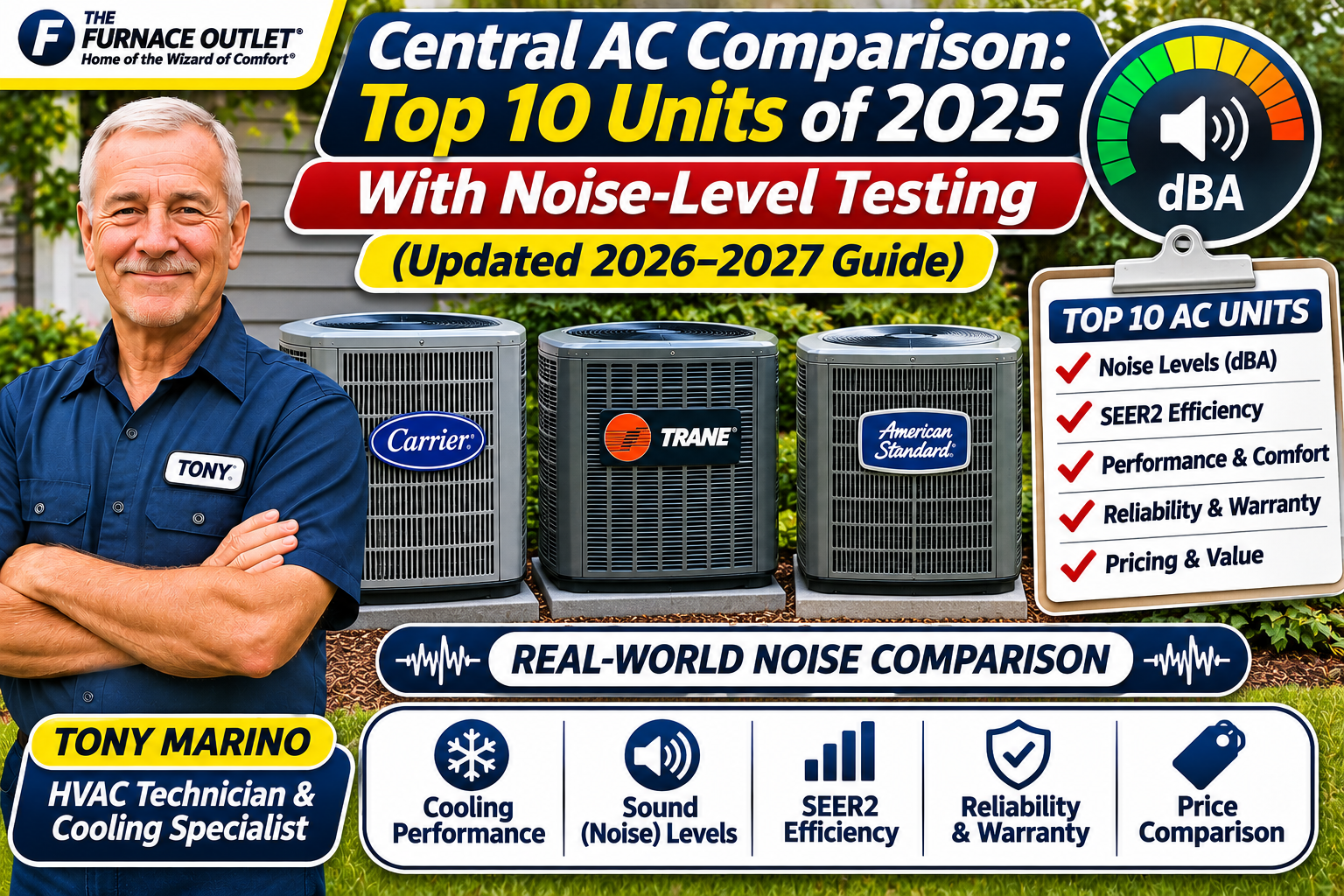
By Tony Marino | HVAC Technician & Cooling Specialist | The Furnace Outlet | Updated November 2026
When homeowners shop for a central air conditioner, cooling capacity and energy efficiency usually receive the most attention. But after years of working with residential HVAC systems, I’ve learned that operating noise can be just as important to everyday comfort. An air conditioner that keeps your home cool but produces a constant mechanical hum outside your bedroom window can quickly become frustrating.
Fortunately, today’s central air conditioners offer substantial improvements in compressor technology, fan design, vibration control, and sound insulation. Premium variable-speed systems can operate at reduced capacity during lighter cooling loads, often producing less noise than conventional single-stage equipment. However, the quietest system on paper isn’t necessarily the quietest installation in a real backyard.
For this updated 2026–2027 guide, I’ve selected ten noteworthy central air conditioners across premium, midrange, and value categories. The comparison examines manufacturer-published noise ratings, cooling technology, efficiency, comfort, and practical buying considerations. This is a review of published laboratory-rating data, not an independent physical sound test conducted by The Furnace Outlet.
Central air-conditioner noise is commonly expressed in A-weighted decibels, abbreviated dBA. The decibel scale is logarithmic, meaning a small numerical difference can represent a substantial change in sound energy. A 10 dB increase corresponds to ten times the sound energy, although the perceived loudness depends on frequency, distance, background noise, and other factors. An important distinction is the difference between sound power and sound pressure. Sound power describes the acoustic energy emitted by equipment, while sound pressure describes the sound measured at a particular listening location. These measurements shouldn’t be compared interchangeably.
The Air-Conditioning, Heating, and Refrigeration Institute publishes AHRI Standard 270, which establishes requirements for rating outdoor HVAC equipment sound performance. Manufacturer sound data prepared under this standard can support meaningful equipment comparisons when the ratings use equivalent operating conditions.
For variable-speed systems, it’s particularly important to distinguish minimum-speed operation from full-capacity operation. A condenser may be exceptionally quiet during mild weather but noticeably louder when operating at maximum cooling output on a very hot afternoon.
Carrier’s Infinity 21 is a premium residential air conditioner designed for homeowners who want advanced temperature control, strong efficiency, and reduced operating noise. The current 26VNA1 model offers variable-speed cooling and efficiency ratings reaching approximately 21 SEER2 in qualifying configurations. Carrier advertises sound levels as low as 55 dBA, making it one of the more compelling choices for noise-conscious homeowners. However, that minimum figure shouldn’t be interpreted as the sound level at every operating speed or equipment capacity.
The variable-speed compressor allows the system to adjust cooling output as demand changes, helping maintain more consistent temperatures and potentially improving humidity management. I would consider this model for homes with long cooling seasons, bedrooms near outdoor equipment, or occupants who are particularly sensitive to mechanical noise.
Trane’s 20 TruComfort Variable Speed system represents the company’s premium cooling technology for the current product generation. It offers efficiency ratings reaching approximately 24 SEER2 and published nominal sound ratings ranging from 64 to 76 dBA across qualifying configurations. Trane’s variable-speed design adjusts cooling capacity to match changing indoor conditions, reducing the need for repeated full-capacity operation. This can improve temperature consistency and provide quieter operation during reduced-load periods.
The published sound range must be interpreted carefully because equipment capacity and operating speed affect the actual rating. I would recommend reviewing the model-specific sound-power data rather than assuming that every Trane 20 TruComfort installation will operate at the lowest advertised figure. For homeowners who prioritize premium comfort and sophisticated system controls, Trane remains a strong contender, although the higher installed cost deserves careful consideration.
American Standard’s Platinum 20 AccuComfort is closely related to Trane’s premium variable-speed technology. It offers efficiency ratings reaching approximately 24 SEER2 and advanced compressor modulation designed to maintain steady indoor temperatures. Manufacturer product data for selected 2-ton configurations show sound-power ratings as low as 52 dBA at minimum cooling speed and approximately 64 dBA at maximum speed. Larger-capacity models can produce higher ratings, with published maximum figures reaching approximately 76 dBA.
This makes the Platinum 20 particularly interesting for homeowners who want a quiet system during reduced-load operation. However, the model’s size matters considerably, and a 5-ton installation shouldn’t be expected to reproduce the same acoustic performance as the quietest 2-ton configuration. I would place this model among the strongest premium candidates when low-speed quietness and precise cooling control are major priorities.
Lennox’s SL25KCV is a premium variable-capacity air conditioner designed to provide advanced cooling control and strong seasonal efficiency. Its variable-capacity operation allows the system to adjust output according to the home’s cooling requirements rather than operating continuously at one fixed capacity.
This operating approach can reduce noticeable compressor cycling and help maintain a steadier indoor environment. The system may be especially appealing in homes where temperature fluctuations and humidity control are important considerations.
Lennox publishes model-specific sound information, but homeowners should request the exact sound-power rating for the proposed capacity and operating condition. I wouldn’t assign one universal decibel figure to the entire SL25KCV family without confirming the equipment size and applicable technical documentation. For premium buyers, I would compare this Lennox model directly with Carrier’s Infinity 21, Trane’s TruComfort systems, and American Standard’s Platinum equipment.
The American Standard Platinum 18 provides another variable-speed option for homeowners who want premium comfort without necessarily selecting the company’s highest-efficiency model. Its published efficiency reaches approximately 18.1 SEER2, with nominal sound ratings ranging from 67 to 76 dBA across configurations. Model-specific technical data also show lower sound levels during minimum-speed operation.
The Platinum 18 may be worth considering when its installed price is substantially lower than the Platinum 20. Both systems offer variable-speed technology, but the efficiency difference and available equipment configurations can affect the financial value. I would evaluate the exact model size, matched indoor equipment, and contractor quotation before deciding which Platinum system offers the better balance of comfort and cost.
Carrier’s Performance 18 offers a middle ground between conventional single-stage cooling and premium variable-speed systems. The current 26TPA8 model uses two-stage operation, allowing the air conditioner to run at a lower cooling stage when full capacity isn’t necessary.
Carrier advertises sound levels as low as approximately 67 dBA, depending on the configuration. Although this is higher than the lowest advertised rating for its Infinity 21, the Performance model can still offer quieter and more consistent operation than some basic single-stage systems.
Two-stage equipment is particularly attractive to homeowners who want improved comfort but don’t require the most sophisticated compressor technology. It can also offer a more manageable upfront investment than premium variable-speed equipment. For many households, I consider this category one of the most practical compromises between cost, operating performance, and mechanical complexity.
The American Standard Gold 17 uses inverter-driven multi-speed cooling technology and offers efficiency ratings reaching approximately 17.1 SEER2. Its product-family nominal sound figures are approximately 72–74 dBA, although technical sound-power data can vary with unit size and operating speed. The distinction between minimum-speed and maximum-speed measurements is important when comparing it with premium variable-speed equipment.
The Gold 17 is intended to provide more adaptable cooling than a conventional single-stage system while remaining below the Platinum series in the product hierarchy. I would recommend evaluating this model when homeowners want improved temperature control but have a limited budget for premium equipment. The final decision should depend on the installed price difference and the home’s actual comfort requirements.
Carrier’s Comfort 16 represents a more straightforward residential cooling option. The current 26SCA5 model offers efficiency ratings reaching approximately 16.5 SEER2, with advertised sound levels as low as 71 dBA. Unlike variable-speed systems, a conventional single-stage air conditioner generally operates at its available cooling capacity whenever the thermostat requests cooling. This simpler approach can make the equipment less expensive to purchase and easier to understand.
The Comfort 16 won’t necessarily match the low-load quietness of premium variable-speed equipment, but it can provide dependable cooling when properly sized and installed. For homeowners prioritizing affordability, straightforward operation, and established dealer support, this model deserves consideration alongside comparable Goodman, Rheem, and American Standard systems.
Trane’s 15 Single-Stage air conditioner provides a conventional cooling option for homeowners who prefer established equipment technology without the additional cost of variable-speed operation.
Trane publishes efficiency ratings reaching approximately 17 SEER2 and nominal sound ratings around 71–73 dBA, depending on the configuration. Although it lacks the compressor modulation of premium TruComfort systems, a correctly installed single-stage unit can still deliver satisfactory comfort. Proper airflow, correct refrigerant charging, and suitable equipment sizing are essential to obtaining the expected performance.
I would consider this model for homeowners who want a recognizable premium-brand installation but don’t require advanced humidity control or continuously variable cooling output.
American Standard’s Silver 16 offers a value-oriented alternative within the company’s residential cooling lineup. It provides single-stage operation and efficiency ratings reaching approximately 17 SEER2 in qualifying configurations.
Manufacturer technical data show sound-power ratings generally around 71–73 dBA, depending on unit size. These figures are relatively consistent because the system doesn’t use the same broad range of compressor operating speeds as premium variable-speed models. The Silver 16 can be a sensible choice when a homeowner wants established brand support, conventional cooling technology, and a lower purchase price than premium equipment.
I would compare it closely with Trane’s single-stage alternatives, because both brands share engineering resources. The contractor’s installation standards and service support may ultimately matter more than small differences in published specifications.
Among the models discussed, the American Standard Platinum 20 has particularly low published minimum-speed sound-power ratings in certain smaller capacities, while Carrier’s Infinity 21 advertises a minimum sound figure of approximately 55 dBA. However, these numbers don’t establish a universal winner across every capacity and operating condition. The Platinum 20’s minimum-speed sound-power figure, for example, shouldn’t be directly compared with a different manufacturer’s nominal or full-load rating without confirming the measurement basis.
For homeowners, the most useful comparison is between equipment of the same nominal capacity, operating under equivalent conditions, with sound ratings reported using the same test standard. A 3-ton system located near a bedroom window may create a very different listening experience from a 5-ton system positioned farther away, even when both belong to the same product family.
Variable-speed air conditioners can adjust compressor and fan operation according to cooling demand. During moderate weather, they may operate at lower output for longer periods instead of repeatedly starting and stopping at full capacity. Lower operating speeds can reduce compressor and fan noise, while longer cycles may improve temperature stability and humidity control. However, these advantages depend on proper equipment matching and installation.
At maximum cooling output, a variable-speed unit may produce substantially more sound than its minimum-speed rating suggests. Homeowners should therefore review both minimum and maximum sound-power figures whenever available. Variable-speed technology can also increase equipment cost and repair complexity, so quieter operation should be considered alongside long-term ownership expenses.
Even a quiet condenser can become annoying when installed incorrectly. Outdoor units positioned too close to walls, fences, or corners may create reflected sound, while poor mounting arrangements can transmit vibration into nearby structures. Loose panels, deteriorated fan components, incorrect refrigerant-system operation, and damaged mounting hardware can also contribute to abnormal noise. In some installations, refrigerant lines can transmit vibration through building framing, creating an indoor humming sound.
I recommend considering equipment placement before selecting the final air conditioner. A few feet of additional separation from bedroom windows or outdoor seating areas can sometimes make a meaningful difference in perceived noise. Homeowners should also verify local setback and noise regulations, especially when outdoor units are installed close to neighboring properties.
Not necessarily. SEER2 measures seasonal cooling efficiency, while acoustic ratings describe equipment sound performance under specified conditions. Although premium variable-speed systems often provide both higher efficiency and quieter reduced-load operation, the two measurements are not interchangeable. A high-efficiency air conditioner may still produce noticeable sound when operating at maximum capacity. Likewise, a moderately efficient single-stage model can have respectable sound performance because of its cabinet design, fan configuration, and compressor mounting.
The U.S. Department of Energy’s air-conditioning guidance explains the role of cooling efficiency in household energy consumption. When comparing equipment, I recommend evaluating SEER2 and sound ratings separately rather than assuming that the highest-efficiency model will automatically be the quietest.
For preliminary U.S. budgeting, conventional single-stage central air-conditioning replacements may cost approximately $4,000–$8,000 installed, depending on equipment capacity and installation requirements. Two-stage systems may cost approximately $5,500–$10,000, while premium variable-speed installations can reach approximately $8,000–$15,000 or more. Complete HVAC system replacements involving furnaces, air handlers, controls, or duct modifications can cost substantially more.
These are broad planning allowances rather than verified national averages or guaranteed contractor prices. The important question is whether quieter operation and improved comfort justify the additional investment. For a homeowner whose outdoor condenser is located directly beneath a bedroom window, paying more for a genuinely quieter system may be worthwhile. For someone whose equipment sits far from occupied spaces, the same premium may provide relatively little practical benefit.
If quiet operation were my highest priority, I would begin by comparing properly sized variable-speed models from Carrier, Trane, American Standard, and Lennox. I would request manufacturer sound-power data for the exact proposed equipment size and examine both minimum and maximum operating conditions. For homeowners seeking a balance of comfort and price, Carrier’s Performance 18 and American Standard’s Gold 17 deserve attention. These systems provide alternatives to basic single-stage operation without necessarily requiring the highest premium-equipment investment.
For budget-conscious buyers, Carrier Comfort 16, Trane 15, and American Standard Silver 16 can provide practical cooling when properly installed. Their simpler designs may be entirely appropriate when the home doesn’t require advanced compressor modulation. My final recommendation is to avoid choosing an air conditioner solely because a brochure advertises an exceptionally low decibel number. Compare equivalent sound measurements, verify proper sizing, evaluate the proposed installation location, and select a contractor who understands airflow and vibration control.
The quietest central air conditioner for your home isn’t necessarily the model with the lowest advertised number. It’s the system that delivers the right cooling capacity, dependable operation, and acceptable noise levels under the conditions where you’ll actually use it.
This article provides general educational information for U.S. homeowners. Sound ratings are derived from published manufacturer information and technical specifications; The Furnace Outlet has not independently conducted physical acoustic testing of the ten systems discussed. Ratings may differ by equipment capacity, compressor speed, matched indoor components, and test methodology. Efficiency specifications, prices, warranties, and product availability are subject to change. Installation, equipment sizing, and servicing should be performed by qualified HVAC professionals.