Newsletter Subscribe
Enter your email address below and subscribe to our newsletter

HVAC made simple
By Tony Marino (Tony the Trusted Tech)
The Furnace Outlet | Updated October 2026
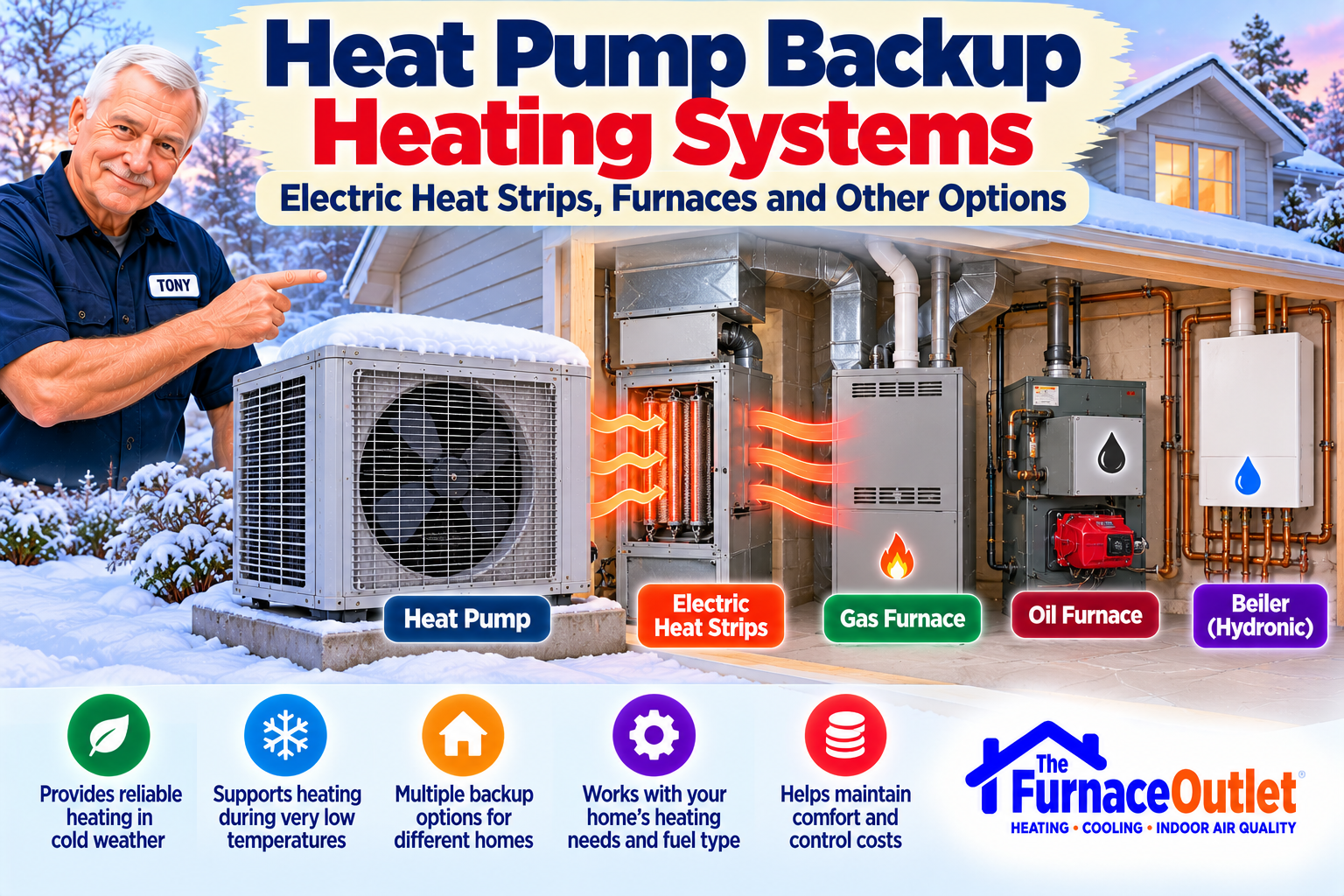
A heat pump can provide efficient heating throughout much of the winter, but not every installation can meet a home’s entire heating demand using the heat pump alone. During severe cold, equipment malfunctions, or certain defrost operations, additional heating capacity may be necessary. That is where backup heating systems become important. Depending on the installation, backup heat may come from electric resistance elements, a gas furnace, an oil furnace, or another heating arrangement designed to operate alongside or instead of the primary heat pump.
I have seen homeowners assume that every heat pump automatically includes electric backup heat, while others believe that switching to emergency heat will improve efficiency during freezing weather. Neither assumption is universally correct. Some modern cold-climate heat pumps operate without conventional electric heat strips, while many ducted systems rely on carefully configured supplemental heating stages. Dual-fuel installations introduce another layer of complexity because a furnace may replace heat pump operation when outdoor conditions or operating costs justify the change.
The right backup heating strategy depends on the home’s heating load, local climate, equipment capabilities, fuel availability, installation requirements, and operating costs. In this guide, I will explain how the major backup heating options work, when they activate, what they cost to operate, and how homeowners can evaluate the most appropriate arrangement for their property.
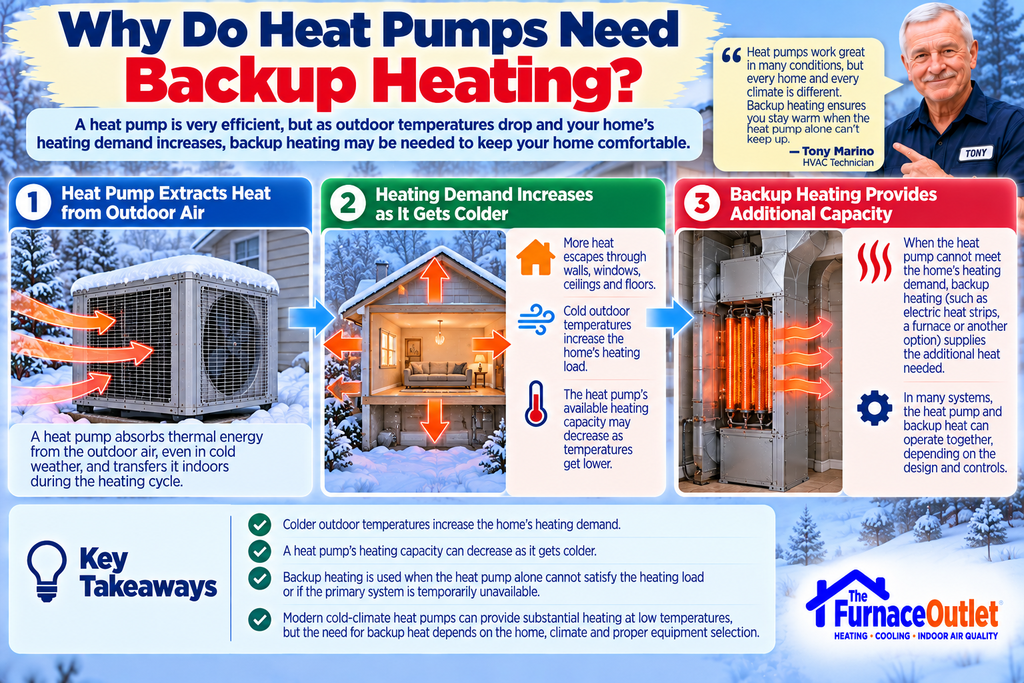
An air-source heat pump heats a home by extracting thermal energy from outdoor air and transferring it indoors through a refrigeration system. As outdoor temperatures decline, the home’s heating demand generally increases because more heat escapes through walls, windows, ceilings, and air leakage pathways. At the same time, the available heating capacity of some heat pumps decreases as outdoor conditions become colder.
Backup heating becomes useful when the heat pump’s available capacity cannot satisfy the building’s heating demand or when the primary system is temporarily unavailable. In many installations, supplemental heating covers the difference between the heat pump’s output and the home’s required heating load. The equipment may continue operating while backup heat supplies additional capacity, although the exact sequence depends on the system design.
Not every heat pump requires backup heat at the same temperature. Modern cold-climate equipment can maintain substantial heating output well below freezing, while older or less capable systems may need supplemental heating sooner. Proper equipment selection should therefore consider documented low-temperature capacity and the home’s calculated heating requirements rather than relying on a universal outdoor temperature threshold.
The thermal balance point is the outdoor temperature at which the heat pump’s available heating capacity approximately matches the building’s heating demand. Above this point, the heat pump may be capable of maintaining indoor comfort without additional heating. Near the balance point, extended compressor operation may be normal because the equipment is producing roughly as much heat as the home is losing.
Below the thermal balance point, the building may require more heat than the compressor can provide independently. Supplemental heating can supply the additional capacity needed to maintain the thermostat setting. However, the balance point varies with equipment performance, building insulation, air leakage, thermostat settings, and outdoor conditions.
The thermal balance point should not be confused with a thermostat’s programmed auxiliary heating threshold or the economic balance point used in some dual-fuel systems. The economic balance point concerns operating cost rather than heating capacity. A professional load calculation and manufacturer performance data can help determine where these different thresholds occur for a particular installation.
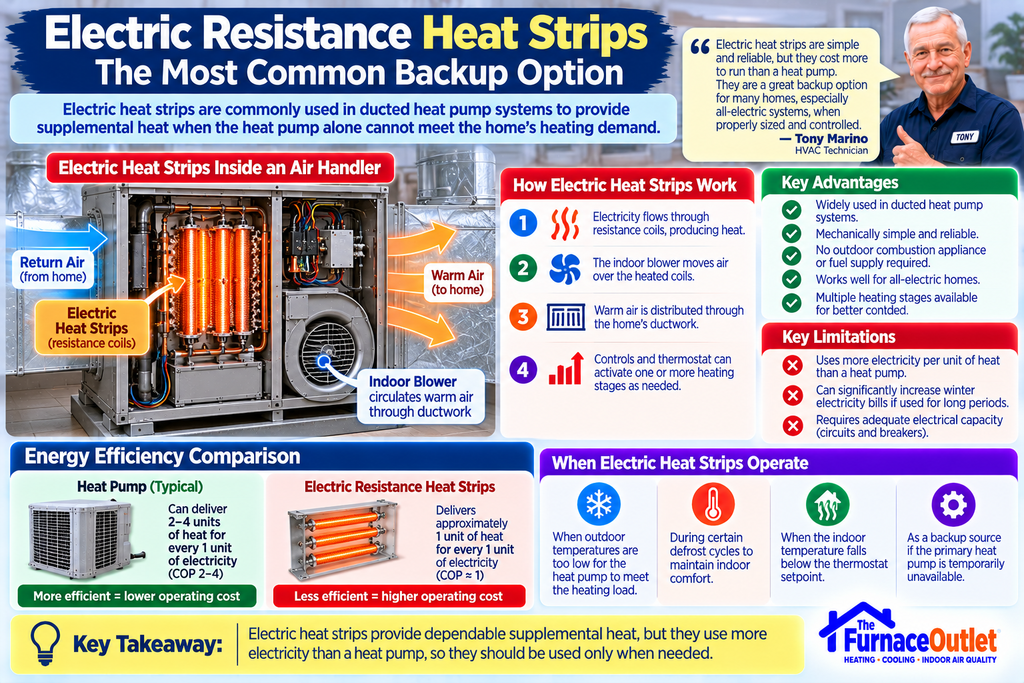
Electric resistance heat strips are widely used in conventional ducted heat pump systems. These heating elements are typically installed inside an indoor air handler, where electricity passes through resistance coils and produces heat. The indoor blower then distributes that warmth through the home’s ductwork.
Electric heat strips are mechanically straightforward and can provide dependable supplemental heating when correctly sized, installed, and controlled. They do not require an outdoor combustion appliance or a separate fuel supply, making them practical for many all-electric homes. Some installations use multiple electric heating stages so the thermostat or control system can activate only the amount of supplemental capacity required.
However, electric resistance heating generally consumes more electricity per unit of delivered heat than an efficiently operating heat pump. Resistance heating converts electrical energy into heat at approximately one unit of heat per unit of electricity, while a heat pump can transfer multiple units of heat for each unit of electricity under suitable conditions. Consequently, prolonged heat strip operation may significantly increase winter electricity consumption.
During normal heating, the heat pump compressor transfers heat from outdoors into the home. If the thermostat determines that additional heating capacity is required, it may activate one or more electric resistance heating stages inside the air handler. Depending on the control arrangement, the compressor may continue operating while the heat strips supplement its output.
Some systems activate auxiliary heating when indoor temperature falls sufficiently below the thermostat setpoint. Others consider compressor operating time, outdoor temperature, equipment staging, or more sophisticated control information. Electric backup may also operate during certain defrost cycles to offset the temporary reduction in indoor heating.
The heat strips should not operate continuously unless the equipment’s intended control strategy and actual heating demand justify that operation. Incorrect staging, a malfunctioning thermostat, inadequate heat pump capacity, or refrigeration problems can cause excessive backup heating demand. A qualified technician should verify the complete sequence before assuming that frequent auxiliary heating is normal or defective.
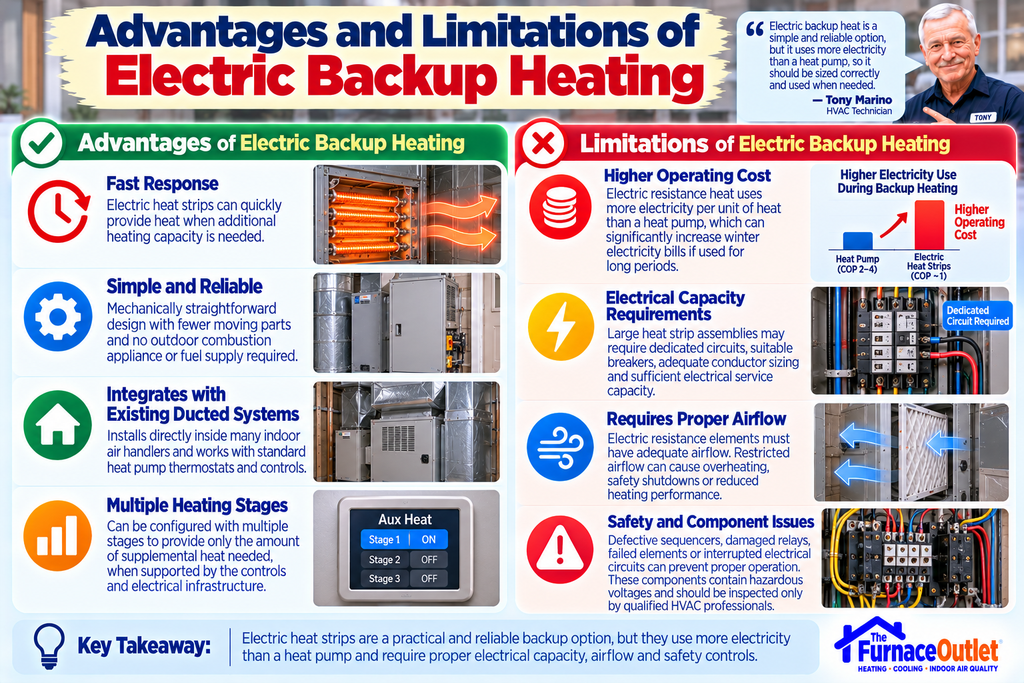
Electric resistance backup offers several practical advantages. It can respond quickly to heating requests, integrates directly with many ducted air handlers, and does not require a gas line, combustion vent, or fuel storage tank. Multiple heating stages can provide flexibility when the controls and electrical infrastructure support them.
The principal limitation is operating cost. Electric resistance heat generally requires substantially more electrical energy than a functioning heat pump to deliver the same amount of heat. For homes with high heating demand or expensive electricity, prolonged operation may produce significant utility bills.
Electrical capacity is another important consideration. Large heat strip assemblies may require dedicated circuits, suitable breakers, adequate conductor sizing, and sufficient electrical service capacity. A contractor should evaluate the home’s electrical infrastructure before recommending additional electric backup capacity.
Electric resistance elements also require appropriate airflow and functioning safety controls. Restricted airflow, defective sequencers, damaged relays, or interrupted electrical circuits can interfere with operation. These components contain hazardous voltages and should be inspected only by qualified professionals.
A dual-fuel heating system combines an electric heat pump with a combustion furnace, commonly fueled by natural gas or propane. Instead of relying exclusively on electric resistance elements, the installation can switch to furnace heating when operating conditions justify using the alternative fuel.
In a typical dual-fuel arrangement, the heat pump provides efficient heating during suitable outdoor conditions. When the outdoor temperature becomes sufficiently low, the heating load exceeds the heat pump’s intended operating strategy, or the control system reaches a programmed changeover threshold, the furnace takes over.
Many conventional dual-fuel systems are configured so the furnace and heat pump compressor do not operate simultaneously in heating mode. This avoids incompatible airflow and temperature conditions within the shared indoor equipment. However, the exact operating sequence depends on manufacturer-approved equipment combinations and controls.
Dual-fuel systems can be attractive where natural gas is readily available, winter temperatures are severe, or electricity and fuel prices make a furnace economical during particular conditions. The correct choice requires comparing actual operating costs and installed equipment performance rather than assuming gas is always cheaper.
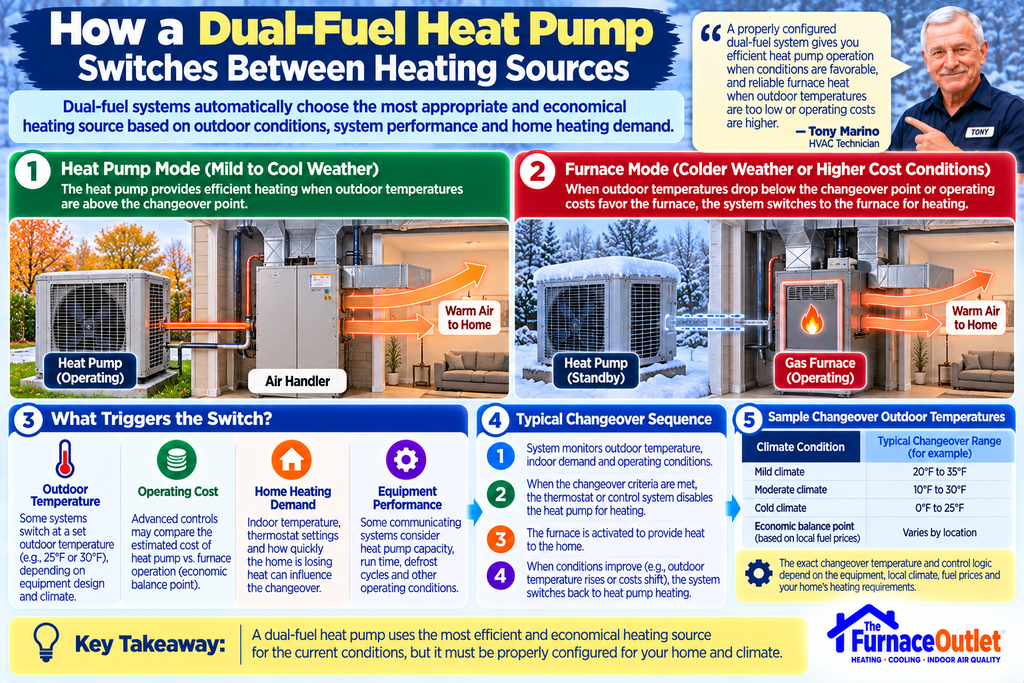
Dual-fuel operation depends on properly configured controls that determine when the heat pump should operate and when the furnace should take over. Some systems use outdoor temperature thresholds, while advanced communicating controls may consider equipment performance, indoor demand, or other operating conditions.
The changeover temperature should reflect the installed heat pump’s capacity, the home’s heating requirements, and potentially the relative cost of electricity and fuel. A system designed around an economic balance point may switch to the furnace when its estimated operating cost becomes lower than that of the heat pump.
Incorrect control configuration can reduce efficiency or comfort. Switching to the furnace too early may prevent the homeowner from benefiting from efficient heat pump operation, while delaying changeover excessively may leave the home inadequately heated if the heat pump cannot satisfy demand.
A qualified contractor should verify furnace compatibility, airflow requirements, thermostat configuration, and manufacturer-approved changeover logic. Homeowners should avoid changing advanced dual-fuel settings without understanding their consequences.
Natural gas and propane furnaces perform similar heating functions but differ in fuel supply, pricing, storage, and installation considerations. Natural gas generally requires an available utility connection, while propane installations use on-site fuel storage and delivery arrangements.
The cost of operating either furnace depends on local fuel prices, furnace efficiency, heating demand, and applicable utility charges. Propane prices may fluctuate significantly by region and season, making a local cost comparison especially important.
Combustion equipment also requires proper venting, combustion-air provisions, and safety inspections. Furnace heat exchangers, burners, ignition systems, venting components, and carbon monoxide safety measures should be evaluated according to manufacturer instructions and applicable codes.
A dual-fuel installation should not be selected solely because a homeowner already has access to a particular fuel. The contractor should compare installed costs, long-term operating expenses, service availability, and the heat pump’s documented cold-weather performance.
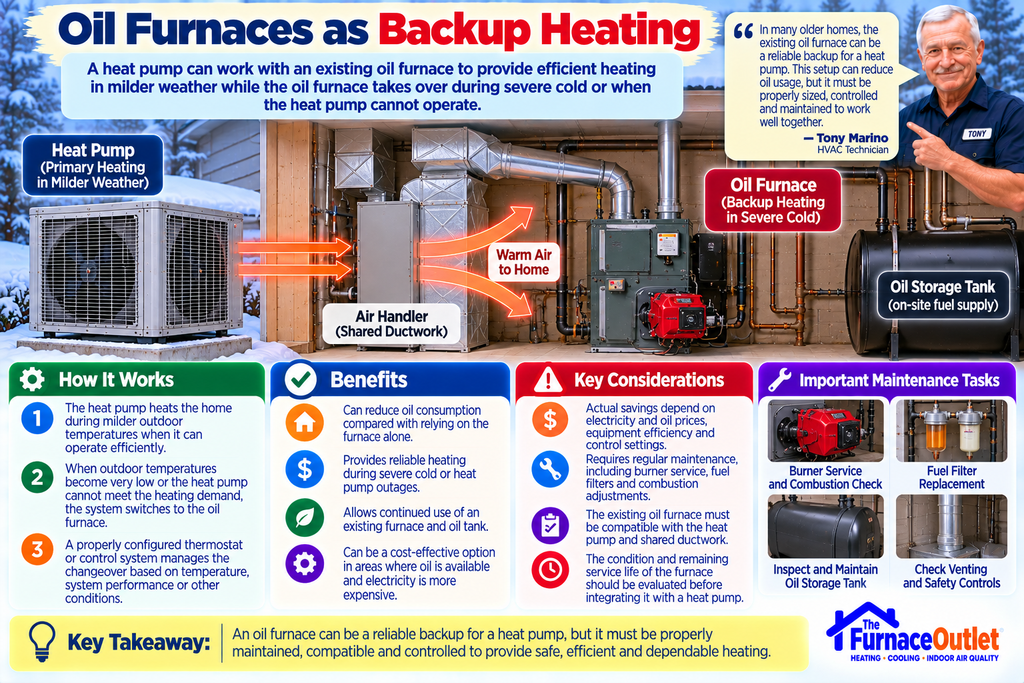
In some regions, particularly where older homes already use oil-fired heating, a heat pump may be integrated with an existing oil furnace. The heat pump can provide heating during suitable outdoor conditions, while the oil furnace serves as an alternative source during severe cold or when the heat pump cannot operate.
This arrangement may reduce oil consumption compared with relying entirely on the furnace, although actual savings depend on electricity prices, oil prices, equipment efficiency, and control settings.
Oil furnaces introduce maintenance requirements involving burners, fuel filters, combustion adjustments, storage tanks, and venting systems. The existing furnace must also be compatible with the proposed heat pump arrangement and its airflow requirements.
A contractor should evaluate the condition and remaining service life of the oil furnace before incorporating it into a new dual-fuel installation. Retaining an unreliable furnace as the only backup source may create unnecessary winter heating risks.
Some cold-climate heat pumps are designed to provide substantial heating capacity at very low outdoor temperatures. In a properly insulated home with an appropriately selected system, it may be possible to meet the design heating load without conventional electric resistance backup.
However, this depends on the specific equipment model, local winter design temperature, building heating demand, and installation quality. A heat pump advertised as suitable for cold climates is not automatically capable of heating every building without supplemental capacity.
Backup heating may still be desirable for equipment outages, extreme weather, or specific operating conditions. Some homeowners use an existing heating system as a secondary source, while others rely on a separate emergency heating arrangement.
The correct decision should follow a recognized load calculation and review of manufacturer low-temperature capacity data. Removing backup heating simply because a heat pump carries a cold-climate designation can leave the home vulnerable to inadequate heating during severe conditions.
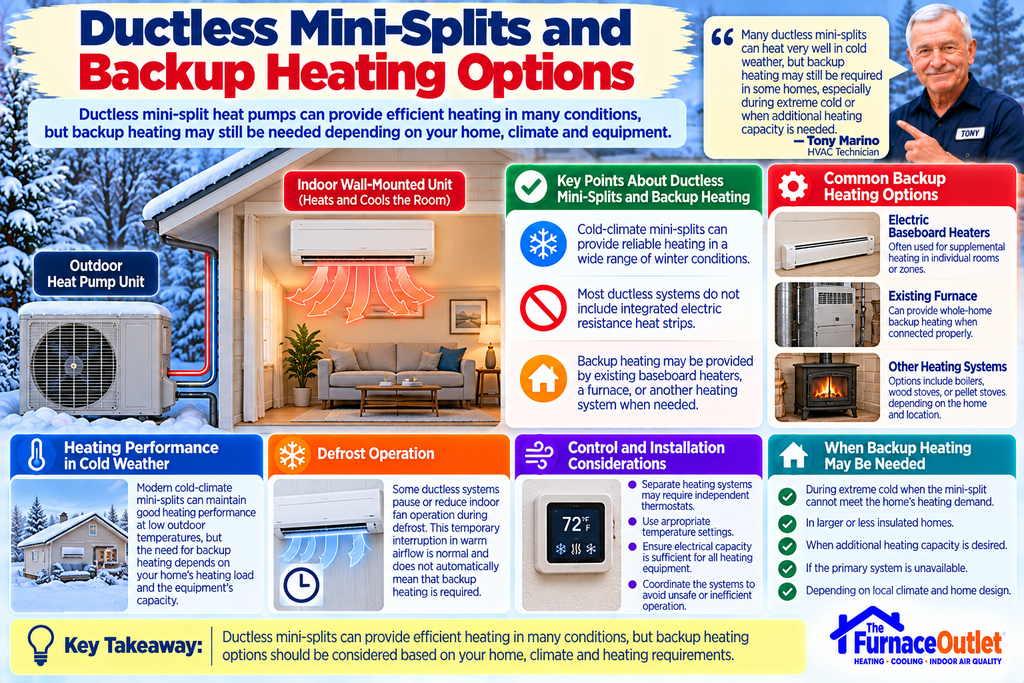
Ductless mini-split heat pumps operate differently from conventional ducted systems because they typically distribute conditioned air through indoor wall-mounted, floor-mounted, or ceiling-mounted units. Many ductless installations do not include integrated electric resistance heat strips.
Cold-climate mini-splits may maintain heating performance through a broad range of winter conditions, but backup requirements still depend on the home’s heating load and equipment capabilities. In some installations, existing baseboard heaters, a furnace, or another heating system remains available for supplemental warmth.
The challenge is ensuring that the backup arrangement provides adequate coverage without creating unsafe or inefficient operation. Separate heating systems may require independent thermostats, careful temperature settings, and appropriate electrical capacity.
Homeowners should also understand that some ductless systems pause or reduce indoor fan operation during defrost. A temporary interruption in warm airflow does not automatically mean that backup heating is required.
Homes with existing hot-water radiators, radiant floors, or other hydronic heating systems may retain a boiler as a secondary heat source when installing an air-source heat pump. In these arrangements, the heat pump may serve part or most of the home’s heating demand while the boiler remains available during colder conditions or equipment outages.
Integration depends on the specific system architecture. An air-to-air heat pump and a hydronic boiler generally distribute heat through different systems, while air-to-water heat pumps may connect more directly with compatible hydronic distribution equipment.
Control coordination is essential. Poorly configured thermostats or heating zones can cause unnecessary simultaneous operation, uneven temperatures, or increased energy consumption.
A contractor experienced with both heat pumps and hydronic systems should evaluate heating capacity, distribution temperatures, zoning, equipment compatibility, and the intended operating sequence before recommending a combined arrangement.
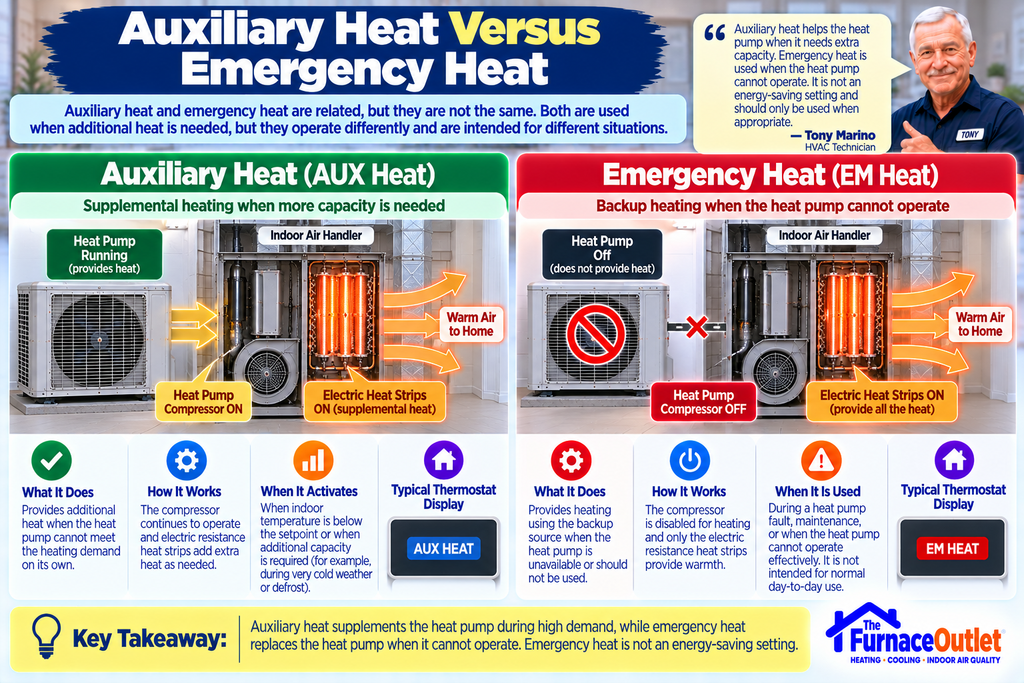
Auxiliary heat and emergency heat are related concepts, but they are not interchangeable. Auxiliary heat generally supplements the primary heat pump when additional heating capacity is required. Emergency heat typically operates as a backup mode when the primary heat pump is unavailable or should not be used.
In many conventional all-electric ducted systems, both modes use the same electric resistance heating elements. The difference lies in how the thermostat controls the compressor and backup heating stages. During auxiliary operation, the compressor may continue heating while resistance elements provide additional capacity. During emergency heat operation, the compressor is typically disabled for heating and the backup source supplies the required warmth.
Dual-fuel installations may use different terminology and control arrangements. A thermostat displaying “AUX” or “EM HEAT” should therefore be interpreted according to the installed equipment.
Emergency heat is not generally an energy-saving setting. It is intended for situations where backup operation is appropriate under manufacturer or qualified technician guidance.
Backup heating may activate when the primary heat pump cannot satisfy heating demand within the intended control strategy. Common triggers include a significant difference between indoor temperature and thermostat setpoint, prolonged heating demand, outdoor temperature thresholds, or equipment-specific staging logic.
Some conventional ducted systems also use electric auxiliary heating during defrost to maintain comfortable supply-air temperatures. Other systems handle defrost differently and may not require the same backup response.
Automatic activation does not mean that the backup source should run constantly whenever outdoor temperatures fall below freezing. Many modern heat pumps operate efficiently below 32°F without requiring continuous supplemental heating.
The appropriate staging strategy should be established using the exact equipment and thermostat documentation. If backup heat operates excessively, a technician should investigate primary heat pump performance, thermostat configuration, and building heating demand.
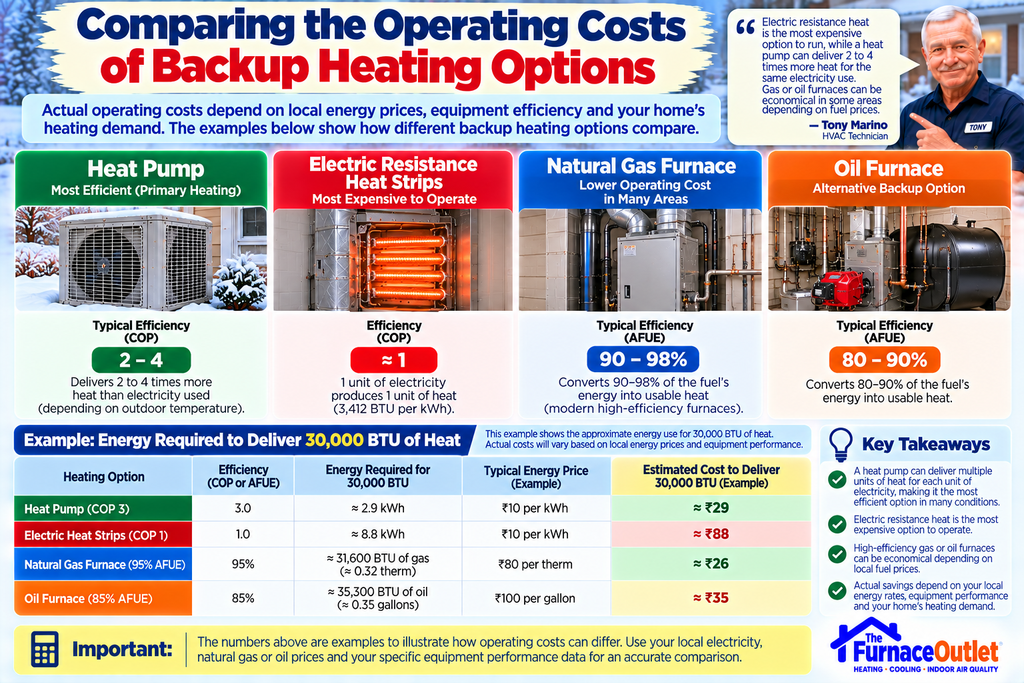
Operating costs depend on electricity prices, fuel prices, equipment efficiency, and the amount of heating required. Electric resistance heat typically delivers approximately 3,412 BTU of heat for each kilowatt-hour consumed, while a heat pump operating at a coefficient of performance of 3 can deliver approximately three times that amount under the same electrical energy input.
For example, consider a heating requirement of 30,000 BTU. Electric resistance heating would require approximately 8.8 kWh of electricity, excluding minor system losses. A heat pump operating at a COP of 3 would require approximately 2.9 kWh to deliver the same heating output. Actual COP changes with outdoor temperature and operating conditions, so these figures illustrate the principle rather than predict a particular home’s bill.
For gas or oil backup, compare the cost per unit of delivered heat after accounting for furnace efficiency. A high-efficiency furnace may be economically attractive in some markets, while an efficient cold-climate heat pump may remain less expensive in others.
The correct comparison uses local energy prices and equipment performance data rather than general assumptions about which fuel is cheapest.
High winter electricity bills may result when electric resistance backup operates more frequently than expected. This can happen during severe cold, large thermostat recovery periods, defrost operation, or conditions where the heat pump cannot satisfy heating demand independently.
However, excessive backup heating can also indicate an underlying problem. Restricted airflow, refrigerant abnormalities, defective defrost controls, thermostat configuration errors, or insufficient heat pump capacity may increase reliance on supplemental heating.
A thermostat displaying “AUX” does not automatically mean that the system is malfunctioning. The important question is whether backup heating is activating appropriately and whether the primary heat pump is delivering its expected output.
A technician should review equipment staging, heating capacity, electrical consumption where measurable, and actual building demand before recommending control changes or replacement equipment.
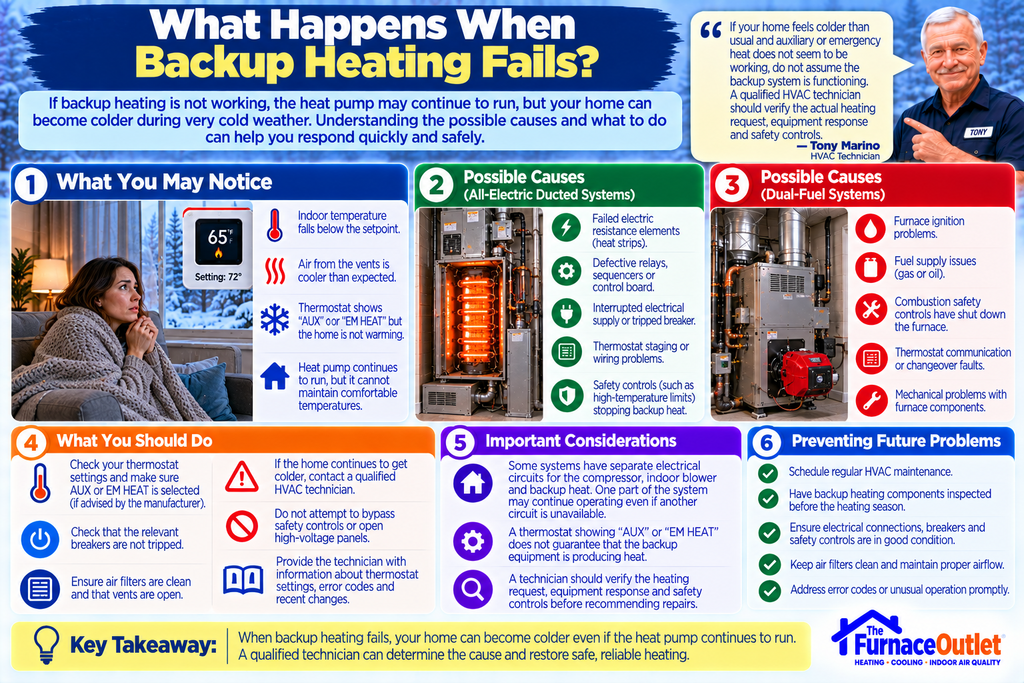
When backup heating is unavailable, the primary heat pump may continue operating while indoor temperature gradually declines during demanding conditions. In an all-electric ducted system, possible causes include failed resistance elements, defective relays or sequencers, interrupted electrical supply, thermostat staging problems, or protective safety controls.
Some installations have separate electrical circuits for the compressor, indoor blower, and electric backup elements. Consequently, one part of the heating system may continue operating even when another circuit is unavailable.
In dual-fuel systems, backup failure may involve furnace ignition problems, fuel supply issues, combustion safety controls, or thermostat communication faults.
Homeowners should not assume that a thermostat’s auxiliary heat indicator confirms the backup equipment is functioning. A qualified technician should verify the actual heating request, equipment response, and relevant safety controls before recommending repairs.
Selecting backup heating begins with determining the home’s design heating load and the heat pump’s available capacity at relevant outdoor temperatures. A contractor should perform an appropriate load calculation, such as ACCA Manual J, and compare the results with manufacturer heating performance data.
The next consideration is the home’s existing infrastructure. Electric heat strips may be practical where adequate electrical service and compatible ducted equipment are available. A gas furnace may be attractive where natural gas service already exists, while retaining an existing oil furnace or boiler may make sense in some retrofit applications.
Installation costs, operating costs, maintenance requirements, reliability, and local contractor support should all be evaluated. A system with low initial cost may be expensive to operate, while a more complex dual-fuel arrangement may require additional controls and maintenance.
I recommend choosing a backup strategy that matches the building and the equipment rather than selecting the largest available heating source without calculating actual requirements.
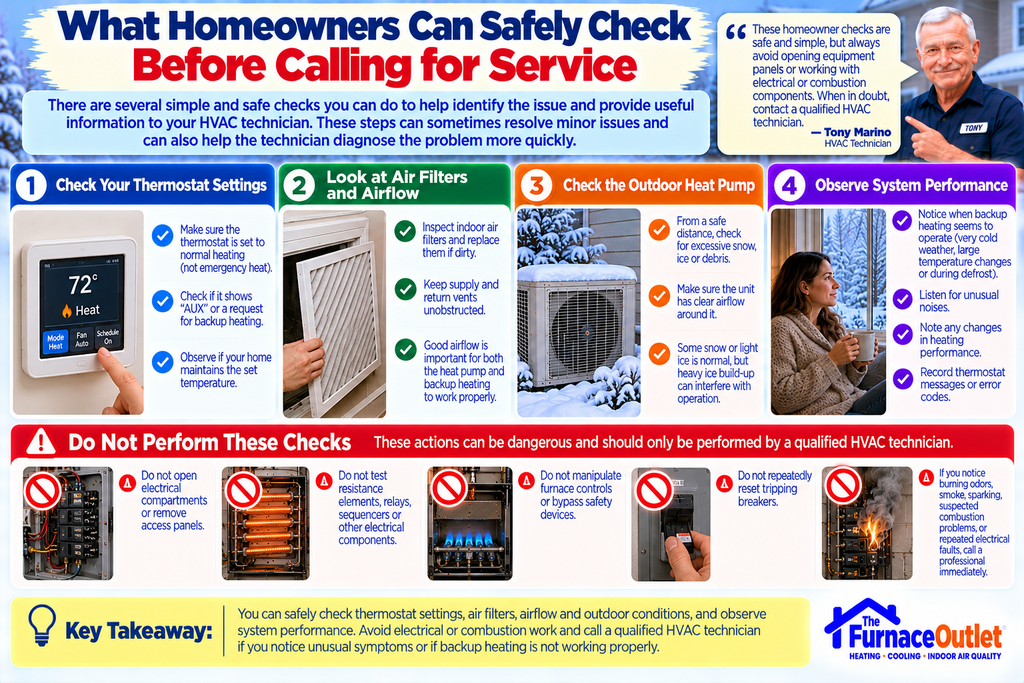
Begin by checking whether the thermostat is set to normal heating or emergency heat and whether it displays an auxiliary heating request. Observe whether the home maintains its selected temperature and whether backup heating appears primarily during severe cold, large temperature adjustments, or defrost events.
Inspect accessible indoor air filters and keep supply and return openings unobstructed. From a safe distance, check the outdoor heat pump for excessive snow, debris, or persistent ice that could interfere with normal operation.
Record thermostat messages, unusual equipment noises, and changes in heating performance. These observations can help a technician determine whether the problem involves primary heating, backup heating, or control staging.
Do not open electrical compartments, test resistance elements, manipulate furnace controls, bypass safety devices, or repeatedly reset tripping breakers. Burning odors, smoke, sparking, suspected combustion problems, or repeated electrical faults require prompt professional attention.
Professional evaluation begins with identifying the exact heat pump, thermostat, indoor air handler, furnace or boiler, and installed backup heating configuration. The technician should establish the intended control sequence and determine when supplemental or alternative heating should operate.
For electric resistance systems, manufacturer-approved testing may include evaluating heat strip circuits, relays, sequencers, contactors, safety limits, and electrical supply. Dual-fuel systems require additional evaluation of furnace operation, combustion safety, venting, and changeover controls.
The technician should also verify primary heat pump performance. A defective compressor, restricted airflow, abnormal defrost operation, or refrigerant-system problem may create excessive backup heating demand even when the backup source itself functions correctly.
The completed assessment should identify whether the issue involves insufficient primary heating capacity, defective backup equipment, incorrect staging, or excessive building heat loss. This distinction is essential before recommending expensive upgrades.
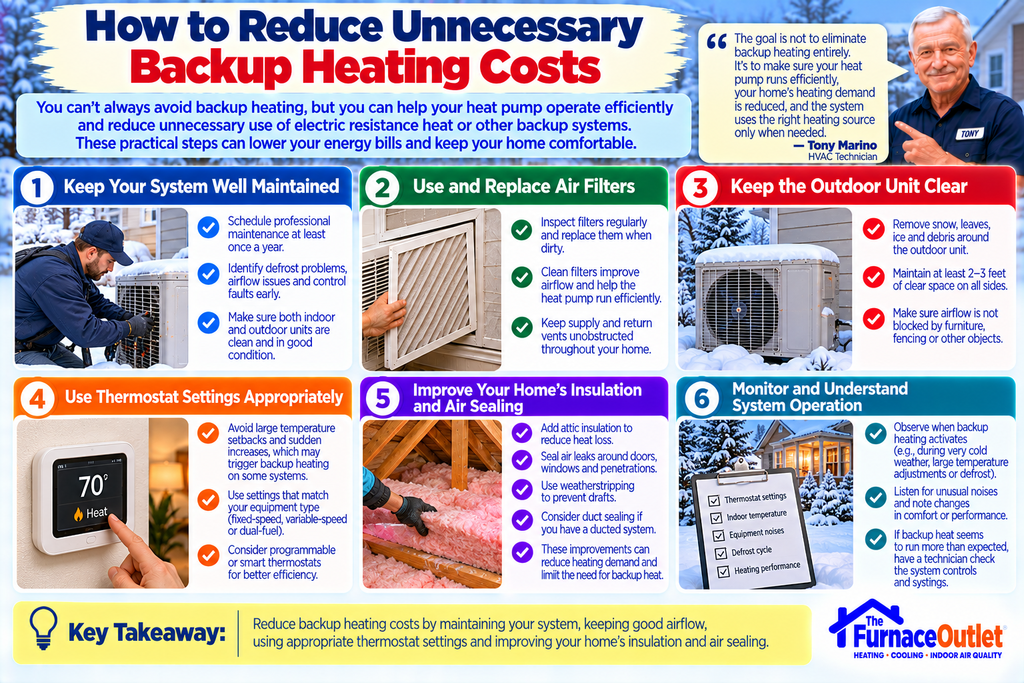
Reducing backup heating costs begins with helping the primary heat pump operate efficiently. Maintain clean indoor filters, preserve unobstructed supply and return airflow, and keep the outdoor unit clear of snow, leaves, and other restrictions. Schedule professional maintenance to identify defrost problems, airflow deficiencies, and control faults that may increase supplemental heating demand.
Thermostat settings also matter. Large temperature setbacks and sudden increases may activate electric resistance heating on some systems, potentially increasing operating costs. The appropriate strategy depends on whether the equipment uses fixed-speed, variable-speed, communicating, or dual-fuel controls.
Building-envelope improvements can reduce heating demand. Attic insulation, air sealing, weatherstripping, and duct leakage correction may allow the heat pump to maintain comfort without as much supplemental heating.
The objective is not to eliminate backup heating entirely. It is to ensure that the system activates the appropriate heating source when required and avoids unnecessary operation.
No. Many conventional ducted heat pumps include electric resistance backup, but some ductless and cold-climate installations operate without integrated heat strips. Other systems use furnaces, boilers, or separate heating equipment.
Electric resistance heating generally consumes more electricity per unit of delivered heat than an efficiently operating heat pump. Actual cost depends on electricity rates and operating duration.
Neither option is universally better. Gas furnaces may offer lower operating costs in some markets, while electric heat strips can provide simpler integration in compatible all-electric systems. Compare local energy prices, installation costs, efficiency, and maintenance requirements.
Many conventional dual-fuel systems are configured to operate either the heat pump compressor or the furnace for heating, rather than both simultaneously. Exact operating arrangements depend on manufacturer-approved equipment and controls.
Not automatically. Many heat pumps operate effectively below 32°F. Emergency heat should generally be used only when appropriate under manufacturer instructions or qualified professional guidance.
Yes, some properly sized cold-climate systems can satisfy the home’s design heating load without conventional electric resistance backup. The decision should be based on documented equipment capacity and a professional load calculation.
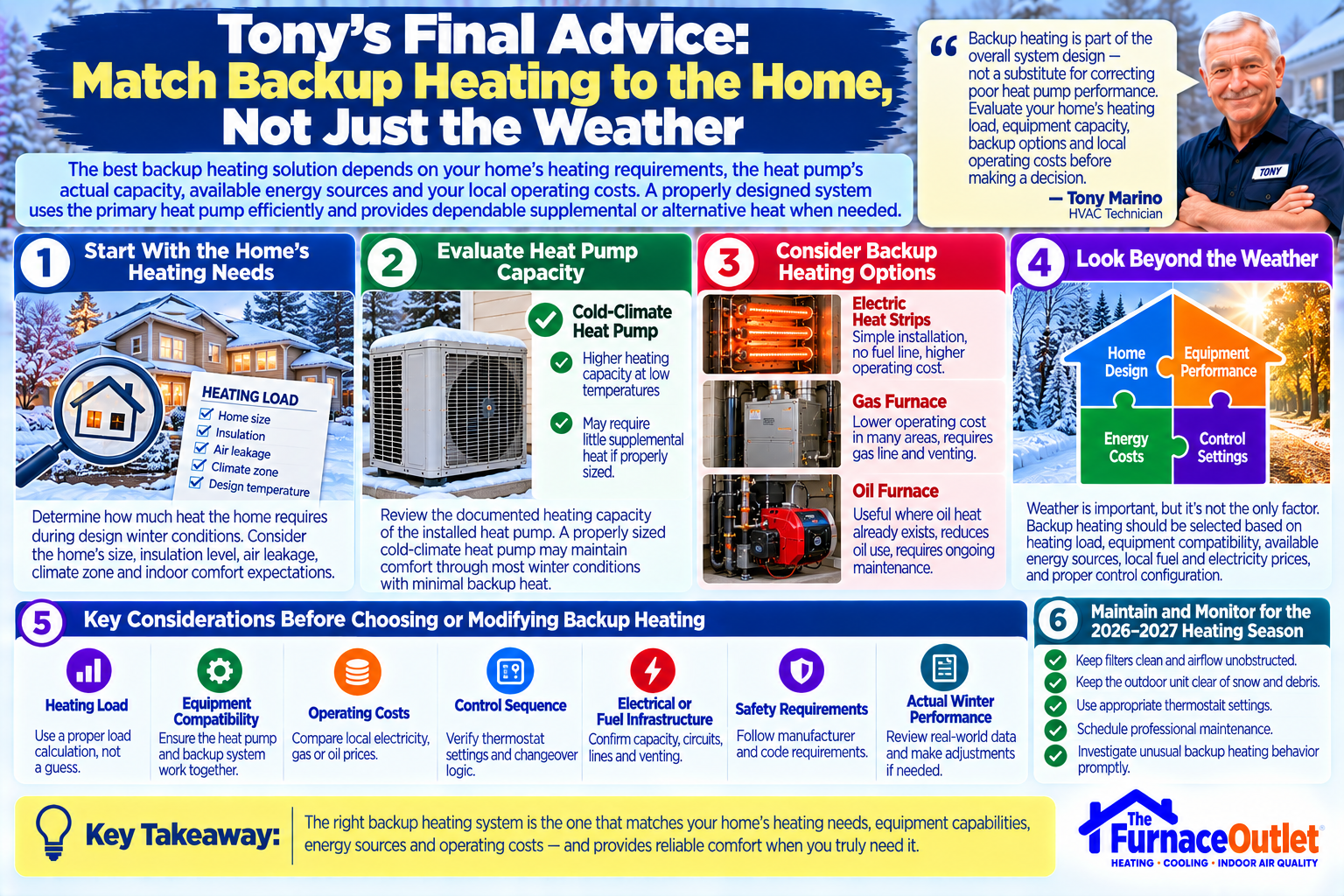
When a homeowner asks me which backup heating system is best, I do not immediately recommend electric heat strips, a gas furnace, or another option. I first want to know how much heat the home requires during design winter conditions, how much capacity the primary heat pump can deliver, and which energy sources are available. A properly sized cold-climate heat pump may require very little supplemental heating, while another installation may depend on a carefully configured backup source to maintain comfort.
I also want homeowners to understand that backup heating is part of the overall system design rather than a substitute for correcting poor heat pump performance. Excessive auxiliary heating can result from legitimate cold-weather demand, but it can also indicate incorrect thermostat staging, airflow restrictions, defrost problems, refrigerant abnormalities, or inadequate equipment sizing. Adding more backup capacity without identifying the cause may increase costs without improving efficiency.
My recommendation is to evaluate heating load, documented heat pump capacity, backup equipment compatibility, and local operating costs before selecting or modifying a backup heating system. A qualified HVAC contractor should verify the intended control sequence, electrical or fuel infrastructure, safety requirements, and actual winter performance.
For the 2026–2027 heating season, maintain proper airflow, review thermostat settings, and investigate unusual backup heating behavior promptly. The best heating arrangement is one that uses the primary heat pump efficiently while providing dependable supplemental or alternative heat when the home genuinely needs it.
This article provides general homeowner education and does not replace professional HVAC diagnosis, equipment specifications, or applicable building codes. Heat pump backup systems may involve hazardous electrical voltages, combustion equipment, pressurized refrigerant, fuel piping, and protective safety controls. Homeowners should not test electric heat strips, modify furnace connections, bypass safety devices, or attempt unauthorized repairs. Electrical faults, suspected gas leaks, combustion problems, and persistent heating failures should be evaluated by appropriately qualified professionals. The Furnace Outlet – HVAC Knowledge Hub
U.S. Department of Energy — Air-Source Heat Pumps: https://www.energystar.gov/products/air_source_heat_pumps
U.S. Department of Energy — Operating and Maintaining Your Heat Pump: https://www.energy.gov/heat-pumps
U.S. Department of Energy — Electric Resistance Heating: https://docs.nlr.gov/docs/legosti/fy97/6987.pdf
ENERGY STAR — Air-Source Heat Pumps: https://www.energystar.gov/products/air_source_heat_pumps
ACCA — Residential HVAC Design and Technical Manuals: https://www.acca.org/standards/technical-manuals
Northeast Energy Efficiency Partnerships — Cold Climate Air-Source Heat Pump List: https://ashp.neep.org/
These resources provide background on heat pump performance, electric resistance heating, equipment selection, and cold-climate operation. The exact equipment manufacturer’s documentation should always govern installation, backup heating compatibility, and control settings.