Newsletter Subscribe
Enter your email address below and subscribe to our newsletter

HVAC made simple
By Jake Lawson | HVAC Specialist | The Furnace Outlet
Indoor air quality has become an increasingly important consideration for homeowners who want cleaner, more comfortable living environments. Dust, pollen, pet allergens, cooking particles, outdoor pollution, and certain chemical emissions can accumulate indoors, especially when ventilation is limited or household activities repeatedly introduce contaminants.
A whole-house air purification system offers a way to treat air circulating through a home’s central heating and cooling equipment. Unlike a portable air purifier designed for an individual room, a central system can filter air from multiple connected spaces as the HVAC blower moves air through the ductwork.
However, whole-house air purification is not a single technology. Products marketed under this description may use high-efficiency mechanical filters, electronic particle collection, activated carbon, ultraviolet germicidal irradiation, or combinations of these approaches. Some technologies have substantial evidence supporting particle removal, while others require more careful evaluation of performance claims and possible byproducts.
As an HVAC specialist with more than 10 years of experience, I recommend beginning with the contaminants homeowners want to address rather than selecting equipment based on promotional descriptions. A household dealing with wildfire smoke particles may benefit from improved filtration, while persistent chemical odors may require source control and a properly designed gas-phase filtration system.
In this guide, I explain the main types of whole-house air purification systems, estimated installation costs, potential benefits, operating expenses, maintenance requirements, and important limitations. My objective is to help homeowners choose an effective solution without spending unnecessarily on equipment that may not solve their particular problem.
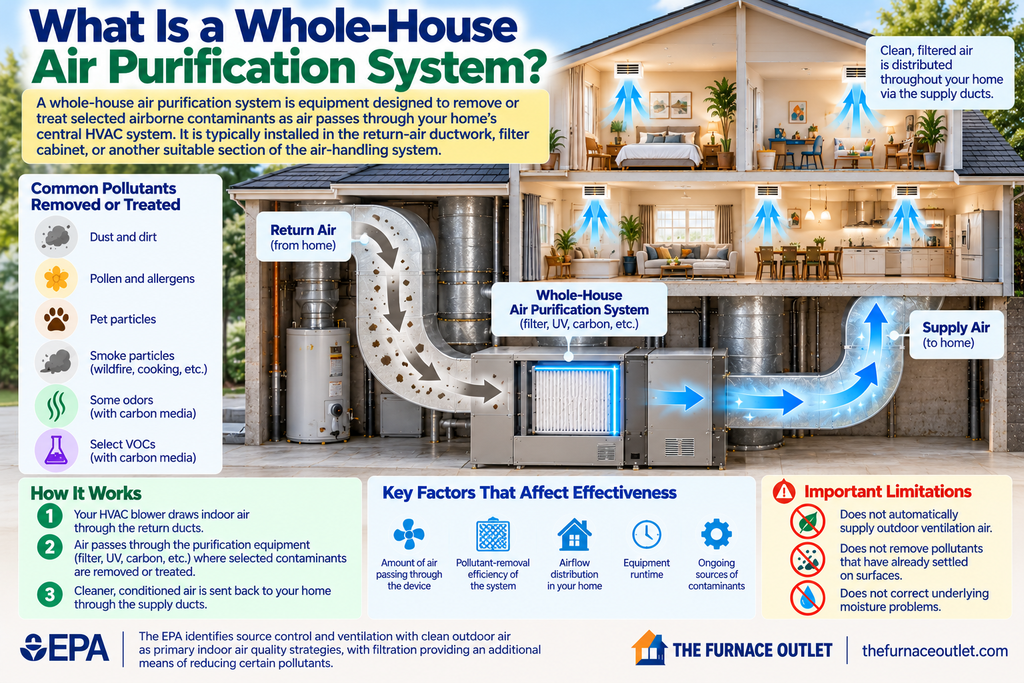
A whole-house air purification system is equipment designed to remove or treat selected airborne contaminants as air passes through a home’s central HVAC system. Most residential installations are located in the return-air ductwork, filter cabinet, or another suitable section of the air-handling system.
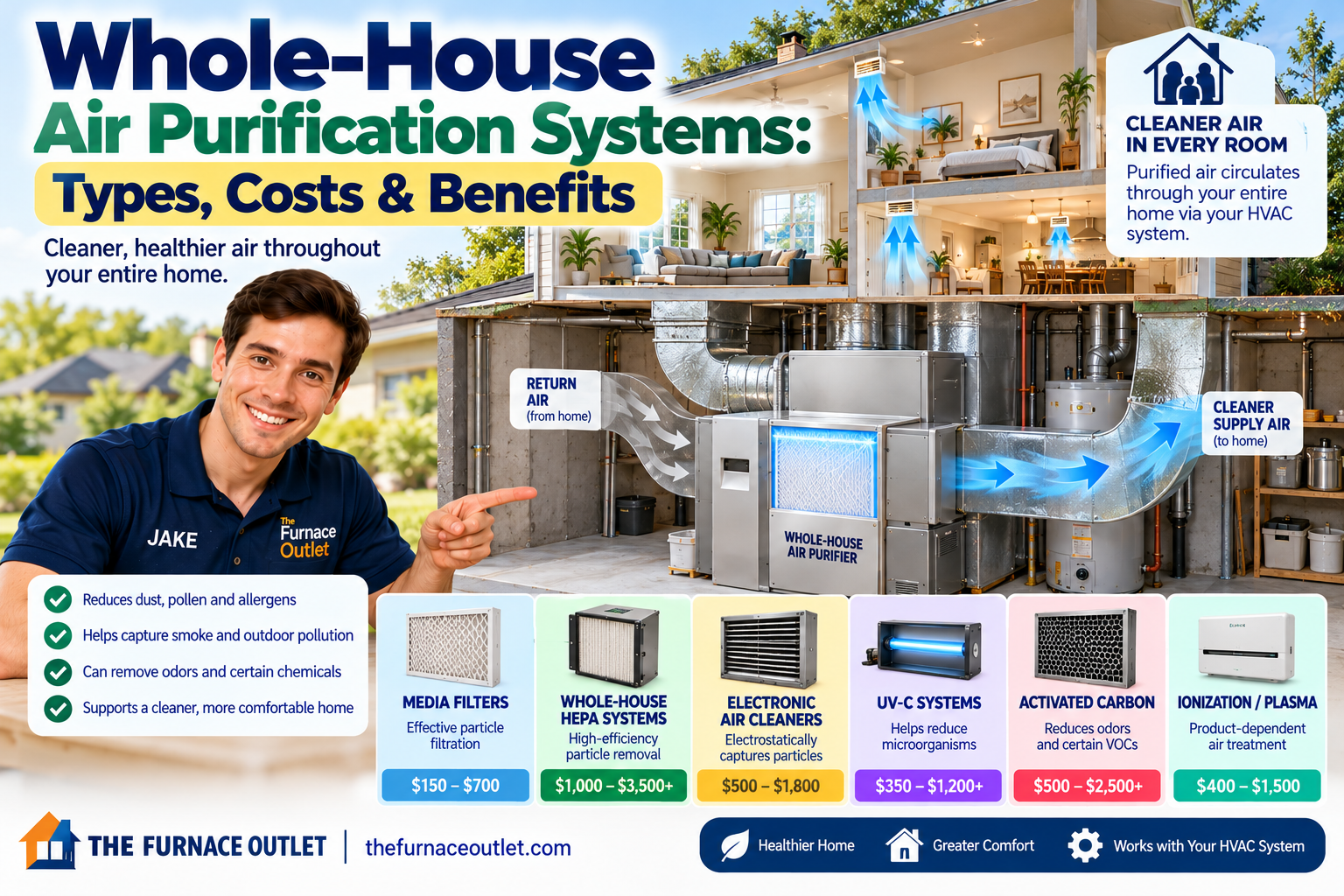
During operation, the HVAC blower draws indoor air through return ducts, passes it through the filtration or treatment equipment, and distributes conditioned air through supply ducts. Depending on the system, this process can reduce certain airborne particles or treat other targeted contaminants. The effectiveness of this arrangement depends on several factors, including the amount of air passing through the device, the system’s pollutant-removal efficiency, airflow distribution, equipment runtime, and the sources continuously introducing contaminants.
Importantly, a whole-house purifier generally recirculates and cleans indoor air. It does not automatically supply outdoor ventilation air, remove pollutants that have settled onto surfaces, or correct underlying moisture problems. The EPA identifies source control and ventilation with clean outdoor air as primary indoor air quality strategies, with filtration providing an additional means of reducing certain pollutants.
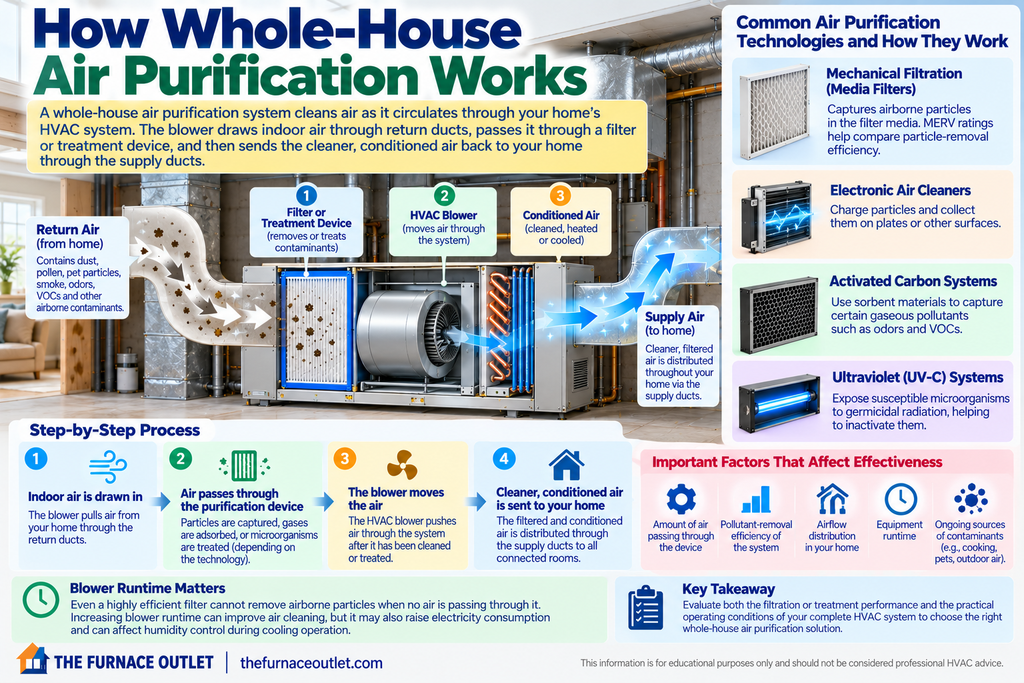
A central air purification system relies on the movement of air through HVAC equipment. As the blower operates, airborne particles enter the return-air pathway and encounter a filter or treatment device. Mechanical filters capture particles within the filter media. Electronic air cleaners may charge particles and collect them on plates or other surfaces. Activated carbon systems use sorbent materials to capture certain gaseous pollutants, while ultraviolet systems expose susceptible microorganisms to germicidal radiation.
These technologies do not perform identical functions, and their effectiveness cannot be evaluated using one universal measurement. For mechanical filtration, the Minimum Efficiency Reporting Value, or MERV, provides a standardized way to compare particle-removal efficiency. Other technologies may require different performance measurements, operating conditions, and safety evaluations.
The amount of time the HVAC blower operates also matters. Even a highly efficient filter cannot remove airborne particles when no air is passing through it. However, increasing blower runtime can raise electricity consumption and may affect humidity control during cooling operation. I recommend evaluating both filtration performance and the practical operating conditions of the complete HVAC system.
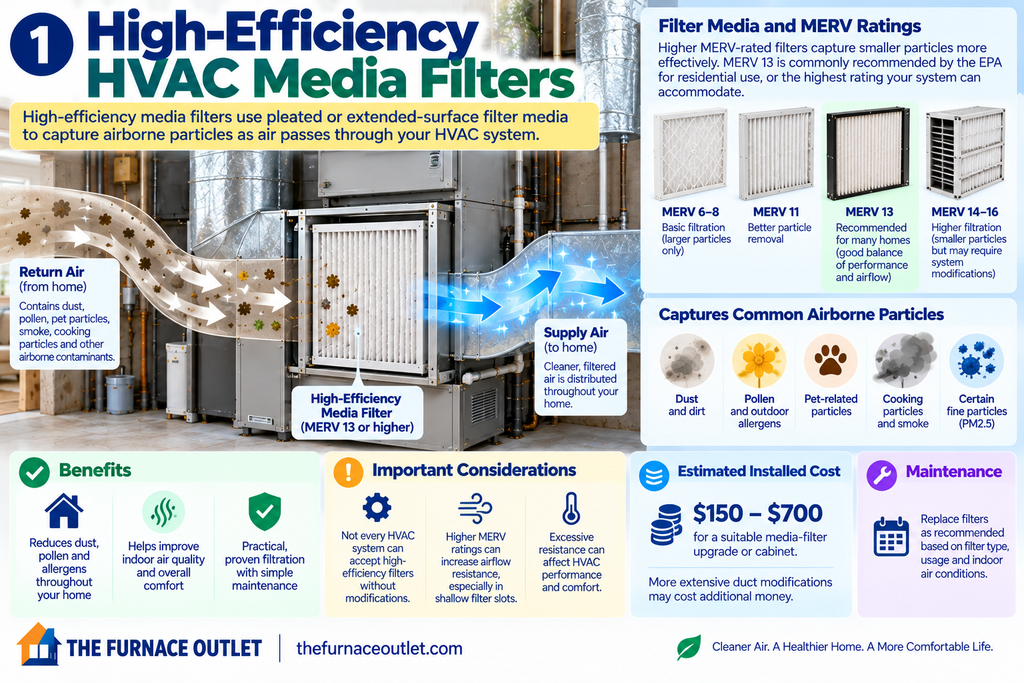
High-efficiency media filtration is usually my preferred starting point for homeowners interested in whole-house particle removal. These systems use pleated or extended-surface filter media to capture airborne particles as air passes through the HVAC equipment. A properly selected filter can help reduce dust, pollen, pet-related airborne particles, and certain fine particles generated by cooking or outdoor pollution.
The EPA recommends selecting an HVAC filter rated MERV 13 or as high as the system can accommodate. However, homeowners should not assume that every existing furnace or air handler can accept any high-efficiency filter without modifications. Higher filtration efficiency may increase airflow resistance, particularly when the filter has limited surface area or becomes heavily loaded with dust. Excessive resistance can affect equipment performance and comfort.
A properly designed deep-media filter cabinet may offer greater filter surface area and lower resistance than a restrictive high-efficiency filter installed in a shallow slot. Estimated installed cost: Approximately $150–$700 for a suitable media-filter upgrade or cabinet, with more extensive duct modifications costing additional money. For many households, this option provides a practical balance of documented particle filtration, maintenance simplicity, and affordability.
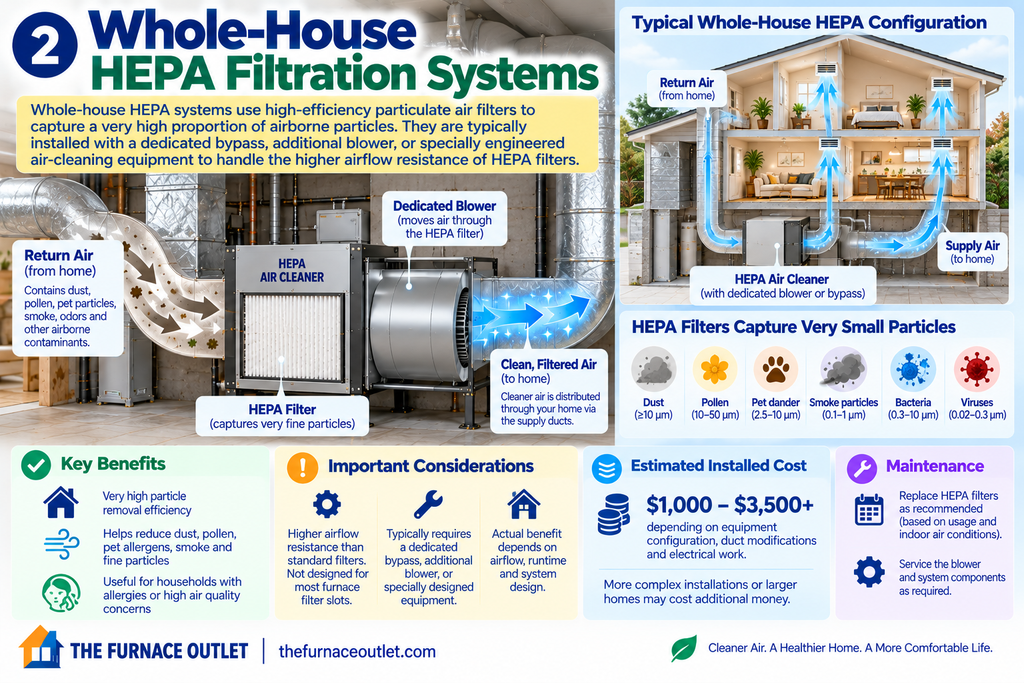
High-efficiency particulate air, or HEPA, filtration is designed to capture a very high proportion of particles under specified testing conditions. HEPA technology is widely used in applications where effective particulate removal is important. However, a true HEPA filter generally creates substantially more airflow resistance than ordinary residential HVAC filtration. Installing one directly into a conventional furnace filter slot can restrict airflow and potentially interfere with system operation.
For that reason, whole-house HEPA solutions often use a dedicated bypass arrangement, additional blower, or specially engineered air-cleaning equipment. The device processes a portion of circulating air rather than forcing the entire HVAC airflow through a restrictive filter. A properly designed system may provide effective fine-particle removal, but its actual benefit depends on how much air it processes and how frequently it operates.
Estimated installed cost: Approximately $1,000–$3,500 or more, depending on equipment configuration, duct modifications, and electrical work. I generally reserve this option for situations where enhanced particle filtration is justified and the homeowner understands the additional installation and maintenance costs.
Electronic air cleaners use electrical processes to capture airborne particles. Some systems charge particles and collect them on oppositely charged plates, while other designs use electrically enhanced filter media. These systems can reduce certain airborne particles, but their performance depends on the particular design, operating conditions, and maintenance practices.
Collection plates may require periodic cleaning, and performance can deteriorate when surfaces accumulate contaminants. Some electronic technologies may also generate ozone, which is a respiratory irritant. For this reason, I recommend examining independent performance information and ozone-emission testing rather than assuming that an electronic air cleaner is automatically superior to mechanical filtration. Estimated installed cost: Approximately $500–$1,800, with more elaborate installations potentially costing more.
Electronic air cleaners may be suitable for certain applications, but I would compare them against a well-designed MERV 13 media-filtration system before recommending additional complexity.
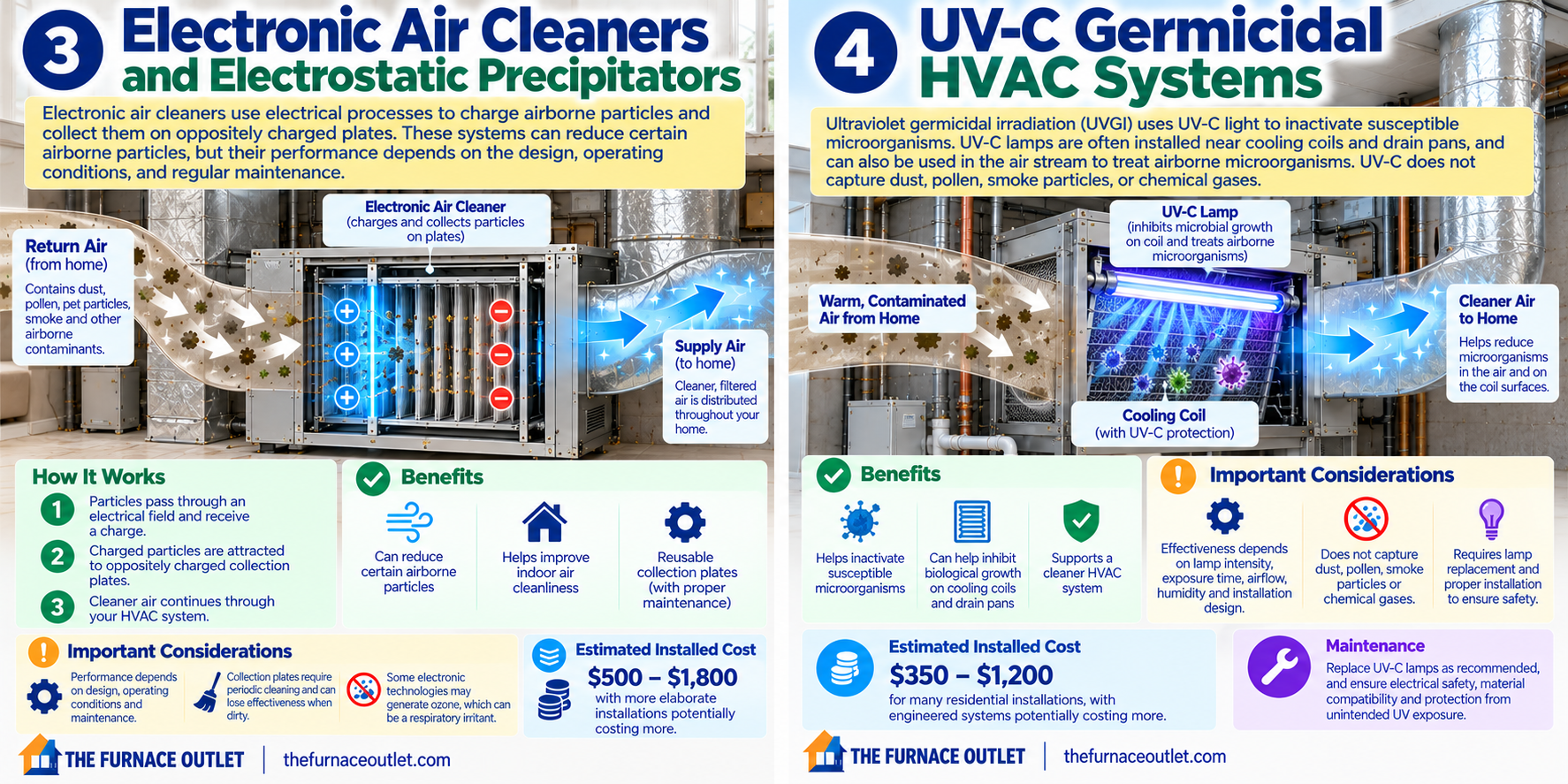
Ultraviolet germicidal irradiation, commonly called UVGI or UV-C treatment, uses ultraviolet radiation to inactivate susceptible microorganisms under appropriate exposure conditions. In residential HVAC equipment, UV-C lamps are often installed near cooling coils and drain pans, where prolonged exposure may help inhibit biological growth on certain surfaces.
Air-stream UV-C systems are also marketed for treating microorganisms passing through ductwork. However, their effectiveness depends on lamp intensity, exposure duration, airflow, humidity, installation geometry, and the characteristics of the organisms involved. A basic residential UV lamp should not automatically be treated as a proven whole-house airborne infection-control system.
UV-C treatment also does not capture ordinary dust, pollen, smoke particles, or chemical gases. It should therefore be considered a potential supplement to appropriate filtration rather than a replacement. Estimated installed cost: Approximately $350–$1,200 for many residential installations, with engineered systems potentially costing substantially more. Homeowners should also consider lamp replacement, electrical safety, material compatibility, and protection against unintended UV exposure.
Activated carbon filtration is designed to capture certain gaseous pollutants through adsorption. Depending on the sorbent material and system design, it may help reduce selected odors and volatile organic compounds. This technology differs from mechanical particle filtration. A MERV-rated filter is primarily evaluated for particle removal and generally should not be expected to provide substantial gas removal unless it includes appropriate gas-phase media.
The quantity of activated carbon matters. Thin carbon-coated pads may have limited capacity compared with systems containing substantial amounts of properly selected sorbent material. Performance also depends on the specific chemicals present, air velocity, contact time, humidity, and how much adsorption capacity remains. Estimated installed cost: Approximately $500–$2,500 or more for residential gas-phase filtration equipment, depending on media quantity and installation complexity.
I recommend source control and appropriate ventilation before investing heavily in carbon filtration. Removing unnecessary solvents or selecting lower-emission materials may be more effective than continuously attempting to capture their emissions.
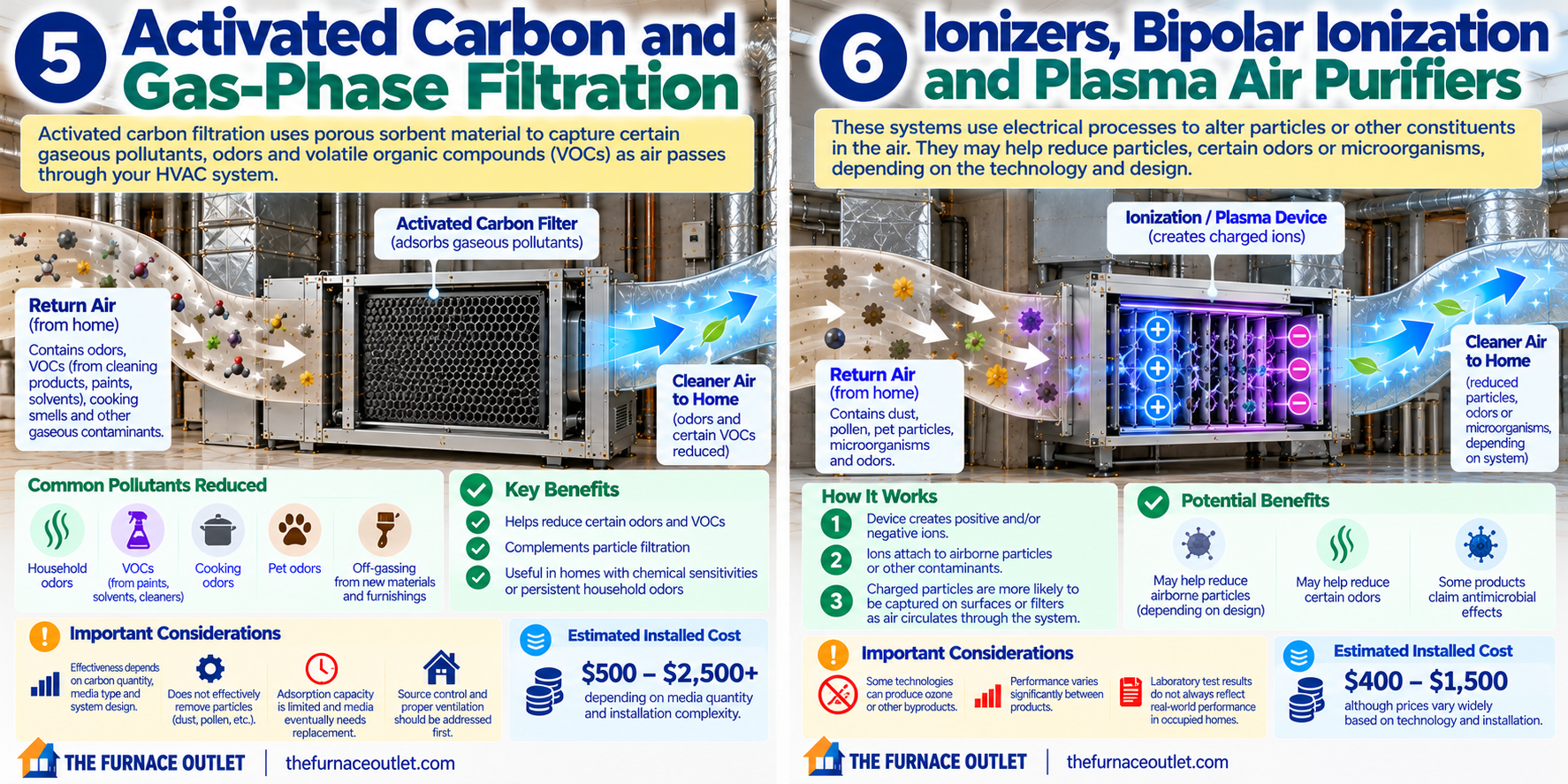
Ionization and plasma-based air purification technologies use electrical processes to alter particles or other constituents of the air. Manufacturers may promote these devices for particle reduction, odor control, or microbial treatment. However, performance varies significantly among products, and some technologies can produce ozone or other chemical byproducts under certain conditions.
The presence of a laboratory test report does not necessarily demonstrate meaningful performance in an occupied home. Testing conditions, pollutant concentrations, airflow rates, and potential secondary emissions all matter. Estimated installed cost: Approximately $400–$1,500, although prices vary widely.
I recommend approaching these products cautiously and asking for credible independent evidence of both effectiveness and emissions safety. For ordinary residential particle control, well-designed mechanical filtration generally provides a more straightforward starting point.
The following figures are broad U.S. planning estimates for equipment and professional installation. They are not standardized market averages or live contractor quotations.
| System type | Estimated installed cost | Primary function |
|---|---|---|
| High-efficiency media filter upgrade | $150–$700 | Airborne particle filtration |
| Dedicated whole-house HEPA system | $1,000–$3,500+ | High-efficiency particle removal |
| Electronic air cleaner | $500–$1,800 | Electrically assisted particle collection |
| Residential UV-C system | $350–$1,200+ | Targeted germicidal treatment |
| Activated carbon filtration | $500–$2,500+ | Selected gaseous pollutants and odors |
| Ionization or plasma device | $400–$1,500 | Product-dependent air treatment |
| Multi-technology installation | $1,500–$5,000+ | Combination of selected functions |
These ranges exclude major HVAC replacements, substantial duct reconstruction, unusual electrical requirements, and specialized engineering. The lowest purchase price is not necessarily the lowest ownership cost. Replacement media, lamp servicing, cleaning requirements, electricity consumption, and repairs can substantially affect long-term spending.
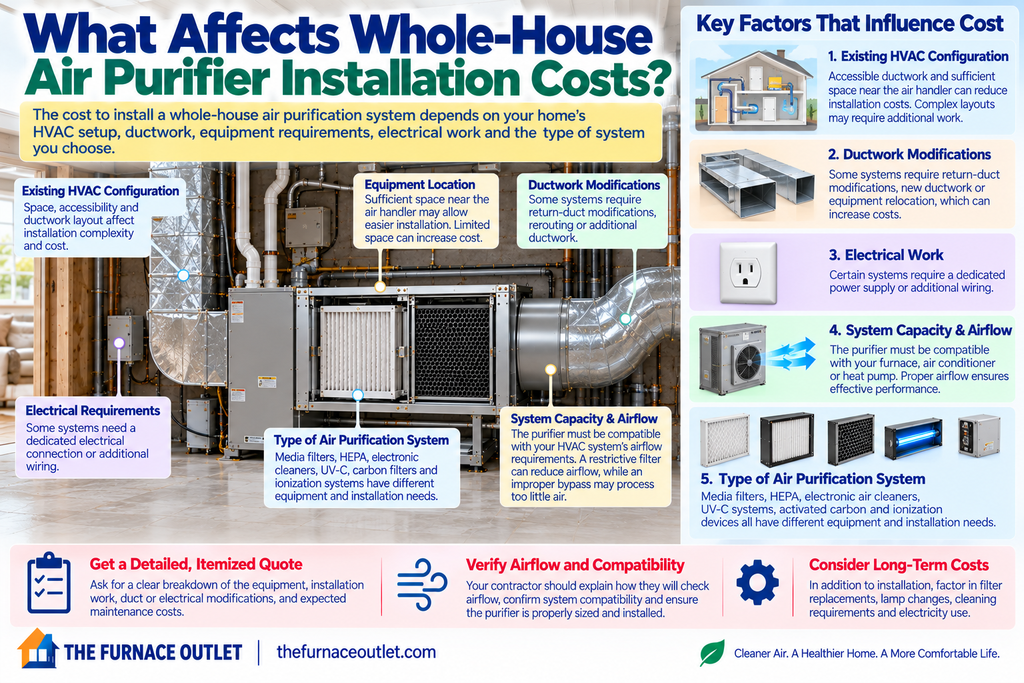
The existing HVAC configuration is one of the largest cost factors. Homes with accessible ductwork and sufficient space near the air handler may accommodate a filter-cabinet upgrade relatively easily. Other installations require return-duct modifications, equipment relocation, additional electrical connections, or a separate air-moving device.
System capacity also matters. A purification product must be compatible with the airflow required by the furnace, air conditioner, or heat pump. A restrictive filter can reduce airflow, while an improperly designed bypass system may process too little air to deliver meaningful whole-home benefits. I recommend requesting an itemized quotation that identifies the equipment, installation work, anticipated maintenance expenses, and any required HVAC modifications. Contractors should also explain how they will verify airflow and system compatibility after installation.
Whole-house purification equipment requires ongoing attention. Mechanical filters must be replaced according to their design, loading conditions, and manufacturer guidance. Electronic collection plates may need cleaning, while UV-C systems may require periodic lamp replacement even when the lamp still appears illuminated.
Activated carbon media eventually loses useful adsorption capacity and must be replaced when appropriate. Some advanced systems also require servicing of electrical components or proprietary replacement cartridges. Electricity costs depend on whether the purification equipment uses a separate motor, consumes power continuously, or requires longer operation of the central HVAC blower. A system that encourages continuous blower operation may increase household electricity use compared with operating the HVAC fan only during heating and cooling calls.
I recommend comparing annual ownership costs rather than relying exclusively on the installation quotation.
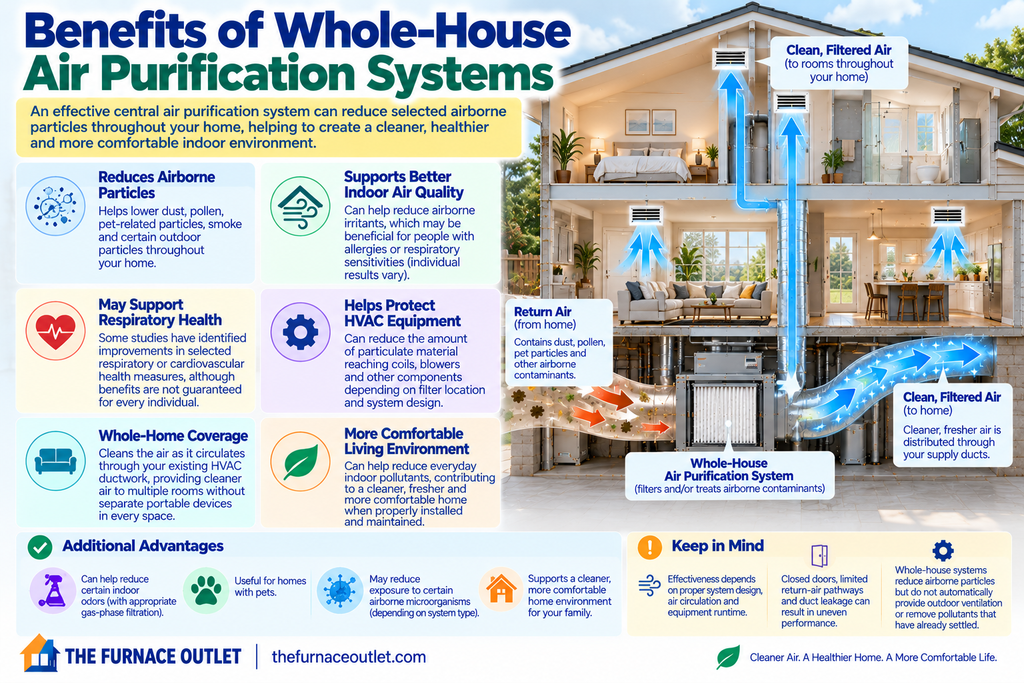
The primary benefit of an effective central filtration system is the ability to reduce selected airborne particles throughout spaces served by the HVAC ductwork. For households experiencing recurring dust, pollen, pet-related particles, or outdoor particle infiltration, improved filtration may help lower airborne concentrations when the equipment operates appropriately.
Some research involving air-cleaning equipment has identified improvements in selected respiratory or cardiovascular health measures, although results vary and individual symptom improvement is not guaranteed. Whole-house filtration may also reduce the amount of particulate material reaching certain HVAC components, depending on filter location and equipment design.
Another advantage is convenience. A centrally installed system can operate without requiring separate portable devices in every room. However, effectiveness depends on air circulation. Closed doors, limited return-air pathways, duct leakage, and irregular blower operation can produce uneven results. I recommend considering these practical factors before assuming that one central device will provide identical air-cleaning performance throughout the home.
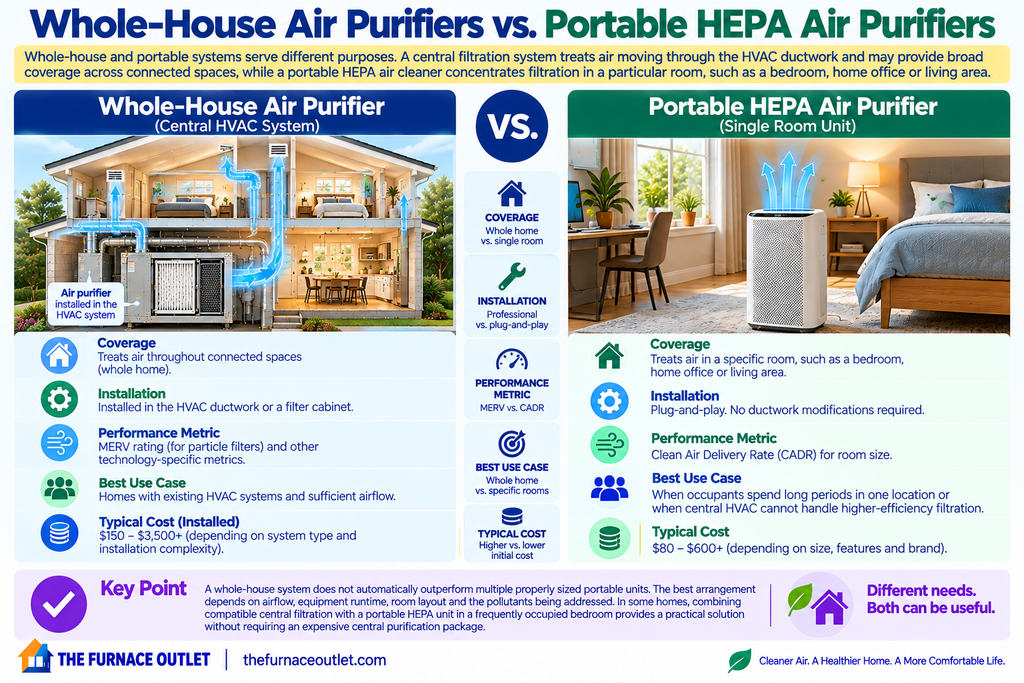
Whole-house and portable systems serve different purposes. A central filtration system treats air moving through the HVAC ductwork and may provide broad coverage across connected spaces. A portable HEPA air cleaner concentrates filtration in a particular room, such as a bedroom, home office, or living area.
Portable units can be especially useful when occupants spend long periods in one location or when the central HVAC system cannot accommodate higher-efficiency filtration. Their performance can also be evaluated using Clean Air Delivery Rate, or CADR, which helps homeowners select equipment suitable for room size.
A whole-house system does not automatically outperform multiple properly sized portable units. The best arrangement depends on airflow, equipment runtime, room layout, and the pollutants being addressed. In some homes, combining compatible central filtration with a portable HEPA unit in a frequently occupied bedroom provides a practical solution without requiring an expensive central purification package.
Different contaminants require different approaches. High-efficiency particle filters can capture many airborne particles associated with smoke, pollen, dust, and pet allergens. However, filtration does not eliminate particles that remain embedded in carpets, upholstery, or bedding.
Smoke also contains gases, and a particle filter alone cannot remove every gaseous component. Activated carbon or other gas-phase media may reduce certain chemicals, but performance depends on the substances present and the system’s adsorption capacity. No conventional whole-house air purifier should be assumed to eliminate carbon monoxide hazards, radon exposure, or an active mold problem. Carbon monoxide requires appropriate combustion safety measures and listed alarms. Radon requires recognized testing and potentially mitigation, while mold problems require moisture correction and appropriate cleanup.
The most effective approach combines pollutant-specific control measures rather than expecting one device to solve every indoor air quality concern.
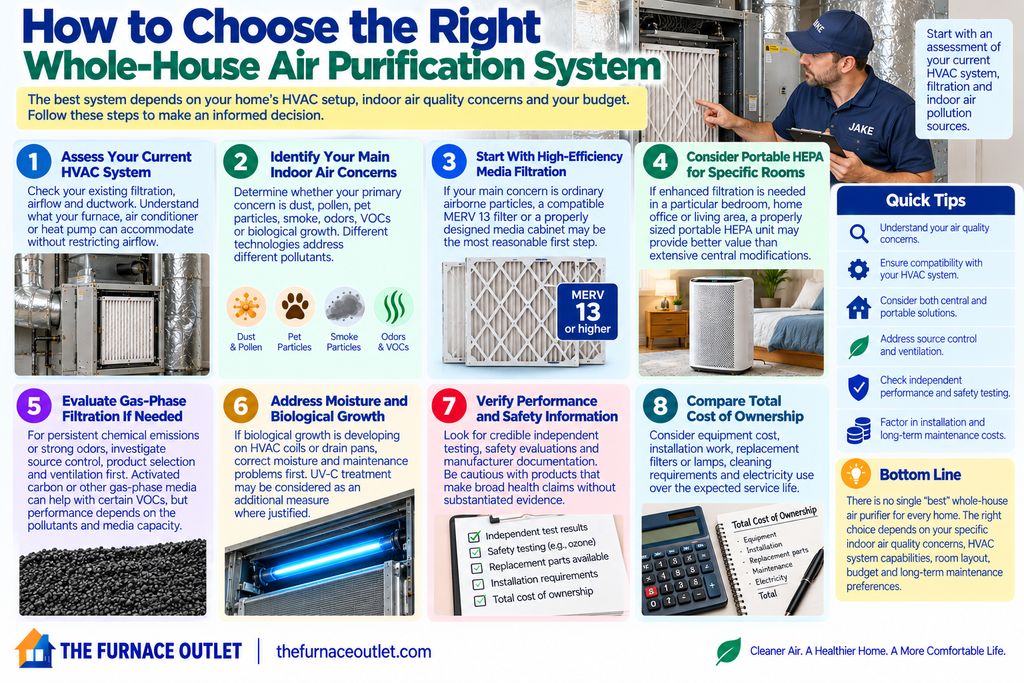
I recommend beginning with an assessment of the home’s existing HVAC filtration, airflow, and indoor pollution sources. If the main concern is ordinary airborne particulate matter, upgrading to a compatible MERV 13 filter or an appropriately designed media cabinet may be the most reasonable first step.
If enhanced filtration is needed in a particular bedroom, a properly sized portable HEPA unit may provide better value than extensive central modifications. For persistent chemical emissions, investigate source control, product selection, and ventilation before considering substantial gas-phase filtration equipment.
If biological growth is developing on HVAC coils or drain pans, address moisture and maintenance problems first. UV-C treatment may be considered as an additional measure where justified. Before purchasing, I recommend verifying independent performance evidence, safety testing, replacement-part availability, installation requirements, and the total expected cost of ownership.
One common mistake is installing the highest-rated filter available without checking airflow compatibility. Excessive pressure drop can interfere with heating and cooling performance. Another mistake is assuming that a purification device introduces fresh outdoor air. Most central air-cleaning equipment recirculates indoor air unless separate ventilation equipment is installed.
Homeowners should also be cautious about products claiming to eliminate nearly every pollutant without identifying testing methods and operating conditions. Poorly installed UV-C equipment can create electrical or radiation hazards, while certain electronic technologies may introduce unwanted emissions. Finally, neglecting filter replacement or maintenance can undermine the performance of even a well-designed system. I recommend professional installation where duct modifications, electrical work, or specialized equipment are involved, followed by appropriate system testing.
For many homeowners, improved central filtration can be a worthwhile investment when the existing HVAC system is compatible and airborne particle reduction is the primary objective. A relatively modest media-filter upgrade may deliver meaningful benefits without the cost or complexity of a multi-technology purification system.
More expensive solutions may be justified in selected circumstances, but their additional cost should be supported by a clear need and credible evidence of performance. I would be cautious about purchasing advanced ionization, plasma, or multi-stage products solely because promotional materials promise exceptionally clean air. The best value comes from matching equipment to the pollutant, ensuring sufficient airflow, and maintaining the system properly.
For many homes, a properly installed high-efficiency media filter offers an effective and practical starting point for airborne particle removal. MERV 13 is a useful target when the HVAC system can accommodate it. Other technologies may be appropriate for specific needs.
Basic filtration upgrades may cost a few hundred dollars, while dedicated HEPA, gas-phase filtration, or multi-technology systems can cost several thousand dollars. Actual costs depend on equipment, ductwork, electrical requirements, and local installation conditions.
A true HEPA filter should not be installed in an ordinary furnace filter slot unless the system is specifically designed for it. Excessive airflow resistance can interfere with HVAC performance. Dedicated HEPA systems often require engineered airflow arrangements.
Certain filtration and properly designed germicidal technologies can reduce airborne particles containing microorganisms or inactivate susceptible organisms. Actual effectiveness depends on equipment design and operating conditions. No residential system guarantees elimination of infection risk.
Some systems containing suitable activated carbon or other gas-phase media can reduce selected odors and chemical pollutants. Ordinary particle filters generally do not remove most gaseous odors effectively.
Longer blower runtime can increase the amount of air passing through the filter, but it may also increase electricity consumption and affect cooling-season humidity control. The appropriate operating strategy depends on the equipment and home.
Not necessarily. Electronic air cleaners may capture particles effectively under certain conditions, but they can require additional maintenance and some designs may produce ozone. Mechanical media filtration is often simpler to evaluate and maintain.
No. Filtration and ventilation perform different functions. Whole-house filtration primarily treats recirculated air, while ventilation exchanges indoor air with outdoor air. Both should be considered according to the home’s conditions and outdoor air quality.
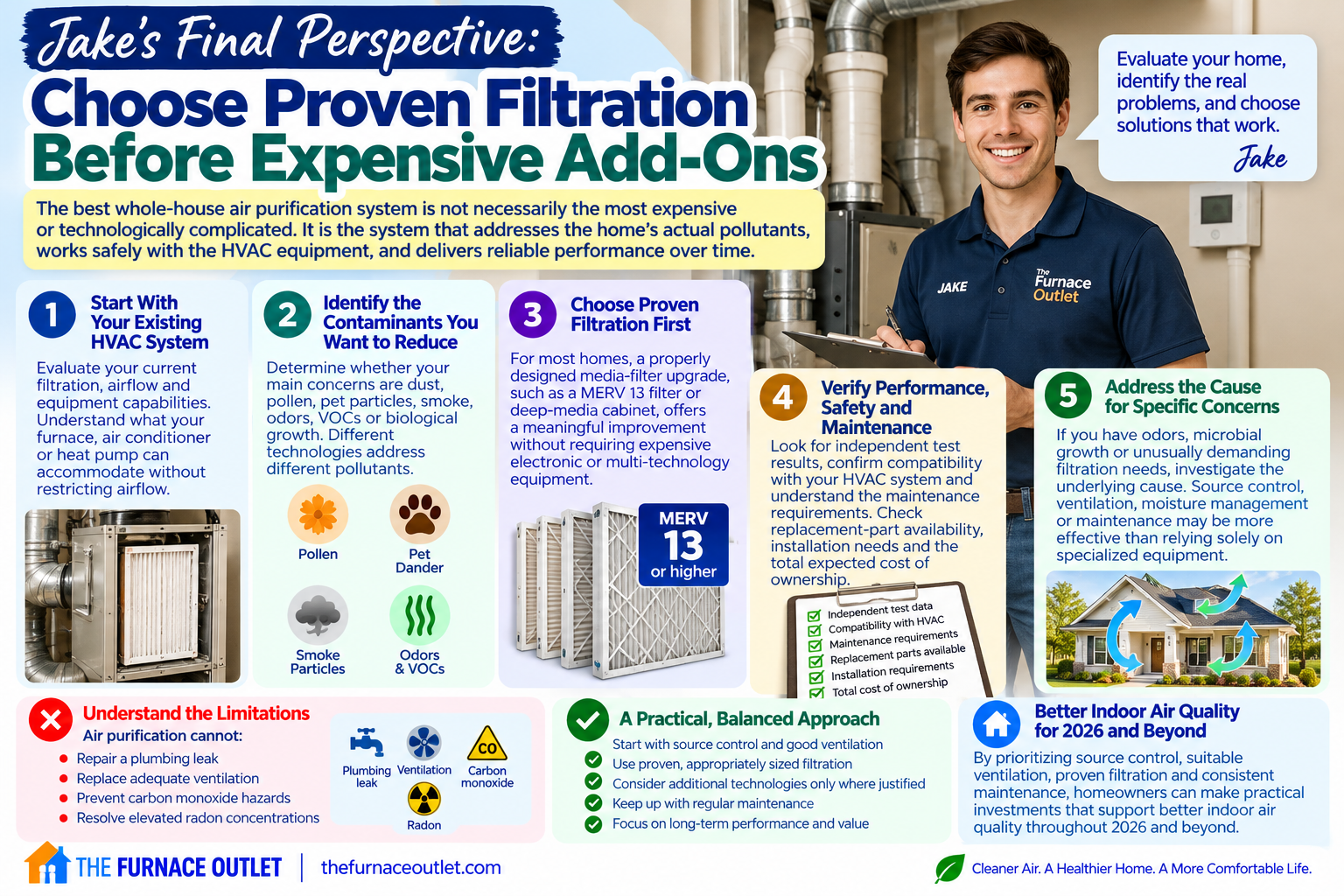
When homeowners ask me which whole-house air purification system they should install, I begin by evaluating their existing HVAC equipment and identifying the contaminants they want to reduce. In many cases, a properly designed media-filter upgrade offers a sensible improvement without requiring expensive electronic or multi-technology equipment.
My preferred approach is to verify airflow compatibility, choose filtration with documented performance, and ensure the homeowner understands the maintenance requirements. If a household has a specific concern involving odors, microbial growth, or unusually demanding filtration needs, I would investigate the cause before recommending specialized equipment.
I also encourage homeowners to recognize what air purification cannot accomplish. A filter cannot repair a plumbing leak, replace adequate ventilation, prevent carbon monoxide hazards, or resolve elevated radon concentrations. Those problems require their own appropriate solutions.
The best whole-house air purification system is not necessarily the most expensive or technologically complicated. It is the system that addresses the home’s actual pollutants, works safely with the HVAC equipment, and delivers reliable performance over time.
By prioritizing source control, suitable ventilation, proven filtration, and consistent maintenance, homeowners can make practical investments that support better indoor air quality throughout 2026 and beyond.
This article is intended for general HVAC and indoor air quality education. Installation costs are illustrative planning estimates and are not guaranteed prices or verified contractor quotations.
Air-cleaning equipment performance varies by product, installation, operating conditions, maintenance, and the contaminants present. Homeowners should consult qualified HVAC professionals before modifying ductwork, installing electrical equipment, or upgrading filtration in ways that may affect airflow. Avoid devices that intentionally generate ozone in occupied spaces. Carbon monoxide protection, radon testing, moisture remediation, and combustion safety require separate appropriate measures.
The Furnace Outlet provides independent educational information and does not imply endorsement by any government agency or professional standards organization.
U.S. Environmental Protection Agency — Guide to Air Cleaners in the Home https://www.epa.gov/indoor-air-quality-iaq/guide-air-cleaners-home
U.S. Environmental Protection Agency — Air Cleaners and Air Filters in the Home https://www.epa.gov/indoor-air-quality-iaq/air-cleaners-and-air-filters-home
U.S. Environmental Protection Agency — Improving Indoor Air Quality https://www.epa.gov/indoor-air-quality-iaq/improving-indoor-air-quality
U.S. Environmental Protection Agency — Ozone Generators That Are Sold as Air Cleaners https://www.epa.gov/indoor-air-quality-iaq/ozone-generators-are-sold-air-cleaners
ASHRAE — Filtration and Disinfection https://www.ashrae.org/technical-resources/filtration-and-disinfection-faq
California Air Resources Board — Air Cleaner Information https://ww2.arb.ca.gov/our-work/programs/air-cleaners-ozone-products
© 2026 The Furnace Outlet | https://thefurnaceoutlet.com
Independent HVAC education for a more comfortable, efficient, and informed home.