Newsletter Subscribe
Enter your email address below and subscribe to our newsletter

HVAC made simple
By Jake Lawson | HVAC Specialist | The Furnace Outlet
Updated: October 2026 | Reading Time: 12–14 Minutes
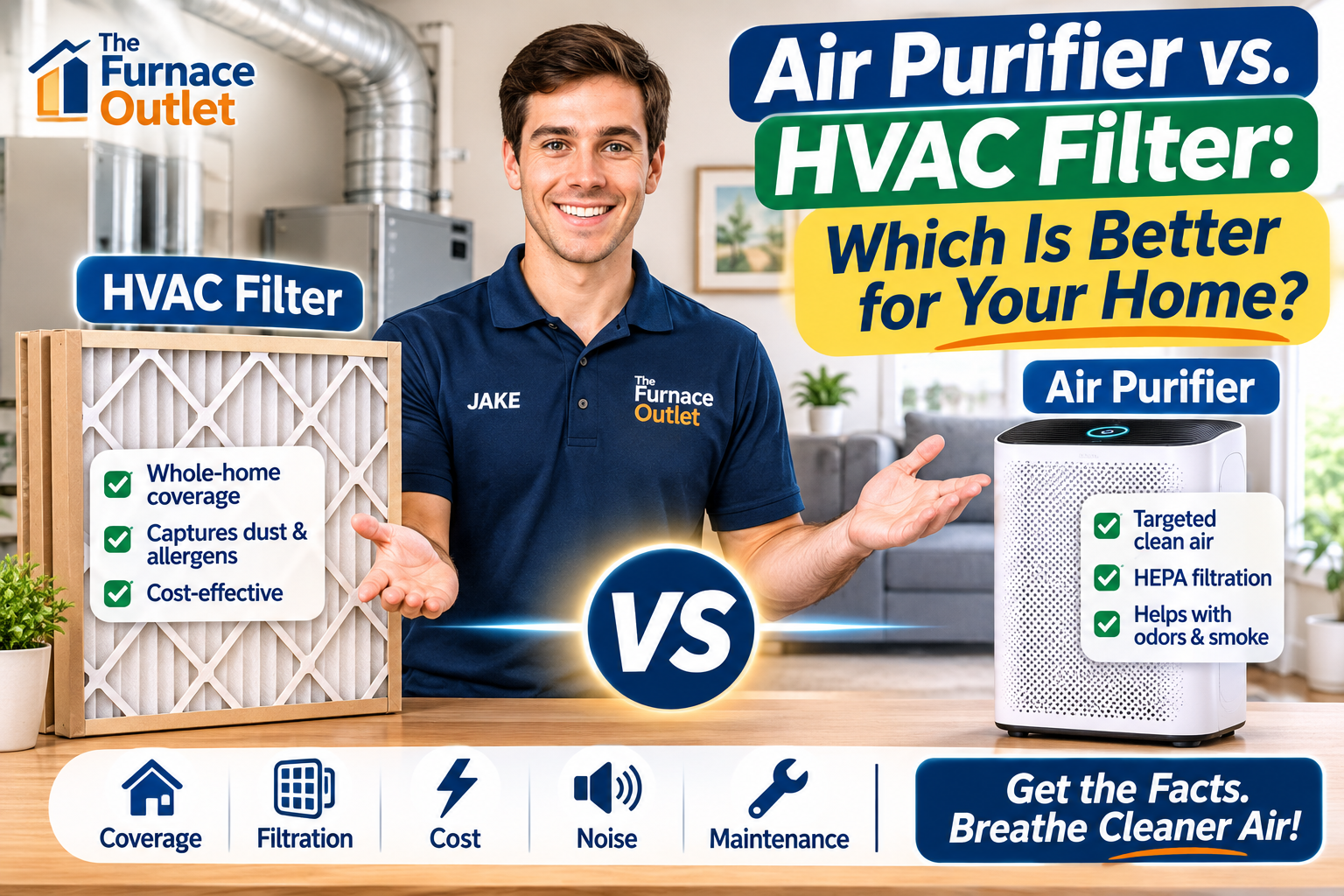
When homeowners want cleaner indoor air, two solutions usually come to mind: purchasing a portable air purifier or upgrading the filter in their central heating and cooling system. Both approaches can reduce airborne particles, but they operate differently, serve different areas, and involve different costs.
A portable air purifier is designed to clean the air within a particular room. An HVAC filter, on the other hand, captures particles as air circulates through a home’s central heating and cooling equipment. Although both technologies use filtration, their actual performance depends on airflow, filter efficiency, operating time, room layout, and the contaminants being addressed. As an HVAC specialist with more than 10 years of experience, I frequently encounter homeowners who assume that a higher-rated HVAC filter eliminates the need for a portable purifier. Others purchase expensive portable equipment without realizing that their existing central filtration system may be poorly maintained or inadequately sized.
Neither approach is automatically superior. A well-designed HVAC filtration system may provide broad particle reduction throughout connected living spaces, while a properly sized portable HEPA purifier can deliver concentrated filtration in a bedroom, nursery, or home office. In this guide, I compare how these systems work, their effectiveness against common indoor pollutants, installation and operating costs, maintenance requirements, and the circumstances in which combining both solutions makes sense. My goal is to help homeowners choose an air-cleaning strategy that addresses their actual indoor air quality concerns rather than spending money on unnecessary equipment.
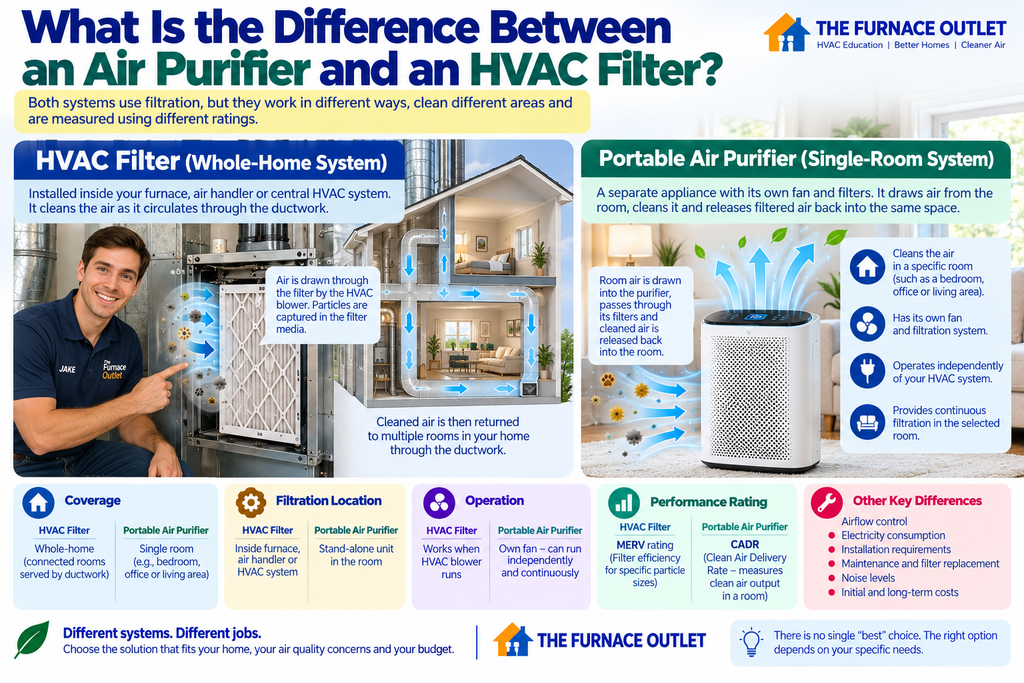
The fundamental difference is where and how each system cleans the air. An HVAC filter is installed within a furnace, air handler, or central heating and cooling system. As the blower draws air through return ducts, particles become trapped in the filter media before the air passes through the equipment and returns to occupied rooms.
A portable air purifier is a separate appliance containing its own fan and filtration components. It draws air from the surrounding room, passes it through its filters, and releases cleaned air back into that space. This difference affects coverage, airflow control, electricity consumption, maintenance, and installation. Central HVAC filtration can treat air from several connected rooms, but it generally operates only when the system blower runs. A portable purifier can operate independently of heating and cooling demand, providing continuous filtration in a selected room.
Another distinction involves performance ratings. HVAC particle filters are commonly evaluated using MERV ratings, while portable air purifiers are often compared using Clean Air Delivery Rate, or CADR. These measurements describe different aspects of performance and should not be treated as interchangeable.
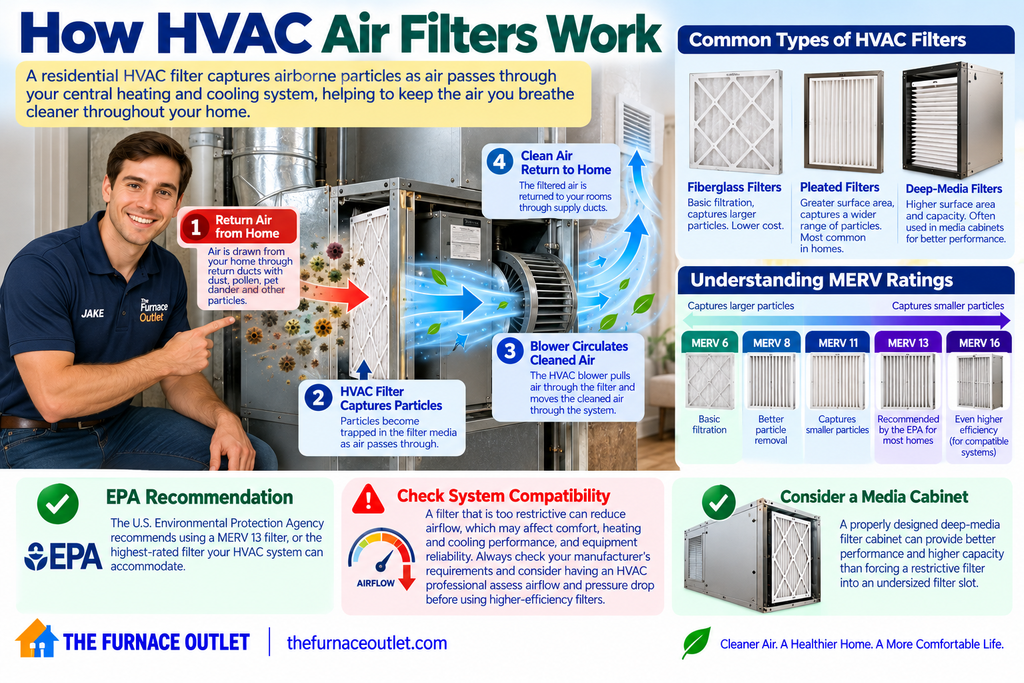
A residential HVAC filter captures airborne particles as air passes through the central heating and cooling system. Common filters use fiberglass, pleated synthetic media, or other materials designed to trap particles of different sizes. Their effectiveness depends on the filter’s construction, surface area, airflow, and particle-removal efficiency. The Minimum Efficiency Reporting Value, or MERV, provides a standardized method for comparing certain aspects of particle filtration performance. Lower-rated filters primarily capture larger particles, while higher-rated filters generally provide better removal of smaller particles within the applicable test-size ranges.
The U.S. Environmental Protection Agency recommends using a MERV 13 filter, or the highest-rated filter the HVAC system can accommodate. However, compatibility is essential. A filter with excessive airflow resistance can reduce system airflow, potentially affecting comfort, heating performance, cooling operation, and equipment reliability. I recommend checking the manufacturer’s requirements and having an HVAC professional assess airflow and pressure drop before making substantial filtration upgrades. A properly designed deep-media filter cabinet may offer better performance than forcing a restrictive filter into an undersized filter slot.
A portable air purifier uses an internal fan to draw room air through one or more filtration stages. Many effective models use mechanical particle filters, including HEPA filters, to capture dust, pollen, smoke particles, and other airborne contaminants. Some units also contain activated carbon intended to reduce selected odors or gaseous pollutants. However, the amount and type of carbon matter considerably, and thin carbon layers may provide limited gas-removal capacity.
Portable purifier performance is often expressed through CADR, which indicates how quickly a device can deliver filtered air for specified particle categories under standardized testing conditions. Higher CADR generally means the purifier can remove particles from a room more quickly, assuming appropriate placement and operating conditions. For example, a purifier suitable for a small bedroom may be inadequate for a large open-plan living area. I recommend selecting a device based on room size, verified CADR, acceptable noise levels, energy consumption, and replacement-filter availability. A portable purifier should also be positioned where airflow is unobstructed, following the manufacturer’s instructions.
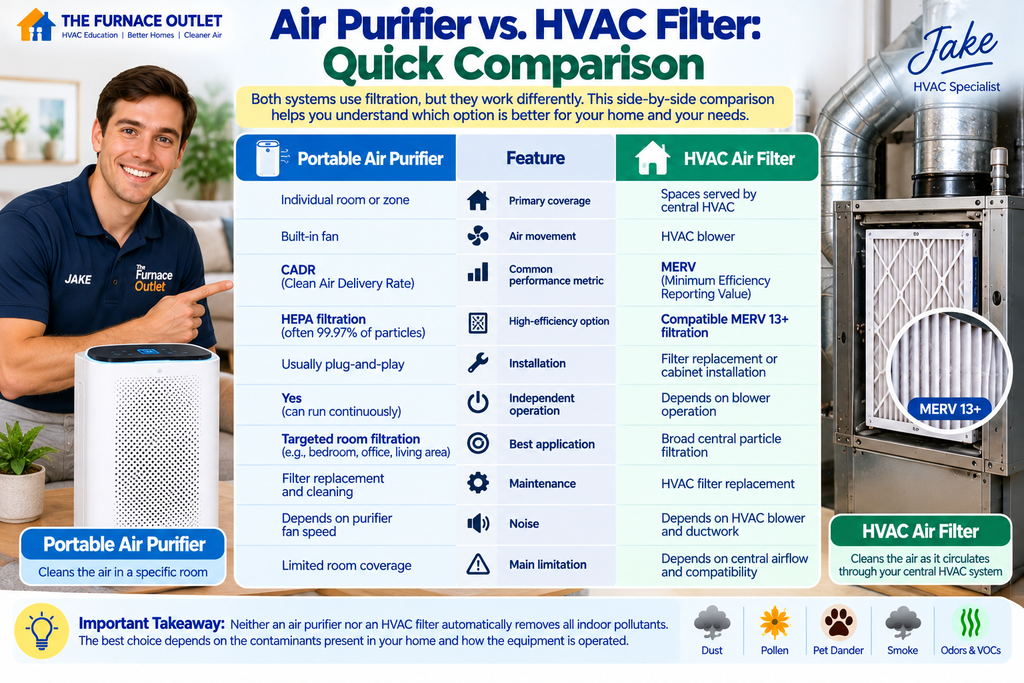
| Feature | Portable Air Purifier | HVAC Air Filter |
|---|---|---|
| Primary coverage | Individual room or zone | Spaces served by central HVAC |
| Air movement | Built-in fan | HVAC blower |
| Common performance metric | CADR | MERV |
| High-efficiency option | HEPA filtration | Compatible MERV 13+ filtration |
| Installation | Usually plug-and-play | Filter replacement or cabinet installation |
| Independent operation | Yes | Depends on blower operation |
| Best application | Targeted room filtration | Broad central particle filtration |
| Maintenance | Filter replacement and cleaning | HVAC filter replacement |
| Noise | Depends on purifier fan speed | Depends on HVAC blower and ductwork |
| Main limitation | Limited room coverage | Depends on central airflow and compatibility |
Neither technology automatically removes all indoor pollutants. Their benefits depend on the contaminants present and how the equipment is operated.
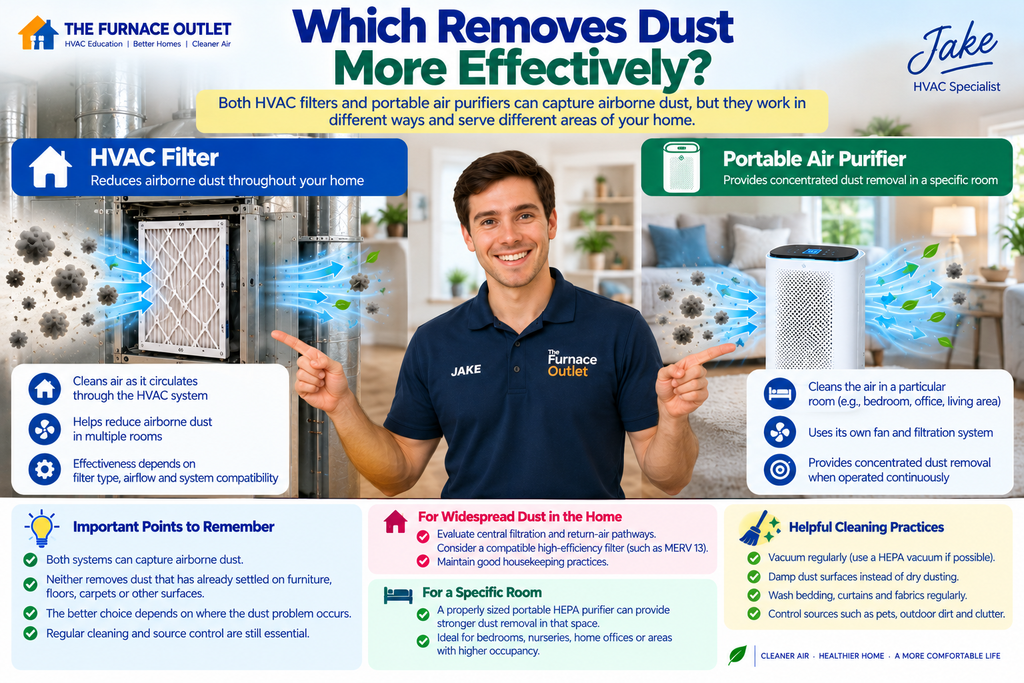
Dust is one of the most common reasons homeowners consider air purification equipment. Household dust contains a mixture of particles originating from clothing, skin, outdoor soil, furnishings, pets, and everyday activities. Both portable air purifiers and HVAC filters can capture airborne dust. However, neither eliminates dust that has already settled on furniture, floors, carpets, or other surfaces.
An effective central filtration system can reduce dust circulating through the HVAC ductwork, potentially lowering airborne particle concentrations across multiple rooms. A portable HEPA purifier may provide more concentrated particle removal in a particular space, especially when operated continuously at an appropriate fan speed. The better choice depends on where the dust problem occurs. For widespread airborne dust, I would first evaluate central filtration, return-air pathways, and housekeeping practices. For a specific room where occupants spend substantial time, a portable HEPA purifier may offer additional benefits. Regular vacuuming, damp dusting, and controlling sources remain important regardless of filtration technology.
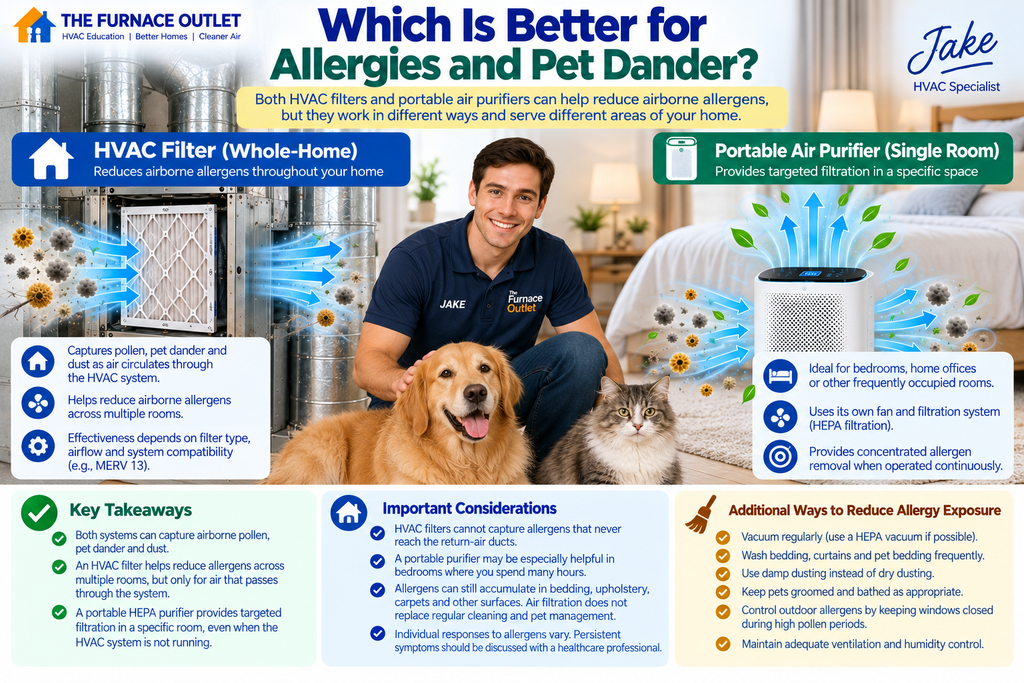
Airborne pollen, pet-related allergens, and certain dust particles can contribute to indoor allergy exposure. A compatible high-efficiency HVAC filter can capture many airborne particles as they pass through the central system. However, the filter cannot capture particles that never reach the return-air ducts. A portable HEPA purifier positioned in a frequently occupied room can provide targeted filtration independent of the central HVAC operating schedule. For example, homeowners who spend eight hours sleeping in a bedroom may benefit from operating a properly sized portable purifier in that room, particularly when central filtration is intermittent.
Nevertheless, allergens can accumulate in bedding, upholstery, carpeting, and other surfaces. Air filtration does not replace appropriate cleaning or pet-allergen management. I recommend treating air filtration as one component of an overall exposure-reduction strategy rather than promising that any particular device will eliminate allergy symptoms. Individual health responses vary, and persistent symptoms should be discussed with a qualified healthcare professional.
Fine particulate matter, commonly called PM2.5, can enter homes from wildfire smoke, traffic pollution, cooking, and other combustion-related sources. Because these particles are small, effective filtration and sufficient airflow are particularly important. A properly selected MERV 13 or higher HVAC filter can capture a substantial portion of fine particles passing through it, provided the system is compatible and operating appropriately. Portable HEPA purifiers can also reduce airborne fine particles and may be especially useful for creating a cleaner-air room during periods of poor outdoor air quality.
For households affected by wildfire smoke, I generally recommend evaluating central filtration and identifying a frequently occupied room where additional portable filtration could provide meaningful protection. During severe outdoor smoke events, homeowners should follow public-health guidance concerning windows, ventilation settings, and outdoor-air intake. Importantly, smoke contains both particles and gases. Mechanical particle filtration does not remove every gaseous smoke component. Air cleaning should complement efforts to reduce smoke infiltration rather than being treated as complete protection from all smoke-related hazards.
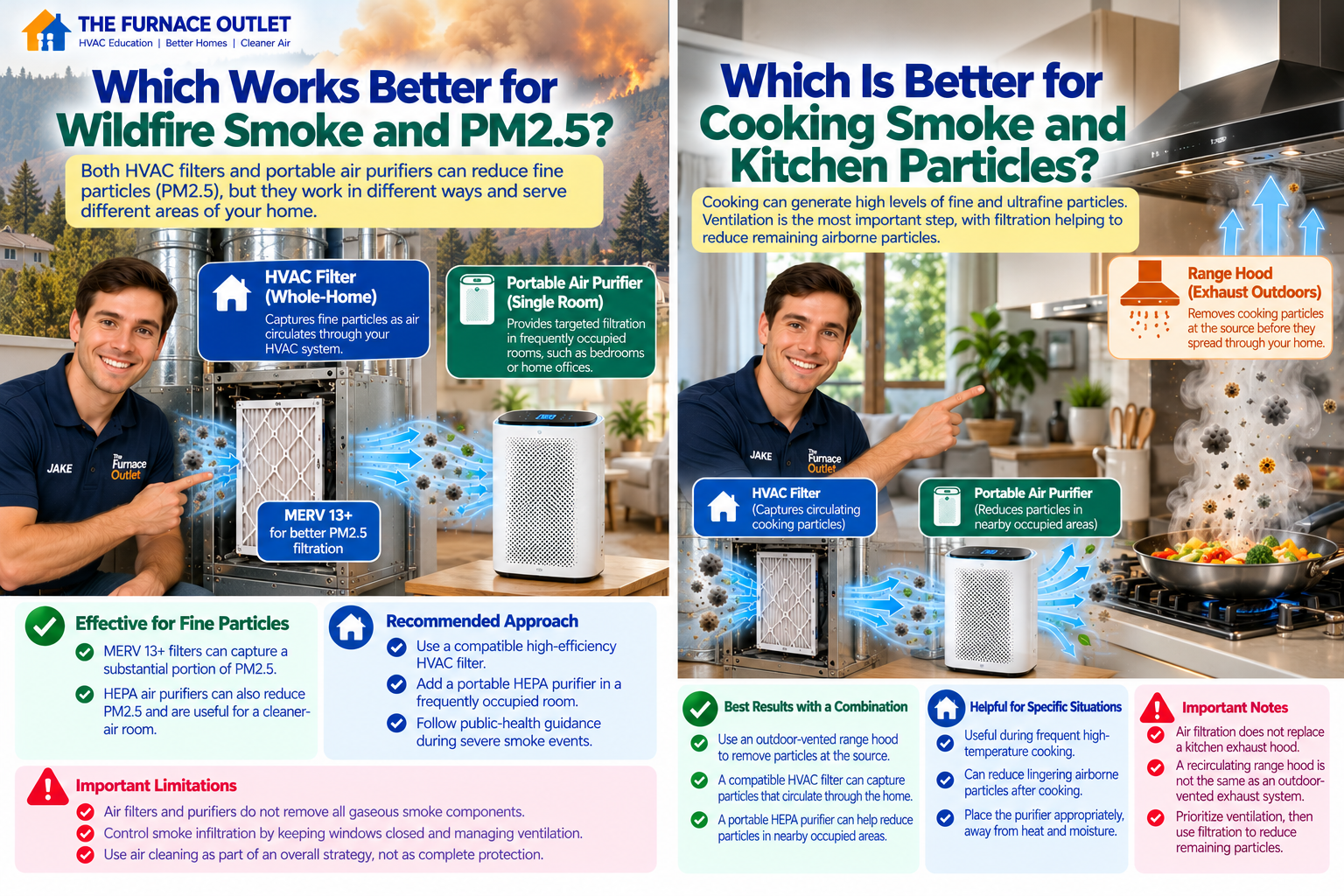
Cooking can generate substantial amounts of fine and ultrafine particles, especially during frying, grilling, and high-temperature cooking. An HVAC filter may capture some cooking-related particles after they circulate through the home and reach the return-air system. A portable HEPA purifier placed appropriately in a nearby occupied area may also help reduce airborne particles, although placement must avoid interfering with safe cooking operations. Neither approach should replace effective kitchen exhaust ventilation.
An appropriately installed range hood that exhausts outdoors can remove pollutants closer to their source, before they spread throughout the home. For homes with frequent high-temperature cooking, I recommend prioritizing source capture and ventilation, then using filtration to reduce remaining airborne particles. A recirculating range hood should not automatically be considered equivalent to an outdoor-vented exhaust system.
Volatile organic compounds, or VOCs, may originate from paints, cleaning products, solvents, furnishings, adhesives, and other household materials. Ordinary mechanical particle filters are not designed to remove most gaseous pollutants effectively. This limitation applies to both standard HVAC filters and portable HEPA filters. Some portable air purifiers include activated carbon or other sorbent materials that can capture selected gases and odors. Whole-house gas-phase filtration equipment is also available.
However, performance depends on the particular chemicals present, sorbent type, media quantity, airflow, humidity, and remaining adsorption capacity. A thin carbon-coated filter should not be assumed to provide the same performance as a substantial gas-phase filtration system. My first recommendation for persistent chemical odors is to identify and reduce the source where possible. Appropriate ventilation, safer product selection, and proper storage of household chemicals may be more effective than attempting to continuously filter emissions.
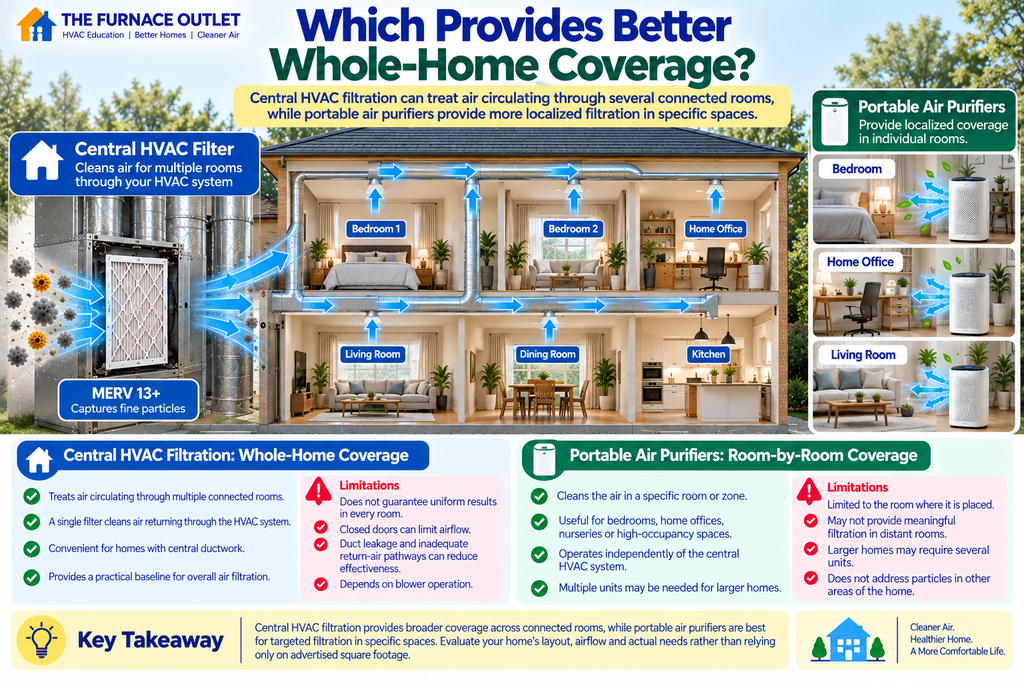
Central HVAC filtration has an important advantage when the goal is to treat air circulating throughout several connected rooms. A single compatible filter can process air returning from multiple spaces, making it convenient for households with extensive central ductwork. However, central filtration does not guarantee uniform results.
Closed bedroom doors, inadequate return-air pathways, duct leakage, furniture placement, and irregular blower operation can affect how air moves through the home. Portable air purifiers provide more localized filtration. A single unit may work effectively in one bedroom but offer limited benefits in distant rooms. Larger homes may require several portable units to provide meaningful coverage in multiple occupied spaces.
I recommend evaluating the actual layout of the home rather than relying on advertising claims about square footage alone. For some households, central filtration provides a practical baseline, while portable purifiers address rooms with higher occupancy or specific pollution concerns.
Electricity consumption depends on equipment design, operating speed, and runtime. A portable air purifier uses its own fan motor. Its energy consumption varies by model and operating setting. For illustration, a purifier consuming 40 watts continuously would use approximately 28.8 kilowatt-hours over 30 days. An HVAC filter does not generally consume electricity directly. However, it creates resistance to airflow, and the central blower consumes electricity while moving air through the system.
Increasing HVAC blower runtime specifically for filtration can increase energy consumption. The additional cost depends on blower efficiency, fan settings, filter resistance, and operating hours. I recommend comparing actual wattage and expected runtime rather than assuming that central filtration is always cheaper to operate. ENERGY STAR information can also help homeowners compare the energy efficiency of eligible portable air cleaners.
Noise can influence whether homeowners use air-cleaning equipment consistently. Portable purifiers often produce noticeable fan noise, especially at higher speeds. Some models provide quiet nighttime settings, although lower fan speeds may also reduce particle-cleaning performance. Central HVAC filtration does not add a separate portable fan to the room, but the existing blower and ductwork may generate sound during operation.
A poorly designed filter upgrade that increases airflow resistance may contribute to undesirable system noise or performance problems. For bedrooms, I recommend balancing acceptable sound levels with adequate CADR at the fan speed occupants will actually use. A purifier that delivers excellent laboratory performance only at an intolerably loud setting may not provide the best practical value.
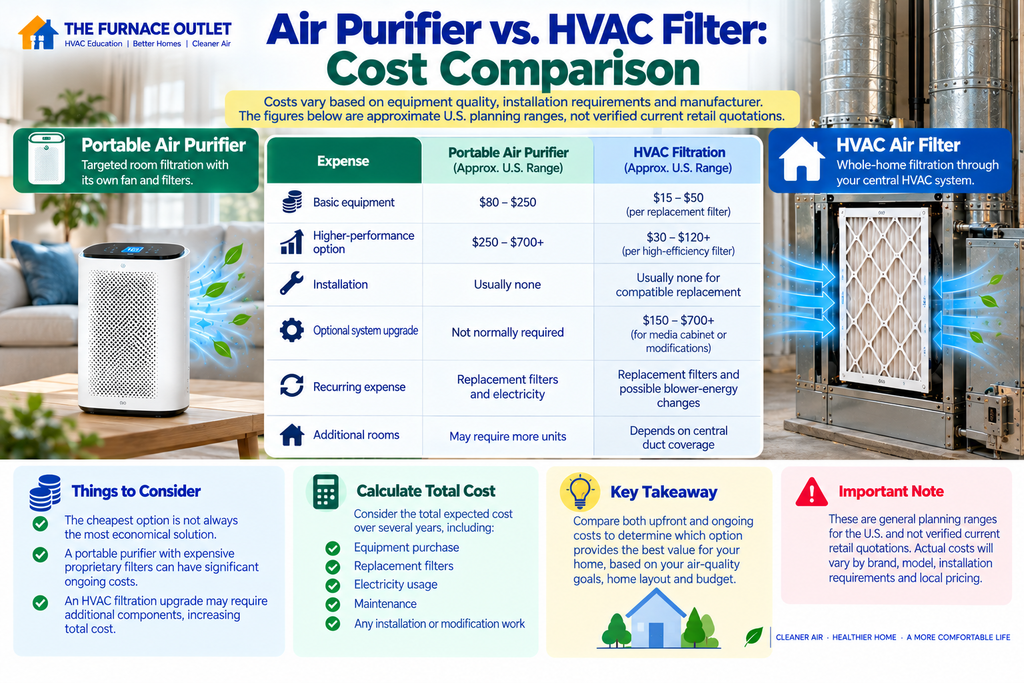
Costs vary substantially by equipment quality, installation requirements, and manufacturer. The following figures are approximate U.S. planning ranges, not verified current retail quotations.
| Expense | Portable Air Purifier | HVAC Filtration |
|---|---|---|
| Basic equipment | $80–$250 | $15–$50 per replacement filter |
| Higher-performance option | $250–$700+ | $30–$120+ per high-efficiency filter |
| Installation | Usually none | Usually none for compatible replacement |
| Optional system upgrade | Not normally required | $150–$700+ for media cabinet or modifications |
| Recurring expense | Replacement filters and electricity | Replacement filters and possible blower-energy changes |
| Additional rooms | May require more units | Depends on central duct coverage |
The cheapest equipment is not always the most economical solution. A portable purifier with expensive proprietary filters may have substantial ongoing costs. Similarly, an HVAC filtration upgrade requiring extensive duct modifications may cost considerably more than a standard filter replacement.
I recommend calculating the total expected cost over several years, including filters, electricity, maintenance, and any installation work.
Both systems require regular maintenance to remain effective. Portable air purifiers generally need periodic filter replacement, cleaning of accessible intake surfaces, and inspection for airflow obstructions. Some models include washable prefilters, but HEPA filters should not be washed unless the manufacturer specifically states that the component is designed for that treatment.
HVAC filters also require replacement based on manufacturer recommendations and actual loading conditions. Homes with pets, construction dust, frequent cooking, or substantial outdoor particle infiltration may require more frequent inspections. I recommend checking filters regularly rather than relying exclusively on calendar reminders. A heavily loaded HVAC filter can increase pressure drop and interfere with airflow, while a neglected portable purifier may deliver less clean air than expected.
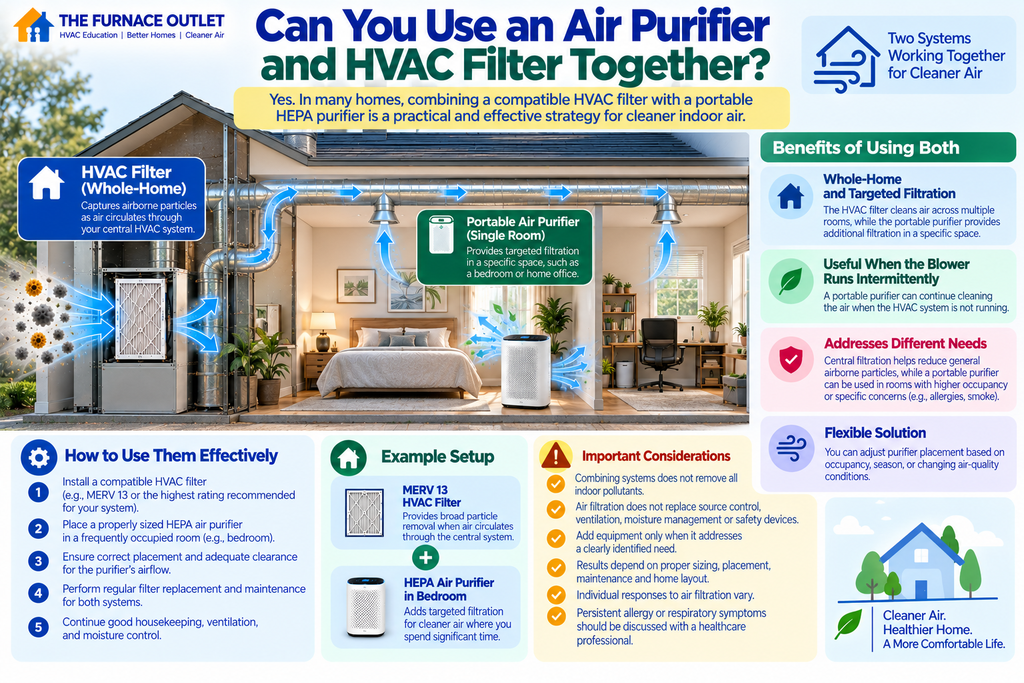
Yes. In many homes, combining compatible central filtration with a portable HEPA purifier is a sensible strategy. The HVAC filter provides broad particle removal when air circulates through the central system. A portable purifier adds targeted filtration in a room where occupants spend substantial time. For example, a household might install a compatible MERV 13 filter in its central HVAC system and operate a properly sized portable HEPA purifier in the main bedroom.
This approach can be particularly useful when the HVAC blower operates intermittently or when room airflow is uneven. However, combining systems does not eliminate the need for source control, ventilation, moisture management, or appropriate safety devices. I recommend adding equipment only when it addresses a clearly identified need.
An HVAC filter upgrade may be the better starting point when the home already has a properly functioning central ducted heating and cooling system. It can be especially practical when airborne particle concerns affect several connected rooms and the equipment can accommodate improved filtration without excessive airflow resistance.
A compatible MERV 13 filter is often a reasonable target, although the exact selection must account for filter dimensions, surface area, blower capability, and manufacturer requirements. Before upgrading, I recommend inspecting the existing filter cabinet, checking for bypass leakage around the filter, and verifying that the filter fits securely.
If the existing filter slot is too restrictive, a properly designed deep-media cabinet may be worth considering. Homeowners should avoid assuming that the highest available MERV rating always produces the best overall result.
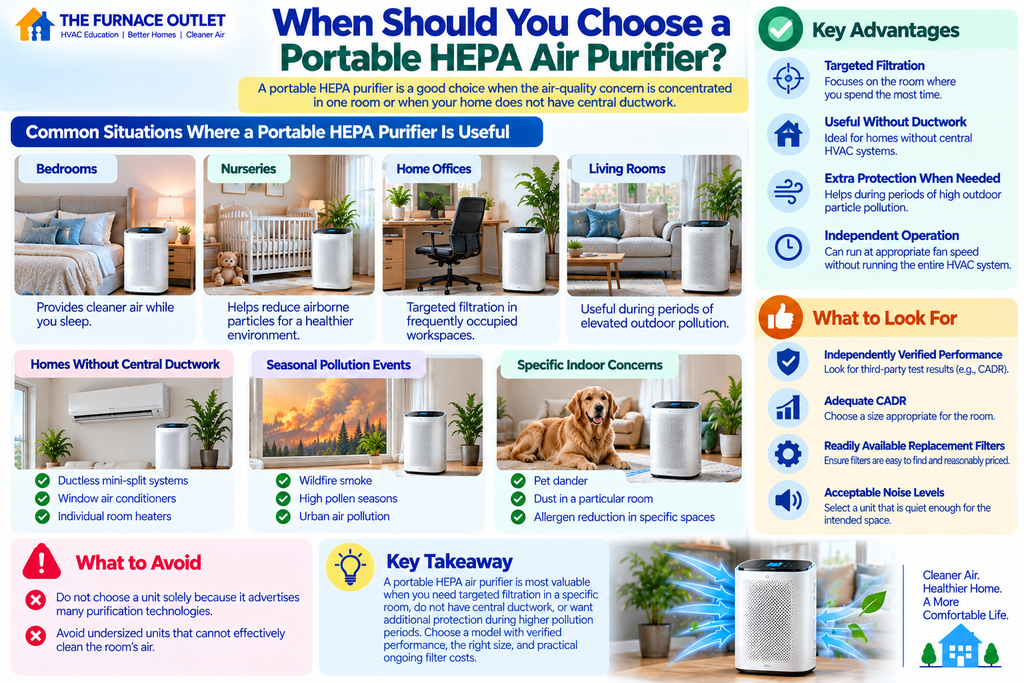
A portable HEPA purifier may be preferable when the primary concern is concentrated in one room. Bedrooms, nurseries, home offices, and other frequently occupied spaces are common examples. Portable units are also useful in homes without central ductwork, including properties using ductless mini-split systems, window air conditioners, or individual room heaters.
They may provide additional filtration during periods of elevated outdoor particle pollution without requiring homeowners to run the entire central HVAC blower continuously. I recommend selecting a purifier with independently verified performance information, adequate CADR, readily available replacement filters, and acceptable noise levels. Avoid choosing equipment solely because it advertises numerous purification technologies.
One mistake is selecting a portable purifier based only on advertised room coverage without examining CADR or the assumptions behind the coverage claim. Another is installing a restrictive high-efficiency HVAC filter without checking whether the heating and cooling equipment can accommodate it. Homeowners should also avoid assuming that all HEPA-branded products provide identical performance. Filter quality, air leakage, fan capacity, and overall device design matter.
A further concern involves electronic purification technologies that intentionally generate ozone or may produce undesirable byproducts. The EPA advises against using ozone generators in occupied spaces. Finally, homeowners should not expect filtration to correct every indoor air quality problem. Carbon monoxide hazards require proper combustion safety and listed alarms. Radon requires recognized testing and, where necessary, mitigation. Mold problems require moisture correction and appropriate cleanup. No favorable purifier display or filter rating should be interpreted as proof that all hidden indoor hazards are absent.
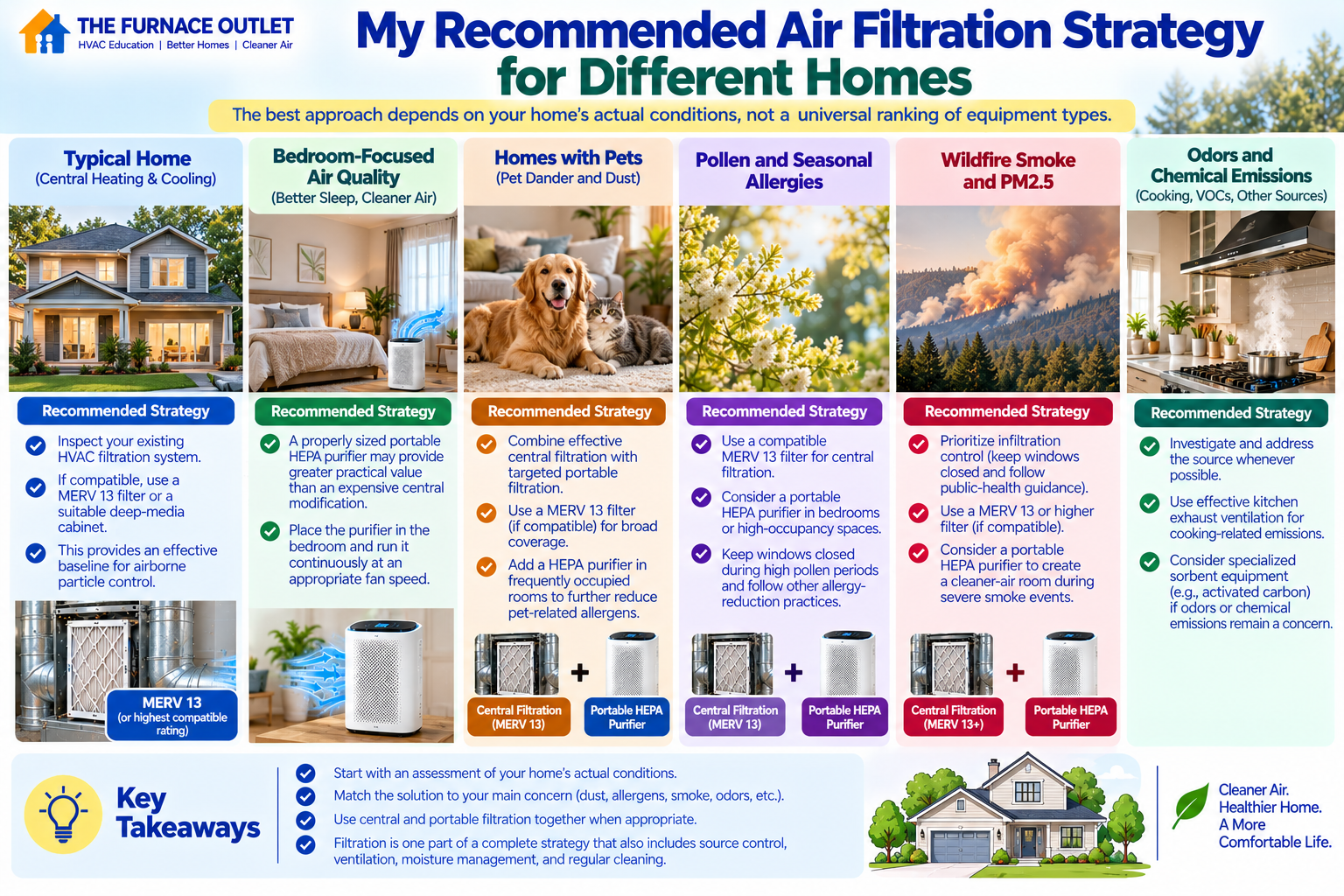
For a typical home with central heating and cooling, I recommend beginning with an inspection of the existing filtration system. If compatible, a MERV 13 filter or suitable deep-media cabinet may provide an effective baseline for airborne particle control. For a household primarily concerned about bedroom air quality, a properly sized portable HEPA purifier may offer greater practical value than an expensive central modification.
For homes with pets or recurring pollen exposure, combining effective central filtration with targeted portable filtration may be useful. For households affected by wildfire smoke, I recommend prioritizing infiltration control, suitable particle filtration, and a cleaner-air room when appropriate. For persistent odors or chemical emissions, I would investigate the source and ventilation before recommending specialized sorbent equipment. The best solution depends on the home’s actual conditions, not a universal ranking of equipment types.
A HEPA purifier generally provides higher single-pass particle capture efficiency under its specified test conditions, but overall room performance also depends on airflow and runtime. A MERV 13 HVAC filter can provide useful particle reduction across connected spaces when properly installed and operated.
Not necessarily. A compatible high-efficiency HVAC filter may adequately address your needs. A portable purifier can provide additional targeted filtration in frequently occupied rooms.
In some homes, central filtration may provide sufficient particle reduction. In others, limited blower runtime or uneven room airflow may make portable filtration beneficial.
Continuous fan operation can increase filtration opportunities but also increases electricity consumption and may affect cooling-season humidity control. The appropriate strategy depends on the HVAC equipment and home.
Some models with suitable activated carbon media may reduce selected odors. Ordinary HEPA filtration primarily removes particles rather than gaseous odor compounds.
Neither an ordinary portable HEPA purifier nor a standard HVAC filter should be relied upon to remove carbon monoxide. Use appropriate combustion safety measures and listed carbon monoxide alarms.
A properly sized portable HEPA purifier can be particularly useful for a bedroom because it operates independently of the central HVAC system. A compatible central filter can provide complementary filtration.
The EPA recommends MERV 13 or the highest rating the HVAC system can accommodate. Check manufacturer requirements and airflow compatibility before upgrading.
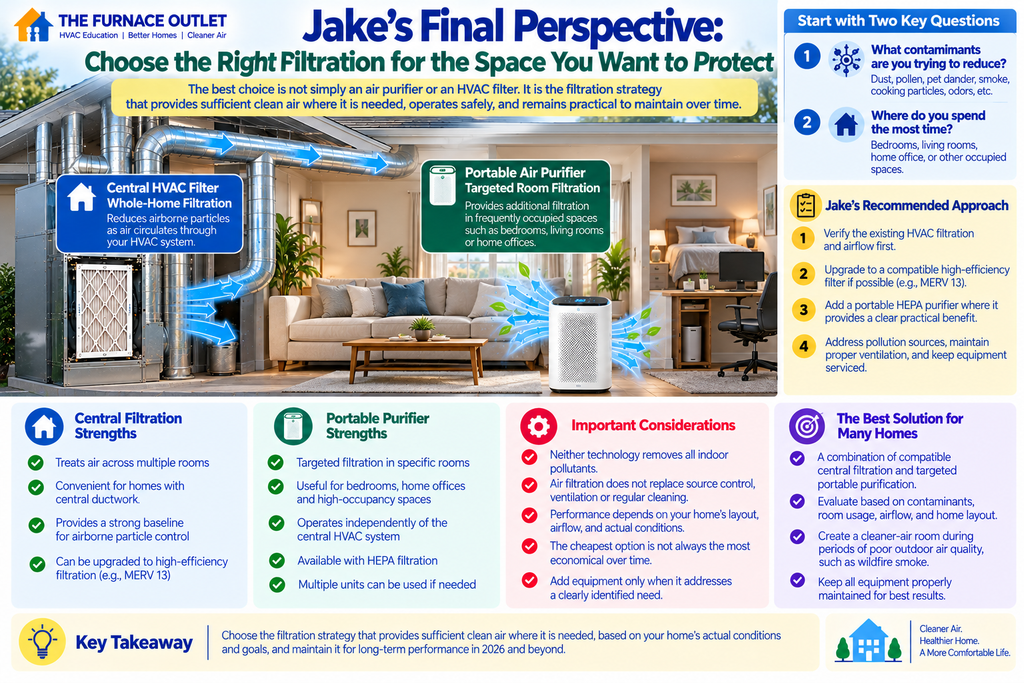
When homeowners ask me whether they should purchase an air purifier or upgrade their HVAC filter, I recommend beginning with two questions: What contaminants are they trying to reduce, and where do they spend the most time?
For a home with an existing central HVAC system, a compatible high-efficiency media filter can be an excellent starting point. It can reduce airborne particles passing through the equipment without requiring separate appliances throughout the house. However, I would not dismiss portable HEPA purifiers. A properly sized unit can provide valuable targeted filtration in bedrooms, home offices, and other frequently occupied spaces, particularly when the central blower does not operate continuously.
My preferred approach is to verify the existing HVAC filtration and airflow first, then add portable filtration where it provides a clear practical benefit. I also encourage homeowners to address pollution sources, maintain appropriate ventilation, and keep their equipment properly serviced.
The best choice is not simply an air purifier or an HVAC filter. It is the filtration strategy that provides sufficient clean air where it is needed, operates safely, and remains practical to maintain over time.
For many households, the most effective solution is a combination of compatible central filtration, targeted portable HEPA purification, and sensible indoor pollution prevention. By making decisions based on airflow, verified performance, room usage, and pollutant sources, homeowners can create a more informed indoor air quality strategy for 2026 and beyond.
This article provides general educational information about residential HVAC filtration and portable air purification. Equipment costs are illustrative estimates and may differ substantially by manufacturer, retailer, location, and installation requirements.
Air-cleaning performance depends on equipment design, maintenance, operating conditions, and the pollutants present. Homeowners should consult qualified HVAC professionals before making filtration changes that could affect system airflow. Air purifiers and HVAC filters do not replace carbon monoxide alarms, radon testing, proper ventilation, combustion safety inspections, or moisture remediation. The Furnace Outlet publishes independent educational content and does not imply endorsement by the EPA, ASHRAE, ENERGY STAR, or other organizations.
U.S. Environmental Protection Agency — Guide to Air Cleaners in the Home https://www.epa.gov/indoor-air-quality-iaq/guide-air-cleaners-home
U.S. Environmental Protection Agency — Air Cleaners and Air Filters in the Home https://www.epa.gov/indoor-air-quality-iaq/air-cleaners-and-air-filters-home
U.S. Environmental Protection Agency — Improving Indoor Air Quality https://www.epa.gov/indoor-air-quality-iaq/improving-indoor-air-quality
U.S. Environmental Protection Agency — Ozone Generators That Are Sold as Air Cleaners https://www.epa.gov/indoor-air-quality-iaq/ozone-generators-are-sold-air-cleaners
ENERGY STAR — Room Air Cleaners https://www.energystar.gov/products/air_cleaners
ASHRAE — Filtration and Disinfection https://www.ashrae.org/technical-resources/filtration-and-disinfection-faq
© 2026 The Furnace Outlet | https://thefurnaceoutlet.com
Independent HVAC education for a cleaner, more comfortable, and better-informed home.