Newsletter Subscribe
Enter your email address below and subscribe to our newsletter

HVAC made simple
By Jake Lawson | HVAC Specialist | The Furnace Outlet
Updated October 2026 | Heat Pump Troubleshooting Guide
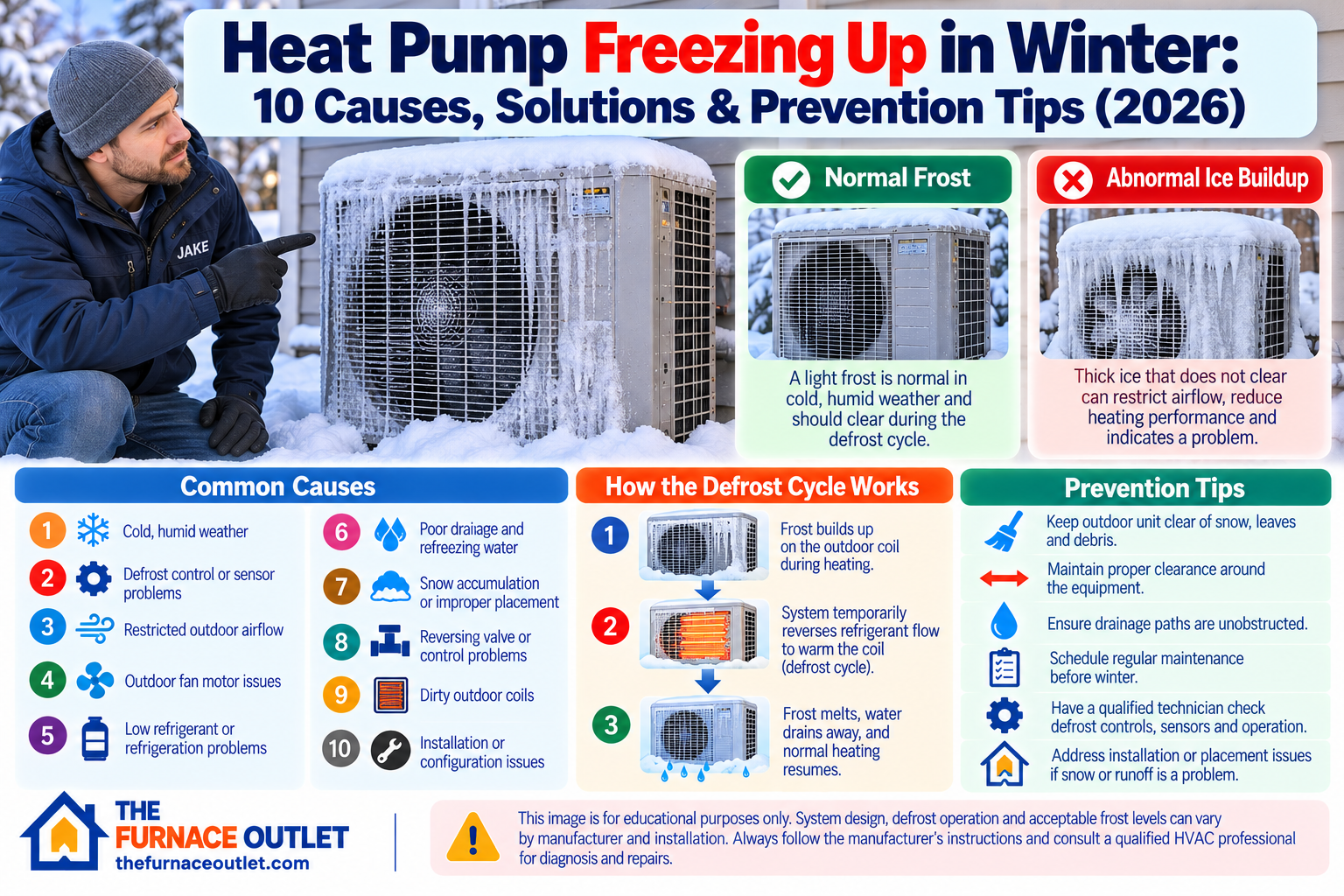
A heat pump covered in frost during winter can look alarming, especially when the outdoor unit appears frozen while your home is supposed to be getting warmer. Homeowners often assume that ice automatically means something has failed, but that is not always the case. A light layer of frost can be a normal part of heat pump operation, particularly during cold, humid weather.
As an HVAC specialist with more than 10 years of experience, I frequently encounter concerns about outdoor heat pumps freezing during winter. The important distinction is between temporary frost that the equipment removes through its automatic defrost cycle and excessive ice that continues accumulating, restricts airflow, or interferes with normal heating.
Persistent freezing can result from faulty defrost controls, restricted airflow, drainage problems, refrigerant-related faults, malfunctioning fans, or unsuitable installation conditions. Some problems are relatively straightforward to identify, while others require professional testing.
In this guide, I will explain why heat pumps freeze in winter, when ice accumulation is normal, what homeowners can safely check, and how to prevent recurring freezing problems without risking damage to the equipment.
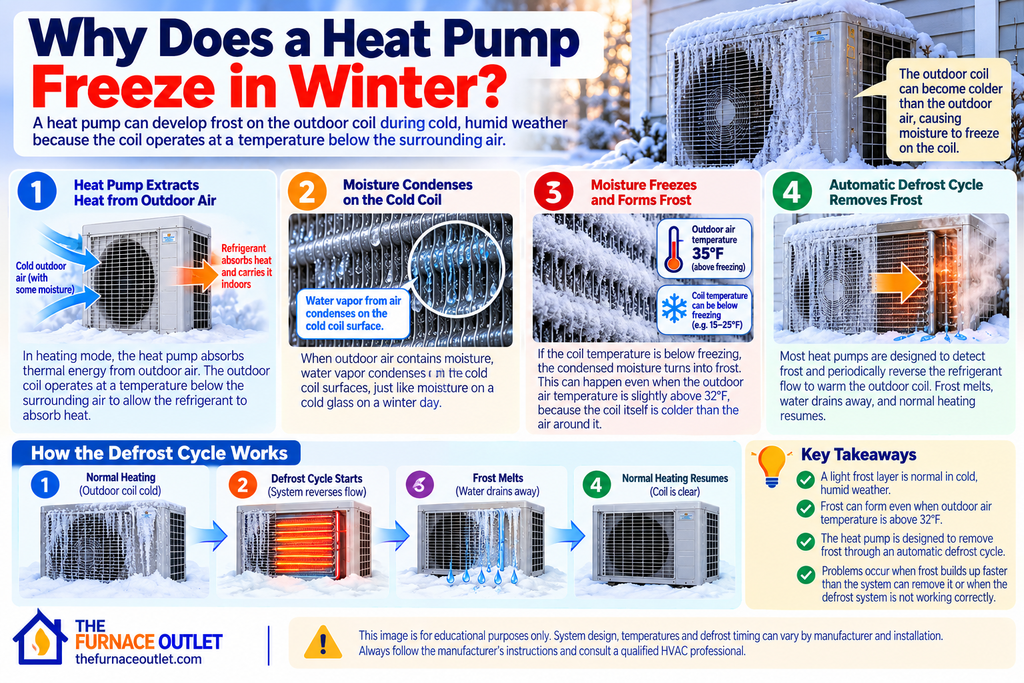
During heating operation, an air-source heat pump extracts thermal energy from outdoor air and transfers it indoors. To accomplish this, the outdoor heat exchanger operates at a temperature below the surrounding air, allowing refrigerant to absorb heat from the environment.
When outdoor air contains moisture, water vapor can condense on the cold coil surfaces. If the coil temperature is below freezing, that moisture may turn into frost. This process can occur even when the outdoor air temperature is slightly above 32°F because the coil itself may be colder than the surrounding air.
A thin frost layer is therefore not necessarily evidence of a malfunction. Most conventional air-source heat pumps are designed to detect frost-producing conditions and periodically initiate an automatic defrost cycle.
During defrost, many systems temporarily reverse refrigerant flow to warm the outdoor coil. Frost melts, water drains away, and normal heating resumes. Problems arise when frost accumulates faster than the equipment can remove it or when the defrost system fails to operate correctly.
The U.S. Department of Energy’s heat pump systems guide explains how heat pumps transfer thermal energy and operate in heating mode.
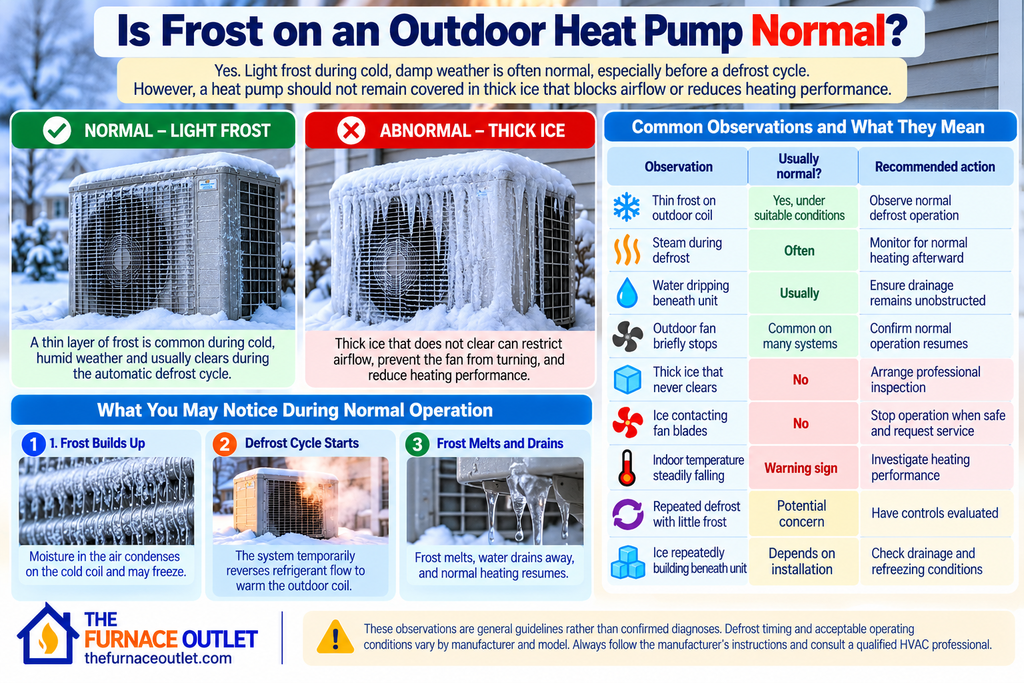
Yes. Light frost during cold, damp weather is often normal, particularly before a scheduled or demand-initiated defrost cycle. You may also notice water dripping beneath the outdoor unit or a temporary cloud of steam as frost melts.
However, a heat pump should not remain encased in thick ice that obstructs the coil, prevents the fan from turning, or significantly reduces heating performance.
| Observation | Usually normal? | Recommended action |
|---|---|---|
| Thin frost on outdoor coil | Yes, under suitable conditions | Observe normal defrost operation |
| Steam during defrost | Often | Monitor for normal heating afterward |
| Water dripping beneath unit | Usually | Ensure drainage remains unobstructed |
| Outdoor fan briefly stops | Common on many systems | Confirm normal operation resumes |
| Thick ice that never clears | No | Arrange professional inspection |
| Ice contacting fan blades | No | Stop operation when safe and request service |
| Indoor temperature steadily falling | Warning sign | Investigate heating performance |
| Repeated defrost with little frost | Potential concern | Have controls evaluated |
| Ice repeatedly building beneath unit | Depends on installation | Check drainage and refreezing conditions |
These observations are general guidelines rather than confirmed diagnoses. Defrost timing and acceptable operating conditions vary among manufacturers and models.
The first possibility is that your heat pump is functioning exactly as intended. Frost commonly develops when outdoor temperatures are near freezing and humidity is relatively high. Under these conditions, moisture in the air can freeze on the outdoor heat exchanger as the equipment extracts thermal energy.
Homeowners sometimes expect freezing problems to become progressively worse as outdoor temperatures decline. However, frost accumulation depends on both temperature and moisture availability. Cold, damp weather can create more frost than much colder, drier conditions.
A properly operating heat pump should periodically remove accumulated frost through its automatic defrost sequence. If the frost disappears and the system continues maintaining indoor comfort, there may be no problem requiring repair.
I recommend observing whether the coil clears naturally rather than attempting to remove ordinary frost manually. The objective is not to prevent all frost formation, but to ensure that the equipment manages it correctly.
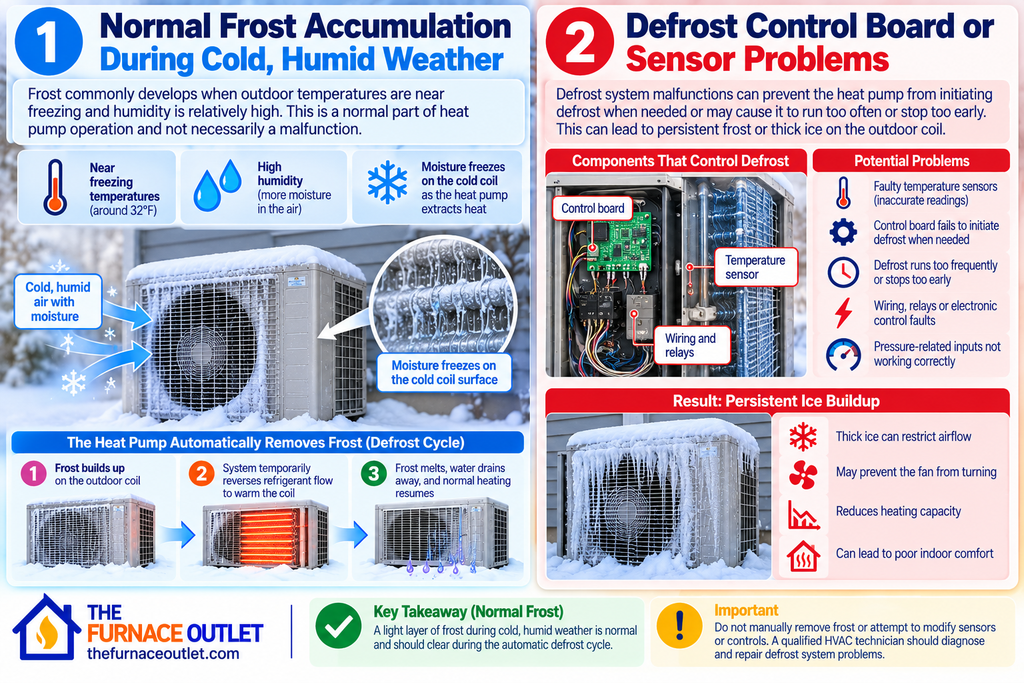
Defrost system malfunctions are among the important causes of persistent outdoor coil icing. Depending on the equipment, defrost operation may be controlled by temperature sensors, operating-time information, pressure-related inputs, or more advanced demand-based algorithms.
If a sensor provides inaccurate information or the control system fails to initiate defrost when necessary, frost can continue accumulating. Eventually, thick ice may restrict airflow and reduce heating capacity.
Some systems may also initiate defrost too frequently or terminate the cycle before the coil has been adequately cleared. These problems can involve sensors, wiring, electronic controls, or other components associated with the defrost sequence.
Homeowners should not attempt to bypass sensors or manually manipulate electrical controls. A qualified technician can evaluate the manufacturer’s defrost sequence, sensor readings, and operating conditions to identify the underlying fault.
For a more detailed explanation, see our related guide, Heat Pump Defrost Cycle Explained: What’s Normal and What’s Not? (2026).
Outdoor airflow is essential because the heat pump must move sufficient air across its heat exchanger to absorb thermal energy. When airflow becomes restricted, equipment performance can decline, and abnormal frost or ice accumulation may develop.
Common obstructions include fallen leaves, windblown debris, snowdrifts, vegetation, and objects placed too close to the outdoor unit. Equipment installed in confined locations may also experience airflow recirculation or inadequate clearance.
Homeowners can safely inspect the surrounding area and remove loose debris or snow from accessible ground surfaces while following manufacturer clearance requirements. Avoid touching the coil fins, reaching into the fan compartment, or using sharp tools around the equipment.
If the coil remains heavily frozen after surrounding obstructions are cleared, professional evaluation is appropriate. Airflow restrictions may be only one contributor to the problem.
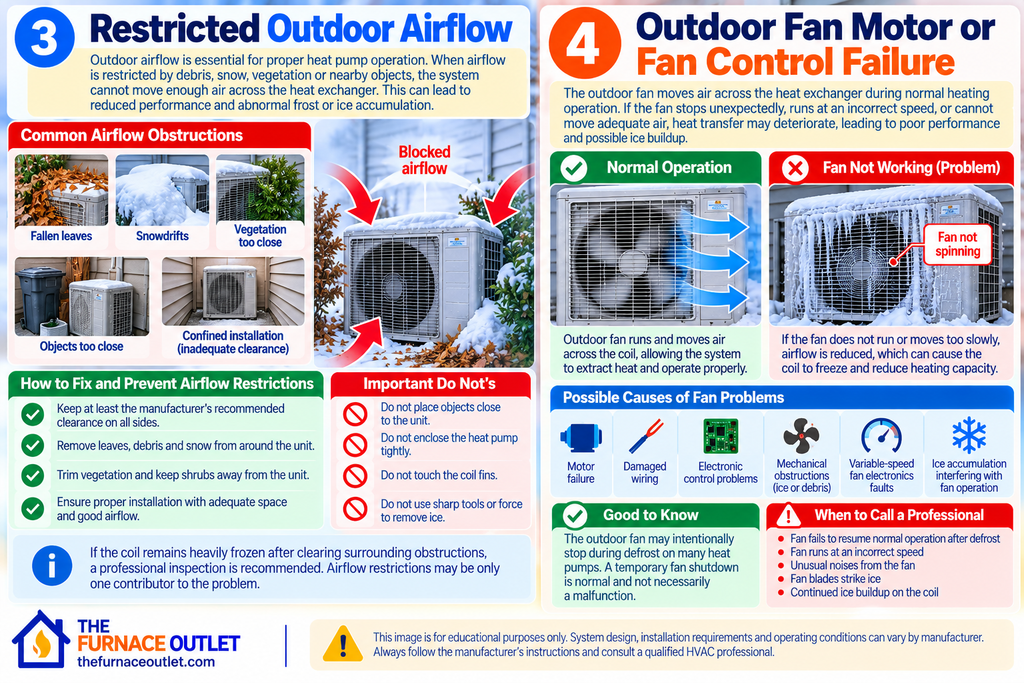
The outdoor fan moves air across the heat exchanger during normal heating operation. If the fan stops unexpectedly, runs at an incorrect speed, or cannot move adequate air, heat transfer may deteriorate.
Possible causes include motor failure, damaged wiring, electronic control problems, mechanical obstructions, or faults involving variable-speed fan electronics. Ice accumulation itself can also interfere with fan operation, creating a cycle in which inadequate airflow contributes to further freezing.
Remember that the outdoor fan may intentionally stop during defrost on many heat pumps. A temporary fan shutdown is therefore not necessarily a malfunction.
The concern arises when the fan fails to resume normal operation after defrost, makes unusual noises, or strikes accumulated ice. In these situations, stop operation when safe and arrange qualified service rather than attempting to reach into the fan housing.
Refrigerant is responsible for absorbing and releasing thermal energy as it circulates through the heat pump. A properly operating system uses a specified refrigerant charge within a sealed refrigeration circuit.
If refrigerant leaks from the system, operating pressures, temperatures, and heating performance may change. Under certain conditions, refrigeration problems can contribute to abnormal outdoor coil temperatures or interfere with normal frost management.
However, heavy icing does not automatically prove that refrigerant is low. Defrost faults, airflow restrictions, sensor problems, and other mechanical issues can produce similar symptoms. A qualified technician should evaluate the equipment against manufacturer operating specifications, identify leaks when appropriate, and perform approved repairs.
The EPA’s Section 608 technician certification guidance explains requirements associated with regulated refrigerant servicing in the United States. I discourage homeowners from attempting refrigerant top-ups or connecting gauges without appropriate training.
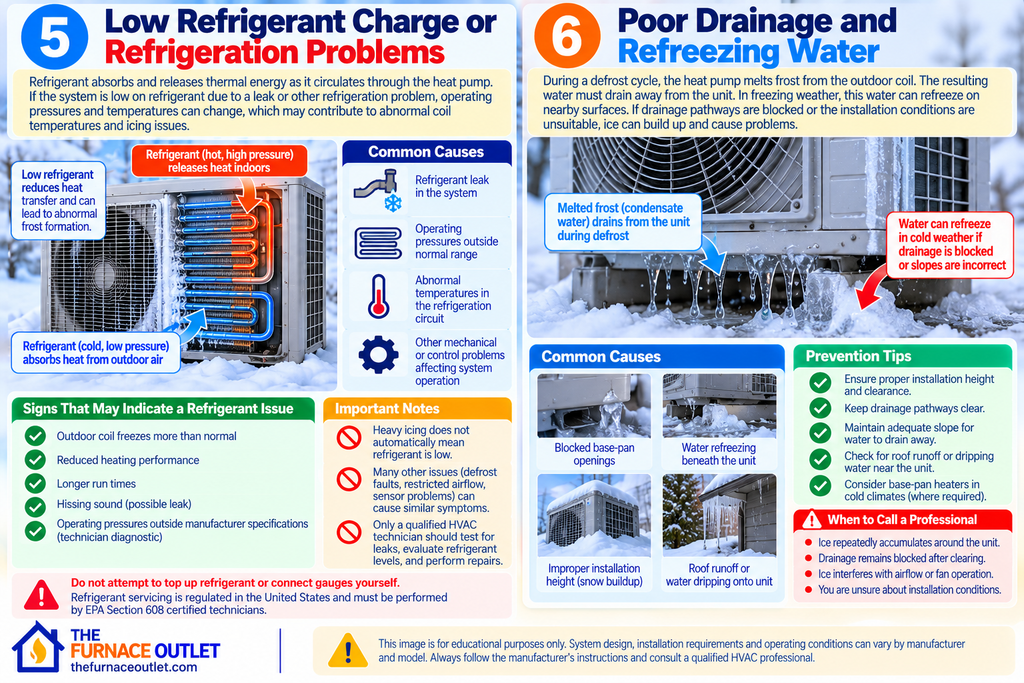
When a heat pump completes a defrost cycle, melted frost must drain away from the outdoor coil and cabinet. During freezing weather, that water may refreeze on nearby surfaces. If drainage pathways are obstructed, water may accumulate inside the unit or beneath it. Repeated freezing can eventually create ice formations that interfere with airflow, fan operation, or equipment components.
Improper installation height, blocked base-pan openings, unsuitable drainage arrangements, and roof runoff can contribute to these problems. Some cold-climate heat pumps use base-pan heaters or other drainage-related features designed for freezing conditions. Whether such equipment is necessary depends on the model and installation environment.
I recommend checking for obvious drainage obstructions from a safe location and arranging professional evaluation if ice repeatedly accumulates around the cabinet or moving components.
Heat pumps installed in snowy climates require careful consideration of equipment height, clearance, and exposure to surrounding conditions. A unit positioned too close to the ground may become obstructed by accumulated snow or ice.
Roof runoff, melting snow from gutters, and drifting snow can also create repeated freezing problems. Water dripping onto the outdoor coil or fan compartment may refreeze and produce ice that the normal defrost sequence cannot adequately manage. Equipment placement matters because a heat pump must maintain access to outdoor air while allowing defrost water to drain away.
Homeowners should avoid enclosing the outdoor unit tightly or covering it during operation. Any protective shelter must comply with the manufacturer’s airflow and clearance requirements. If freezing repeatedly results from installation conditions, a qualified contractor may recommend changes to drainage, mounting height, or equipment placement.
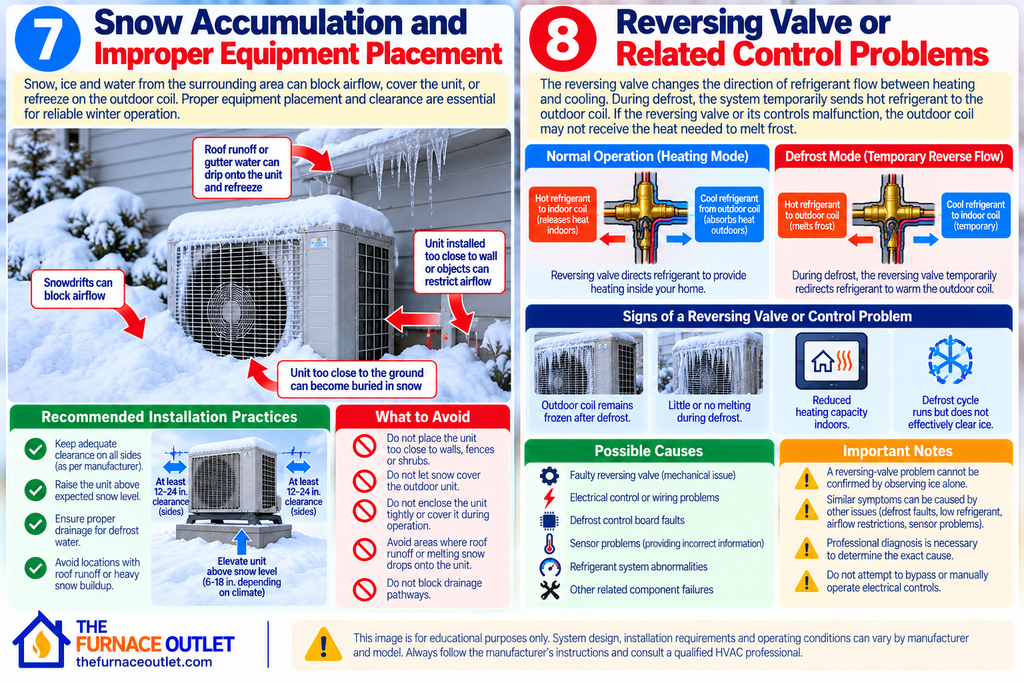
Many heat pumps use a reversing valve to change refrigerant flow direction between heating and cooling. During a conventional reverse-cycle defrost sequence, the system temporarily redirects heat toward the outdoor coil.
If the reversing valve or associated controls malfunction, the equipment may fail to deliver the required heat to the outdoor coil during defrost. This can prevent frost from melting properly. Possible causes include electrical control faults, wiring problems, valve-related mechanical issues, or other refrigeration system abnormalities.
A reversing-valve problem cannot be confirmed by observing ice alone. Similar symptoms may result from faulty sensors, inadequate refrigerant performance, or incorrect defrost control operation. Professional diagnosis is necessary to determine whether the valve itself is defective or another component is preventing normal operation.
Outdoor heat exchangers can accumulate dirt, leaves, pollen, and other environmental debris over time. These deposits may interfere with airflow and heat transfer, particularly when they become concentrated around coil surfaces.
Restricted heat transfer can affect operating conditions and contribute to poor winter performance. In some cases, contamination may worsen frost-related problems. However, not every dirty-looking coil requires aggressive cleaning, and visible debris does not establish the exact cause of persistent freezing. Homeowners can keep the surrounding area clear and remove loose debris without contacting delicate coil surfaces. More extensive coil cleaning should follow manufacturer-approved procedures and may require professional service.
I recommend including outdoor coil inspection in routine maintenance before the heating season begins.
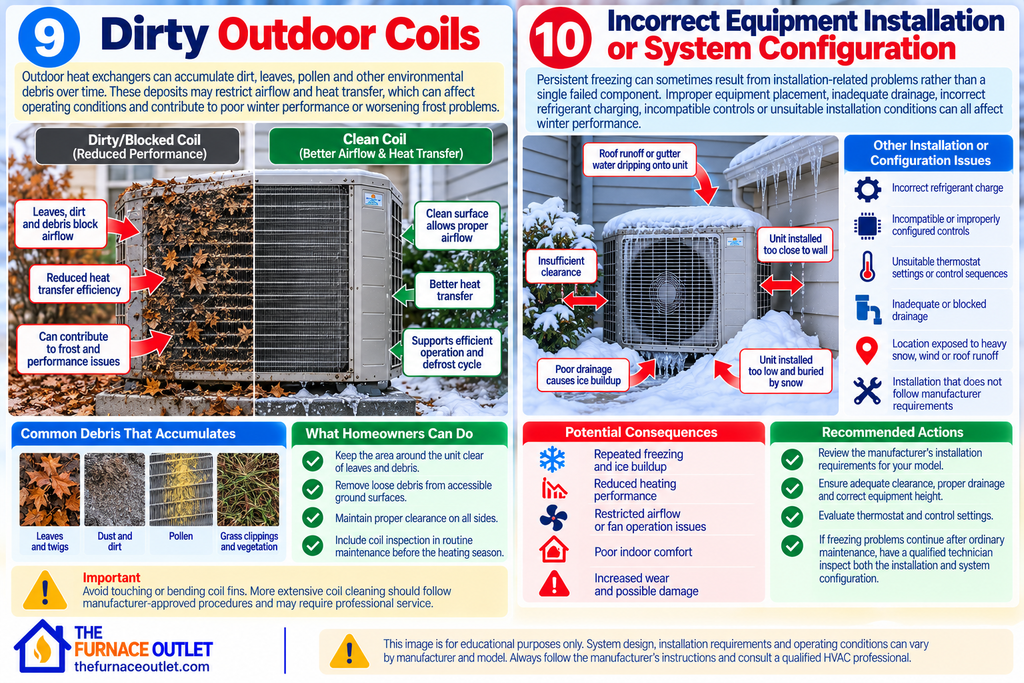
Persistent freezing sometimes results from installation-related problems rather than a single failed component. Improper equipment clearance, inadequate drainage, incorrect refrigerant charging, incompatible controls, or unsuitable installation conditions can affect winter performance.
For example, a unit installed where snow repeatedly blocks the coil may struggle despite functioning defrost controls. Similarly, an improperly configured thermostat or control system may interfere with the intended operating sequence. A technician should evaluate installation conditions alongside mechanical performance when freezing problems recur after ordinary maintenance.
Before replacing equipment, I recommend reviewing the manufacturer’s installation requirements and determining whether the existing system was installed and configured appropriately for the local climate.
If your outdoor heat pump is heavily frozen, the safest approach is to avoid forcing ice removal. Heat exchanger fins, refrigerant tubing, fan blades, and electrical components can be damaged by aggressive cleaning or improper heating methods.
Begin by observing whether the equipment is undergoing a normal defrost cycle. Light frost may clear automatically without homeowner intervention. If thick ice persists, the fan contacts ice, or heating performance declines significantly, stop operation when safe and contact a qualified HVAC technician. If your system has emergency heating, use it only according to manufacturer instructions or professional guidance.
Never chip ice with tools, pour boiling water onto the coil, use an open flame, or bypass defrost controls. These actions can damage equipment or create serious safety hazards. A technician should identify the cause of the freezing rather than simply remove visible ice and return the equipment to service.
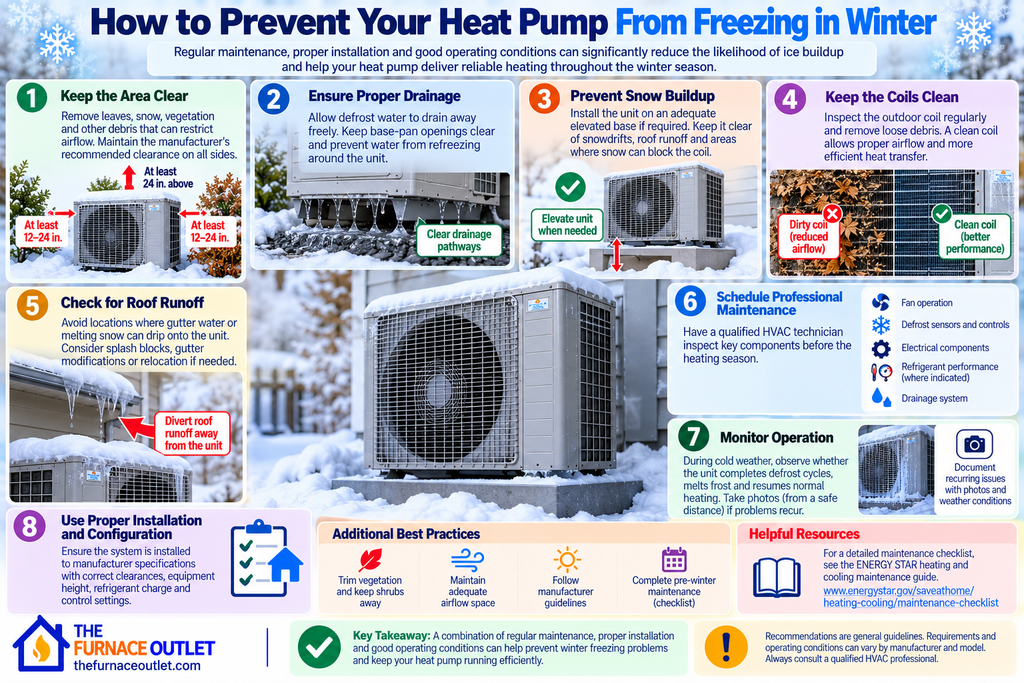
Preventive maintenance can reduce the likelihood of recurring ice accumulation and unexpected heating failures. Homeowners should keep outdoor equipment clear of leaves, snow, vegetation, and other obstructions while maintaining manufacturer-specified airflow clearances.
Drainage conditions deserve particular attention. Meltwater should be able to leave the unit without repeatedly refreezing around critical components. If roof runoff or drifting snow affects the equipment, a contractor may need to evaluate the installation arrangement. Professional maintenance should include inspection of the outdoor coil, fan operation, defrost sensors, electrical controls, refrigerant performance where indicated, and drainage components.
The ENERGY STAR heating and cooling maintenance checklist provides practical guidance on routine HVAC servicing. I also recommend documenting recurring freezing problems, including outdoor weather conditions, photographs taken from a safe distance, and whether the equipment successfully completes defrost cycles. This information can help a technician identify patterns that are difficult to reproduce during a service visit.
The outdoor coil can operate below the surrounding air temperature. Consequently, moisture may freeze on the coil even when outdoor air is slightly above freezing.
A light frost layer can be normal during cold, humid conditions. Thick ice that persists, restricts airflow, or interferes with fan operation requires investigation.
Defrost duration varies by manufacturer, equipment design, and operating conditions. A normal cycle should remove frost and allow the system to resume heating according to its intended sequence.
I do not recommend pouring hot or boiling water onto frozen equipment. Rapid temperature changes and improper water application can damage components or create electrical and refreezing hazards.
Refrigerant-related problems can contribute to abnormal operating conditions and icing, but frost alone cannot confirm a refrigerant leak or low charge. Professional diagnosis is required.
Light frost that clears during normal defrost does not generally require shutdown. Heavy persistent ice, fan interference, electrical symptoms, or declining heating performance warrant professional attention and may require stopping operation when safe.
When homeowners tell me their heat pump is freezing during winter, I first determine whether they are seeing ordinary frost or a genuine ice accumulation problem. A properly functioning heat pump may develop frost under cold, humid conditions, but its automatic defrost system should remove that frost and allow normal heating to continue.
Persistent ice is a different situation. It may indicate problems involving defrost controls, airflow, drainage, refrigerant performance, fan operation, or installation conditions. Rather than assuming the system needs more refrigerant or a new control board, I recommend identifying the actual cause through appropriate testing.
My preferred approach combines safe homeowner observations with professional diagnosis when symptoms persist. Keeping outdoor airflow clear, maintaining drainage, scheduling regular inspections, and addressing abnormal operation early can help protect heating performance throughout winter.
The goal is not to eliminate every trace of frost, but to ensure that the heat pump removes frost effectively, maintains indoor comfort, and operates safely during cold weather.
This article is published by The Furnace Outlet for general educational purposes only. It does not replace professional HVAC diagnosis, manufacturer instructions, or applicable safety requirements. Electrical testing, refrigerant servicing, defrost control repairs, and internal equipment modifications should be performed by appropriately qualified professionals. Heat pump performance varies by climate, equipment design, installation quality, and operating conditions. The Furnace Outlet publishes independent educational content, and references to external organizations do not imply affiliation or endorsement.
© 2026 The Furnace Outlet. All rights reserved.