Newsletter Subscribe
Enter your email address below and subscribe to our newsletter

HVAC made simple
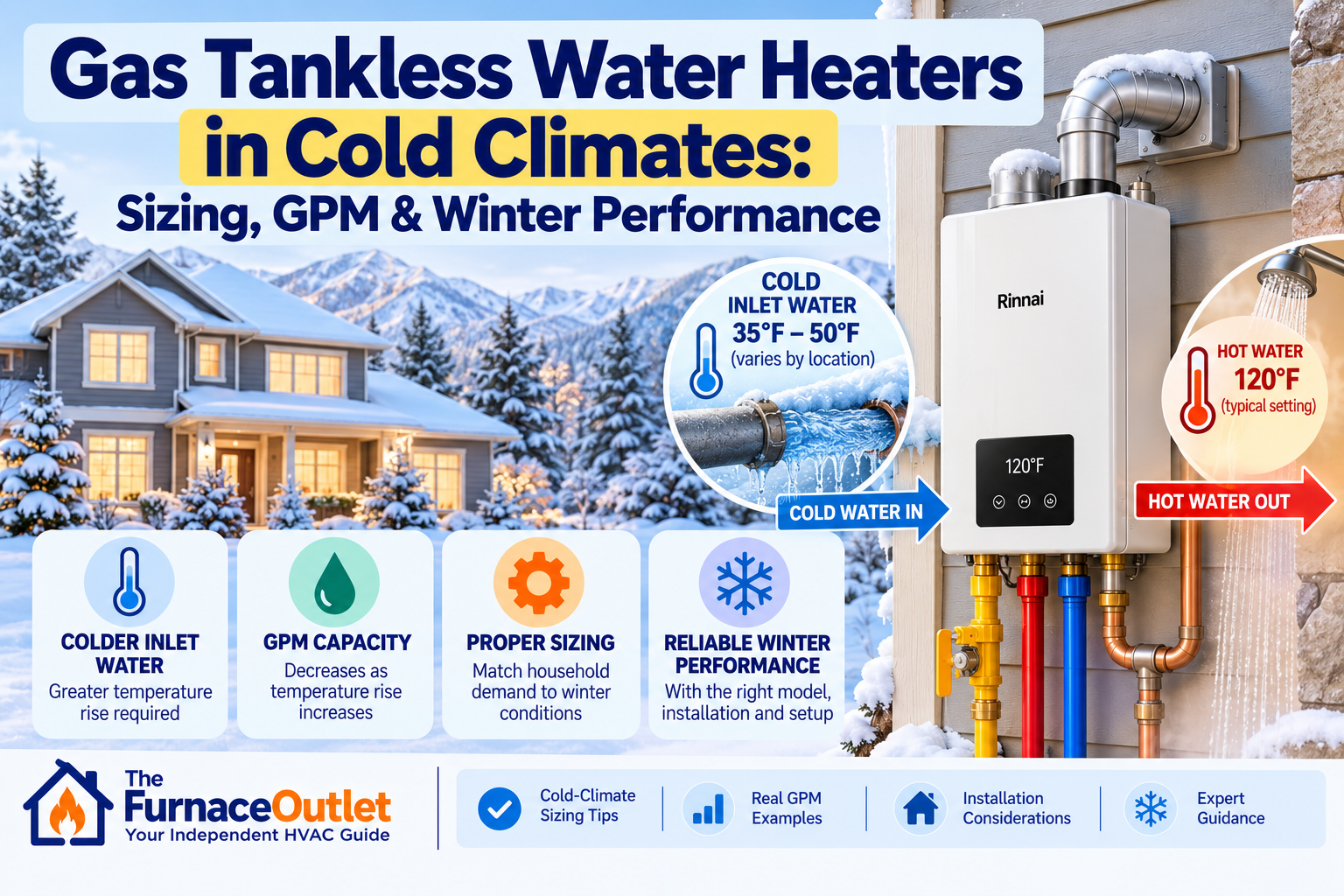
Gas tankless water heaters can work extremely well in cold climates, but winter performance depends much more heavily on correct sizing than it does in warmer regions. The reason is simple: a tankless heater must raise incoming water to the desired outlet temperature in real time. When groundwater becomes colder, the heater has to add more heat to every gallon passing through it, and the maximum gallons per minute it can deliver decreases.
This is why I would never select a tankless water heater for a cold-climate home simply because the product page says “11 GPM” or “199,000 BTU.” That maximum GPM figure is normally associated with a relatively small temperature rise. What matters in winter is how many GPM the heater can produce at the home’s actual winter temperature rise. DOE guidance follows the same principle, recommending that tankless sizing be based on maximum required flow and the maximum temperature rise from incoming water to the desired outlet temperature.
For a cold-climate installation, my sizing sequence would therefore be straightforward: determine the coldest realistic incoming-water temperature, choose the desired outlet temperature, calculate the required temperature rise, estimate simultaneous hot-water demand, and then verify that demand against the manufacturer’s published flow-versus-temperature-rise table.
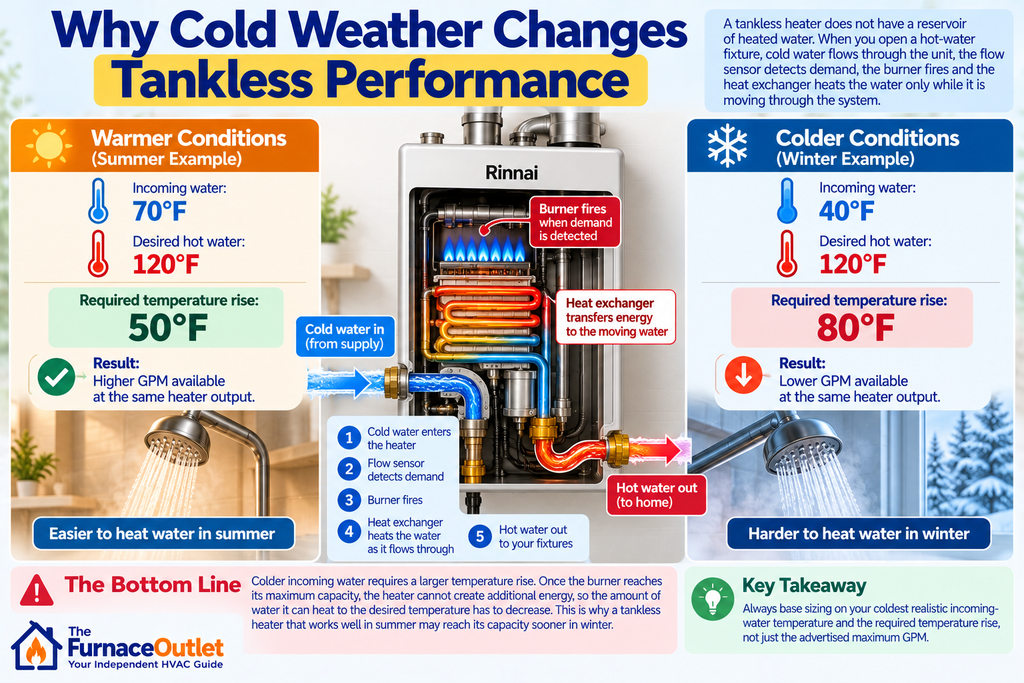
A tankless heater does not have a reservoir of already heated water waiting for you. When a shower starts, cold water enters the heater, a flow sensor detects demand, the burner fires and the heat exchanger transfers energy into the moving water. The heater has only the short period during which that water passes through the heat exchanger to raise it to the desired temperature. DOE describes gas tankless operation in essentially this way: water flow activates the burner, the heat exchanger heats the incoming water, and energy is consumed only while hot water is being demanded.
Suppose incoming water is 70°F and you want 120°F hot water. The required temperature rise is only 50°F. If winter groundwater falls to 40°F, the same heater must now produce an 80°F temperature rise to deliver 120°F water.
That extra 30°F makes a substantial difference. Once the burner reaches its maximum heating capacity, the heater cannot simply create additional energy. Instead, the amount of water it can heat to the desired temperature has to decrease. This is why a tankless heater that comfortably serves several fixtures during summer may reach its capacity sooner during winter.
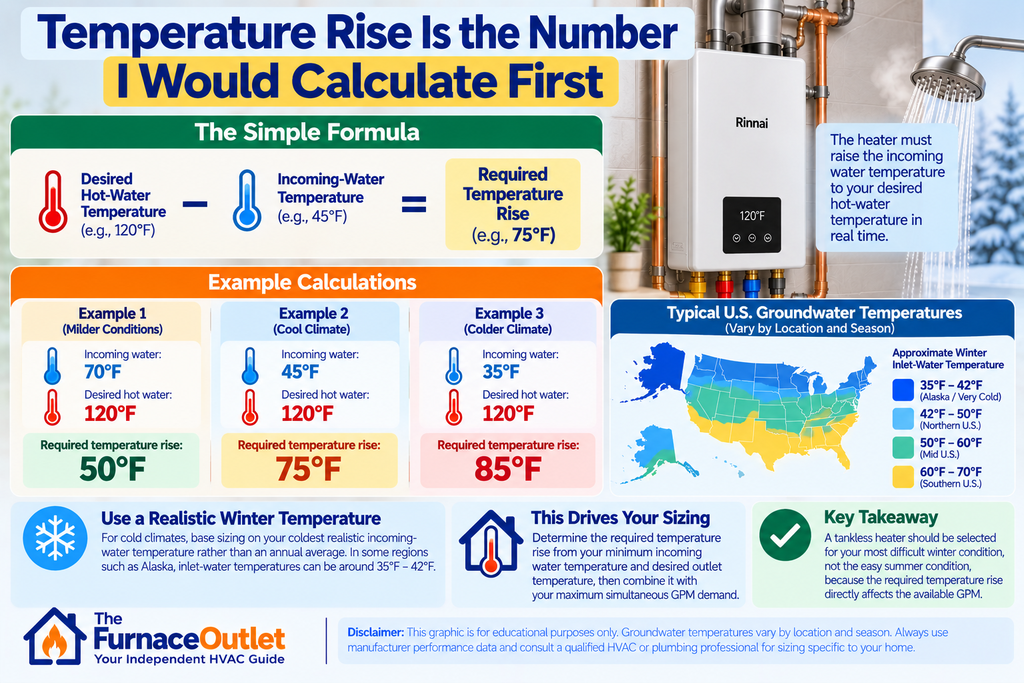
The basic calculation is uncomplicated: desired hot-water temperature minus incoming-water temperature equals required temperature rise. If incoming water is 45°F and the heater is set to 120°F, the required rise is 75°F. If incoming water is 35°F, the required rise becomes 85°F. DOE’s tankless sizing guidance specifically recommends determining maximum temperature rise from the minimum incoming-water temperature and desired outlet temperature and then combining that information with maximum simultaneous flow demand.
For cold climates, I would use a realistic winter inlet-water temperature rather than an annual average. Rinnai’s groundwater-temperature guidance illustrates how dramatic regional differences can become, showing approximately 35–42°F inlet-water conditions for Alaska and noting that actual inlet temperatures can vary with location and season.
This is one of the most important distinctions between warm- and cold-climate tankless sizing. A heater should be selected for the difficult winter condition rather than the easy summer condition.
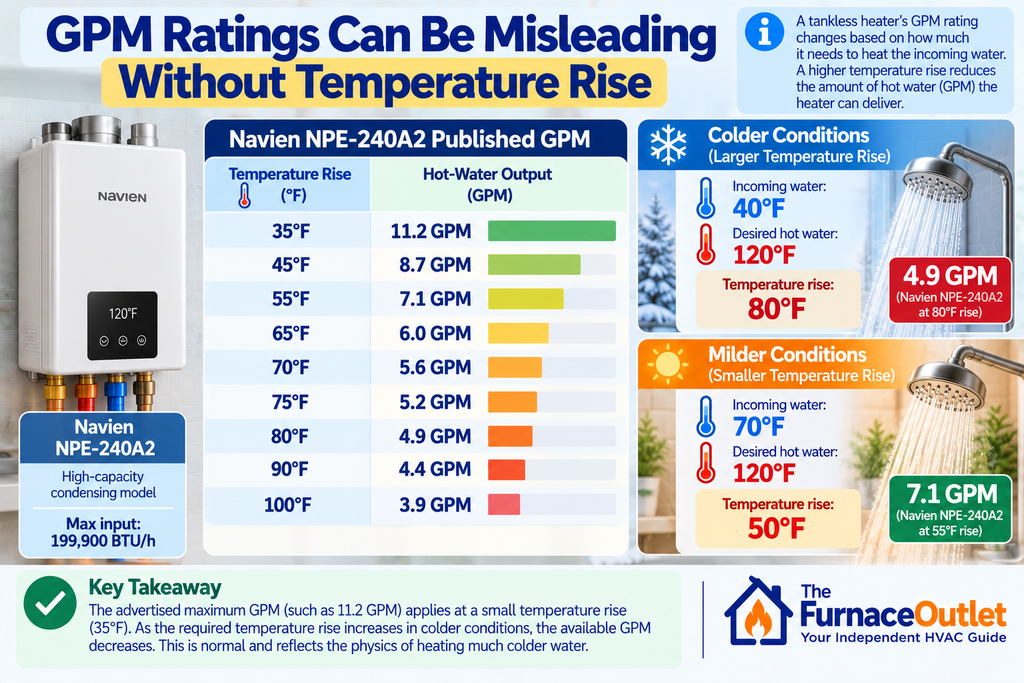
When manufacturers advertise a tankless heater at 10, 11 or even more gallons per minute, that number needs context. Maximum flow changes according to the amount of heating required.
The Navien NPE-240A2 provides an excellent real-world example. It is a high-capacity condensing model with a maximum burner input of 199,900 BTU/h. Navien publishes 11.2 GPM at a 35°F temperature rise, which sounds enormous. However, the same manufacturer’s performance table shows 7.1 GPM at a 55°F rise, 5.6 GPM at a 70°F rise, 4.9 GPM at an 80°F rise and 4.4 GPM at a 90°F rise.
| Temperature Rise | Navien NPE-240A2 Published Flow |
|---|---|
| 35°F | 11.2 GPM |
| 45°F | 8.7 GPM |
| 55°F | 7.1 GPM |
| 65°F | 6.0 GPM |
| 70°F | 5.6 GPM |
| 75°F | 5.2 GPM |
| 80°F | 4.9 GPM |
| 90°F | 4.4 GPM |
| 100°F | 3.9 GPM |
That table explains cold-climate tankless performance better than almost any advertised maximum-GPM number. At an 80°F rise, this nearly 200,000-BTU/h heater delivers less than half its published 11.2-GPM maximum. That does not indicate poor performance; it reflects the physics of heating much colder water.
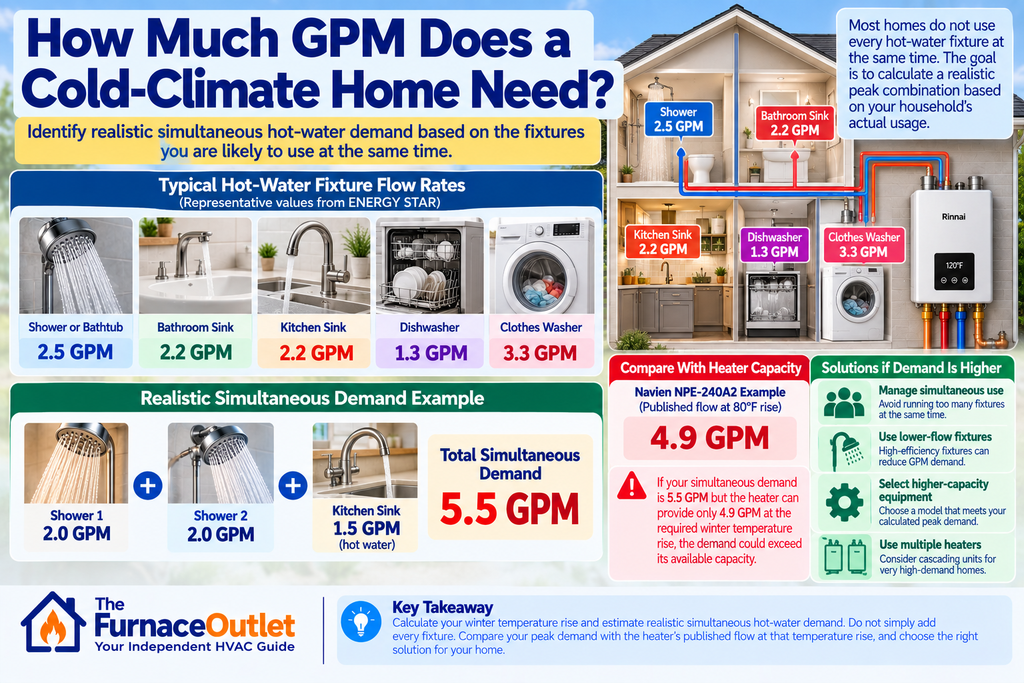
Once I know the winter temperature rise, I would calculate realistic simultaneous hot-water demand. ENERGY STAR notes that tankless heaters are rated according to how many gallons of hot water they can produce per minute and that households likely to operate multiple hot-water fixtures simultaneously need greater capacity. Its consumer guidance uses representative figures of about 2.5 GPM for a shower or bathtub, 2.2 GPM for kitchen and bathroom sinks, 1.3 GPM for a dishwasher and 3.3 GPM for a clothes washer.
I would not simply add every fixture in the house because most homes do not operate every hot-water fixture simultaneously. Instead, I would identify realistic peak combinations. Two 2.0-GPM showers running together represent approximately 4 GPM. Add a kitchen sink using another 1.5 GPM of hot water and the simultaneous demand could approach 5.5 GPM. If the heater can provide only about 4.9 GPM at the required winter temperature rise, that combination could exceed its available capacity.
The solution is not necessarily to abandon tankless technology. The household may be able to manage simultaneous demand, use lower-flow fixtures, select equipment with greater capacity or, in unusually demanding applications, use multiple heaters.
Imagine a home where winter inlet water reaches 40°F and the desired outlet temperature is 120°F. The required temperature rise is therefore 80°F. Now assume two showers could operate simultaneously at approximately 2.0 GPM each while another hot-water fixture contributes 1.0 GPM. Peak demand would be approximately 5 GPM.
Using Navien’s published NPE-240A2 table as an example, the heater provides approximately 4.9 GPM at an 80°F rise. That puts our hypothetical 5-GPM demand almost exactly at the heater’s published capacity under those conditions.I would consider that a much more meaningful sizing analysis than saying, “This is an 11.2-GPM water heater, so 5 GPM will be easy.” The 11.2-GPM rating applies at a much smaller 35°F temperature rise.
If winter inlet water instead reached 30°F while the desired outlet remained 120°F, the required rise would become 90°F. Navien’s published flow at that condition is approximately 4.4 GPM, making the same 5-GPM household demand too high for one unit at that temperature rise.
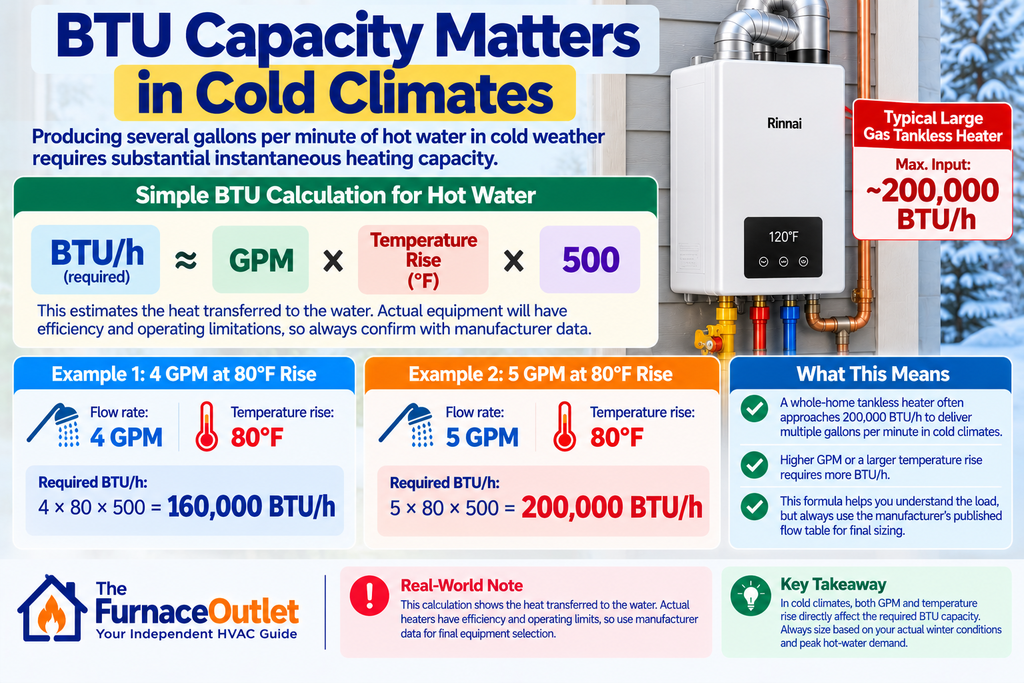
A large whole-home gas tankless heater commonly approaches 200,000 BTU/h maximum burner input because producing several gallons of hot water per minute requires substantial instantaneous heating capacity. The relationship can be understood with a useful approximation for heat transferred to water: BTU/h ≈ GPM × temperature rise × 500. If the target is 4 GPM at an 80°F rise, the water requires roughly 4 × 80 × 500, or 160,000 BTU/h of useful heat transfer.
At 5 GPM and an 80°F rise, the theoretical heat transferred to the water rises to approximately 200,000 BTU/h. Real equipment also has efficiency and operating limitations, which is why I would use this formula to understand the load rather than to replace manufacturer performance data.
The manufacturer’s published flow table remains my final authority when choosing equipment.
Rinnai’s RX199iN illustrates the same point from another direction. Rinnai lists the unit with a maximum domestic hot-water flow of 11.1 GPM, a maximum input around 199,000 BTU/h and a 0.98 UEF rating. Rinnai also publishes groundwater-based sizing information showing how available flow decreases in colder regions. Its RX-series groundwater guidance lists approximately 4.6 GPM at 35°F incoming water for the 199,000-BTU RX199iN/RXP199iN sizing example.
The lesson is not that one manufacturer’s heater is better than another based on those isolated figures, because test conditions and outlet-temperature assumptions need to be compared carefully. The lesson is that the large GPM number printed near the top of a product page should never be treated as guaranteed winter output.
Often yes, but I would calculate it rather than assume it. Two modern showers at approximately 2.0 GPM each create about 4 GPM of total water flow. Depending on mixing at the shower valve, the actual hot-water flow through the heater may be somewhat lower than the total fixture flow, but conservative sizing is sensible.
A large gas tankless heater capable of roughly 4.5–5 GPM at a severe winter temperature rise may handle those showers successfully. Add a bathtub, dishwasher or another shower simultaneously, however, and the load can exceed a single heater’s capacity.
For a household that routinely uses several high-flow fixtures simultaneously, I would design around that actual lifestyle rather than expecting family members to schedule hot-water use around an undersized appliance.
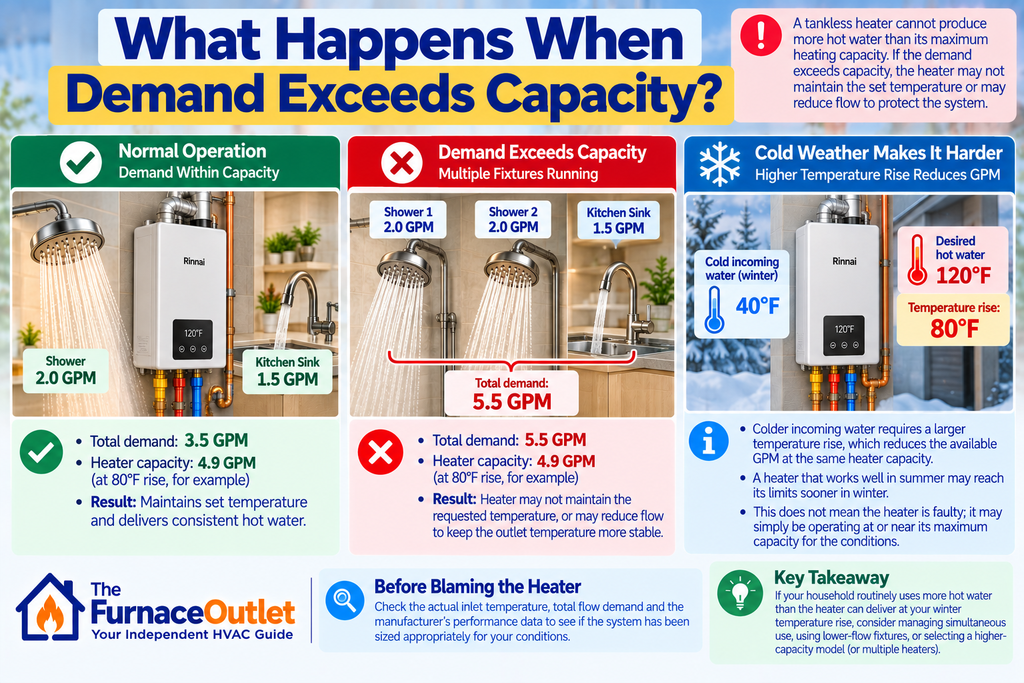
A properly controlled tankless heater does not magically exceed its burner capacity. Depending on the appliance and conditions, excessive flow can result in an inability to maintain the requested outlet temperature, or sophisticated equipment may manage water flow to help maintain the setpoint.
This is why homeowners sometimes report that a tankless heater performs perfectly most of the year but seems less capable during extremely cold weather. The appliance may be operating correctly; the winter temperature rise has simply pushed the system closer to its maximum heating capacity. Before blaming the heater, I would compare actual inlet temperature, flow demand and manufacturer performance data.
For many cold-climate whole-home applications, I would lean toward a high-efficiency condensing gas tankless heater. ENERGY STAR explains that certified condensing tankless heaters use a secondary heat exchanger to recover additional energy from combustion gases and use approximately 9% less energy than conventional gas tankless equipment.
That additional efficiency is particularly appealing where substantial amounts of energy are required to raise very cold incoming water to household temperatures. However, higher efficiency does not create unlimited capacity. A 0.95 or 0.98 UEF heater can still be undersized if simultaneous GPM demand exceeds its performance at the required winter temperature rise. I would therefore evaluate capacity first and efficiency second among models capable of satisfying the load.
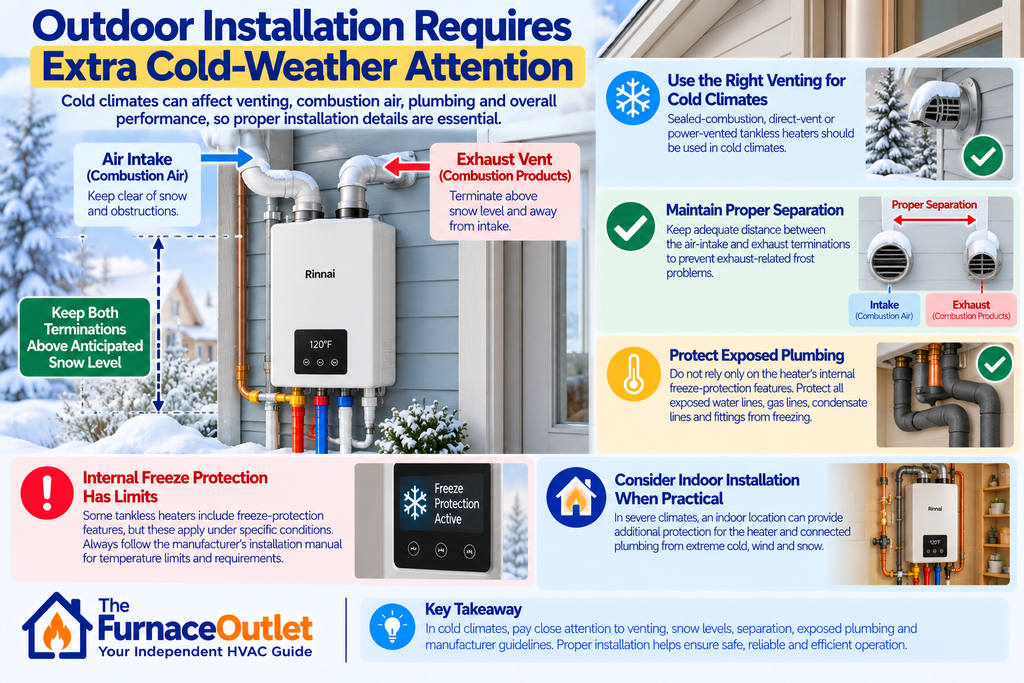
Cold climates also influence where I would install the heater. DOE’s Building Science Education guidance states that sealed-combustion, direct-vent or power-vented equipment should be used in cold climates and notes that air-intake and exhaust terminations need to remain sufficiently above anticipated snow levels, with proper separation to help prevent frost problems.
Some tankless heaters incorporate freeze-protection features, but I would never interpret internal freeze protection as permission to ignore exposed plumbing, condensate lines, vent terminations or manufacturer temperature limitations. Rinnai documentation for certain current equipment, for example, specifies internal freeze-protection capability under defined conditions, but the exact installation manual must govern how that protection applies.
In severe climates, I generally prefer an appropriate indoor installation when practical because the heater and connected plumbing receive additional protection from extreme outdoor conditions.
Cold-climate performance is not limited to water temperature. Snow accumulation, drifting snow and frost can interfere with combustion-air intake or exhaust if an installation is poorly located.
This is particularly important with direct-vent equipment because the heater needs reliable combustion airflow as well as a clear path for exhaust gases. DOE specifically highlights locating intake and exhaust terminations above anticipated snow level and preventing exhaust-related frost accumulation at the intake. I would therefore treat vent termination as part of winter-system design rather than merely an installation detail.
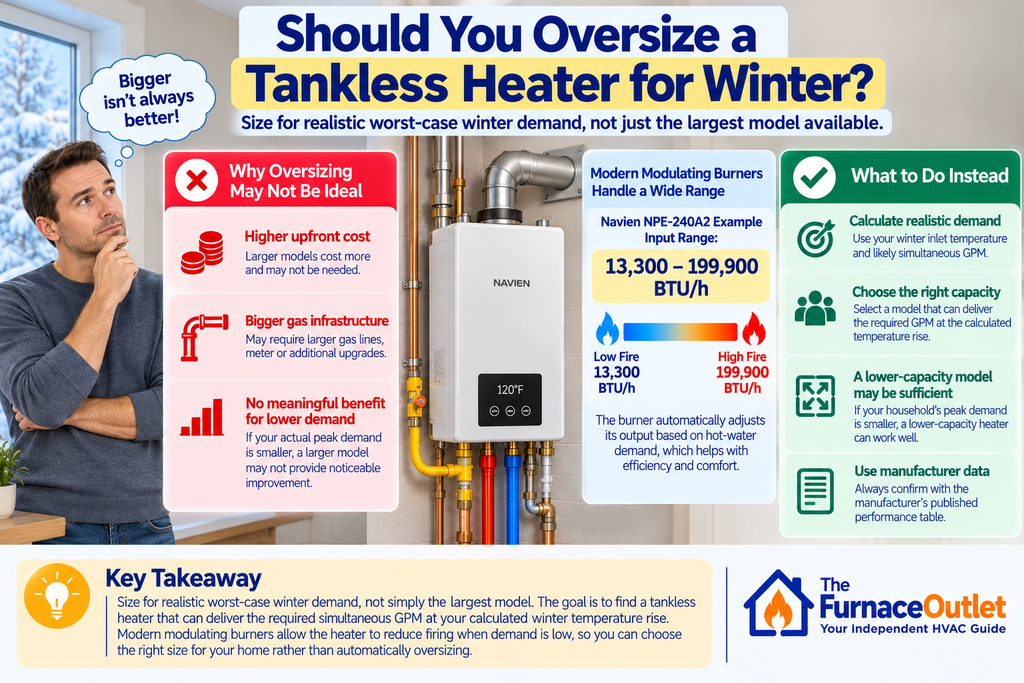
I would size for realistic worst-case winter demand, but I would not automatically buy the largest appliance available without doing the calculation. Oversizing can add equipment cost and potentially increase gas-infrastructure requirements without providing meaningful benefit.
The objective is to find equipment capable of delivering the required simultaneous GPM at the calculated winter temperature rise. If that requires a 199,000-BTU/h model, that is a legitimate reason to select one. If the household’s actual peak demand is much smaller, a lower-capacity heater may be perfectly appropriate.
Modern modulating burners can operate across a range of outputs. Navien’s NPE-240A2, for example, lists an input range from 13,300 to 199,900 BTU/h, allowing the heater to reduce firing substantially when demand is low.
Large homes, luxury showers, multiple bathrooms or commercial-style hot-water demands can exceed what a single residential tankless heater can provide during severe winter conditions. Multiple tankless heaters can be installed in cascading arrangements for applications requiring substantially greater flow. Navien, for example, publishes commercial cascading configurations using multiple 199,900-BTU/h units to satisfy high-demand applications.
For an ordinary household, however, I would first examine whether the apparent need for multiple heaters comes from unrealistic assumptions about simultaneous usage. Proper fixture-flow measurements and realistic peak-demand analysis can prevent unnecessary equipment expense.
Before purchasing a gas tankless heater for a cold region, I would establish the home’s lowest realistic winter inlet-water temperature and desired outlet temperature, calculate the resulting temperature rise, identify realistic simultaneous fixture use and total GPM, and then check the exact manufacturer’s flow table at that temperature rise. I would also verify maximum burner input, gas-supply capacity, modulation range, venting, combustion-air requirements, freeze protection, condensate management for condensing equipment and the proposed location of outdoor terminations.
I would have the installer verify that the gas meter, regulator and piping can supply the heater at maximum firing while accounting for other gas appliances. A 199,000-BTU/h heater cannot deliver its rated winter performance if the gas system cannot provide the required fuel under operating conditions.
Yes. Properly sized gas tankless heaters can perform very well in cold climates. The critical issue is selecting the heater according to winter inlet-water temperature, required temperature rise and simultaneous GPM demand rather than advertised maximum GPM alone. DOE specifically recommends sizing around maximum flow and temperature rise.
That depends on simultaneous hot-water use. Two showers may require roughly 4–5 GPM of total fixture flow, while multiple showers and other appliances can require considerably more. Calculate realistic simultaneous demand and compare it with the heater’s GPM at your winter temperature rise.
The heater has to add more heat to colder incoming water. Once the burner approaches maximum output, less water can be heated to the requested outlet temperature each minute.
It can be sufficient for many homes, but BTU rating alone cannot answer the question. A nearly 200,000-BTU/h Navien NPE-240A2, for example, is published at 4.9 GPM at an 80°F rise and 4.4 GPM at a 90°F rise. The home’s simultaneous demand must be compared with those performance conditions.
I generally favor condensing technology for many cold-climate installations because of its higher efficiency, but it does not eliminate sizing requirements. Capacity at the required winter temperature rise remains the first consideration.
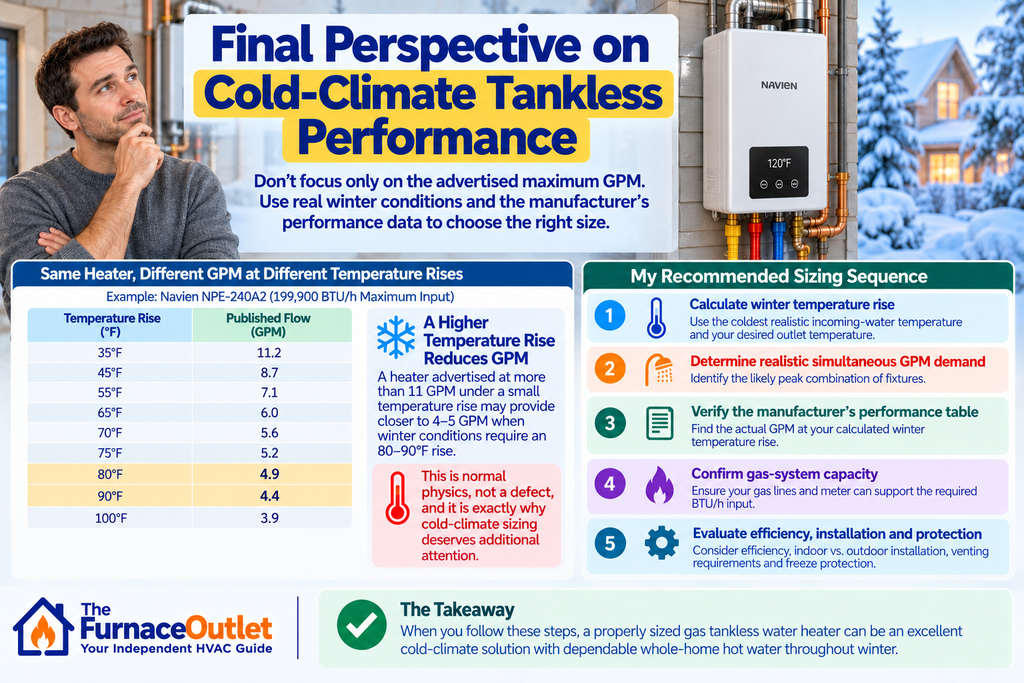
If I were choosing a gas tankless water heater for a cold climate, the first number I would look for would not be the advertised maximum GPM. I would determine the coldest realistic incoming-water temperature, subtract it from the desired outlet temperature and use that temperature rise to find the heater’s actual published winter flow capacity.
The difference can be dramatic. A heater advertised at more than 11 GPM under a small temperature rise may provide closer to 4–5 GPM when winter conditions require an 80–90°F rise. That is normal physics rather than a defect, and it is exactly why cold-climate sizing deserves additional attention. Navien’s current NPE-240A2 data demonstrate this clearly, ranging from 11.2 GPM at a 35°F rise to 4.9 GPM at 80°F and 4.4 GPM at 90°F.
My preferred sequence is therefore to calculate winter temperature rise, determine realistic simultaneous GPM demand, verify the manufacturer’s performance table, confirm gas-system capacity, and then evaluate efficiency, installation location, venting and freeze protection. When those steps are followed, a properly sized gas tankless water heater can be an excellent cold-climate solution with dependable whole-home hot water throughout winter.
For sizing principles and cold-climate installation guidance, see U.S. Department of Energy — Tankless Water Heater Measure Guide and DOE Building Science Education — Gas-Fired Tankless Water Heaters. Consumer capacity guidance is available from ENERGY STAR — Whole-Home Gas Tankless Water Heaters. For current manufacturer performance data, see Navien NPE-240A2 Specifications and Flow Table and Rinnai RX199iN Specifications.
The Furnace Outlet provides this information for general educational purposes. Tankless-water-heater capacity varies by model, incoming-water temperature, setpoint, flow demand, gas supply and installation conditions. Published GPM figures should always be verified against the exact manufacturer’s current performance data and installation instructions. Gas piping, combustion, venting, freeze protection and installation are safety-critical matters and should comply with applicable codes and be handled by appropriately qualified professionals where required.
The Furnace Outlet is an independent informational resource and is not associated with, endorsed by or affiliated with Navien, Rinnai, ENERGY STAR, the U.S. Department of Energy or any manufacturer or organization mentioned. Product names and trademarks remain the property of their respective owners.