Newsletter Subscribe
Enter your email address below and subscribe to our newsletter

HVAC made simple
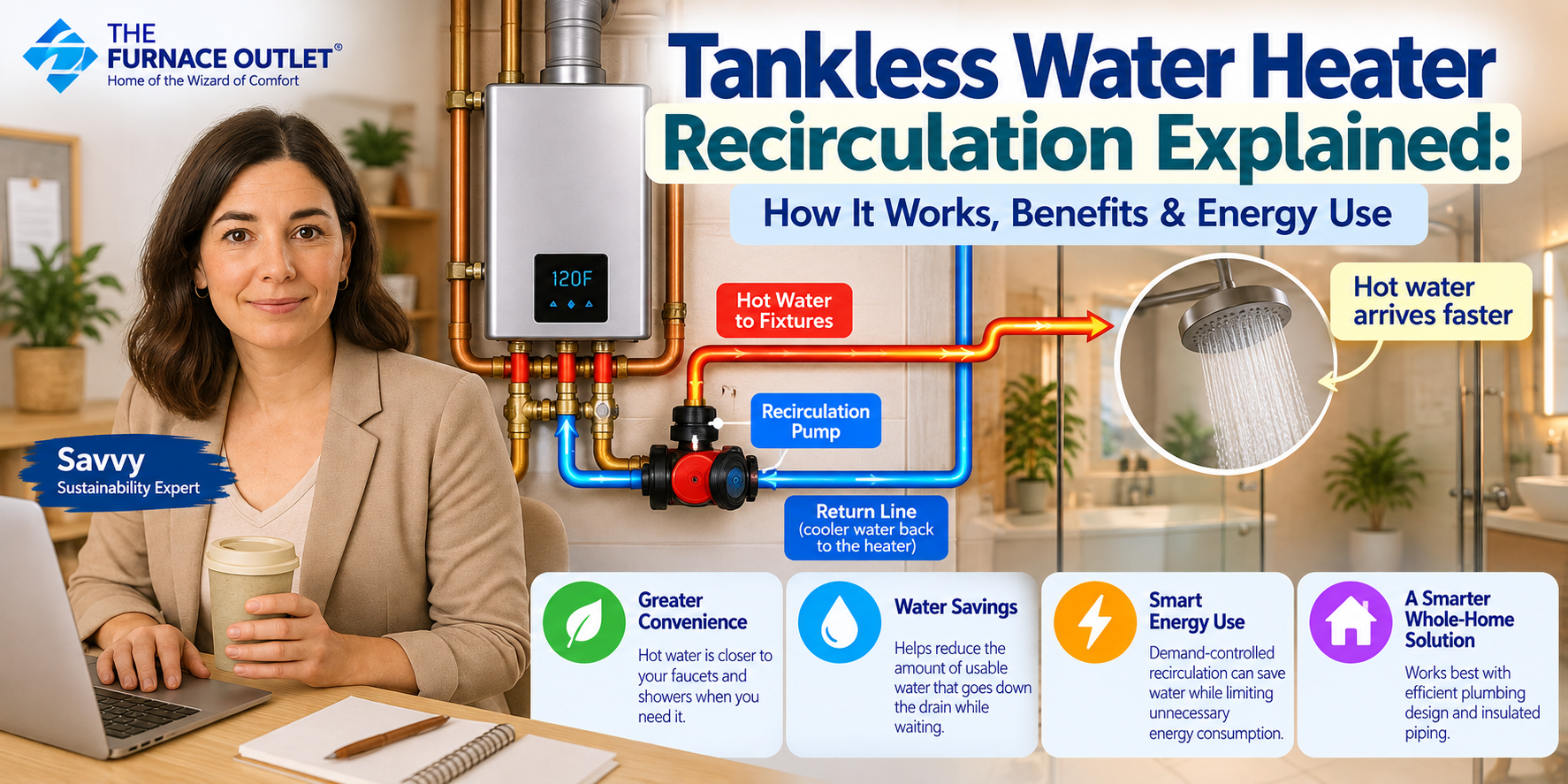
A tankless water heater can produce hot water very quickly, but that does not necessarily mean hot water will appear instantly at every faucet or shower in the home. The heater may begin operating within seconds of detecting water flow, yet the newly heated water still has to travel through the plumbing between the heater and the fixture. If a bathroom is located a considerable distance from the water heater, the cooled water already sitting inside that hot-water pipe must move out before newly heated water reaches the shower. This delay is primarily a hot-water distribution problem rather than a tankless water-heater problem, and a recirculation system is one way to address it.
A properly designed hot-water recirculation system can reduce waiting time and prevent significant quantities of usable water from going down the drain while occupants wait for the water to become hot. From my sustainability perspective, however, recirculation should not simply mean keeping hot water moving around the house continuously. Circulating hot water through pipes that are not being used can increase heat loss and cause the water heater to operate unnecessarily. The most effective approach is therefore to combine efficient plumbing design, insulated piping and an intelligent or demand-controlled recirculation strategy that provides hot water when it is actually needed.
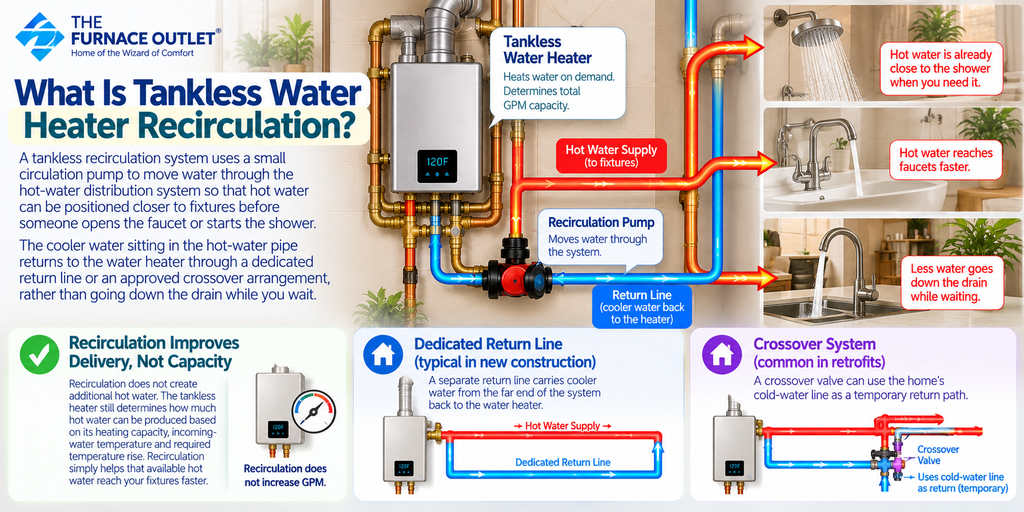
A tankless recirculation system uses a small circulation pump to move water through the hot-water distribution system so that hot water can be positioned closer to fixtures before someone opens the faucet or starts the shower. Depending on the plumbing design, the cooler water sitting in the hot-water pipe can return to the water heater through a dedicated return line or through an approved crossover arrangement that temporarily uses another part of the home’s plumbing as the return path.
The important distinction is that the recirculation system does not create additional hot water. The tankless heater still determines how much hot water can be produced based on its heating capacity, incoming-water temperature and required temperature rise. Recirculation instead addresses how quickly that available hot water reaches the fixture. If a tankless heater is undersized for two simultaneous showers, adding a recirculation pump will not increase its GPM capacity, but if the heater is correctly sized and occupants are simply waiting too long for hot water to reach a distant bathroom, recirculation can provide a meaningful improvement.
The misunderstanding often begins with the phrase “instantaneous water heater,” which describes how the appliance heats water rather than how quickly hot water travels through the house. When a faucet opens, the tankless heater senses sufficient flow and begins transferring heat to the incoming water. The resulting hot water then enters the home’s distribution piping, where it must push the existing cooler water ahead of it before reaching the fixture.
The waiting time depends heavily on pipe length, pipe diameter and the amount of water contained between the heater and the fixture. A long, large-diameter plumbing run contains more water than a short, compact run, so it generally takes longer for newly heated water to arrive. This is why efficient hot-water distribution starts with good plumbing design. EPA WaterSense encourages designs that minimize the volume of water between the hot-water source and fixtures, with its WaterSense Homes guidance using 0.5 gallon or less between the hot-water source and an individual fixture or fixture group as an important efficiency target.
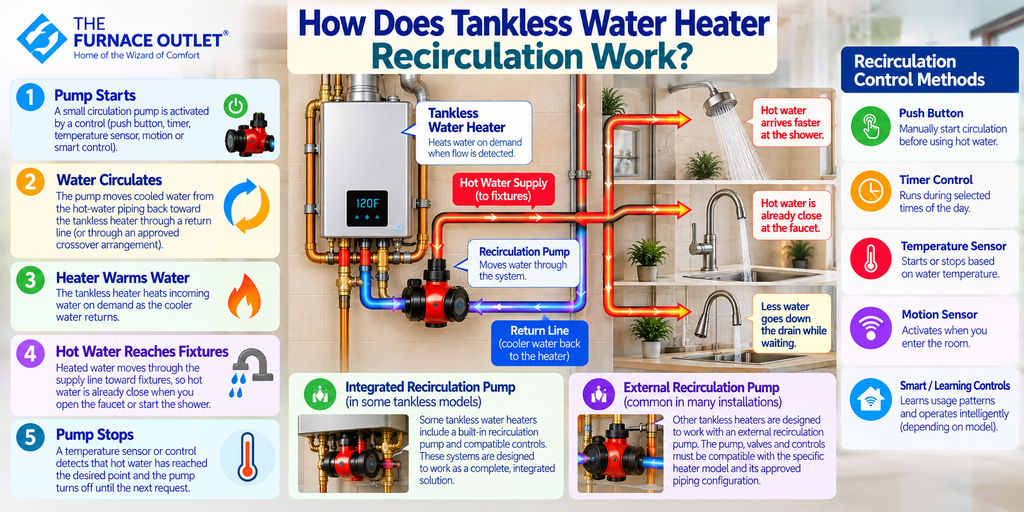
In a typical system, a small pump creates circulation through the hot-water piping. Instead of allowing cooled water to remain in a long hot-water line until somebody opens a faucet and sends that water down the drain, the pump moves the cooler water back toward the heater while heated water moves toward the fixtures. Once sufficiently warm water has reached the appropriate part of the plumbing system, a properly controlled system stops circulating until another hot-water request occurs.
The exact operating method varies considerably among manufacturers and system designs. Some tankless heaters include an integrated recirculation pump, while others are designed to work with an external pump. Controls can include push buttons, timers, temperature sensors, motion-based controls or intelligent systems that attempt to learn household hot-water patterns. For this reason, the recirculation arrangement should be designed around the exact heater model and its approved piping and control configurations, rather than assuming that any pump can simply be added to any tankless heater.
A dedicated return system uses a separate plumbing line to return water from the distant portion of the hot-water distribution system toward the heater. Hot water travels from the heater through the supply piping toward the fixtures, while cooler water at the far end can travel back through the dedicated return line. The circulation pump creates the pressure difference needed to move water through this loop when recirculation is requested.
This arrangement is particularly attractive during new construction or a substantial renovation because the additional return pipe can be installed while walls and ceilings are accessible. It can also provide predictable circulation performance when properly designed. The presence of a dedicated return line does not, however, make the system automatically energy efficient. If the pump runs continuously, the entire loop can remain hot for long periods, increasing heat loss through the piping. A dedicated return loop therefore works best when the piping is appropriately insulated and the pump uses a control strategy that limits unnecessary circulation.
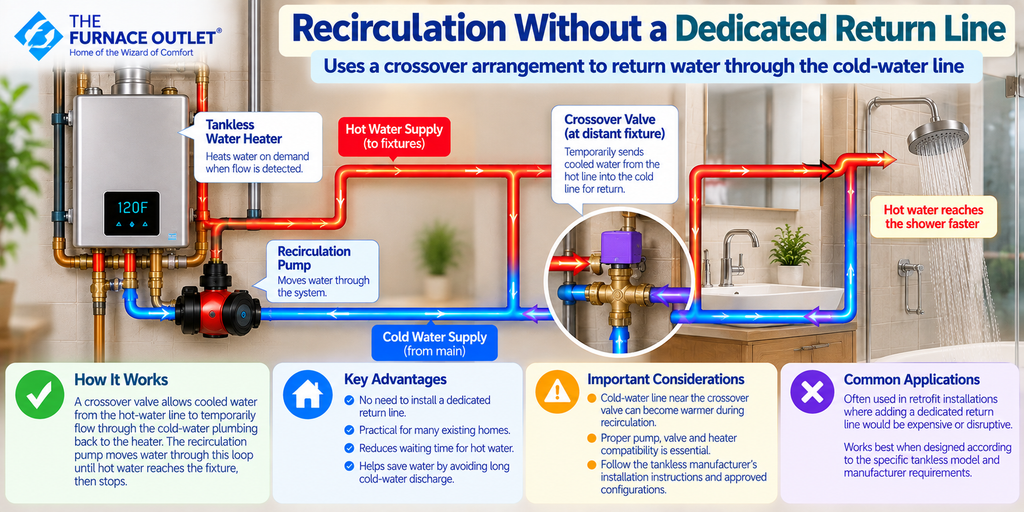
Installing a new return line through an existing finished house can be expensive and disruptive, so some retrofit systems use a crossover or bypass arrangement instead. In these designs, a special valve near a distant fixture allows cooled water from the hot-water line to temporarily move through the cold-water plumbing as part of the return path. This can create recirculation without opening walls throughout the house to install an entirely separate pipe.
A crossover system can make recirculation practical for many existing homes, but it involves tradeoffs. Depending on the design, the cold-water line near the crossover valve can temporarily become warmer during recirculation, and system performance depends on proper pump, valve and heater compatibility. I would therefore treat crossover recirculation as an engineered solution rather than a generic plumbing accessory. The tankless manufacturer’s installation documentation should confirm whether the proposed arrangement is permitted and how the pump, crossover valve and controls should operate together.
Convenience is the most immediately noticeable benefit of recirculation. If a bathroom is located far from the water heater, occupants may otherwise wait many seconds for hot water to arrive. A properly designed recirculation system can move heated water closer to that bathroom before the shower is opened, substantially reducing the waiting period.
That convenience can be particularly valuable in larger homes, multi-story layouts and houses where the water heater is located at one end of the building. It may be far less important in a compact house with a centrally located heater and short plumbing runs. Before installing recirculation, I would therefore measure how long hot water actually takes to reach the most distant fixtures. If the wait is already very short, additional pumps, valves and controls may provide little practical benefit.
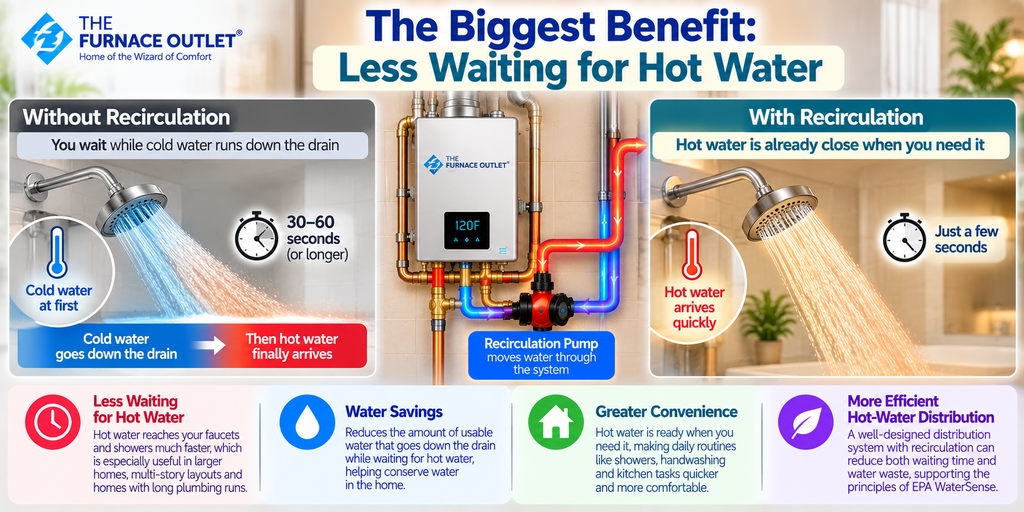
The second major advantage is water conservation. Without recirculation, the cooler water occupying the hot-water pipe typically flows down the drain while the homeowner waits for hot water. One occurrence may not seem significant, but repeating that process at showers and sinks throughout the year can create considerable cumulative waste, particularly where long plumbing runs contain substantial volumes of water.
A recirculation system can redirect much of that water through the plumbing rather than discarding it. EPA WaterSense places considerable emphasis on efficient hot-water distribution because reducing the volume of water between the heater and fixtures can reduce both waiting time and wasted water. This is an important reminder that water-heating efficiency is not solely about the appliance’s UEF; the distribution system between the appliance and the fixture also affects whole-home efficiency.
The easiest way to provide nearly immediate hot water is to keep the recirculation pump running and the entire loop hot continuously, but this can create a substantial energy disadvantage. Hot plumbing continuously transfers heat to the surrounding building. As the circulating water cools, the heater has to replace that lost heat even though nobody may actually be using hot water.
The pump itself also consumes electricity, but I would pay at least as much attention to distribution heat loss as to pump wattage. Even an efficient pump can support an inefficient system if it causes dozens of feet of plumbing to remain hot throughout the day and night. This is why continuous recirculation can partially undermine one of the fundamental advantages of tankless water heating: avoiding unnecessary energy consumption when there is no hot-water demand.
Demand-controlled recirculation attempts to provide the convenience and water savings of recirculation without maintaining a hot plumbing loop continuously. Instead of operating around the clock, the pump runs when somebody actually requests hot water. The request might be initiated by a push button, compatible smart control, motion sensor or another manufacturer-approved method. The system then circulates water until an appropriate temperature condition is reached and shuts the pump off.
From my sustainability perspective, this is generally the most logical approach because it aligns recirculation with the basic philosophy of tankless water heating: use energy when hot water is needed rather than continuously maintaining heat that may not be used. EPA WaterSense guidance has specifically addressed demand-initiated recirculation as an approach to efficient hot-water delivery because properly controlled systems can reduce water waste without the same degree of unnecessary distribution heat loss associated with continuous circulation.
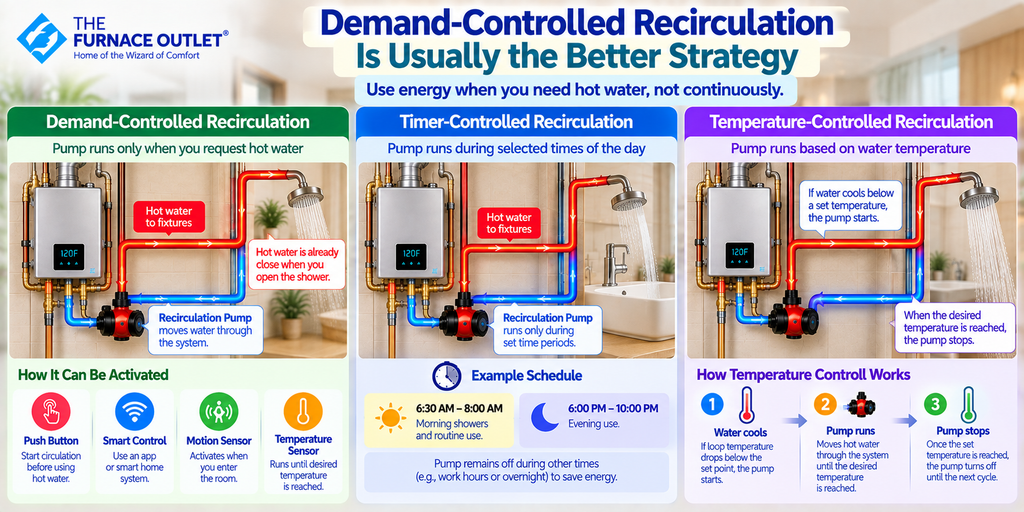
A timer provides a simpler way to reduce unnecessary circulation. Instead of running continuously, the pump might operate during the morning period when household members typically shower and again during the evening when hot-water use is highest. During working hours or overnight, the pump remains off.
This strategy can significantly improve on 24-hour circulation, particularly in households with predictable schedules, but it still relies on anticipated rather than actual demand. If everybody leaves early one morning, the system may circulate unnecessarily, while someone taking an unexpected afternoon shower may receive no recirculation benefit. A timer can therefore be a practical compromise, but where compatible technology is available I generally prefer demand-based or intelligently adaptive control.
Some systems use water temperature to determine when circulation should occur. When water in the loop cools below a specified threshold, the pump starts and moves hot water through the piping. Once the desired temperature reaches the sensor, circulation stops. This is more controlled than operating the pump continuously, but it can still cause repeated heating cycles even when nobody intends to use hot water.
This illustrates why the control strategy can matter more than the pump itself. A homeowner may purchase an efficient circulation pump but still experience unnecessary water-heating energy use if the control system repeatedly reheats the plumbing. When comparing recirculation options, I would therefore ask not only how much electricity the pump consumes, but also what causes it to start, what causes it to stop and how frequently it is likely to operate when nobody is using hot water.
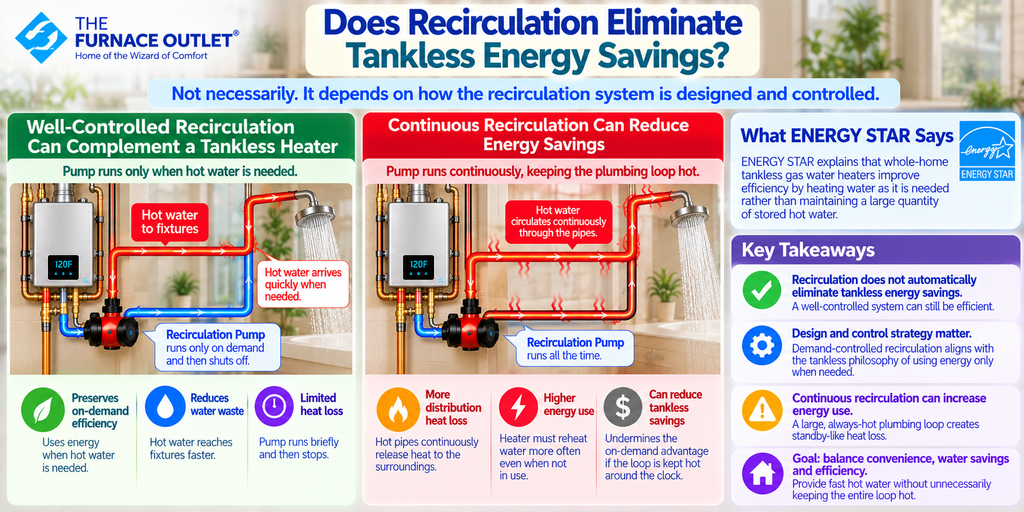
Not necessarily. A well-controlled recirculation system can complement a tankless heater very effectively, particularly where long plumbing runs otherwise create significant water waste. The problem occurs when recirculation is designed primarily for maximum convenience without considering distribution heat loss.
ENERGY STAR explains that whole-home tankless gas water heaters improve efficiency in part by heating water as it is needed rather than maintaining a large quantity of stored hot water. A continuously heated recirculation loop effectively creates another source of standby-like heat loss, except that the heat is being stored and lost through the plumbing rather than through a conventional storage tank.
The objective should therefore be to preserve the on-demand advantage. If the circulation pump runs briefly before hot-water use and then shuts down, the system can provide convenience and water conservation while keeping unnecessary heat loss relatively limited. If the pump keeps a large plumbing loop hot around the clock, the energy equation becomes considerably less attractive.
Any recirculation system will benefit from reducing heat loss from the hot-water and return piping. Pipe insulation slows heat transfer from hot water into surrounding spaces, allowing the water to remain warmer for longer and reducing the amount of energy needed to restore loop temperature.
Insulation becomes especially important when a dedicated return line creates a relatively long circulation loop. Every additional foot of uninsulated hot piping creates another opportunity for heat to escape. I would therefore consider accessible hot-water and return-line insulation part of the recirculation project rather than an optional finishing touch. Efficient distribution combines good controls with sensible pipe routing and insulation instead of expecting the water heater alone to compensate for unnecessary heat loss.
Recirculation and tankless sizing solve entirely different problems, and confusing them can lead to an expensive disappointment. Tankless capacity is determined by how much water the heater can raise to the required temperature at a particular flow rate. If a home needs 7 GPM under its design conditions but the heater can supply only 5 GPM at that temperature rise, a recirculation pump cannot provide the missing capacity.
Recirculation instead improves delivery. A properly sized heater may have more than enough capacity for a shower, but the shower can still take a long time to become hot because the bathroom is far from the heater. In that situation, recirculation can help significantly. I would therefore size the tankless heater first based on simultaneous demand and temperature rise, then evaluate recirculation separately based on plumbing distance, stored pipe volume and acceptable waiting time.
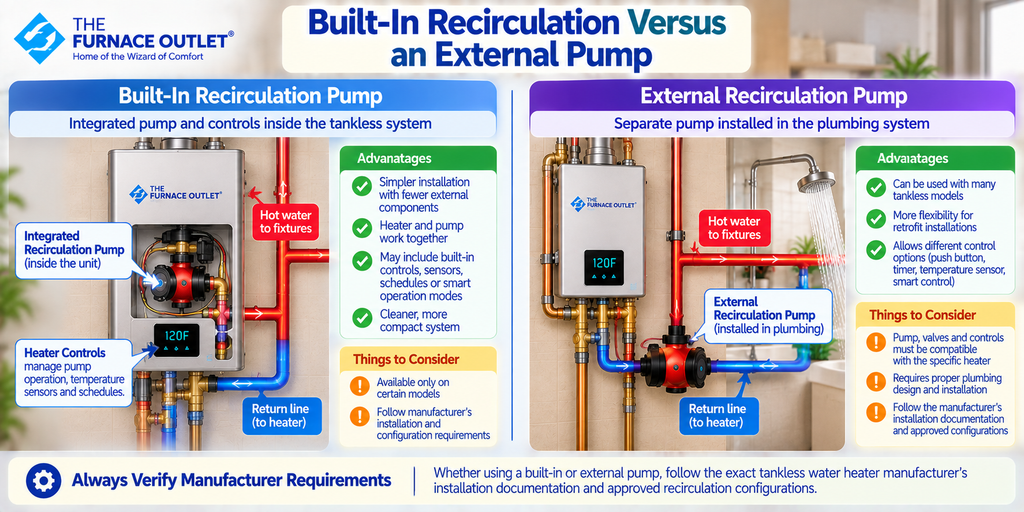
Some modern tankless systems incorporate a recirculation pump or offer manufacturer-designed recirculation capabilities, while other installations rely on an external pump. An integrated arrangement can simplify system design because the heater’s controls may coordinate pump operation with temperature sensors, schedules or intelligent operating modes.
An external system can provide more flexibility, particularly when upgrading an existing installation, but compatibility becomes especially important. Pump flow, check valves, return piping, crossover components and control logic all need to work correctly with the heater. I would therefore avoid selecting a recirculation pump purely by price or advertised flow rate and instead verify the exact water-heater manufacturer’s requirements before purchasing components.
Recirculation makes the strongest case in a home where important fixtures are far from the water heater and occupants routinely wait for hot water. Large homes, elongated floor plans, multi-story properties and installations where the heater is located in a garage or at one extreme end of the building are common examples where distribution delays can become frustrating.
The economics and sustainability argument become weaker when plumbing runs are already short. If a centrally located tankless heater supplies nearby bathrooms and the kitchen with little waiting, installing a pump and additional controls may solve a problem that barely exists. In new construction, I would first design a compact hot-water distribution system with short, appropriately sized runs and then use recirculation only where the building layout genuinely requires it.
A recirculation system introduces additional equipment that should be considered during future maintenance. Depending on the design, this may include a pump, check valves, temperature sensors, crossover valves, controls and dedicated return piping. These components can wear, become obstructed or operate incorrectly over time.
Hard-water maintenance also remains important because recirculation does not prevent mineral scale from forming inside the tankless heat exchanger. The heater still needs descaling according to manufacturer requirements and local water conditions. During professional service, I would ask the technician to verify recirculation operation as well as servicing the heater itself. A failed control that allows unnecessary pump operation can increase energy consumption, while a malfunctioning valve can reduce circulation effectiveness or produce unexpected plumbing behavior.
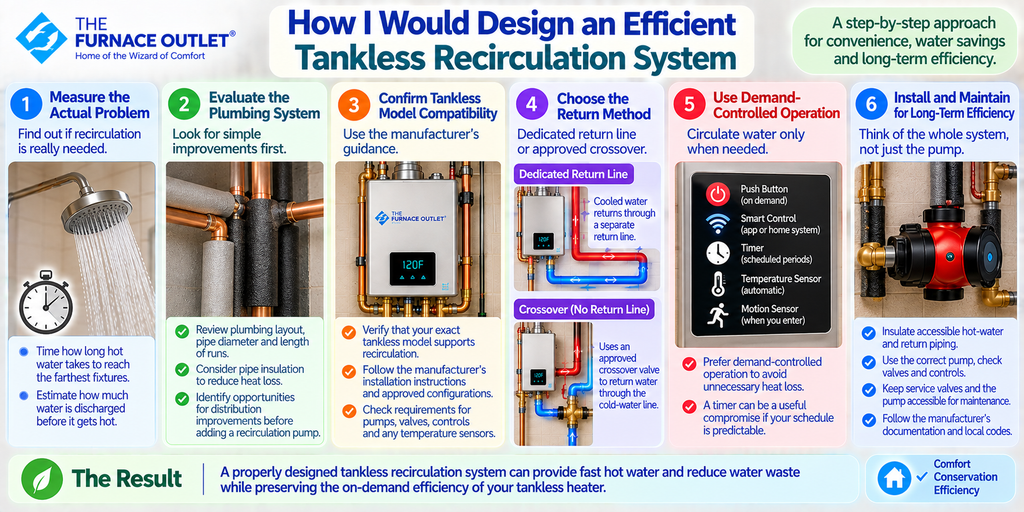
I would begin by measuring the actual problem rather than automatically installing equipment. Determine how long hot water takes to reach the distant fixtures and how much water is discharged before the desired temperature arrives. I would then look at plumbing layout, pipe diameter and insulation to determine whether straightforward distribution improvements could reduce the problem.
If recirculation remains worthwhile, I would verify that the exact tankless model supports the proposed system, determine whether a dedicated return line is available and compare that arrangement with any manufacturer-approved crossover alternative. I would prioritize demand-controlled operation, insulate accessible hot-water and return piping, and ensure that the pump, service valves and controls remain accessible for future maintenance. This approach treats recirculation as part of the complete hot-water distribution system rather than as a standalone accessory.
The most important thing to remember is that a tankless heater and a recirculation system perform different jobs. The tankless heater produces hot water, while the recirculation system helps deliver that hot water efficiently through the house. A perfectly functioning tankless heater can still leave someone waiting at a distant shower if several gallons of cooled water are sitting between the heater and the bathroom.
A thoughtfully designed recirculation system can dramatically improve convenience and reduce the amount of usable water sent down the drain while waiting. At the same time, an unnecessarily hot circulation loop can increase distribution heat loss and partially offset the energy benefits that made tankless attractive in the first place. From my sustainability perspective, the best solution is therefore not simply maximum circulation; it is the minimum circulation necessary to provide the desired comfort and water savings.
I would prioritize a compact plumbing layout whenever possible, insulate the hot-water piping, and use demand-controlled or intelligently managed recirculation where long runs still create significant waiting. That combination preserves the on-demand philosophy of tankless water heating while addressing one of its most misunderstood limitations: the heater can produce hot water quickly, but the plumbing determines how quickly that hot water reaches you.
Does a tankless water heater provide instant hot water at the faucet? A tankless heater begins producing hot water when sufficient flow is detected, but the heated water still has to travel through the plumbing. Long pipe runs can therefore create a noticeable delay even when the heater is operating correctly, which is why recirculation can be useful in larger homes.
Does recirculation increase the GPM of a tankless water heater? Recirculation does not increase the heater’s fundamental heating capacity. GPM capability is still determined by the heater’s output and the required temperature rise, while recirculation primarily reduces the time required for available hot water to reach distant fixtures.
Do I need a dedicated return line for tankless recirculation? A dedicated return line is one common solution and can be particularly attractive in new construction, but some compatible retrofit systems use a crossover arrangement instead. The correct configuration depends on the heater and plumbing design, so manufacturer requirements should determine which options are acceptable.
Does a tankless recirculation pump waste energy? It can if it operates unnecessarily. Continuous circulation can increase distribution heat loss because hot pipes continually release heat into their surroundings, while demand-controlled circulation can substantially reduce unnecessary operation by running the pump only when hot water is requested.
Is demand-controlled recirculation better than continuous circulation? From an energy perspective, I generally prefer demand-controlled operation because it provides hot-water convenience when needed without keeping the entire plumbing loop hot throughout the day. The exact best strategy still depends on household use patterns and the equipment manufacturer’s supported controls.
Should recirculation piping be insulated? Insulating accessible hot-water and return piping is an important efficiency measure because it reduces heat loss from the circulation loop. This becomes increasingly valuable as the length of the plumbing loop increases.
Is recirculation worthwhile in a small home? It depends on the actual plumbing layout rather than square footage alone. If hot water already reaches the most distant fixture quickly, recirculation may offer limited benefit, while even a modest home can benefit if the heater and primary bathroom are located far apart.
For further technical research, homeowners and installers can review EPA WaterSense guidance on efficient hot-water delivery, which explains how plumbing design and demand-initiated recirculation can reduce water and energy waste. The more detailed EPA WaterSense Guide for Efficient Hot Water Delivery Systems provides useful technical background on distribution design and recirculation strategies.
For understanding how tankless technology fits into the broader efficiency picture, ENERGY STAR’s whole-home tankless gas water-heater guidance explains the on-demand operating principle and efficiency advantages. For manufacturer-specific recirculation considerations, Rinnai’s residential tankless water-heater resources provide useful examples of integrated recirculation technology and control strategies. Because recirculation configurations vary considerably by model, the installation manual for the exact water heater should remain the primary technical authority.
This article is provided by The Furnace Outlet for general educational purposes and is not a substitute for the installation, operation or service documentation supplied with a specific tankless water heater or recirculation system. Recirculation pumps, return piping, crossover valves, controls, electrical requirements and permitted configurations vary by manufacturer and model, and plumbing or electrical modifications must comply with applicable codes. Always follow the current manufacturer’s instructions and use appropriately qualified professionals where required.