Newsletter Subscribe
Enter your email address below and subscribe to our newsletter

HVAC made simple
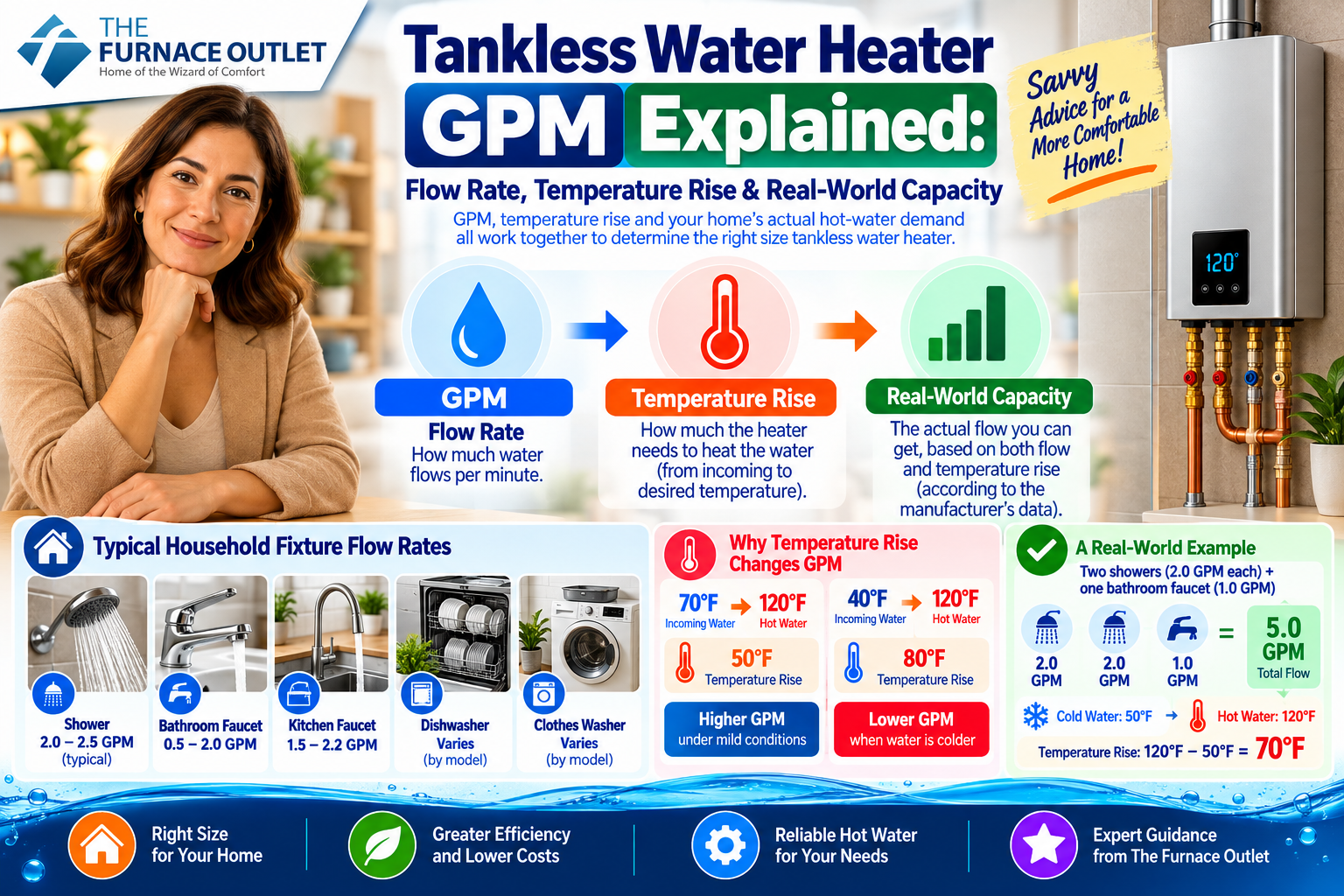
When I compare tankless water heaters, one specification seems to dominate almost every product page: GPM. You may see one heater advertised at 7 GPM, another at 9 GPM and a premium model promoted as capable of more than 10 GPM. It is tempting to assume that the model with the largest number is automatically the most powerful and therefore the best choice.
I’m Savvy, The Furnace Outlet’s sustainability-focused HVAC enthusiast, and this is one of those specifications I never evaluate by itself. GPM is important, but a tankless water heater’s real capacity depends on something equally important: how many degrees it must raise the temperature of the incoming water.
A heater that can produce impressive flow when incoming water is relatively warm may deliver considerably less when winter water arrives much colder. The heater has a limited amount of heating capacity, and the more heat it has to add to every gallon, the fewer gallons it can heat each minute to the target temperature. Understanding that relationship is the key to making sense of tankless water-heater specifications.
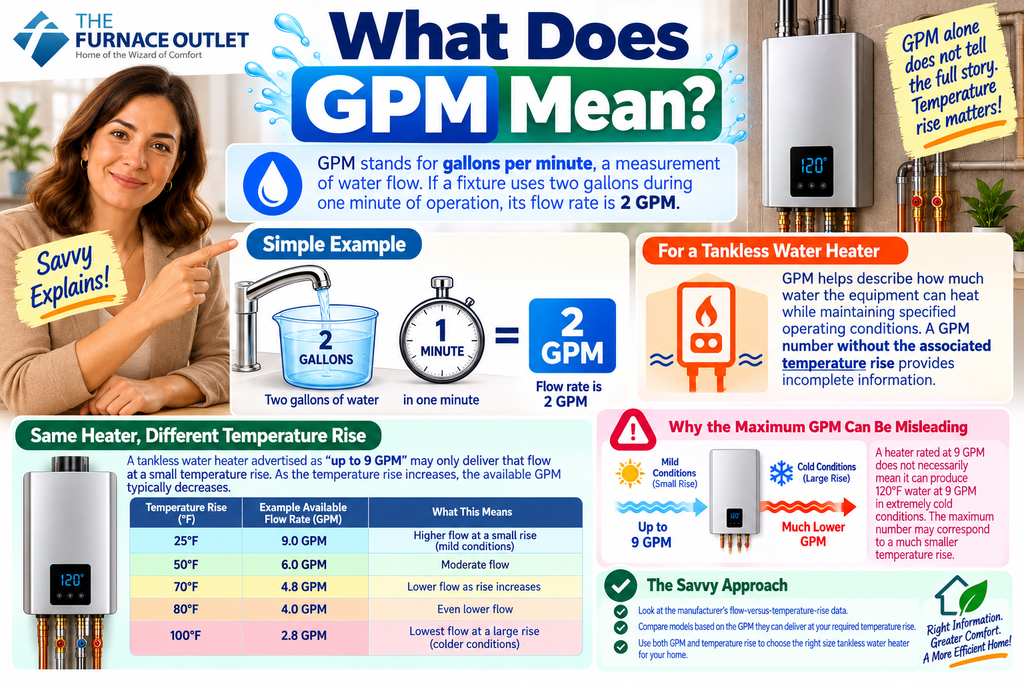
GPM stands for gallons per minute, a measurement of water flow. If a fixture uses two gallons during one minute of operation, its flow rate is 2 GPM. For a tankless water heater, GPM helps describe how much water the equipment can heat while maintaining specified operating conditions. That last part is critical because a GPM number without the associated temperature rise provides incomplete information.
Consider a heater advertised as capable of delivering up to 9 GPM. That does not necessarily mean it can take extremely cold incoming water and produce 120°F water at 9 GPM. The maximum number may correspond to a much smaller temperature rise. That is why I prefer to read the manufacturer’s flow-versus-temperature-rise data rather than comparing products using only the maximum GPM printed in advertisements.
From the homeowner’s perspective, GPM describes how much water fixtures demand at a particular moment. If one shower is operating at 2 GPM, total fixture flow is approximately 2 GPM. If a second 2-GPM shower starts, combined flow becomes approximately 4 GPM. Add another fixture and total demand rises again.
This simultaneous demand is much more important for tankless sizing than the total number of people living in the house. A family of five that showers at different times could have relatively modest peak demand. A family of three that routinely operates two showers simultaneously may require considerably greater instantaneous capacity.
The tankless heater therefore needs to be selected around peak realistic simultaneous demand, not simply bedroom count or household population.
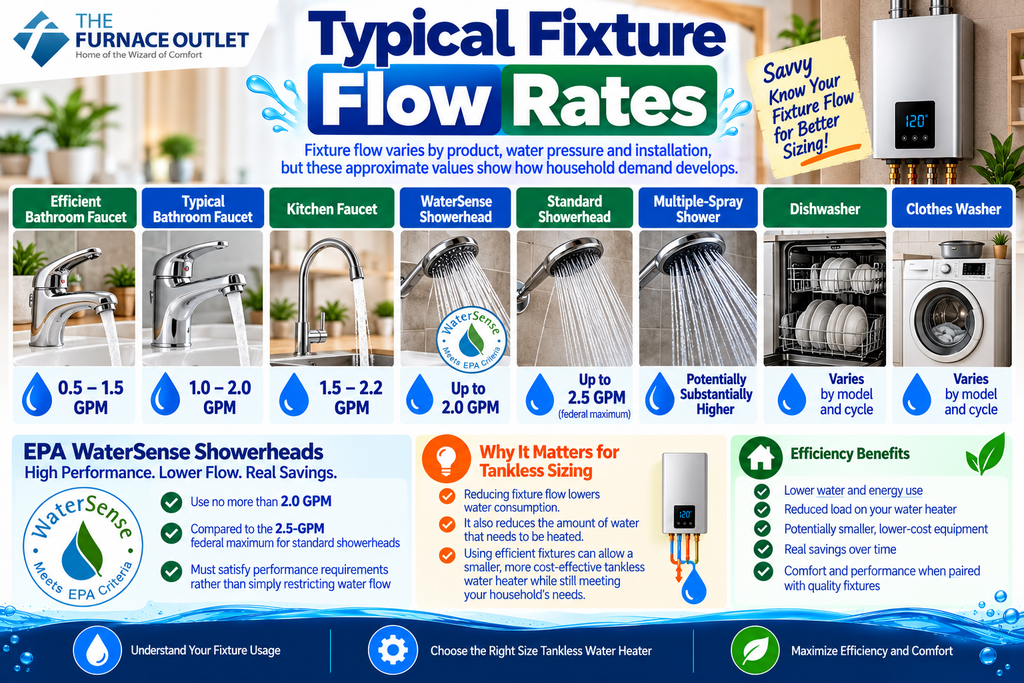
Fixture flow varies by product, water pressure and installation, but approximate values can help illustrate how household demand develops.
| Fixture | Approximate Flow |
|---|---|
| Efficient bathroom faucet | 0.5–1.5 GPM |
| Typical bathroom faucet | 1.0–2.0 GPM |
| Kitchen faucet | 1.5–2.2 GPM |
| WaterSense showerhead | Up to 2.0 GPM |
| Standard showerhead | Up to approximately 2.5 GPM |
| Multiple-spray shower | Potentially substantially higher |
| Dishwasher | Varies by model and cycle |
| Clothes washer | Varies by model and cycle |
EPA’s WaterSense specification limits labeled showerheads to 2.0 GPM or less, compared with the 2.5-GPM federal maximum for standard showerheads. WaterSense products must also satisfy performance requirements rather than simply restricting water flow.
This matters for water-heater sizing because reducing fixture flow reduces both water consumption and the amount of water that needs to be heated.
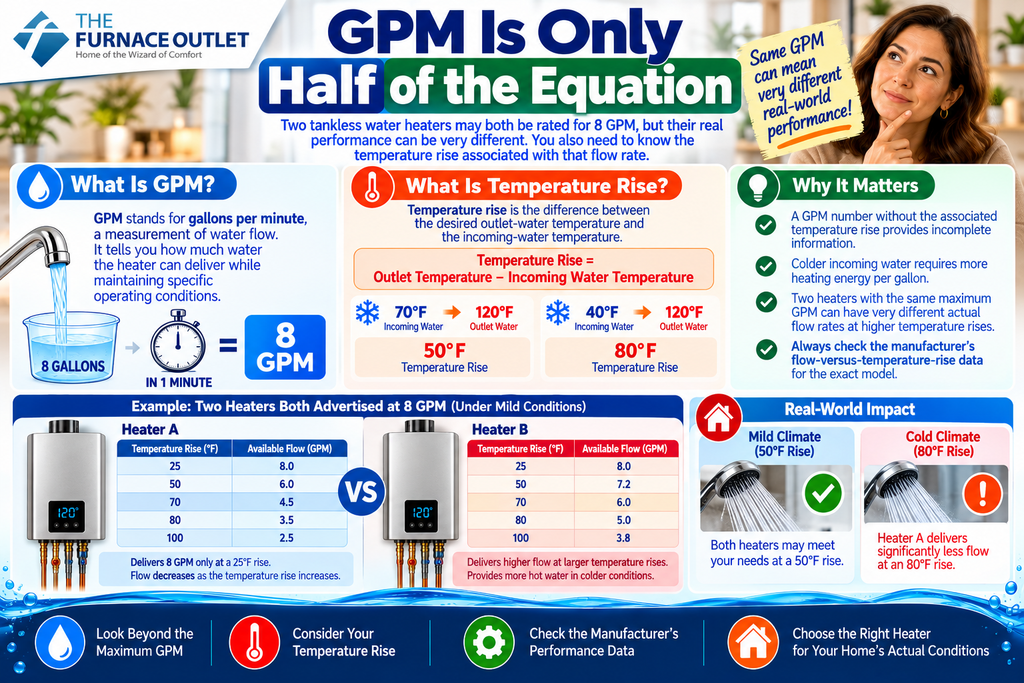
Suppose two tankless water heaters are both described as capable of approximately 8 GPM. It would be easy to conclude that they provide essentially the same capacity. That conclusion may be wrong. To understand real performance, I need to know the temperature rise associated with that flow rate.
Temperature rise is simply the difference between incoming-water temperature and the desired outlet-water temperature: Temperature Rise = Outlet Temperature − Incoming Water Temperature
If incoming water is 70°F and the desired outlet temperature is 120°F, the required rise is 50°F. If incoming water is 40°F and the target remains 120°F, the heater must now produce an 80°F rise. That second operating condition requires much more heating energy per gallon.
The physics behind this relationship is straightforward. Water requires a predictable amount of energy to increase its temperature. As more gallons pass through the heater each minute, the heater must transfer more energy into the water during that same minute. If the incoming water becomes colder while the desired outlet temperature stays the same, each gallon requires additional energy.
Eventually the heater reaches the limit of its heating capacity. At that point, it cannot simultaneously increase temperature and maintain unlimited flow. Consequently, the maximum flow available at the target temperature decreases as required temperature rise increases. This relationship is why I consider a manufacturer flow curve one of the most useful pieces of information available when comparing tankless water heaters.
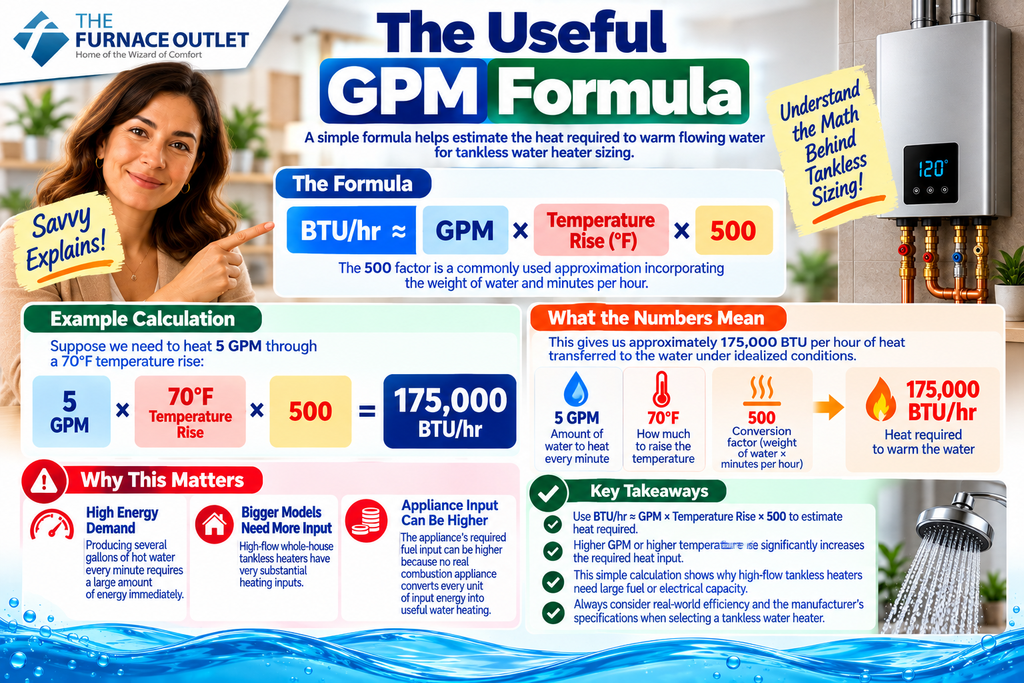
We can also approximate the relationship mathematically for electric resistance or heat-input calculations. The approximate heat required to warm flowing water can be expressed as: BTU/hr ≈ GPM × Temperature Rise × 500
The 500 factor is a commonly used approximation incorporating the weight of water and minutes per hour. Suppose we need to heat 5 GPM through a 70°F temperature rise: 5 × 70 × 500 = 175,000 BTU/hr
That gives us approximately 175,000 BTU per hour of heat transferred to the water under idealized conditions. The appliance’s required fuel input can be higher because no real combustion appliance converts every unit of input energy into useful water heating.
This simple calculation demonstrates why high-flow whole-house tankless heaters can have very substantial heating inputs. Producing several gallons of hot water every minute without a storage tank requires a large amount of energy immediately.
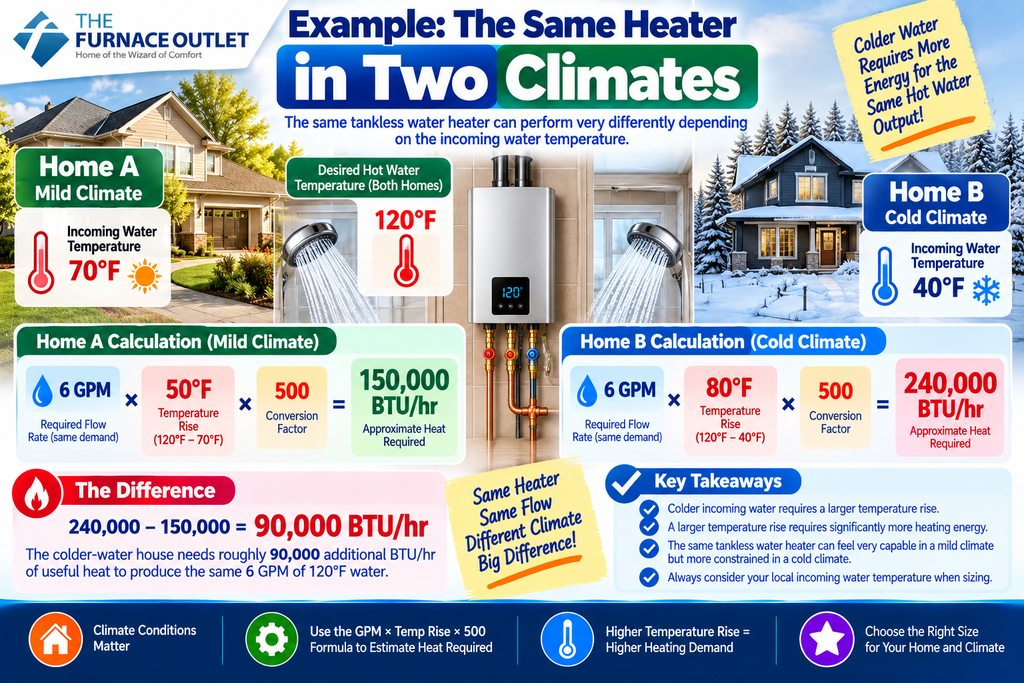
Imagine a tankless heater serving two otherwise identical homes. In Home A, incoming water is 70°F. In Home B, incoming water is 40°F. Both homeowners want 120°F water.
Home A requires: 120°F − 70°F = 50°F temperature rise. Home B requires: 120°F − 40°F = 80°F temperature rise
If both houses demand 6 GPM, Home A requires roughly: 6 × 50 × 500 = 150,000 BTU/hr
Home B requires roughly: 6 × 80 × 500 = 240,000 BTU/hr
The difference is enormous. The colder-water house needs roughly 90,000 additional BTU/hr of useful heat to produce the same theoretical flow and temperature. This is why the same tankless water heater can feel extremely capable in one climate and much more constrained in another.
I do not think maximum GPM claims are inherently misleading when manufacturers clearly publish the associated operating conditions. The problem arises when shoppers interpret the headline number as guaranteed performance.
“Up to 10 GPM” means exactly that: up to that flow under particular conditions. If your home requires an 80°F temperature rise, the unit may provide substantially less flow than it does at a 35°F or 40°F rise.
When comparing products, I therefore look beyond the product-page headline and find the manufacturer’s performance chart. I identify my approximate required temperature rise and then read across the chart to determine the available flow. That number is much closer to the capacity I actually care about.
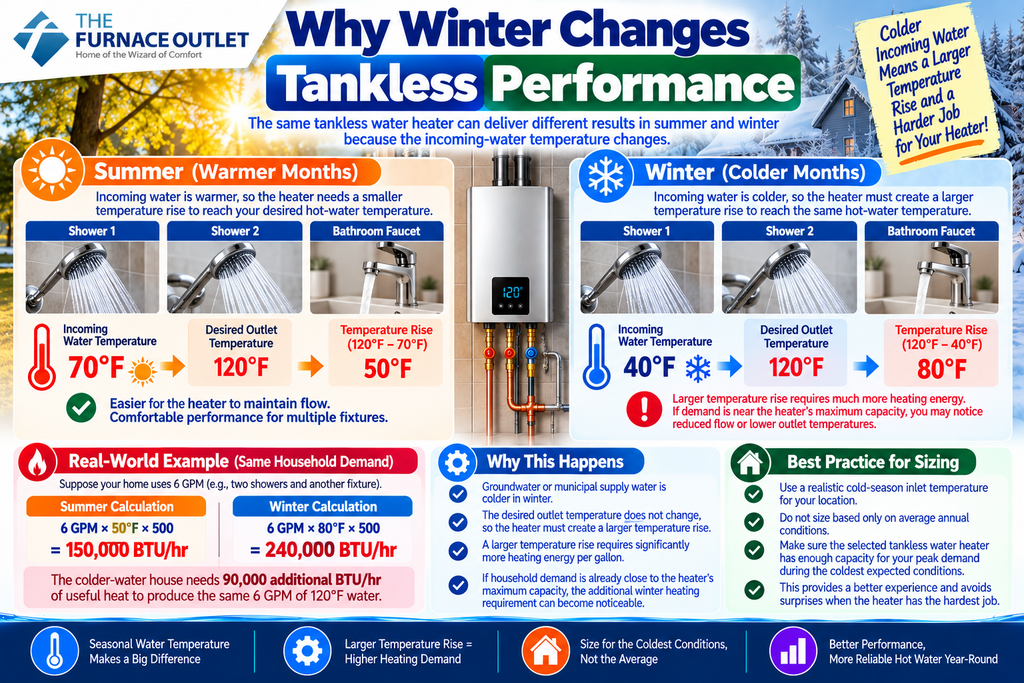
Tankless performance can appear seasonal because incoming-water temperature changes. Suppose a heater handles two showers and another fixture comfortably during warmer months. During winter, groundwater or municipal supply water may arrive substantially colder.
The desired outlet temperature has not changed, so the heater must now create a larger temperature rise. If household demand is already close to the heater’s maximum capacity, this additional winter heating requirement may become noticeable.
This is why I prefer sizing around a realistic cold-season inlet temperature rather than average annual conditions. Designing around mild weather can make an installation look adequate on paper while leaving little capacity margin during the part of the year when the heater has the hardest job.
There is another detail that makes household GPM calculations more interesting: the water coming from a showerhead is usually not entirely water from the hot-water heater. A shower valve mixes hot and cold water to achieve a comfortable bathing temperature. Suppose the tankless heater supplies water at 120°F, the cold supply is 50°F and someone showers at approximately 105°F. The final 2-GPM shower stream contains a mixture of hot and cold water. That means a 2-GPM shower does not necessarily impose a full 2-GPM demand on the hot-water heater.
However, I would be careful about using this fact to aggressively downsize equipment. Incoming temperatures, user preferences and fixture operation vary. A good design should provide adequate capacity without relying on optimistic assumptions about mixing.
Two simultaneous showers provide a useful real-world benchmark. If both showerheads are WaterSense-labeled 2.0-GPM models, their combined maximum fixture flow is approximately 4 GPM. EPA notes that WaterSense-labeled showerheads use no more than 2.0 GPM and are independently certified against additional performance criteria.
Two standard 2.5-GPM showerheads could instead create approximately 5 GPM of combined fixture flow. Add a kitchen or bathroom faucet and simultaneous household demand can climb further.
This is why simply saying that a tankless heater “supports two bathrooms” is not precise enough for me. Two bathrooms with efficient showerheads are very different from two luxury showers containing rain heads, hand showers and body sprays.
A genuine 5 GPM of available hot-water capacity at the required temperature rise can accommodate several moderate-demand combinations. It might support two efficient showers under suitable conditions, or one shower plus several smaller fixtures. The exact combination depends on fixture flow, hot/cold mixing and operating temperatures.
A 5-GPM system may therefore work very well in one household and feel restrictive in another. The critical phrase remains “at the required temperature rise.” If a heater provides 5 GPM at a 70°F rise, that tells me much more than a marketing claim of 7 or 8 GPM without operating conditions.
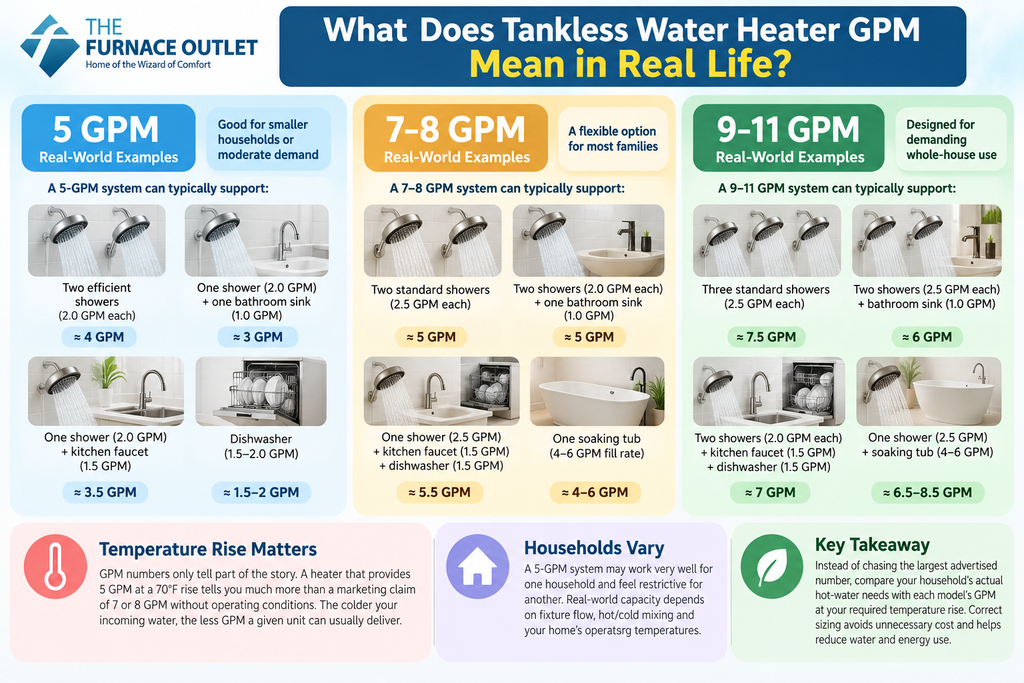
Real-world capacity around 7–8 GPM at the home’s required temperature rise can support significantly more simultaneous demand. That range may be appropriate for households where two showers and additional fixtures regularly overlap, although exact sizing still needs to reflect fixture characteristics and climate.
For larger families, this can be an attractive capacity range because it creates more flexibility without automatically moving into the highest-output equipment available. I would still calculate the expected peak load rather than buying based on a family-size label.
High-output tankless systems are designed for demanding whole-house applications, but even these products remain subject to temperature-rise limitations. Large homes with multiple bathrooms, high-flow fixtures or frequent simultaneous showers can justify substantial capacity. However, a heater advertised around 10 or 11 maximum GPM should still be evaluated at the expected winter temperature rise.
In extremely demanding homes, one heater may not be the appropriate solution. Manufacturers may support engineered multi-unit configurations, but fuel supply, controls, venting, plumbing and installation costs all become more significant.
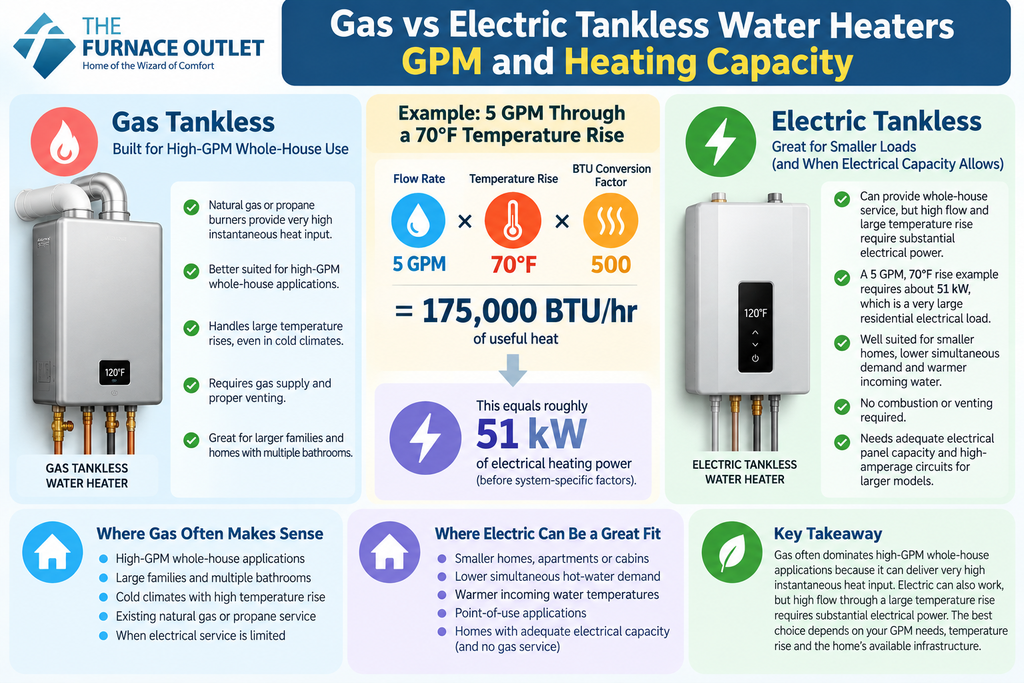
Gas tankless heaters often dominate high-GPM whole-house applications because natural gas or propane burners can provide very high instantaneous heat input. Electric tankless systems can also provide whole-house service, but producing high flow through a large temperature rise requires substantial electrical power.
Using the earlier example, heating 5 GPM through a 70°F rise requires approximately 175,000 BTU/hr of useful heat. That corresponds to roughly 51 kW of heating power before considering system-specific factors. That is a very large residential electrical load.
This does not make electric tankless undesirable. It means electric tankless needs to be matched carefully to the application and the home’s electrical infrastructure. Smaller homes, lower simultaneous demand and warmer incoming water can make electric systems considerably more practical.
One of my favorite alternatives to simply buying a larger heater is reducing unnecessary water demand. Suppose two standard showerheads each use 2.5 GPM. Their combined maximum flow is 5 GPM.
Replace them with WaterSense-labeled 2.0-GPM showerheads and maximum combined shower flow falls to 4 GPM, a reduction of 1 GPM. EPA says WaterSense-labeled showerheads are 20 percent more water-efficient than the federal maximum and that reducing shower-water consumption also saves the energy otherwise required to heat that water.
That is exactly the type of efficiency improvement I like because one change can reduce water consumption, water-heating energy and peak demand on the heater.
Tankless heating capacity is not the only factor affecting perceived flow. Household water pressure, plumbing diameter, pressure losses, fixture restrictions, filters and other components can influence the actual water delivered at a fixture.
A 10-GPM-capable heater cannot make a plumbing system deliver 10 GPM if the water supply or distribution system cannot provide that flow. EPA’s WaterSense showerhead requirements even include performance testing across different pressures, illustrating that fixture flow and performance are influenced by pressure conditions. When homeowners experience unexpectedly low flow, the water heater should therefore not automatically receive the blame.
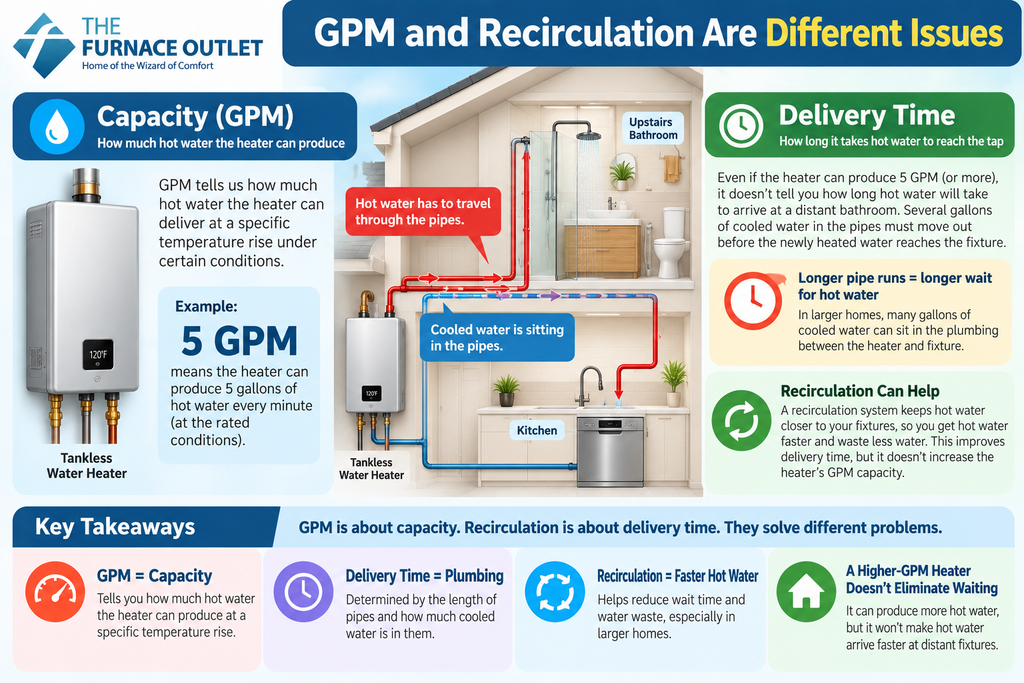
Another distinction I frequently make is between capacity and delivery time. GPM tells us how much hot water the heater can produce under particular conditions. It does not tell us how long that hot water takes to reach a distant bathroom.
If several gallons of cooled water are sitting in a long pipe between the heater and fixture, that water must move before freshly heated water arrives. Recirculation and efficient hot-water distribution can address that problem, but installing a higher-GPM heater generally does not.
This distinction matters because homeowners sometimes replace a water heater expecting “instant hot water everywhere,” only to discover that plumbing distance remains unchanged.
When I compare two tankless water heaters, I first ignore the headline maximum GPM and find the manufacturer’s complete performance data. I then identify the flow available at the approximate temperature rise the home will experience during colder conditions.
Next, I compare that capacity with realistic simultaneous household demand. I consider showerheads, faucets and other hot-water loads likely to overlap rather than assuming every fixture will run simultaneously. After that, I evaluate the infrastructure required to produce the advertised performance. A high-output gas heater needs an adequate fuel supply, while a powerful electric tankless heater can require substantial electrical capacity.
Finally, I consider water efficiency. If the household can reduce unnecessary flow without compromising comfort, it may be possible to meet the same practical needs using less water and less energy rather than simply installing larger equipment.
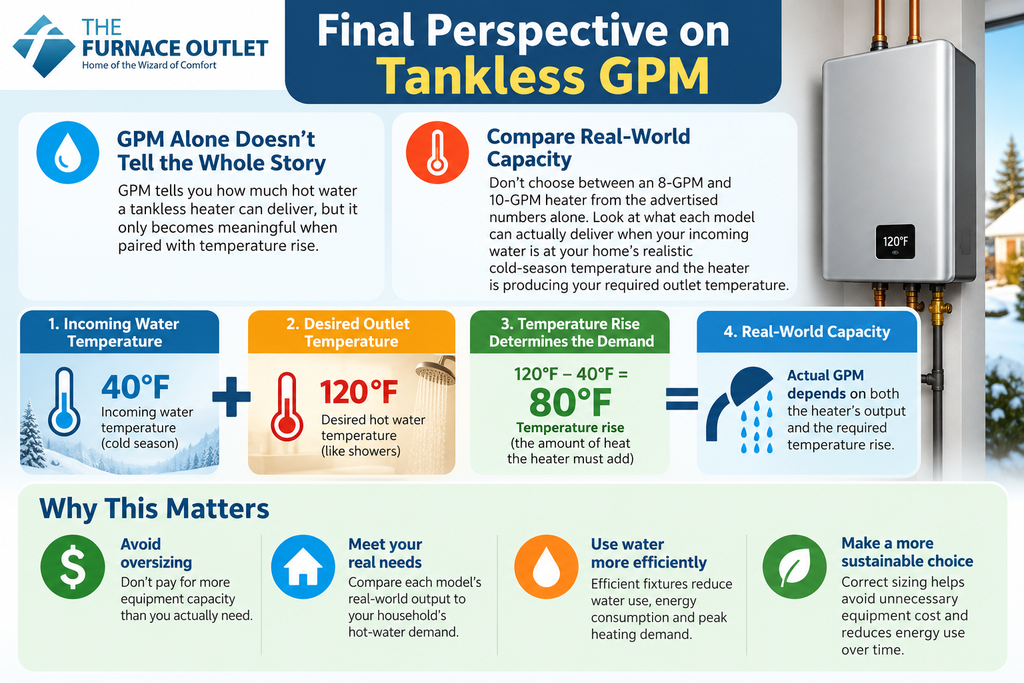
GPM is one of the most important tankless water-heater specifications, but it becomes meaningful only when paired with temperature rise. I would never choose between an 8-GPM and 10-GPM heater from those two numbers alone. I want to know what each unit can actually deliver when the incoming water is at the home’s realistic cold-season temperature and the heater is producing the required outlet temperature. That is real-world capacity.
Once you understand this relationship, tankless shopping becomes much easier. Instead of chasing the largest advertised number, you can compare the amount of hot water your household genuinely needs with the amount each heater can realistically produce. From my sustainability perspective, that is also the better approach. Correct sizing can avoid unnecessary equipment cost while efficient fixtures can reduce water use, energy consumption and peak heating demand at the same time.
GPM means gallons per minute and describes water flow. For a tankless heater, the useful number is how much water it can heat each minute at a specified temperature rise rather than simply its maximum advertised flow.
A larger temperature rise requires the heater to add more energy to every gallon. Because the heater has limited heating capacity, it generally cannot maintain the same maximum flow as the required temperature increase becomes larger.
It can be under appropriate conditions. Two 2.0-GPM showerheads have approximately 4 GPM of combined fixture flow, while two 2.5-GPM showerheads could reach 5 GPM. Actual hot-water demand also depends on mixing and temperature conditions.
It may be more than sufficient in some homes and insufficient in unusually demanding ones. Calculate the fixtures likely to operate simultaneously and then compare that demand with the heater’s available GPM at the required winter temperature rise.
The advertised maximum may correspond to a smaller temperature rise. Colder winter inlet water requires the heater to add more heat to each gallon, which can reduce the maximum flow available at the target outlet temperature.
No. GPM primarily describes flow capacity under specified conditions. Energy efficiency is evaluated using other performance metrics. A larger heater can provide greater capacity without necessarily being the most appropriate or efficient choice for a particular household.
Yes. Lower fixture flow reduces the volume of water the heater must heat each minute. WaterSense-labeled showerheads use no more than 2.0 GPM, potentially reducing both water consumption and water-heating demand compared with higher-flow fixtures.
Not automatically. Select capacity around realistic peak demand and cold-season temperature rise, then consider installation requirements, energy source, efficiency and cost. More capacity than the house needs may provide little practical benefit.
For water-efficiency information and independently certified showerhead flow requirements, use the EPA WaterSense Showerhead Specification. EPA’s WaterSense program limits labeled showerheads to 2.0 GPM while also establishing performance requirements.
For broader tankless water-heating guidance, consult the U.S. Department of Energy Energy Saver. Efficiency-certified water-heater information can also be researched through ENERGY STAR Water Heaters and certified equipment information through the AHRI Directory of Certified Product Performance.
For homeowners interested in reducing both water consumption and water-heating demand, EPA also provides broader guidance through EPA WaterSense.
The Furnace Outlet provides this guide for general educational and informational purposes. GPM examples, temperature-rise calculations, BTU calculations and fixture-flow examples are simplified planning tools and should not replace manufacturer performance data, engineering calculations or a professional site assessment. Actual tankless water-heater performance can vary with inlet-water temperature, outlet temperature, water pressure, elevation, fuel supply, electrical capacity, plumbing configuration, equipment condition and other factors. Always verify the flow-versus-temperature-rise performance and installation requirements for the exact model being considered. Gas, electrical, plumbing and venting work should comply with applicable codes and be performed by appropriately qualified professionals where required. The Furnace Outlet is an independent informational resource and is not a manufacturer, installer or representative of the brands or organizations referenced.