Newsletter Subscribe
Enter your email address below and subscribe to our newsletter

HVAC made simple
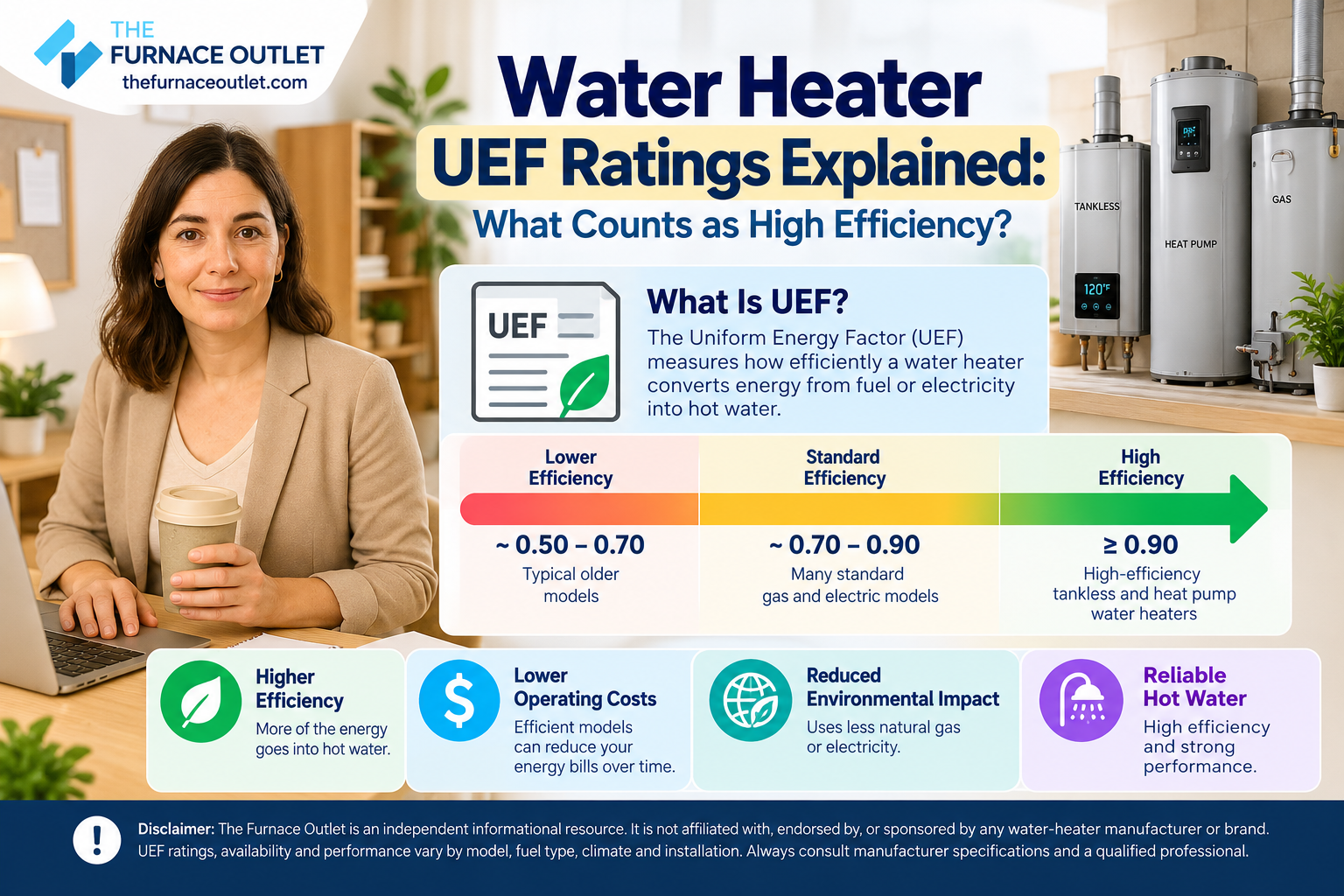
When I compare water heaters, one of the first efficiency specifications I look for is UEF, or Uniform Energy Factor. It gives homeowners a standardized way to compare how efficiently residential water heaters use energy under the U.S. Department of Energy test procedure. In general, a higher UEF means greater energy efficiency, but that simple rule needs an important qualification: a UEF number becomes most useful when you compare water heaters of a similar type, size, and usage category.
I’m Savvy Mavi, Savvy the Sustainability Expert, and this is one specification where I would avoid shopping by the biggest number alone. A conventional gas storage heater may have a UEF below 1.0, an efficient gas tankless model may be around or above 0.95, while a modern heat-pump water heater can have a UEF above 3.0. Those differences do not mean that one technology can be understood simply by dividing one UEF number by another. Each technology heats water differently, uses a different energy source, and has different installation and operating characteristics.
For homeowners, the practical goal is therefore not merely to find the highest UEF. It is to understand what UEF measures, what counts as efficient within each water-heater category, and how efficiency fits alongside hot-water capacity, installation cost, energy prices, and total cost of ownership.
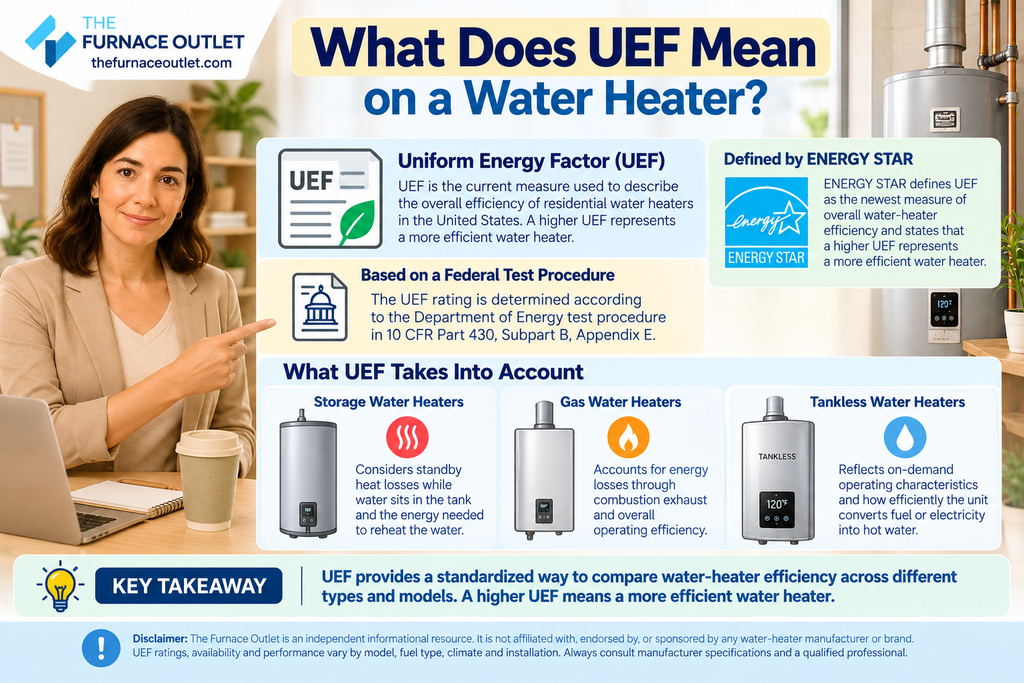
Uniform Energy Factor is the current measure used to describe the overall efficiency of residential water heaters in the United States. ENERGY STAR defines UEF as the newest measure of overall water-heater efficiency and states that a higher UEF represents a more efficient water heater. The rating is determined according to the Department of Energy test procedure in 10 CFR Part 430, Subpart B, Appendix E.
In practical terms, UEF considers how effectively the water heater delivers useful hot water relative to the energy it consumes during a standardized test. That standardized approach is important because water heaters lose or use energy in different ways. A storage heater can lose heat while water sits in the tank, a gas appliance can lose energy through combustion exhaust, and a tankless heater can have different operating characteristics because it heats water on demand.
UEF brings these performance characteristics into a standardized test framework so that shoppers have something more meaningful than manufacturer claims such as “high efficiency” or “energy saving.” It does not reproduce every home’s actual operating conditions, but it creates a common basis for evaluating comparable equipment.
The easiest rule to remember is that higher UEF means greater standardized efficiency. If I am comparing two genuinely similar water heaters and one has a meaningfully higher UEF, that higher-rated model is generally using energy more efficiently under the DOE test procedure.
Where homeowners can get into trouble is comparing UEF numbers from completely different technologies without context. A gas storage water heater with a UEF of 0.86 and a heat-pump water heater with a UEF of 3.5 are not simply two versions of the same appliance. The gas model burns fuel to generate heat, whereas the heat pump primarily uses electricity to move heat from the surrounding air into the stored water.
I would therefore treat UEF as an efficiency comparison metric rather than an overall product score. It tells me something very important, but it does not tell me everything I need to know before choosing a water heater.
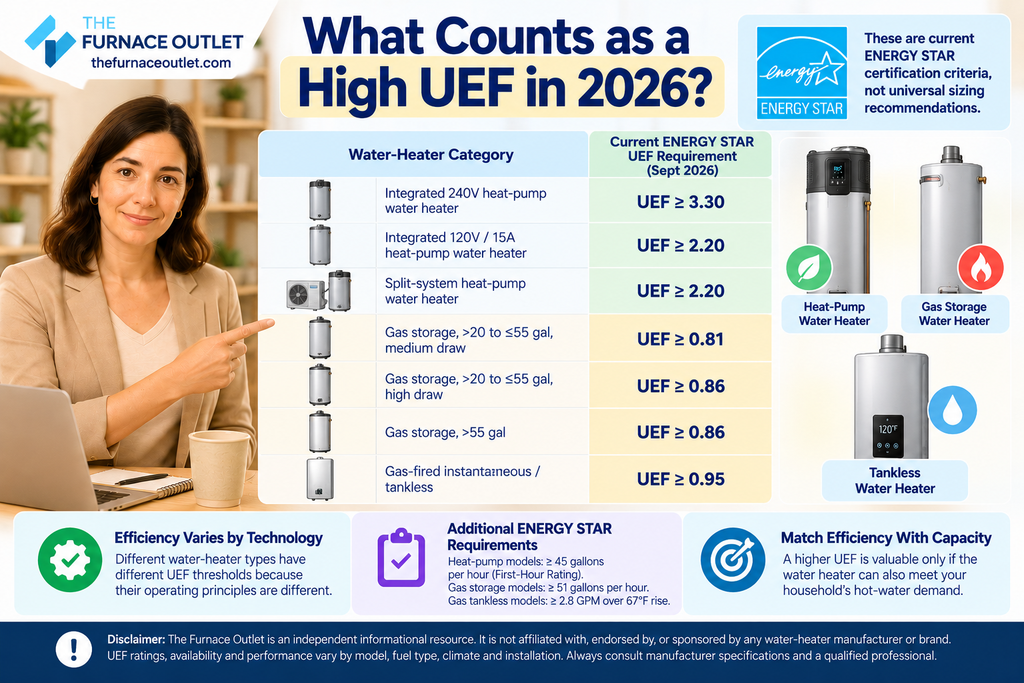
There is no single UEF number that I would call “high efficiency” for every residential water heater. Current ENERGY STAR criteria illustrate why. Different technologies have different qualifying thresholds because their operating principles and achievable efficiencies are fundamentally different.
As of September 2026, ENERGY STAR’s current residential criteria use the following benchmarks:
| Water-Heater Category | Current ENERGY STAR UEF Requirement |
|---|---|
| Integrated 240V heat-pump water heater | UEF ≥ 3.30 |
| Integrated 120V / 15A heat-pump water heater | UEF ≥ 2.20 |
| Split-system heat-pump water heater | UEF ≥ 2.20 |
| Gas storage, >20 to ≤55 gal, medium draw | UEF ≥ 0.81 |
| Gas storage, >20 to ≤55 gal, high draw | UEF ≥ 0.86 |
| Gas storage, >55 gal | UEF ≥ 0.86 |
| Gas-fired instantaneous/tankless | UEF ≥ 0.95 |
These figures are ENERGY STAR certification criteria, not universal sizing recommendations or minimum federal efficiency standards for every water heater. ENERGY STAR also applies additional requirements. For example, qualifying heat-pump water heaters must meet a First-Hour Rating requirement of at least 45 gallons per hour, while qualifying gas storage units must reach at least 51 gallons per hour. Gas tankless models must provide at least 2.8 GPM over a 67°F temperature rise.
That distinction is useful because efficiency is only valuable when the water heater can also satisfy the household’s hot-water demand.
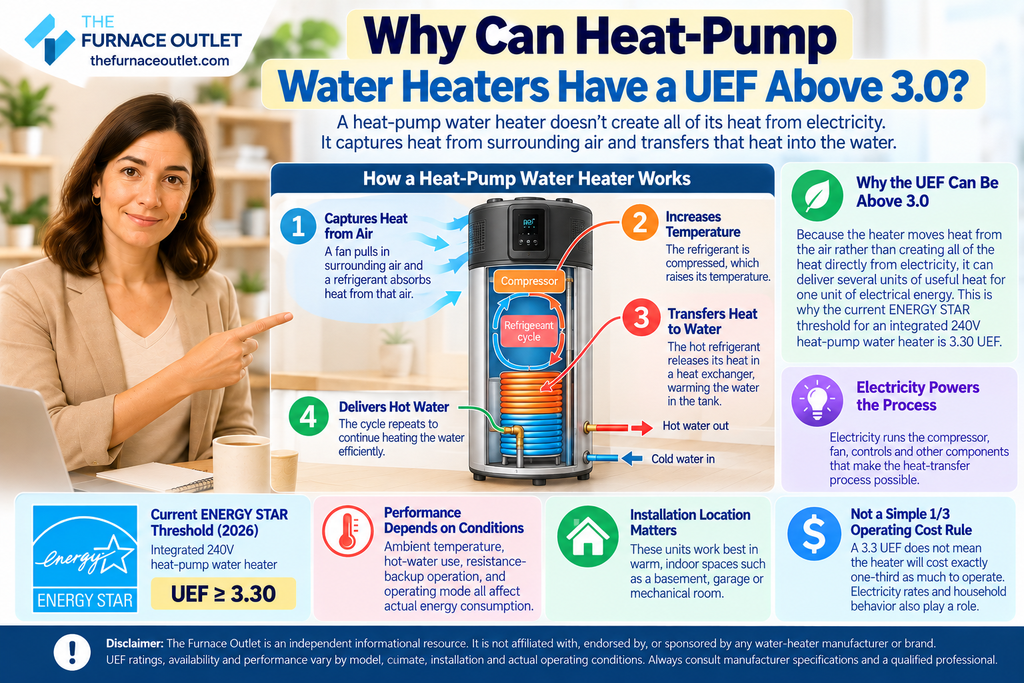
A UEF above 3.0 can initially seem impossible. If efficiency is about energy output compared with energy input, how can a water heater deliver several units of useful heat for one unit of electricity?
The answer is that a heat-pump water heater does not create all of its heat directly from electricity. Instead, it uses a refrigeration cycle to capture heat from surrounding air and transfer that heat into the water. Electricity powers the compressor, fan, controls, and other components that make the heat-transfer process possible.
That operating principle allows a heat-pump water heater to deliver substantially more heat to the water than would be provided by converting its electrical input directly into heat through resistance elements alone. It is one reason the current ENERGY STAR threshold for an integrated 240V heat-pump water heater is 3.30 UEF.
I would still avoid turning a 3.3 UEF into a promise that the heater will cost exactly one-third as much to operate as another appliance. Ambient temperature, hot-water consumption, resistance-backup operation, operating mode, installation location, electricity rates, and household behavior can all influence actual consumption.
A conventional gas storage water heater keeps a tank of water hot and reheats it as necessary. Energy can be lost through the tank and through the combustion and venting process, so improvements in insulation, heat traps, burner design, and heat-exchanger technology can raise efficiency.
ENERGY STAR explains that some higher-efficiency gas storage models improve on conventional designs through better insulation, heat traps, and more efficient burners. More advanced condensing designs use a secondary heat exchanger to recover additional heat from combustion gases. Because the exhaust is cooled enough for water vapor to condense, these systems require appropriate condensate management and venting.
For current ENERGY STAR certification, gas storage heaters between more than 20 and 55 gallons require at least 0.81 UEF under the medium draw pattern or 0.86 under the high draw pattern. Qualifying models above 55 gallons require at least 0.86 UEF.
Those numbers give me a useful high-efficiency benchmark within the gas-storage category. I would still compare First-Hour Rating, tank capacity, installation requirements, venting, condensate requirements where applicable, warranty, and operating costs before deciding which model makes sense.
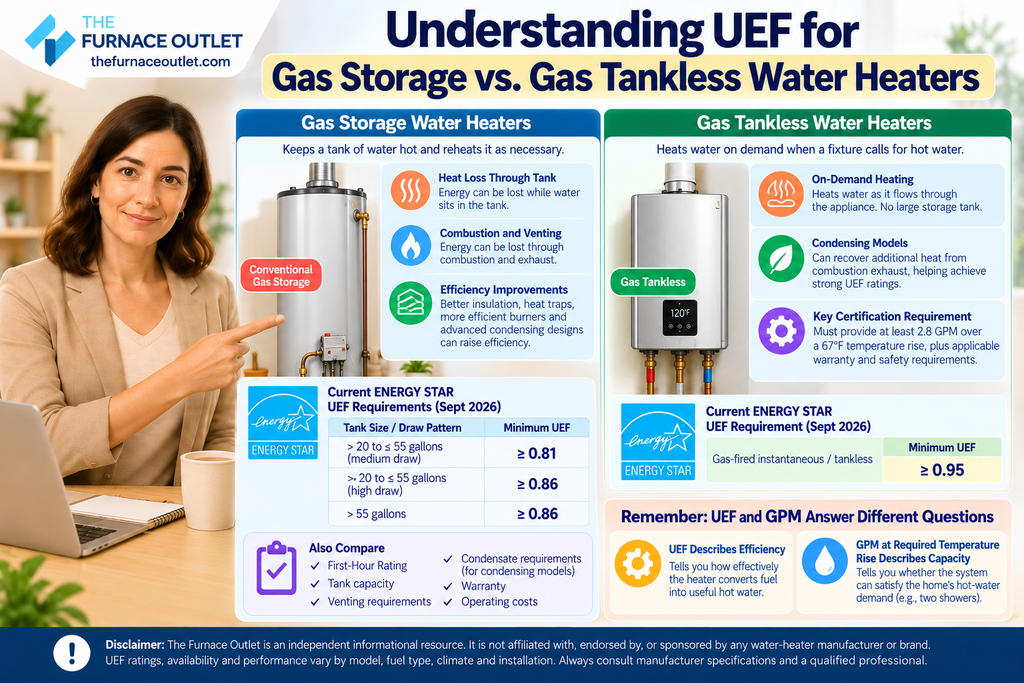
Gas tankless water heaters eliminate the large continuously heated storage tank. When a fixture calls for hot water, the heater senses flow and heats the water as it passes through the appliance. High-efficiency condensing tankless models can recover additional heat from combustion exhaust, helping them achieve strong UEF ratings.
Current ENERGY STAR certification requires a gas-fired instantaneous water heater to achieve at least 0.95 UEF. Certification also requires a maximum flow of at least 2.8 GPM over a standardized 67°F temperature rise, plus applicable warranty and safety requirements. I would therefore consider 0.95 an important current high-efficiency reference point for residential gas tankless equipment. However, a 0.95 UEF does not tell me whether the heater can serve two showers and another fixture simultaneously during winter.
For that question, I need the home’s required GPM and temperature rise. UEF describes efficiency; GPM at the required temperature rise describes whether the tankless system can satisfy the load. Those specifications complement rather than replace each other.
Heat-pump water heaters occupy a much higher numerical UEF range because they transfer environmental heat rather than relying exclusively on direct electric-resistance heating. For an integrated 240V model, the current ENERGY STAR threshold is 3.30 UEF, while qualifying integrated 120V/15A and split-system configurations currently require at least 2.20.
When comparing HPWHs, however, I would not simply sort the products from highest to lowest UEF and stop there. Tank capacity and First-Hour Rating matter because a highly efficient water heater still needs to satisfy the household’s busiest periods. Installation conditions also deserve attention because heat-pump operation interacts with the surrounding space.
I would therefore evaluate UEF alongside tank size, FHR, operating modes, installation-space requirements, condensate drainage, sound characteristics, electrical requirements, warranty, and the manufacturer’s recommended operating-temperature range. A slightly higher UEF does not automatically outweigh a configuration that fits the home and its hot-water pattern better.
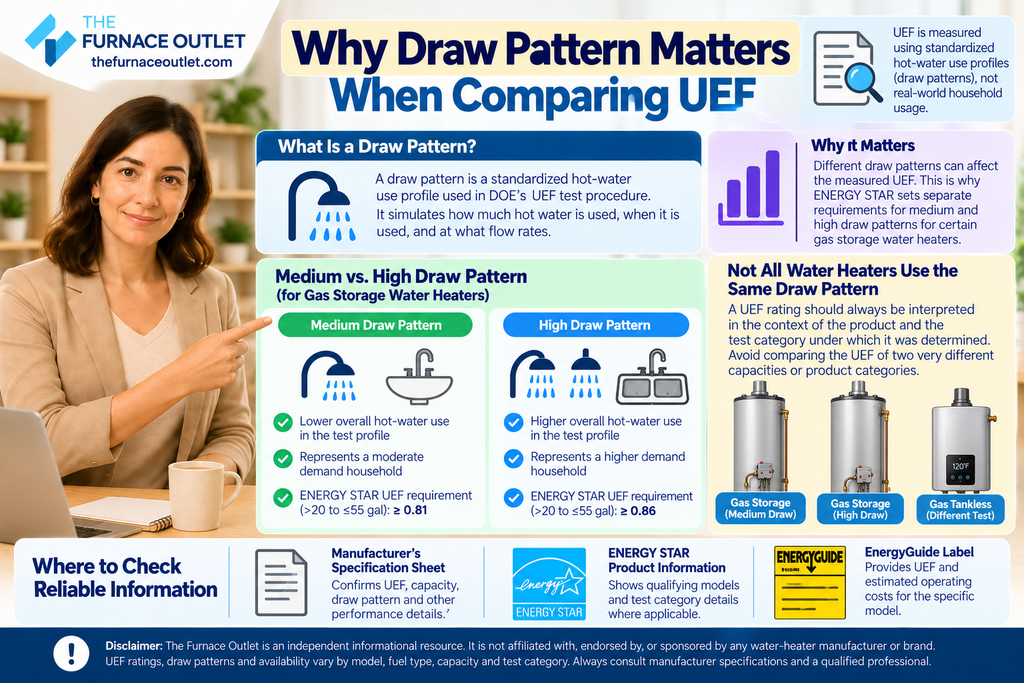
One detail that is easy to overlook is the draw pattern used in UEF testing. DOE’s standardized procedure subjects water heaters to defined hot-water use profiles rather than treating every appliance as though it serves the same demand pattern. ENERGY STAR’s current criteria explicitly distinguish medium and high draw patterns for certain gas storage water heaters.
This is another reason I would avoid casually comparing the UEF of two very different capacities or product categories. A rating should be interpreted in the context of the product and the test category under which it was determined.
When comparing exact models, I would check the manufacturer’s specification sheet, ENERGY STAR product information where applicable, and the EnergyGuide label. Those sources provide a more reliable foundation than a retailer’s simplified product title or an isolated efficiency claim.
UEF and First-Hour Rating answer different questions. UEF measures standardized energy efficiency, while FHR estimates the maximum amount of hot water a storage heater can supply during an hour beginning with the heater fully heated.
ENERGY STAR currently defines FHR as an estimate of the maximum volume of hot water that a storage heater can provide during that first hour, with the UEF test measuring FHR at a 125°F outlet temperature.
Imagine two storage water heaters where one has the higher UEF but insufficient first-hour performance for a household’s morning demand. The more efficient heater may still be the wrong size for that household. Conversely, choosing excessive hot-water capacity simply to avoid shortages can increase equipment size and cost unnecessarily. My goal would therefore be to find adequate FHR and strong UEF together, rather than allowing one specification to substitute for the other.
Tankless systems require the same separation between efficiency and capacity. UEF tells me how efficiently the appliance performs under standardized testing, while GPM tells me about its flow capability at a particular temperature rise. Current ENERGY STAR requirements illustrate the distinction clearly. A qualifying gas tankless heater needs at least 0.95 UEF, but it must separately meet a flow criterion of at least 2.8 GPM over a 67°F rise.
A real household may need considerably more than 2.8 GPM. If two showers operate simultaneously, for example, their combined flow alone can create a substantial requirement. I would calculate realistic simultaneous hot-water demand and winter temperature rise and then check the exact model’s manufacturer performance table.
A high UEF cannot compensate for insufficient heating capacity.
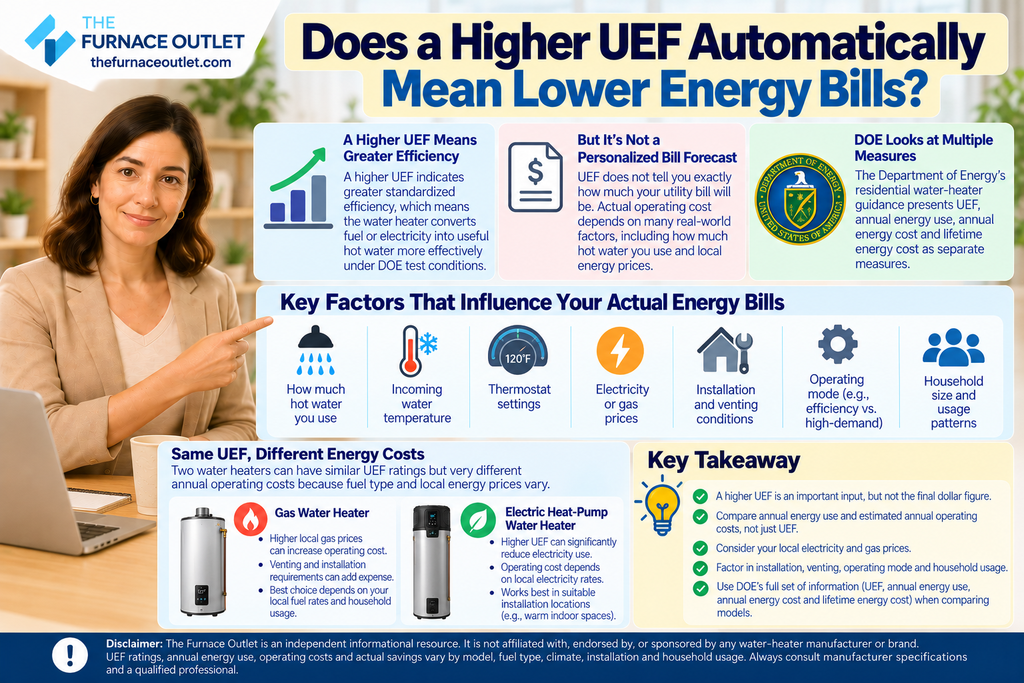
A higher UEF indicates greater standardized efficiency, but it does not provide a personalized utility-bill forecast. Actual operating cost depends on how much hot water the household uses, incoming-water temperature, thermostat settings, electricity or gas prices, installation, operating mode, and other factors.
DOE’s residential water-heater purchasing guidance makes this distinction useful by presenting UEF, annual energy use, annual energy cost, and lifetime energy cost as separate measures. In other words, efficiency is an important input to the economic comparison, but it is not itself the final dollar figure. The Department of Energy’s Energy.gov
Fuel type makes cross-technology comparisons particularly important. A gas heater and an electric heat-pump heater purchase energy in different forms and at different local prices. A homeowner deciding between technologies should therefore consider both efficiency and local utility economics rather than comparing UEF numbers alone.
UEF helps me compare efficiency, while the familiar yellow EnergyGuide information is intended to make energy consumption and operating-cost comparisons easier for consumers. I would use both rather than expecting either one to answer every question.
When I see two comparable models, UEF helps identify which one performs more efficiently under the standardized test. Energy-use and operating-cost information then provides additional context for what that efficiency could mean financially under the assumptions used for the estimate.
Neither number guarantees what a particular family will spend. A household taking several long showers every day will use more hot water than a household with modest demand, regardless of the water heater’s laboratory efficiency. Local electricity and gas prices can also move the economics substantially.
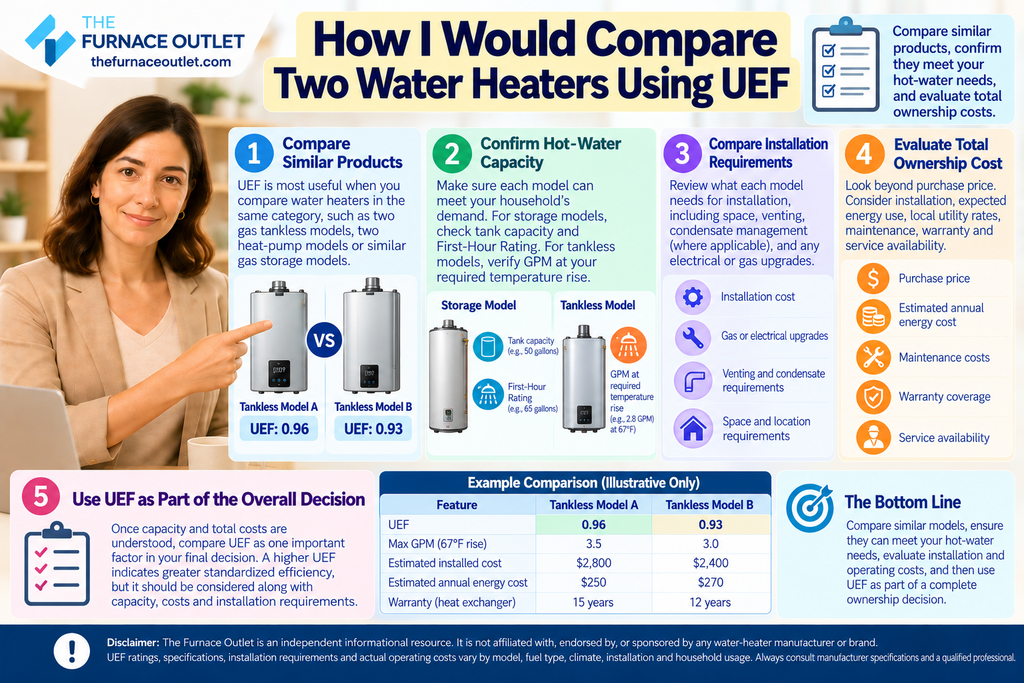
I would first make sure I am comparing appropriate products. If I am choosing between two gas tankless heaters, comparing their UEF values directly is useful. The same applies when comparing two similar heat-pump water heaters or appropriately classified gas storage models.
Next, I would confirm that each model provides enough hot water. For storage equipment, that means looking at tank capacity and First-Hour Rating. For tankless equipment, it means verifying GPM at the home’s required temperature rise. An efficient heater that cannot satisfy peak demand is not a successful selection.
After capacity, I would compare installation requirements and economics. That includes purchase price, professional installation, electrical or gas upgrades, venting, condensate handling, maintenance, expected energy consumption, local energy prices, warranty, and service availability. Only then does the efficiency comparison become part of a complete ownership decision.
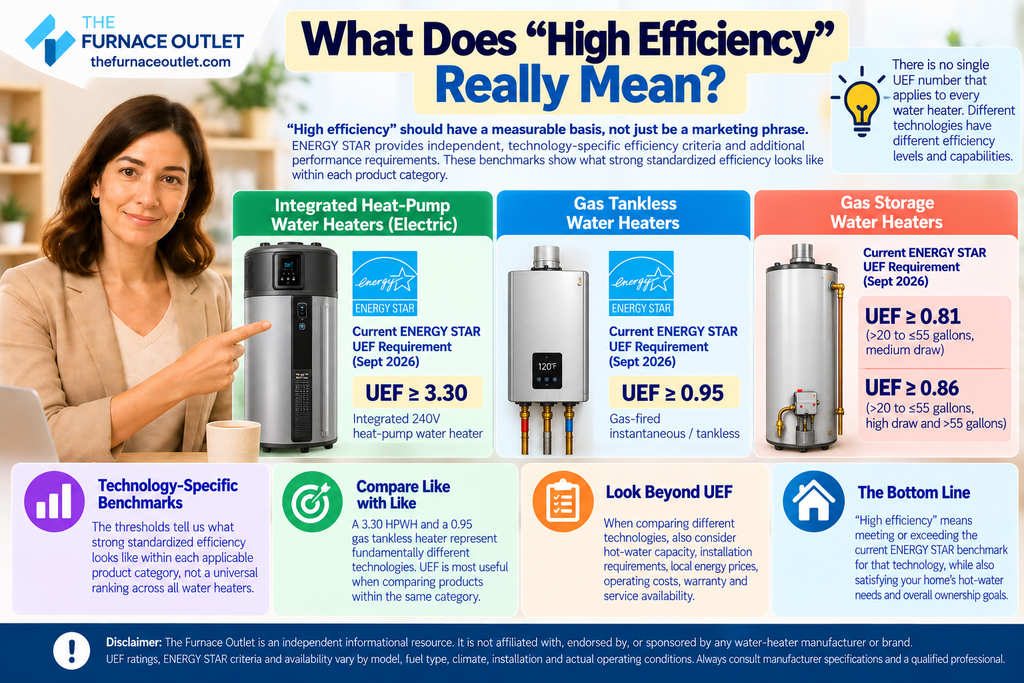
For me, “high efficiency” should have a measurable basis rather than being treated as a marketing phrase. The current ENERGY STAR thresholds provide a useful independent reference because they establish technology-specific efficiency criteria and additional performance requirements. As of September 2026, those benchmarks include 3.30 UEF for qualifying integrated 240V HPWHs, 0.95 for qualifying gas tankless heaters, and 0.81 or 0.86 for qualifying residential gas storage equipment depending on tank size and draw category.
I would not turn those thresholds into a universal ranking system. A 3.30 HPWH and a 0.95 gas tankless heater represent fundamentally different technologies. Instead, the thresholds tell us what strong standardized efficiency looks like within each applicable product category.
That is ultimately the most useful way to interpret UEF. Compare like with like first, then compare technologies using the broader factors that actually affect the home.
Yes, a higher UEF represents greater standardized energy efficiency, but the comparison is most meaningful among appropriate water-heater categories. I would not choose a water heater solely because it has the largest UEF number. Capacity, installation requirements, fuel type, operating costs, warranty, and household demand still need to be considered.
For residential gas tankless equipment, 0.95 is an important benchmark because it is the current minimum UEF required for ENERGY STAR certification. A 0.95 rating should not be interpreted the same way for a heat-pump water heater because the technologies operate differently and occupy very different UEF ranges.
A UEF around 3.0 indicates substantially different efficiency performance from conventional resistance water heating, but the current ENERGY STAR benchmark provides useful context. An integrated 240V HPWH currently needs at least 3.30 UEF to satisfy the program’s UEF criterion. I would therefore compare the exact product against the current threshold rather than using 3.0 as a permanent definition of “high efficiency.”
A heat-pump water heater uses electricity to transfer heat from surrounding air into the water rather than producing all of the heat through direct electric resistance. Because environmental heat contributes to the useful heat delivered to the water, the UEF can exceed 1.0 and can exceed 3.0 for modern residential HPWHs.
No. UEF primarily describes standardized energy efficiency. For a storage water heater, I would also examine tank capacity and First-Hour Rating. For a tankless heater, I would calculate simultaneous GPM and temperature rise and check the exact model’s performance under those conditions.
Not automatically. A higher UEF is attractive when the products are genuinely comparable, but a water heater must also fit the home’s demand, installation conditions, infrastructure, budget, and ownership priorities. The strongest choice is one that combines adequate hot-water delivery with appropriate efficiency and practical long-term economics.
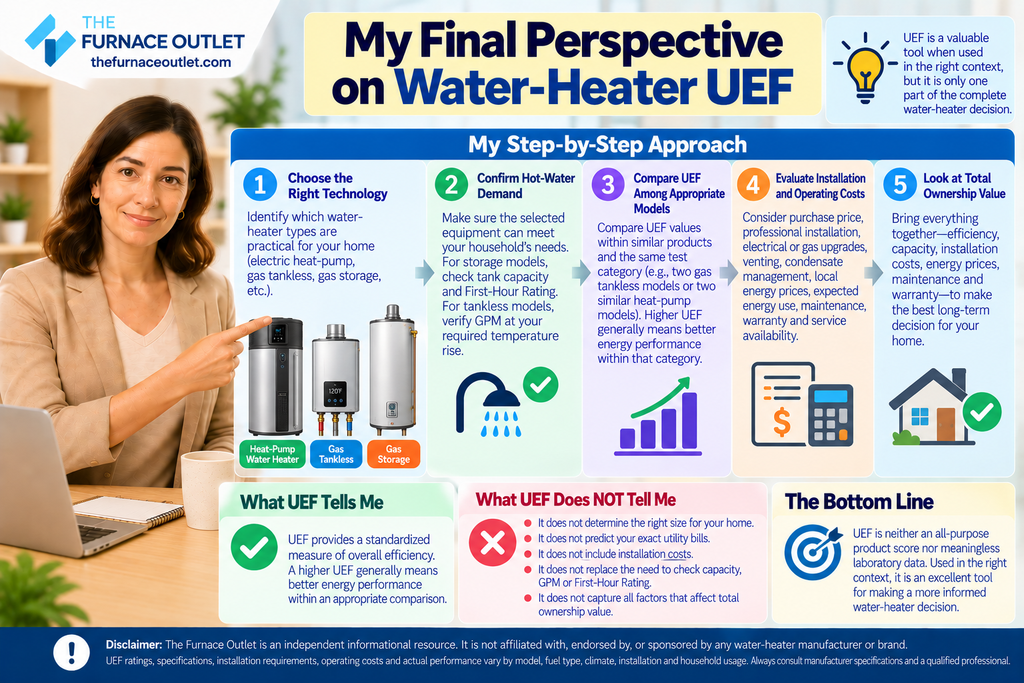
UEF is one of the most useful specifications on a modern water heater once we understand what it is designed to tell us. It provides a standardized measure of overall efficiency, and higher UEF generally means better energy performance within an appropriate comparison. What it does not provide is a complete answer about sizing, utility bills, installation cost, or total ownership value.
I would therefore use UEF as part of a sequence. First determine which water-heater technologies are practical for the home. Next make sure the equipment can meet realistic hot-water demand. Then compare UEF among appropriate models before examining installation costs, energy prices, maintenance, warranty, and long-term ownership economics.
That approach prevents two common mistakes: buying a water heater because it has the biggest efficiency number without understanding the technology, or ignoring efficiency because the rating seems too complicated. UEF is neither an all-purpose product score nor meaningless laboratory data. Used in the right context, it is an excellent tool for making a more informed water-heater decision.
For readers who want to verify current efficiency requirements or explore the testing framework in greater depth, these resources provide a strong starting point. The criteria can change over time, so I recommend checking the current versions when researching an actual purchase.
The Furnace Outlet is an independent informational and educational resource. It is not associated with, affiliated with, endorsed by, or sponsored by any manufacturer or brand discussed in this article, and it does not receive manufacturer compensation for inclusion or rankings.
Water-heater UEF ratings, ENERGY STAR criteria, federal efficiency requirements, specifications, operating costs, energy consumption, installation requirements, rebates, and product availability can change. Efficiency and cost also vary according to model, capacity, draw pattern, household hot-water demand, climate, incoming-water temperature, fuel or electricity prices, installation conditions, and operating settings. UEF is a standardized efficiency metric and should not be interpreted as a guarantee of household energy consumption, utility savings, payback, or hot-water availability. Verify the specifications and certification status of the exact equipment being considered and use appropriately qualified plumbing, electrical, gas, or HVAC professionals where required for sizing and installation.