Newsletter Subscribe
Enter your email address below and subscribe to our newsletter

HVAC made simple
When homeowners ask me whether a tank or tankless water heater is better, I usually tell them that the question needs one extra phrase: better for what kind of home? A tankless water heater can be an excellent solution for one household and an unnecessarily complicated upgrade for another. A conventional storage water heater may look less sophisticated, yet it can deliver excellent comfort when its tank capacity and first-hour rating are properly matched to the household.
I’m Savvy Mavi, Savvy the Sustainability Expert, so energy efficiency naturally matters to me. Tankless water heaters have an important efficiency advantage because they heat water on demand rather than continuously maintaining a tank of hot water. However, efficiency is only part of the decision. Installation cost, household demand, fuel availability, available space, water temperature, maintenance, electrical or gas infrastructure, and long-term ownership costs can all change which system makes more sense.
There is another important distinction to establish before we begin. “Tank” covers several technologies, including conventional gas storage, electric resistance storage, and increasingly important heat-pump water heaters. Likewise, tankless systems can be gas-fired or electric. This comparison therefore focuses primarily on the fundamental difference between storing hot water and heating it on demand, while explaining where the different technologies change the equation.
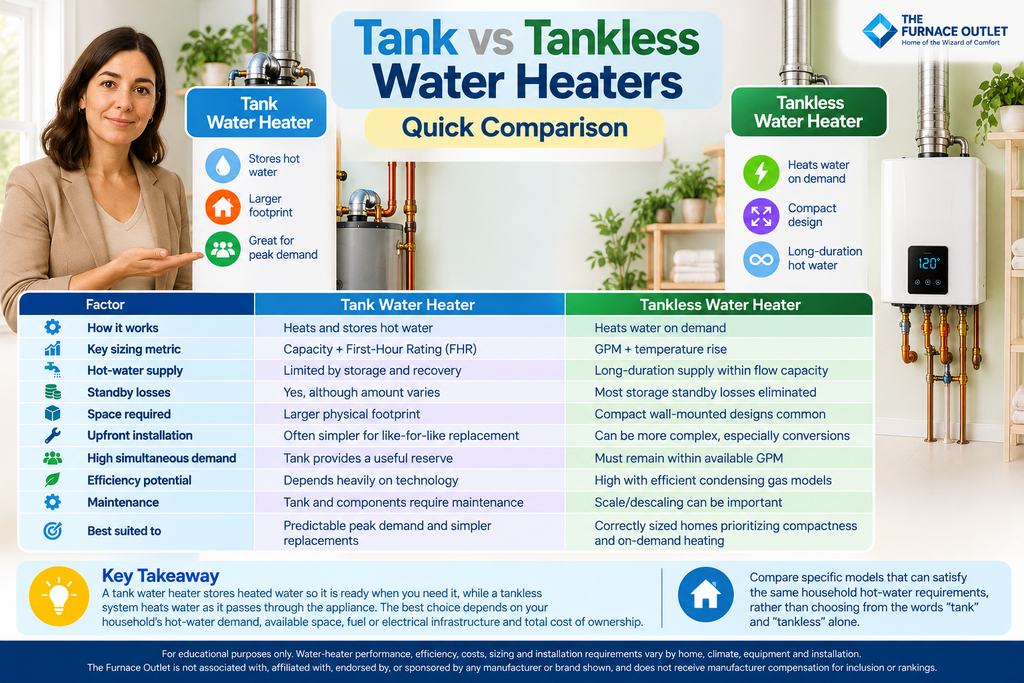
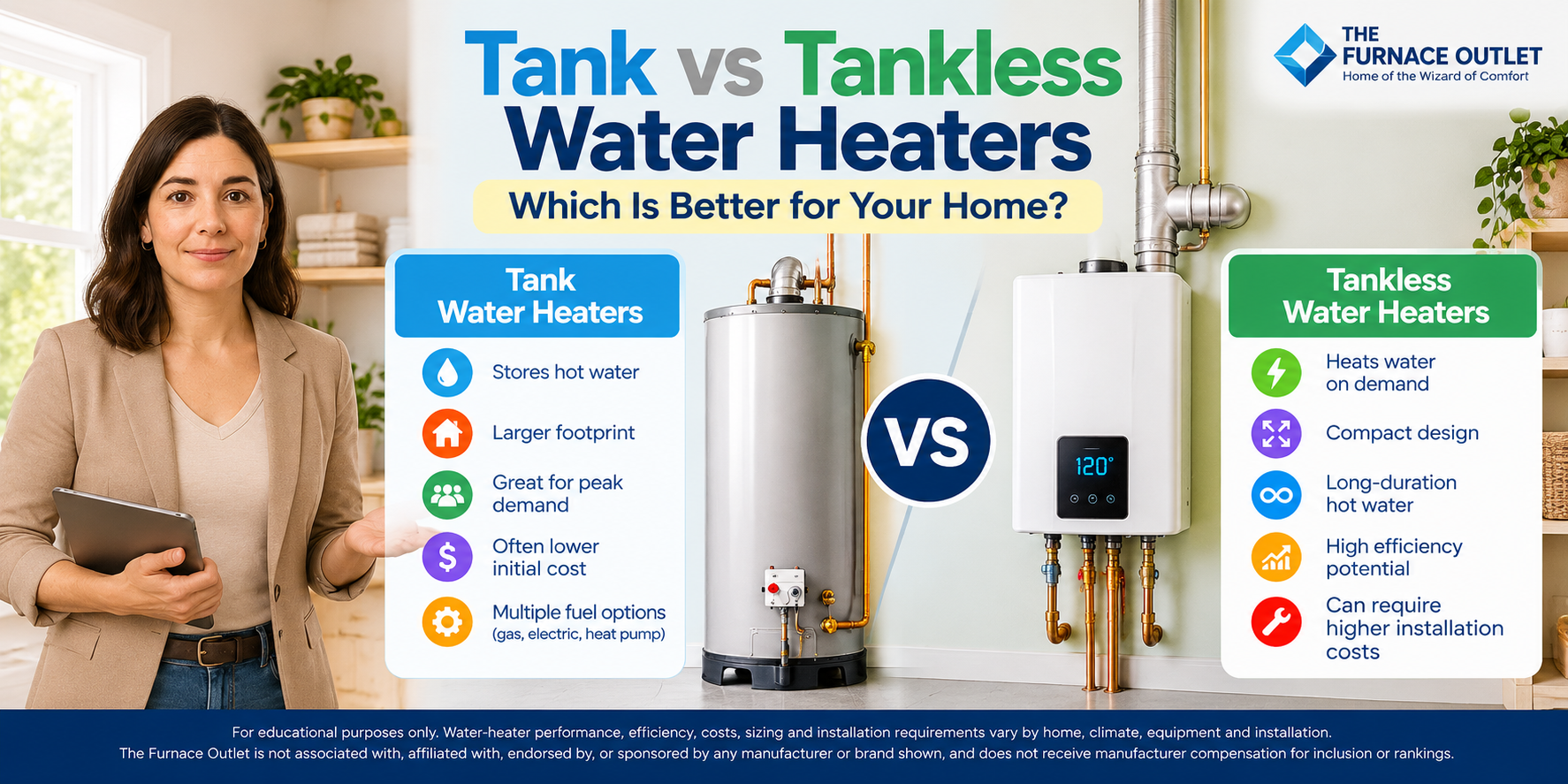
If you want the short version, a tank water heater stores heated water so it is ready when you need it, while a tankless system heats water as it passes through the appliance. ENERGY STAR defines storage water heaters around their stored hot-water capacity and instantaneous systems around their ability to produce hot water continuously at a specified flow rate. ENERGY STAR
| Factor | Tank Water Heater | Tankless Water Heater |
|---|---|---|
| How it works | Heats and stores hot water | Heats water on demand |
| Key sizing metric | Capacity + First-Hour Rating (FHR) | GPM + temperature rise |
| Hot-water supply | Limited by storage and recovery | Long-duration supply within flow capacity |
| Standby losses | Yes, although amount varies | Most storage standby losses eliminated |
| Space required | Larger physical footprint | Compact wall-mounted designs common |
| Upfront installation | Often simpler for like-for-like replacement | Can be more complex, especially conversions |
| High simultaneous demand | Tank provides a useful reserve | Must remain within available GPM |
| Efficiency potential | Depends heavily on technology | High with efficient condensing gas models |
| Maintenance | Tank and components require maintenance | Scale/descaling can be important |
| Best suited to | Predictable peak demand and simpler replacements | Correctly sized homes prioritizing compactness and on-demand heating |
I would therefore avoid making the decision from the words “tank” and “tankless” alone. The real comparison is between two specific systems that can satisfy the same household’s hot-water requirements.
A storage water heater maintains a reservoir of heated water. When someone opens a hot-water faucet, heated water leaves the tank while cold replacement water enters and is subsequently reheated. Depending on the equipment, heat may come from gas combustion, electric resistance elements, or a heat pump.
The major advantage is the stored reserve. If several people need hot water during a busy morning, the household can draw from water that has already been heated. The heater then works to recover the temperature of the replacement water.
This is why I do not size a tank water heater from gallon capacity alone. First-Hour Rating, or FHR, is particularly important because it estimates how much hot water a fully heated storage water heater can supply during the first hour of use. ENERGY STAR explicitly recommends considering both capacity and FHR when estimating how much hot water a storage system can provide during a busy period.
A 50-gallon tank should therefore not automatically be assumed to perform exactly like every other 50-gallon tank.
A tankless water heater takes the opposite approach. Instead of keeping dozens of gallons heated and waiting for use, the appliance activates when hot water is requested. Water flows through a heat exchanger, where it is heated before traveling to the fixture.
This largely eliminates the standby losses associated with maintaining a conventional storage tank. DOE notes that demand-type water heaters provide hot water only when needed and therefore avoid the standby energy losses associated with storage water heaters. DOE has also reported that in homes using 41 gallons or less of hot water daily, demand systems can be 24%–34% more energy efficient than conventional storage-tank water heaters, although actual results depend on the installation and usage. The Department of Energy’s Energy.gov
That sounds like an automatic victory for tankless, but there is a limitation that matters enormously: instantaneous heating capacity.
A tankless heater can continue producing hot water for a long time, but only up to the flow rate it can heat at the required temperature rise. It does not provide unlimited gallons per minute.
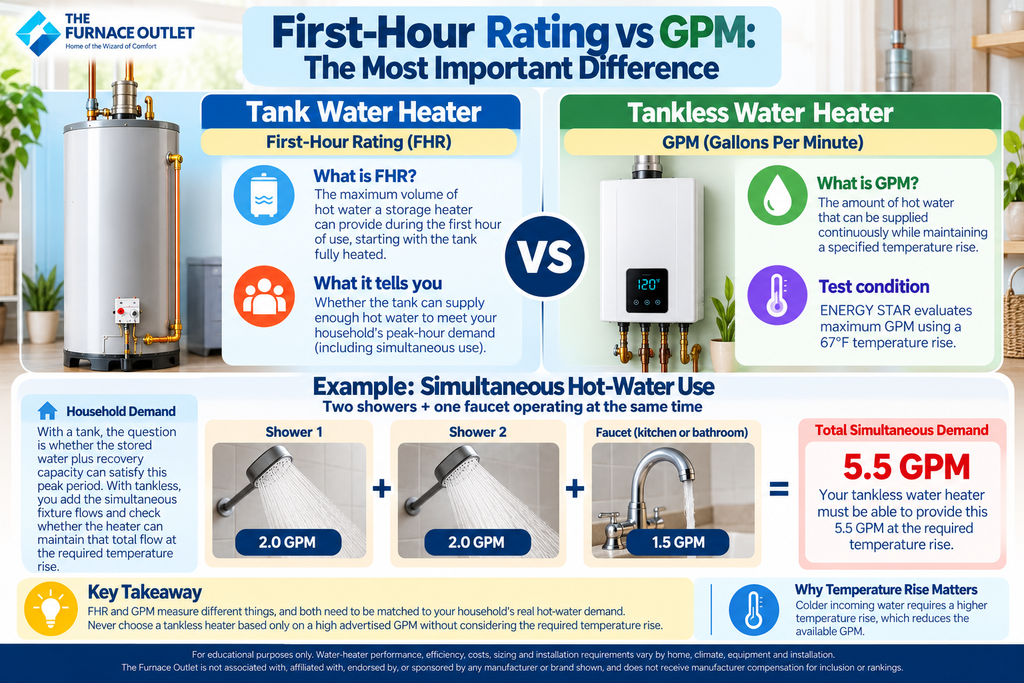
This is probably the single most useful technical distinction for homeowners to understand.
For a storage water heater, I primarily want to know whether its First-Hour Rating can satisfy the household’s peak-hour demand. For a tankless water heater, I want to know whether its GPM capacity at the required temperature rise can satisfy simultaneous demand.
ENERGY STAR defines FHR as the maximum volume of hot water a storage heater can provide during an hour beginning with the heater fully heated. For instantaneous systems, GPM represents the amount of hot water that can be supplied while maintaining a specified temperature rise; ENERGY STAR’s current test criteria use a 67°F temperature rise when evaluating maximum GPM.
Consider a household where two showers could operate while someone uses a hot-water faucet. With a tank, the question becomes whether the stored water plus recovery capacity can satisfy that peak period. With tankless, you add the simultaneous fixture flows and determine whether the heater can maintain that flow while raising the incoming water to the desired outlet temperature.
This is why a tankless heater advertised at a high maximum GPM should never be selected from that number alone.
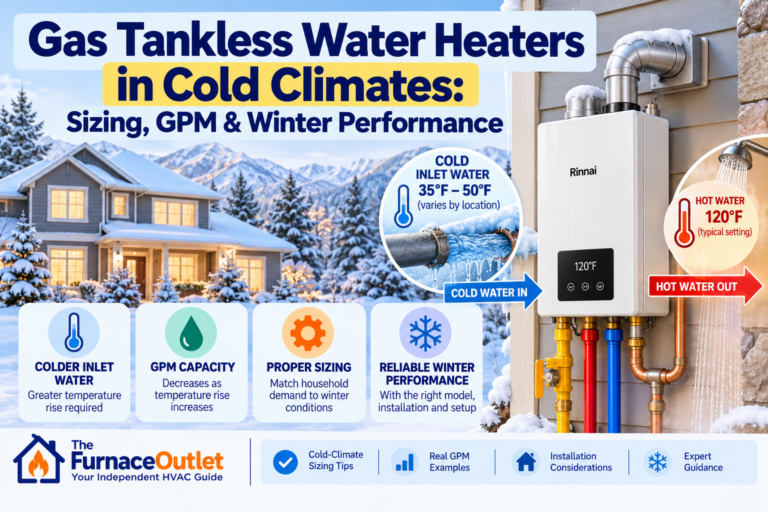
Imagine that you want 120°F water. If the incoming water is 70°F, the heater needs to produce a 50°F temperature rise. If the incoming water is only 40°F, it must produce an 80°F rise.
Heating each gallon by 80°F requires substantially more energy than heating it by 50°F, so the tankless heater’s available flow falls as the required temperature rise increases.
That means two identical tankless systems installed in different climates can provide noticeably different practical flow during colder conditions. Household sizing should therefore use realistic incoming-water temperatures rather than maximum brochure numbers.
ENERGY STAR similarly advises sizing whole-home tankless gas systems around GPM rather than tank capacity.
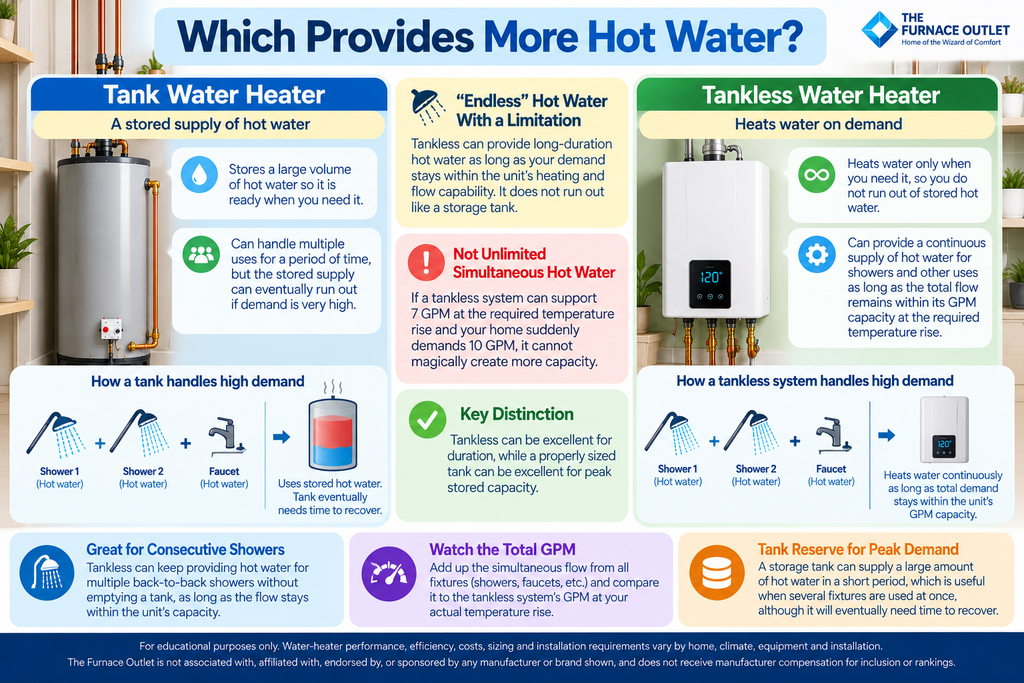
Tankless is frequently marketed as providing “endless hot water.” That description is useful but incomplete.
A correctly sized tankless system can continue heating water as long as the household remains within the unit’s heating and flow capability. You do not empty a stored tank and then wait for it to recover. That can be extremely attractive for households taking several consecutive showers.
However, tankless does not mean unlimited simultaneous hot water. If the system can support the required temperature rise at 7 GPM and the household suddenly demands 10 GPM, the heater cannot magically create the additional capacity.
A storage tank works differently. Its stored hot water can provide substantial short-term output, but eventually the stored supply can be depleted faster than the heater recovers.
This gives us a useful distinction: tankless can be excellent for duration, while a properly sized tank can be excellent for peak stored capacity.
Against a conventional gas or electric storage heater, tankless can have an important efficiency advantage because it avoids most storage standby losses. But the answer becomes more complicated once modern high-efficiency tank technologies enter the comparison.
ENERGY STAR’s current criteria illustrate the difference. Certified gas-fired instantaneous water heaters must meet a UEF of at least 0.95, while certified gas-fired storage heaters have different UEF thresholds depending on tank volume and draw pattern.
UEF, or Uniform Energy Factor, is the standardized measure used to compare water-heater efficiency. Higher values indicate greater efficiency under the applicable DOE test procedure, although fuel prices and household usage determine actual operating costs.
There is also a major exception to the simple “tankless is more efficient” narrative: heat-pump water heaters. Current ENERGY STAR criteria require a UEF of at least 3.30 for qualifying integrated 240-volt heat-pump water heaters. Because heat pumps transfer environmental heat rather than generating all of their heat through resistance, they can reach efficiency levels that fundamentally change the tank-versus-tankless discussion.
So if sustainability is the goal, I would compare tankless vs heat pump, not merely tankless vs an old-fashioned resistance tank.
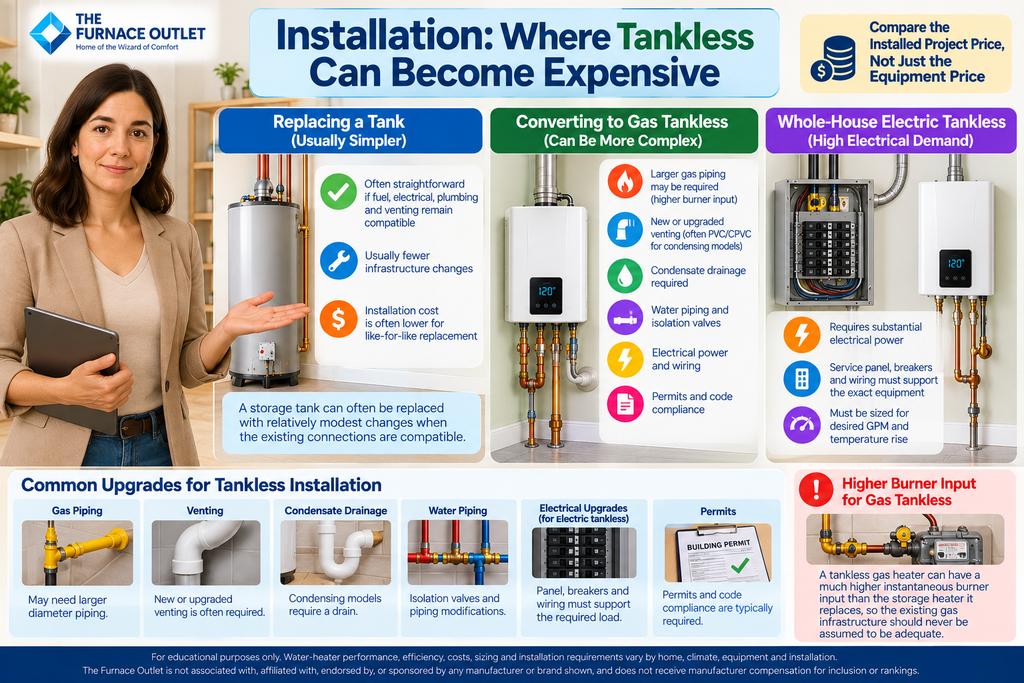
A tankless appliance looks compact on the wall, which can create the impression that installation must also be simple. That is not always true.
Replacing an existing tank with a similar storage unit may require relatively modest changes if the fuel, electrical supply, plumbing and venting remain compatible. Converting to gas tankless can involve changes to gas piping, venting, condensate drainage, water piping, isolation valves, electrical power and permitting.
A tankless gas heater may have a much higher instantaneous burner input than the storage heater it replaces, so the existing gas infrastructure should never be assumed to be adequate.
Whole-house electric tankless systems create a different challenge. Heating several gallons of water every minute without stored thermal energy can require substantial electrical power. The service panel, breakers and wiring need to support the exact equipment.
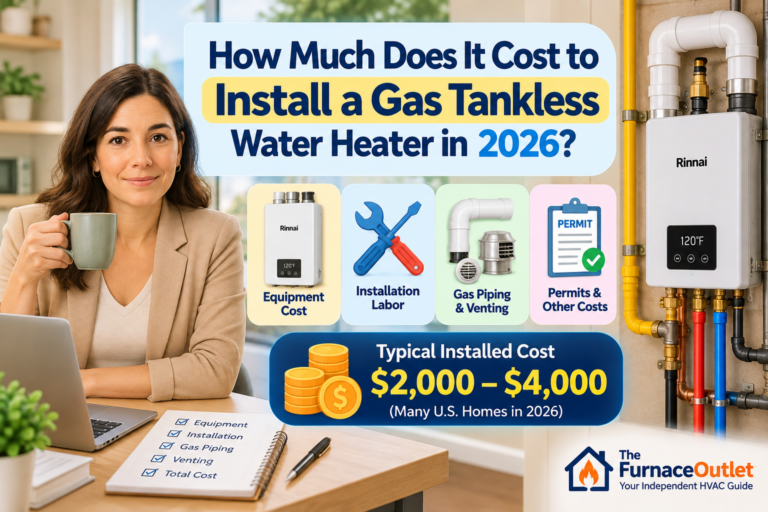
This is why I compare installed project price, not equipment price.
Tankless equipment has one straightforward advantage when floor space is scarce. Many systems mount on a wall and occupy considerably less usable space than a conventional storage tank.
That can matter in smaller houses, utility closets, renovations and other locations where every square foot counts.
A tank water heater requires room for the cylinder and associated plumbing, while heat-pump tanks can be taller and may also require sufficient surrounding air or ducting arrangements depending on the model and installation.
Tankless therefore deserves serious consideration when reclaiming floor space is an important project goal, provided the home’s infrastructure and hot-water demand are compatible with it.
Large households are where sizing becomes particularly important.
Suppose four or five family members take showers during a concentrated morning period. A tankless system can be attractive because consecutive showers do not necessarily exhaust a stored reservoir. However, if several showers operate simultaneously, the tankless system must have enough GPM at the actual temperature rise to serve them.
A large storage heater takes the opposite approach. Its reserve can absorb a substantial peak, after which recovery becomes important.
There is also a third option I would strongly consider: a 65- or 80-gallon heat-pump water heater. ENERGY STAR specifically recommends considering larger HPWH tanks for households with high hot-water draw periods because additional storage can reduce reliance on less-efficient resistance backup.
For a large household, I therefore would not automatically declare tankless the winner. I would calculate the demand and compare a high-capacity tankless system with a correctly sized high-efficiency storage alternative.
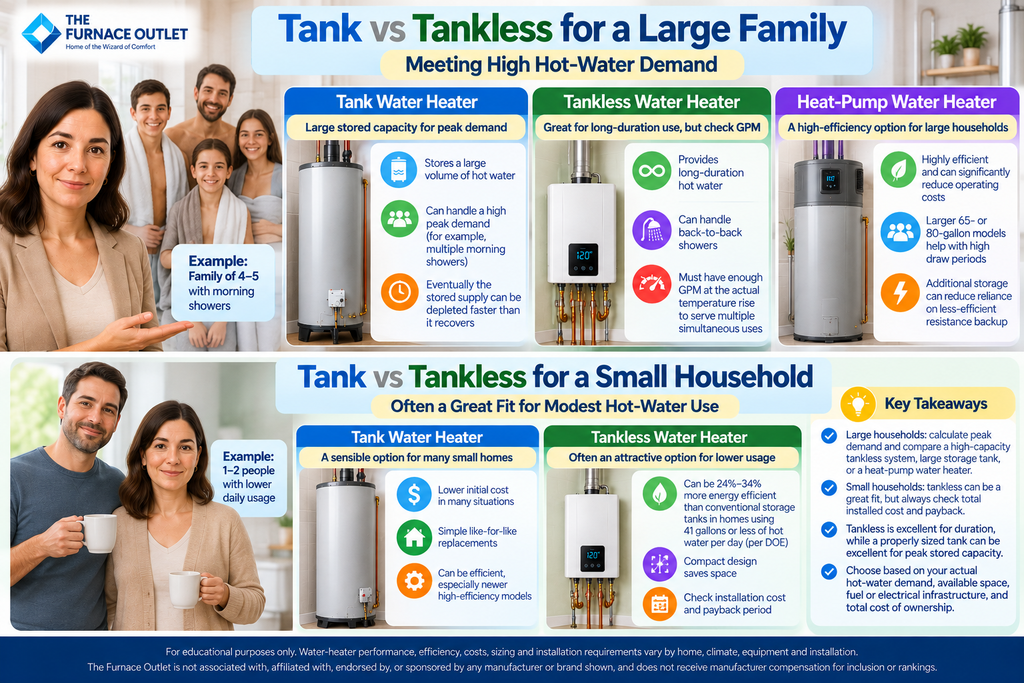
Tankless can be particularly appealing for a household with modest hot-water use because there is less reason to maintain a large reservoir throughout the day.
DOE’s finding that demand heaters can be 24%–34% more energy efficient than conventional storage tanks in homes using 41 gallons or less of hot water per day helps illustrate that potential, although that figure should not be treated as a guaranteed household saving. The Department of Energy’s Energy.gov
However, a small household should still calculate the payback. If converting to tankless requires expensive gas, venting or electrical work, energy savings may take many years to recover the additional initial investment.
Sometimes a modest, efficient storage system is the economically sensible answer.
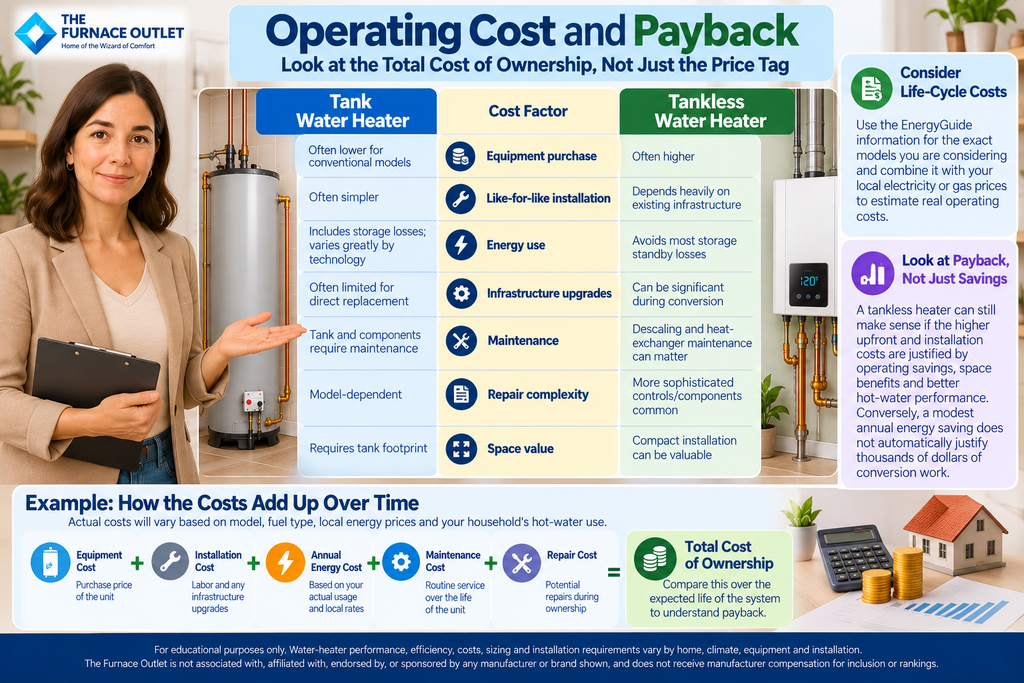
I never compare water heaters using efficiency percentages alone. The question that matters financially is how much the system will cost to own.
| Cost Factor | Tank | Tankless |
|---|---|---|
| Equipment purchase | Often lower for conventional models | Often higher |
| Like-for-like installation | Often simpler | Depends heavily on existing infrastructure |
| Energy use | Includes storage losses; varies greatly by technology | Avoids most storage standby losses |
| Infrastructure upgrades | Often limited for direct replacement | Can be significant during conversion |
| Maintenance | Tank/component maintenance | Descaling and heat-exchanger maintenance can matter |
| Repair complexity | Model-dependent | More sophisticated controls/components common |
| Space value | Requires tank footprint | Compact installation can be valuable |
I would take the EnergyGuide information for the exact systems being considered and combine it with local electricity or gas prices. DOE’s water-heating guidance similarly emphasizes life-cycle economics rather than simply purchasing the lowest-priced appliance. The Department of Energy’s Energy.gov
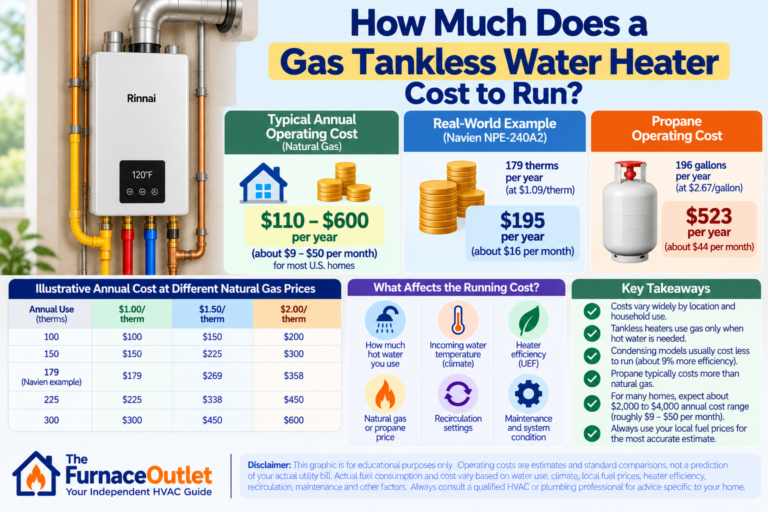
A tankless heater costing substantially more to install can still make sense if its operating savings, space benefits and hot-water performance justify that investment. Conversely, saving a modest amount of energy each year does not automatically justify thousands of dollars of conversion work.
Storage water heaters may accumulate sediment, and applicable tank designs can require attention to corrosion protection such as sacrificial anodes. Water quality plays a significant role in how quickly deposits and corrosion become concerns.
Tankless systems eliminate the storage tank but not maintenance. Mineral scale can accumulate inside the heat exchanger, particularly in hard-water areas, making periodic flushing or descaling important according to the manufacturer’s instructions.
I would therefore ask about local water hardness before selecting either technology. A sophisticated high-efficiency water heater operating with difficult water chemistry needs an appropriate maintenance strategy if you want it to deliver its intended performance over the long term.
Rather than choosing a universal winner, I would match the system to the household.
| Your Situation | Technology I Would Investigate First |
|---|---|
| Existing tank works well and budget is limited | Efficient like-for-like storage replacement |
| Want long-duration hot water | Properly sized tankless |
| Several fixtures operate simultaneously | Compare high-FHR storage with high-capacity tankless |
| Very limited floor space | Tankless |
| Existing electric resistance tank | Compare a heat-pump water heater before choosing either conventional tank or tankless |
| Existing gas infrastructure | Compare efficient gas storage and condensing tankless |
| Expensive tankless conversion required | Calculate payback before converting |
| Sustainability is the priority | Compare HPWH and high-efficiency tankless using local energy conditions |
| Large household | Calculate peak demand before choosing |
| Small household with modest demand | Tankless may be attractive, but verify conversion economics |
My approach is therefore not tank versus tankless in isolation. It is demand versus capacity, installation cost versus operating cost, and efficiency versus practical household needs.
Not universally. Tankless systems can reduce standby losses, save space and provide long-duration hot water when properly sized. Storage heaters can have lower replacement complexity and provide a useful reserve for high short-term demand. The better option depends on household demand, fuel availability, installation cost and infrastructure.
It can provide long-duration hot water, but not unlimited flow. Every tankless heater has a maximum heating capacity. If simultaneous demand exceeds its available GPM at the required temperature rise, the system cannot maintain unlimited output.
First-Hour Rating estimates how much hot water a fully heated storage water heater can supply during the first hour. ENERGY STAR uses FHR as an important performance metric for storage water heaters.
GPM means gallons per minute. For tankless equipment, it indicates hot-water flow capability, but the figure must always be considered alongside temperature rise. ENERGY STAR evaluates instantaneous-water-heater GPM using a specified temperature-rise condition.
It can. DOE notes that demand water heaters eliminate the standby losses associated with storage tanks and reports potential efficiency advantages for households with relatively low daily hot-water consumption. Actual savings depend on equipment, fuel prices, usage and installation. The Department of Energy’s Energy.gov
It can be excellent for consecutive hot-water use, but large households with substantial simultaneous demand require careful GPM sizing. A large high-FHR storage heater or properly sized heat-pump water heater may also perform extremely well.
Not without checking the home’s electrical capacity. Whole-house electric tankless equipment can require substantial instantaneous electrical power, so panel capacity, breakers, conductors and installation cost should be evaluated before making the switch.
Absolutely, particularly if you currently use electric resistance water heating. ENERGY STAR’s current efficiency requirements illustrate how much more efficient qualifying heat-pump technology can be, and larger HPWH tanks can help handle high-demand periods efficiently.
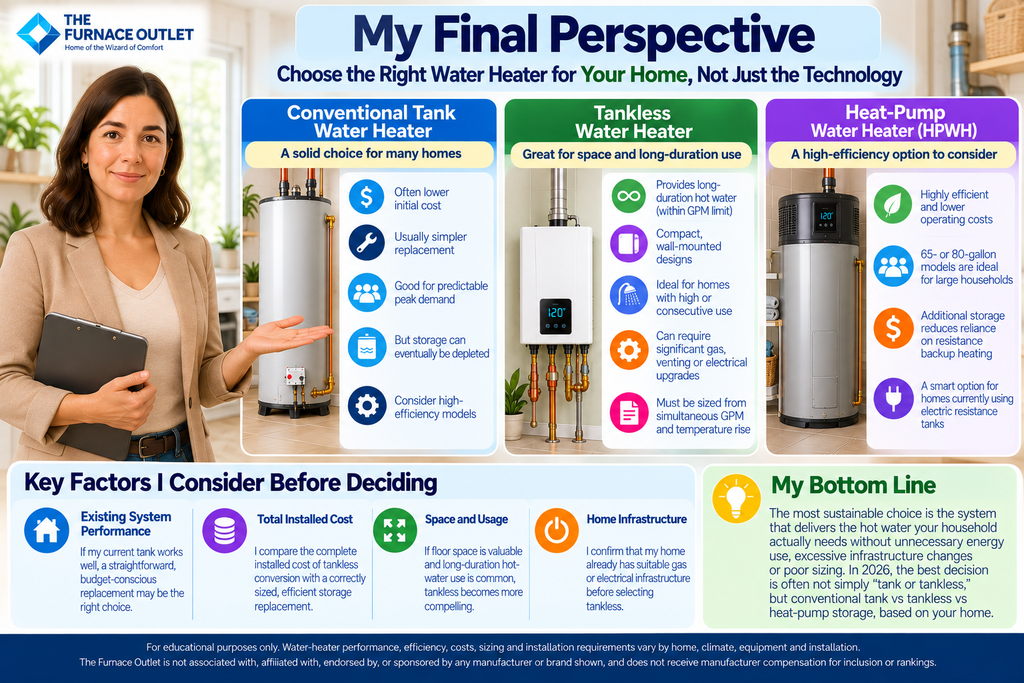
If my existing storage water heater performed well and I wanted a straightforward, budget-conscious replacement, I would not switch to tankless simply because the technology sounds more modern. I would compare the cost of a correctly sized, efficient storage replacement with the complete installed cost of the tankless conversion and calculate whether the benefits justify the difference.
If floor space were valuable, long-duration hot-water use were common, and the home already had suitable gas or electrical infrastructure, tankless would become much more compelling. I would size it from simultaneous GPM and realistic temperature rise, not from household size or maximum advertised flow alone.
For a home currently using an electric resistance tank, I would add a third candidate before making the decision: a heat-pump water heater. Modern HPWH efficiency means the smartest comparison in 2026 is often not simply “tank or tankless,” but conventional tank vs tankless vs heat-pump storage.
The most sustainable choice is ultimately the system that delivers the hot water your household actually needs without unnecessary energy use, excessive infrastructure changes or poor sizing. Choose the technology after understanding the home, rather than trying to make the home fit the technology.
For additional research, I recommend the ENERGY STAR Residential Water Heater Criteria for current definitions and efficiency requirements, ENERGY STAR Whole-Home Tankless Gas Water Heater guidance for tankless selection considerations, and the U.S. Department of Energy water-heater efficiency guidance for life-cycle energy-cost comparisons. Homeowners considering heat-pump storage should also review ENERGY STAR’s Heat Pump Water Heater Design Considerations, particularly its guidance on tank sizing and peak demand.
The Furnace Outlet is an independent informational and educational resource. It is not associated with, affiliated with, endorsed by, or sponsored by any water-heater manufacturer or brand discussed in this article, and it does not receive manufacturer compensation for inclusion or rankings.
Water-heater performance, UEF, FHR, GPM, costs, savings, warranties and installation requirements vary by exact model, household demand, incoming-water temperature, energy prices, climate, water quality and installation. Always verify current manufacturer specifications and local code requirements for the exact equipment being considered. Gas, electrical, venting and plumbing work should be performed by appropriately qualified or licensed professionals where required. This article is educational and does not replace manufacturer instructions, professional sizing, permits or applicable plumbing, fuel-gas and electrical codes.