Newsletter Subscribe
Enter your email address below and subscribe to our newsletter

HVAC made simple
By Samantha Reyes — the Smart Shopper
When I first heard an HVAC contractor describe an air conditioner as “three tons,” I pictured an enormous machine sitting beside the house. Fortunately, AC tonnage has nothing to do with how much the equipment weighs. It describes how much cooling capacity the system can provide.
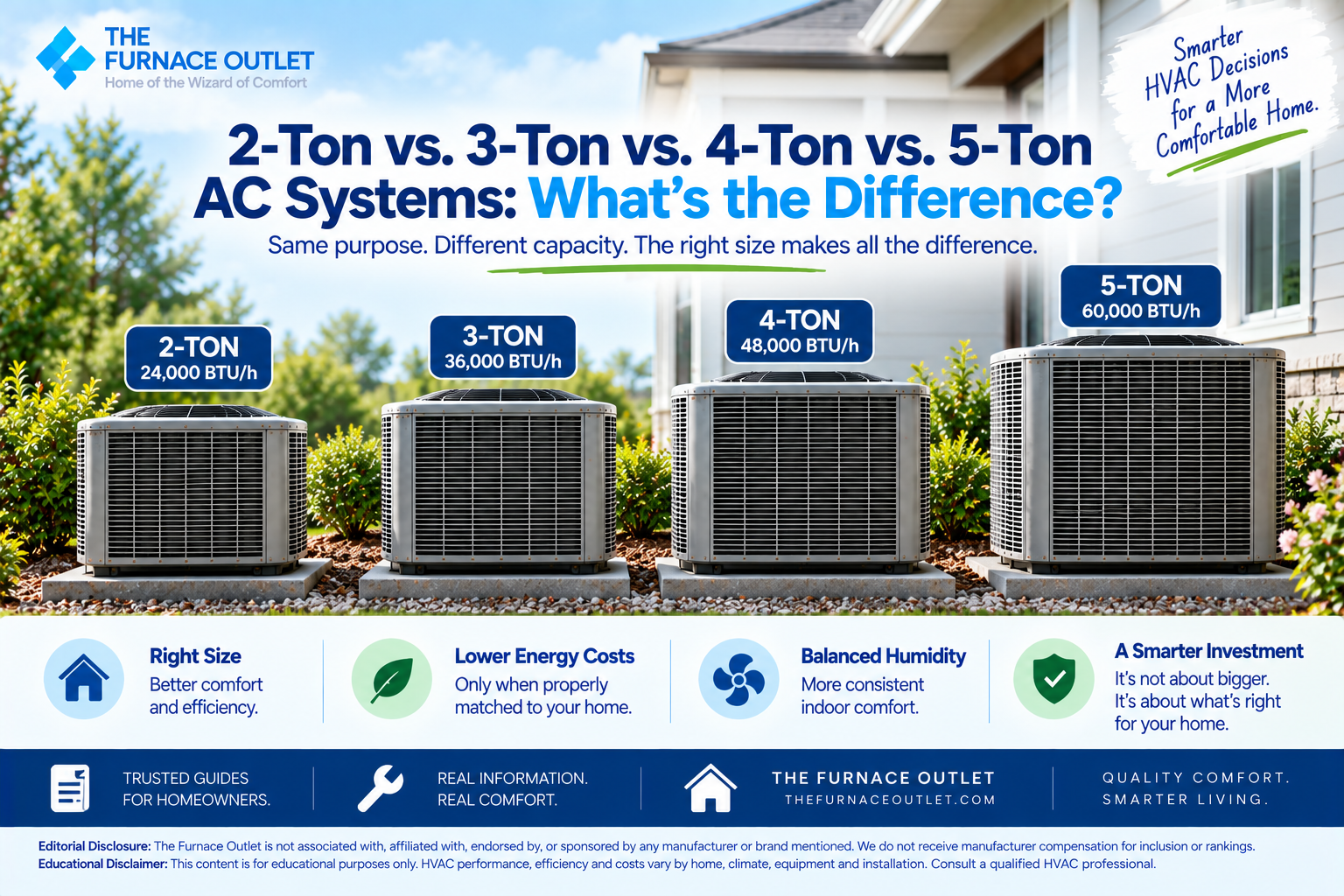
Understanding the difference between a 2-ton, 3-ton, 4-ton and 5-ton central air conditioner is useful when you’re replacing an HVAC system because capacity has a major influence on comfort. What homeowners need to resist, however, is turning tonnage into a ranking system. A 5-ton air conditioner isn’t automatically better than a 3-ton system any more than an oversized pair of shoes is better than one that fits properly.
The objective is to match the equipment’s cooling capacity to the cooling requirements of your particular home. Let’s look at what those tonnage numbers actually mean, why homes require different capacities and what you should ask before accepting a contractor’s recommendation.
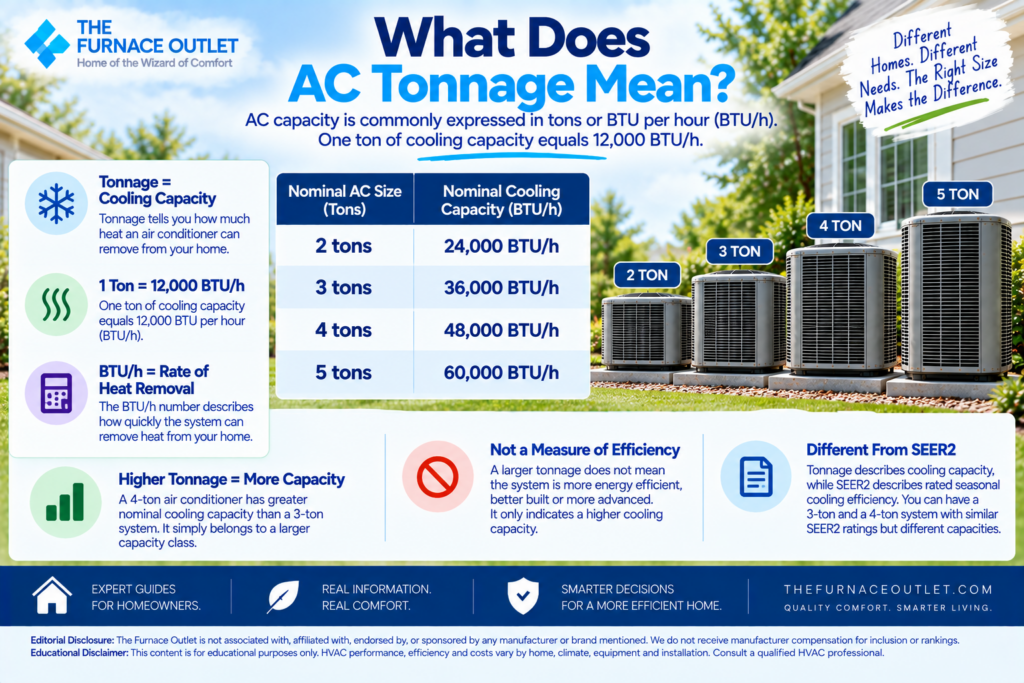
Central air-conditioning capacity is commonly expressed in tons or BTU per hour (BTU/h). One ton of cooling capacity equals 12,000 BTU/h, so converting between the two is straightforward.
| Nominal AC Size | Nominal Cooling Capacity |
|---|---|
| 2 tons | 24,000 BTU/h |
| 3 tons | 36,000 BTU/h |
| 4 tons | 48,000 BTU/h |
| 5 tons | 60,000 BTU/h |
The BTU/h number describes a rate of heat removal. In simple homeowner language, a 4-ton air conditioner has greater nominal cooling capacity than a 3-ton air conditioner. That doesn’t mean the 4-ton model is more energy efficient, better built or more technologically advanced. It simply belongs to a larger capacity class.
This distinction becomes particularly important when you encounter SEER2. Tonnage describes cooling capacity, while SEER2 describes rated seasonal cooling efficiency. You can therefore have a 3-ton system and a 4-ton system from the same product family with similar efficiency ratings but different capacities.
A nominal 2-ton central air conditioner provides approximately 24,000 BTU/h of cooling capacity. It may be appropriate for smaller homes or homes with relatively modest cooling loads, but I would avoid assigning it to a specific square-footage range without knowing much more about the building.
A compact, well-insulated home in a moderate climate might be adequately served by two tons, while another home of similar size in a hotter climate with significant solar gain and air leakage might require more capacity. Windows, insulation, orientation, ceiling height, construction quality and local outdoor design conditions all influence the result.
The advantage of appropriately using a smaller system is not simply that the equipment may cost less. When capacity closely matches the load, the air conditioner can operate in healthier cooling cycles rather than rapidly satisfying the thermostat and shutting down. That can contribute to better temperature consistency and, in humid conditions, provide more opportunity for moisture removal.
I would therefore view a 2-ton recommendation as neither small nor large in isolation. The question is whether 24,000 BTU/h is appropriate for the calculated load of the home.
A 3-ton air conditioner provides approximately 36,000 BTU/h of nominal cooling capacity, placing it a full 12,000 BTU/h above a 2-ton system. That difference is substantial enough that moving from two to three tons should be based on the home’s cooling requirements rather than a desire for extra power.
A contractor recommending three tons should be able to explain why that capacity fits the building. Perhaps the home is larger, has greater solar exposure, experiences more demanding summer conditions or has other characteristics that produce a higher calculated load.
It is also important to remember that not all 3-ton air conditioners are equivalent. One may be a straightforward single-stage model, another could use two-stage operation, and a premium system might incorporate a variable-capacity compressor. Their SEER2 ratings, noise levels, controls and prices can differ considerably even though they share the same nominal tonnage.
That is why I would first determine the capacity the house needs and only then compare the technologies available within that capacity range.
A 4-ton central air conditioner has approximately 48,000 BTU/h of nominal cooling capacity. Compared with a 3-ton system, that represents another 12,000 BTU/h of capacity, or roughly one-third more nominal cooling capacity. Four tons may be entirely appropriate for a home with a sufficiently large cooling load. The mistake is assuming that installing four tons where three tons would adequately serve the home provides additional protection against hot weather.
An oversized system can bring the indoor temperature down quickly, satisfy the thermostat and shut off before completing longer cooling cycles. That may contribute to more noticeable temperature fluctuations and, particularly in humid climates, can reduce the opportunity for moisture removal. The homeowner can end up paying for more capacity while receiving less refined comfort. If a contractor recommends moving from an existing 3-ton unit to a 4-ton replacement, I would ask what has changed. Perhaps the original equipment was undersized or a home addition increased the load. Those are legitimate possibilities. But “more tonnage will cool better” is not enough explanation for me to approve the change.
A 5-ton air conditioner provides approximately 60,000 BTU/h of nominal cooling capacity. This is a large residential central AC capacity, but it should still be evaluated according to the same principle as every other size: does the home actually need it? Larger homes can certainly have substantial cooling loads, especially in demanding climates. High ceilings, large glass areas, significant exterior exposure and other characteristics can increase the required capacity. But square footage alone still cannot prove that a house needs five tons.
Very large homes may also require more than one HVAC system rather than one increasingly large central system. Zoning, multiple floors, building layout and duct design can make system configuration just as important as total nominal capacity. If someone recommends five tons simply because your house is “big,” I would want more information. At this level of capacity, I would especially want to see how the recommendation relates to the home’s calculated cooling load and whether the existing duct system can support the required airflow.
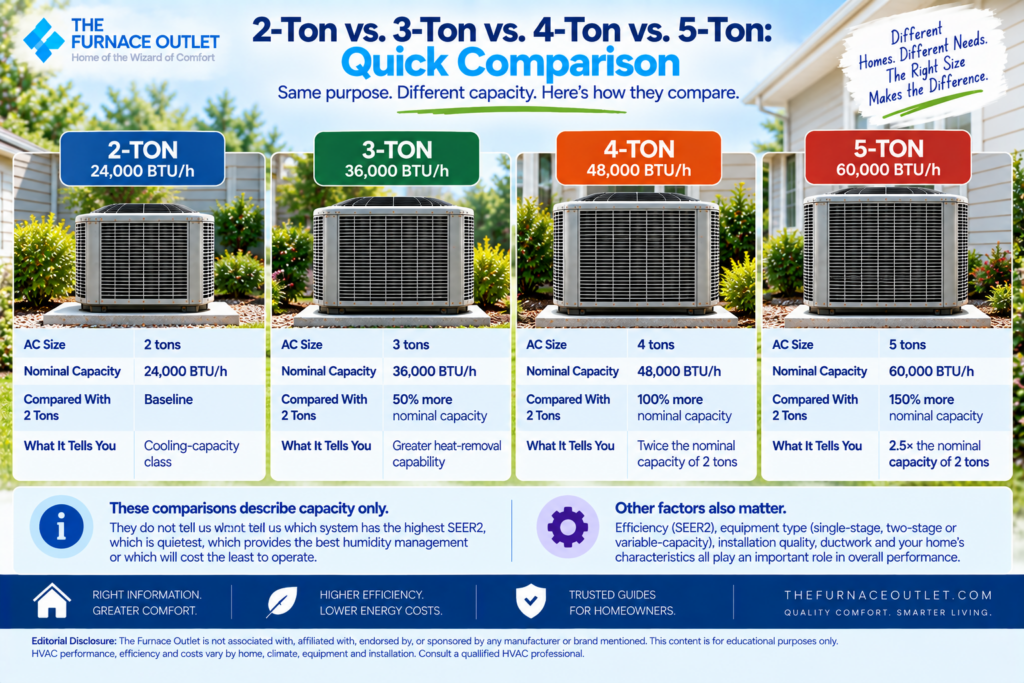
The easiest way to understand these systems is to compare what changes and what does not.
| AC Size | Nominal Capacity | Compared With 2 Tons | What It Tells You |
|---|---|---|---|
| 2 ton | 24,000 BTU/h | Baseline | Cooling-capacity class |
| 3 ton | 36,000 BTU/h | 50% more nominal capacity | Greater heat-removal capability |
| 4 ton | 48,000 BTU/h | 100% more nominal capacity | Twice the nominal capacity of 2 tons |
| 5 ton | 60,000 BTU/h | 150% more nominal capacity | 2.5× the nominal capacity of 2 tons |
These comparisons describe capacity only. They do not tell us which system has the highest SEER2, which is quietest, which provides the best humidity management or which will cost the least to operate. Those questions require looking at the complete equipment specifications and how the system is installed.

This is probably the question most homeowners actually want answered, and unfortunately it is also where many oversimplified HVAC recommendations begin. You may encounter charts claiming that a certain square-footage range requires two tons, another range requires three tons and so on. Those charts can be useful for rough planning, but they are not a substitute for calculating the home’s cooling load.
Consider two 2,000-square-foot houses. One has excellent attic insulation, efficient windows, good air sealing and substantial shade. The other has older windows, inadequate insulation, considerable air leakage and strong afternoon solar exposure. It would be unreasonable to assume their cooling requirements must be identical simply because their floor plans contain the same number of square feet. Climate creates another major difference. A house exposed to long periods of extreme summer heat faces a different cooling challenge from a comparable home in a region with a mild cooling season.
For those reasons, I would use square footage to understand the general scale of the project, but I would want the contractor to use a recognized residential load-calculation procedure such as ACCA Manual J when determining the actual cooling requirement.
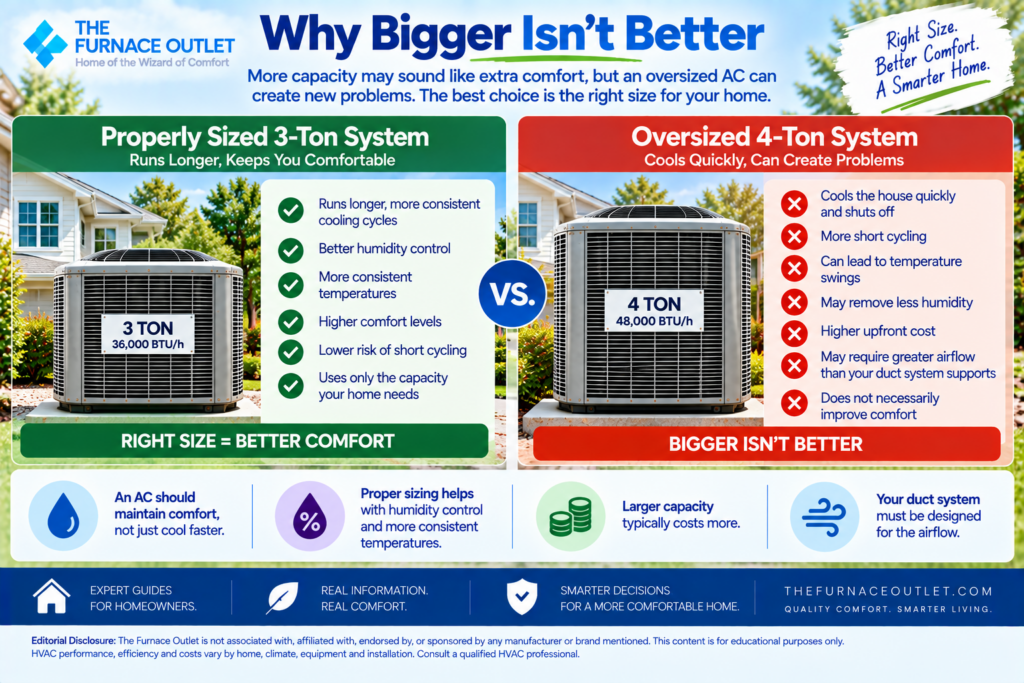
Imagine your home’s calculated cooling requirements can be appropriately served by a 3-ton system. A 4-ton unit has more capacity, so buying the larger system may initially sound like a sensible safety margin. But an air conditioner is not supposed to cool the house as rapidly as possible. It is supposed to maintain comfortable indoor conditions while appropriately handling heat and moisture.
An oversized single-stage air conditioner may satisfy the thermostat quickly and shut down. As conditions change, it starts again. Repeated short cycles can contribute to temperature swings and may provide less effective moisture removal than appropriately designed longer cooling cycles. There are also financial considerations. Larger-capacity equipment can cost more, and greater capacity may require greater airflow. If the duct system was not designed for that airflow, simply increasing tonnage can create another set of performance problems.
I would therefore rather own a properly sized 3-ton system than an unnecessarily oversized 4- or 5-ton system.

Undersizing is the other side of the problem. If the air conditioner does not have enough capacity to meet the home’s cooling load during demanding conditions, it may struggle to maintain the desired indoor temperature. However, long runtime alone does not prove that a system is undersized. A properly sized air conditioner may run for extended periods during hot weather, while variable-capacity equipment may intentionally operate for long periods at reduced output.
If a home is not cooling properly, I would want a technician to investigate the entire system before concluding that more tonnage is required. Restricted airflow, duct leakage, dirty coils, refrigerant issues, insulation deficiencies and other problems can all contribute to poor cooling. Replacing a poorly performing 3-ton unit with a 4-ton unit without understanding why the original system struggled can simply hide one problem while creating another.
When replacing an old system, one of the easiest approaches is to read the old equipment’s capacity and install the same size again. Sometimes that will indeed be appropriate, but the old nameplate is not a load calculation.
The previous system may have been oversized from the day it was installed. Alternatively, your home may have changed. New windows, attic insulation, air sealing or other improvements may have reduced the cooling load, while an addition or major remodeling project may have increased it.
A replacement project therefore creates a valuable opportunity to verify the home’s requirements instead of automatically repeating a decision made 10 or 15 years ago. I would want the contractor to consider the existing tonnage as useful historical information while still evaluating what the house needs today.
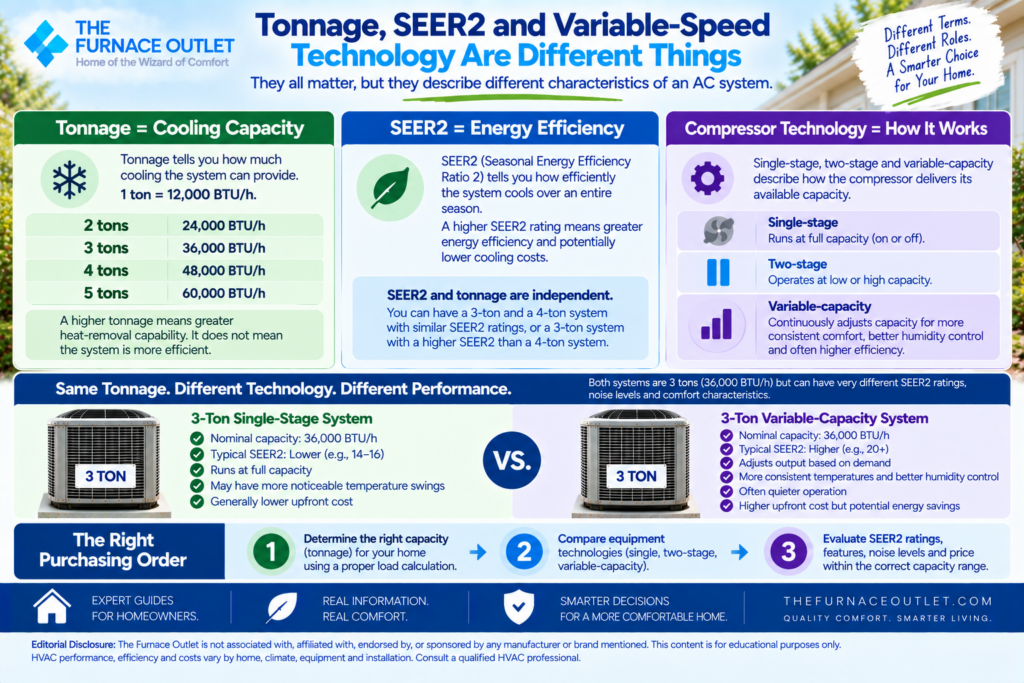
Homeowners often encounter tonnage, SEER2 and compressor technology at the same time, which can make them seem interchangeable. They describe different characteristics of the system. Tonnage describes cooling capacity. SEER2 describes rated seasonal cooling efficiency. Single-stage, two-stage and variable-capacity describe how the compressor can deliver its available capacity.
For example, you could be comparing two properly sized 3-ton systems where one is a basic single-stage model and another uses variable-capacity technology with a significantly higher SEER2 rating. They belong to the same nominal capacity class but can provide very different efficiency, noise and comfort characteristics. This is why the purchasing order matters. Determine the appropriate capacity first, then compare the equipment technologies and efficiency levels available to meet that requirement.
Moving from three tons to four tons does not affect only the outdoor condenser. The indoor system has to move enough air to support the selected equipment. Duct size, return-air capacity, filters, registers, blower performance and overall static pressure can influence whether the system receives and delivers appropriate airflow. Installing substantially larger equipment on a duct system that cannot adequately support it can contribute to noise, poor airflow and compromised performance.
I would therefore ask the contractor whether the existing duct system was evaluated as part of the replacement. If a significant increase in tonnage is being proposed, I would specifically ask whether the ducts and return-air system can handle the airflow requirements of the new equipment. That conversation can be just as important as the tonnage printed on the proposal.
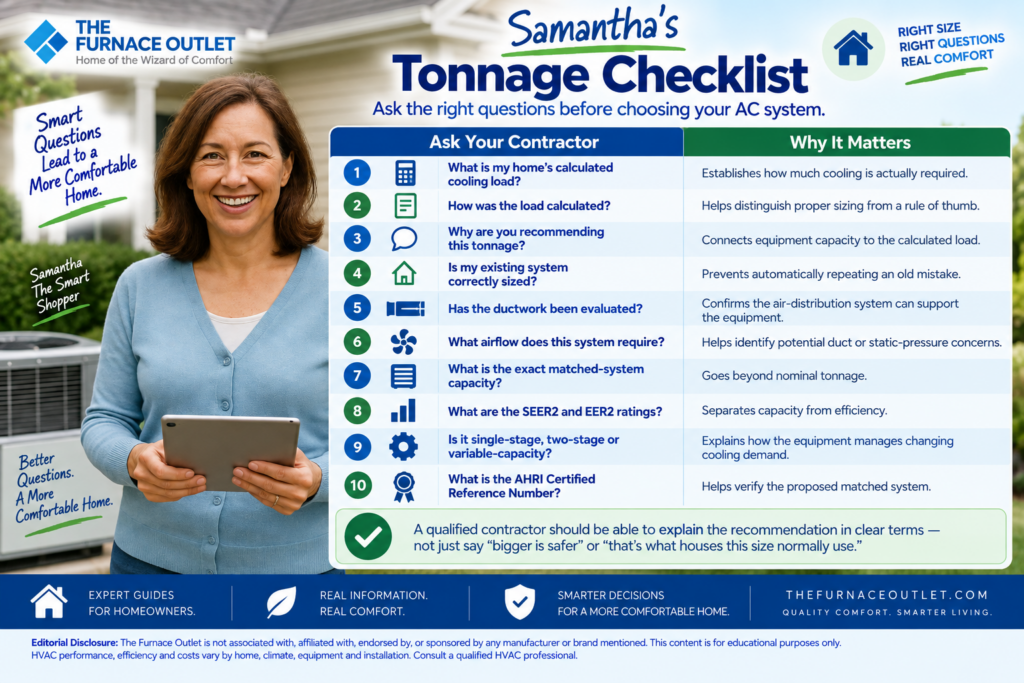
Before approving a 2-, 3-, 4- or 5-ton central AC, I would want the contractor to explain the recommendation in terms I can understand.
| Ask Your Contractor | Why It Matters |
|---|---|
| What is my home’s calculated cooling load? | Establishes how much cooling is actually required |
| How was the load calculated? | Helps distinguish proper sizing from a rule of thumb |
| Why are you recommending this tonnage? | Connects equipment capacity to the calculated load |
| Is my existing system correctly sized? | Prevents automatically repeating an old mistake |
| Has the ductwork been evaluated? | Confirms the air-distribution system can support the equipment |
| What airflow does this system require? | Helps identify potential duct or static-pressure concerns |
| What is the exact matched-system capacity? | Goes beyond nominal tonnage |
| What are the SEER2 and EER2 ratings? | Separates capacity from efficiency |
| Is it single-stage, two-stage or variable-capacity? | Explains how the equipment manages changing cooling demand |
| What is the AHRI Certified Reference Number? | Helps verify the proposed matched system |
A contractor should be able to explain why a particular capacity is appropriate without falling back on statements such as “bigger is safer” or “that’s what houses this size normally use.”
Comparing 2-ton, 3-ton, 4-ton and 5-ton air conditioners becomes much easier once you stop thinking of them as good, better and best. They are simply different cooling-capacity classes, ranging from approximately 24,000 BTU/h for two tons to 60,000 BTU/h for five tons.
The smart-shopping question is therefore not, “What’s the biggest air conditioner I can afford?” It is, “How much cooling does my house actually require, and which system provides that capacity appropriately?” Once you have that answer, you can make meaningful comparisons involving SEER2, compressor technology, noise, humidity control, warranties and price.
I would much rather invest in a properly sized 3-ton system with good ductwork and careful installation than spend more money on an unnecessary 4- or 5-ton unit simply because larger sounds safer. In central air conditioning, the best size isn’t the biggest one. It’s the one that fits the home.
— Samantha Reyes, the Smart Shopper
Best Central Air Conditioners of 2026: Brands, Models & Buying Advice – The Furnace Outlet
For additional information on residential HVAC sizing and system selection, homeowners can consult the Air Conditioning Contractors of America (ACCA), the U.S. Department of Energy’s Energy Saver guidance and the AHRI Directory of Certified Product Performance.
The Furnace Outlet | THEFURNACEOUTLET.COM
Editorial Disclosure: The Furnace Outlet is not affiliated with, endorsed by, or sponsored by any manufacturer or brand mentioned. We do not receive manufacturer compensation for inclusion or rankings.
Educational Disclaimer: This guide is for educational purposes only. HVAC sizing, capacity, efficiency and performance vary by home, climate, equipment, ductwork and installation. Final equipment sizing should be determined by a qualified HVAC professional using an appropriate residential load calculation.