Newsletter Subscribe
Enter your email address below and subscribe to our newsletter

HVAC made simple

By Samantha Reyes — Samantha the Smart Shopper
Buying a new central air conditioner can become confusing remarkably quickly. You may begin with a simple goal—keep the house comfortable during summer—and suddenly find yourself comparing SEER2 ratings, compressor stages, refrigerants, communicating thermostats, sound ratings, warranties and equipment combinations that seem to require an HVAC engineering degree to understand.
I understand why homeowners get overwhelmed. When I first became serious about energy efficiency, it was because of an unexpectedly high utility bill. That experience changed the way I looked at major home purchases. Instead of asking only, “How much does it cost?”, I started asking a much better question: “What am I actually getting for the money I am spending?”
That question is particularly important with central air conditioning because the most expensive system is not automatically the smartest purchase, and the least expensive system is not necessarily the best value. Your climate, home construction, ductwork, electricity costs, comfort expectations and—perhaps most importantly—the quality of the installation can matter just as much as the name printed on the outdoor cabinet.
The central AC market has also changed considerably. SEER2 has replaced the older SEER testing framework for current equipment, variable-speed compressors have become more common, and the industry has been moving away from R-410A toward lower-global-warming-potential refrigerants such as R-454B and R-32. Homeowners shopping in 2026 therefore need to evaluate more than just brand reputation.
In this guide, I’ll walk through several of the strongest central air-conditioning choices available in 2026, explain what separates premium systems from more affordable equipment, and help you decide which features are actually worth paying for. Most importantly, we’ll look at central AC the way a homeowner should: as a complete comfort system and long-term household investment, rather than simply a large metal box sitting outside the house.

There is no single air conditioner I would recommend for every household. Instead, I prefer to think about the market in terms of different types of buyers.
| Category | Brand / Model Family | Why It Deserves Consideration |
|---|---|---|
| Best for Premium Comfort | Carrier Infinity Variable-Speed | Excellent temperature control, quiet operation and advanced comfort features |
| Best Premium High-Efficiency Choice | Trane 20 TruComfort Variable Speed | Very high efficiency potential combined with variable-speed cooling |
| Best Balance of Efficiency and Features | Rheem Prestige | Inverter-driven operation with strong efficiency potential |
| Best Midrange Approach | Rheem Classic Plus | Two-stage cooling offers a useful middle ground between basic and premium systems |
| Best R-32 Value Choice | Daikin DC5SE | Straightforward mid-efficiency system using R-32 refrigerant |
| Other Brands Worth Comparing | Lennox, American Standard, Bryant and Goodman | Broad product ranges with options at different price and efficiency levels |
These categories should be treated as starting points rather than absolute rankings. Central air conditioners are sold as part of matched systems, and efficiency can vary according to the outdoor condenser, indoor coil, furnace or air handler and other components used together.
That is why you should always ask your contractor for the exact model numbers and rated system combination, rather than choosing an air conditioner based only on the headline efficiency number advertised for a product family.
If your current air conditioner is 10, 15 or even 20 years old, shopping for its replacement may feel very different from the last time you bought HVAC equipment. Several changes are especially important.
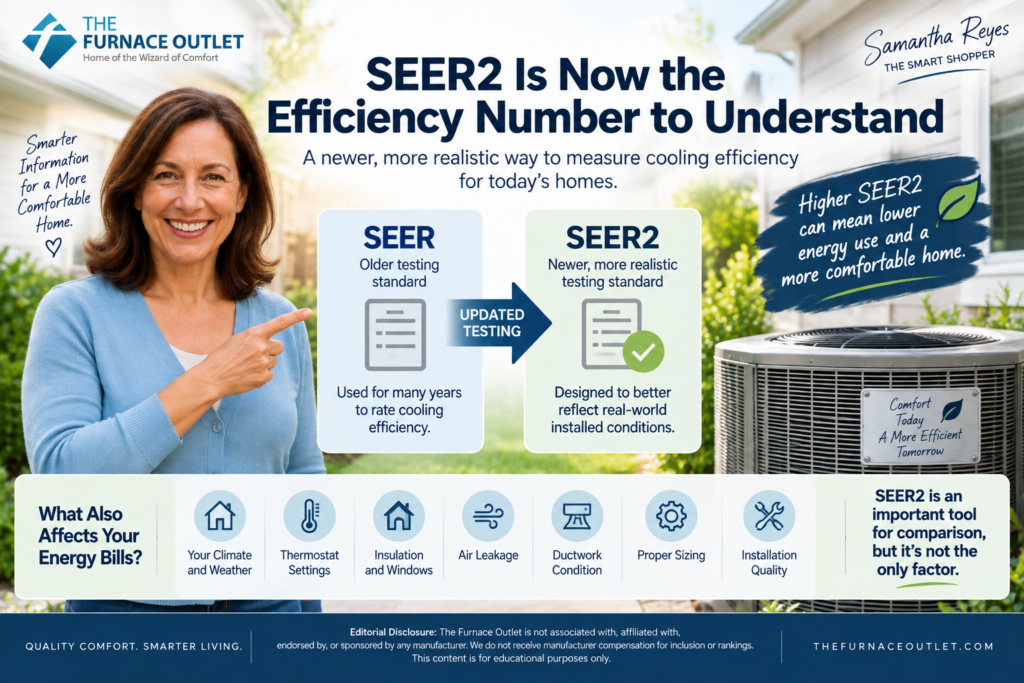
For decades, SEER was one of the most familiar measurements associated with central air conditioning. Today, shoppers will generally encounter SEER2, or Seasonal Energy Efficiency Ratio 2.
SEER2 continues to describe seasonal cooling efficiency, but the updated testing procedure was designed to better represent the external static pressure HVAC systems encounter in installed conditions. In simple terms, it is a newer testing framework intended to provide a more realistic way of rating current equipment.
The basic shopping rule is still easy to understand: a higher SEER2 rating generally indicates greater cooling efficiency under standardized test conditions.
Where homeowners sometimes go wrong is assuming that SEER2 works like a direct prediction of their electricity bill. It does not. A 20-SEER2 system does not guarantee a specific percentage reduction in your household energy bill because the air conditioner operates as part of a much larger system. Your climate, thermostat setting, insulation, windows, air leakage, ductwork, equipment sizing and installation quality all influence actual energy use. Two homes with identical air conditioners can therefore have very different summer electricity bills. I consider SEER2 extremely useful when comparing equipment, but I would never make a purchase based on SEER2 alone.
The other major change involves what circulates through the refrigeration circuit. R-410A dominated residential central air conditioning for many years, but federal HFC transition rules have pushed new residential HVAC equipment toward refrigerants with lower global warming potential. Two refrigerants homeowners are likely to encounter frequently are R-454B and R-32.
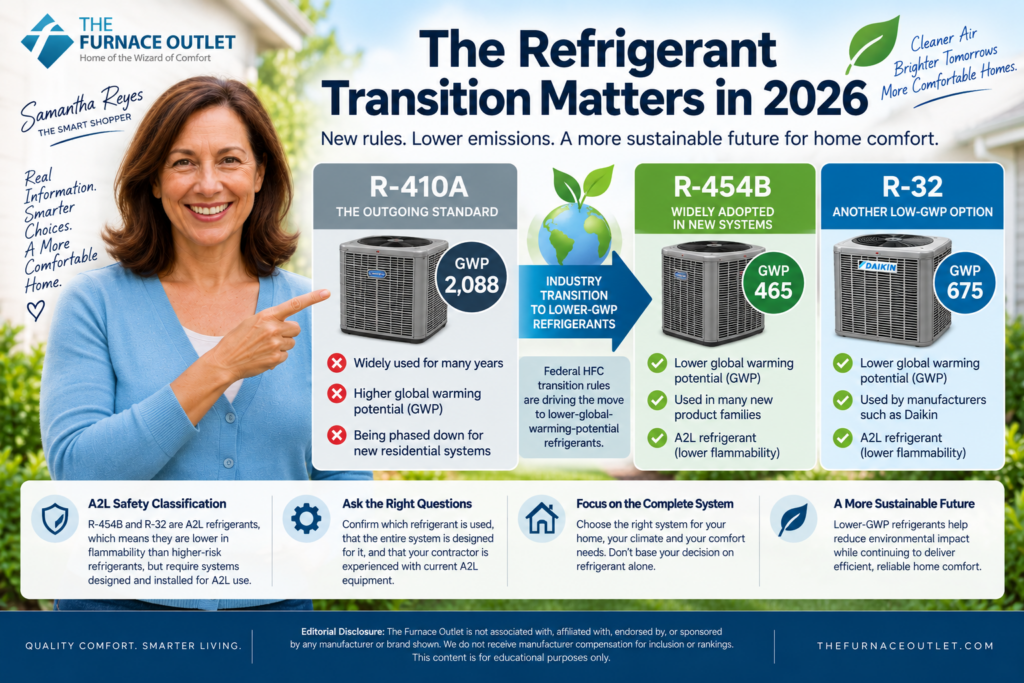
R-454B has been adopted across many new product families, while manufacturers such as Daikin have introduced residential systems using R-32. Both belong to the A2L safety classification, which means they have lower flammability than refrigerants in more highly flammable classifications but require equipment, procedures and installation practices specifically designed for A2L refrigerants.
For homeowners, this does not mean you need to become a refrigerant technician before purchasing an air conditioner. It does mean that I would ask the contractor what refrigerant the proposed system uses, whether the entire indoor and outdoor equipment combination was designed for it, and how experienced the installation team is with current A2L equipment. The refrigerant should be part of the purchasing conversation, but I would not choose one otherwise inferior system simply because someone convinced me that one new refrigerant is universally better than another.
One of the biggest price differences between central air conditioners comes from the way the compressor operates. Understanding this distinction makes it much easier to compare quotes.
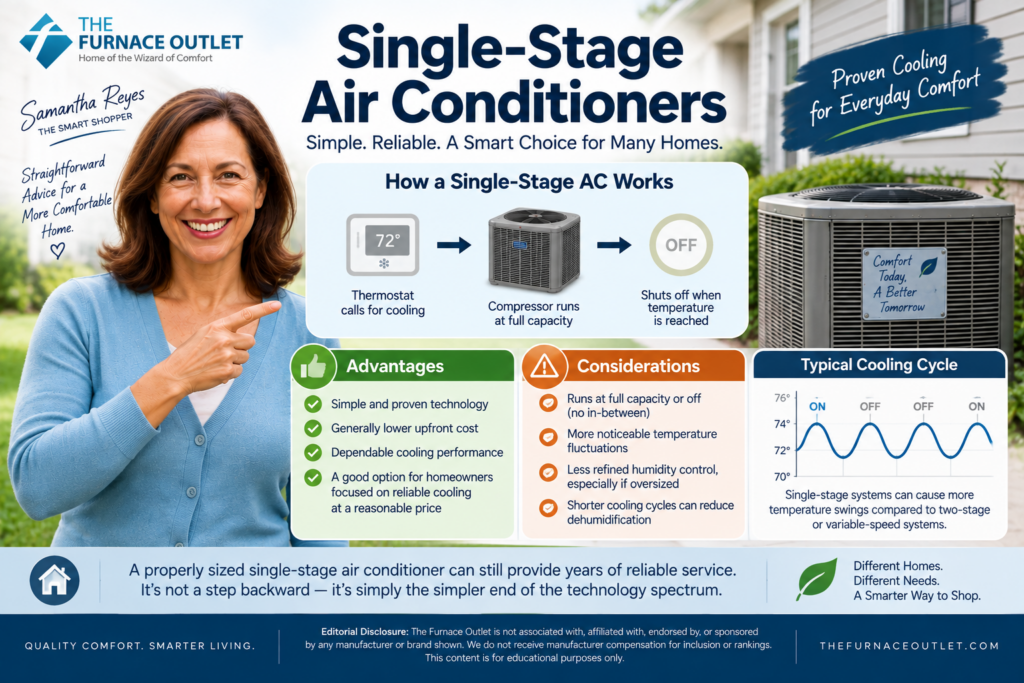
A traditional single-stage air conditioner has a relatively simple operating strategy. When the thermostat calls for cooling, the compressor operates at its designed capacity. Once the thermostat is satisfied, the compressor shuts off. This simplicity has advantages. Single-stage systems generally cost less than sophisticated variable-speed equipment and can be perfectly appropriate for homeowners whose primary concern is dependable cooling at a reasonable purchase price.
The trade-off is comfort control. Because the system repeatedly cycles between full cooling and off, room temperatures may fluctuate more noticeably. Humidity management can also be less refined, particularly when equipment is oversized and cooling cycles become too short. A properly sized single-stage system can still provide years of good service. “Single-stage” should not automatically be interpreted as “bad.” It simply represents the simpler end of the technology spectrum.
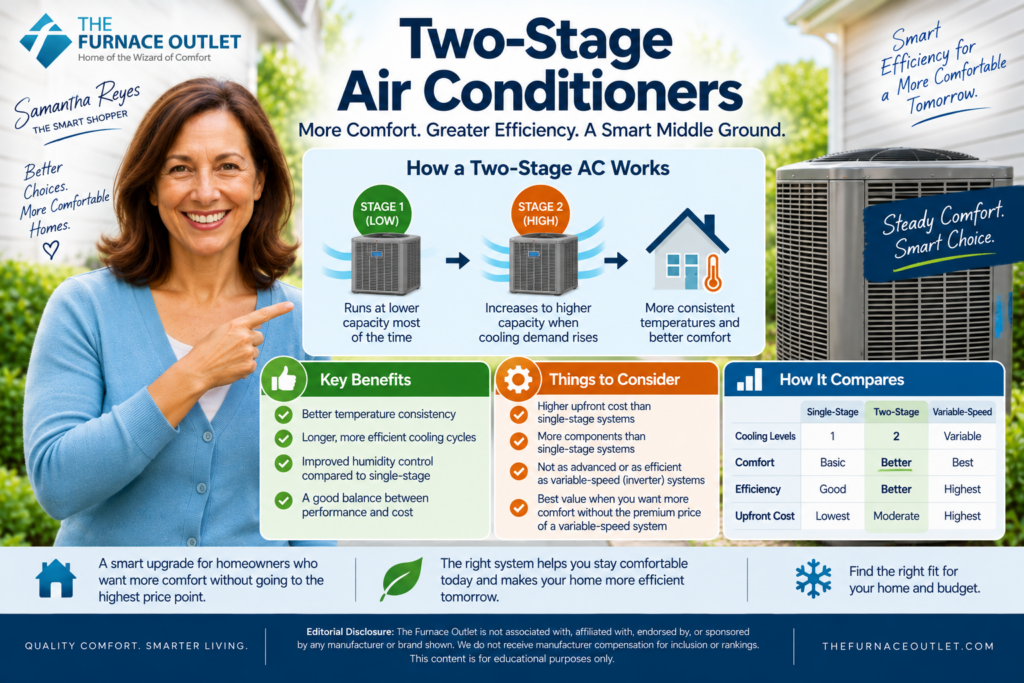
Two-stage systems provide a useful middle ground. Instead of operating only at maximum capacity, they can spend much of their time at a lower stage and move to higher output when cooling demand increases. For many households, I think this category deserves more attention than it receives.
A two-stage system can provide longer cooling cycles and steadier indoor conditions than basic single-stage equipment while avoiding some of the cost associated with premium inverter-driven systems.
If your budget allows you to move beyond entry-level equipment but you are not convinced you need a flagship variable-speed system, I would specifically ask contractors to include a two-stage option in their proposals.
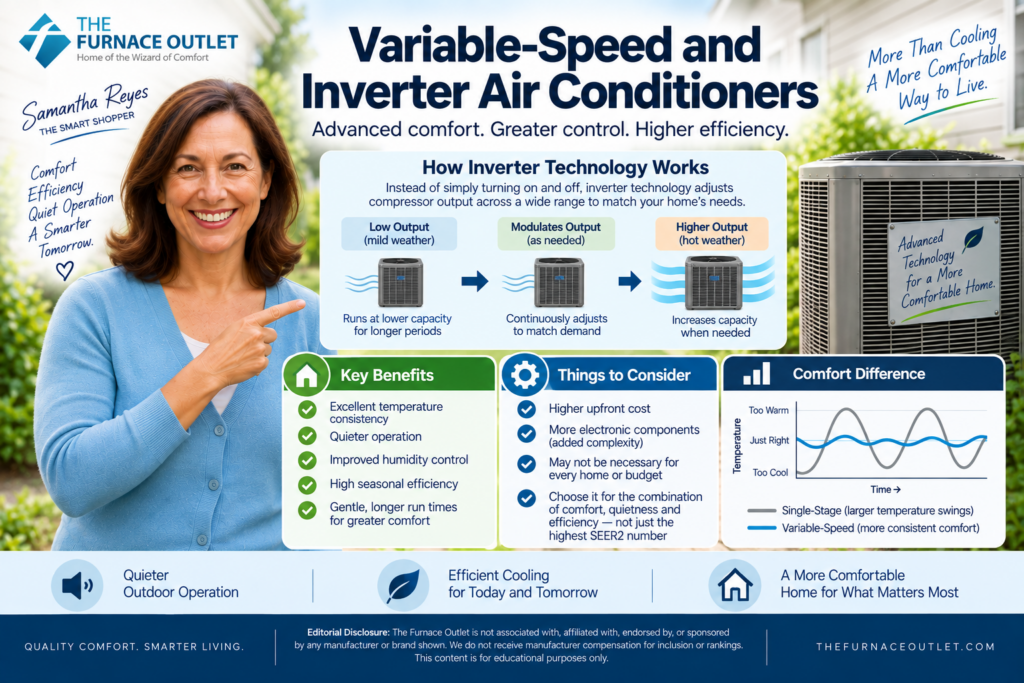
Variable-speed systems take modulation considerably further. Instead of choosing between one or two fixed operating levels, inverter technology allows compressor output to change across a broader range. During moderate weather, the air conditioner may operate gently for longer periods rather than repeatedly starting and stopping at maximum output. As outdoor conditions become more demanding, the system can increase capacity.
This approach can provide excellent temperature consistency, quieter operation and improved humidity control. It can also contribute to high seasonal efficiency. However, premium technology comes with premium pricing and additional electronic complexity. I would therefore buy variable-speed equipment because I value the combination of comfort, quietness and efficiency, rather than assuming that the highest SEER2 number automatically provides the best financial return.
Carrier remains one of the most recognizable names in residential HVAC, and its Infinity family represents the premium end of its central air-conditioning lineup. The appeal of Carrier’s variable-speed equipment is not simply maximum cooling capacity. It is the system’s ability to adjust operation according to changing cooling demand.
That distinction matters in real homes because most summer days do not require maximum cooling every minute. When equipment can operate for longer periods at reduced output, indoor temperatures can remain more consistent and humidity can be managed more effectively. Carrier’s current-generation premium equipment has also moved to Puron Advance, Carrier’s branding for R-454B refrigerant, as part of the broader refrigerant transition.
Some Infinity configurations can reach efficiency levels around 21 SEER2, while premium equipment can operate at impressively low sound levels under appropriate conditions.
I would put Carrier Infinity high on the shopping list for a homeowner who plans to stay in the house for years and places significant value on quiet operation, precise temperature management and humidity control. It may be particularly attractive in warm, humid climates where air conditioning operates for long periods and indoor moisture control is an important part of comfort.
The main consideration is price. Premium Carrier equipment can represent a substantial investment, and advanced communicating systems make the quality of the installing dealer especially important. If I were considering Carrier Infinity, I would spend almost as much time evaluating the local Carrier contractor as I would evaluating the equipment itself.
Trane is another brand that deserves serious consideration at the premium end of the market. Its current 20 TruComfort Variable Speed Air Conditioner with WeatherGuard, model family 5TTV0, represents the newer generation of Trane’s premium residential cooling equipment and replaces the earlier XV20i.
Trane lists the system at up to 23.6 SEER2 and 14 EER2, depending on the equipment combination, while using R-454B refrigerant. It also incorporates Trane Link communicating technology. Those numbers are impressive, but the reason I would consider the system goes beyond efficiency.
Variable-speed operation can provide much more precise cooling than a conventional single-stage system. When the home requires only modest cooling, the compressor does not necessarily need to operate at full capacity. This can create longer, gentler cycles and more stable indoor conditions.

This is where I put on my smart-shopper hat. Suppose one contractor quotes a good mid-efficiency system and another option costs several thousand dollars more because it offers premium variable-speed technology and significantly higher SEER2. I would not immediately choose either one.
Instead, I would ask what the additional money is buying me. How much of the difference is expected to come back through lower electricity consumption? How much am I paying for improved humidity control, quieter operation and temperature consistency? How long do I expect to remain in the house? If you value all those benefits, a premium Trane system can make considerable sense. If the only reason you are stretching the budget is to obtain the highest SEER2 number on the proposal, I would examine the economics more carefully.
Rheem is particularly interesting because its residential lineup gives shoppers meaningful choices between premium and midrange technology. At the upper end, Rheem’s Prestige equipment offers inverter-driven operation and efficiency reaching around 20 SEER2 in applicable configurations. That places it firmly in the high-efficiency category.
The Classic Plus RA16AY, meanwhile, represents the kind of system I think many practical homeowners should investigate. It offers two-stage cooling and efficiency reaching approximately 17 SEER2 in qualifying combinations. The difference between those products illustrates an important buying decision.
You may decide that you want some of the comfort benefits of staged cooling but do not need to pay for the most sophisticated inverter-driven equipment available. A good two-stage system can spend significant operating time at reduced capacity while still having the ability to increase cooling when conditions become demanding. That can provide better comfort than basic single-stage equipment without requiring the same investment as flagship variable-speed systems.
I would especially consider Rheem if I wanted to compare several technology levels from the same manufacturer. Ask the contractor to price a good single-stage or mid-efficiency system, a two-stage option and an inverter option if appropriate. Seeing the actual installed-price differences can make the decision much easier.
Sometimes the middle option turns out to be the smartest purchase.
Daikin deserves a place in the 2026 discussion not only because it is a major HVAC manufacturer, but because its refrigerant strategy differs from many competitors. Daikin has embraced R-32 across portions of its residential lineup. The Daikin DC5SE, for example, is a mid-efficiency split-system central air conditioner using R-32. Daikin currently lists it at up to approximately 16.5 SEER2, with capacities covering roughly 1.5 through 5 tons.
This is not the type of air conditioner designed to win a competition based on the largest SEER2 number. And that may be exactly why some homeowners should look at it. There is a large group of buyers who simply want reliable whole-home cooling, reasonable efficiency and current refrigerant technology without moving into the price range of sophisticated premium communicating systems.
For that buyer, equipment like the DC5SE deserves consideration. Daikin also lists the unit as AHRI Certified and provides warranty coverage subject to the manufacturer’s applicable registration, maintenance, eligibility and warranty conditions. As with any warranty, homeowners should read the actual terms rather than relying only on a sales summary.
A “best central air conditioner” guide would be incomplete if it implied that only four brands were worth buying. Lennox has a long history in residential HVAC and offers equipment across multiple efficiency levels. American Standard shares substantial technology and manufacturing heritage with Trane. Bryant operates within the same broader corporate family as Carrier and provides choices across multiple price categories. Goodman has a particularly strong presence among value-conscious residential buyers.
The reason I would not simply rank eight or ten manufacturers from number one to number ten is that this creates a false sense of precision. HVAC purchasing does not work that neatly. Brand reputation matters, but local dealer quality can matter even more. The best manufacturer on paper can still produce disappointing results if the equipment is incorrectly sized, poorly matched or badly installed.
Conversely, a well-selected midrange system installed by an excellent contractor can provide outstanding comfort and reliability. I would therefore use brand rankings to create a shortlist, not to make the final decision.
This is one of the questions homeowners ask most often, and there is no universal number that makes sense for everyone. The value of higher efficiency depends partly on how much cooling you actually use. A homeowner in a very hot region who runs central air conditioning heavily for months has far more opportunity to benefit from efficiency improvements than someone living in a mild climate where the system runs occasionally.

Electricity prices matter too. Saving a certain number of kilowatt-hours is financially more valuable where electricity is expensive. This is why I like contractors who provide alternatives rather than presenting one system as the obvious answer. Ask for at least two sensible choices: perhaps a good mid-efficiency system and a higher-efficiency staged or variable-speed option.
Then calculate the difference in installed price. If the higher-efficiency system costs $4,000 more, the question is no longer “Is 20 SEER2 better than 16 SEER2?” Of course it is more efficient under the rating procedure. The useful question becomes: “What am I getting for the additional $4,000?”
Some of that value may come from energy savings. Some may come from quieter operation, improved humidity control and better temperature consistency. Those are legitimate benefits, but they should be understood before you pay for them.
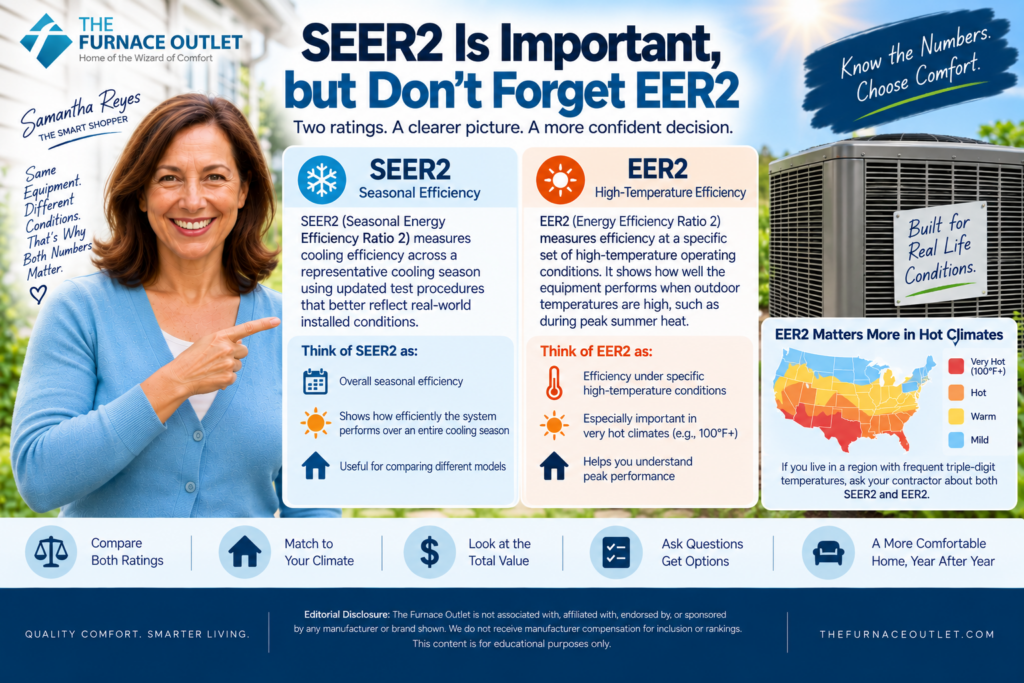
SEER2 measures efficiency across a representative cooling season. EER2 provides another perspective on efficiency under specified operating conditions. For homeowners in extremely hot climates, EER2 deserves attention because peak summer conditions can place tremendous demand on air-conditioning equipment.If I lived in a region where outdoor temperatures regularly climbed well above 100°F, I would ask the contractor about both SEER2 and EER2 rather than focusing entirely on the seasonal number.
The point is not to collect as many HVAC acronyms as possible. It is to understand how the proposed equipment is expected to perform under the conditions that actually matter where you live.
One of the easiest mistakes to make is assuming that a larger air conditioner will cool the house better. Air-conditioning capacity is commonly expressed in tons, with one ton representing approximately 12,000 BTU per hour of cooling capacity. But capacity needs to match the home’s cooling load. An oversized system can reduce indoor temperature quickly and then shut down. Those short cycles can create uneven comfort and may reduce moisture removal because the equipment does not operate long enough to dehumidify effectively.
An undersized system creates a different problem. It may struggle to maintain the desired temperature during demanding weather and operate for very long periods near its maximum capability. Proper sizing therefore involves much more than square footage. A professional load calculation should consider factors such as climate, insulation, windows, orientation, air leakage, ceiling height and the characteristics of the building envelope.
If a contractor looks at the label on your old condenser and immediately says, “You have a four-ton unit, so we’ll put another four-ton unit in,” I would ask how they confirmed that four tons is still appropriate. Your home may have changed since the original system was installed. New windows, additional insulation, remodeled rooms, additions or air-sealing improvements can all influence the load.
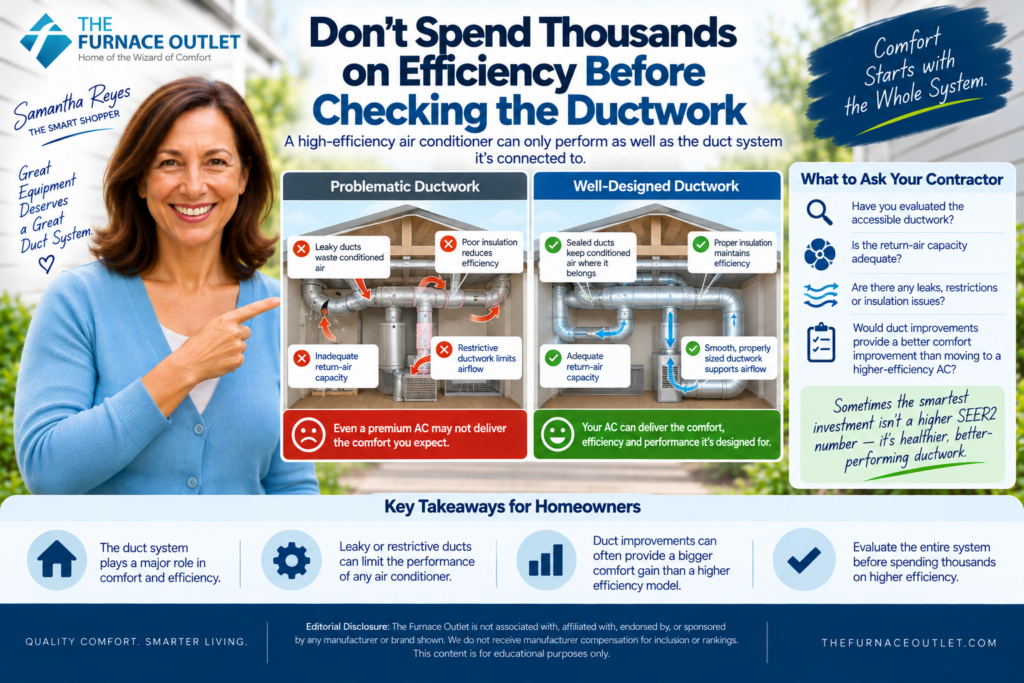
Homeowners naturally focus on the outdoor condenser because it is visible and expensive. But the duct system can have an enormous influence on comfort and performance. Conditioned air has to travel from the indoor equipment through supply ducts, reach the rooms and then return through the return-air system. Leakage, poor insulation, inadequate return capacity or restrictive ductwork can interfere with that process.
This means a premium high-efficiency air conditioner connected to problematic ductwork may never deliver the comfort you expected. Before committing to an expensive equipment upgrade, ask whether the contractor has evaluated accessible ductwork, return-air capacity and airflow. Sometimes spending money on duct corrections can produce a more noticeable comfort improvement than simply moving one level higher on the air-conditioner product ladder.
If there is one lesson I would want every homeowner to take away from this guide, it is this: You are buying an installation, not just an air conditioner.
Central AC equipment does not arrive as a finished appliance that simply gets plugged into the wall. The contractor has to integrate the outdoor unit, indoor coil or air handler, refrigerant piping, drainage, electrical components, controls, airflow and duct system. Refrigerant charging needs to be correct. Airflow needs to be appropriate. The equipment needs to be matched. The system needs to be commissioned correctly.
That is why I would rather have a properly sized and carefully installed midrange system from a reputable manufacturer than flagship equipment installed carelessly. When checking contractors, look beyond online star ratings. Ask how long they have installed the particular equipment being quoted, whether technicians are trained for the refrigerant involved, whether permits are included where required, how startup and commissioning are performed, and what labor warranty the company provides.
Never compare HVAC quotes using the total price alone. Two proposals that appear to describe similar “3-ton 17 SEER2 systems” can contain very different equipment and installation work.
I recommend creating a comparison table like this:
| What to Compare | Contractor A | Contractor B | Contractor C |
|---|---|---|---|
| Outdoor unit model | |||
| Indoor coil model | |||
| Furnace / air-handler model | |||
| AHRI matched-system reference | |||
| Rated SEER2 | |||
| Rated EER2 | |||
| Refrigerant | |||
| Compressor type | |||
| Thermostat / control | |||
| Load calculation included | |||
| Duct inspection included | |||
| Duct modifications included | |||
| Manufacturer warranty | |||
| Contractor labor warranty | |||
| Permits included | |||
| Old equipment removal | |||
| Total installed price |
This is where the AHRI Directory of Certified Product Performance can become useful. HVAC efficiency ratings generally apply to certified equipment combinations, not simply the outdoor cabinet viewed in isolation.
Ask for the AHRI information for the exact proposed combination when applicable. It gives you a much better basis for comparing what contractors are actually selling.

A long warranty sounds reassuring, but the headline number doesn’t tell the whole story. First, distinguish between the manufacturer’s parts warranty and the contractor’s labor warranty. If a covered component fails, the manufacturer may provide the replacement part while labor, diagnostics, refrigerant, shipping or other expenses may be subject to separate terms.
Registration requirements also deserve attention. Some manufacturers offer enhanced warranty coverage when eligible equipment is registered within a particular period following installation, although requirements can vary by jurisdiction and warranty program. Do not assume somebody else will take care of it. Ask the contractor who is responsible for registration, request confirmation when it has been completed, and keep your documentation. Also ask what happens if you sell the home. Warranty transferability varies and can be relevant if you do not expect to remain in the property for the full life of the equipment.
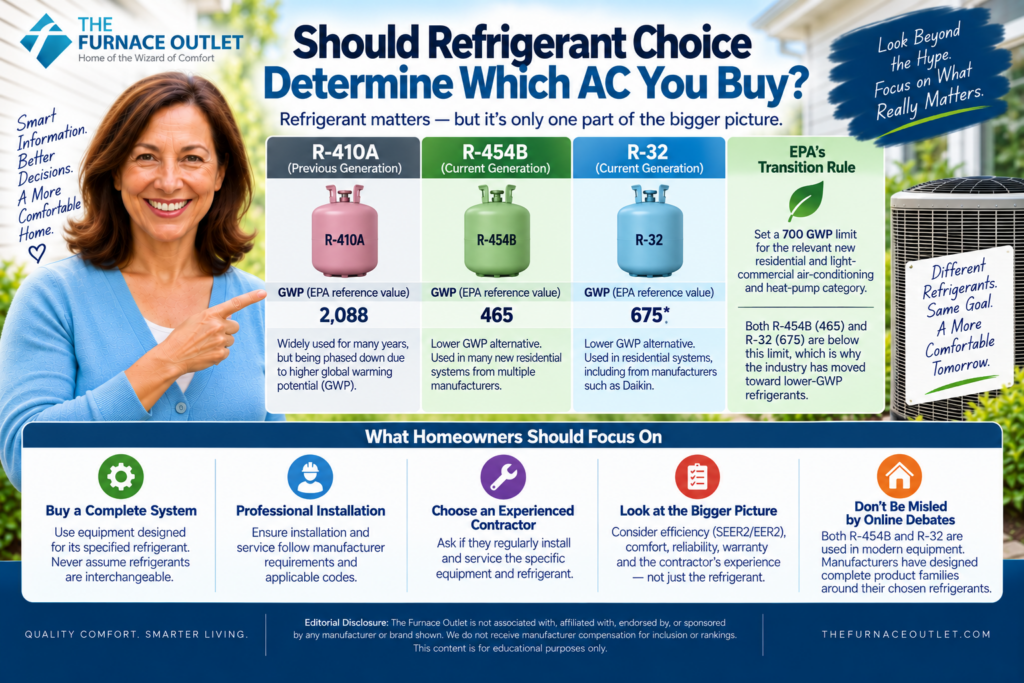
I would consider refrigerant, but I would not make it the only deciding factor. The industry’s transition away from higher-GWP refrigerants has created plenty of online debate around R-32 and R-454B. Both are being used in modern residential equipment, and manufacturers have designed product families specifically around their chosen refrigerants.
EPA’s technology-transition framework set a 700 GWP limit for the relevant new residential and light-commercial air-conditioning and heat-pump category. EPA’s reference values list R-410A at a GWP of 2,088 and R-454B at 465, illustrating why the industry has been moving toward lower-GWP alternatives.
For a homeowner, however, the most important issue is compatibility and professional installation. Never assume refrigerants are interchangeable. Buy a complete system designed for its specified refrigerant and have it installed and serviced according to manufacturer requirements and applicable codes. I would also ask whether the contractor regularly installs and services the particular equipment. Familiarity with the new generation of systems is more reassuring to me than a salesperson simply declaring that their preferred refrigerant is “the best.”
There is another change that could easily confuse shoppers using older articles. The U.S. Environmental Protection Agency sunset the ENERGY STAR specification for central air conditioners effective February 1, 2026.
That means you may still encounter older webpages, archived brochures or retailer content describing particular central air conditioners as ENERGY STAR certified even though the central-air-conditioner program itself has now been sunset. This does not suddenly make efficient central air conditioners inefficient. It simply means shoppers should use current information and understand that the ENERGY STAR framework for central air conditioners has changed. Heat pumps are a separate category, so do not assume that every ENERGY STAR change affecting central AC applies identically to heat pumps.
Before signing a contract, I want to know exactly what I am purchasing. That means obtaining the model numbers for both the outdoor and indoor equipment, confirming the rated efficiency of the matched combination, identifying the refrigerant and understanding whether the compressor is single-stage, two-stage or variable-speed.
I also want to know how the contractor determined the required capacity. If ductwork has not been evaluated, I would ask why. If a special thermostat or communicating control is required, I want that included clearly in the proposal rather than discovering it later. Warranty information should be equally specific. Ask what the manufacturer covers, how long the contractor covers labor, whether registration is required and whether maintenance requirements affect coverage.
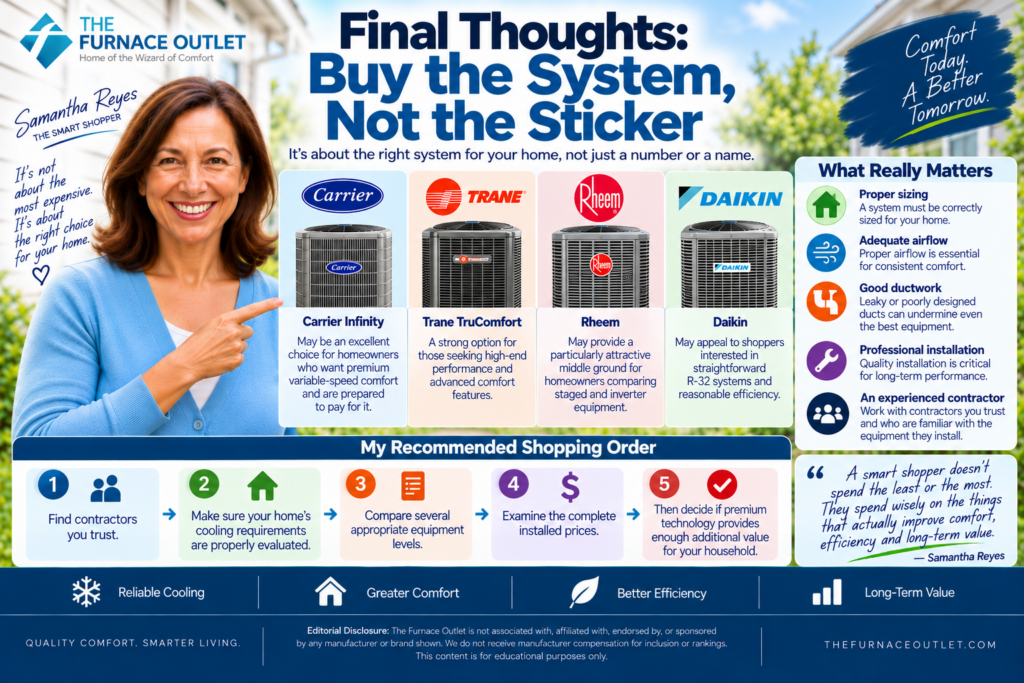
After comparing dozens of specifications, it becomes tempting to reduce the decision to one number or one brand. I don’t think that’s the smartest way to buy central air conditioning. Carrier Infinity or Trane TruComfort may be excellent choices for a homeowner who wants premium variable-speed comfort and is prepared to pay for it. Rheem may provide a particularly attractive middle ground for someone comparing staged and inverter equipment. Daikin may appeal to shoppers interested in straightforward R-32 systems and reasonable efficiency.
But none of those choices will overcome poor sizing, inadequate airflow, bad ductwork or careless installation. That is why my own shopping order would be straightforward. I would first find contractors I trust, make sure the home’s cooling requirements are properly evaluated, compare several appropriate equipment levels, examine the complete installed prices and then decide whether premium technology provides enough additional value for my household.
Don’t buy a larger air conditioner simply because larger sounds better. Don’t chase the highest SEER2 number without considering what the efficiency upgrade costs. Don’t choose a refrigerant based on internet arguments, and don’t assume the most expensive brand guarantees the best result. Instead, understand what you’re buying and why you’re buying it.
A central air conditioner may sit outside your home where you barely notice it, but the results of that purchase will be felt inside your home every hot day for years to come. For me, that’s what being a smart shopper is really about: not spending the least money or the most money, but spending wisely on the things that actually improve comfort, efficiency and long-term value.
— Samantha Reyes, Samantha the Smart Shopper
The Furnace Outlet | www.thefurnaceoutlet.com
Editorial Disclosure: The Furnace Outlet is not associated with, affiliated with, endorsed by, or sponsored by any manufacturer or brand mentioned in this guide. We do not receive compensation from manufacturers for inclusion or rankings.
Educational Disclaimer: This article is provided for general educational and informational purposes. HVAC efficiency, performance, sizing, operating costs, equipment availability and installation requirements vary according to the home, climate, equipment combination and installation. Manufacturer specifications and regulations can change. Verify current equipment information and consult a qualified HVAC professional before purchasing or installing HVAC equipment.