Newsletter Subscribe
Enter your email address below and subscribe to our newsletter

HVAC made simple
By Tony Marino | The Trusted HVAC Tech | The Furnace Outlet | Originally Updated 2025 | Pricing Reviewed November 2026
If you’re planning to replace your central air conditioner, you’ve probably noticed that the price of a Goodman 3-ton R-32 system can vary considerably from one contractor to another. One company might quote $4,800, while another wants $8,500 for what appears to be a similar installation. Naturally, homeowners wonder whether they’re paying for better equipment or simply being overcharged.
I’ve worked with residential HVAC systems for years, and I can tell you that the outdoor unit is only part of the expense. The indoor evaporator coil, refrigerant piping, electrical connections, installation labor, permits, and system testing all contribute to the final bill.
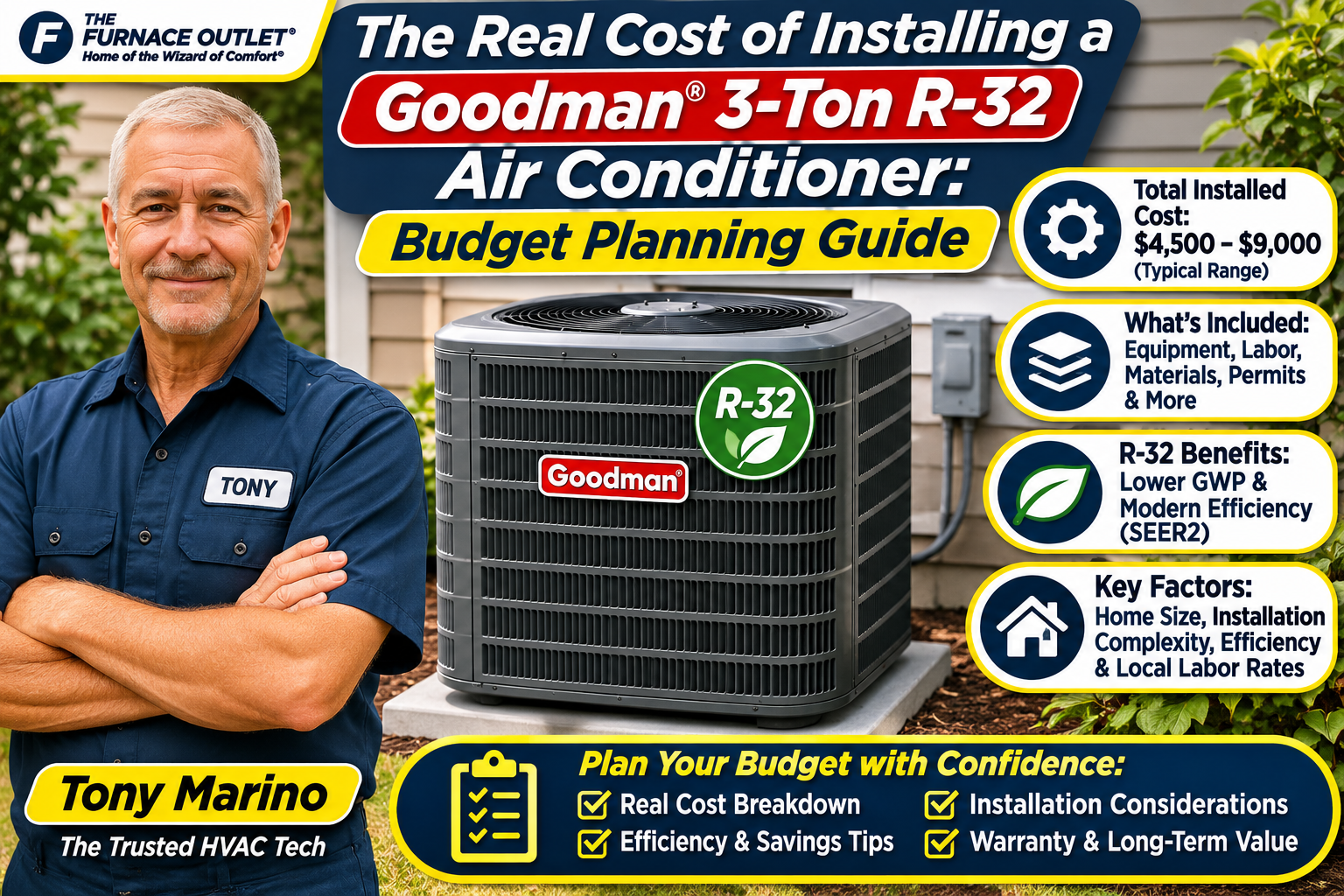
For budgeting purposes, a conventional Goodman 3-ton R-32 central air conditioner replacement may cost approximately $4,500–$9,000 installed in many U.S. markets, assuming existing ductwork can be reused. Higher-efficiency systems, difficult installations, and major equipment modifications can push the total beyond $10,000. These figures are planning estimates rather than guaranteed prices. Your actual cost depends on the equipment selected, local labor rates, and the condition of your existing HVAC system.
A 3-ton air conditioner provides approximately 36,000 BTU per hour of nominal cooling capacity. That doesn’t mean it weighs three tons; the measurement describes how much heat the equipment is designed to remove. Goodman’s R-32 lineup includes models such as the GLXS4B series, which offers single-stage cooling in several capacities. The 3-ton GLXS4BA3610 is one example, with efficiency ratings dependent on the approved indoor equipment combination.
Goodman’s official product literature library provides specifications for its R-32 air conditioners, including the GLXS4B and other models.A complete installation normally includes the outdoor condenser, compatible indoor evaporator coil, necessary refrigerant connections, electrical components, and professional commissioning. If the existing furnace blower or air handler isn’t compatible, additional equipment may be required. Before comparing quotations, confirm whether each contractor is pricing the same complete system.
The outdoor condenser itself represents a significant portion of the installation budget. For a conventional Goodman 3-ton R-32 unit, homeowners might encounter equipment-only prices of approximately $1,500–$3,200, depending on the model, distributor, and market. However, that price doesn’t necessarily include the indoor coil, refrigerant-line modifications, thermostat, installation accessories, or labor. Contractors also have purchasing arrangements and business expenses that aren’t reflected in online equipment listings.
A complete matched system can cost considerably more than the outdoor condenser alone. I always recommend asking for both the outdoor and indoor model numbers in writing. Without that information, it’s difficult to determine whether two contractors are offering equivalent equipment.
Professional installation is one of the biggest variables in the total price. A straightforward replacement might involve removing the existing equipment, installing a compatible outdoor unit and indoor coil, preparing the refrigerant connections, completing electrical work, and testing the system. A more complicated project may require replacing refrigerant piping, modifying ductwork, upgrading electrical components, or working in a difficult attic or crawlspace.
For preliminary budgeting, labor and routine installation materials may account for roughly $1,500–$3,500 or more, depending on the job. This is an illustrative allowance rather than a fixed national rate, and contractors may package these expenses differently. Goodman’s HVAC Learning Center emphasizes that installation costs depend on the home, equipment requirements, labor, and existing ductwork. The cheapest contractor isn’t automatically the best choice. Poor installation can reduce cooling performance, increase energy consumption, and create expensive problems later.
One reason air conditioner replacement estimates vary is that contractors don’t always include the same work. If the existing refrigerant lines are incompatible, damaged, or unsuitable for the new equipment, replacing them can add several hundred dollars or more. Electrical upgrades may also be necessary if the existing circuit, disconnect, or wiring doesn’t meet the new system’s requirements.
An aging or poorly matched indoor coil may need replacement. Significant ductwork repairs, airflow corrections, or a new air handler can add substantially to the project. Permit and inspection fees also vary by municipality. Some contractors include them in their quotations, while others list them separately.
I recommend setting aside an additional 10–15% contingency when planning a replacement, particularly if the existing equipment is old or its installation history is uncertain. That reserve can help cover unexpected work without forcing you to compromise on essential installation requirements.
R-32 is a lower-global-warming-potential refrigerant used in newer residential air conditioning equipment. It has a GWP of approximately 675, compared with approximately 2,088 for R-410A. However, R-32 is classified as an A2L refrigerant, meaning it is mildly flammable under the applicable refrigerant safety classification. This doesn’t mean an appropriately designed R-32 air conditioner is inherently unsafe. It means the equipment, installation procedures, tools, and safety requirements must be suitable for that refrigerant.
The U.S. Environmental Protection Agency’s HFC reduction program explains the regulatory transition toward refrigerants with lower climate impacts. A qualified installer must verify compatible indoor equipment, required safety provisions, refrigerant piping, and manufacturer-specific installation instructions. R-32 must never be used as a simple replacement charge in an older R-410A system that wasn’t designed and approved for it.
Goodman offers R-32 air conditioners with different efficiency levels, including conventional single-stage and more advanced configurations. SEER2 measures seasonal cooling efficiency under standardized testing conditions. A higher rating generally indicates lower electricity consumption for comparable cooling output. For example, if an older air conditioner has a seasonal efficiency rating of 10 SEER and a replacement system offers substantially better efficiency, the newer equipment may reduce cooling electricity consumption under similar conditions.
However, actual savings depend on climate, thermostat settings, operating hours, ductwork, and local electricity rates. The Department of Energy’s central air conditioning guide explains why efficiency, proper sizing, and installation quality all matter. I wouldn’t automatically pay thousands more for a higher-efficiency model without estimating the likely annual savings. In a hot climate with heavy cooling demand, the upgrade may be worthwhile. In a milder climate, the payback period could be much longer.
Suppose your existing air conditioner costs approximately $900 annually to operate, and a newer system reduces cooling electricity consumption by an estimated 25%. That would represent approximately $225 in annual savings, assuming electricity prices and cooling demand remain comparable. Over ten years, the simple cumulative savings would be about $2,250 before accounting for electricity price changes, maintenance, financing, or equipment performance differences.
If the higher-efficiency equipment costs $1,500 more, the simple payback would be approximately 6.7 years under those assumptions. These numbers are illustrative, not a prediction for a particular Goodman model. Your contractor should use the actual matched-system efficiency ratings and local utility rates when estimating savings.
A 3-ton air conditioner isn’t automatically suitable for every medium-sized house. Some homes around 1,500–1,800 square feet may require approximately three tons of cooling, but square footage alone isn’t a reliable sizing method. Insulation quality, window exposure, climate, ceiling height, air leakage, and ductwork all influence cooling demand.
An oversized system may cycle too frequently and struggle with humidity control. An undersized unit may run continuously during extreme temperatures without maintaining comfort. A professional Manual J cooling-load calculation is the appropriate starting point. Don’t assume the capacity of your existing air conditioner is correct simply because it has been installed for years.
When reviewing estimates, ask each contractor to specify the exact outdoor condenser, indoor coil, system efficiency rating, installation materials, and labor scope. The quoted equipment combination should have a verifiable matched-system rating. The AHRI Directory is an important resource for checking certified HVAC system combinations.
Also confirm whether the estimate includes removing the old equipment, handling the existing refrigerant, replacing necessary electrical components, obtaining permits, and completing startup testing. A professional installation should include verification of airflow, refrigerant-system performance, electrical operation, and overall cooling performance. If one contractor’s quote is substantially cheaper, find out which services or materials may be missing before accepting it.
Eligible Goodman air conditioners may qualify for a 10-year limited parts warranty when applicable registration and other requirements are satisfied. Coverage varies by model, location, ownership, and warranty certificate. A parts warranty generally doesn’t mean that labor, diagnostic visits, or every repair expense is covered.
Ask your contractor whether a separate labor warranty is included and what it costs to extend that protection. You should also budget for regular maintenance, including filter replacement, coil inspection, condensate drainage checks, and professional system evaluation. Maintenance expenses are relatively small compared with major compressor or electrical repairs, and regular servicing can help preserve performance.
Goodman can be an attractive choice for homeowners seeking conventional central air conditioning without paying premium-brand prices. Its R-32 product lineup provides options for different efficiency requirements, and the brand has an established contractor and parts distribution network. However, I wouldn’t recommend choosing Goodman solely because the equipment price appears low.
A properly sized system, compatible indoor components, qualified installation, and dependable local service are essential to long-term value. If a contractor offers a competitively priced Goodman system with complete installation documentation and a solid labor warranty, it deserves serious consideration.
How much should I budget for a Goodman 3-ton R-32 AC installation? A reasonable preliminary allowance for a conventional replacement is approximately $4,500–$9,000, with more complex installations potentially exceeding $10,000. Local quotations are necessary for accurate pricing.
Is R-32 more expensive to install than R-410A? Costs depend on equipment compatibility, installation requirements, and contractor readiness. R-32 systems require appropriate A2L-rated equipment and safety procedures, but the refrigerant alone doesn’t determine the installation price.
Can I keep my existing indoor coil? Only if the coil and complete system configuration are approved for the new equipment and refrigerant. An older R-410A coil shouldn’t automatically be assumed compatible with an R-32 condenser.
Does a Goodman 3-ton AC need a new furnace? Not necessarily. The existing furnace may remain if its blower, controls, airflow capability, and matched-system configuration meet the new air conditioner’s requirements.
When homeowners ask me whether a Goodman 3-ton R-32 air conditioner is a good investment, I tell them to look beyond the advertised equipment price. The condenser is important, but installation quality, indoor equipment compatibility, correct sizing, and complete system testing are what determine whether the investment delivers reliable comfort. For a straightforward replacement, I would begin with a budget of approximately $4,500–$9,000, obtain at least three detailed contractor quotations, and allow extra money for unexpected modifications.
Don’t spend more than necessary, but don’t sacrifice essential installation work to save a few hundred dollars. A correctly installed, appropriately sized Goodman system can provide better long-term value than a more expensive air conditioner installed poorly.