Newsletter Subscribe
Enter your email address below and subscribe to our newsletter

HVAC made simple
By Tony Marino | Tony the Trusted Tech, The Furnace Outlet
Updated: November 2026
Replacing a central air conditioner is a major investment, and choosing between Payne and Goodman can be surprisingly difficult. Both brands offer relatively affordable residential cooling systems, but they differ in equipment design, refrigerant selection, available features, and how their systems are typically sold and installed.
One comparison I’m seeing more frequently is the Payne 3-ton air conditioner versus Goodman’s newer 3-ton R-32 systems. Homeowners want to know whether the Payne name is worth paying extra for, whether Goodman’s R-32 refrigerant offers an advantage, and which equipment will deliver better comfort over the next decade.
I’ve spent decades working with residential heating and cooling systems, and my advice is simple: don’t buy an air conditioner based on its brand name or outdoor unit price alone. The right equipment, correct indoor coil, proper installation, and dependable local service matter far more.
Let’s look at what smart buyers should compare before signing an installation contract.
A 3-ton central air conditioner has a nominal cooling capacity of approximately 36,000 BTU per hour. In HVAC terminology, one ton equals 12,000 BTU per hour of cooling capacity, so three tons represents three times that amount.
However, the actual cooling capacity of an installed system depends on the outdoor condenser, indoor evaporator coil, airflow, operating conditions, and equipment match. Two systems advertised as 3-ton units may deliver slightly different real-world capacities.
A 3-ton system is sometimes suggested for homes around 1,500–2,000 square feet, but that is only a rough starting point, not a reliable sizing rule. A well-insulated home in a mild climate can have very different cooling requirements from an older house in Texas or Florida.
Before comparing Payne and Goodman, I recommend requesting an ACCA Manual J load calculation. An oversized air conditioner may cool the home quickly but struggle with humidity control, while an undersized system can run continuously during extreme heat.
Payne is positioned as a value-oriented HVAC brand, offering residential air conditioners designed around straightforward cooling performance. Its lineup includes single-stage systems and, depending on the model, higher-efficiency options.
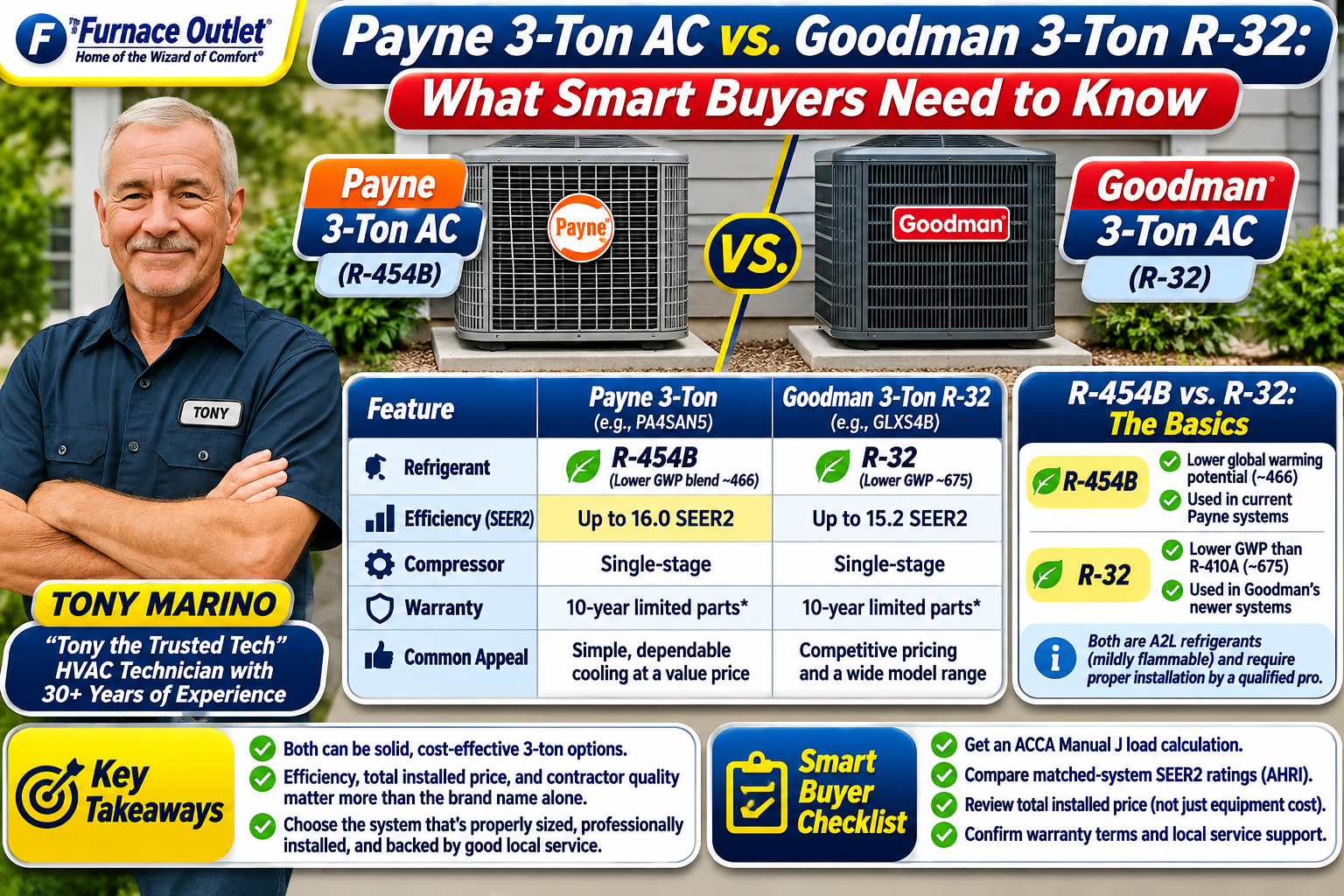
For the current refrigerant generation, Payne offers 3-ton systems using R-454B refrigerant. One example is the PA4SAN5 family, which features a single-stage compressor and published efficiency ratings reaching up to 16 SEER2 across eligible matched configurations.
Payne’s appeal is relatively simple equipment with an emphasis on conventional cooling performance. For homeowners who want dependable comfort without paying for every premium feature, that approach can make sense.
However, not every Payne 3-ton system carries the same efficiency rating or uses identical components. The exact model number, matched indoor equipment, and installation specifications determine what you’re purchasing.
I would evaluate Payne based on the contractor’s experience with the equipment, the complete installed price, and the availability of future service rather than assuming the brand automatically performs better than Goodman.
Goodman has built a substantial presence in the residential HVAC market by offering equipment across several price and performance categories. Its newer R-32 air conditioners are particularly relevant for homeowners replacing older R-410A systems.
The Goodman GLXS4B is one example of a current R-32 split-system air conditioner. It is available in several capacities, including 3 tons, and the product family offers efficiency ratings up to 15.2 SEER2 with a single-stage compressor.
Goodman also offers other R-32 product families with different efficiency levels and features. That gives homeowners the opportunity to compare a basic replacement system with higher-efficiency configurations.
One reason Goodman attracts attention is that equipment can be competitively priced through certain distribution channels. However, a lower online equipment price doesn’t necessarily translate into a lower professionally installed price.
I would consider Goodman a legitimate alternative to Payne, particularly when a qualified local installer offers a complete matched system with clear warranty terms.
One of the biggest differences in this comparison is the refrigerant. Many current Payne systems use R-454B, while Goodman’s GLXS4B and several related product families use R-32.
Both refrigerants were introduced into residential equipment as lower-global-warming-potential alternatives to R-410A. They help manufacturers comply with updated U.S. refrigerant regulations and reduce the climate impact associated with potential refrigerant releases.
R-32 is a single-component refrigerant with a global warming potential of approximately 675 under commonly used regulatory values. R-454B is a refrigerant blend with a lower global warming potential, approximately 466 under the same general framework.
Both are classified as A2L refrigerants, meaning they are mildly flammable and require compatible equipment and specific installation safety measures.
Neither refrigerant automatically makes an air conditioner more efficient, quieter, or more reliable. Those outcomes depend on the complete system design, operating conditions, and installation.
My recommendation is to select the better overall HVAC system rather than choosing solely between R-32 and R-454B. Both require properly trained technicians, appropriate service equipment, and manufacturer-approved components.
SEER2 measures seasonal cooling efficiency under standardized test conditions. A higher SEER2 rating generally indicates that a system uses less electricity to deliver the same amount of cooling over a typical cooling season.
For example, suppose you’re comparing two correctly matched 3-ton systems rated at 14.3 SEER2 and 15.2 SEER2. Under otherwise similar conditions, the higher-rated system would theoretically use about 6% less electricity for the same seasonal cooling output.
If the lower-efficiency system costs approximately $900 per year to operate, a 6% improvement would represent roughly $54 in annual savings. This is an illustrative calculation, not a prediction of your actual utility bill.
In a hot climate with long cooling seasons, efficiency differences can become more meaningful. However, installation quality, duct leakage, thermostat settings, insulation, and electricity rates can have an even larger impact on operating expenses.
I recommend comparing the AHRI-certified efficiency of the exact matched systems rather than relying on a manufacturer’s advertised maximum rating.
Many value-oriented Payne and Goodman air conditioners use single-stage compressors. These operate at a fixed cooling stage when the compressor is running, making them relatively straightforward in design.
Single-stage systems can provide satisfactory comfort when correctly sized and installed. However, they generally offer less flexibility than two-stage or variable-speed systems during periods of reduced cooling demand.
Two-stage equipment can operate at a lower capacity during milder conditions, while variable-speed systems can adjust output over a broader range. These capabilities may improve temperature consistency, reduce cycling, and support better humidity management when properly configured.
If you’re comparing a single-stage Payne with a single-stage Goodman, the differences may be relatively modest. If one quotation includes two-stage equipment and the other includes a basic single-stage model, the comparison changes significantly.
Always compare systems with similar compressor technology before deciding which brand offers better value.
Homeowners often ask me which brand is cheaper. The answer depends heavily on the model, contractor, local labor rates, and installation requirements.
For broad 2026–2027 U.S. budgeting, a straightforward professionally installed 3-ton central air-conditioning replacement may fall around $4,000–$7,500. Projects involving premium equipment, major ductwork changes, electrical upgrades, or difficult installation conditions can exceed that range.
These are illustrative planning estimates, not verified national averages or current quotations for specific Payne or Goodman models.
A basic Goodman R-32 system may sometimes be available at an attractive equipment price, while a Payne system may be competitively priced through an established local contractor. Either could end up costing less once labor, materials, and accessories are included.
I recommend obtaining at least three detailed quotations that identify the outdoor condenser, indoor coil, refrigerant, efficiency rating, electrical work, installation materials, and warranty coverage.
Goodman equipment is frequently advertised in packages that include an outdoor condenser and a compatible indoor evaporator coil. Some packages also include an air handler or other components.
These bundles can appear significantly cheaper than a contractor’s complete installed quotation because the advertised price may exclude labor, permits, refrigerant-line work, electrical modifications, duct transitions, and commissioning.
Another important consideration is whether the package is properly matched. A condenser and coil sold together are not necessarily an AHRI-certified combination with the efficiency rating you expect.
The existing furnace or air handler must also be compatible with the proposed indoor coil and applicable A2L refrigerant safety requirements.
Before purchasing an online bundle, confirm that a qualified installer is willing to install the equipment and that the proposed configuration meets the manufacturer’s requirements.
I’ve seen expensive equipment perform poorly because the installer rushed the job. I’ve also seen reasonably priced systems provide years of dependable comfort because every detail was handled correctly.
A professional installation should include accurate load calculations, verification of the matched equipment, proper refrigerant-line preparation, leak testing, evacuation, electrical checks, condensate drainage, and airflow adjustments.
With R-32 and R-454B systems, technicians must also follow the applicable A2L refrigerant safety requirements. Depending on the equipment and installation, this may involve specific leak-detection provisions, compatible components, and manufacturer-defined safety measures.
Ductwork deserves particular attention. A new 3-ton condenser cannot overcome severely undersized return ducts, major air leakage, or restricted airflow.
I would rather purchase a properly installed midrange system than a premium condenser connected to poorly designed ductwork.
Both brands sell residential air conditioners built around established refrigeration technologies, but there isn’t enough reliable, model-specific public failure-rate data to declare one universally more dependable.
Reliability depends on compressor design, coil construction, electrical components, installation quality, operating conditions, and maintenance.
Payne may appeal to homeowners who value a contractor-led purchasing and service experience. Goodman may appeal to buyers who want a broader range of competitively priced equipment options.
Neither brand is immune to compressor failures, refrigerant leaks, electrical problems, or fan-motor issues.
Before choosing, ask local contractors which brand they service regularly, how quickly replacement parts are available, and whether they will handle warranty claims directly.
Warranty protection is another area where buyers should compare the exact equipment rather than general brand claims.
Payne advertises a 10-year limited parts warranty on eligible equipment, subject to the applicable terms and registration requirements.
Goodman also offers a 10-year limited parts warranty on qualifying registered products, with registration generally required within 60 days of installation where permitted by law.
Warranty coverage does not necessarily include labor, refrigerant, diagnostic fees, or all replacement expenses. Those costs can become significant even when the failed component itself is covered.
I recommend asking the contractor for the full written warranty terms and a separate explanation of any labor warranty they provide.
A slightly higher installed price may be worthwhile when it includes stronger workmanship coverage and dependable local service.
In hot regions such as Florida, Texas, Arizona, and much of the southeastern United States, cooling performance and operating efficiency deserve special consideration.
A properly sized single-stage Payne or Goodman system can cool a home effectively, but humidity control may become more challenging when equipment is oversized or airflow is poorly adjusted.
In humid climates, I pay particular attention to indoor coil selection, blower airflow, condensate drainage, and the ability of the system to maintain appropriate cooling cycles.
For homeowners who prioritize humidity control and temperature consistency, a higher-efficiency two-stage or variable-speed system may justify additional consideration.
The brand name alone won’t solve a humidity problem. Correct equipment sizing and system configuration are essential.
If your existing R-410A air conditioner is nearing the end of its service life, a new R-32 or R-454B system may be an appropriate replacement.
However, R-32 and R-454B are not direct drop-in replacements for R-410A. A technician cannot simply charge an older R-410A condenser with one of these newer refrigerants.
The replacement system must use compatible components approved for the selected refrigerant. This typically includes a properly matched outdoor condenser and indoor coil, along with any required safety features.
Existing refrigerant lines may sometimes be reusable when the manufacturer permits it and the installation meets the required conditions, but that decision requires professional evaluation.
I recommend treating refrigerant compatibility as a system-level consideration rather than a reason to choose one brand automatically.
Is Goodman cheaper than Payne for a 3-ton air conditioner?
Goodman may offer a lower equipment-only purchase price in some markets, but that doesn’t guarantee a lower installed cost. Contractor labor, indoor coil selection, electrical requirements, permits, and warranty coverage all affect the final price. Comparing complete written quotations is the most reliable approach.
Is R-32 better than R-454B for residential air conditioning?
Neither refrigerant is universally better for homeowners. R-32 is a single-component refrigerant, while R-454B is a blend with a lower global warming potential. Both are A2L refrigerants used in properly designed modern equipment. Overall efficiency, reliability, and serviceability depend on the complete system rather than refrigerant choice alone.
How much electricity does a 3-ton air conditioner use?
Electricity consumption varies with efficiency, outdoor temperature, indoor settings, operating hours, and the condition of the home. A 3-ton system does not consume a fixed amount of electricity simply because it has a 36,000 BTU nominal cooling capacity. Comparing matched-system SEER2 ratings and local electricity costs provides a better estimate of annual operating expenses.
Can I install a Goodman R-32 bundle myself?
Central air-conditioning installation involves high-voltage electrical connections, refrigerant handling, pressure testing, evacuation, and safety requirements. A2L refrigerants introduce additional installation considerations. Professional installation is strongly recommended, and local licensing and permit requirements must be followed.
If you’re comparing a Payne 3-ton air conditioner with a Goodman 3-ton R-32 system, I wouldn’t automatically pay more for Payne, and I wouldn’t automatically choose Goodman because its equipment price looks lower.
For a straightforward replacement, a correctly matched Goodman R-32 system can represent good value when installed by a qualified contractor who stands behind the work. Payne can be equally sensible when a trusted local installer offers competitive pricing, strong service support, and a properly specified system.
My recommendation is to compare the exact model numbers, AHRI-certified efficiency ratings, installation scope, warranty terms, and contractor reputation.
The smartest purchase isn’t necessarily the cheapest outdoor unit or the most recognizable brand. It’s the complete cooling system that fits your home, your budget, and your expectations for dependable comfort over the next 10–15 years.
This article provides general educational information about Payne and Goodman residential air-conditioning systems. Product specifications, refrigerants, efficiency ratings, warranty conditions, availability, and prices vary by model and location. All cost estimates are illustrative. Refrigerant handling, electrical work, and HVAC installation should be performed by appropriately qualified professionals following manufacturer instructions, applicable safety standards, and local regulations.
These five sources support the technical comparison and provide useful references for publication.
1. Payne — PA4SAN5 Single-Stage Air Conditioner — Official specifications for Payne’s R-454B equipment, efficiency, and warranty features.
2. Goodman — GLXS4B R-32 Air Conditioner — Official product information, compressor technology, capacity options, and efficiency ratings.
3. Goodman — Air Conditioner Product Lineup — Comparison of Goodman’s available R-32 models and higher-efficiency alternatives.
4. Goodman — Literature Library — Technical specifications, product literature, and warranty certificates for matched equipment.
5. U.S. EPA — HFC Technology Transition Requirements — Regulatory information explaining the transition toward lower-GWP refrigerants