Newsletter Subscribe
Enter your email address below and subscribe to our newsletter

HVAC made simple
By Samantha Reyes — Samantha the Smart Shopper
A central air conditioner is one of those home investments we would all like to install and then forget about for a very long time. Unfortunately, an AC system doesn’t come with an expiration date printed on the cabinet. Two systems installed in the same year can reach very different ages depending on climate, operating hours, sizing, installation quality, maintenance and even the condition of the ductwork.
As a homeowner, I wouldn’t become overly concerned simply because my air conditioner has celebrated its tenth birthday. ENERGY STAR suggests considering replacement when an air conditioner is more than 10 years old, particularly when repairs, rising energy bills or comfort problems are becoming noticeable. That is a decision point, however, rather than a universal end-of-life date.
The smarter question is not simply, “How old is my AC?” It is, “How well is my AC performing for its age, and does continuing to repair it still make financial sense?”
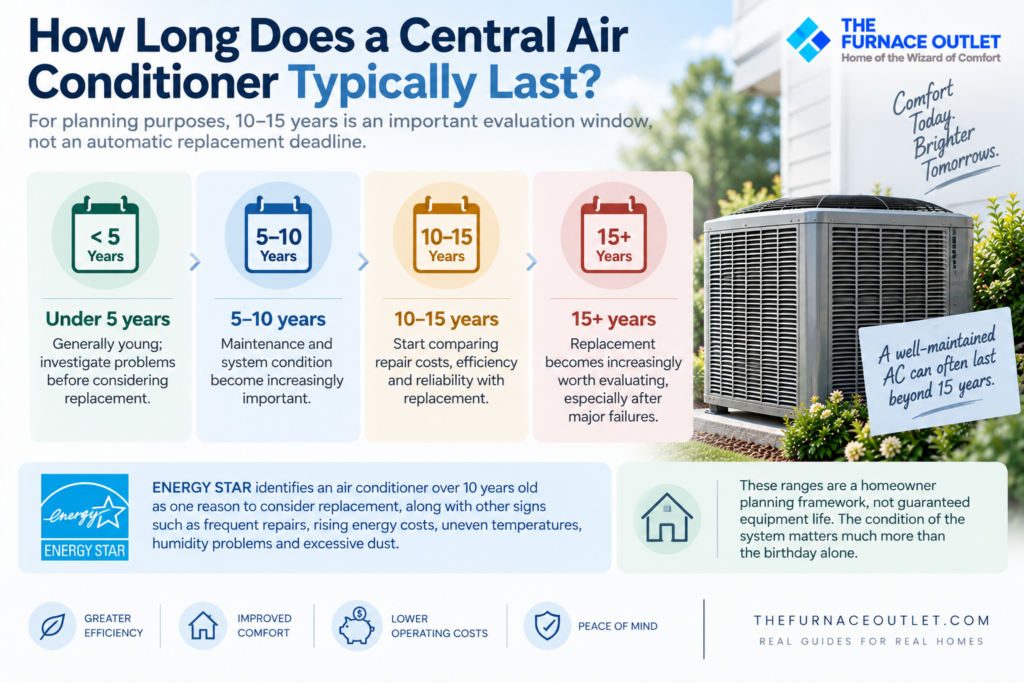
For planning purposes, I think of approximately 10–15 years as an important evaluation window for a central air conditioner rather than treating any particular year as an automatic replacement deadline. Some properly installed and maintained systems can continue operating beyond that range, while equipment exposed to demanding conditions may develop expensive problems considerably earlier.
| System Age | How I Would Think About It |
|---|---|
| Under 5 years | Generally young; investigate problems before considering replacement |
| 5–10 years | Maintenance and system condition become increasingly important |
| 10–15 years | Start comparing repair costs, efficiency and reliability with replacement |
| 15+ years | Replacement becomes increasingly worth evaluating, especially after major failures |
These ranges are a homeowner planning framework, not guaranteed equipment life. The condition of the system matters much more than the birthday alone.
ENERGY STAR specifically identifies an air conditioner over 10 years old as one reason to consider replacement and also points to frequent repairs, rising energy costs, uneven temperatures, humidity problems and excessive dust as signals that the HVAC system deserves closer evaluation.
I would put installation quality near the top of the list because an expensive air conditioner installed incorrectly doesn’t suddenly become a good system because it carries a respected brand name. Correct sizing, proper refrigerant charging, adequate airflow, compatible indoor and outdoor components, appropriate electrical installation and good ductwork all influence how the equipment operates. An installation problem can force components to work harder year after year.
Sizing is especially important. ENERGY STAR notes that oversized equipment can experience excessive short cycling, repeatedly turning on and off and creating additional compressor wear. That is why I would rather have a properly sized mid-range system professionally installed and commissioned than a premium flagship system selected primarily because someone assumed bigger was better.
An air conditioner serving a home in a long, hot cooling season may accumulate dramatically more operating hours than an identical system in a mild climate. Age measured only in calendar years therefore doesn’t tell the complete story.
Heat, humidity and extended cooling seasons can all increase the workload. Outdoor equipment can also face environmental stresses such as dirt, leaves, vegetation, coastal salt exposure or other contaminants depending on where the home is located. Think of two cars that are both ten years old. One has traveled 40,000 miles and another 150,000 miles. Their ages match, but their workloads certainly don’t. Central air conditioners deserve similar thinking.
HVAC maintenance can sound like one more service somebody wants homeowners to buy, but there are practical reasons for doing it. ENERGY STAR recommends annual pre-season HVAC checkups and identifies dirt and neglect as major contributors to heating and cooling equipment failure and inefficiency.
A professional cooling-system inspection should address items such as the evaporator and condenser coils, refrigerant level, electrical connections, controls, condensate drainage and blower components. ENERGY STAR specifically notes that dirty coils can make the system run longer and potentially reduce equipment life, while incorrect refrigerant levels and airflow problems can also hurt efficiency and longevity.
I wouldn’t expect maintenance to make every air conditioner last 20 years. Components eventually wear out. What maintenance can do is give the equipment a better opportunity to operate under the conditions it was designed for.
The filter may be one of the least exciting parts of your HVAC system, but it is also one of the easiest things homeowners can control. ENERGY STAR recommends checking the filter monthly, particularly during periods of heavy use, and replacing or cleaning it when dirty. Its general guidance says that, at minimum, filters should typically be changed every three months, although the appropriate interval depends on the filter, system and household conditions. A clogged filter restricts airflow, makes the system work harder and can contribute to equipment problems and premature failure.
I would follow the equipment and filter manufacturer’s recommendations rather than assuming every household needs exactly the same replacement schedule.
Your condenser needs airflow. Allowing leaves, vegetation and debris to accumulate around it isn’t doing the equipment any favors. Keeping the outdoor unit reasonably clean and unobstructed is a simple homeowner task, while internal cleaning and servicing should be left to an appropriately qualified technician. ENERGY STAR recommends keeping both indoor and outdoor equipment clear of dirt and debris as part of maintaining good HVAC performance.
I would also resist the temptation to treat an outdoor condenser like garden furniture. Avoid enclosing it tightly with decorative screening or vegetation that restricts the airflow the manufacturer intended it to have.

Age alone wouldn’t convince me to replace a functioning system. I would become much more interested in replacement when several warning signs begin appearing together.
1. Repairs are becoming frequent. One repair does not necessarily condemn an older AC. Repeated service calls are different. When a system begins needing one component after another, I would start tracking how much money is being invested in keeping it operational.
2. A major component fails. Compressor, coil and other major repairs deserve a repair-versus-replacement calculation, particularly on older equipment. I wouldn’t spend several thousand dollars automatically without first learning what a complete replacement would cost.
3. Electricity consumption keeps increasing. A higher utility bill doesn’t automatically prove the AC is failing—weather, electricity rates and household behavior matter too. But an aging system that runs longer while providing less comfort deserves professional evaluation. ENERGY STAR specifically identifies rising energy bills combined with frequent repairs as a replacement warning sign.
4. Some rooms won’t stay comfortable. Hot and cold rooms can result from equipment problems, duct issues, insulation, air leakage or poor system design. The solution isn’t automatically a new condenser, but persistent uneven temperatures are a reason to investigate the entire system.
5. Humidity control has deteriorated. An AC system should contribute to moisture removal while cooling. Excessive indoor humidity can point toward equipment, sizing, airflow or duct-related problems and should be diagnosed rather than simply tolerated.
6. The system runs constantly or cycles unusually. Long operating periods can occur during extreme weather, so this isn’t automatically a failure. A significant change from normal behavior, however, can indicate declining performance or another problem requiring diagnosis.
7. The system has become noticeably noisy. New sounds may come from relatively minor components or something more serious. I wouldn’t diagnose a compressor from a noise alone, but grinding, rattling or other new mechanical sounds deserve attention.
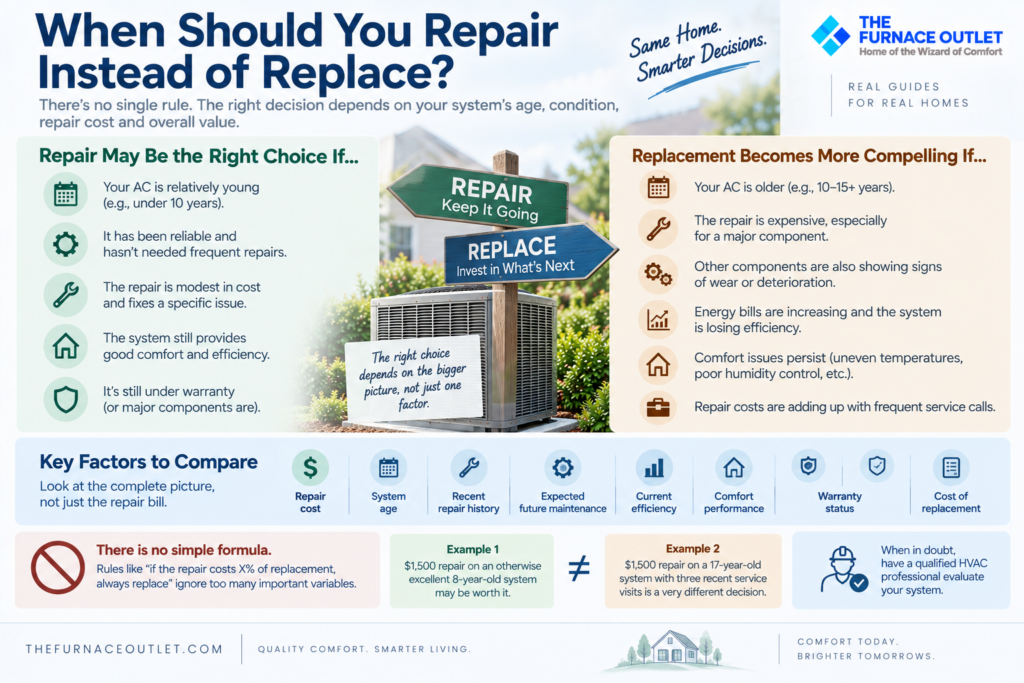
If my air conditioner were relatively young, otherwise reliable and facing a modest repair, repairing it would usually be my first consideration. Replacement becomes more compelling when the equipment is older and the repair is expensive, particularly if other components are also showing deterioration.
I would compare the repair cost, system age, recent repair history, expected future maintenance, current efficiency, comfort performance, warranty status and cost of replacement.
I don’t like simplistic formulas such as “if the repair costs X percent of replacement, always replace.” They ignore too many variables. A $1,500 repair on an otherwise excellent eight-year-old system is a very different decision from the same repair on a 17-year-old unit that has already required three service visits.
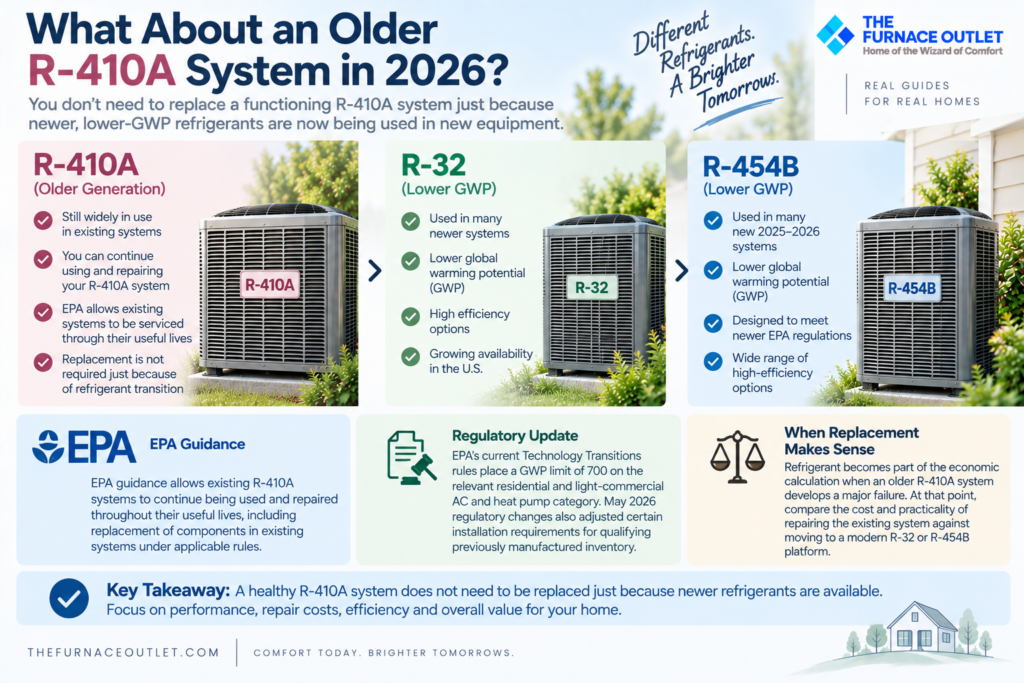
This is an especially important question now because homeowners are seeing newer systems designed around lower-GWP refrigerants such as R-32 and R-454B. If you own a functioning R-410A central air conditioner, you do not need to replace it simply because the HVAC market is transitioning to newer refrigerants. EPA guidance allows existing systems to continue being used and repaired throughout their useful lives, including replacement of components in existing systems under applicable rules.
EPA’s current Technology Transitions rules place a GWP limit of 700 on the relevant residential and light-commercial AC and heat-pump category, while the agency’s May 2026 regulatory changes also adjusted certain installation requirements for qualifying previously manufactured inventory. For me, refrigerant becomes part of the economic calculation when an older R-410A system develops a major failure. At that point I would compare the cost and practicality of repairing the existing system against moving to a modern R-32 or R-454B platform. I wouldn’t replace a healthy system solely because its refrigerant is from the previous equipment generation.
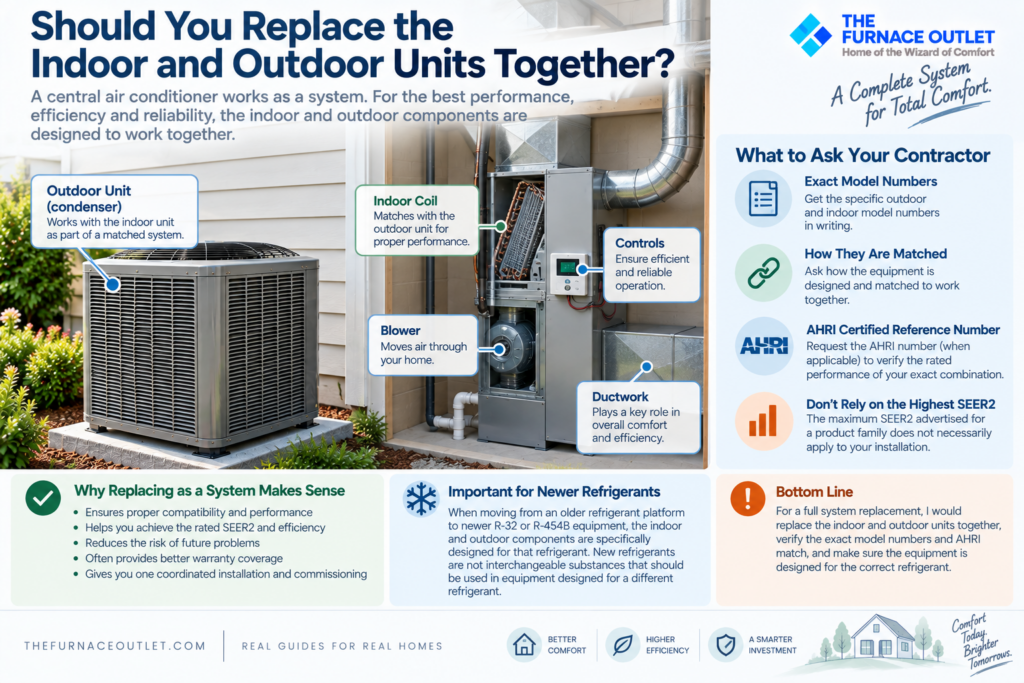
Central air conditioning operates as a system. The outdoor condenser, indoor coil, blower, controls and ductwork all influence performance. If I were purchasing a complete replacement, I would want the contractor to provide the exact outdoor and indoor model numbers and explain how they are matched. I would also request the AHRI Certified Reference Number when applicable rather than assuming the maximum SEER2 advertised for the outdoor unit automatically applies to my installation.
That becomes especially important when moving from an older refrigerant platform to newer R-32 or R-454B equipment. New refrigerants are not simply interchangeable substances that should be dropped into equipment designed around another refrigerant.
I wouldn’t promise that. New systems offer substantial advances in efficiency, controls, compressor technology and comfort, but some are also considerably more sophisticated than older single-stage equipment. A variable-capacity system, for example, can provide impressive temperature consistency, humidity control and efficiency, but it contains more advanced electronics and controls. That doesn’t mean it is unreliable; it means I would consider warranty coverage, local technician expertise, replacement-parts availability and dealer support alongside SEER2.
The best strategy for longevity remains surprisingly traditional: choose the right equipment, size it correctly, install it properly and maintain it.
Once my air conditioner passed roughly the ten-year mark, I would start keeping a closer eye on its overall economics rather than waiting for a midsummer emergency. I would know the system’s installation year and refrigerant, keep service records, note significant repairs, monitor unusual changes in comfort or operating behavior, maintain the filters and arrange regular professional maintenance.
If replacement began looking likely, I would get quotes before the existing system completely failed. That gives me time to compare equipment, contractors, warranties, SEER2 ratings, refrigerants and prices without making a major purchase because the house is 90°F and I need cooling immediately.
If there’s one number I wouldn’t become obsessed with, it is the age printed on the installation record. A central air conditioner doesn’t suddenly become bad on its tenth, fifteenth or twentieth birthday. What matters is how reliably, efficiently and comfortably it continues to perform—and what it costs to keep it doing so.
My approach is simple: maintain a healthy system rather than replacing it prematurely, but don’t repeatedly pour money into aging equipment when the economics have clearly shifted toward replacement. As the system gets older, watch the repair frequency, energy consumption, comfort, noise and overall condition more carefully.
The smartest replacement is usually the one you have time to plan.
— Samantha Reyes, the Smart Shopper
Best Central Air Conditioners of 2026: Brands, Models & Buying Advice – The Furnace Outlet
The Furnace Outlet | THEFURNACEOUTLET.COM
Editorial Disclosure: The Furnace Outlet is not associated with, affiliated with, endorsed by, or sponsored by any manufacturer or brand mentioned. We do not receive manufacturer compensation for inclusion or rankings. HVAC lifespan, efficiency, repair costs and performance vary by equipment, home, climate, usage, installation and maintenance. Consult a qualified HVAC professional for an evaluation specific to your system.
ENERGY STAR — Maintenance Checklist
ENERGY STAR — When Is It Time to Replace?
EPA — Frequent Questions on the Phasedown of HFCs