Newsletter Subscribe
Enter your email address below and subscribe to our newsletter

HVAC made simple
By Mark Callahan | The Furnace Outlet
Choosing a 3-ton air conditioning system for a small commercial property involves more than comparing equipment prices and brand reputation. Unlike residential environments, commercial spaces frequently experience extended operating hours, greater occupancy fluctuations, additional heat generated by electronic equipment, and more demanding ventilation requirements. These factors make equipment selection, installation quality, energy efficiency, and long-term reliability particularly important.
Daikin, Goodman, and Carrier are three well-established HVAC brands serving the North American market. Although each manufacturer offers equipment suitable for certain light commercial applications, their product portfolios, control technologies, installation requirements, and ownership costs can differ significantly.
Goodman is often an attractive starting point for budget-conscious property owners, Daikin deserves consideration for advanced efficiency and comfort control, and Carrier offers a broad range of commercial HVAC solutions. However, the best 3-ton air conditioner ultimately depends on the building’s cooling load, ventilation requirements, electrical infrastructure, operating schedule, and available local service support.
A 3-ton air conditioner has a nominal cooling capacity of 36,000 BTU per hour. This capacity may be appropriate for smaller offices, retail stores, professional practices, salons, workshops, and other commercial spaces with moderate cooling requirements.
Commercial cooling loads cannot be accurately determined using square footage alone. Large storefront windows, lighting systems, computer equipment, customer traffic, ventilation requirements, ceiling height, insulation quality, and local climate can substantially increase cooling demand.
A conventional residential-style split system may be suitable for some small commercial properties, while others may require dedicated commercial equipment, rooftop packaged units, or specialized ventilation arrangements. Before comparing brands, property owners should establish which equipment configuration is suitable for their building.
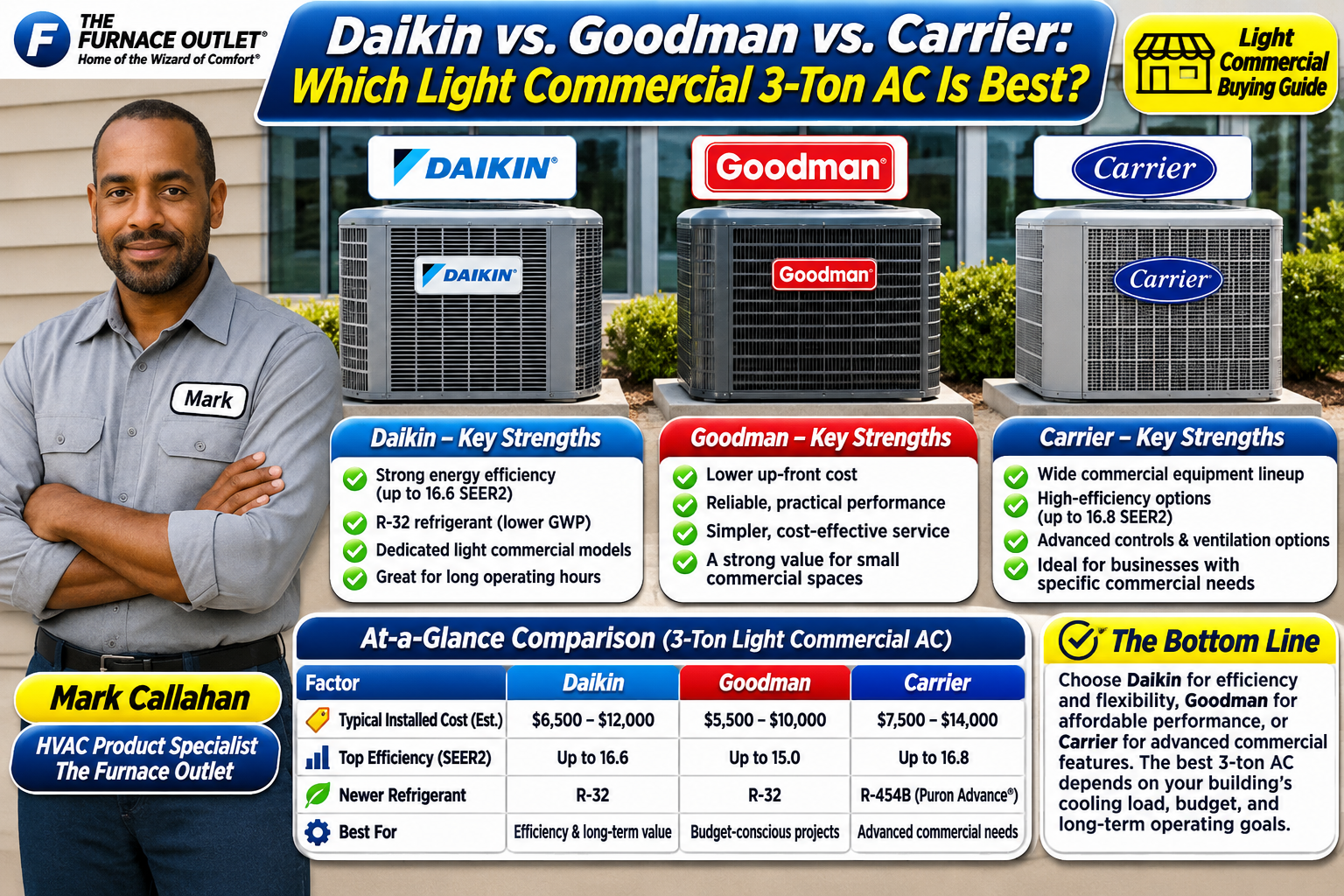
All three brands deserve consideration, but they appeal to different commercial purchasing priorities. Goodman generally fits cost-sensitive installations, Daikin offers dedicated light commercial equipment across multiple efficiency tiers, and Carrier is particularly worth evaluating when commercial controls, ventilation, and facility management requirements are more demanding.
| Comparison Factor | Daikin | Goodman | Carrier |
|---|---|---|---|
| Market positioning | Mid-range to premium | Value-oriented | Mid-range to premium |
| Initial investment | Moderate to high | Generally lower | Moderate to high |
| Commercial equipment selection | Extensive | More limited | Extensive |
| Energy efficiency options | Very good | Good to very good | Very good |
| Advanced commercial controls | Available | Model dependent | Available |
| Maintenance complexity | Model dependent | Generally simpler on basic models | Model dependent |
| Best application | Energy-conscious businesses | Budget-conscious businesses | Commercial facilities with advanced requirements |
| Overall buying priority | Efficiency and long-term value | Affordability | Commercial system integration |
These comparisons reflect general product positioning rather than independently measured reliability rankings. Individual equipment specifications, contractor quotations, warranties, and local parts availability should determine the final purchasing decision.
Daikin is a strong candidate for business owners looking for commercial-grade equipment with competitive energy efficiency and flexible installation options. Its light commercial portfolio includes packaged rooftop units, split-system air conditioners, heat pumps, and combination gas heating and electric cooling systems.
The manufacturer’s newer light commercial equipment incorporates R-32 refrigerant across several product families, providing alternatives to older R-410A equipment. Daikin also offers multiple efficiency tiers, allowing businesses to balance initial purchasing costs against anticipated operating expenses.
The Daikin NEXIO Plus DHC Series is an example of the manufacturer’s dedicated light commercial packaged air conditioners. According to Daikin’s official product specifications, its 3-to-5-ton equipment category offers ratings reaching 16.6 SEER2 and 12.5 EER2, although exact ratings vary by model.
Daikin is particularly worth considering for businesses operating throughout the day, properties located in hot climates, and commercial spaces where electricity consumption represents a substantial recurring expense.
Goodman has established its market position around affordable heating and cooling equipment designed to deliver practical performance. Its conventional split systems and packaged equipment may offer an economical solution for smaller commercial properties where the building’s requirements permit their use.
A significant advantage of selecting a conventional Goodman system is the potential for lower equipment acquisition costs without necessarily sacrificing the essential cooling performance required by a small business. Straightforward equipment configurations can also simplify routine servicing compared with more complex communicating or modulating systems.
Goodman is particularly attractive for small offices, independent retailers, rental commercial properties, and businesses working within strict renovation budgets. However, property owners must confirm that the selected equipment is approved for the intended commercial application, particularly regarding warranty coverage, ventilation requirements, and electrical compatibility.
Carrier offers a broad portfolio of commercial HVAC equipment designed for applications ranging from smaller retail properties to larger commercial buildings. Its commercial equipment families include packaged rooftop units, heat pumps, gas-electric systems, and higher-efficiency configurations.
Depending on the selected model, Carrier equipment may support advanced fan technology, equipment monitoring, ventilation accessories, and more sophisticated building control arrangements. These capabilities can be valuable in businesses with demanding occupancy schedules or multiple commercial locations.
The Carrier WeatherMaker 48FC illustrates Carrier’s commercial rooftop engineering approach, incorporating electronically commutated indoor fan technology and dedicated equipment controls. The official Carrier technical specifications describe these features for an R-410A gas-electric equipment family. Buyers purchasing new equipment should request the applicable newer refrigerant model and current installation eligibility rather than assuming legacy equipment remains suitable for every installation. carrier.com
Carrier is particularly worth evaluating for commercial properties where ventilation management, equipment integration, and responsive contractor support are more important than obtaining the lowest initial purchase price.
Goodman operates within the Daikin corporate family, which explains why certain equipment platforms may share engineering approaches, manufacturing resources, and component technologies. However, common corporate ownership does not make every Daikin and Goodman air conditioner identical.
Differences may include cabinet construction, compressor configuration, efficiency ratings, available accessories, control systems, commercial application approvals, and warranty terms. Buyers should therefore compare exact equipment model numbers instead of assuming that a less expensive Goodman system provides every feature available in a comparable Daikin commercial unit.
For straightforward cooling applications, a competitively priced Goodman system may deliver excellent value. For properties requiring dedicated commercial controls, ventilation accessories, or more advanced operating capabilities, a Daikin light commercial model may offer advantages that justify additional expenditure.
Energy efficiency becomes particularly important in commercial environments because air conditioning systems frequently operate for longer periods than residential equipment. Even a moderate improvement in efficiency can translate into meaningful electricity savings over several years of business operation.
Daikin and Goodman offer equipment using R-32 refrigerant, while Carrier’s newer commercial product lines incorporate R-454B, marketed as Puron Advance. Both refrigerants have lower global warming potential than R-410A and require equipment designed for their respective A2L refrigerant safety requirements.
| Efficiency Factor | Daikin | Goodman | Carrier |
|---|---|---|---|
| Newer refrigerant options | R-32 | R-32 | R-454B |
| Standard-efficiency equipment | Available | Available | Available |
| High-efficiency options | Available | Model dependent | Available |
| Advanced capacity control | Select models | Select models | Select models |
| Commercial ventilation accessories | Extensive options | Application dependent | Extensive options |
Carrier’s newer Carrier WeatherMaster 50GE commercial equipment family offers efficiency ratings reaching 16.8 SEER2, with staged cooling and R-454B refrigerant. The official Carrier WeatherMaster specifications provide further information about available configurations and performance capabilities. carrier.com
However, refrigerant selection alone does not determine equipment efficiency. Compressor design, heat exchanger performance, airflow management, equipment sizing, operating conditions, and installation quality all influence actual electricity consumption.
The total cost of installing a 3-ton commercial air conditioning system depends on equipment configuration, installation complexity, electrical infrastructure, ductwork condition, local labor rates, and required commercial accessories.
The following figures provide illustrative US budgeting estimates for comparing the three brands. Rooftop installations requiring cranes, structural modifications, new roof curbs, or extensive electrical work may cost considerably more.
| Cost Component | Goodman | Daikin | Carrier |
|---|---|---|---|
| Equipment | $2,500–$4,500 | $3,000–$6,000 | $3,500–$7,500 |
| Installation and related work | $3,000–$5,500 | $3,500–$6,000 | $4,000–$6,500 |
| Estimated total | $5,500–$10,000 | $6,500–$12,000 | $7,500–$14,000 |
These estimates are intended for preliminary financial planning rather than guaranteed market quotations. Comparing itemized proposals from qualified commercial HVAC contractors is essential because a lower equipment price does not necessarily translate into a lower completed installation cost.
Commercial property owners should evaluate electricity expenses alongside initial purchasing costs. A higher-efficiency air conditioner may justify its additional investment when the equipment operates for extended periods throughout the cooling season.
Consider a 3-ton system delivering an equivalent of 2,000 full-load cooling hours annually at an electricity rate of $0.16 per kWh. Using comparable seasonal efficiency ratings produces the following illustrative operating cost estimates.
| Efficiency Rating | Annual Electricity Usage | Annual Cooling Cost | 10-Year Cooling Cost |
|---|---|---|---|
| 13.4 SEER2 | 5,373 kWh | $860 | $8,600 |
| 15.0 SEER2 | 4,800 kWh | $768 | $7,680 |
| 16.6 SEER2 | 4,337 kWh | $694 | $6,940 |
| 16.8 SEER2 | 4,286 kWh | $686 | $6,860 |
Under these assumptions, upgrading from 13.4 SEER2 to 16.8 SEER2 could reduce cooling electricity expenses by approximately $174 annually, or $1,740 over ten years. Actual savings depend on building loads, commercial electricity tariffs, ventilation requirements, equipment performance, and operating schedules, while demand charges may further affect commercial utility bills.
Commercial air conditioning reliability depends heavily on installation quality, operating conditions, preventive maintenance, and equipment selection. Although premium equipment may incorporate advanced protection and diagnostic features, no brand can compensate indefinitely for inadequate airflow, improper refrigerant charging, neglected maintenance, or incorrect sizing.
A properly maintained light commercial air conditioner may provide approximately 15–20 years of service, although demanding operating environments can shorten its useful life. Coastal exposure, airborne contaminants, excessive operating hours, and restricted airflow can accelerate equipment deterioration.
There is insufficient independent, directly comparable failure-rate data to establish that Daikin, Goodman, or Carrier universally lasts longer than the others. Property owners should prioritize local service availability, component warranties, maintenance accessibility, and expected repair costs rather than relying entirely on brand reputation.
Warranty coverage is particularly important when installing equipment traditionally marketed for residential applications in a commercial property. Residential warranty benefits do not necessarily extend to offices, retail stores, rental commercial properties, or other business environments.
The Goodman official warranty overview identifies various limited warranty benefits for its residential equipment families. Commercial buyers should obtain written confirmation of the warranty applicable to their specific installation before purchasing equipment. apps.goodmanmfg.com
Daikin and Carrier commercial warranties also vary according to equipment model, application, component type, and applicable terms. Businesses should examine labor coverage, compressor protection, replacement parts availability, registration requirements, and optional extended service agreements.
A packaged rooftop air conditioner combines major cooling components within a single outdoor cabinet, making it particularly suitable for commercial properties where indoor equipment space is limited. Rooftop installations may also support dedicated ventilation accessories and simplify certain maintenance procedures.
Split-system air conditioners separate the outdoor condensing equipment from the indoor air handler or furnace. This configuration can be economical for smaller commercial buildings with existing mechanical rooms and suitable ductwork.
Daikin and Carrier offer dedicated commercial rooftop equipment, while Goodman may provide a cost-effective alternative where conventional split or packaged equipment satisfies the building’s requirements. The most economical configuration is frequently the one that works with existing infrastructure without compromising performance or regulatory compliance.
A conventional 3-ton air conditioning system often operates near 1,200 CFM, based on an approximate airflow guideline of 400 CFM per ton. However, actual airflow requirements depend on equipment specifications, indoor humidity, sensible and latent cooling loads, and duct system resistance.
Commercial buildings may also require additional outdoor air ventilation to accommodate employees, customers, and other occupants. Introducing outdoor air increases the cooling and dehumidification load, particularly in hot and humid climates.
The U.S. Department of Energy’s light commercial HVAC purchasing guidance emphasizes appropriate sizing, climate-specific equipment selection, efficient fan technology, economizers, and quality installation as important contributors to commercial energy performance. Department of Energy
Different business environments require different levels of cooling performance and equipment functionality. Selecting equipment according to building requirements generally produces better results than choosing a brand solely because of its reputation.
| Commercial Application | Brand to Consider First | Primary Reason |
|---|---|---|
| Small office | Goodman or Daikin | Affordability and practical cooling |
| Retail store | Daikin | Balanced efficiency and commercial features |
| Budget commercial rental | Goodman | Lower potential capital investment |
| Professional office | Daikin or Carrier | Comfort and control options |
| Premium showroom | Carrier or Daikin | Advanced equipment configurations |
| Extended-hours business | Daikin or Carrier | Higher-efficiency options |
| Existing Carrier rooftop replacement | Carrier | Potential retrofit compatibility |
| Small workshop | Goodman | Straightforward equipment options |
Specialized environments such as restaurants, medical facilities, and server rooms may require dedicated ventilation, humidity control, redundancy, or precision cooling equipment. Standard 3-ton comfort-cooling equipment should not automatically be considered suitable for these applications.
Is Daikin better than Goodman for commercial air conditioning? Daikin offers a broader range of dedicated commercial equipment and may provide more suitable features for demanding installations. Goodman can nevertheless deliver excellent value in smaller commercial spaces where its equipment is approved for the application.
Is Carrier worth the additional investment? Carrier may justify a higher initial price when advanced commercial controls, rooftop replacement compatibility, ventilation accessories, or higher-efficiency configurations provide measurable operational benefits. The exact equipment specifications and installation quotation should determine whether the premium is worthwhile.
Are Daikin and Goodman manufactured by the same company? Goodman belongs to the Daikin corporate family, and some products share engineering and manufacturing resources. However, differences in specifications, controls, equipment features, and warranties remain important.
How many square feet can a 3-ton commercial AC cool? There is no universally reliable square footage recommendation for commercial cooling equipment. Occupancy, ventilation, insulation, equipment-generated heat, and local climate must be included in a commercial cooling load calculation.
Which brand is cheapest to maintain? Conventional Goodman equipment may offer lower servicing costs in some markets because of its relatively straightforward configurations. However, local parts availability, technician familiarity, warranty coverage, and equipment complexity ultimately determine maintenance expenses.
For most small businesses seeking a balance between equipment cost, commercial functionality, efficiency, and long-term operating value, Daikin deserves serious consideration. Its dedicated light commercial product portfolio provides flexibility for both conventional and more demanding applications.
Goodman is a compelling option for budget-conscious businesses requiring straightforward cooling without extensive commercial control features, provided the selected equipment carries appropriate commercial application approval. Carrier is particularly attractive for businesses prioritizing advanced commercial functionality, higher-efficiency configurations, or compatibility with existing rooftop infrastructure.
Ultimately, the best 3-ton commercial air conditioner is the system that satisfies the building’s calculated cooling requirements, ventilation needs, electrical infrastructure, and long-term operating budget. Correct equipment sizing and professional installation should take priority over brand preference.
When comparing Daikin, Goodman, and Carrier commercial air conditioners, refrigerant technology is another important consideration affecting environmental impact, servicing requirements, and equipment compatibility. Explore our detailed guide on R-454B vs. R-32 refrigerants to understand how these newer refrigerants differ.
This article provides general educational and preliminary purchasing guidance. Equipment specifications, pricing, commercial warranties, refrigerant requirements, and installation regulations vary by model and location, and all commercial HVAC installations should be designed and performed by appropriately qualified professionals.
Editorial Disclosure: The Furnace Outlet is not associated with, affiliated with, endorsed by, or sponsored by Carrier, Trane, Lennox, Bryant or any other manufacturer mentioned in this article. We do not receive manufacturer compensation for inclusion or rankings.
The Furnace Outlet
For educational purposes only. HVAC equipment removal, refrigerant handling, recycling and disposal requirements can vary by equipment and location. Consult a qualified HVAC professional and applicable federal, state and local requirements before removing or disposing of HVAC equipment.
© 2026 The Furnace Outlet | www.thefurnaceoutlet.com