Newsletter Subscribe
Enter your email address below and subscribe to our newsletter

HVAC made simple
By Savvy Mavi | The Furnace Outlet
Electric furnaces offer a relatively affordable, straightforward heating solution for homeowners who do not have access to natural gas or prefer an all-electric HVAC system. Although these systems are generally less expensive to purchase and install than many other central heating systems, their operating costs can become substantial during colder months.
The actual cost of running an electric furnace depends on its heating capacity, local electricity rates, operating hours, outdoor temperatures, insulation quality, and thermostat settings. A homeowner in Florida may spend considerably less on electric heating than someone using the same furnace in Minnesota or Michigan.
This guide breaks down electric furnace electricity consumption, hourly and monthly operating costs, seasonal heating expenses, and practical strategies for reducing utility bills. It also compares electric furnaces with gas furnaces and heat pumps to help homeowners make informed long-term heating decisions.
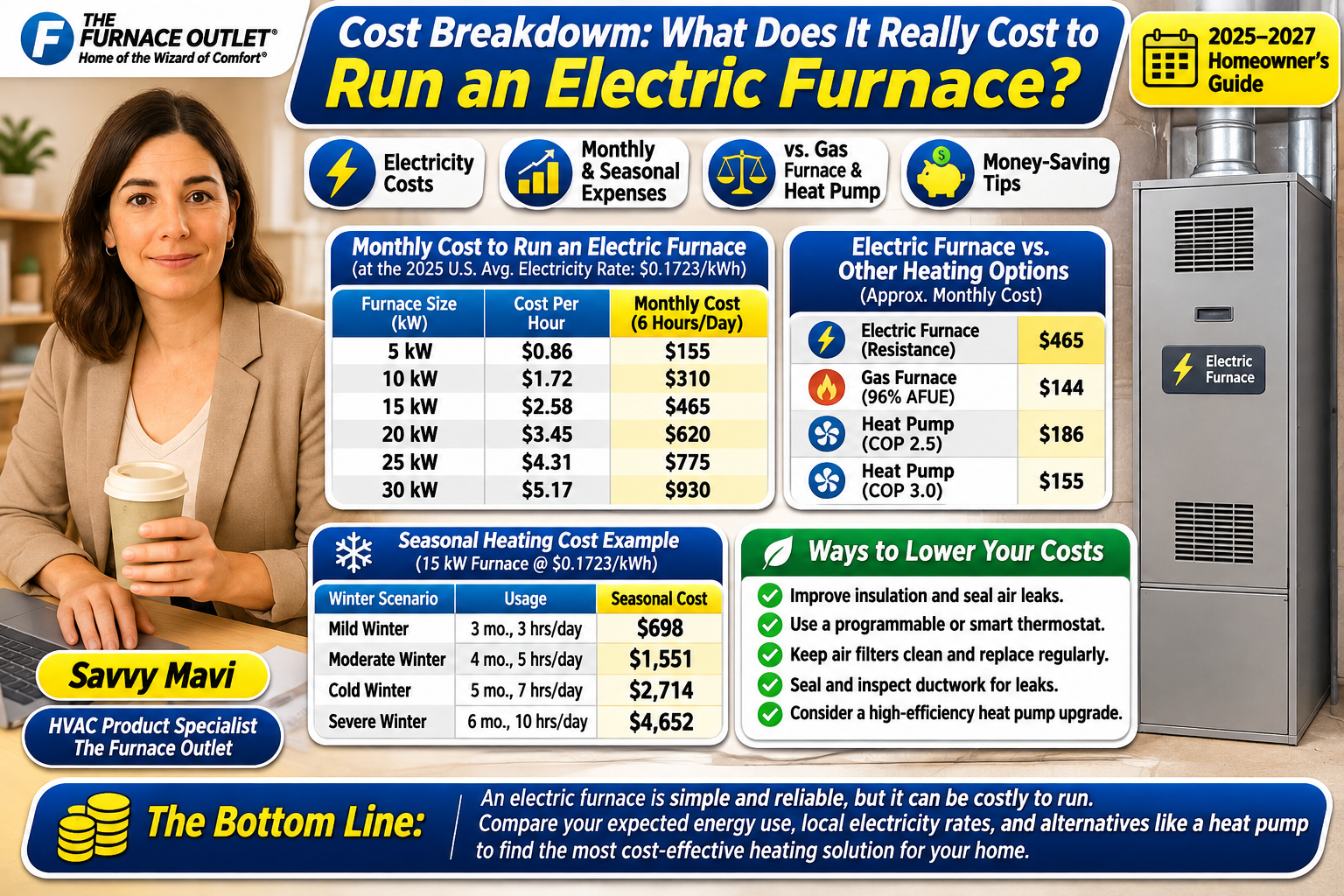
An electric furnace can cost approximately $155 to $1,034 per month to operate under the illustrative usage scenarios below. Larger furnaces operating for extended periods in cold climates can cost considerably more, particularly in regions with expensive electricity.
According to the U.S. Energy Information Administration, the average residential electricity price increased from 16.48 cents per kWh in 2024 to 17.23 cents per kWh in 2025. This represents an increase of approximately 4.6%, making energy efficiency increasingly important for homeowners relying on electric resistance heating. U.S. Energy Information Administration (EIA)
| Furnace Capacity | Cost Per Hour | Monthly Cost: 6 Hours/Day |
|---|---|---|
| 5 kW | $0.86 | $155.07 |
| 10 kW | $1.72 | $310.14 |
| 15 kW | $2.58 | $465.21 |
| 20 kW | $3.45 | $620.28 |
| 25 kW | $4.31 | $775.35 |
| 30 kW | $5.17 | $930.42 |
These calculations assume an electricity rate of $0.1723 per kWh, a 30-day month, and six equivalent full-power operating hours daily. Blower electricity consumption, fixed utility charges, and additional household electricity usage are excluded.
Unlike gas furnaces, which are generally marketed according to their BTU input capacity and AFUE efficiency, electric furnaces are commonly rated in kilowatts. The kilowatt rating indicates how much electrical power the heating elements consume when operating at their rated capacity.
One kilowatt of electric resistance heating produces approximately 3,412 BTU of heat per hour. Understanding this relationship helps homeowners compare electric furnace sizes with conventional gas heating equipment.
| Electric Furnace Size | Approximate Heating Output |
|---|---|
| 5 kW | 17,060 BTU/h |
| 8 kW | 27,296 BTU/h |
| 10 kW | 34,120 BTU/h |
| 15 kW | 51,180 BTU/h |
| 20 kW | 68,240 BTU/h |
| 25 kW | 85,300 BTU/h |
| 30 kW | 102,360 BTU/h |
A larger electric furnace consumes more electricity when operating at full capacity, but it may operate for shorter periods than a smaller system. Correct equipment sizing should be based on the home’s calculated heating requirements rather than kilowatt ratings alone.
Calculating an electric furnace’s operating cost requires three basic pieces of information: heating element capacity in kilowatts, equivalent full-power operating hours, and the applicable electricity rate.
Monthly operating cost = Furnace kW × Daily equivalent full-power hours × Days per month × Electricity rate
For example, a 15 kW electric furnace operating for six equivalent full-power hours daily would consume 90 kWh per day. Over a 30-day month, this represents 2,700 kWh of electricity, costing approximately $465.21 at the 2025 national average residential rate.
Homeowners can also explore The Furnace Outlet HVAC Calculators to estimate energy consumption and compare heating equipment requirements.
Electric furnace operating hours can change dramatically throughout the heating season. During mild weather, heating elements may operate for relatively short periods, while freezing temperatures and inadequate insulation can significantly increase electricity consumption.
| Furnace Size | 4 Hours/Day | 6 Hours/Day | 8 Hours/Day | 10 Hours/Day |
|---|---|---|---|---|
| 5 kW | $103 | $155 | $207 | $258 |
| 10 kW | $207 | $310 | $414 | $517 |
| 15 kW | $310 | $465 | $620 | $775 |
| 20 kW | $414 | $620 | $827 | $1,034 |
| 25 kW | $517 | $775 | $1,034 | $1,292 |
| 30 kW | $620 | $930 | $1,241 | $1,551 |
All figures use an electricity rate of $0.1723 per kWh and a 30-day billing period. Equivalent full-power hours account for staged heating elements and intermittent operation, so they should not be confused with the total time the thermostat remains in heating mode.
Electricity prices vary considerably across the United States. Two households operating identical electric furnaces for the same amount of time can experience dramatically different heating bills simply because of regional utility rates.
The following comparison uses 2025 state-level residential electricity prices published in the EIA Electric Power Annual. Calculations assume a 15 kW furnace operating for six equivalent full-power hours daily.
| State | 2025 Electricity Rate | Monthly Heating Cost |
|---|---|---|
| Arkansas | 12.87¢/kWh | $347.49 |
| Iowa | 13.62¢/kWh | $367.74 |
| Florida | 15.21¢/kWh | $410.67 |
| Arizona | 15.26¢/kWh | $412.02 |
| Colorado | 15.69¢/kWh | $423.63 |
| Illinois | 17.67¢/kWh | $477.09 |
| Connecticut | 29.31¢/kWh | $791.37 |
| Massachusetts | 30.41¢/kWh | $821.07 |
| California | 31.35¢/kWh | $846.45 |
| Hawaii | 40.40¢/kWh | $1,090.80 |
These figures isolate the impact of electricity prices rather than predicting actual heating bills in individual states. Climate, housing characteristics, utility tariffs, and heating demand must also be considered. U.S. Energy Information Administration
Seasonal heating expenses depend on both the length of the heating season and the intensity of winter conditions. A homeowner using an electric furnace for occasional supplemental heating may spend only a few hundred dollars annually, while a household relying entirely on resistance heating may spend several thousand dollars.
| Heating Scenario | Assumed Usage | Seasonal Cost at 15 kW |
|---|---|---|
| Mild winter | 3 months, 3 hours/day | $698 |
| Moderate winter | 4 months, 5 hours/day | $1,551 |
| Cold winter | 5 months, 7 hours/day | $2,714 |
| Severe winter | 6 months, 10 hours/day | $4,652 |
These scenarios use 30-day months and the national average 2025 electricity rate. Actual energy consumption will fluctuate as outdoor temperatures, thermostat settings, and household heating demand change.
Electric resistance furnaces convert nearly all the electricity consumed by their heating elements into heat. Unlike conventional gas furnaces, they do not lose combustion energy through exhaust gases or require a chimney to remove combustion byproducts.
However, nearly 100% point-of-use efficiency does not necessarily translate into lower heating bills. Electricity can be substantially more expensive than natural gas per unit of useful heat, while heat pumps can deliver several units of heat for each unit of electricity consumed by transferring thermal energy rather than generating it directly.
Duct leakage, insufficient insulation, blower electricity consumption, and heat losses through unconditioned spaces can also reduce overall heating system performance.
Natural gas furnaces frequently offer lower operating costs in areas where natural gas is affordable. Electric furnaces may have lower initial installation expenses, but homeowners should consider the cumulative energy costs over the equipment’s expected service life.
The following comparison assumes a monthly useful heating requirement of approximately 9.21 million BTU, electricity priced at $0.1723 per kWh, and natural gas priced at $1.50 per therm.
| Heating System | Monthly Energy Consumption | Estimated Monthly Cost |
|---|---|---|
| Electric resistance furnace | 2,700 kWh | $465.21 |
| 80% AFUE gas furnace | 115.2 therms | $172.80 |
| 96% AFUE gas furnace | 96 therms | $144.00 |
| Heat pump with average COP of 2.5 | 1,080 kWh | $186.08 |
| Heat pump with average COP of 3.0 | 900 kWh | $155.07 |
These calculations exclude blower electricity, fixed utility charges, installation expenses, maintenance, and supplemental heating requirements. Nevertheless, they demonstrate why homeowners should compare the cost of delivering equivalent amounts of heat rather than simply comparing equipment efficiency percentages.
A heat pump operates differently from an electric resistance furnace because it transfers heat from the outdoor environment into the building. Under favorable operating conditions, a heat pump can deliver two to four times as much heat as an electric resistance system using the same amount of electricity.
| Average Heat Pump COP | Estimated Energy Savings | Monthly Heating Cost |
|---|---|---|
| 1.5 | 33.3% | $310.14 |
| 2.0 | 50% | $232.61 |
| 2.5 | 60% | $186.08 |
| 3.0 | 66.7% | $155.07 |
| 4.0 | 75% | $116.30 |
The comparison assumes an equivalent monthly heating requirement and an electric furnace operating cost of $465.21. Actual heat pump efficiency depends on outdoor temperature, equipment selection, defrost cycles, installation quality, and the use of auxiliary electric resistance heating.
Homeowners replacing an aging electric furnace should consider whether a properly sized heat pump with supplemental electric heating could provide better long-term financial value.
Although electric furnaces can be expensive to operate, their relatively straightforward design can help reduce initial equipment and installation expenses. They do not require natural gas connections, combustion air piping, or traditional combustion exhaust systems.
| Expense | Estimated US Cost |
|---|---|
| Electric furnace equipment | $700–$2,500 |
| Standard professional installation | $800–$2,500 |
| Electrical circuit modifications | $300–$1,500 |
| Electrical panel upgrade | $1,500–$4,000+ |
| Thermostat replacement | $100–$350 |
| Typical complete furnace replacement | $1,800–$5,000+ |
| Annual professional maintenance | $100–$250 |
| Heating element replacement | $200–$600 |
| Blower motor replacement | $400–$1,000+ |
These figures represent preliminary budgeting estimates rather than verified contractor quotations. Electrical service upgrades can significantly increase installation expenses, particularly when a larger electric furnace exceeds the home’s existing electrical capacity.
Poor insulation is one of the most significant contributors to excessive electric heating expenses. When conditioned air escapes through poorly insulated ceilings, walls, windows, and doors, the furnace must operate longer to maintain the desired indoor temperature.
Leaking ductwork can create similar problems by allowing heated air to escape into attics, crawlspaces, garages, and other unconditioned areas. Restricted airflow caused by dirty filters, inadequate return ducts, or improperly configured ductwork may also affect equipment operation and indoor comfort.
| Factor | Potential Impact on Heating Costs |
|---|---|
| Poor attic insulation | Increased heat loss |
| Leaking ductwork | Reduced delivered heating |
| High thermostat settings | Increased heating demand |
| Extreme outdoor temperatures | Longer operating cycles |
| High electricity rates | Increased cost per operating hour |
| Incorrect furnace sizing | Poor cycling and comfort performance |
| Excessive auxiliary heating | Substantially increased electricity usage |
| Dirty air filters | Restricted airflow and potential overheating |
Addressing these underlying problems can provide greater long-term savings than replacing a functioning electric furnace with another resistance heating system of similar capacity.
Reducing unnecessary furnace operating time is one of the most direct ways to lower electric heating expenses. Even modest improvements in insulation, air sealing, and temperature management can produce meaningful financial savings throughout winter.
Consider a 15 kW electric furnace operating at an electricity rate of $0.1723 per kWh. Reducing its equivalent full-power runtime by just one hour daily saves approximately $77.54 per month.
| Daily Runtime Reduction | Monthly Savings | Savings Over 5 Months |
|---|---|---|
| 30 minutes | $38.77 | $193.84 |
| 1 hour | $77.54 | $387.68 |
| 1.5 hours | $116.30 | $581.51 |
| 2 hours | $155.07 | $775.35 |
| 3 hours | $232.61 | $1,163.03 |
These calculations assume that heating demand can be reduced without compromising necessary indoor comfort or creating freezing risks. Actual savings depend on the home’s thermal characteristics and furnace operating conditions.
A compatible programmable or smart thermostat can help reduce unnecessary heating by adjusting indoor temperature settings according to household schedules. Remote temperature monitoring can also help homeowners identify excessive heating operation when the property is unoccupied.
However, thermostat compatibility must be confirmed before purchasing equipment. Conventional electric furnaces, multistage electric heating systems, and heat pumps with auxiliary resistance heating may require different control configurations.
For heat pump systems, aggressive thermostat setbacks can sometimes trigger expensive auxiliary heating during temperature recovery. Selecting an appropriate thermostat and configuring it correctly is essential to achieving energy savings.
Although replacing an electric furnace with a heat pump can involve a substantial upfront investment, the long-term operating savings may justify the additional expense.
Consider a household currently spending $2,500 annually on electric resistance heating. A heat pump that reduces heating electricity consumption by 60% could potentially save approximately $1,500 per year.
| Additional Heat Pump Investment | Annual Savings | Simple Payback |
|---|---|---|
| $3,000 | $1,500 | 2 years |
| $4,500 | $1,500 | 3 years |
| $6,000 | $1,500 | 4 years |
| $7,500 | $1,500 | 5 years |
| $9,000 | $1,500 | 6 years |
These illustrative payback calculations exclude financing, maintenance, changes in utility rates, cooling savings, and equipment replacement expenses. Homeowners should obtain professional load calculations and realistic seasonal performance estimates before making an investment decision.
Improving attic insulation, sealing uncontrolled air leaks, repairing leaking ductwork, and maintaining appropriate thermostat settings are practical starting points for reducing electric heating consumption. Homeowners should also replace or clean air filters according to manufacturer recommendations and arrange periodic professional equipment inspections.
Review your utility provider’s electricity pricing structure to determine whether time-of-use rates or other residential energy programs could reduce costs. When replacing equipment, compare electric resistance heating with properly sized heat pumps and other available heating technologies rather than focusing exclusively on the initial purchase price.
An electric furnace may remain an economical choice for properties in mild climates, well-insulated smaller homes, buildings without natural gas access, and households requiring only occasional supplemental heating. Lower installation expenses and relatively straightforward maintenance can make resistance heating attractive when annual heating demand is limited.
However, homeowners experiencing long winters, high electricity rates, and substantial heating requirements should carefully evaluate more efficient alternatives. In these situations, the cumulative operating expenses of electric resistance heating can exceed the initial savings associated with purchasing a less expensive furnace.
How much does a 10 kW electric furnace cost to run per hour? At the 2025 national average residential electricity rate of $0.1723 per kWh, a 10 kW furnace costs approximately $1.72 per full-power operating hour. Additional blower electricity consumption may slightly increase this figure.
How much does a 15 kW electric furnace cost per month? A 15 kW furnace operating for six equivalent full-power hours daily costs approximately $465 per 30-day month at the assumed national electricity rate. Increasing operation to ten equivalent full-power hours daily raises the estimated cost to approximately $775.
Does a 20 kW electric furnace use twice as much electricity as a 10 kW furnace? At full capacity, a 20 kW furnace consumes twice as much heating element power as a 10 kW model. However, total energy consumption depends on operating duration, heating stages, and the building’s heating demand.
Are electric furnaces cheaper to maintain than gas furnaces? Electric furnaces generally have fewer combustion-related components and do not require gas burner or combustion vent maintenance. However, heating elements, electrical controls, sequencers, and blower motors may still require professional servicing.
Can an electric furnace increase my electricity bill by $500 per month? Yes, particularly when larger heating elements operate for extended periods during cold weather. A 15 kW furnace operating for approximately 6.5 equivalent full-power hours daily would consume enough electricity to cost roughly $504 per month at the assumed national average rate.
Electric furnaces can offer affordable installation, reliable heating, and relatively straightforward maintenance, but homeowners should never underestimate their long-term electricity consumption. At the 2025 national average residential electricity rate, a 15 kW electric furnace can easily cost several hundred dollars per month during winter.
Before investing in a new heating system, calculate your expected seasonal heating expenses, evaluate local electricity rates, and compare the potential savings of a heat pump. Combining efficient equipment with improved insulation, proper ductwork, and intelligent temperature management can deliver significantly better long-term financial value.
When evaluating the long-term cost of running an electric furnace, homeowners should also consider whether upgrading to a high-efficiency gas furnace could provide better financial value. Although gas furnaces may require a higher initial investment, their lower operating costs can result in substantial savings in regions where natural gas is affordable. Explore our detailed guide on Installation Costs for a 60,000–80,000 BTU Goodman Furnace: Equipment, Labor & Long-Term Savings to compare installation expenses, heating efficiency, and long-term ownership costs before making your decision.
Operating costs, installation expenses, seasonal savings, and equipment payback periods presented in this guide are illustrative estimates. Actual expenses depend on local utility tariffs, equipment specifications, building characteristics, climate, and installation quality. Consult a qualified HVAC professional before selecting or modifying electrical heating equipment.
Editorial Disclosure: The Furnace Outlet is not associated with, affiliated with, endorsed by, or sponsored by Carrier, Trane, Lennox, Bryant or any other manufacturer mentioned in this article. We do not receive manufacturer compensation for inclusion or rankings.
The Furnace Outlet
For educational purposes only. HVAC equipment removal, refrigerant handling, recycling and disposal requirements can vary by equipment and location. Consult a qualified HVAC professional and applicable federal, state and local requirements before removing or disposing of HVAC equipment.
© 2026 The Furnace Outlet | www.thefurnaceoutlet.com