Newsletter Subscribe
Enter your email address below and subscribe to our newsletter

HVAC made simple
By Mark Callahan | The Furnace Outlet
Installing a new Goodman gas furnace can be one of the most practical ways to improve home heating without paying the premium associated with some higher-priced HVAC brands. Goodman furnaces in the 60,000–80,000 BTU range are commonly considered for small to medium-sized American homes, offering a balance of heating capacity, affordability, energy efficiency, and serviceability.
However, the price of the furnace itself represents only part of the total investment. Professional installation, venting modifications, ductwork improvements, gas connections, electrical requirements, and local permit fees can significantly influence the final cost. Understanding these expenses before requesting contractor estimates can help homeowners avoid unexpected charges and select a furnace that delivers better long-term value.
This guide examines the installation costs associated with Goodman 60,000 and 80,000 BTU furnaces, compares standard and high-efficiency models, and explains how homeowners can make informed heating investments in 2026–2027 using 2025-era pricing as a budgeting reference.
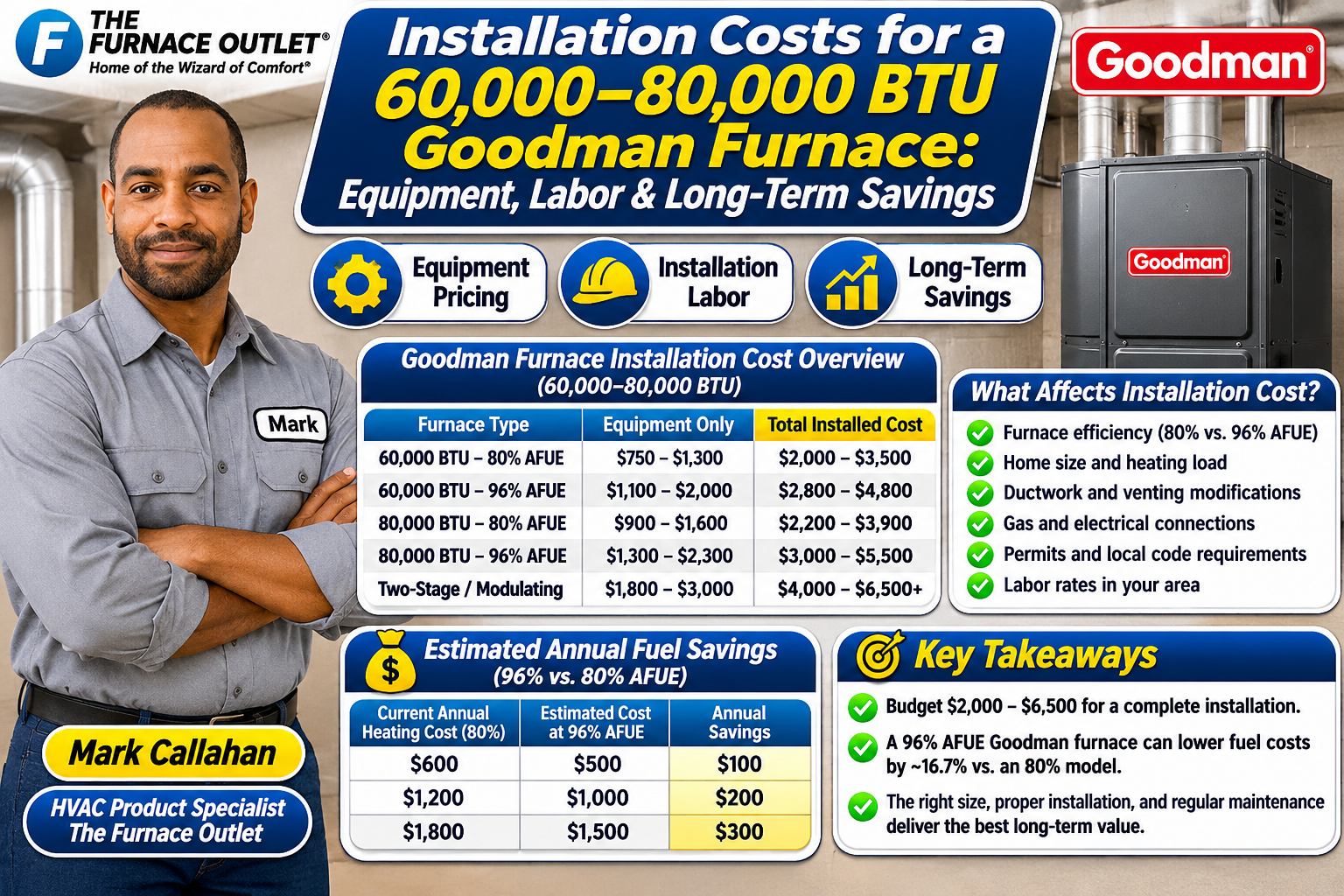
Homeowners should generally budget between $2,000 and $6,500 for a professionally installed Goodman furnace in the 60,000–80,000 BTU capacity range. Basic replacements involving existing compatible ductwork and venting are typically less expensive, while high-efficiency installations requiring additional modifications can cost considerably more.
The following figures provide approximate US budgeting ranges rather than guaranteed contractor prices.
| Furnace Type | Equipment Only | Total Installed Cost |
|---|---|---|
| 60,000 BTU – 80% AFUE | $750–$1,300 | $2,000–$3,500 |
| 60,000 BTU – 96% AFUE | $1,100–$2,000 | $2,800–$4,800 |
| 80,000 BTU – 80% AFUE | $900–$1,600 | $2,200–$3,900 |
| 80,000 BTU – 96% AFUE | $1,300–$2,300 | $3,000–$5,500 |
| Premium two-stage or modulating furnace | $1,800–$3,000 | $4,000–$6,500+ |
Published Goodman furnace pricing estimates from PICKHVAC provide a useful starting point for comparing equipment capacities and installed prices. Actual contractor quotations will depend on regional labor rates, equipment availability, installation complexity, and the services included.
The BTU rating represents the amount of fuel energy a gas furnace consumes per hour at its rated heating input. However, the actual heat delivered to the home depends on furnace efficiency, which is expressed as Annual Fuel Utilization Efficiency, or AFUE.
An 80,000 BTU furnace is not automatically the better investment simply because it has greater heating capacity. Installing an oversized furnace can result in short cycling, uneven temperatures, unnecessary equipment wear, and higher initial installation expenses.
| Furnace Input | AFUE | Approximate Useful Heating Capacity |
|---|---|---|
| 60,000 BTU | 80% | 48,000 BTU |
| 60,000 BTU | 96% | 57,600 BTU |
| 80,000 BTU | 80% | 64,000 BTU |
| 80,000 BTU | 96% | 76,800 BTU |
The Goodman residential product catalog provides heating input, output, cabinet dimensions, and blower capacity specifications for individual furnace models. These specifications should be reviewed alongside a professional Manual J heating load calculation before purchasing equipment.
A home’s square footage provides a preliminary starting point for furnace sizing, but insulation quality, ceiling height, outdoor winter temperatures, window efficiency, and air leakage can substantially affect heating requirements.
| Home Size | Preliminary Furnace Capacity to Investigate |
|---|---|
| 1,000–1,400 sq. ft. | 40,000–60,000 BTU |
| 1,400–1,800 sq. ft. | 60,000–80,000 BTU |
| 1,800–2,200 sq. ft. | 60,000–100,000 BTU |
| 2,200–2,600 sq. ft. | 80,000–120,000 BTU |
These ranges are illustrative, not equipment sizing recommendations. A well-insulated home in a moderate climate may require significantly less heating capacity than a similarly sized older home in Minnesota, Michigan, or northern Canada.
Homeowners can use the HVAC calculators at The Furnace Outlet for preliminary planning before obtaining a professional heating load assessment.
The total installation price includes considerably more than purchasing the furnace and connecting it to existing ductwork. A complete installation requires safe fuel connections, proper ventilation, electrical integration, airflow verification, and equipment commissioning.
| Installation Component | Estimated Cost |
|---|---|
| Furnace equipment | $750–$3,000 |
| Installation labor | $800–$2,000 |
| Old furnace removal and disposal | $100–$300 |
| Gas connection modifications | $150–$500 |
| Electrical modifications | $100–$400 |
| Venting modifications | $200–$1,000 |
| Condensate drainage installation | $100–$400 |
| Thermostat replacement | $100–$350 |
| Minor ductwork modifications | $200–$800 |
| Permits and inspections | $75–$350 |
These individual expenses are illustrative and should not automatically be added together because many contractors include standard materials and services in their installation packages. Major ductwork replacement, structural modifications, or extensive gas infrastructure upgrades can increase project costs beyond these ranges.
An 80% AFUE Goodman furnace generally offers a lower initial purchase price and may provide a straightforward replacement for an existing non-condensing gas furnace. These systems typically use an approved metal venting arrangement and do not require the condensate management associated with high-efficiency condensing furnaces.
This configuration can be attractive for homeowners in moderate climates with relatively short heating seasons. However, more fuel energy is lost through exhaust gases compared with a 96% AFUE furnace, which can translate into higher long-term natural gas expenses.
Existing chimney compatibility must also be evaluated, particularly when another gas appliance shares the venting system.
A 96% AFUE furnace extracts additional heat from combustion gases through a secondary heat exchanger. This process reduces heat loss through the exhaust but produces condensate that must be collected and safely discharged.
Upgrading from an 80% furnace to a 96% furnace may require manufacturer-approved vent piping, combustion air arrangements, condensate drainage, and additional installation labor. Depending on the home’s existing infrastructure, these modifications can increase the total installation cost by several hundred dollars or more.
The higher initial investment is often more attractive in regions with long winters and substantial annual natural gas consumption.
Single-stage furnaces operate at their rated firing capacity whenever the thermostat calls for heat. Their relatively straightforward design generally makes them less expensive to purchase and install.
Two-stage furnaces can operate at a lower heating output during moderate weather and switch to higher output when additional heat is required. This can improve temperature consistency, reduce noticeable operating noise, and provide longer heating cycles.
| Furnace Configuration | Estimated Installed Cost |
|---|---|
| 80% AFUE single-stage | $2,000–$3,900 |
| 96% AFUE single-stage | $2,800–$5,500 |
| 80% AFUE two-stage | $2,700–$4,500 |
| High-efficiency two-stage | $3,500–$6,000 |
| Premium modulating furnace | $4,500–$6,500+ |
Homeowners should consider comfort requirements, thermostat compatibility, maintenance costs, and local service availability rather than selecting a more advanced furnace exclusively for its additional features.
The difference between an 80% AFUE furnace and a 96% AFUE furnace can become financially significant over several heating seasons. Assuming both systems deliver the same amount of useful heat, upgrading from 80% to 96% AFUE theoretically reduces furnace fuel consumption by approximately 16.7%.
| Current Annual Heating Fuel Cost at 80% AFUE | Estimated Cost at 96% AFUE | Annual Savings | 15-Year Savings |
|---|---|---|---|
| $600 | $500 | $100 | $1,500 |
| $900 | $750 | $150 | $2,250 |
| $1,200 | $1,000 | $200 | $3,000 |
| $1,500 | $1,250 | $250 | $3,750 |
| $1,800 | $1,500 | $300 | $4,500 |
These calculations assume unchanged fuel prices, heating demand, and comparable operating conditions. They exclude blower electricity consumption, maintenance expenses, financing costs, and future utility rate changes.
The ENERGY STAR furnace resource provides additional information about efficient heating equipment, equipment maintenance, home insulation, and duct sealing. Improving the building envelope alongside a furnace replacement can further reduce heating requirements.
Consider a homeowner receiving a $3,000 quotation for an 80% AFUE furnace and a $4,200 quotation for a 96% AFUE alternative. The additional investment amounts to $1,200 before applicable utility incentives.
| Additional Investment | Annual Fuel Savings | Simple Payback Period |
|---|---|---|
| $1,200 | $100 | 12 years |
| $1,200 | $150 | 8 years |
| $1,200 | $200 | 6 years |
| $1,200 | $300 | 4 years |
A homeowner experiencing prolonged winters and high heating costs may recover the additional investment relatively quickly. Conversely, homeowners in warmer climates with limited furnace use may find a standard-efficiency system more economical where local regulations permit its installation.
Homeowners considering a high-efficiency Goodman furnace should distinguish between federal tax credits, utility rebates, manufacturer promotions, and regional energy-efficiency programs.
Under the federal Section 25C Energy Efficient Home Improvement Credit, qualifying gas furnaces installed during 2025 could receive a tax credit covering 30% of eligible expenses, subject to a maximum furnace credit of $600. Qualifying gas furnaces generally required a minimum efficiency rating of 97% AFUE, meaning a standard 96% Goodman furnace did not automatically qualify.
According to the official ENERGY STAR furnace tax credit guidance and Goodman’s 2025 tax credit documentation, the Section 25C credit ended for equipment placed into service after December 31, 2025.
Homeowners purchasing furnaces in 2026 or 2027 should investigate available utility rebates, local incentives, and manufacturer promotions rather than including the expired federal credit in their projected savings.
One of the most common reasons furnace installation projects exceed their original budgets is the discovery of incompatible or deteriorated supporting infrastructure. Existing gas pipes, electrical circuits, return air ducts, supply plenums, and venting systems may require modifications before the new furnace can operate safely.
| Potential Additional Requirement | Estimated Additional Cost |
|---|---|
| Return air duct improvement | $300–$1,000 |
| Supply plenum replacement | $250–$750 |
| Condensate pump | $100–$300 |
| Chimney liner installation | $800–$2,500 |
| Gas line extension | $300–$1,000+ |
| Major ductwork replacement | $2,000–$6,000+ |
| Advanced thermostat and controls | $200–$600 |
These expenses are not required for every project. Requesting a comprehensive installation quotation before authorizing work can help homeowners identify which modifications are necessary and which are optional.
Goodman furnaces can provide many years of heating service when correctly sized, professionally installed, and regularly maintained. A reasonable preliminary service-life expectation for a residential gas furnace is approximately 15–20 years, although actual longevity varies considerably.
| Maintenance or Repair Item | Estimated Cost |
|---|---|
| Annual professional tune-up | $100–$250 |
| Replacement air filter | $15–$60 |
| Flame sensor service | $100–$250 |
| Ignitor replacement | $150–$350 |
| Blower motor replacement | $400–$1,000+ |
| Control board replacement | $300–$800 |
Warranty coverage varies by equipment model, registration status, location, and ownership conditions. Homeowners should also remember that a manufacturer parts warranty may not cover diagnostic charges, replacement labor, or other associated service expenses.
Request written estimates from at least three qualified HVAC contractors using comparable equipment specifications and installation requirements. Each estimate should identify the furnace model, heating capacity, efficiency rating, installation materials, permit responsibilities, commissioning procedures, and labor warranty.
Avoid choosing a contractor based solely on the lowest price. An improperly sized furnace or poorly executed installation can increase energy consumption, shorten equipment life, create combustion safety risks, and undermine the savings associated with purchasing affordable equipment.
Is a 60,000 BTU Goodman furnace cheaper to install than an 80,000 BTU furnace? Generally, the smaller furnace has a lower equipment price, but installation labor may be similar. Differences in cabinet size, airflow requirements, venting, and ductwork compatibility can influence the final quotation.
How long does Goodman furnace installation take? A straightforward replacement may take approximately four to eight hours. Projects requiring new venting, ductwork modifications, or fuel supply upgrades can take one or more additional days.
Can I purchase a Goodman furnace myself and hire someone to install it? Some contractors accept homeowner-supplied equipment, while others provide installation services only for equipment purchased through their company. Confirm installation responsibility, equipment compatibility, warranty conditions, and labor coverage before purchasing.
Can I install a Goodman gas furnace myself? Gas furnace installation involves combustion safety, electrical connections, fuel piping, ventilation, and applicable building codes. A qualified HVAC professional should perform the installation and verify safe operation.
For homeowners seeking an affordable replacement, a properly sized 60,000 or 80,000 BTU Goodman furnace can offer an attractive combination of initial affordability and long-term heating performance. An 80% AFUE model may make financial sense in moderate climates where permitted, while a 96% AFUE furnace can provide greater fuel savings in colder regions.
The best investment is not necessarily the largest furnace or the model with the highest efficiency rating. Correct equipment sizing, quality workmanship, adequate return airflow, safe venting, and dependable local service are essential to achieving reliable comfort and long-term value.
All installation, maintenance, and equipment prices are illustrative US budgeting estimates and may vary by location, contractor, equipment availability, and installation requirements. Always consult a qualified HVAC professional and follow manufacturer instructions, applicable building codes, and current local regulations.
Editorial Disclosure: The Furnace Outlet is not associated with, affiliated with, endorsed by, or sponsored by Carrier, Trane, Lennox, Bryant or any other manufacturer mentioned in this article. We do not receive manufacturer compensation for inclusion or rankings.
The Furnace Outlet
For educational purposes only. HVAC equipment removal, refrigerant handling, recycling and disposal requirements can vary by equipment and location. Consult a qualified HVAC professional and applicable federal, state and local requirements before removing or disposing of HVAC equipment.
© 2026 The Furnace Outlet | www.thefurnaceoutlet.com