Newsletter Subscribe
Enter your email address below and subscribe to our newsletter

HVAC made simple
By Jake Lawson | The Furnace Outlet
Smart thermostats have transformed how homeowners manage indoor comfort, monitor energy consumption, and control heating and cooling equipment. With features such as automated scheduling, remote temperature adjustments, occupancy detection, geofencing, and energy usage reports, these devices offer considerably more functionality than traditional thermostats.
However, purchasing a smart thermostat does not automatically guarantee compatibility with your existing HVAC system. Differences in operating voltage, thermostat wiring, compressor technology, heating stages, proprietary communication protocols, and electrical requirements can prevent certain thermostats from functioning correctly.
Installing an incompatible thermostat can result in temperature fluctuations, equipment short cycling, excessive energy consumption, loss of advanced comfort features, or damage to HVAC control components. Understanding your system’s technical requirements before purchasing a smart thermostat is essential for achieving dependable performance and long-term energy savings.
Smart thermostat compatibility depends primarily on how the thermostat communicates with the heating and cooling equipment. Most conventional residential HVAC systems in North America use 24V alternating current control circuits that allow thermostats to activate heating, cooling, and indoor blower operation.
However, not every HVAC system follows this conventional arrangement. Some equipment uses line-voltage controls, millivolt circuits, proprietary digital communication systems, or manufacturer-specific control interfaces that require specialized thermostats.
Homeowners must also consider whether their equipment uses single-stage, two-stage, variable-speed, or multi-zone operation. A thermostat may successfully activate an HVAC system while failing to support its full range of operating capabilities.
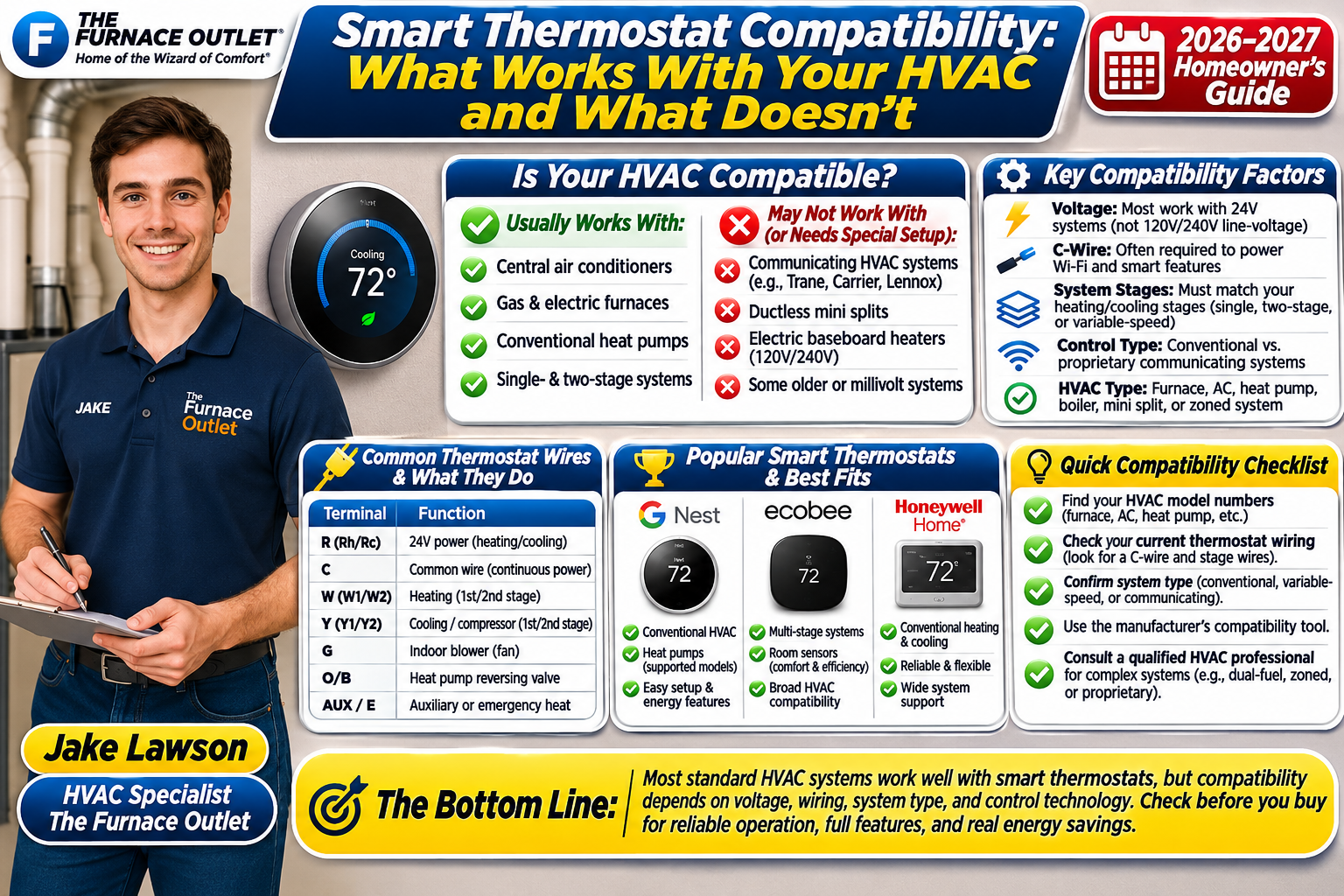
Most central air conditioners, gas furnaces, electric air handlers, and conventional heat pumps use low-voltage 24VAC thermostat controls. These systems are generally suitable candidates for mainstream smart thermostats, provided their wiring and equipment configurations are supported.
Electric baseboard heaters, certain wall heaters, and some radiant heating systems use 120V or 240V line-voltage thermostats. Connecting a conventional 24V smart thermostat directly to these circuits can destroy the thermostat and create serious electrical hazards.
The operating voltage of the HVAC equipment itself does not necessarily determine thermostat voltage. For example, a central air conditioner operating on a 240V electrical supply may still use a conventional 24V thermostat control circuit. Always verify the thermostat control specifications rather than relying exclusively on the equipment’s electrical nameplate.
According to the ENERGY STAR smart thermostat compatibility guide, most conventional forced-air HVAC systems are compatible with smart thermostats. However, variable-speed, zoned, multistage, and electric baseboard heating systems may require specialized equipment or professional installation.
The common wire, commonly referred to as the C-wire, provides a return path for the continuous low-voltage power required by many smart thermostats. Unlike traditional battery-powered thermostats, smart thermostats require electricity to support Wi-Fi connectivity, digital displays, occupancy sensors, and advanced control functions.
Older residential HVAC installations frequently lack a connected C-wire because conventional thermostats did not require continuous power. Installing a smart thermostat without an adequate power supply may result in unexpected restarts, intermittent Wi-Fi connectivity, battery depletion, and irregular equipment operation.
Some manufacturers offer approved power connectors or power extender kits that eliminate the need to install an entirely new thermostat cable in compatible systems. However, these accessories do not work universally, making manufacturer-specific compatibility verification essential.
Conventional HVAC thermostats use standardized terminal designations to identify different equipment functions. Understanding these designations can help homeowners recognize their existing system configuration before purchasing a replacement thermostat.
| Terminal | Function |
|---|---|
| R | 24V power supply |
| Rc | Cooling transformer power |
| Rh | Heating transformer power |
| C | Common power return |
| W/W1 | First-stage heating |
| W2 | Second-stage heating |
| Y/Y1 | First-stage compressor operation |
| Y2 | Second-stage compressor operation |
| G | Indoor blower control |
| O/B | Heat pump reversing valve |
| AUX | Auxiliary heating |
| E | Emergency heating |
Wire colors do not always correspond to standardized terminal functions because previous installers may have used different wiring conventions. Homeowners should rely on terminal labels, equipment wiring diagrams, and manufacturer documentation rather than wire colors alone. The Google thermostat wire identification guide provides additional information about conventional and proprietary thermostat connections. Google Home and Nest Help
Different residential HVAC configurations present different thermostat compatibility requirements. Conventional single-stage equipment generally offers the greatest flexibility, while advanced communicating systems and specialized heating equipment require more careful evaluation.
| HVAC System | Compatibility | Important Consideration |
|---|---|---|
| Central air conditioner | Generally high | Verify voltage and cooling stages |
| Gas furnace | Generally high | Confirm heating stages |
| Electric furnace | Generally high | Verify 24V controls |
| Conventional heat pump | High with compatible thermostat | O/B and auxiliary heat support |
| Dual-fuel heat pump | Model dependent | Advanced configuration required |
| Two-stage HVAC system | Model dependent | Independent stage control |
| Variable-speed HVAC | Model dependent | Possible loss of advanced features |
| Communicating HVAC | Limited | Proprietary controls often required |
| Ductless mini split | Limited | Approved interface or smart controller |
| Electric baseboard heater | Limited | Line-voltage thermostat required |
| Hydronic boiler | Model dependent | Voltage and relay compatibility |
| PTAC system | Model dependent | Manufacturer-approved controls |
| Millivolt heating system | Limited | Specialized interface may be required |
| Zoned HVAC system | Model dependent | Zone control panel compatibility |
This comparison provides preliminary purchasing guidance rather than definitive installation approval. Always confirm compatibility using the exact HVAC equipment model, thermostat model, and existing control configuration.
Traditional gas furnaces paired with conventional central air conditioners are generally among the easiest HVAC systems to integrate with smart thermostats. These systems commonly use standard heating, cooling, blower, and low-voltage power connections.
Single-stage systems usually require relatively straightforward thermostat configurations. Two-stage furnaces and air conditioners may require additional control terminals if the thermostat is expected to manage each operating stage independently.
Some equipment can manage staging internally, while other systems depend on thermostat commands. Selecting a thermostat without the necessary staging capabilities may prevent homeowners from taking full advantage of their HVAC investment.
Heat pumps require more specialized thermostat functionality because they provide both heating and cooling through the same refrigeration system. A compatible thermostat must support the equipment’s reversing valve configuration and any installed auxiliary or emergency heating components.
Incorrect reversing valve configuration can cause a heat pump to deliver warm air during cooling operation or cold air during heating operation. Improper auxiliary heat settings may also activate electric resistance heating unnecessarily, increasing household electricity expenses.
The Google Nest compatibility guide demonstrates how supported heating stages, heat pump configurations, auxiliary heat, and dual-fuel functionality vary between thermostat models. Homeowners should verify these capabilities before purchasing rather than assuming every smart thermostat supports every heat pump configuration. Google Home and Nest Help
Dual-fuel HVAC systems combine an electric heat pump with a gas or propane furnace. The heat pump generally handles heating during suitable outdoor conditions, while the furnace provides heating when required by capacity, efficiency, or operating cost considerations.
A compatible thermostat or equipment controller must coordinate these heating sources according to manufacturer-approved operating parameters. Incorrect configuration can cause unnecessary fuel consumption, inefficient heating transitions, or equipment operating conflicts.
Professional thermostat installation is strongly recommended for dual-fuel systems because successful operation depends on more than conventional thermostat wiring.
Premium HVAC systems frequently incorporate proprietary digital communication technology that allows indoor equipment, outdoor equipment, and thermostats to exchange detailed operating information. Unlike conventional thermostats that send simple heating and cooling commands, communicating controllers can coordinate compressor capacity, blower speed, humidity management, equipment diagnostics, and advanced zoning functions.
Examples include Carrier Infinity, Trane ComfortLink, Lennox S30/S40 platforms, and Daikin ComfortNet or ComfortBridge-related equipment configurations. Requirements differ considerably across manufacturers and equipment generations.
Some communicating systems can be configured to accept conventional 24V thermostats through approved interfaces or alternative control arrangements. However, doing so may eliminate advanced diagnostic information, precise capacity control, or other premium features.
Variable-speed equipment does not automatically require a proprietary thermostat. Some systems use conventional thermostat signals while allowing the equipment’s internal electronics to manage compressor and blower performance.
Other advanced systems depend on communicating thermostats to achieve their full range of operating capabilities. Installing a generic smart thermostat on these systems may reduce available modulation, eliminate humidity control features, or limit the equipment to less sophisticated operating modes.
The distinction between conventional variable-speed equipment and proprietary communicating equipment is particularly important. Always review the manufacturer’s approved control options before replacing an existing premium thermostat.
Many ductless mini split systems use proprietary communication between the indoor and outdoor equipment. Their temperature settings and operating modes are commonly controlled through handheld infrared remotes, wired controllers, or manufacturer-specific smartphone applications.
Conventional 24V smart thermostats generally cannot connect directly to these systems. Depending on the equipment, homeowners may be able to use manufacturer-approved Wi-Fi modules, compatible infrared smart controllers, or specialized thermostat interfaces.
An infrared smart controller typically replicates remote-control commands rather than communicating directly with the refrigeration system. Homeowners should therefore verify whether the proposed controller supports all required heating, cooling, fan, and operating modes.
Hydronic boilers may use conventional 24V control circuits, isolated relay contacts, millivolt controls, or proprietary digital communication. Consequently, boiler compatibility depends on both the thermostat and the equipment’s control requirements.
Electric baseboard heaters commonly use line-voltage controls and require thermostats specifically rated for their voltage, electrical current, and connected heating load. A conventional low-voltage thermostat must never be connected directly to a line-voltage heating circuit.
Homeowners with older boilers, electric resistance heating, or unfamiliar thermostat wiring should obtain professional compatibility confirmation before purchasing replacement controls.
Different smart thermostat manufacturers offer varying levels of equipment compatibility, accessory support, and energy management functionality. Selecting the right product requires comparing the exact thermostat model rather than relying exclusively on brand reputation.
| Thermostat Brand | Best Suited For | Important Consideration |
|---|---|---|
| Google Nest | Conventional HVAC and supported heat pumps | Power supply and stage limitations vary |
| ecobee | Multistage systems and room temperature monitoring | Verify accessory and PEK compatibility |
| Honeywell Home | Conventional residential HVAC | Check specific model capabilities |
| Sensi | Conventional heating and cooling upgrades | C-wire requirements vary |
| Mysa | Supported electric resistance heating | Verify voltage and connected load |
| Manufacturer-specific controls | Communicating HVAC equipment | Usually best for retaining advanced features |
The ecobee thermostat upgrade and compatibility guide illustrates how different thermostat models support different combinations of auxiliary heating, dual transformers, and indoor air quality accessories. This reinforces the importance of reviewing model-specific specifications before purchasing. support.ecobee.com
Smart thermostats reduce unnecessary energy consumption by adjusting temperature settings according to occupancy, household schedules, and user preferences. Their financial benefits depend on previous thermostat habits, climate conditions, HVAC efficiency, and household energy rates.
For example, a household spending $1,500 annually on heating and cooling could save approximately $120 annually if a smart thermostat reduces HVAC energy expenses by 8%. If the total installed thermostat cost is $250, the simplified payback period would be approximately 2.1 years.
These savings are illustrative rather than guaranteed. Homeowners can consult the ENERGY STAR smart thermostat program for certified equipment and energy management guidance. ENERGY STAR
For preliminary US budgeting, basic smart thermostats may cost approximately $70–$150, while advanced models may range from $150–$350. Premium communicating HVAC controllers can cost considerably more.
Professional installation may add approximately $100–$300, depending on wiring availability and system complexity. Installing new thermostat wiring, approved interface modules, or additional control components can increase the overall project expense.
These figures are general planning estimates rather than verified national pricing averages. Local contractor rates and the home’s existing electrical infrastructure ultimately determine installation costs.
Begin by locating the model numbers of your furnace, air handler, heat pump, air conditioner, and existing thermostat. Review the equipment documentation to identify the thermostat voltage, control protocol, heating and cooling stages, and supported accessories.
If the existing thermostat uses a conventional low-voltage configuration, switch off HVAC power before inspecting accessible thermostat terminals. Photograph the existing connections without disconnecting wires, and use the prospective thermostat manufacturer’s online compatibility checker.
If the system uses proprietary terminals, unfamiliar wiring, multiple transformers, or line-voltage controls, stop and consult a qualified HVAC technician. Never experiment with wiring connections or bypass equipment safety controls to make a thermostat operate.
Frequent thermostat restarts, excessive auxiliary heating, incorrect heating and cooling operation, irregular blower performance, and unexplained short cycling may indicate wiring, power supply, or configuration problems.
These symptoms do not necessarily mean the thermostat itself is defective. A failing transformer, damaged control board, insufficient power supply, or incorrect equipment settings can produce similar symptoms.
If problems begin immediately after thermostat replacement, discontinue abnormal equipment operation and arrange professional diagnosis before attempting further configuration changes.
Can I install a smart thermostat on an old HVAC system? Many older HVAC systems support modern smart thermostats if they use conventional low-voltage controls. However, additional wiring or an approved power adapter may be necessary.
Do all smart thermostats require a C-wire? No, power requirements vary by manufacturer and model. Some thermostats can operate without a dedicated C-wire in compatible installations, while others require continuous wired power.
Can an incompatible thermostat damage my HVAC system? Incorrect voltage or wiring connections can damage transformers, control boards, and thermostat electronics. Improper configuration can also cause inefficient operation and unnecessary equipment wear.
Will a smart thermostat work without Wi-Fi? Most smart thermostats retain basic temperature control without an internet connection. Remote access, weather-based automation, and certain cloud-dependent features may become unavailable.
Should I replace my communicating thermostat with a universal smart thermostat? Generally, retaining a manufacturer-approved communicating controller is preferable when advanced equipment functionality depends on it. Consult the HVAC manufacturer before making any replacement decision.
The best smart thermostat is not necessarily the most expensive or technologically advanced product. It is the thermostat that supports your HVAC equipment’s complete operating requirements without sacrificing reliability, energy efficiency, or available comfort features.
Homeowners with conventional 24V systems generally have considerable purchasing flexibility, while those with communicating equipment, ductless mini splits, dual-fuel systems, and specialized heating equipment should prioritize manufacturer-approved controls.
Taking the time to verify voltage, wiring, power availability, equipment stages, and communication protocols before purchasing can prevent expensive mistakes. A properly matched smart thermostat can provide years of dependable comfort, convenient temperature management, and meaningful energy savings.
This article provides general educational guidance and should not replace manufacturer-specific installation instructions or professional electrical advice. Thermostat compatibility varies by equipment model and configuration, and electrical modifications should be performed by appropriately qualified professionals.
Editorial Disclosure: The Furnace Outlet is not associated with, affiliated with, endorsed by, or sponsored by Carrier, Trane, Lennox, Bryant or any other manufacturer mentioned in this article. We do not receive manufacturer compensation for inclusion or rankings.
The Furnace Outlet
For educational purposes only. HVAC equipment removal, refrigerant handling, recycling and disposal requirements can vary by equipment and location. Consult a qualified HVAC professional and applicable federal, state and local requirements before removing or disposing of HVAC equipment.
© 2026 The Furnace Outlet | www.thefurnaceoutlet.com