Newsletter Subscribe
Enter your email address below and subscribe to our newsletter

HVAC made simple
By Samantha Reyes | The Furnace Outlet
When homeowners begin researching a new heating and cooling system, Trane and American Standard frequently appear among the leading HVAC brands worth considering. Both offer residential air conditioners, heat pumps, gas furnaces, air handlers, and advanced climate control technologies designed to provide dependable year-round comfort.
What many homeowners do not realize, however, is that Trane and American Standard share the same corporate parent and considerable engineering similarities. Although their equipment is marketed under different brand names, many comparable systems offer similar underlying technologies, energy efficiency ratings, and construction characteristics.
Does that mean homeowners should simply purchase whichever brand offers the lowest installation price? Not necessarily. Equipment selection, warranty coverage, contractor expertise, local service availability, and long-term ownership expenses can make one brand a more attractive investment than the other.
This comprehensive guide explores the relationship between Trane and American Standard, how their HVAC systems compare, and what homeowners should prioritize before making a purchasing decision.
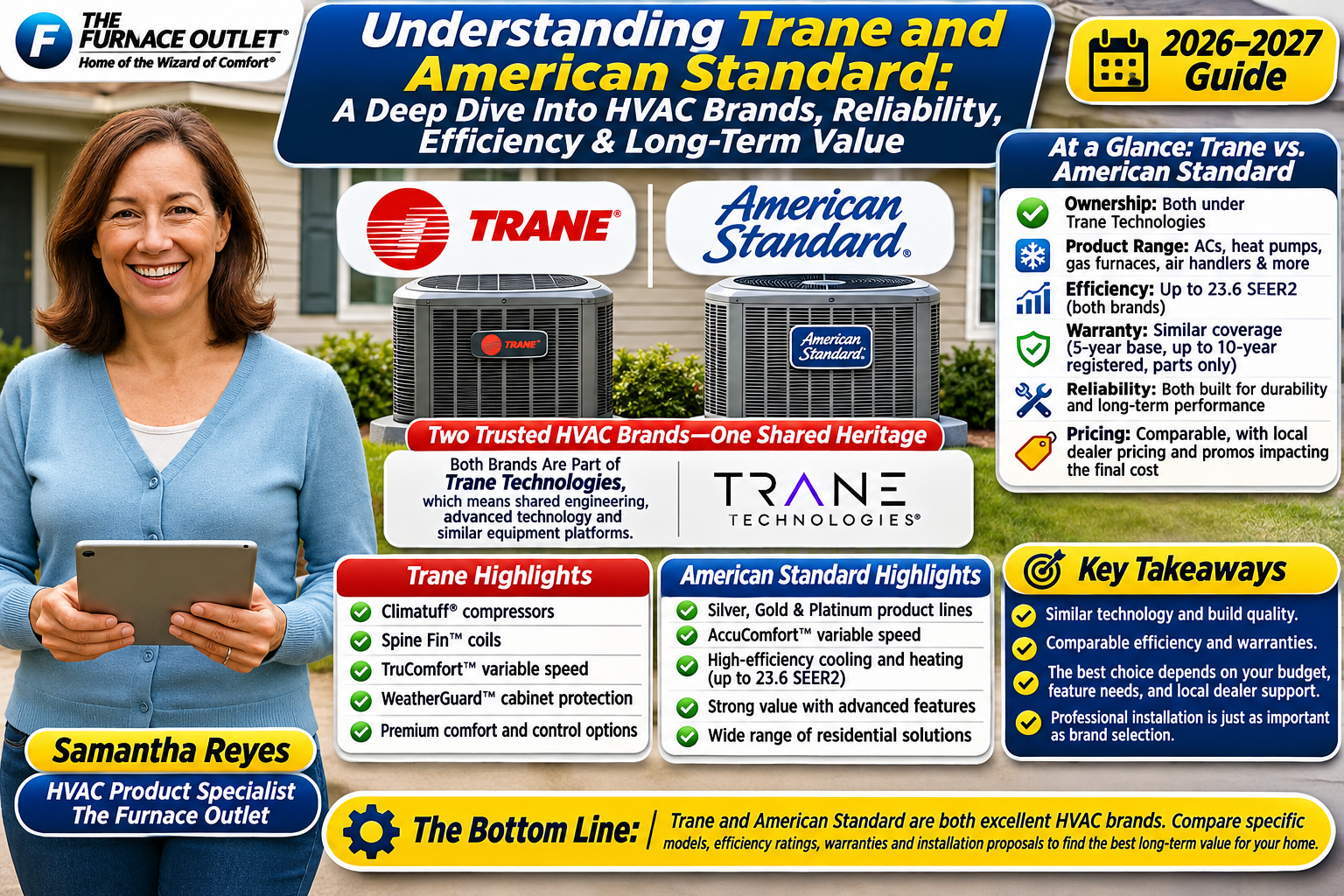
Both Trane and American Standard HVAC operate under Trane Technologies, a global company specializing in heating, cooling, refrigeration, and climate management solutions. Their shared corporate ownership explains why many residential systems feature similar compressor technologies, heat exchangers, electronic controls, and equipment designs.
Trane was acquired by American Standard Companies in 1984. Following corporate restructuring, Trane became an independent company before being acquired by Ingersoll Rand in 2008. In 2020, corporate restructuring led to the establishment of Trane Technologies as a climate-focused business.
Today, the two HVAC brands retain separate identities, product naming conventions, marketing strategies, and dealer networks. However, their engineering foundations have considerable overlap, making direct model-level comparisons particularly valuable for homeowners.
Many comparable Trane and American Standard systems are built around shared equipment platforms and manufacturing technologies. Homeowners may encounter similar cabinet designs, compressor configurations, coil materials, blower motors, and electronic control systems when comparing equivalent equipment tiers.
However, shared ownership does not mean every product is identical or that replacement components are universally interchangeable. Certain models may feature different cabinet protection, equipment configurations, control compatibility, warranty provisions, and available accessories.
Rather than assuming that one brand offers better equipment, homeowners should compare complete model numbers, certified efficiency ratings, installation requirements, and written warranty documentation.
Trane offers a broad selection of residential HVAC equipment, ranging from conventional single-stage air conditioners and gas furnaces to advanced variable-speed heating and cooling systems. Its higher-end equipment is designed to provide improved temperature consistency, humidity management, and integrated comfort control.
Depending on the model, Trane equipment may incorporate Climatuff compressors, Spine Fin coil technology, variable-speed operation, communicating controls, and WeatherGuard cabinet protection. These features can be particularly attractive to homeowners prioritizing indoor comfort, quieter operation, and advanced system integration.
According to the official Trane air conditioner product catalog, its central air conditioners offer efficiency ratings ranging from 13.4 to as high as 23.6 SEER2, depending on the equipment combination. Trane®
American Standard offers residential HVAC equipment designed to serve a wide range of comfort requirements and household budgets. Its product portfolio includes central air conditioners, heat pumps, gas furnaces, packaged systems, air handlers, smart thermostats, and indoor air quality solutions.
American Standard generally organizes its residential equipment into Silver, Gold, and Platinum product families. Silver systems emphasize conventional performance and affordability, Gold equipment introduces enhanced operating capabilities, and Platinum systems prioritize advanced comfort management and variable-speed technology.
The official American Standard air conditioner catalog lists equipment with efficiency ratings ranging from 13.4 to 23.6 SEER2. These ratings demonstrate that American Standard is not simply a budget alternative to Trane but a competitive HVAC brand offering premium equipment capabilities. American Standard®
Energy efficiency is one of the most important considerations when purchasing a residential HVAC system. Higher-efficiency equipment may reduce electricity and natural gas consumption, particularly in households with substantial annual heating and cooling requirements.
Both brands offer single-stage, multi-speed, and variable-speed cooling technologies. Their premium central air conditioning systems reach published efficiency ratings of up to 23.6 SEER2, although the certified rating depends on the complete indoor and outdoor equipment combination.
For heat pumps, homeowners should evaluate both SEER2 and HSPF2 ratings. When comparing gas furnaces, Annual Fuel Utilization Efficiency, commonly known as AFUE, provides a standardized measurement of how efficiently equipment converts fuel into usable heat.
Neither brand automatically delivers superior energy efficiency. A properly matched American Standard system may outperform a lower-tier Trane system, while an advanced Trane system may outperform conventional American Standard equipment.
Both manufacturers offer compressor technologies designed to accommodate different cooling demands. Conventional single-stage compressors operate at full capacity whenever cooling is required, making them relatively straightforward and potentially more affordable to repair.
Multi-speed and variable-speed systems provide greater flexibility by adjusting cooling output according to household demand. Longer operating cycles at reduced capacity can improve humidity removal, minimize temperature fluctuations, and reduce unnecessary compressor cycling.
Trane markets its advanced variable-speed technology under the TruComfort name, while American Standard uses AccuComfort branding. Both technologies are intended to deliver more precise indoor temperature management than conventional fixed-capacity equipment.
Homeowners living in hot, humid climates may find variable-speed equipment particularly beneficial. However, households with relatively modest cooling requirements may achieve better financial value from a properly sized conventional system.
Both brands manufacture heat pumps capable of providing heating and cooling through a single refrigeration system. These systems are increasingly attractive to homeowners interested in reducing natural gas consumption or transitioning toward all-electric residential heating.
In October 2026, Trane Technologies announced new residential cold-climate heat pumps under both brands. The new equipment is designed to continue heating at outdoor temperatures as low as −20°F, incorporating variable-speed operation and advanced communicating controls. Trane Technologies
This development highlights the considerable technological overlap between the two brands. Nevertheless, homeowners in colder regions should compare actual heating capacity at local winter design temperatures, coefficient of performance, defrost characteristics, and supplemental heating requirements rather than relying exclusively on minimum operating temperature claims.
Trane and American Standard both offer conventional and high-efficiency gas furnaces suitable for different residential heating applications. Their equipment portfolios include systems with single-stage, two-stage, and modulating heating capabilities, depending on model availability.
An 80% AFUE furnace may represent a practical replacement option in certain installations, while a high-efficiency condensing furnace rated at 95% AFUE or higher may provide substantial fuel savings in colder climates.
The selection process should also consider venting requirements, condensate drainage, blower technology, electrical compatibility, and existing ductwork. Upgrading to a high-efficiency furnace without addressing these installation requirements can compromise system performance and increase project expenses.
Trane and American Standard both emphasize equipment durability, component quality, and accelerated environmental testing. Their shared engineering resources make it difficult to justify a universal claim that one brand is inherently more reliable than the other.
Reliability depends on equipment complexity, installation quality, operating conditions, maintenance practices, and replacement component availability. Advanced variable-speed systems may provide superior comfort but can also involve more expensive electronic components when repairs are required.
Homeowners should avoid interpreting manufacturer marketing claims as independent evidence of failure rates or equipment lifespan. Without comparable model-specific reliability data, there is insufficient evidence to declare either brand the clear winner.
Both manufacturers compete primarily in the mainstream-to-premium residential HVAC market. Installed costs vary substantially according to equipment capacity, efficiency ratings, compressor technology, indoor equipment requirements, local labor expenses, and installation complexity.
For preliminary US budgeting, homeowners may allow approximately $6,000–$11,000 for a conventional central air conditioning replacement and $10,000–$16,000 or more for premium variable-speed cooling equipment. Gas furnace replacements may range from approximately $4,000–$9,000, while complete heat pump or combined heating and cooling installations can exceed $15,000 in complex applications.
These figures are broad planning estimates rather than verified national averages or manufacturer quotations. American Standard is sometimes perceived as the more affordable alternative, but local dealer pricing can reverse that assumption. Obtaining comparable proposals from contractors representing both brands is the most reliable way to determine actual purchasing value.
Consider two correctly sized three-ton central air conditioning systems operating under equivalent seasonal cooling demand. One system has a certified efficiency rating of 14.3 SEER2, while the other achieves 20 SEER2.
Assuming 1,500 equivalent full-load cooling hours annually and an electricity rate of $0.16 per kWh, the 14.3 SEER2 system would have an illustrative annual cooling electricity expense of approximately $604. The 20 SEER2 system would cost approximately $432 under the same assumptions.
This represents potential annual savings of approximately $172, or $2,580 over 15 years, assuming unchanged electricity rates and comparable operating conditions. If the premium system costs $2,000 more upfront, its simplified energy-related payback period would be approximately 11.6 years.
This comparison demonstrates why homeowners should evaluate efficiency improvements against additional purchase expenses. Premium equipment may deliver better comfort, but the most efficient system is not necessarily the most economical investment.
Warranty protection is another area where the two brands share considerable similarities. Both typically provide five-year base limited parts warranties and extended coverage of approximately 10 years for qualifying registered equipment, subject to product-specific terms and regional regulations.
The Trane warranty and registration program explains that eligible equipment generally must be registered within 60 days of installation to receive extended registered coverage. Certain components may qualify for different warranty periods depending on the equipment model. Trane®
Similarly, the American Standard warranty program provides extended registered warranty protection for qualifying equipment. Standard limited warranties generally exclude repair labor, making it important to investigate optional labor coverage and dealer service agreements. American Standard®
Homeowners should obtain written confirmation of compressor coverage, heat exchanger protection, parts warranty duration, registration requirements, transferability, and labor exclusions before signing an installation agreement.
Although the brands share manufacturing resources and related equipment platforms, homeowners should not assume that replacement components are interchangeable. Electronic control boards, communicating thermostats, blower assemblies, compressor modules, and refrigerant-related components must match manufacturer specifications.
Premium variable-speed HVAC equipment may involve higher replacement component expenses than conventional single-stage systems. Specialized diagnostics and proprietary controls can also increase service costs when appropriately trained technicians are not readily available.
Before selecting either brand, investigate local service availability, replacement part lead times, and the contractor’s ability to support the equipment throughout its operating life.
The HVAC industry’s transition toward lower-global-warming-potential refrigerants is influencing equipment selection across both brands. Many newer Trane and American Standard residential air conditioning and heat pump systems incorporate R-454B refrigerant instead of the R-410A refrigerant commonly used in previous-generation equipment.
R-454B belongs to the A2L refrigerant safety classification, meaning it exhibits lower flammability compared with more highly flammable refrigerants. Equipment designed for R-454B incorporates specific engineering safeguards and installation requirements.
Homeowners should ensure that replacement equipment, indoor coils, refrigerant piping, controls, and any required mitigation systems are approved for the selected configuration. R-454B must not be treated as a direct replacement refrigerant for existing R-410A equipment.
Trane Technologies also maintains other residential HVAC brands serving different market segments. These include Ameristar, RunTru, and Oxbox, which generally emphasize more accessible heating and cooling solutions than premium Trane and American Standard equipment.
The official Trane Technologies brand portfolio identifies these related brands and their respective market positioning. Homeowners working within restrictive budgets may benefit from comparing these alternatives before committing to a premium HVAC installation. Trane Technologies
Shared corporate ownership, however, does not mean that all these brands offer identical construction, component quality, efficiency ratings, or warranty protection.
One of the most expensive mistakes homeowners can make is investing in premium HVAC equipment without evaluating the quality of the proposed installation. Even sophisticated heating and cooling systems can experience disappointing performance when connected to undersized ductwork, improperly configured controls, or inadequate electrical infrastructure.
A qualified HVAC contractor should perform an appropriate Manual J load calculation, evaluate ductwork capacity, select compatible system components, verify refrigerant requirements, and commission the equipment according to manufacturer specifications.
A properly installed mid-range American Standard system may provide better comfort and long-term reliability than an incorrectly installed premium Trane system. The reverse is equally possible, which is why contractor selection deserves at least as much attention as equipment selection.
Does Trane own American Standard? Both brands belong to Trane Technologies. They operate under separate residential HVAC brand identities but share considerable engineering and manufacturing resources.
Is American Standard as good as Trane? Comparable American Standard systems can offer similar efficiency, comfort capabilities, and warranty protection. The better choice depends on specific equipment specifications, installation quality, and long-term ownership costs.
Is American Standard cheaper than Trane? American Standard may be less expensive in certain markets, but this is not universally true. Local dealer pricing, equipment configurations, and installation requirements ultimately determine total project costs.
Are Trane and American Standard parts interchangeable? Some components may be shared across related equipment platforms, but compatibility must be confirmed using manufacturer-approved replacement part numbers. Installing an incompatible component can damage equipment or compromise warranty coverage.
How long do Trane and American Standard HVAC systems last? Properly maintained central air conditioners and heat pumps may provide approximately 15–20 years of service, while gas furnaces can sometimes operate longer. Actual lifespan depends on climate, usage, installation quality, maintenance, and component durability.
Trane and American Standard both deserve serious consideration when purchasing a residential heating and cooling system. Their shared engineering resources, competitive efficiency ratings, advanced compressor technologies, and comparable warranty structures make the differences between individual equipment models more significant than the differences between the brand names themselves.
Rather than automatically paying more for Trane or assuming American Standard offers better financial value, request detailed proposals from qualified contractors representing both brands. Compare certified efficiency ratings, equipment features, installation specifications, warranty terms, and future service availability.
The smartest HVAC investment is not necessarily the system with the most recognizable logo. It is the system that delivers dependable comfort, appropriate energy efficiency, reasonable ownership expenses, and reliable professional support throughout its operating life.
Although Trane and American Standard share considerable engineering similarities, homeowners should also evaluate competing manufacturers before making a final purchasing decision. Our comprehensive guide to the best central AC brands compares leading HVAC manufacturers based on energy efficiency, reliability, equipment features, and long-term ownership value.
This article provides general educational and purchasing guidance based on published manufacturer information rather than independent equipment testing. Pricing and operating cost examples are illustrative, and homeowners should verify equipment specifications, warranty conditions, installation requirements, and local pricing before making purchasing decisions.
Editorial Disclosure: The Furnace Outlet is not associated with, affiliated with, endorsed by, or sponsored by Carrier, Trane, Lennox, Bryant or any other manufacturer mentioned in this article. We do not receive manufacturer compensation for inclusion or rankings.
The Furnace Outlet
For educational purposes only. HVAC equipment removal, refrigerant handling, recycling and disposal requirements can vary by equipment and location. Consult a qualified HVAC professional and applicable federal, state and local requirements before removing or disposing of HVAC equipment.
© 2026 The Furnace Outlet | www.thefurnaceoutlet.com