Newsletter Subscribe
Enter your email address below and subscribe to our newsletter

HVAC made simple
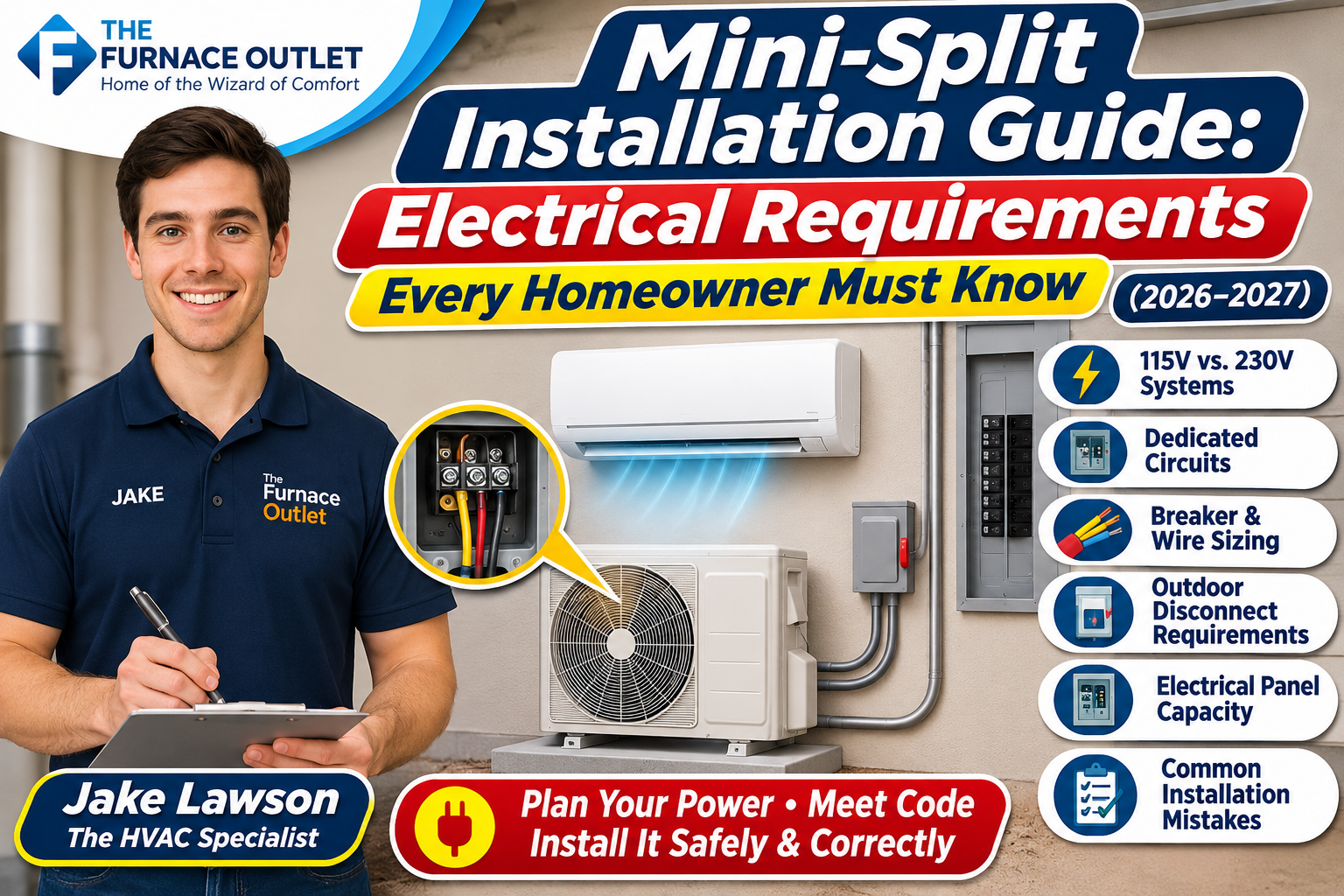
By Jake Lawson — Jake the HVAC Specialist | The Furnace Outlet
Installing a ductless mini-split can be one of the smartest ways to improve comfort in a bedroom, home office, garage, addition, or even an entire house. These systems offer efficient heating and cooling without requiring traditional ductwork, but there’s one part of the installation that homeowners frequently underestimate: the electrical setup. Before choosing equipment or scheduling installation, you need to understand voltage requirements, circuit capacity, breaker sizing, disconnect switches, wiring, and the electrical demands of the specific mini-split you’re buying.
After more than 10 years working with residential and commercial HVAC systems, I’ve seen installations delayed because the homeowner assumed a mini-split could simply plug into an existing outlet. Most permanently installed mini-splits require a dedicated electrical circuit, properly sized conductors, an appropriate overcurrent protective device, and an outdoor disconnect. Getting these details wrong can create electrical hazards, equipment damage, failed inspections, and expensive corrections.
This guide explains the electrical requirements homeowners should understand before installing a mini-split in the United States. We’ll cover 115V versus 230V systems, common BTU capacities, breaker and wire sizing, electrical panel considerations, installation costs, and the questions you should ask your contractor before work begins.
Most permanently installed ductless mini-split systems require a dedicated branch circuit supplying the outdoor unit or other designated power connection. Unlike a portable air conditioner, a mini-split typically includes an outdoor compressor and one or more indoor air handlers connected through refrigerant piping, communication wiring, and electrical connections. The equipment must receive power according to the manufacturer’s installation instructions and the applicable electrical code.
A dedicated circuit helps ensure the system receives the electrical supply it needs without sharing capacity with unrelated household loads. This is particularly important because compressor-driven equipment can experience changing electrical demands as operating conditions and compressor speed change. Inverter-driven mini-splits generally control compressor speed electronically, but they still require properly designed electrical protection.
Some systems receive their main electrical supply at the outdoor unit and distribute power to indoor air handlers through manufacturer-specified interconnecting cables. Other configurations require separate electrical supplies or additional circuits for particular components. Always verify the exact wiring arrangement rather than assuming every mini-split uses the same configuration.
Mini-splits are available in different voltage configurations, and selecting the correct one is essential. Smaller systems are sometimes designed for nominal 115V operation, while many larger residential models operate on nominal 208/230V single-phase power. The appropriate choice depends on the equipment model, heating and cooling capacity, available electrical service, and installation requirements.
A 115V mini-split may be attractive for smaller spaces because many American homes already have 120V circuits. However, that doesn’t mean the unit can safely use an existing bedroom outlet or share a circuit with household appliances. The installation may still require a new dedicated circuit, suitable breaker, properly sized wiring, and a disconnect.
A 208/230V mini-split typically uses a two-pole breaker connected to the home’s electrical panel. These systems are common in residential installations and may offer suitable options for larger capacities and multi-zone configurations. In typical U.S. residential service, the supply is nominally 120/240V, while equipment labeled 208/230V is generally designed to accommodate specified supply-voltage ranges. Your electrician should confirm compatibility with the actual service voltage.
One of the most common questions homeowners ask is how many amps a 9,000, 12,000, 18,000, or 24,000 BTU mini-split requires. Cooling capacity gives you a general idea of system size, but it doesn’t determine the correct breaker or wire size. Two mini-splits with the same BTU rating can have different electrical requirements because of differences in compressor technology, efficiency, heating performance, and manufacturer design.
The following table provides general planning information rather than equipment-specific electrical specifications.
| Mini-split capacity | Common voltage options | Electrical planning considerations |
|---|---|---|
| 9,000 BTU/h | 115V or 208/230V | Often a smaller single-zone system; verify dedicated-circuit requirements |
| 12,000 BTU/h | 115V or 208/230V | Check the nameplate for minimum circuit ampacity and maximum protection |
| 18,000 BTU/h | Usually 208/230V | Confirm circuit capacity, breaker rating, and conductor sizing |
| 24,000 BTU/h | Usually 208/230V | Higher-capacity equipment may require a larger dedicated circuit |
| 30,000 BTU/h | Usually 208/230V | Review manufacturer specifications and electrical panel capacity |
| 36,000 BTU/h | Usually 208/230V | Confirm exact outdoor-unit electrical requirements and connected indoor units |
These voltage configurations are common examples, not universal rules. A 12,000 BTU model from one manufacturer may require different electrical protection from another model with identical cooling capacity. The equipment nameplate and installation manual must determine the final electrical design.
Breaker sizing is one of the most important electrical decisions in a mini-split installation. The breaker protects the circuit against specified overcurrent conditions, but HVAC equipment has special requirements because compressors and motors behave differently from ordinary household electrical loads.
Many mini-split nameplates identify the Minimum Circuit Ampacity (MCA) and Maximum Overcurrent Protection (MOCP or MOP). MCA is used when determining the minimum acceptable conductor ampacity under the applicable rules, while MOCP establishes the maximum permitted rating for the specified overcurrent protective device. Some equipment specifies a fuse type or other protection requirements that must also be followed.
For example, imagine a mini-split nameplate showing an MCA of 18 amps and a maximum overcurrent protection rating of 30 amps. That doesn’t automatically mean the system requires a 30-amp breaker or that any conductor commonly associated with a 20-amp circuit is acceptable. The installer must select a compliant conductor and protective device using the nameplate, manufacturer instructions, conductor conditions, and applicable electrical code.
The critical point is that breaker sizing shouldn’t be guessed from the BTU rating or selected solely from a generic online chart. A qualified electrician should confirm the correct protection before installing or energizing the equipment.
Mini-split wire sizing depends on several factors, including MCA, conductor material, insulation rating, terminal temperature limitations, installation method, ambient temperature, and the number of current-carrying conductors. Circuit length can also matter because excessive voltage drop may affect equipment performance.
Homeowners often see references to 14 AWG, 12 AWG, 10 AWG, and 8 AWG copper conductors when researching HVAC installations. These sizes are used in different residential electrical applications, but there is no universally correct wire gauge for every mini-split of a given capacity. HVAC circuit conductors may be sized under equipment-specific rules that differ from simplified general-purpose branch-circuit examples.
The installer should also verify whether the circuit requires an equipment grounding conductor, the correct cable or raceway type, and any special requirements for outdoor or wet locations. Using an oversized breaker to compensate for nuisance trips or choosing smaller conductors to reduce installation costs is never an acceptable shortcut.
Most permanently installed outdoor mini-split units require a disconnecting means that allows service personnel to isolate the equipment from its electrical supply. This is a fundamental safety feature because technicians need a reliable way to disconnect power before performing maintenance or repairs.
The disconnect is commonly installed near the outdoor condenser in a location that meets applicable code requirements. Depending on the equipment and electrical design, the disconnect may be non-fused or fused. The correct configuration depends on the required overcurrent protection and the manufacturer’s instructions.
Homeowners should understand that a disconnect switch isn’t simply an optional accessory. It is part of the electrical installation and must be appropriately rated, installed, and accessible. The electrician should also use suitable outdoor-rated components and wiring methods for the installation environment.
Before approving an electrical installation, ask your contractor to show you the mini-split’s nameplate or technical specifications. Two values are particularly important: Minimum Circuit Ampacity and Maximum Overcurrent Protection. These ratings help establish the electrical requirements for the specific equipment rather than relying on assumptions based on its cooling capacity.
MCA establishes the minimum required conductor ampacity before applicable installation adjustments are considered. MOCP identifies the maximum permitted protective-device rating. For certain HVAC equipment, the electrical code allows conductor and overcurrent protection arrangements that differ from ordinary household circuits because compressor and motor loads are subject to specialized rules.
A manufacturer’s installation instructions may also specify copper conductors, grounding arrangements, terminal connections, and separation between power and communication wiring. For example, Daikin’s published installation documentation illustrates how equipment-specific manuals identify voltage, circuit protection, conductor requirements, and wiring precautions. This particular manual is an example of manufacturer documentation, not a universal wiring specification for residential mini-splits. daikincomfort.com
Before installing a new mini-split, the electrician should assess your electrical panel and available service capacity. Many American homes have 100-amp, 150-amp, or 200-amp electrical services, but the service rating alone doesn’t determine whether an additional mini-split circuit can be installed safely.
A panel may have available breaker spaces but insufficient calculated electrical capacity for the proposed equipment. Conversely, a panel that appears full may have acceptable service capacity but require an approved distribution solution. The electrician must evaluate the existing loads, panel specifications, available circuit positions, and applicable electrical rules.
Older homes deserve particular attention because outdated panels, deteriorated wiring, or previous modifications may complicate installation. A full service upgrade isn’t automatically necessary for every mini-split, but the possibility should be evaluated before purchasing equipment or finalizing the installation budget.
A single-zone mini-split normally connects one outdoor unit to one indoor air handler. Its electrical requirements are usually easier to plan because the system contains fewer components and a relatively straightforward power and communication arrangement. However, the installation still requires correct circuit sizing, grounding, equipment connections, and electrical protection.
Multi-zone systems connect one outdoor unit to multiple indoor air handlers, allowing different rooms to receive independent temperature control. The electrical requirements may be more complicated because the outdoor equipment can have a larger capacity and must communicate with several indoor units.
Some multi-zone systems supply power to the indoor units from the outdoor equipment, while others require different arrangements. The contractor should verify the exact indoor-outdoor equipment combination and follow the manufacturer’s wiring diagram. Mixing wiring methods from different brands or models can cause control failures and potentially damage expensive electronics.
Mini-split systems frequently use interconnecting cables that carry power, control signals, or communication between indoor and outdoor equipment. These connections are essential because the system’s electronic controls must coordinate compressor operation, fan speed, temperature sensing, and other functions.
Communication wiring is not necessarily interchangeable with ordinary thermostat cable. Some systems use proprietary connections, specific conductor counts, shielding requirements, or manufacturer-approved cable types. The correct installation depends on the equipment design, wiring diagram, and applicable code.
Grounding is equally important because metal equipment enclosures and electrical components must have appropriate fault protection. A properly installed equipment grounding conductor helps establish a safe fault-current path. Never use refrigerant piping, condensate tubing, or improvised connections as substitutes for a code-compliant equipment grounding system.
Ground-fault circuit-interrupter protection is another issue that deserves attention during mini-split planning. GFCI requirements for outdoor HVAC equipment have changed across different editions of electrical codes, and their application can depend on the jurisdiction, equipment type, installation date, and locally adopted amendments.
For that reason, homeowners should avoid assuming that every outdoor mini-split requires the same GFCI arrangement nationwide. Some jurisdictions may require protection under their adopted rules, while others may apply different provisions or amendments. Compatibility with inverter-driven equipment and manufacturer requirements should also be considered when selecting protective devices.
The International Residential Code’s appliance-disconnect provisions illustrate the importance of accessible electrical isolation for air-conditioning and heat-pump equipment. Your licensed electrician and local building authority should confirm the specific code edition and requirements that apply to your property. E4101.5 Disconnecting means.
Electrical installation costs vary considerably depending on circuit length, panel accessibility, wiring method, equipment requirements, and local labor rates. A straightforward installation near an adequately sized electrical panel will generally cost less than a project requiring long cable runs, difficult wall access, trenching, or a service upgrade.
For preliminary U.S. budgeting, homeowners might allow approximately $300–$1,000 for a relatively straightforward dedicated-circuit installation, including typical electrical materials and labor. More complicated wiring projects may cost $1,000–$2,500 or more, while substantial panel or service upgrades can add several thousand dollars. These are illustrative planning ranges, not verified current market quotations, and actual contractor estimates may differ significantly.
Ask for an itemized estimate that identifies the dedicated circuit, breaker or fuses, disconnect, wiring, grounding, permits, and any panel modifications. This makes it easier to compare contractors and helps prevent electrical work from appearing later as an unexpected installation expense.
Some mini-split systems are marketed as DIY-friendly because they simplify certain mechanical installation steps. However, a simplified refrigerant connection system doesn’t eliminate electrical safety requirements. The equipment still needs a compliant power supply, grounding, overcurrent protection, and any required disconnect.
Homeowners should also understand that local electrical permit requirements and licensing rules may restrict who can perform the electrical work. Even when the equipment manufacturer advertises simplified installation, that doesn’t automatically authorize unlicensed electrical modifications.
The ENERGY STAR contractor installation guidance emphasizes the importance of manufacturer-specific training, installation procedures, and compliance with applicable regulations. These considerations apply whether you’re installing a conventional professional system or a product marketed toward DIY buyers. ENERGY STAR
One common mistake is choosing a breaker based only on the mini-split’s BTU rating. Another is assuming that a nearby electrical outlet can supply the equipment without evaluating circuit capacity. These shortcuts can lead to nuisance shutdowns, wiring problems, equipment damage, and failed inspections.
Improper communication wiring is another frequent concern. Incorrect terminal connections, unsuitable cable, or failure to follow the manufacturer’s wiring diagram can prevent indoor and outdoor components from communicating properly. Inverter-driven systems contain sensitive electronic controls, making correct installation especially important.
I also recommend paying attention to outdoor disconnect placement, weather protection, conductor support, grounding, and accessibility. These details may not be obvious after installation, but they matter for long-term reliability and safe servicing.
Can a mini-split run on a regular 110V outlet? Some smaller mini-splits are designed for nominal 115V power, but most permanently installed systems aren’t intended to share an ordinary household outlet circuit. Even a 115V model may require a dedicated branch circuit and specific electrical protection. Check the exact installation manual before assuming an existing outlet is suitable.
What breaker size does a 12,000 BTU mini-split need? There is no universal breaker size for every 12,000 BTU mini-split because electrical requirements vary by manufacturer and model. The correct protective device must be selected using the equipment nameplate, maximum overcurrent protection rating, installation instructions, and applicable code. A qualified electrician should make the final determination.
Does a 230V mini-split need a neutral wire? Some 208/230V mini-splits operate using two ungrounded conductors and an equipment grounding conductor without requiring a neutral. Other equipment configurations may have different wiring requirements. The manufacturer’s electrical diagram determines whether a neutral conductor is needed, and the equipment grounding conductor must never be used as a substitute.
Do I need an electrician to install a mini-split? A licensed electrician is strongly recommended for dedicated circuits, breakers, disconnects, grounding, and electrical connections. Depending on local regulations, licensed electrical work may be legally required. An HVAC installer should also verify the complete system’s mechanical and electrical requirements before commissioning.
When homeowners ask me what they should know before installing a mini-split, my recommendation is to settle the electrical requirements before choosing the final equipment model. A system that looks perfect for your room may require a voltage configuration, dedicated circuit, or panel modification you haven’t budgeted for. Identifying those requirements early can prevent delays and unnecessary expenses.
Start with a properly sized mini-split, obtain the manufacturer’s electrical specifications, and have a qualified electrician evaluate your panel and wiring requirements. The ENERGY STAR air-source heat pump guidance also emphasizes proper sizing and professional installation as important parts of achieving dependable comfort and efficiency. A well-planned electrical installation helps protect the equipment, supports reliable operation, and makes future maintenance safer. ENERGY STAR
Educational disclaimer: This article provides general information about mini-split electrical requirements for U.S. homeowners. It is not an electrical installation manual or a substitute for manufacturer instructions, applicable electrical codes, permits, or licensed professional services. Electrical panels and HVAC circuits can contain lethal voltages, including when equipment appears to be switched off. Electrical design, wiring, testing, and commissioning should be performed by appropriately qualified professionals.