Newsletter Subscribe
Enter your email address below and subscribe to our newsletter

HVAC made simple
By Tony Marino | Tony the Trusted Tech, The Furnace Outlet
Updated: November 2026
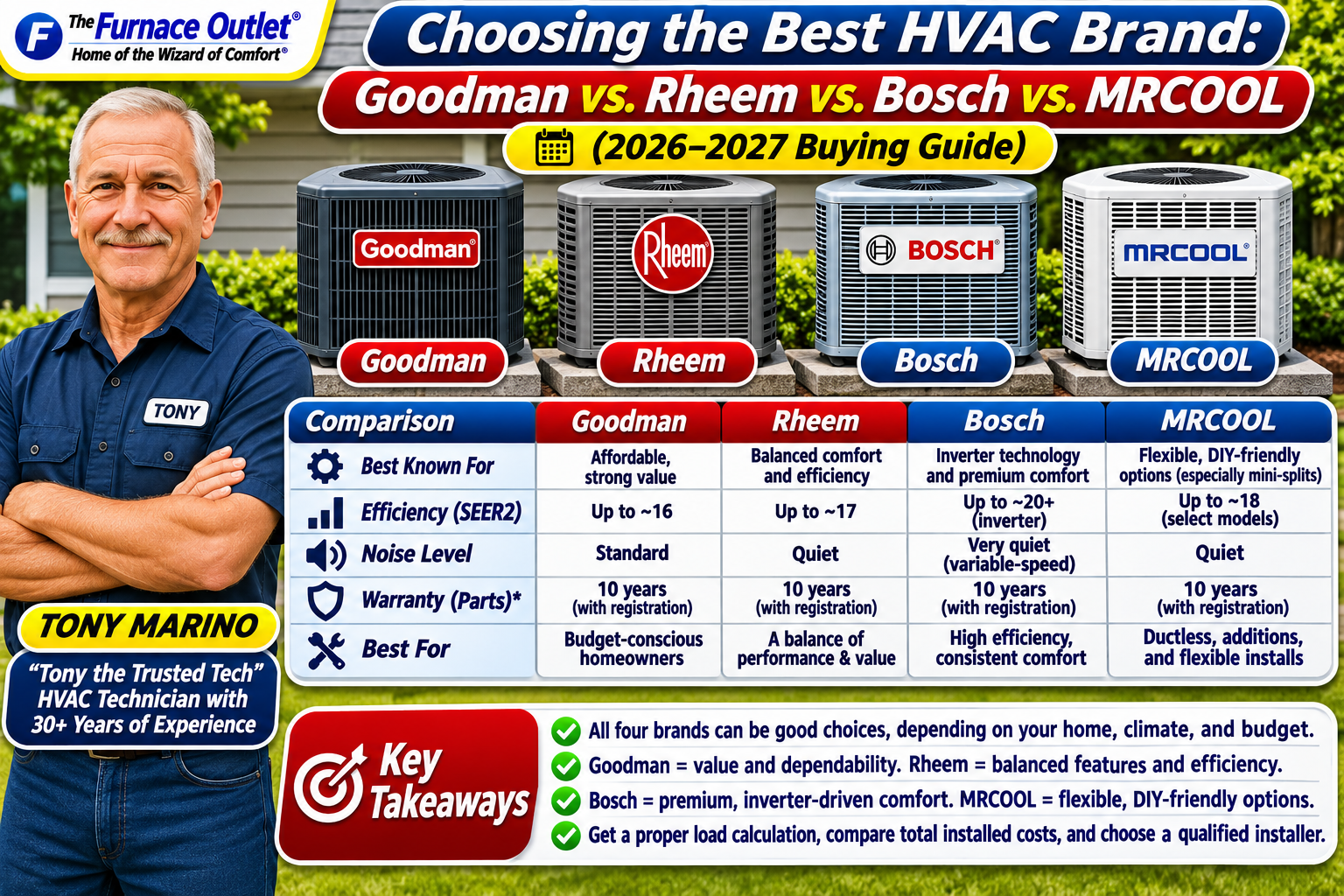
If you’re shopping for a new heating and cooling system, you’ve probably noticed how quickly brand comparisons become confusing. Goodman promises practical affordability, Rheem offers a broad selection of dependable residential equipment, Bosch emphasizes advanced inverter technology, and MRCOOL attracts homeowners interested in flexible installation and DIY-friendly mini-splits.
After decades around HVAC equipment, I’ve learned that choosing the right brand isn’t as simple as picking the most expensive unit or trusting whichever manufacturer your contractor prefers. A system that performs beautifully in one house might be an expensive mistake in another. The real question isn’t which brand is universally best. It’s which manufacturer offers the right equipment, efficiency, comfort features, service support, and installed value for your particular home. Let’s compare these four brands without the marketing noise.
Goodman has built much of its reputation around offering residential heating and cooling equipment at competitive prices. Its lineup includes central air conditioners, heat pumps, gas furnaces, air handlers, and packaged systems. For homeowners replacing an aging central HVAC system, Goodman is often worth considering because its conventional equipment can be more affordable than comparable premium-branded options.
The brand offers different efficiency levels and compressor configurations, so it would be a mistake to assume every Goodman system performs identically. A basic single-stage air conditioner and a higher-efficiency inverter heat pump serve different comfort needs. Goodman also uses R-32 refrigerant in selected newer equipment, reflecting the industry’s transition toward refrigerants with lower global warming potential.
What I like about Goodman is its straightforward value proposition. If your home has good ductwork and you have a capable local installer, you may not need to spend thousands more to achieve dependable heating and cooling. The trade-off is that some entry-level models lack the advanced sound control, capacity modulation, and comfort features available in more sophisticated equipment. Compare individual models rather than judging the entire brand by its least expensive products.
Rheem occupies an interesting position in the residential HVAC market. It offers central air conditioners, heat pumps, gas furnaces, and other home comfort equipment across several product tiers. The brand appeals to homeowners who want a balance between purchase price, efficiency, and equipment features without automatically moving into the highest-priced category. Depending on the product family, Rheem systems offer single-stage, multi-stage, and variable-capacity operation. Higher-end configurations can provide improved temperature control and quieter operation compared with basic fixed-capacity systems.
Rheem’s newer product lines also reflect the industry’s refrigerant transition, with R-454B used in selected residential HVAC equipment. One thing I always emphasize is local contractor support. A Rheem system installed by an experienced contractor who understands the controls, airflow requirements, and commissioning procedures may be a better investment than a more expensive alternative installed poorly. For homeowners who want conventional central heating and cooling with a range of upgrade options, Rheem deserves a serious look.
Bosch has become a recognizable name in the residential heat pump market, particularly through its inverter-driven ducted heat pump systems. Unlike a conventional single-stage compressor that runs at a fixed output when operating, an inverter-driven compressor can adjust its capacity as heating or cooling demand changes. This allows compatible Bosch systems to deliver more consistent temperatures, potentially quieter operation, and improved part-load efficiency. Bosch’s inverter heat pumps are particularly interesting for homeowners who want to upgrade an existing ducted system without necessarily adopting a fully proprietary communicating HVAC configuration. However, compatibility still depends on the exact equipment combination and controls.
The main consideration is initial cost. Advanced inverter equipment may carry a higher price than basic single-stage systems, and specialized replacement components can be more expensive. Bosch is worth considering when comfort, temperature consistency, and efficient heat pump operation are higher priorities than achieving the lowest possible purchase price. I would still evaluate cold-weather capacity, backup heating requirements, and local service availability before making a decision.
MRCOOL stands out because its product lineup includes ductless mini-splits, selected DIY-oriented systems, central ducted equipment, and other heating and cooling configurations. Its DIY mini-split products are especially popular among homeowners who want to reduce the complexity of installing a ductless system. Selected packages use factory-precharged refrigerant line sets designed for compatible equipment. However, DIY-friendly doesn’t mean every homeowner can install every component without professional help. Electrical connections, mounting, condensate drainage, permits, and local building requirements still need to be addressed.
Not every MRCOOL product is a DIY system, either. Some equipment requires conventional professional refrigerant installation and commissioning. I see MRCOOL as an interesting option for garages, additions, home offices, and homes where ductless zoning makes practical sense. For a complete central HVAC replacement, I’d compare the exact MRCOOL system with conventional Goodman, Rheem, and Bosch equipment rather than assuming the same buying considerations apply across every product category.
Energy efficiency is one of the most important comparisons, but it’s also one of the easiest to misunderstand. Central air conditioners and heat pumps commonly use SEER2 to measure seasonal cooling efficiency. Heat pumps also use HSPF2 to describe seasonal heating efficiency, while EER2 can provide additional insight into cooling performance at specified operating conditions.
Goodman and Rheem offer equipment across multiple efficiency tiers. Bosch’s inverter-driven systems can deliver strong part-load efficiency, while selected MRCOOL mini-splits also achieve high seasonal efficiency ratings. However, comparing the highest advertised SEER2 rating from one brand against the lowest-priced system from another isn’t meaningful.
A ductless mini-split and a conventional ducted central air conditioner may also have very different installation requirements and distribution losses. For a fair comparison, select equipment of similar capacity and intended application, then compare certified matched-system ratings. The ENERGY STAR heat pump guidance provides useful information about high-efficiency equipment and performance considerations.
The difference between fixed-capacity and inverter-driven equipment can have a major impact on everyday comfort. A single-stage air conditioner generally operates at its designated capacity whenever the compressor is running. It shuts off when the thermostat is satisfied and restarts when additional cooling is needed. An inverter-driven system can vary compressor output, allowing it to respond more gradually to changes in heating and cooling demand. This can improve temperature stability and reduce the noticeable cycling associated with some conventional systems.
Bosch places significant emphasis on inverter technology, but Goodman, Rheem, and MRCOOL also offer equipment with advanced compressor configurations in selected product lines. My advice is to decide whether your home actually benefits from the additional technology. A modestly priced single-stage system can be entirely appropriate in a straightforward installation, while an inverter heat pump may be more attractive in a home with variable loads or significant comfort challenges.
For general U.S. budgeting, a professionally installed conventional central air-conditioning replacement from a value-oriented product line might cost approximately $4,500–$8,500. Higher-efficiency central heat pump systems, including inverter-driven configurations, may cost approximately $7,000–$14,000 or more, depending on capacity, equipment matching, labor, and installation complexity. A single-zone ductless mini-split installation may cost approximately $3,000–$6,500 when professionally installed, while larger multi-zone projects can be considerably more expensive.
These figures are illustrative planning estimates, not verified national averages or brand-specific quotations. The same brand can have products at very different price points. Goodman often competes strongly on equipment affordability. Rheem offers a broad middle ground, Bosch inverter systems may command a premium, and MRCOOL pricing depends heavily on whether you’re comparing a DIY-oriented mini-split, a professionally installed ductless system, or central equipment. Don’t compare an outdoor condenser’s online price with a contractor’s complete installation quotation. The full job may include indoor equipment, electrical work, refrigerant piping, permits, condensate drainage, duct modifications, and commissioning.
Homeowners often want a simple reliability ranking, but I don’t believe a universal ranking would be particularly useful without comparable, independently collected failure data. Reliability depends on the equipment model, installation quality, maintenance history, climate, operating hours, and local service conditions. Goodman and Rheem have established residential HVAC product lines, while Bosch offers sophisticated inverter equipment that requires appropriate installation and technical support. MRCOOL’s product range is diverse, so service and replacement-part considerations can differ by system.
A poorly installed premium system can develop problems sooner than a correctly installed budget-friendly unit. I recommend evaluating the contractor’s experience with the specific brand, availability of replacement components, local technical support, and the written warranty terms. Those practical considerations often tell you more about long-term ownership than a generalized online brand ranking.
Many residential HVAC manufacturers offer limited parts warranties that may extend to ten years on eligible equipment when applicable registration and ownership conditions are satisfied. However, warranty coverage differs by brand, model, component, purchase date, and installation circumstances. Goodman, Rheem, Bosch, and MRCOOL all have product-specific warranty programs, and you shouldn’t assume their terms are identical. Some warranties cover parts but not the labor required to diagnose and replace them. Others have specific registration deadlines, professional installation requirements, or exclusions.
Before purchasing, ask your contractor for the warranty document covering the exact model numbers being installed. I also recommend asking who handles warranty claims, whether local replacement parts are readily available, and what labor protection is included in the installation contract. A ten-year parts warranty isn’t the same thing as ten years of free repairs.
Newer residential HVAC systems increasingly use refrigerants such as R-32 and R-454B as the industry moves away from higher-global-warming-potential R-410A in new equipment. Goodman uses R-32 in selected systems, while Rheem and Bosch offer R-454B equipment in relevant newer product lines. MRCOOL refrigerant selection varies by model and generation. Both R-32 and R-454B are classified as A2L refrigerants, meaning they have lower flammability than many common hydrocarbon refrigerants but still require appropriate equipment design and safety precautions.
I wouldn’t choose a system solely because it uses R-32 rather than R-454B. The important factors are certified system performance, proper equipment matching, manufacturer-approved installation, and access to trained service technicians. The U.S. Environmental Protection Agency’s HFC phasedown information explains the broader refrigerant transition affecting residential HVAC equipment.
For homeowners in colder regions, the most important question isn’t simply whether a heat pump can produce heat in winter. It’s how much heating capacity the equipment can deliver at your local winter design temperature and how efficiently it performs under those conditions. Bosch offers inverter heat pump systems that deserve consideration, while selected Goodman, Rheem, and MRCOOL heat pumps may also be suitable depending on the model and application. Cold-climate performance varies substantially within each brand.
A heat pump with an impressive cooling efficiency rating may still require supplemental heating during extreme winter conditions. Before purchasing, I would review the manufacturer’s published heating capacity at low outdoor temperatures, the home’s calculated heating load, and the proposed backup heating arrangement. The U.S. Department of Energy’s air-source heat pump guide provides background on heat pump operation and cold-weather considerations.
In hot and humid regions, cooling capacity and moisture removal are both important. A properly sized variable-capacity system may provide improved humidity control because it can operate at reduced output for longer periods, although actual performance depends on controls, airflow, and equipment design. Bosch inverter systems and advanced products from Goodman, Rheem, and MRCOOL can all be considered where suitable models are available.
However, no brand can compensate for major duct leakage, excessive outdoor air infiltration, or incorrect sizing. For humid climates, I would evaluate latent cooling performance, blower settings, thermostat controls, and whether additional dehumidification is needed. A good installation should address both indoor temperature and humidity rather than focusing exclusively on the thermostat reading.
I’ve seen homeowners become so focused on brand names that they overlook the most important part of the purchase: determining the actual heating and cooling requirements of the house. A contractor should perform an appropriate residential load calculation, commonly using ACCA Manual J, before selecting the equipment. The system must also be matched to the ductwork, electrical infrastructure, available installation space, and intended operating conditions.
An oversized system may cycle unnecessarily or struggle with humidity control, while an undersized system may have difficulty maintaining comfort during extreme weather. Even a premium Bosch inverter heat pump or a high-efficiency Rheem system can disappoint if the installation isn’t properly designed. The U.S. Department of Energy’s HVAC quality installation guidance explains why sizing, airflow, equipment matching, and commissioning matter.
Is Goodman better than Rheem?
Goodman can be an attractive choice when affordability and straightforward central HVAC performance are priorities. Rheem offers a broad range of systems with different efficiency and comfort features. Neither brand is automatically better in every application, so I recommend comparing specific models, installation quality, warranty coverage, and total cost.
Is Bosch worth the extra money?
Bosch can justify a higher initial investment when inverter operation, temperature consistency, and efficient heat pump performance are important to the homeowner. However, the additional cost should be weighed against expected energy savings, local climate, and long-term service requirements. Not every house needs a premium inverter system.
Is MRCOOL a good alternative to traditional HVAC brands?
MRCOOL can be a practical option for ductless installations, room additions, garages, and homeowners interested in selected DIY-oriented products. Its central HVAC equipment should be evaluated separately from its mini-split offerings. Check local service availability, installation requirements, and warranty conditions before purchasing.
Which brand has the lowest operating cost?
Operating costs depend more on the specific equipment’s certified efficiency, heating and cooling loads, electricity rates, and installation quality than on the brand name alone. A high-efficiency system from any of these manufacturers may cost less to operate than a lower-efficiency alternative under comparable conditions.
Which brand should I choose for a long-term home investment?
For long-term ownership, I would prioritize a properly sized system, a reputable installer, strong local service support, clear warranty terms, and an efficiency level appropriate for your climate. Goodman, Rheem, Bosch, and MRCOOL can all be reasonable choices when their equipment matches those requirements.
If keeping the initial investment under control is your main priority, Goodman is worth investigating. Its value-oriented central HVAC equipment can provide dependable comfort without requiring a premium-brand budget. If you want a balanced range of conventional and higher-featured residential systems, Rheem deserves consideration. It offers options for homeowners who want to move beyond basic equipment without automatically purchasing the most expensive configuration. If advanced inverter heat pump technology and temperature consistency are important, Bosch belongs on your shortlist. The additional investment may make sense when its features match your home’s heating and cooling requirements.
If you’re exploring ductless zoning, a garage conversion, an addition, or selected DIY-friendly mini-split configurations, MRCOOL offers options worth comparing. But here’s the advice I’d give any homeowner before signing a contract: don’t let the brand logo make the decision for you. Get a proper load calculation, compare exact equipment models, ask for complete installed prices, verify warranty terms, and choose a contractor who knows how to commission the system correctly. The best HVAC brand is the one that delivers the right comfort, efficiency, reliability, and value for your home—not the one with the loudest advertising.
This article provides general educational information about residential HVAC equipment in the United States. Product availability, refrigerant types, efficiency ratings, warranty terms, installation requirements, and pricing vary by model, region, and purchase date. All cost ranges are illustrative estimates rather than verified quotations. Homeowners should consult qualified HVAC professionals and review current manufacturer documentation before purchasing or installing equipment.
These sources provide additional model-specific information to support the comparison.
Editorial note: Avoid describing any brand as categorically more reliable than another without comparable independent failure-rate data. The article’s brand recommendations are qualitative, and its cost ranges are estimates rather than verified market averages.