Newsletter Subscribe
Enter your email address below and subscribe to our newsletter

HVAC made simple
By Tony Marino | Tony the Trusted Tech, The Furnace Outlet
Updated: November 2026
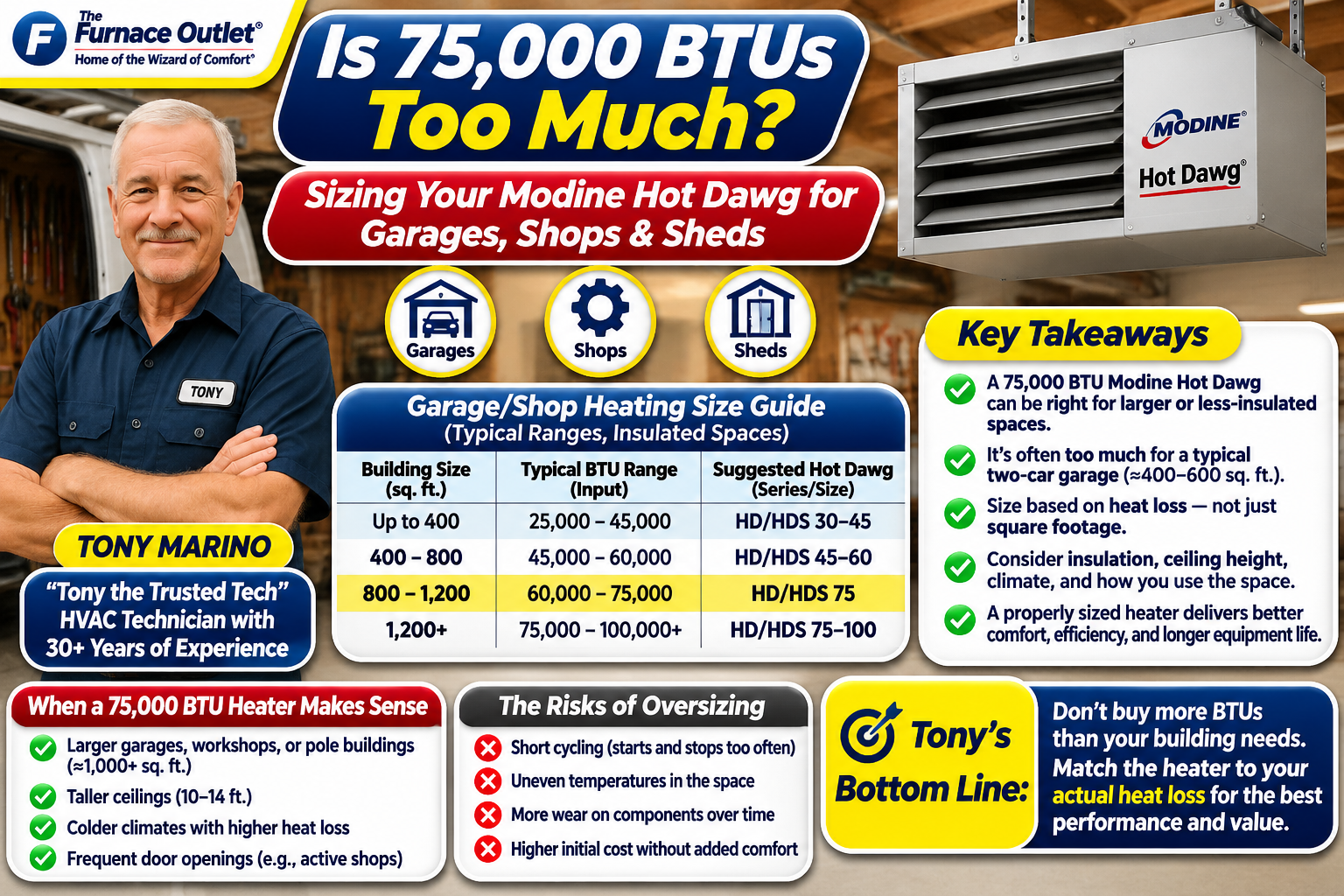
When homeowners start shopping for a garage heater, one of the most common mistakes I see is choosing the biggest unit their budget allows. The thinking is understandable: if 45,000 BTUs can heat a garage, surely 75,000 BTUs will heat it faster and better. Unfortunately, heating equipment doesn’t always work that way.
The Modine Hot Dawg is a popular gas-fired unit heater used in residential garages, workshops, and other suitable spaces. Its compact design and ceiling-mounted installation make it attractive when floor space is limited. But choosing the right heating capacity is just as important as choosing the right brand.
I’ve worked around heating systems for decades, and my advice is simple: don’t buy a 75,000 BTU heater until you understand how much heat your building actually loses. In this guide, I’ll explain when a 75,000 BTU Modine Hot Dawg makes sense, when it may be oversized, and how to choose the right capacity for your garage, shop, or shed.
The first thing homeowners need to understand is the difference between heating input and heating output. A gas-fired unit heater commonly advertises its capacity using BTUs per hour of fuel input, but not all that energy becomes useful heat inside the building.
For example, a hypothetical 75,000 BTU/h input heater operating at 80% thermal efficiency would deliver approximately 60,000 BTU/h of useful heating output. The remaining energy is lost primarily through the combustion and venting process.
However, you should never assume that every Hot Dawg model has exactly the same efficiency or that a 75,000 BTU input rating corresponds to a particular currently available model. Modine’s HD and HDS series include specific nominal capacities, and product availability and specifications vary. The model’s actual nameplate input, rated output, fuel type, and installation instructions must be verified before purchase.
This distinction matters because a building’s heating load represents the useful heat required to maintain the desired indoor temperature. When selecting equipment, compare the calculated heat loss with the heater’s rated output, not simply its advertised input.
For many ordinary two-car residential garages, 75,000 BTU/h of gas input may be more than necessary. A typical two-car garage might measure approximately 400–600 square feet, although actual dimensions vary considerably.
If the garage has insulated walls, a reasonably insulated ceiling, a well-sealed overhead door, and an eight- or nine-foot ceiling, its heating requirements may be substantially lower than the output of a 75,000 BTU input heater.
On the other hand, a garage with little insulation, substantial air leakage, frequent overhead-door openings, and extremely cold outdoor temperatures can require considerably more heat. The same floor area can produce very different heating loads depending on the building.
I would not automatically recommend a 75,000 BTU unit for a conventional two-car garage. I would first calculate the heat loss, determine the desired indoor temperature, and compare smaller heater options.
A heater in this capacity range may be appropriate for a larger detached garage, workshop, or service building with substantial heat loss. These spaces often have taller ceilings, more exterior wall area, larger overhead doors, and more frequent air exchange than a typical residential garage.
Imagine a 1,200-square-foot workshop with a 12-foot ceiling in a cold northern climate. If the building has moderate insulation and large doors that open throughout the day, its heating requirements may be significant.
A 75,000 BTU input heater might be reasonable in that situation, but the actual answer depends on its rated output and the building’s calculated design heating load.
I also look at how the building is used. A workshop maintained at 60°F throughout winter has different operating requirements from a garage that is heated only occasionally while someone works on a vehicle.
The right heater should handle the building’s expected heating demand without excessive cycling or unnecessary fuel consumption.
Many online garage-heater calculators estimate heating capacity by multiplying square footage by a fixed number of BTUs. These estimates can be useful for an initial discussion, but they are not reliable enough for final equipment selection.
A 600-square-foot garage in North Carolina may need much less heating capacity than a similarly sized garage in Minnesota. Likewise, a well-insulated workshop with a sealed overhead door may lose substantially less heat than an older building with uninsulated walls.
Ceiling height also matters because taller spaces contain more air and often have more wall area exposed to outdoor conditions. However, air volume alone does not determine steady-state heating demand; heat loss through the building envelope and air infiltration are the more important factors.
I recommend evaluating the local winter design temperature, insulation levels, building dimensions, air leakage, garage-door construction, and desired indoor temperature before choosing a heater.
A proper heating-load calculation considers heat moving through walls, ceilings, windows, doors, and other building surfaces, along with heat lost when outdoor air enters the space.
For a simplified illustration, suppose a workshop has an estimated design heating load of 35,000 BTU/h. The selected heater must provide enough useful output to meet that requirement under the expected winter design conditions.
A gas heater rated at 45,000 BTU/h input and 80% efficiency would provide approximately 36,000 BTU/h output. In this hypothetical example, it could be a closer capacity match than a 75,000 BTU/h input heater delivering 60,000 BTU/h output.
The example is intentionally simplified. Actual heater selection should also consider manufacturer ratings, installation conditions, ventilation, recovery expectations, and the building’s intended use.
The important lesson is that heating capacity should be matched to heat loss, not selected solely from a generic square-footage chart.
An oversized heater may warm the air near the thermostat quickly and then shut off before heat distributes evenly throughout the building. This can produce uncomfortable temperature differences, particularly in garages with tall ceilings or obstructed airflow.
Frequent cycling can also increase wear on ignition components, controls, and other parts. Although modern equipment includes protective controls, repeatedly operating in short cycles is generally undesirable.
Oversizing doesn’t automatically mean the heater will consume more fuel every hour of the season. Fuel consumption ultimately depends on building heat loss, equipment efficiency, cycling behavior, and operating habits. However, excessive capacity can reduce comfort and contribute to inefficient operation.
I prefer a heater that runs in appropriately sized heating cycles and distributes warmth consistently instead of repeatedly delivering short bursts of intense heat.
Absolutely. A heater that cannot meet the building’s design heating load may run continuously during severe weather without reaching the thermostat setting.
In a workshop where people spend several hours working, this can create uncomfortable conditions and limit the usefulness of the space.
Undersizing may be particularly frustrating in buildings with frequently opened overhead doors. Each opening can introduce a large volume of cold outdoor air, requiring additional heating energy to restore comfortable conditions.
The goal isn’t to choose the smallest possible heater. It’s to select equipment that meets the expected heating load while allowing for realistic operating conditions.
Before recommending a larger garage heater, I often ask homeowners about insulation. A poorly insulated garage can lose heat through its ceiling, walls, overhead doors, and gaps around the building.
Improving attic or roof insulation, insulating suitable wall cavities, and reducing air leakage can lower the heating load. Weatherstripping around overhead doors and sealing unnecessary gaps may also improve comfort.
These improvements can sometimes make a smaller heater practical, reducing initial equipment costs and ongoing fuel consumption.
However, garage insulation and air sealing should not interfere with code-required ventilation, combustion-air provisions, or other safety requirements. Attached garages also require careful attention to separation from occupied living areas.
A well-insulated building generally costs less to heat, regardless of which heater is installed.
Garages and workshops often have higher ceilings than residential living spaces. Because warm air naturally rises, the upper portion of the building may become warmer than the occupied working area.
A properly positioned unit heater helps distribute warm air, but airflow direction and mounting height must follow the manufacturer’s installation requirements.
In larger workshops, suitable air-circulation or destratification fans may help reduce temperature differences between the ceiling and floor. These should be selected and positioned so they do not interfere with the heater or create uncomfortable drafts.
I also recommend considering shelving, vehicles, overhead doors, and work areas when planning heater placement. A powerful heater installed in the wrong location may provide less useful comfort than a smaller unit with better airflow distribution.
Modine Hot Dawg heaters are gas-fired appliances that require proper fuel supply, venting, electrical connections, mounting support, and combustion-air provisions.
Installation requirements vary by model. Some configurations use different venting and combustion-air arrangements, and the applicable clearances must be verified from the exact manufacturer’s instructions.
Garage installations also have specific safety considerations because vehicles, gasoline, solvents, and other potentially flammable materials may be present. Applicable codes and the heater’s listing govern installation height, ignition-source protection, and clearances.
A qualified installer should verify gas-piping capacity, vent routing, structural support, electrical supply, and compliance with local requirements before installing the equipment.
I would never recommend modifying venting arrangements or bypassing safety controls to make a heater fit a particular location.
A 75,000 BTU heater is likely to be substantially oversized for many small insulated sheds, but the term shed covers a wide variety of buildings.
A compact backyard workshop measuring 200 square feet may have relatively modest heating requirements if properly insulated. A large agricultural or equipment-storage building can have a much higher heating load.
The bigger concern is whether the structure is suitable for a permanently installed gas-fired heater. Fuel supply, safe venting, combustion air, structural mounting, electrical service, and local building regulations must all be considered.
For small sheds, an appropriately rated electric heating solution may sometimes be more practical, especially where natural gas or propane infrastructure is unavailable.
Modine offers certain heater configurations for natural gas or propane, depending on the model. The fuel choice can significantly affect operating costs.
Natural gas is often less expensive per unit of delivered heat in areas with established utility service, while propane may be more practical for detached buildings without natural gas access.
For example, a heater using 75,000 BTU/h of gas input consumes approximately 0.75 therm of natural gas per hour while its burner is operating at full input. At an illustrative gas commodity rate of $1.50 per therm, that equals about $1.13 per burner-hour, excluding applicable fixed charges, taxes, and other utility costs.
Actual monthly expenses depend on burner operating hours, fuel rates, weather, insulation, and thermostat settings. A properly sized heater will cycle according to heating demand rather than necessarily operating continuously.
I recommend comparing local natural gas and propane prices before selecting equipment, particularly for buildings that require substantial winter heating.
For preliminary 2026–2027 budgeting, a professionally installed gas unit heater might cost approximately $2,000–$5,500 or more, depending on equipment capacity, fuel type, mounting conditions, venting, and existing utilities.
These are broad planning estimates rather than verified Modine-specific market averages. Complex installations involving new gas piping, propane infrastructure, electrical circuits, or difficult vent routing can cost substantially more.
The heater itself is only part of the total investment. Mounting brackets, gas connections, vent components, thermostat wiring, permits, and labor all contribute to the final price.
I recommend requesting an itemized quotation that identifies the exact heater model, rated output, installation materials, and required safety provisions.
Is a 75,000 BTU heater too powerful for a 500-square-foot garage?
It may be oversized, particularly if the garage is well insulated and located in a moderate climate. However, the answer depends on heat loss, ceiling height, air leakage, and winter temperatures. A heating-load calculation is the appropriate way to determine whether a smaller heater would provide adequate comfort.
Can a 75,000 BTU Hot Dawg heat a 1,000-square-foot workshop?
A heater in this capacity range may be suitable for some 1,000-square-foot workshops, but square footage alone cannot confirm the correct size. Insulation, climate, ceiling height, overhead-door usage, and the heater’s actual output rating must be considered before making a recommendation.
Will a larger garage heater warm the building faster?
A higher-output heater can deliver more heat while operating, which may improve temperature recovery under certain conditions. However, excessive capacity can produce short cycling and uneven temperatures. Proper sizing and air distribution are more important than simply choosing the largest available heater.
Are Modine Hot Dawg heaters safe for residential garages?
Appropriately listed Modine Hot Dawg models can be installed in suitable residential garages when all manufacturer instructions, applicable codes, venting requirements, and safety clearances are followed. Installation should be performed by qualified professionals familiar with gas-fired heating equipment.
When someone asks me whether a 75,000 BTU Modine Hot Dawg is too much, my first question is always about the building itself. I want to know its dimensions, insulation, ceiling height, location, and how the space will be used.
For a small, insulated residential garage, a lower-capacity heater may provide better comfort and value. For a larger workshop with substantial heat loss, higher capacity may be justified.
My recommendation is to calculate the building’s heating load, verify the exact Modine model’s rated output, and have a qualified installer evaluate the gas supply, venting, mounting location, and safety requirements.
A properly sized heater should keep your garage or workshop comfortable without unnecessary cycling, excessive fuel consumption, or avoidable installation complications. Bigger isn’t automatically better. The right amount of heat is what matters.
This article provides general educational information about gas-fired garage and workshop heaters. BTU calculations, efficiency examples, fuel costs, and installation estimates are illustrative and should not be used as substitutes for professional equipment sizing or installation design. Gas piping, venting, combustion-air requirements, electrical connections, and mounting arrangements must comply with the manufacturer’s instructions and applicable local codes. Consult a qualified HVAC professional before purchasing or installing gas-fired heating equipment.
Modine’s official specifications confirm that the Hot Dawg HD/HDS75 has a 75,000 BTU/h input rating, with approximately 61,500 BTU/h rated output in the referenced product literature. Modine generally positions this capacity for larger garages rather than typical two-car garages.
For supporting information, consult the Modine Hot Dawg Homeowner FAQs, Hot Dawg HD/HDB Product Specifications, and Hot Dawg HDS/HDC Separated Combustion Specifications. These manufacturer resources explain available capacities, typical applications, fuel options, venting arrangements, and installation considerations.