Newsletter Subscribe
Enter your email address below and subscribe to our newsletter

HVAC made simple
By Tony Marino | Tony the Trusted Tech | The Furnace Outlet
When homeowners start shopping for a new central air conditioner, Carrier and Goodman often end up on the same shortlist. Carrier has a long-standing reputation for premium comfort equipment, while Goodman attracts buyers looking for dependable cooling without paying a premium for the brand name. Both manufacturers offer systems capable of cooling an average-sized home, but their pricing structures, equipment packages, and available features can be quite different.
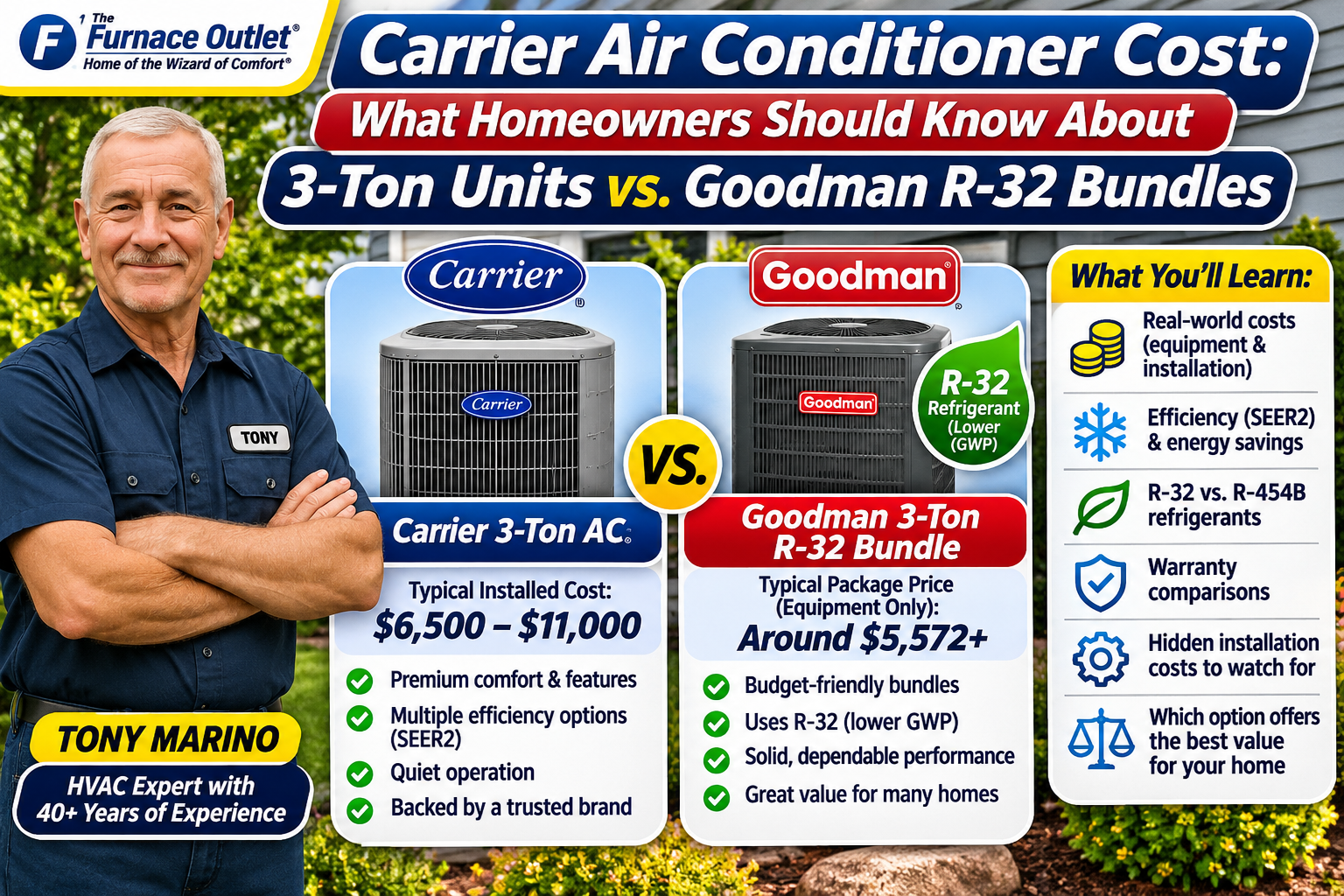
One comparison I frequently encourage homeowners to make is between a Carrier 3-ton central air conditioner and a Goodman 3-ton R-32 bundle. At first glance, the Goodman package may appear significantly less expensive. However, comparing an equipment-only bundle with a professionally installed Carrier system is not a fair comparison. You need to understand exactly what each quotation includes before deciding which represents better value.
In this 2026–2027 buying guide, I’ll explain what Carrier 3-ton systems typically cost, how Goodman R-32 bundles compare, which installation expenses homeowners often overlook, and when spending more on Carrier makes financial sense.
A 3-ton air conditioner provides approximately 36,000 BTUs of nominal cooling capacity per hour. In HVAC terminology, one ton represents 12,000 BTUs per hour, so a 3-ton system is designed to remove roughly three times that amount of heat under specified operating conditions.
However, the actual delivered capacity depends on the equipment combination, outdoor temperature, indoor airflow, and operating conditions. A 3-ton rating does not guarantee that the system will adequately cool every home within a particular square-footage range.
Some homeowners assume that a 3-ton AC is automatically suitable for a 1,500- to 2,000-square-foot house. That may be true in certain climates, but insulation, ceiling height, window exposure, ductwork, and local weather can change the cooling requirement considerably. Before recommending either Carrier or Goodman, I would want a proper Manual J load calculation rather than a sizing decision based on floor area alone.
Carrier offers several central air conditioner families, including the Comfort, Performance, and Infinity series. These systems target different budgets and comfort requirements, from straightforward single-stage cooling to advanced variable-capacity operation with communicating controls.
For a typical U.S. replacement project, a Carrier 3-ton split air conditioning system may cost approximately $6,500–$11,000 installed, depending on the model, matched indoor coil, contractor, and installation conditions. Premium configurations with advanced controls, major modifications, or extensive installation work can cost considerably more. These figures are planning estimates, not guaranteed dealer prices.
Carrier’s own pricing guidance describes a much broader range of approximately $3,000–$15,000 or more for central air conditioning installations, reflecting differences in equipment and project complexity. Importantly, some additional equipment or modifications may not be included in a basic advertised price. Homeowners should review the complete scope of work before accepting a quotation.
A basic Carrier Comfort system is generally the most economical entry point. Performance models offer additional features depending on the configuration, while Infinity systems can justify higher prices for homeowners who value sophisticated temperature control, quieter operation, and enhanced humidity management.
Goodman R-32 bundles are popular because they allow homeowners and contractors to purchase compatible equipment together instead of selecting every component separately. Depending on the package, a bundle may include an outdoor condenser, matching evaporator coil, air handler or gas furnace, thermostat, and selected installation accessories.
A 3-ton Goodman R-32 package can offer substantial upfront savings compared with a premium Carrier installation. For example, a publicly listed Goodman 3-ton R-32 system combining an air conditioner, evaporator coil, and 92% AFUE gas furnace has been advertised at approximately $5,572 for the equipment package. That example illustrates how bundled equipment can be priced, but it is not an installed quotation and should not be treated as a universal market price.
The exact package matters enormously. A Goodman condenser-and-coil bundle is not equivalent to a package that includes a complete furnace, nor is either directly comparable to a contractor’s turnkey Carrier quotation. Shipping, installation labor, electrical work, refrigerant line modifications, permits, and commissioning may all be additional expenses.
My advice is to compare the total installed price of equivalent systems rather than the headline cost of the equipment.
For a straightforward 3-ton central AC replacement, homeowners may encounter installed Goodman quotations in the neighborhood of $4,000–$7,000, while Carrier quotations can fall around $6,500–$11,000. These are broad U.S. planning ranges rather than matched bids, and the difference may narrow or widen depending on efficiency, components, labor, and local market conditions.
A properly itemized quotation should explain whether the contractor is replacing only the outdoor condenser or also installing a new evaporator coil, furnace, air handler, thermostat, and refrigerant line set. It should also identify any electrical upgrades, condensate drainage improvements, ductwork modifications, or additional safety components.
Sometimes a Goodman quote appears thousands of dollars cheaper simply because the Carrier contractor has included more extensive work. In other cases, the equipment and installation scope are genuinely comparable, and Goodman offers a meaningful upfront advantage.
The most reliable comparison comes from requesting quotations based on the same cooling load, similar efficiency targets, equivalent installation work, and clearly identified warranty coverage.
One important difference between many newer Goodman and Carrier systems is the refrigerant they use. Goodman has introduced residential air conditioning equipment using R-32, while Carrier uses R-454B, marketed as Puron Advance, across many newer product lines.
Both refrigerants have substantially lower global warming potential than the older R-410A refrigerant. R-32 has a commonly cited 100-year global warming potential of approximately 675 under the regulatory reference convention, while R-454B is commonly cited at approximately 466. These values can differ slightly depending on the assessment methodology.
Both are classified as A2L refrigerants, meaning they have lower flammability than traditional A3 refrigerants but still require equipment and installation practices designed for their characteristics. They are not interchangeable, and homeowners should never assume that an R-32 system can be charged with R-454B or vice versa.
From a purchasing standpoint, I would not choose Carrier or Goodman based solely on refrigerant type. Properly matched equipment, correct installation, future service support, and overall efficiency are more important considerations. Both refrigerants can be appropriate when used in systems specifically designed for them.
SEER2, or Seasonal Energy Efficiency Ratio 2, is an important measure of cooling efficiency. A higher SEER2 rating generally indicates that a system can deliver more seasonal cooling per unit of electricity under standardized testing conditions.
Carrier offers equipment across several efficiency levels, including premium variable-capacity systems designed for improved comfort and energy performance. Goodman also offers different efficiency tiers, so homeowners should compare specific AHRI-rated equipment combinations rather than assuming every Carrier system is more efficient than every Goodman model.
Consider two properly sized systems rated at 14.3 SEER2 and 17 SEER2. For the same standardized seasonal cooling output, the 17 SEER2 system would theoretically use approximately 16% less electricity. Actual savings depend on climate, operating hours, thermostat settings, ductwork, and installation quality.
If a higher-efficiency Carrier system costs several thousand dollars more than a Goodman alternative, the electricity savings alone may not recover that premium quickly. However, homeowners who live in very hot climates, operate their cooling systems for much of the year, or place a high value on quieter and more consistent comfort may find the additional investment worthwhile.
A standard single-stage air conditioner operates at essentially one compressor capacity when cooling is required. This straightforward design can provide reliable comfort and is often less expensive to purchase and repair.
Variable-capacity systems can adjust compressor output to better match changing cooling demand. Instead of repeatedly switching between full operation and shutdown, they can run at reduced capacity for extended periods, potentially improving temperature consistency, sound levels, and humidity control.
Carrier’s premium Infinity configurations offer these advanced comfort capabilities, while more affordable Carrier and Goodman systems use simpler compressor designs. The correct comparison is therefore between specific models with similar capabilities, not simply between brand names.
For homeowners who want dependable cooling at the lowest reasonable upfront cost, a well-installed Goodman single-stage system may be entirely satisfactory. For someone who prioritizes precise comfort, quieter operation, and sophisticated controls, a premium Carrier system may justify its higher purchase price.
One of the biggest mistakes homeowners make is assuming the advertised equipment price represents the complete cost of replacement. In practice, installation expenses can substantially change the total project budget.
Refrigerant line compatibility is particularly important when replacing older equipment with a new R-32 or R-454B system. The contractor must follow the manufacturer’s requirements for line sizing, condition, approved components, and installation procedures. A new line set may be required when the existing piping is unsuitable.
Electrical upgrades can also increase costs if the existing circuit, disconnect, wiring, or protective equipment does not meet the new system’s requirements. Condensate drainage, emergency drain protection, equipment pads, permits, and disposal of the old system can add further expenses.
Ductwork deserves special attention. Installing an expensive new condenser on a system with severely restricted airflow, leaking ducts, or an incorrectly sized return can undermine both comfort and efficiency.
I recommend requesting a written quotation that clearly identifies equipment, materials, labor, permits, removal, startup testing, and any potential additional charges. A contractor willing to explain these details is usually more valuable than one offering an unusually low price without documentation.
Both Carrier and Goodman offer limited warranties on qualifying residential equipment, but coverage depends on the exact model, registration requirements, installation circumstances, and applicable state law.
Many Carrier residential air conditioners offer a 10-year limited parts warranty with timely registration, subject to the applicable warranty terms. Goodman also offers 10-year limited parts coverage on many qualifying products, although registration requirements and additional protections vary.
A parts warranty is not the same as a labor warranty. Homeowners may still be responsible for diagnostic charges, labor, refrigerant, transportation, or other costs associated with replacing a covered component.
Before purchasing, ask the contractor for the actual warranty certificate for the proposed equipment and clarify who pays for labor if a compressor, fan motor, or control board fails. I would also confirm whether the installing contractor provides a separate workmanship warranty and whether extended labor coverage is available.
Carrier has a strong reputation for advanced residential cooling technology, while Goodman is known for accessible pricing and relatively straightforward equipment options. However, brand reputation alone cannot establish which particular system will last longer.
Reliability depends on compressor design, manufacturing quality, electrical conditions, airflow, refrigerant charge, maintenance, and installation workmanship. A premium system installed incorrectly can develop problems much sooner than a budget-oriented system installed and commissioned properly.
In my experience-based approach to evaluating HVAC equipment, installation quality receives at least as much attention as the manufacturer. Correct airflow, proper refrigerant charging, clean electrical connections, and thorough startup testing are essential regardless of the logo on the outdoor cabinet.
Homeowners should also consider local service availability. A dependable contractor familiar with the selected brand can make routine maintenance, warranty claims, and future repairs considerably easier.
Goodman R-32 bundles make particular sense for homeowners who want to control upfront costs without sacrificing the essentials of dependable cooling. They can be attractive for straightforward replacements, rental properties, and homes where advanced variable-capacity features are not a priority.
Carrier Comfort and Performance systems may appeal to homeowners who prefer the Carrier product lineup and have access to a trusted local dealer offering competitive installation pricing. These systems can provide a middle ground between basic equipment and premium comfort technology.
Carrier Infinity systems are more appropriate for buyers willing to pay extra for advanced controls, variable-capacity operation, quieter cooling, and improved temperature consistency. Those benefits may be particularly valuable in homes with long cooling seasons or demanding comfort requirements.
The best value is not necessarily the system with the lowest purchase price or the highest efficiency rating. It is the system that meets the home’s cooling load, provides the desired comfort, and delivers acceptable ownership costs over its expected service life.
Is a Carrier 3-ton air conditioner worth the extra money?
A Carrier 3-ton system may justify its higher price when the selected model offers meaningful improvements in comfort, sound levels, efficiency, or controls. However, if you are comparing two basic single-stage systems with similar performance and installation quality, a lower-priced Goodman package may provide better financial value. The decision should be based on specific models and complete installed quotations.
Are Goodman R-32 bundles cheaper than Carrier systems?
Goodman R-32 bundles often have attractive equipment pricing, but the advertised amount may exclude installation and additional components. Carrier systems are frequently sold through contractor quotations that include professional installation. To determine the real difference, compare equivalent equipment and identical scopes of work.
Can I replace my Carrier R-410A condenser with a Goodman R-32 unit?
You should not assume that an older R-410A indoor coil, controls, or refrigerant piping can be reused with a new Goodman R-32 condenser. Compatibility must be verified against manufacturer instructions and applicable codes. In many cases, replacing the matched indoor coil and making additional system changes will be necessary.
How long should a 3-ton Carrier or Goodman AC last?
Many central air conditioners provide approximately 12–20 years of service, although actual lifespan varies with climate, maintenance, installation quality, and operating conditions. A properly installed and maintained system has a better chance of delivering dependable service than one that is oversized, poorly charged, or neglected.
When homeowners ask whether they should buy a Carrier 3-ton air conditioner or a Goodman R-32 bundle, I recommend beginning with the total installed cost and the features they actually need. Goodman can offer excellent upfront value, particularly when a compatible equipment bundle is professionally installed and the homeowner does not require advanced comfort technology.
Carrier deserves serious consideration when the quotation includes higher-end efficiency, quieter operation, sophisticated controls, or a particularly strong local dealer relationship. Those advantages may justify the additional investment, but they should be demonstrated through specific equipment specifications rather than general claims about premium quality.
For the 2026–2027 buying season, my advice is to obtain at least two or three detailed installation quotations, confirm the Manual J sizing calculation, compare AHRI-rated efficiency, review warranty terms, and insist on proper commissioning. A well-matched, professionally installed system will usually deliver better value than an expensive brand purchased without understanding the complete installation.
This article is intended for general homeowner education and purchasing guidance. Equipment prices, installation costs, efficiency ratings, warranties, and product availability vary by model, location, contractor, and time of purchase. Refrigerant handling and HVAC installation should be performed by appropriately qualified professionals in accordance with manufacturer instructions and applicable safety codes.