Newsletter Subscribe
Enter your email address below and subscribe to our newsletter

HVAC made simple
By Tony Marino | HVAC Technician & Home Comfort Specialist | The Furnace Outlet | Updated November 2026
A smart thermostat can make your heating and cooling system easier to manage, improve temperature consistency, and potentially reduce energy consumption. But choosing the right one isn’t as simple as buying the thermostat with the biggest screen or the most impressive smartphone app. Google Nest, ecobee, and Honeywell Home are three of the most recognizable names in smart temperature control. Each offers different strengths, from automatic learning and room sensors to advanced HVAC equipment management.
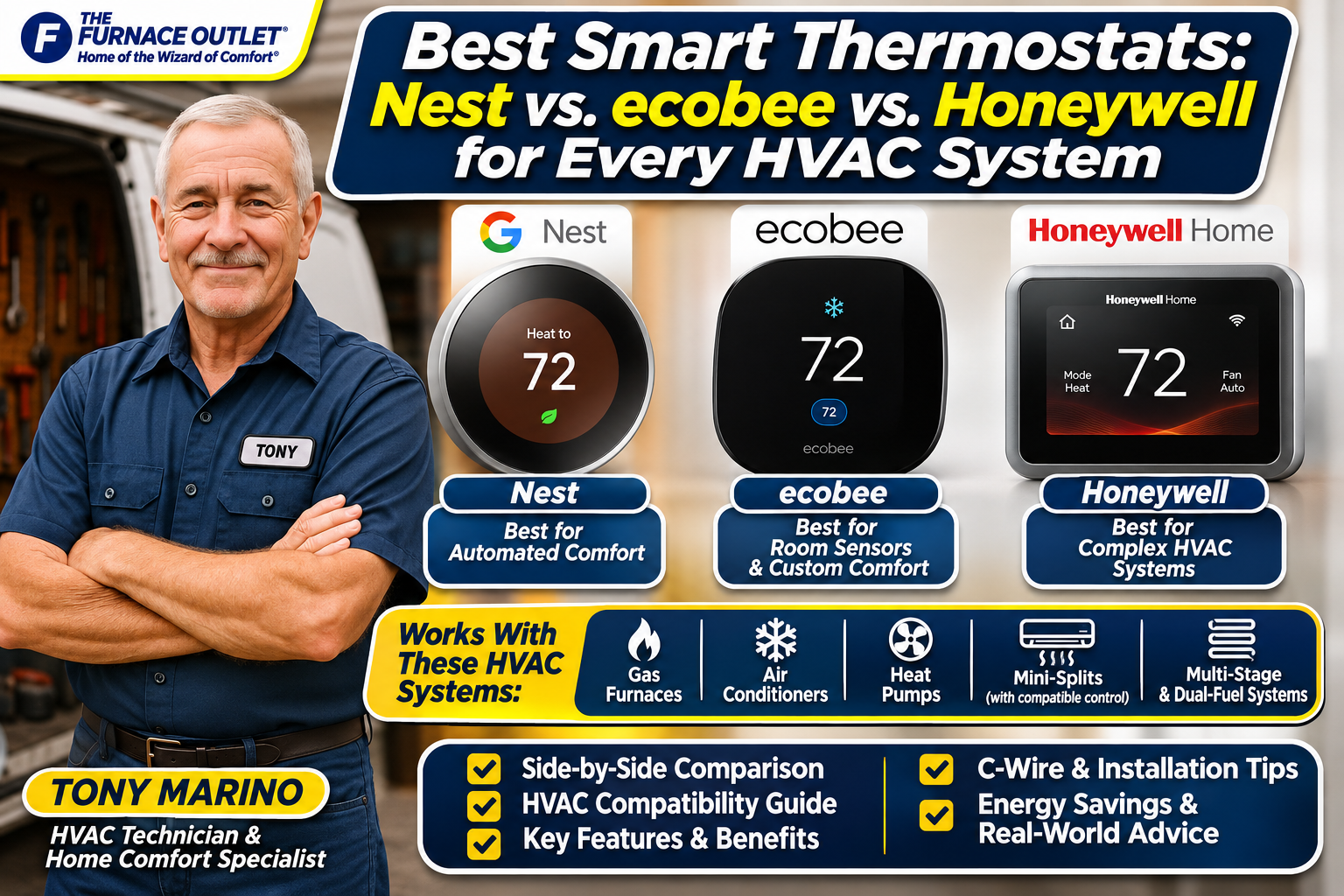
After decades of working with residential heating and cooling systems, I’ve learned that thermostat compatibility matters more than flashy features. A sophisticated thermostat isn’t much use if it can’t correctly control your furnace, heat pump, or air conditioner. For most homeowners, I consider the Google Nest Learning Thermostat an excellent choice for automated comfort, ecobee Smart Thermostat Premium a particularly strong option for room-by-room comfort, and Honeywell Home T10+ Pro a compelling choice for more complicated HVAC installations.
However, the best option depends on your equipment, wiring, comfort priorities, and budget.
The fourth-generation Google Nest Learning Thermostat offers an attractive design, automatic temperature adjustments, and integration with Google’s smart-home ecosystem. Its main advantage is convenience. Rather than requiring homeowners to manually program every heating and cooling period, Nest can learn household preferences and help establish an appropriate schedule. The fourth-generation model also supports a wireless Nest Temperature Sensor, allowing homeowners to prioritize temperatures in different rooms at selected times.
Nest can work with many conventional furnaces, central air conditioners, heat pumps, and certain dual-fuel systems. However, compatibility must be checked against the exact thermostat wiring and equipment configuration. Google’s official Nest thermostat compatibility guide explains supported system types, wiring requirements, and equipment limitations.
I particularly like Nest for homeowners who want their thermostat to handle much of the scheduling automatically. The potential drawback is that complicated equipment configurations may require additional setup or professional installation. Homeowners with multi-stage heat pumps, backup heating, or specialized accessories should verify compatibility carefully.
The ecobee Smart Thermostat Premium is an excellent choice for homeowners who want greater control over temperatures in different parts of their homes. Its SmartSensor technology can help prioritize occupied rooms and reduce the discomfort caused by temperature differences between living areas, bedrooms, and home offices. For example, a two-story home might have a comfortable downstairs living room but an upstairs bedroom that becomes too warm during summer. An ecobee thermostat with compatible room sensors can use temperature information from the bedroom when determining heating or cooling demand.
However, room sensors don’t independently control airflow or create separate HVAC zones. The thermostat still operates the connected heating and cooling equipment as one controlled system unless additional zoning hardware is installed. ecobee also supports scheduling, remote access, smart-home integrations, and compatible HVAC accessories. The manufacturer’s smart thermostat compatibility guidance explains important differences between Premium, Enhanced, and other models. For families dealing with uneven room temperatures, ecobee Premium is one of my favorite options to consider.
Honeywell Home, part of Resideo’s thermostat product family, has a long history in residential heating and cooling controls. The T10+ Pro Smart Thermostat is designed for homeowners who want advanced comfort management and professional HVAC configuration options. It supports compatible wireless room sensors, programmable schedules, geofencing, and control of certain indoor-air-quality accessories. The T10+ Pro can control up to three heating stages and two cooling stages on supported heat pump configurations, or two heating and two cooling stages on conventional systems without an additional equipment interface module.
With compatible additional equipment, certain configurations support more stages and accessories. This flexibility makes the T10+ particularly attractive for homes with multi-stage heating, heat pumps, dual-fuel arrangements, or integrated humidification and ventilation. The official Honeywell Home T10 thermostat specifications explain its equipment compatibility and control features. I generally recommend professional installation for complex Honeywell Home configurations because incorrect staging or accessory settings can affect system operation.
For straightforward daily operation, Nest has an advantage for homeowners who prefer automated scheduling and a minimalist interface. Its learning features can reduce the amount of manual programming required, although homeowners should still review temperature settings to ensure they match their comfort preferences. ecobee provides more opportunities to customize schedules, sensor priorities, and comfort settings. That flexibility can be especially useful in larger households with different room-use patterns.
Honeywell Home T10+ Pro offers a familiar programmable thermostat experience with additional professional configuration options. For someone who wants a thermostat that requires relatively little attention after setup, I would lean toward Nest. For homeowners who enjoy adjusting comfort settings and monitoring individual rooms, ecobee may be the better fit. For complicated HVAC equipment, Honeywell’s installer-focused capabilities deserve serious consideration.
Most conventional gas furnaces use standard low-voltage thermostat controls, making them compatible with many smart thermostats. For a basic single-stage gas furnace paired with a central air conditioner, Nest, ecobee, and Honeywell Home may all be suitable choices. However, two-stage and variable-speed furnaces require closer attention. Some systems allow the thermostat to control individual heating stages, while others use internal furnace controls or proprietary communicating technology. A conventional smart thermostat may operate certain communicating systems only after compatible control changes, potentially sacrificing advanced features.
For straightforward furnace installations, Nest offers convenient automatic scheduling. For homeowners who want room sensors and additional customization, ecobee is an attractive alternative. Honeywell Home may be particularly useful where additional stages or HVAC accessories need coordinated control.
Heat pump compatibility requires more attention than many homeowners realize. A heat pump can provide both heating and cooling, and some systems include auxiliary electric resistance heating or emergency heating. The thermostat must correctly manage reversing-valve operation, compressor stages, and supplemental heating. An incorrectly configured thermostat can activate auxiliary heat unnecessarily, increasing electricity consumption. Nest Learning Thermostat, ecobee Premium, and Honeywell Home T10+ Pro can support various compatible heat pump configurations, but the exact number of stages and accessory options differs.
For conventional heat pumps with backup electric heating, I would compare ecobee and Honeywell Home closely because of their configurable controls. Nest can also be an excellent option when the particular equipment and wiring are supported. For dual-fuel systems combining a heat pump with a gas furnace, professional setup is strongly recommended to ensure proper heating changeover and equipment protection.
This is where homeowners need to be especially careful. Most ductless mini-split systems don’t use the same standard 24-volt thermostat wiring found on conventional central HVAC equipment. Instead, many mini-splits rely on manufacturer-specific controllers that communicate directly with the indoor and outdoor equipment. Installing an ordinary Nest, ecobee, or Honeywell Home thermostat directly may not be possible without a compatible interface module.
Even when an interface is available, it may affect how the mini-split’s variable-speed features operate. For Mitsubishi, Daikin, GREE, Fujitsu, LG, and similar ductless systems, I recommend checking the manufacturer’s approved control options before buying a third-party thermostat. In many cases, the manufacturer’s own Wi-Fi controller provides a better solution for retaining full equipment functionality.
The C-wire, or common wire, provides a continuous electrical power connection for compatible smart thermostats. Older homes may not have a C-wire connected at the thermostat location, creating installation challenges. Google’s fourth-generation Nest Learning Thermostat is designed to operate without a C-wire in many compatible installations, although some systems require additional power hardware.
ecobee includes a Power Extender Kit with certain models, allowing compatible systems to operate without an existing C-wire at the thermostat. Honeywell Home models may require a suitable common-wire connection or an approved power solution, depending on the model and installation. Never assume that a thermostat is compatible simply because its terminals resemble your existing wiring. efore disconnecting the old thermostat, photograph the wiring and check the manufacturer’s compatibility instructions.
Smart thermostats can help reduce unnecessary heating and cooling by adjusting temperatures when a home is unoccupied or occupants are sleeping. Features such as scheduling, geofencing, occupancy detection, and remote temperature control can make efficient operation easier. However, savings aren’t guaranteed. A homeowner who already uses an efficient programmable thermostat consistently may experience smaller savings than someone replacing an older thermostat that maintains the same temperature around the clock.
The HVAC system’s efficiency, insulation, climate, electricity prices, and household behavior also influence results. With heat pumps, aggressive temperature setbacks can sometimes trigger supplemental heating during recovery, reducing potential savings. The best approach is to use moderate settings appropriate for the equipment and monitor actual energy consumption.
Room sensors can make a noticeable difference in homes with uneven temperatures. ecobee and Honeywell Home both offer compatible wireless sensors that allow homeowners to prioritize temperatures in selected rooms. Nest’s fourth-generation Learning Thermostat also supports compatible temperature sensors.
For example, homeowners might prioritize the living room during the day and the bedroom overnight. However, sensors don’t solve every comfort problem. If one bedroom receives insufficient airflow because of undersized ductwork, a thermostat sensor cannot independently increase the amount of conditioned air reaching that room. Persistent temperature differences may require duct balancing, insulation improvements, zoning modifications, or HVAC system evaluation.
Nest is particularly appealing to homeowners already using Google Home and other compatible Google-connected devices. ecobee offers broad smart-home functionality and integration options, making it attractive for households using multiple connected-device platforms. Honeywell Home T10+ Pro supports compatible smart-home integrations and app-based control through the Resideo ecosystem.
Before purchasing, verify current support for your preferred voice assistant, mobile platform, and smart-home automation system. Software integrations can change over time, and features available on one thermostat model may not be supported on another. I recommend choosing the thermostat primarily for HVAC compatibility and comfort control, with smart-home integration as an additional benefit.
Smart thermostat prices vary by retailer, model, promotions, and installation requirements. For preliminary budgeting, many mainstream smart thermostats fall approximately within the $100–$300 retail range, while premium models and professional-control packages may cost more. A professionally installed thermostat can add roughly $100–$300 or more in labor, depending on wiring complexity and local rates.
Additional C-wire installation, control modules, or specialized HVAC configuration may increase the total. These are broad planning estimates rather than verified current retailer quotations. Some utilities offer rebates for eligible ENERGY STAR-certified smart thermostats, potentially reducing the purchase cost. Before purchasing, check your utility’s current incentive program and the thermostat’s eligibility.
For homeowners with straightforward HVAC equipment who want automatic scheduling, Nest Learning Thermostat is a strong choice. For families with uneven room temperatures or changing occupancy patterns, ecobee Smart Thermostat Premium offers particularly useful comfort-management features. For homes with complicated multi-stage heating, dual-fuel systems, or specialized accessories, Honeywell Home T10+ Pro deserves serious consideration.
However, the most expensive thermostat isn’t automatically the best. A simpler thermostat that correctly controls your HVAC equipment may provide greater practical value than a premium model with features you rarely use. I would prioritize compatibility, installation requirements, local support, and the features your household will actually use.
Is Nest better than ecobee? Nest may be better for homeowners who prefer automated learning and simple daily operation. ecobee may be more suitable for homeowners who want extensive room-sensor control and customizable comfort settings.
Is Honeywell Home better for heat pumps? Honeywell Home T10+ Pro offers useful heat pump and multi-stage control capabilities, but the best choice depends on the exact equipment configuration. ecobee and Nest also support many heat pump systems.
Can a smart thermostat damage an HVAC system? Incorrect wiring or configuration can cause equipment malfunctions and, in some circumstances, damage. Complex systems should be installed or configured by a qualified HVAC professional.
Do smart thermostats work without Wi-Fi? Many models retain basic local heating and cooling control during an internet outage, but remote access, weather-based functions, and some connected features may be unavailable.
Can I install a smart thermostat myself? Some standard 24-volt systems are suitable for knowledgeable DIY installation. Dual-fuel, communicating, multi-stage, and specialized systems may require professional assistance.
When homeowners ask me whether Nest, ecobee, or Honeywell Home makes the best smart thermostat, my first question is always about their heating and cooling equipment. A thermostat is the control center of your comfort system. If it can’t communicate correctly with your furnace, heat pump, or air conditioner, its advanced features won’t matter. For simple automated comfort, I like Nest. For room sensors and household flexibility, ecobee is an excellent option. For more complex HVAC configurations, Honeywell Home T10+ Pro offers valuable control capabilities.
Before buying, confirm equipment compatibility, inspect the existing thermostat wiring, and determine whether professional installation is appropriate. A properly selected and configured smart thermostat can make your home more comfortable, easier to manage, and potentially more energy efficient for years to come.