Newsletter Subscribe
Enter your email address below and subscribe to our newsletter

HVAC made simple
By Jake Lawson | HVAC Specialist | The Furnace Outlet | Updated November 2026
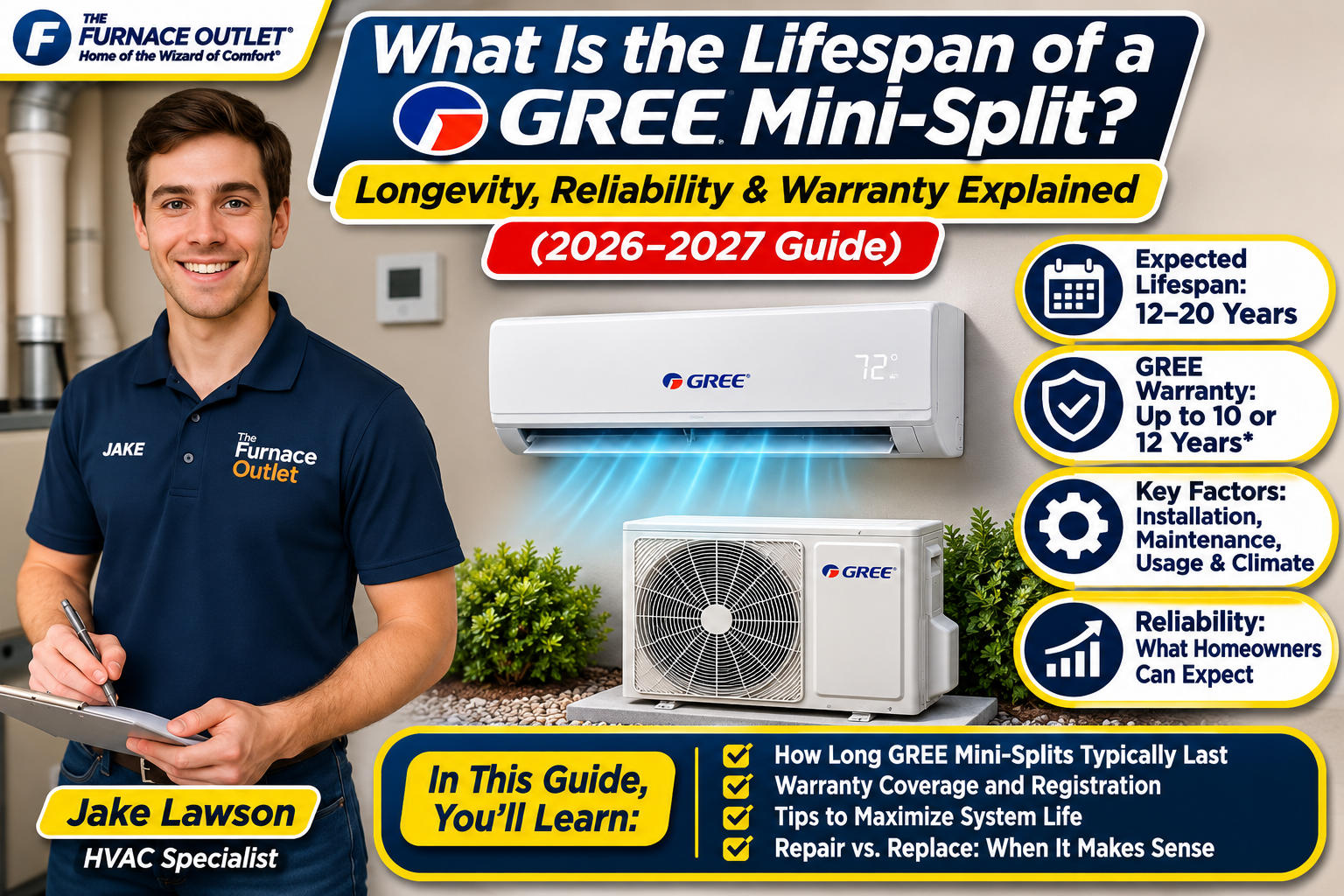
If you’re considering a GREE mini-split heat pump, one of the most important questions is how many years of dependable heating and cooling you can expect before expensive repairs or replacement become necessary. A properly installed and maintained GREE mini-split may provide approximately 12–20 years of useful service, with 15 years being a reasonable planning benchmark for many homeowners. However, this is an estimated service-life range, not a manufacturer-guaranteed lifespan or a published brand-specific reliability statistic.
I’ve worked with enough ductless heating and cooling equipment to know that brand reputation tells only part of the story. Installation quality, refrigerant-line connections, airflow, electrical protection, maintenance, and local climate can all influence how long a system operates reliably. GREE offers everything from conventional single-zone mini-splits to sophisticated multi-zone and cold-climate heat pumps. These systems have different components and operating requirements, so their long-term performance shouldn’t be judged as though every model were identical.
Let’s examine what determines GREE mini-split longevity, how its warranty programs work, and when repairing an older system stops making financial sense.
For budgeting purposes, homeowners can reasonably plan around 12–20 years of potential service from a properly maintained ductless mini-split. Some systems may experience major failures earlier, while others can continue operating beyond that range.
GREE doesn’t provide a universal guaranteed operating lifespan covering every residential mini-split model. Its limited warranties protect against specified defects for defined periods, but warranty duration should not be confused with expected equipment life. A mini-split installed in a mild climate and used primarily for seasonal cooling may experience different operating stresses from one providing year-round heating and cooling in a region with harsh winters.
The system’s age is also only one consideration. A 14-year-old mini-split that operates efficiently without frequent repairs may remain worth keeping, while a much younger system with repeated refrigerant leaks could become uneconomical to maintain.
GREE is an established international HVAC manufacturer offering residential and commercial heating and cooling equipment. Its mini-split systems use technologies commonly found in modern ductless equipment, including inverter-driven compressors and electronic temperature controls. Inverter technology allows a compressor to adjust its operating speed according to heating or cooling demand rather than repeatedly switching between full output and complete shutdown.
This can improve temperature consistency and reduce unnecessary cycling under suitable conditions. However, inverter systems also contain sophisticated electronic components that may be expensive to repair. I wouldn’t claim that GREE mini-splits last longer than Mitsubishi, Daikin, Fujitsu, or LG without reliable, independently verified model-specific failure data.
Instead, I would evaluate the exact GREE model, its warranty, the installer’s experience, and the availability of replacement parts. A well-installed GREE system can be a sensible long-term investment, particularly when supported by a contractor familiar with the equipment.
Installation quality is one of the biggest factors affecting mini-split reliability. Refrigerant lines must be correctly connected, pressure-tested, evacuated, and charged according to manufacturer specifications. Poor flare connections, moisture contamination, or incorrect refrigerant charging can lead to leaks, compressor problems, and reduced performance.
System sizing is equally important. An oversized mini-split may operate inefficiently at low loads, while an undersized unit may struggle to maintain comfort during extreme temperatures. Environmental exposure also matters. Coastal salt air can accelerate corrosion, while heavy dust, vegetation, snow accumulation, and restricted airflow can place additional stress on outdoor equipment.
Electrical problems, including voltage irregularities and inadequate grounding, may damage sensitive electronic controls. Regular maintenance helps identify developing problems before they result in expensive failures.
The compressor is one of the most important and expensive components in a mini-split heat pump. Under favorable operating conditions, an inverter compressor may continue functioning for many years, potentially throughout much of the system’s useful service life. However, there is no fixed replacement interval that applies to every GREE compressor.
Premature compressor failure can result from refrigerant loss, moisture contamination, overheating, electrical faults, or improper installation. When a compressor fails, the repair may involve substantial labor, refrigerant handling, and additional components. For an older mini-split, replacing the entire system may be more economical than installing a new compressor, particularly when other components are approaching the end of their useful life.
GREE warranty coverage in the United States varies by product, distributor, installation type, registration status, and applicable warranty program. Under the GREE Comfort program, standard residential coverage commonly includes five years on eligible parts and seven years on the compressor. Certain qualifying systems installed by GREE Select Dealers may receive 10-year limited parts and compressor coverage when registered within the required period. GREE Comfort’s current guidance specifies registration within 60 days of installation for its applicable Select Dealer extended warranty program.
Other GREE product lines distributed through Gree Climate Solution LLC may offer up to 12 years of limited parts or compressor coverage for qualifying owner-occupied residential installations, subject to registration and other conditions. These programs should not be treated as interchangeable. Homeowners can review the GREE Comfort warranty program to identify the coverage associated with their equipment. Before purchasing, request the actual warranty certificate for the specific indoor and outdoor model numbers.
A common misunderstanding is that a 10-year parts warranty means homeowners won’t pay anything for repairs during the first decade. In most cases, manufacturer limited warranties cover eligible replacement parts rather than every expense associated with the repair. Labor, diagnostic charges, refrigerant, shipping, and other service-related costs may be excluded unless additional coverage specifically includes them.
For example, a replacement control board might qualify as a covered part, but the homeowner could still be responsible for the technician’s diagnostic and installation charges. This is why I recommend asking the installing contractor whether a separate labor warranty is available. A strong labor warranty can provide meaningful financial protection, particularly during the early years of ownership.
Warranty registration requirements depend on the specific GREE program and the date of installation. For applicable GREE Comfort Select Dealer extended coverage, the system must be installed by a qualifying dealer and registered within the required 60-day period. Other GREE warranty programs may impose similar registration deadlines or different eligibility requirements.
Homeowners should retain the original purchase invoice, installation date, contractor details, and model and serial numbers for both indoor and outdoor units. The GREE Comfort warranty registration and lookup page allows homeowners to check applicable registration records. I recommend confirming registration with the installer immediately after installation rather than waiting until a repair becomes necessary.
Routine maintenance is one of the simplest ways to protect a mini-split investment. Indoor filters should be inspected regularly and cleaned according to the owner’s manual. In homes with pets, construction dust, or heavy daily usage, cleaning may be necessary more frequently. The indoor coil and blower should remain free of excessive dirt buildup, while the outdoor unit needs adequate clearance for airflow. Condensate drainage should also be checked periodically because blocked drain lines can cause water leaks and moisture-related problems.
GREE’s official single-zone mini-split maintenance guidance recommends filter care, coil cleaning, drainage inspection, and annual professional maintenance. I suggest scheduling a professional inspection at least annually, with more frequent servicing where operating conditions are demanding. Homeowners can handle basic accessible filter cleaning, but refrigerant-system repairs and electrical diagnostics should be performed by qualified technicians.
Mini-split systems are designed to operate for extended periods, and many inverter models work most efficiently by adjusting compressor output to match demand. Running a mini-split continuously doesn’t necessarily mean the compressor operates at maximum capacity throughout the day. In fact, repeated manual shutdowns and restarts may offer little benefit when the system is maintaining a stable indoor temperature.
However, excessively low cooling settings, restrictive airflow, or prolonged operation beyond the equipment’s intended conditions can increase operating stress. The best approach is to use reasonable thermostat settings, maintain clean filters, and allow the system’s controls to manage compressor operation. If the mini-split runs constantly without maintaining the desired temperature, have the equipment inspected rather than assuming continuous operation is normal.
An older GREE mini-split may begin showing reduced heating or cooling capacity, unusual operating noises, inconsistent temperatures, or repeated fault codes. A noticeable increase in electricity consumption can also indicate deteriorating performance, although weather conditions and usage patterns must be considered. Other warning signs include recurring refrigerant leaks, repeated electronic control failures, or excessive frost that doesn’t clear through normal defrost operation.
Water dripping from the indoor unit may indicate a blocked condensate drain rather than a major system failure. Similarly, a temporary error code doesn’t automatically mean the compressor needs replacement. The important distinction is whether the problem is isolated and repairable or part of a pattern of recurring expensive failures.
Repair decisions should consider equipment age, repair cost, efficiency, warranty status, and overall system condition. A 10-year-old GREE mini-split with a failed sensor or minor electrical component may be worth repairing if the remaining equipment is in good condition. However, a 15-year-old system requiring a compressor replacement or extensive refrigerant leak repairs deserves a closer financial evaluation.
As a practical budgeting guideline, I would seriously compare replacement options when a major repair approaches 40–50% of the installed cost of a comparable new system. This isn’t a universal industry rule, but it can help homeowners avoid investing heavily in aging equipment. A newer system may also provide improved efficiency, quieter operation, and updated refrigerant technology, depending on the replacement model.
GREE competes with established mini-split manufacturers such as Mitsubishi Electric, Daikin, and Fujitsu. These brands offer different compressor technologies, cold-climate capabilities, efficiency ratings, warranty programs, and service networks. Premium brands may have extensive contractor training programs and established local service support, but that doesn’t automatically prove longer equipment life.
GREE may offer attractive value when its purchase price, warranty coverage, and local contractor support are competitive. For a meaningful comparison, homeowners should examine specific model specifications and the availability of qualified technicians rather than relying solely on general brand rankings.
Replacing a GREE mini-split can cost substantially more than the outdoor unit’s advertised equipment price. For preliminary U.S. budgeting, a professionally installed single-zone mini-split replacement may cost approximately $3,000–$6,500, while multi-zone replacements can range from $6,000–$15,000 or more. These figures are illustrative planning ranges rather than verified national averages or model-specific quotations.
Installation expenses depend on equipment capacity, refrigerant-line compatibility, electrical work, indoor unit configuration, and local labor costs. When replacing an older system, contractors must also determine whether existing refrigerant piping and electrical connections are suitable for the new equipment. A complete replacement quotation should identify equipment, installation materials, labor, refrigerant handling, permits, and warranty coverage.
Can a GREE mini-split last 20 years? Yes, some properly installed and maintained systems may remain operational for 20 years, but that shouldn’t be considered a guaranteed or typical outcome for every installation. Climate, usage, maintenance, and equipment condition all influence service life.
Is GREE a reliable mini-split brand? GREE manufactures established ductless heating and cooling equipment, but reliability depends on the exact model and installation quality. Homeowners should also consider warranty coverage and local service availability.
Does GREE offer a 10-year warranty? Certain qualifying GREE Comfort systems installed by eligible Select Dealers can receive 10-year limited parts and compressor coverage when properly registered. Other GREE product programs may offer different coverage, including up to 12 years for eligible equipment.
Do GREE mini-splits need annual servicing? Annual professional maintenance is a sensible recommendation for most residential installations. Filters and accessible components may need more frequent attention depending on usage and environmental conditions.
Should I replace my GREE mini-split after 15 years? Not automatically. If the system remains reliable and efficient, continued operation may be reasonable. Replacement becomes more attractive when expensive repairs, declining performance, or repeated failures occur.
When homeowners ask me whether a GREE mini-split will last 15 or 20 years, I explain that no manufacturer can promise a fixed operating lifespan. A properly installed GREE system has the potential to provide many years of dependable heating and cooling, but the actual outcome depends heavily on installation quality, maintenance, and operating conditions.
My recommendation is to choose a qualified installer, confirm the exact warranty terms before purchasing, register the equipment promptly, and maintain the system according to manufacturer instructions. If you already own a GREE mini-split, don’t replace it simply because it has reached a particular age. Evaluate its condition, repair history, and operating efficiency before making that decision. A well-maintained mini-split can remain a valuable part of your home’s comfort system long after its original installation.
This article provides general educational information for U.S. homeowners. Estimated equipment lifespans are planning assumptions, not manufacturer guarantees or independently verified model-specific averages. Warranty coverage varies by equipment, distributor, installation date, registration status, and applicable conditions. Always review the exact manufacturer’s warranty certificate and consult a qualified HVAC professional for installation, maintenance, refrigerant servicing, and major repair decisions.