Newsletter Subscribe
Enter your email address below and subscribe to our newsletter

HVAC made simple
By Savvy Mavi | Energy Efficiency & Sustainable Living Contributor | The Furnace Outlet | Updated November 2026
Ductless mini-split systems have become increasingly popular among American homeowners looking for efficient heating and cooling without extensive ductwork. But beyond energy savings and improved comfort, one of their biggest attractions has been the availability of government incentives and utility rebates.
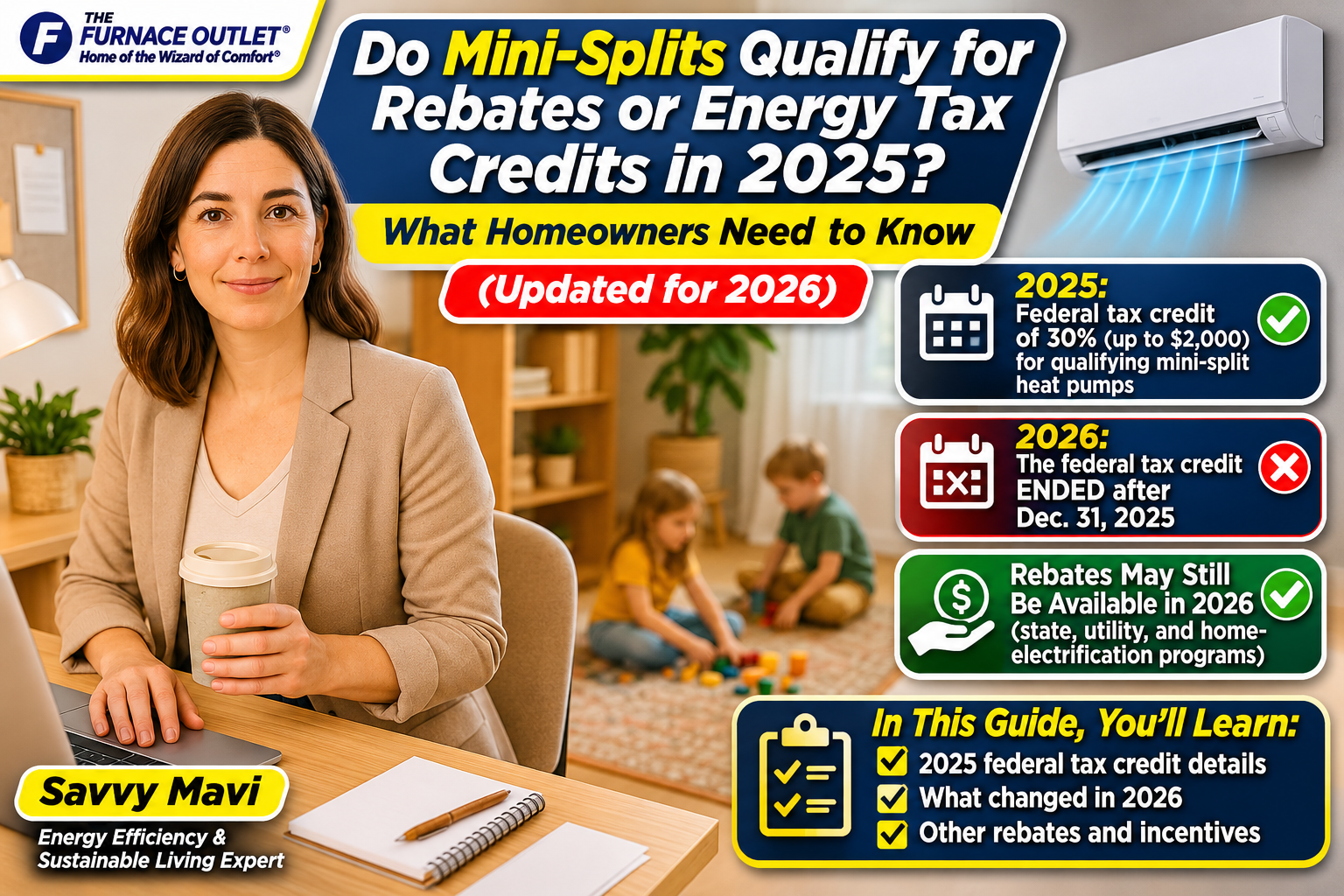
During 2025, qualifying mini-split heat pumps were eligible for a federal income tax credit worth up to $2,000. Some homeowners could also receive additional financial assistance through state energy programs and local utilities. However, federal legislation enacted in July 2025 changed the incentive landscape. The Energy Efficient Home Improvement Credit under Section 25C ended for qualifying equipment placed in service after December 31, 2025.
That distinction matters enormously for homeowners planning an installation in 2026 or reviewing a mini-split purchased during 2025. Let’s examine which systems qualified, how much homeowners could save, and which incentives may still be available.
Yes. Eligible ductless mini-split heat pumps installed and placed in service during 2025 could qualify for the federal Energy Efficient Home Improvement Credit under Internal Revenue Code Section 25C. The credit covered 30% of qualifying project expenses, subject to a maximum of $2,000 annually for eligible heat pumps and heat pump water heaters combined.
For example, a qualifying mini-split heat pump installation costing $5,000 could potentially generate a $1,500 federal tax credit. A qualifying installation costing $8,000 could reach the $2,000 maximum, rather than the full $2,400 calculated at 30%. Eligible costs could include qualifying equipment and associated installation labor.
According to the IRS Energy Efficient Home Improvement Credit guidance, the credit was nonrefundable, meaning it could reduce eligible federal income tax liability but could not produce a refund beyond that liability. Unused credit amounts could not be carried forward to future tax years.
Homeowners researching mini-split incentives may encounter older articles claiming that the federal heat pump tax credit remains available through 2032. That information is outdated. Federal legislation enacted in July 2025 accelerated the expiration of the Section 25C Energy Efficient Home Improvement Credit. As a result, qualifying heat pumps had to be placed in service no later than December 31, 2025, to qualify under the applicable rules.
A homeowner who purchased equipment in December 2025 but did not have it installed and operational until January 2026 generally cannot claim the expired credit. However, someone whose qualifying mini-split was installed and placed in service during 2025 may still claim the credit on their 2025 federal income tax return, subject to eligibility requirements.
The IRS guidance on the termination of residential energy credits confirms the December 31, 2025 deadline.
Not every mini-split qualified automatically. The federal tax credit primarily applied to eligible air-source heat pumps capable of providing both heating and cooling. For 2025, qualifying air-source heat pumps generally needed to meet the applicable ENERGY STAR Most Efficient requirements. ENERGY STAR provided eligibility pathways for cold-climate applications and for cooling-dominated or dual-fuel applications. These pathways were based on equipment performance rather than simply the homeowner’s geographic location.
An ordinary cooling-only ductless air conditioner did not qualify for the heat pump-specific $2,000 credit merely because it was energy efficient. The ENERGY STAR air-source heat pump tax credit guidance explains the applicable 2025 requirements. Homeowners should verify the exact outdoor and indoor equipment combination because eligibility can depend on the certified system rather than the brand name alone.
Several major manufacturers offered mini-split heat pump systems that could satisfy the 2025 federal efficiency requirements. Mitsubishi Electric, Daikin, Fujitsu, LG, and other manufacturers offered eligible equipment configurations, although not every product or combination qualified. The important factor was the exact model’s certification and compliance with the applicable tax-credit requirements.
For example, a high-efficiency Mitsubishi mini-split might qualify while another configuration from the same manufacturer might not. Homeowners should obtain the model numbers, applicable certification information, and manufacturer documentation before claiming any credit. For 2025, the IRS also required a Qualified Manufacturer Identification Number, commonly called a QMID, for specified eligible equipment. This information had to be reported on the applicable tax return.
Although the federal Section 25C tax credit ended after 2025, state and utility rebate programs may still provide meaningful savings for eligible mini-split installations. These incentives vary considerably by state, electric utility, household income, equipment efficiency, and whether the installation replaces an existing heating system. Some utilities offer rebates for qualifying cold-climate heat pumps, while others provide incentives for replacing electric resistance heating or older fossil-fuel equipment.
Certain programs require contractors to submit rebate applications before installation, while others allow homeowners to apply after completing eligible work. Rebate amounts can range from modest equipment discounts to substantial project assistance, depending on the program. Because availability changes, homeowners should confirm current program funding and eligibility before purchasing equipment.
The federal Home Electrification and Appliance Rebates program, commonly called HEAR, authorizes substantial financial assistance for eligible low- and moderate-income households. Under the program framework, qualifying heat pumps used for space heating and cooling may receive rebates of up to $8,000. Households earning less than 80% of their area’s median income may qualify for assistance covering up to 100% of eligible costs, subject to program limits.
Households earning between 80% and 150% of area median income may qualify for assistance covering up to 50% of eligible costs. However, the $8,000 figure represents a maximum program allowance, not an automatic payment to every homeowner. States and participating jurisdictions administer these programs and may impose additional requirements, restrict eligible equipment, or offer different rebate amounts.
The ENERGY STAR Home Electrification and Appliance Rebates overview explains the income categories and maximum incentive amounts. Homeowners should verify whether their state currently operates an applicable program and whether funding remains available.
In some situations, homeowners may combine eligible utility rebates, state incentives, and other assistance programs, potentially reducing their out-of-pocket installation costs. However, stacking incentives isn’t always straightforward. Different programs may prohibit using multiple rebates for the same expense, require deductions for other financial assistance, or impose maximum reimbursement limits.
For a qualifying 2025 installation, the federal tax-credit calculation may also be affected by certain rebates or subsidies. Homeowners should request written confirmation from each program administrator rather than assuming every advertised incentive can be combined. A knowledgeable HVAC contractor may help identify applicable programs, but final eligibility should be verified with the relevant agencies and a qualified tax professional.
Mini-split installation costs depend on system capacity, efficiency, number of indoor units, electrical requirements, and installation complexity. For preliminary U.S. budgeting, a professionally installed single-zone ductless mini-split may cost approximately $3,000–$6,500, while a multi-zone installation can cost $6,000–$15,000 or more. These figures are broad planning estimates rather than guaranteed national averages or current contractor quotations.
Consider a hypothetical qualifying 2025 heat pump installation costing $6,000. A homeowner with sufficient tax liability could potentially receive a federal credit of $1,800, reducing the effective project cost to $4,200 before considering other incentives. For an installation completed in 2026, that same federal credit would no longer be available. However, an eligible state or utility rebate could still reduce the homeowner’s actual expense. This is why the installation date and local incentive rules are essential to any financial comparison.
Absolutely, provided the equipment suits the home’s heating and cooling requirements. Mini-split heat pumps can offer efficient heating and cooling, individual room temperature control, and the ability to serve spaces without existing ductwork. Their variable-speed compressors can adjust output according to demand, potentially reducing electricity consumption compared with less efficient conventional equipment.
In colder climates, appropriately selected cold-climate heat pumps can provide useful heating at low outdoor temperatures, although performance varies by model and conditions. The financial benefit depends on local electricity rates, the heating system being replaced, insulation quality, installation costs, and operating habits. Homeowners replacing electric resistance heating may see meaningful savings, while those switching from inexpensive natural gas heating should compare operating costs carefully.
The absence of a federal tax credit doesn’t automatically make a mini-split a poor investment.
Before purchasing a mini-split, homeowners should check their state energy office, electric utility, and applicable home energy rebate programs. The ENERGY STAR Rebate Finder can help identify participating incentive programs associated with energy-efficient products. Contact your utility directly to confirm current funding, eligible models, installation requirements, and application deadlines.
It’s also worth asking contractors whether they participate in utility or state rebate programs. Some incentives require installation by approved contractors, and certain programs must be authorized before work begins. Keep copies of equipment specifications, invoices, proof of payment, rebate approvals, and installation documentation.
Can I claim a federal tax credit for a mini-split installed in 2025? Yes, if the system and installation meet the applicable requirements. Qualifying heat pumps placed in service during 2025 could receive a credit of 30% of eligible costs, up to $2,000, subject to tax liability and other limitations.
Can I claim the same credit for a mini-split installed in 2026? No. The Section 25C federal tax credit ended for qualifying property placed in service after December 31, 2025. State and utility incentives may still be available.
Do cooling-only mini-splits qualify for the $2,000 heat pump credit? No. The heat pump-specific credit applied to qualifying heating-and-cooling equipment, not ordinary cooling-only mini-split air conditioners.
Can renters qualify for mini-split rebates? Certain home electrification rebate programs may assist eligible renters, subject to program rules and property-owner approvals. Availability depends on the jurisdiction and program administrator.
Do I need a special tax form for a 2025 mini-split installation? Eligible homeowners generally claim the federal credit using IRS Form 5695 with their 2025 federal income tax return. The applicable QMID and other required information must be included.
If you installed a qualifying mini-split heat pump during 2025, don’t overlook the potential federal tax credit when preparing your tax return. Verify the equipment’s eligibility, confirm the installation date, and retain the necessary manufacturer documentation.
If you’re planning a mini-split installation in 2026, the financial picture is different. The federal Section 25C credit is no longer available, but state programs, utility rebates, and qualifying home electrification assistance may still reduce your costs.
I recommend comparing at least three complete installation quotations and asking each contractor to identify available incentives before signing a contract.
Most importantly, choose a properly sized, efficient system that fits your home’s needs. Rebates can make a good investment more affordable, but they shouldn’t be the only reason for choosing a particular mini-split.