Newsletter Subscribe
Enter your email address below and subscribe to our newsletter

HVAC made simple
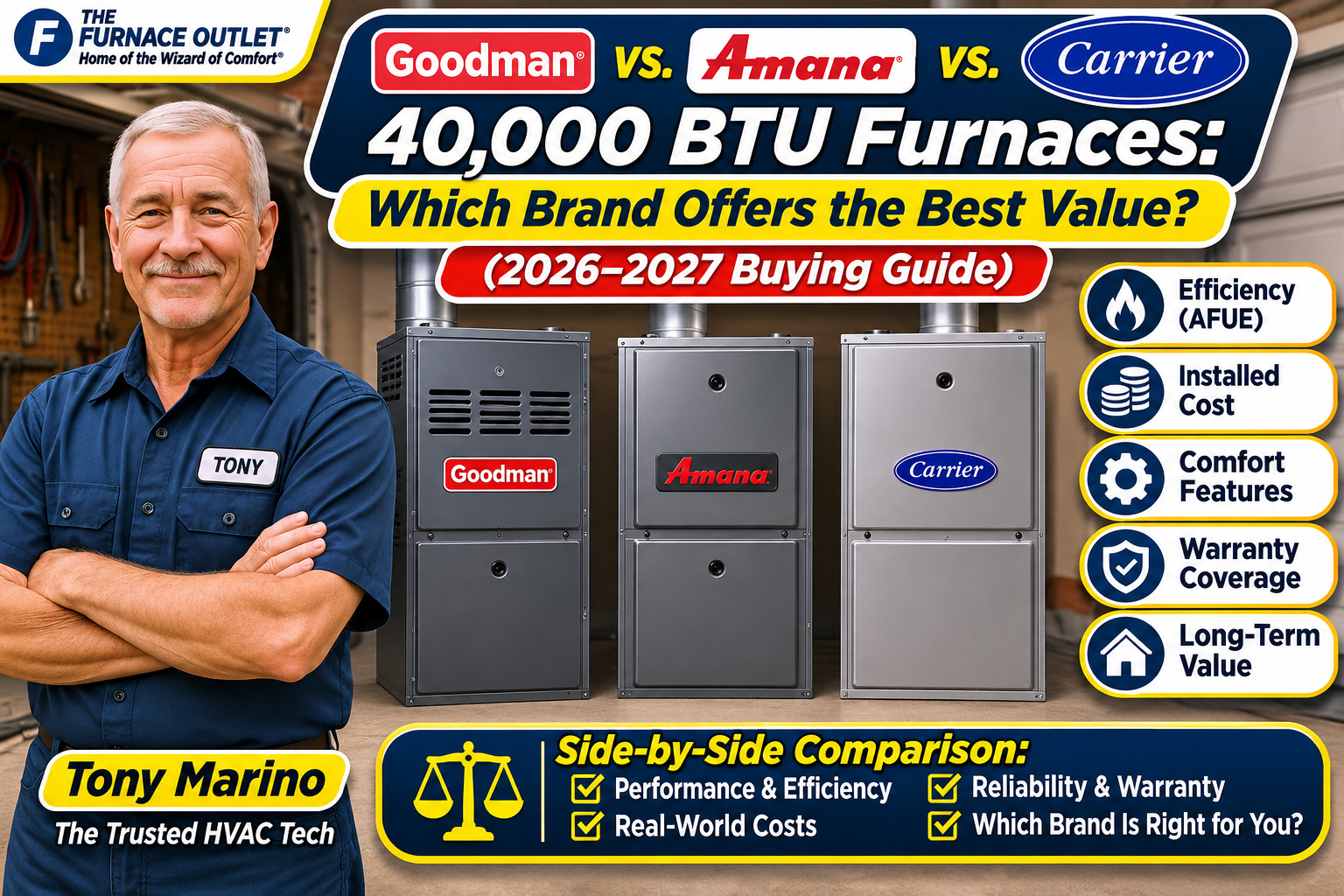
By Tony Marino | The Trusted HVAC Tech | The Furnace Outlet | Updated November 2026
When homeowners compare 40,000 BTU gas furnaces, three names frequently come up: Goodman, Amana, and Carrier. All three offer established heating equipment, but their pricing, comfort features, warranty terms, and product positioning can differ considerably. I’ve spent years working with residential heating systems, and one thing I’ve learned is that a more expensive furnace doesn’t automatically mean better heating. A correctly sized, professionally installed midrange furnace can outperform a premium system that was poorly selected or installed.
Goodman generally appeals to budget-conscious homeowners, Amana emphasizes efficiency and warranty value, and Carrier offers a broad range of conventional and premium comfort technologies. However, those distinctions depend on the exact models being compared. If you’re considering a 40,000 BTU furnace, the most important questions concern heating capacity, AFUE efficiency, operating comfort, installation quality, and long-term ownership costs.
A furnace advertised as 40,000 BTU usually refers to its nominal fuel input capacity, not necessarily the heat delivered into your home. For example, a 40,000 BTU-per-hour input furnace rated at 96% AFUE converts approximately 96% of its annual fuel energy into useful heating. That corresponds to roughly 38,400 BTU per hour of useful heat on an annual-efficiency basis, although actual rated output should be confirmed from manufacturer specifications. A furnace rated at 80% AFUE would provide approximately 32,000 BTU per hour of useful heating from the same nominal input under a simplified comparison.
This difference matters because homeowners sometimes compare equipment based only on the advertised BTU figure. Carrier’s 40,000 BTU furnace guide explains the relationship between heating capacity, efficiency, and equipment selection. Before choosing any brand, have your contractor calculate the home’s heating load using ACCA Manual J or another appropriate professional method.
Goodman has built its reputation around offering practical residential HVAC equipment at competitive prices. Its furnace lineup includes conventional single-stage models as well as more advanced configurations. For a homeowner considering a nominal 40,000 BTU furnace, a model family such as the Goodman GR9S96 provides an example of the brand’s high-efficiency, single-stage approach, with available capacities and configurations depending on the exact model.
The GR9S96 series offers up to 96% AFUE efficiency, a multi-speed ECM blower, and electronic diagnostic controls. According to Goodman’s official gas furnace lineup, the manufacturer also offers two-stage and other configurations for homeowners seeking additional comfort features. Goodman’s biggest advantage is value. A straightforward furnace with an efficient blower and conventional controls may meet the needs of a smaller, well-insulated home without requiring premium equipment pricing. The trade-off is that entry-level models may not provide the same temperature consistency, airflow refinement, or sound control as higher-tier variable-speed systems.
Amana and Goodman are both part of Daikin’s broader HVAC manufacturing organization. Their equipment can share engineering approaches and components, although individual models and warranty packages aren’t necessarily identical. Amana offers high-efficiency gas furnaces with single-stage, two-stage, and more advanced operating configurations across its product lineup. The Amana AMES96 is one example of a single-stage, multi-speed ECM furnace rated at up to 96% AFUE. Its design includes an insulated cabinet, electronic diagnostics, and a stainless-steel secondary heat exchanger.
Amana’s official AMES96 specifications explain these features and the equipment’s efficiency characteristics. Amana can be attractive when a homeowner values a strong manufacturer warranty package and a contractor with good local service support. However, don’t assume every Amana furnace includes the same warranty benefits. Coverage depends on the model, registration requirements, and applicable warranty certificate.
Carrier offers a wider selection of heating technologies across its Comfort, Performance, and Infinity furnace families. Its entry-level and midrange models provide conventional heating options, while premium configurations may include two-stage or modulating gas valves, variable-speed blowers, and integrated comfort controls. A two-stage furnace can operate at a reduced heating level during milder weather and increase output when necessary. Modulating systems can make smaller adjustments to heating output, potentially improving temperature consistency.
Carrier’s high-efficiency furnace comparison identifies models with efficiency ratings reaching approximately 98.5% AFUE in select configurations. However, not every Carrier furnace is available in a 40,000 BTU input size. Homeowners must verify the exact model’s capacity, operating stages, and installation requirements. Carrier’s biggest advantage is its range of comfort technologies, although advanced equipment can increase the initial investment.
All three brands offer high-efficiency gas furnaces, so the difference in annual fuel consumption may be relatively small when comparing models with similar AFUE ratings. For example, a Goodman furnace rated at 96% AFUE and an Amana furnace with the same efficiency rating should have broadly comparable standardized fuel-conversion efficiency.
A Carrier furnace rated at 97% AFUE would use slightly less fuel to deliver the same annual useful heat, assuming comparable operating conditions. However, the difference between 96% and 97% AFUE is only about 1% in fuel consumption for equivalent delivered heating, not a dramatic reduction in utility bills. Homeowners should consider the actual price difference before paying substantially more for a small efficiency improvement. Blower electricity consumption, thermostat settings, ductwork, and local fuel prices also influence total operating costs.
The type of gas valve and blower can affect comfort as much as the furnace’s efficiency rating. A single-stage furnace generally operates at one main heating output. It is relatively straightforward and often less expensive to purchase and maintain. A two-stage furnace can provide lower heat output during moderate weather and switch to higher output when heating demand increases. This may reduce temperature swings and allow longer, gentler heating cycles.
A modulating furnace can adjust heating output more precisely, offering additional comfort potential when properly installed and controlled. Goodman and Amana offer different operating configurations across their ranges, while Carrier’s premium products emphasize advanced comfort control. For a small home with a modest heating load, a properly sized single-stage furnace may be entirely adequate. For homeowners particularly sensitive to temperature fluctuations, a two-stage or modulating model may justify additional consideration.
Furnace noise depends on cabinet insulation, blower design, ductwork, gas-valve operation, and installation quality. Premium variable-speed equipment can provide quieter operation under some conditions because it can operate at lower airflow or heating levels when full capacity isn’t required. However, even an expensive furnace may be noisy if the ductwork is undersized or airflow is restricted.
Amana emphasizes cabinet insulation and sound-reduction features on certain models, while Carrier offers advanced blower technology in selected premium systems. Goodman also provides ECM blower configurations designed for efficient air circulation. I recommend asking contractors about the exact furnace’s published sound characteristics and whether the existing ductwork can support the required airflow.
Installation prices vary substantially by location, furnace efficiency, contractor, and required modifications. For preliminary U.S. budgeting, a conventional 40,000 BTU Goodman gas furnace installation might cost approximately $3,000–$5,500. A comparable Amana installation may fall around $3,500–$6,000, while Carrier equipment may range from approximately $4,000–$7,500 or more.
These are broad illustrative planning ranges, not verified national averages or model-specific retail quotations. Premium two-stage or modulating equipment can exceed these figures, especially when new venting, gas piping, condensate drainage, or ductwork modifications are required. A complete contractor proposal should identify the exact equipment, installation materials, labor, permits, and warranty coverage. The cheapest quotation isn’t necessarily the best investment if essential installation work has been excluded.
Homeowners frequently ask whether Goodman, Amana, or Carrier is the most reliable furnace brand. There isn’t enough consistent, model-specific, independently verified failure-rate information to declare one brand the universal winner. All three manufacturers produce equipment with established heating technologies, and each has different product tiers.
Installation quality, proper airflow, combustion setup, maintenance, and local service availability have a substantial influence on long-term reliability. A furnace that is oversized, poorly vented, or connected to restrictive ductwork may experience unnecessary wear regardless of its manufacturer. I would place more confidence in a skilled installer offering a properly sized furnace and thorough commissioning than in a premium brand name alone.
Warranty protection deserves careful attention because gas furnaces contain components that can be expensive to replace. Goodman and Amana offer limited parts and heat-exchanger warranties on eligible equipment, with additional coverage available for certain models under specified conditions. Carrier also provides limited warranty protection, but exact terms vary by model, registration, and installation circumstances.
Manufacturer warranties frequently exclude labor and diagnostic charges, so a separate contractor labor warranty can be valuable. Before purchasing, ask for the exact warranty certificate, confirm registration requirements, and check whether local contractors can obtain replacement parts promptly.
A 40,000 BTU furnace may be suitable for a smaller home or a well-insulated property in a moderate climate, but square footage alone cannot establish the correct capacity. A tightly insulated home in a relatively mild region may require much less heating than an older, drafty house of similar size in Minnesota or Wisconsin.
Window performance, ceiling height, air leakage, insulation, and outdoor design temperatures all affect the heating load. An oversized furnace can short-cycle and produce uneven temperatures. An undersized furnace may struggle during extreme cold. Before comparing brands, confirm that the proposed 40,000 BTU input model provides sufficient rated heating output for the calculated load.
For homeowners prioritizing affordability, Goodman is a sensible starting point. Its conventional high-efficiency furnaces can provide strong value when paired with professional installation. Amana deserves consideration when its warranty terms, contractor support, and equipment package justify the price difference over a comparable Goodman model. Carrier becomes particularly attractive when homeowners want more sophisticated heating controls, quieter operation, or enhanced temperature consistency from an appropriately sized model.
However, none of these advantages automatically makes one manufacturer the best choice for every household. Compare the exact models, not simply the brands, and evaluate the complete installed price alongside efficiency, comfort features, and warranty coverage.
Is Goodman cheaper than Amana and Carrier? Goodman is generally positioned as a value-oriented brand, although actual installed prices depend on the equipment and contractor. A premium Goodman configuration may cost more than a basic model from another manufacturer.
Are Goodman and Amana furnaces the same? They share a parent manufacturing organization and may use related engineering platforms, but model specifications, features, and warranty terms can differ.
Is a 96% AFUE furnace worth buying? A 96% AFUE furnace can offer meaningful fuel savings compared with an older 80% AFUE unit, particularly in colder climates. Actual savings depend on heating demand and fuel prices.
Can a 40,000 BTU furnace heat a 1,500-square-foot house? Possibly, but only a professional heating-load calculation can determine whether the capacity is appropriate.
Does Carrier offer better reliability? Carrier offers established heating equipment and advanced models, but brand reputation alone doesn’t establish superior reliability for every installation.
If I were choosing between Goodman, Amana, and Carrier for a 40,000 BTU heating application, I would begin with a professional heating-load calculation and compare the exact furnace models that meet the home’s requirements. Goodman would be on my shortlist for straightforward value. Amana would deserve attention for its equipment and warranty package, while Carrier would be worth considering for advanced comfort features. But I wouldn’t pay a large premium simply because one brand is better known. The best furnace is the one that provides sufficient heating capacity, dependable operation, reasonable energy costs, and good local service support without unnecessary expense. Get detailed quotations from qualified contractors, verify the equipment specifications, and make installation quality a major part of your decision.