Newsletter Subscribe
Enter your email address below and subscribe to our newsletter

HVAC made simple
By Jake | The Furnace Outlet | 2025 Buying Guide | Reviewed November 2026
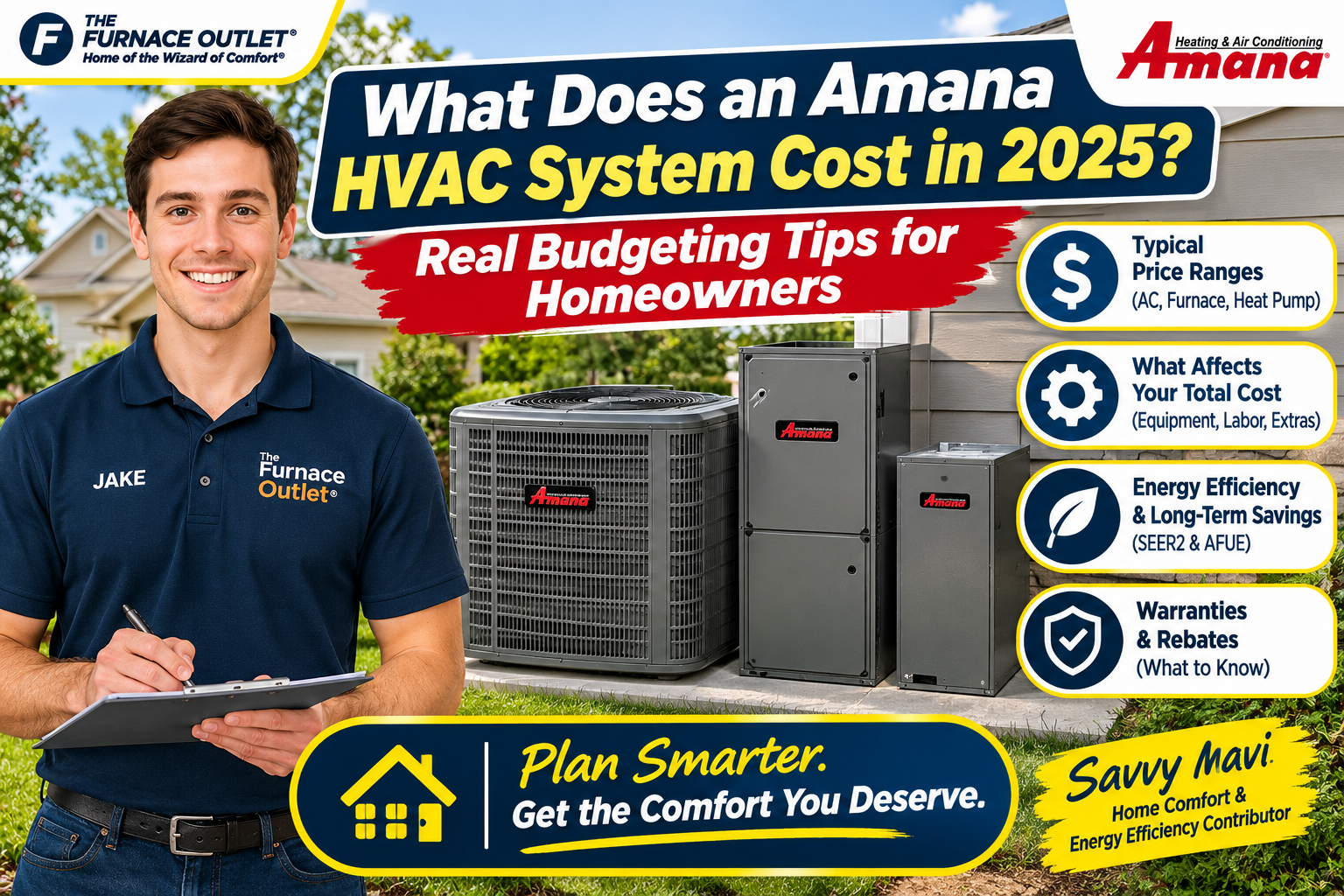
Replacing your home’s heating and cooling system is a major investment, and understanding the complete cost before contacting contractors can save you from unexpected expenses. Amana is an established HVAC brand offering central air conditioners, gas furnaces, and heat pumps, with options ranging from conventional equipment to higher-efficiency systems.
For homeowners planning around 2025 pricing, an Amana central air conditioner typically costs approximately $3,000–$8,000 installed, while a gas furnace may cost $3,500–$8,500. Heat pump installations can range from roughly $5,000–$12,000, and replacing both a furnace and central air conditioner may require $7,000–$15,000 or more.
These are broad U.S. budgeting estimates, not fixed manufacturer prices. Actual costs depend on equipment capacity, efficiency, installation complexity, regional labor rates, and existing ductwork. Amana’s official pricing guidance confirms that the company does not publish a universal installed retail price because every home has different requirements.
Let’s examine where your money goes, which upgrades are worth considering, and how to avoid spending more than necessary.
An Amana central air conditioner is often a practical choice for homeowners who already have a functioning furnace and ductwork but need to replace an aging cooling system. Conventional single-stage models generally have lower purchase prices, while higher-efficiency and variable-capacity systems cost more.
For a straightforward replacement, a standard-efficiency Amana central AC may cost approximately $3,000–$5,000 installed. Midrange systems commonly fall around $4,500–$6,500, while premium equipment can reach $6,500–$9,000 or more, depending on capacity and installation conditions.
These estimates broadly align with published Amana air conditioner pricing research from HomeGuide, although local contractor quotations may differ substantially.
Homeowners should also understand that an outdoor condenser price doesn’t represent the complete cooling system. The indoor evaporator coil, refrigerant connections, electrical work, and installation labor must be included when comparing estimates.
Amana gas furnaces are available in different efficiency categories and operating configurations. Entry-level models typically use simpler heating controls, while premium furnaces may include variable-speed blowers and more sophisticated gas-valve operation. A conventional Amana gas furnace replacement may cost approximately $3,500–$5,500 installed. Higher-efficiency systems often fall between $5,000 and $7,500, while premium installations can exceed $8,500.
The final cost depends on heating capacity, AFUE efficiency, venting requirements, gas piping, and installation accessibility. Replacing an older furnace with a high-efficiency condensing model may require new vent piping and condensate drainage. A high-efficiency furnace can reduce fuel consumption, but the financial benefit depends on winter temperatures, household heating demand, and local natural gas prices.
Heat pumps deserve serious consideration because they provide both heating and cooling. Instead of generating heat through combustion, an air-source heat pump transfers heat between the indoor and outdoor environments. A conventional Amana heat pump replacement may cost approximately $5,000–$7,500 installed, while higher-efficiency equipment can range from $7,500–$10,000. Premium variable-capacity systems or complex installations may exceed $12,000.
These estimates assume relatively straightforward installation conditions. Replacing an entire indoor air handler, modifying ductwork, or installing a dual-fuel configuration can increase the total. A heat pump may be particularly attractive in regions with moderate winters and substantial cooling demand. However, homeowners in colder climates should evaluate low-temperature heating capacity and supplemental heating requirements before choosing a system.
If both your furnace and air conditioner are approaching the end of their useful lives, replacing them together may offer installation efficiencies compared with scheduling two separate projects. For a conventional Amana furnace and central AC combination, homeowners might budget approximately $7,000–$10,000. A midrange matched system may cost $9,000–$12,000, while premium configurations can exceed $15,000.
These figures assume existing ductwork remains usable and major structural modifications aren’t required. Replacing both components together can also simplify equipment matching, thermostat compatibility, and airflow planning. However, replacing a functioning furnace isn’t automatically necessary just because the air conditioner needs replacement. A qualified contractor should evaluate the condition, age, and compatibility of your existing equipment before recommending a complete system replacement.
Two homeowners purchasing similar Amana equipment may receive dramatically different quotations because installation conditions vary. A straightforward replacement with accessible equipment and suitable ductwork usually costs less than an installation involving an attic, crawlspace, outdated electrical wiring, or significant duct modifications.
Labor rates also differ between metropolitan and rural markets. Local permits, inspections, refrigerant piping, condensate drainage, and equipment removal can further affect pricing. Ductwork deserves particular attention because poorly sealed or undersized ducts can reduce the performance of even an expensive HVAC system. Before accepting a quotation, request a written explanation of what is included and which additional expenses could arise during installation.
The purchase price is only one part of an HVAC system’s lifetime expense. Energy consumption can represent a substantial ongoing cost, especially in regions with long cooling or heating seasons. For air conditioners and heat pumps, SEER2 measures seasonal cooling efficiency. Higher ratings generally indicate less electricity consumption for comparable cooling output under standardized conditions.
For gas furnaces, AFUE measures the proportion of fuel energy converted into useful heating. A 96% AFUE furnace converts a greater proportion of its fuel into useful heat than an 80% AFUE furnace. However, higher efficiency doesn’t automatically guarantee the best financial return. A premium system costing $2,500 more but saving only $150 annually would have a simple payback period of approximately 16.7 years.
Homeowners should estimate actual energy savings using their climate, utility rates, equipment efficiency, and expected annual operating hours rather than relying on advertised savings percentages.
One expensive mistake homeowners make is assuming that a larger air conditioner or furnace will provide better comfort. Oversized cooling equipment may cycle frequently, waste energy, and struggle to remove humidity. An undersized system may operate continuously without maintaining comfortable indoor temperatures during extreme weather.
The appropriate equipment capacity depends on insulation, windows, ceiling height, climate, air leakage, and the home’s heating and cooling loads. ENERGY STAR’s heating and cooling guidance recommends professional load calculations and proper equipment matching rather than relying on square footage alone. Ask your contractor to perform a Manual J calculation and explain how the recommended Amana system matches your home’s requirements.
Unexpected installation expenses can quickly change an affordable HVAC quotation into a much larger project. Electrical upgrades, refrigerant-line replacement, condensate drainage modifications, and ductwork repairs are common examples. Older homes may also require changes to venting, gas connections, or equipment platforms. For preliminary planning, homeowners might allow several hundred dollars for minor modifications, while substantial ductwork or electrical upgrades can cost several thousand dollars.
I recommend maintaining a contingency reserve of approximately 10–15% of the quoted installation price, particularly when replacing equipment in an older property. This doesn’t mean you should automatically approve additional work. Every proposed modification should be explained, documented, and priced before installation proceeds.
Warranty protection can influence the long-term value of an HVAC purchase, particularly when comparing equipment with similar installed prices. Amana offers limited parts warranties on eligible equipment, and certain models include additional unit-replacement or heat-exchanger protection subject to specific conditions.
According to Amana’s official warranty information, qualifying coverage may require product registration within 60 days of installation, although state-specific exceptions and other terms apply. Warranty coverage varies by product and shouldn’t be assumed to include labor, diagnostic visits, or every repair expense. Before purchasing, review the exact warranty certificate and ask whether the contractor provides a separate installation labor warranty.
Rebates can make higher-efficiency equipment more affordable, but eligibility depends on the installation date, specific equipment combination, household circumstances, and applicable programs. or qualifying installations completed during 2025, the federal Energy Efficient Home Improvement Credit under Section 25C potentially offered up to $600 for eligible central air conditioners or qualifying furnaces and up to $2,000 for eligible heat pumps, subject to statutory limits and certification requirements.
Those federal credits applied to eligible installations completed by December 31, 2025. They should not be assumed available for new installations in 2026. Homeowners who installed qualifying equipment in 2025 should review their documentation and consult a tax professional about potential eligibility. Utility-company rebates and state energy-efficiency programs may provide additional opportunities, but these vary geographically and can change without notice. Always confirm eligibility before purchasing equipment rather than assuming every high-efficiency Amana model qualifies.
Obtaining at least three detailed quotations is one of the most effective ways to evaluate your HVAC budget. Each proposal should identify the exact Amana model numbers, equipment capacities, efficiency ratings, installation materials, labor scope, permit costs, warranty coverage, and any necessary ductwork modifications.
Ask whether the contractor will verify system airflow, refrigerant charge, electrical operation, and heating or cooling performance after installation. A quotation that includes proper sizing, documented commissioning, and a strong labor warranty may offer better long-term value than a cheaper proposal that leaves essential work unspecified. Avoid making your decision based entirely on the lowest advertised equipment price.
Financing can make an unexpected HVAC replacement more manageable, particularly when the existing equipment fails during extreme weather. However, monthly payment affordability shouldn’t be confused with the total cost of borrowing. For example, financing $8,000 over five years at a hypothetical 9% annual interest rate would produce payments of approximately $166 per month and roughly $1,960 in total interest, assuming a standard fully amortizing loan without additional fees.
Actual financing offers may include promotional rates, deferred-interest provisions, origination fees, or different repayment conditions. Compare the total repayment amount, not just the monthly payment, and ask whether paying cash changes the contractor’s quoted price.
An Amana HVAC system can be a worthwhile investment when the equipment is correctly sized, professionally installed, and matched to your household’s heating and cooling needs. For 2025 budgeting, I would begin with approximately $3,000–$8,000 for central air conditioning, $3,500–$8,500 for a gas furnace, or $7,000–$15,000 or more for a complete furnace and AC replacement.
My recommendation is to prioritize installation quality, efficiency appropriate to your climate, dependable warranty coverage, and realistic long-term operating costs. Premium equipment can provide excellent comfort, but expensive features aren’t automatically the best choice for every household. The smartest investment is the system that delivers dependable performance without creating unnecessary financial strain.
This article provides general educational and budgeting information for U.S. homeowners. Prices are approximate planning ranges rather than guaranteed quotations or verified manufacturer retail prices. Federal incentive information refers to qualifying 2025 installations and may not apply to later purchases. Equipment specifications, warranty conditions, tax eligibility, and installation requirements vary. Always obtain detailed quotations from qualified HVAC contractors and consult appropriate professionals regarding electrical work, refrigerant handling, and tax matters.