Newsletter Subscribe
Enter your email address below and subscribe to our newsletter

HVAC made simple
By Tony Marino (Tony the Trusted Tech)
The Furnace Outlet | Updated October 2026
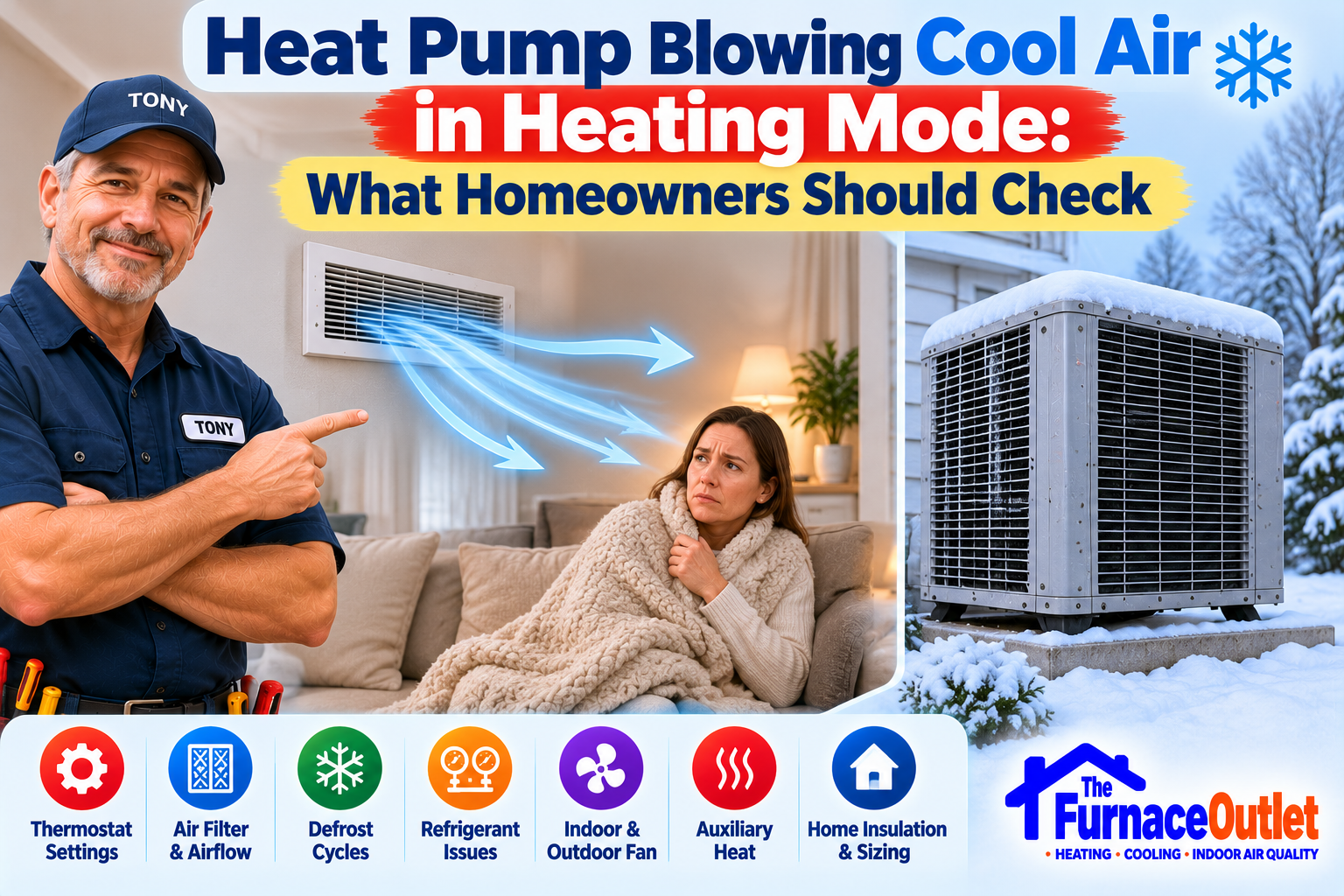
When your heat pump is set to heating mode but the air coming from the vents feels cool, your first reaction may be that something has gone wrong. You expect warm air during winter, particularly when the thermostat is calling for heat. Instead, you may notice a gentle stream of lukewarm air, occasional cold drafts, or supply air that never seems warm enough to raise the indoor temperature. Although these symptoms can indicate a genuine heating problem, they do not always mean the heat pump has failed.
After years of working with residential heating systems, I have found that one of the biggest sources of confusion is the difference between how a heat pump delivers warmth and how a conventional gas furnace operates. A furnace typically supplies noticeably hotter air for shorter periods, while many heat pumps provide moderate-temperature air over longer operating cycles. What feels cool against your skin may still be warm enough to heat the room effectively.
However, there is an important distinction between air that merely feels less hot than expected and air that is genuinely too cool to maintain comfort. Defrost operation, thermostat settings, restricted airflow, auxiliary heating problems, refrigerant abnormalities, and control failures can all influence supply-air temperature. The objective is to identify whether the equipment is operating normally or whether a specific problem is preventing it from delivering adequate heating.
In this guide, I will explain why heat pumps sometimes blow cool air in heating mode, what homeowners can safely check, which symptoms require professional attention, and how HVAC technicians diagnose the underlying cause.
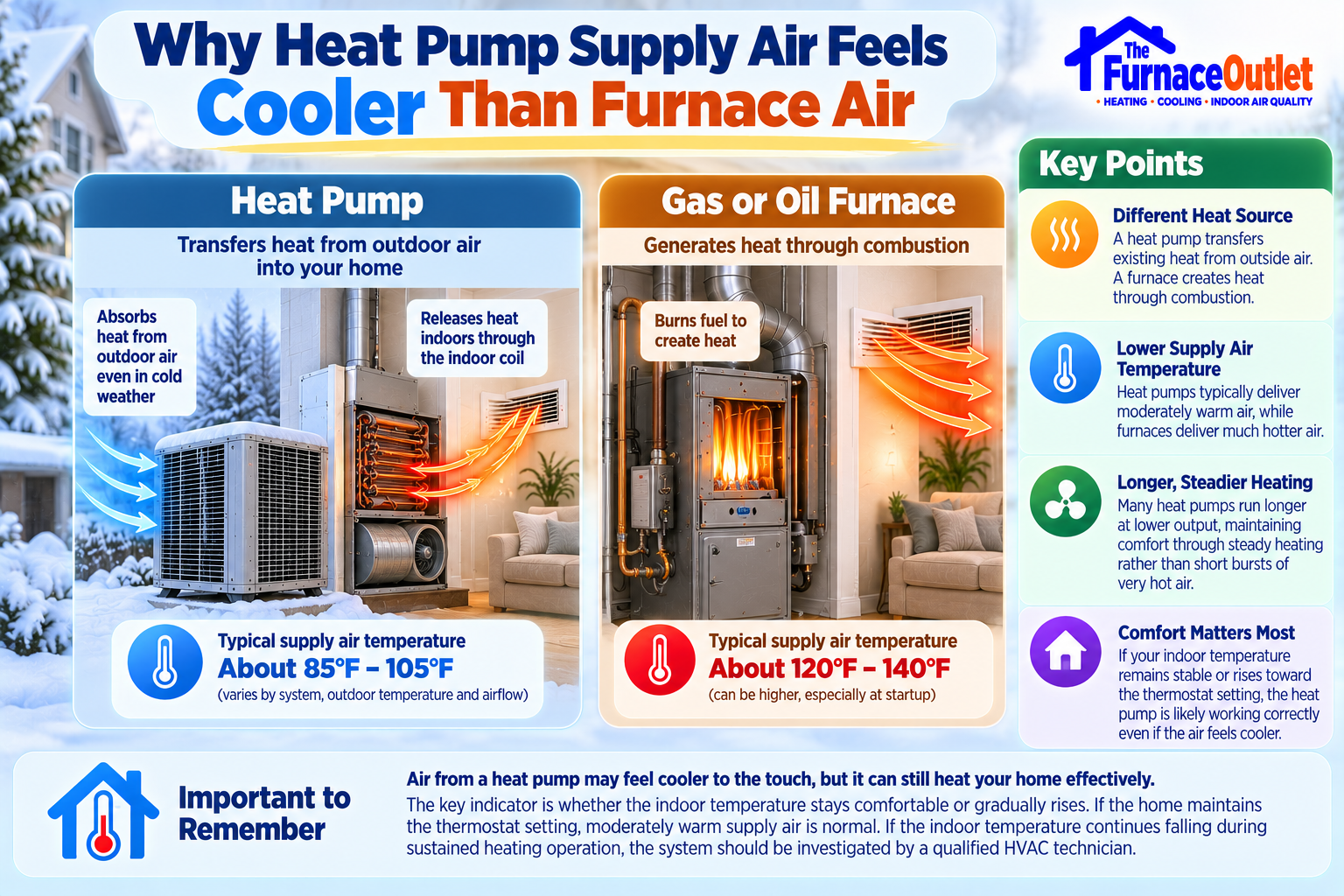
A heat pump does not generate heat through combustion in the same way as a gas or oil furnace. Instead, it transfers thermal energy from outdoor air into the home through a refrigeration system. During heating operation, the outdoor coil absorbs heat from the environment, while the indoor coil releases that heat into the air circulating through the house.
Because this process differs from combustion heating, supply-air temperatures may be lower than those produced by conventional furnaces. Depending on equipment design, operating conditions, and airflow, a heat pump may deliver moderately warm air rather than the intense heat homeowners associate with furnace operation. Modern variable-speed systems can also run for extended periods at reduced output, maintaining comfort through steady heating rather than short bursts of very hot air.
Human perception can make the difference seem more dramatic. Air that is warmer than the room but cooler than skin temperature may feel surprisingly cool when it moves across your hand. Therefore, holding your hand near a supply register is not a reliable way to determine whether the heat pump is heating correctly.
The more meaningful question is whether the indoor temperature remains stable or gradually rises toward the thermostat setting. If the home stays comfortable, moderately warm supply air may be entirely normal. If the indoor temperature continues falling during sustained heating operation, the system deserves further investigation.
The difference between normal operation and inadequate heating is best evaluated through indoor comfort, equipment behavior, and operating conditions rather than supply-air sensation alone. A properly functioning heat pump may produce air that feels only slightly warm while still delivering enough heat to maintain the thermostat setting. This is particularly common with variable-speed systems operating at lower compressor speeds.
A more concerning situation occurs when the thermostat requests heating continuously, but indoor temperature remains below the selected setting or gradually declines. Homeowners may also notice unusually weak airflow, persistent outdoor icing, repeated fault messages, or unexpected changes in compressor and fan operation.
A brief period of cooler supply air during a defrost cycle can also be normal, depending on equipment design. However, air that remains cold long after the system should have returned to heating may indicate a control or performance problem.
I recommend observing the system over a reasonable period rather than judging it from a few seconds at the register. Record the thermostat setting, actual indoor temperature, outdoor conditions, and whether the equipment eventually satisfies the heating demand. These observations provide useful information without requiring homeowners to access hazardous equipment components.
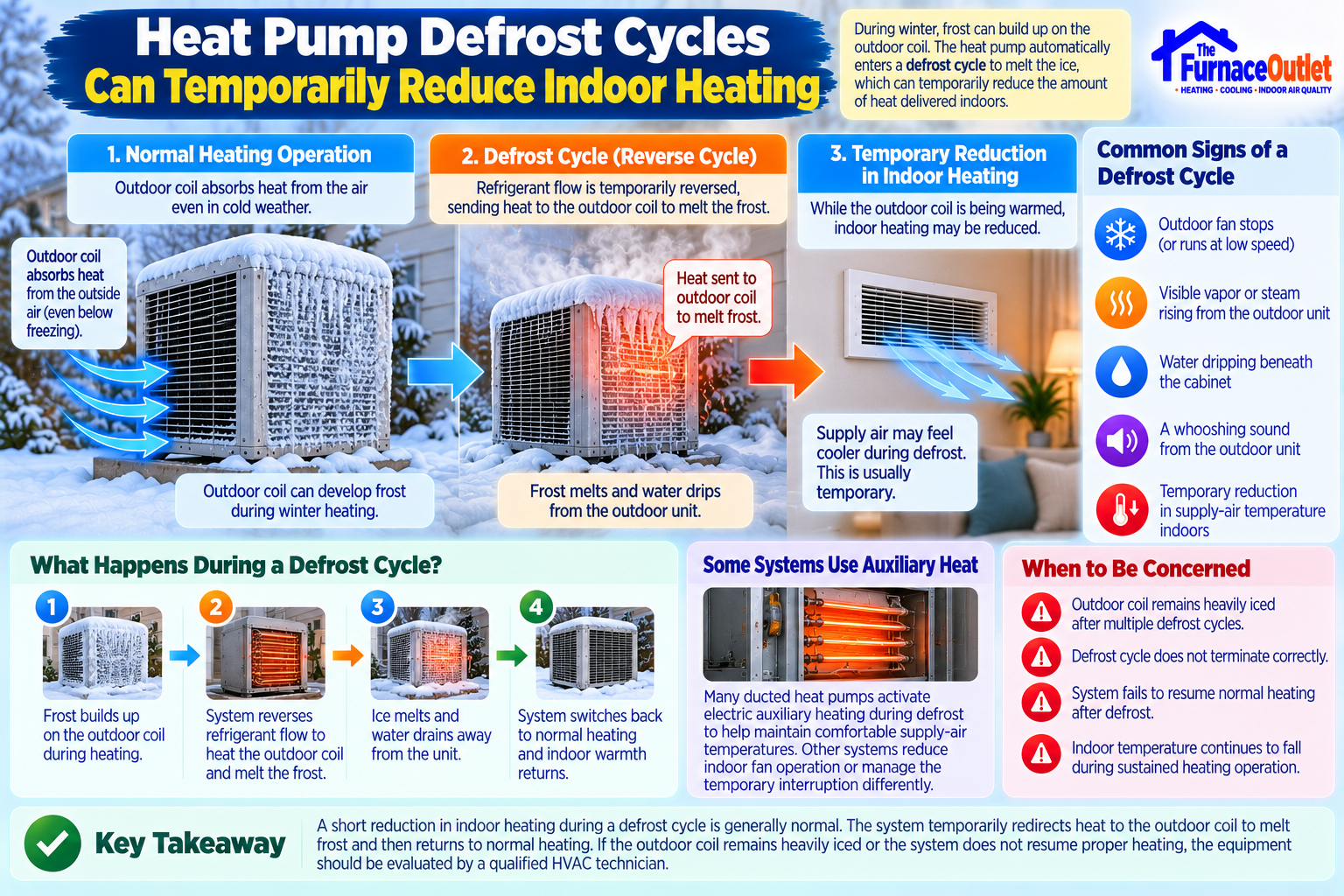
During winter heating, the outdoor coil absorbs thermal energy from surrounding air and may operate below freezing. When moisture in the air contacts the cold coil, frost can develop. A properly functioning heat pump periodically removes excessive frost through an automatic defrost cycle.
Many conventional systems use reverse-cycle defrost, temporarily changing refrigerant flow so heat is directed toward the outdoor coil. This melts accumulated frost and restores efficient heat transfer. However, while the outdoor coil is being warmed, the indoor heat exchanger may provide less heating than usual.
Homeowners sometimes notice a temporary change in supply-air temperature, a whooshing sound from the outdoor equipment, visible vapor rising from the outdoor coil, or water dripping beneath the cabinet. The outdoor fan commonly stops during defrost, although exact sequences vary by manufacturer.
Some ducted systems activate electric auxiliary heating during defrost to help maintain comfortable supply-air temperatures. Others reduce indoor fan operation or manage the temporary heating interruption differently.
A short reduction in indoor heating associated with successful defrost is generally expected. The concern arises when the outdoor coil remains heavily iced, defrost does not terminate correctly, or the equipment fails to resume normal heating afterward.
Before suspecting a mechanical failure, confirm that the thermostat is requesting the intended heating operation. A thermostat set to cooling, fan-only, or an incorrectly configured automatic mode may produce airflow that does not match the homeowner’s expectations.
The fan setting deserves particular attention. When the thermostat fan is set to “ON,” the indoor blower may continue circulating air even when the compressor is not actively heating. During these periods, supply air may feel cool because it is simply room-temperature air moving through the duct system.
Setting the fan to “AUTO,” where appropriate for the installed equipment, generally allows the thermostat or equipment controls to manage blower operation according to heating demand. However, some advanced systems intentionally circulate air for ventilation, filtration, or temperature balancing, so the correct setting depends on the equipment configuration.
Incorrect thermostat programming can also affect reversing-valve commands, heating stages, and auxiliary heat operation. These problems may become apparent after thermostat replacement or control-system changes. Homeowners can verify ordinary user settings, but installer configuration and wiring should be checked by qualified professionals.
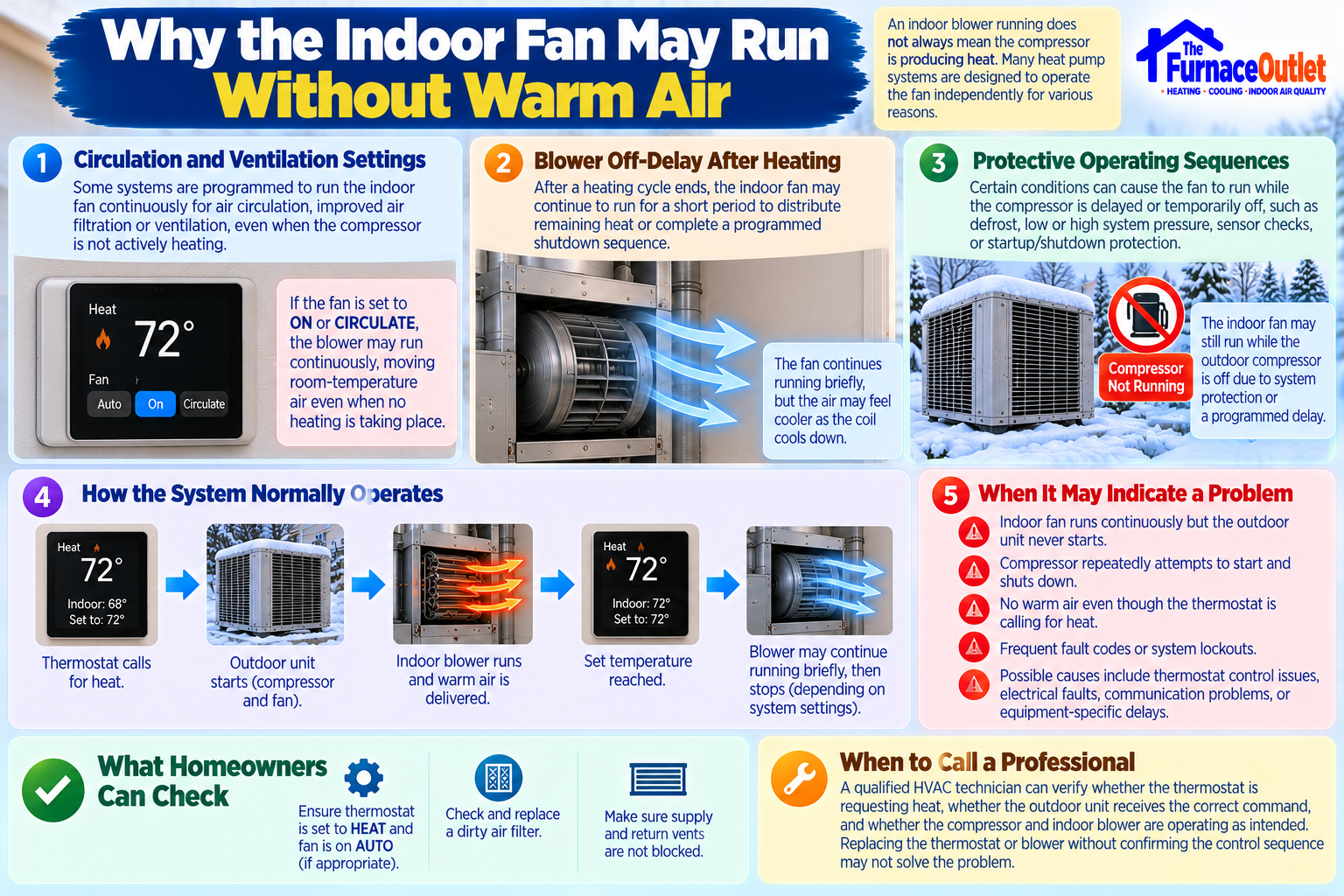
An indoor blower that continues operating does not necessarily mean the compressor is producing heat. Some systems include blower delays, continuous circulation settings, ventilation functions, or protective operating sequences that allow the fan to run independently of active heating.
After a heating cycle ends, the blower may continue briefly to distribute remaining heat or complete a programmed operating sequence. During this period, supply-air temperature can gradually approach room temperature. This behavior may be normal when it matches the manufacturer’s intended controls.
Problems become more likely when the blower runs continuously but the outdoor heat pump never starts during a legitimate heating request, or when the compressor repeatedly attempts to start and shuts down. Possible causes include thermostat control problems, electrical faults, protective lockouts, communication failures, or equipment-specific operating delays.
A technician should determine whether the thermostat is requesting heat, whether the outdoor equipment receives the correct command, and whether the compressor and indoor blower respond as intended. Replacing the thermostat or blower without verifying the control sequence may fail to correct the problem.
A heat pump must move sufficient indoor air across its heat exchanger to distribute heating effectively. A heavily clogged air filter, blocked return-air grille, restrictive ductwork, or malfunctioning indoor blower can interfere with that process.
Restricted airflow may produce uneven room temperatures, weak supply airflow, extended heating cycles, or abnormal refrigeration operating conditions. In severe cases, protective controls may interrupt equipment operation. However, restricted airflow does not always make supply air colder; depending on the system, it can also increase indoor coil temperature and create high-pressure conditions.
This is why a technician should evaluate actual airflow rather than assume that every cool-air complaint originates from a dirty filter. Blower settings, duct restrictions, coil condition, and equipment design all influence heating performance.
Homeowners should inspect accessible filters and maintain them according to manufacturer instructions. Supply registers and return-air openings should remain unobstructed. If airflow remains weak after routine maintenance, professional testing may be needed.
A light frost coating on the outdoor coil is normal during certain winter conditions. However, excessive frost or ice can restrict airflow and reduce the coil’s ability to absorb heat from outdoor air. When heat absorption deteriorates, the system may struggle to maintain adequate indoor heating output.
Defrost sensors, control problems, reversing-valve abnormalities, and refrigeration faults can interfere with frost removal. Outdoor airflow restrictions, snow accumulation, and fan problems may also contribute to abnormal operating conditions.
The location and behavior of ice provide useful clues. Frost distributed across the coil differs from ice concentrated beneath the cabinet, where refrozen defrost water may indicate a drainage problem. A system can defrost correctly while still developing ice around its base because of poor drainage clearance.
If thick ice remains after repeated defrost attempts or reaches the fan assembly, professional investigation is appropriate. Homeowners should never chip ice from the coil, pour boiling water into the cabinet, or reach through the fan grille.
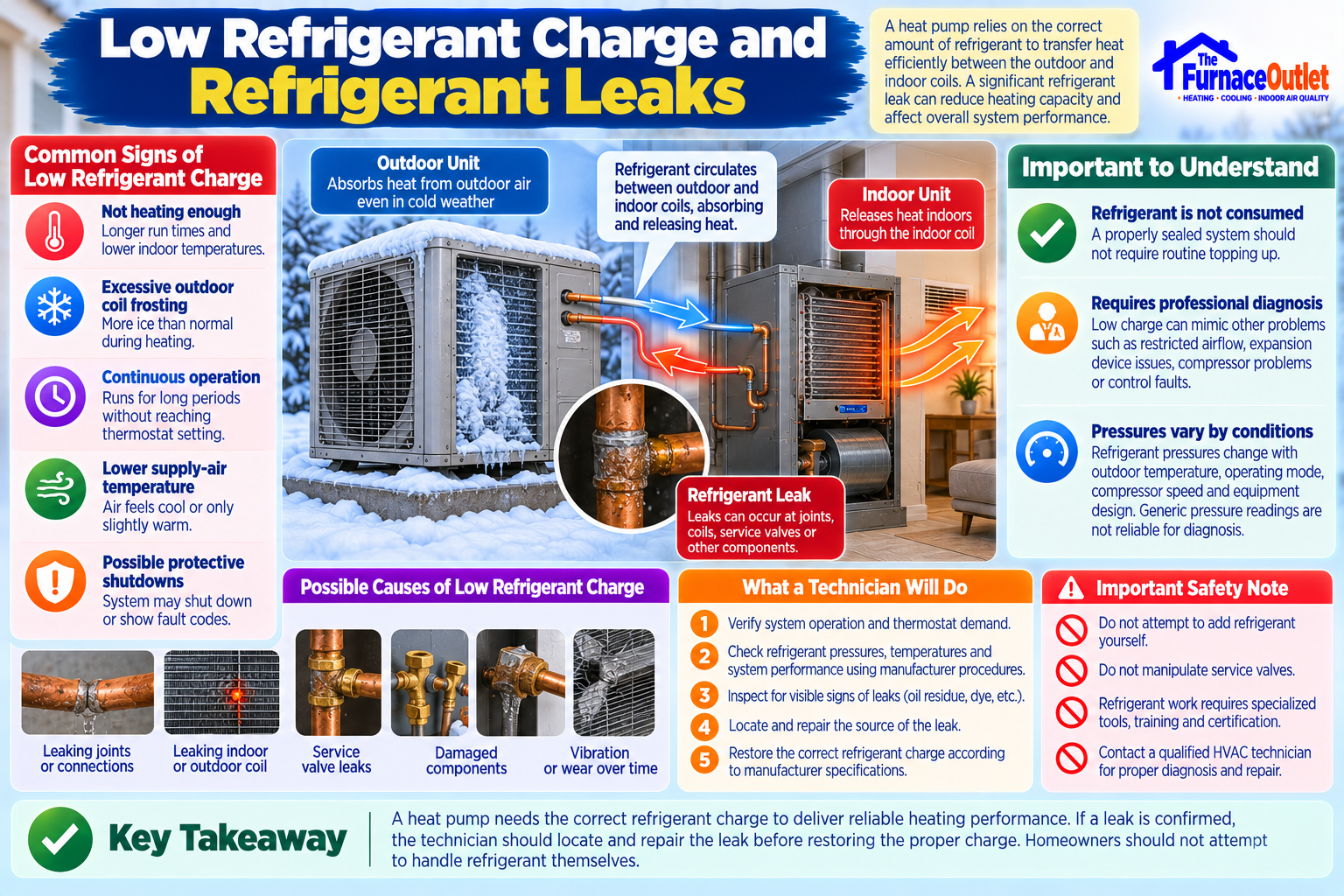
A heat pump requires an appropriate refrigerant charge to transfer heat efficiently. A significant leak can reduce heating capacity and affect the refrigeration system’s pressure and temperature relationships.
Depending on equipment design and operating conditions, insufficient charge may contribute to prolonged heating cycles, inadequate indoor warmth, abnormal coil frosting, or protective shutdowns. However, these symptoms do not establish that refrigerant is low.
Restricted airflow, malfunctioning expansion devices, compressor problems, and incorrect control commands can produce overlapping symptoms. Refrigerant pressures also vary with outdoor temperature, operating mode, compressor speed, and equipment design, so generic pressure readings are not a reliable substitute for manufacturer-specific diagnosis.
Refrigerant is not normally consumed during operation. A properly sealed system should not require routine topping up. If a significant loss is confirmed, the technician should investigate the leak and recommend an appropriate repair before restoring the correct charge.
Homeowners should never manipulate refrigerant service valves or attempt to add refrigerant themselves.
The reversing valve changes refrigerant flow direction so the heat pump can operate in heating or cooling mode. In conventional reverse-cycle defrost systems, the valve also helps redirect heat toward the outdoor coil during frost removal.
If the valve fails to shift correctly, develops internal leakage, or receives an incorrect control signal, heating performance may deteriorate. The system may run without delivering adequate warmth, operate unpredictably during mode transitions, or struggle to complete defrost.
Possible causes include a defective solenoid, damaged wiring, incorrect thermostat configuration, control-board problems, or mechanical valve failure. However, supply air that feels cool does not automatically establish reversing-valve failure.
A qualified technician should evaluate valve commands, electrical conditions, refrigerant temperatures, and operating behavior before recommending replacement. Reversing-valve repairs commonly require sealed refrigeration-system work and should not be authorized without a confirmed diagnosis.
The compressor establishes the pressure difference required for refrigerant circulation and heat transfer. If compressor operation is impaired, the heat pump may deliver inadequate heating even while the indoor blower continues moving air.
Potential causes include internal mechanical damage, electrical supply problems, protective shutdowns, or abnormal refrigeration conditions. Modern inverter-driven systems introduce additional possibilities involving electronic drive modules, sensors, communication circuits, and compressor-speed commands.
A compressor that is not operating correctly may produce fault codes, unusual sounds, intermittent heating, or extended operation without sufficient temperature improvement. However, none of these symptoms alone proves that compressor replacement is necessary.
Before recommending major repairs, the technician should verify the heating request, compressor command, electrical supply, applicable protective controls, and actual refrigeration performance. Compressor replacement can be expensive, so the diagnosis should distinguish compressor failure from electronic control faults or other system problems.
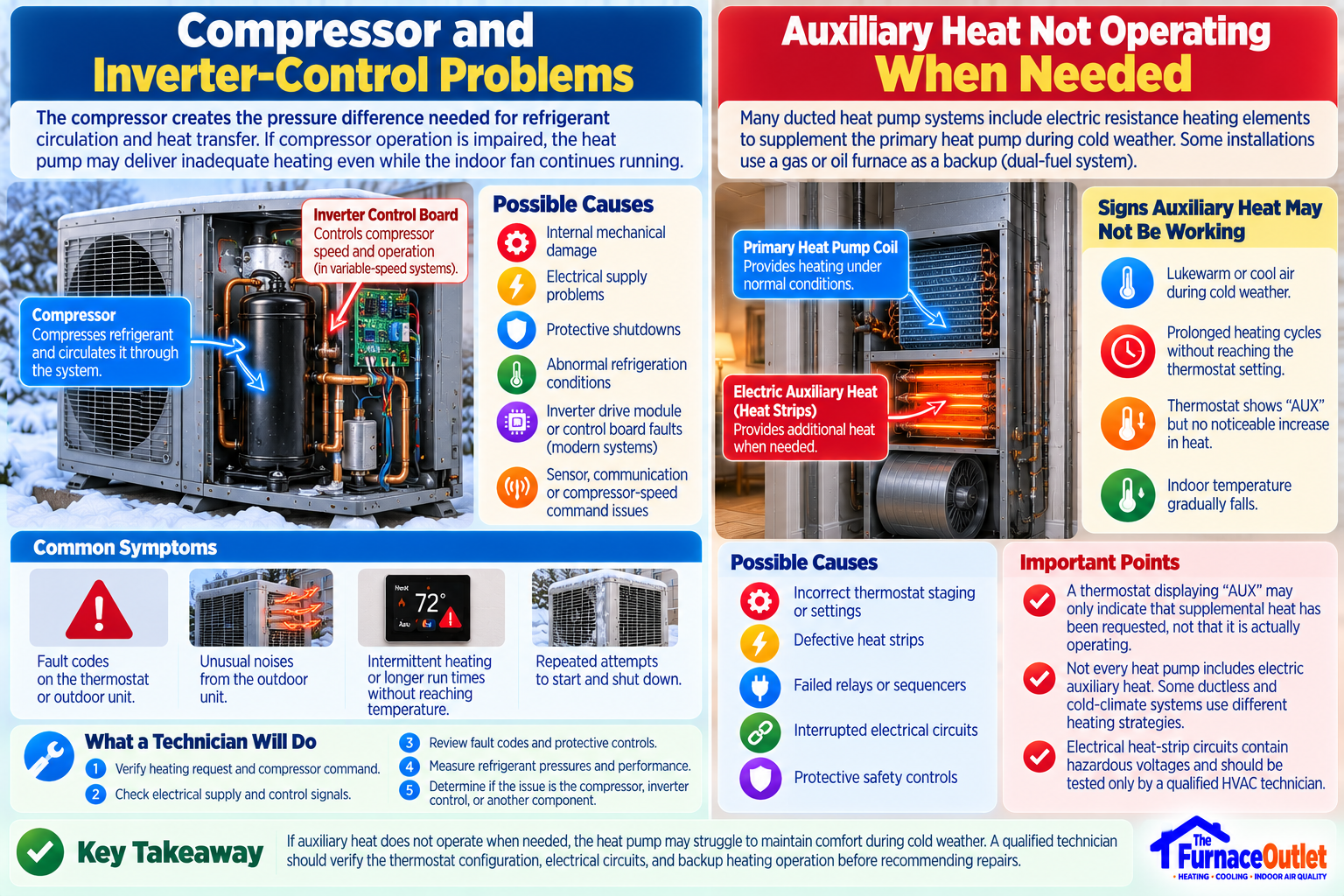
Many ducted heat pump systems include electric resistance heating elements that supplement the primary heat pump during demanding winter conditions. Other installations use a gas or oil furnace as part of a dual-fuel arrangement.
If auxiliary heating fails when additional output is required, the compressor may continue operating while indoor temperature gradually falls. Homeowners may notice lukewarm supply air, prolonged heating cycles, or a thermostat displaying “AUX” without the expected improvement in comfort.
Possible causes include incorrect thermostat staging, defective heat strips, failed relays or sequencers, interrupted electrical circuits, or protective safety controls. However, a thermostat displaying “AUX” may indicate only that supplemental heating has been requested, not that the backup equipment is actually energized.
Not every heat pump includes electric resistance backup. Some ductless and cold-climate installations use different heating strategies.
A qualified technician should identify the installed equipment and verify whether auxiliary heating is expected and functioning correctly. Electrical heat-strip circuits contain hazardous voltages and should never be tested by homeowners.
As outdoor temperatures fall, a home’s heating demand generally increases because more heat escapes through walls, windows, ceilings, floors, and air leaks. At the same time, some heat pumps deliver less heating capacity under increasingly cold conditions.
A system that maintains comfort easily during mild winter weather may struggle during severe cold if its available heating capacity becomes insufficient for the building’s heating load. The compressor may run continuously, and supply air may feel less warm than expected.
However, outdoor temperature alone does not determine whether the equipment should maintain comfort. Cold-climate heat pumps can provide substantial heating output at temperatures well below freezing, while other systems rely more heavily on supplemental heating.
The correct evaluation compares the installed heat pump’s documented low-temperature heating capacity with the home’s actual heating demand. If the equipment is undersized or the building loses excessive heat, repairs to otherwise functional components may not solve the problem.
Sometimes the heat pump is producing its expected heating output, but the home loses heat too quickly to maintain comfort. Inadequate attic insulation, deteriorated weatherstripping, poorly sealed windows, uncontrolled air leakage, and duct losses can substantially increase winter heating demand.
Homeowners may notice drafts near doors and windows, cold rooms, uneven temperatures between floors, or a system that operates continuously without reaching the thermostat setting. These symptoms may become more noticeable during windy weather.
Replacing the heat pump without addressing excessive heat loss may not provide the expected improvement. Appropriate air sealing, insulation upgrades, and duct leakage correction can reduce heating demand and improve comfort.
A qualified energy auditor or HVAC contractor can evaluate building-envelope conditions and determine whether the installed equipment is properly matched to the home’s heating requirements.
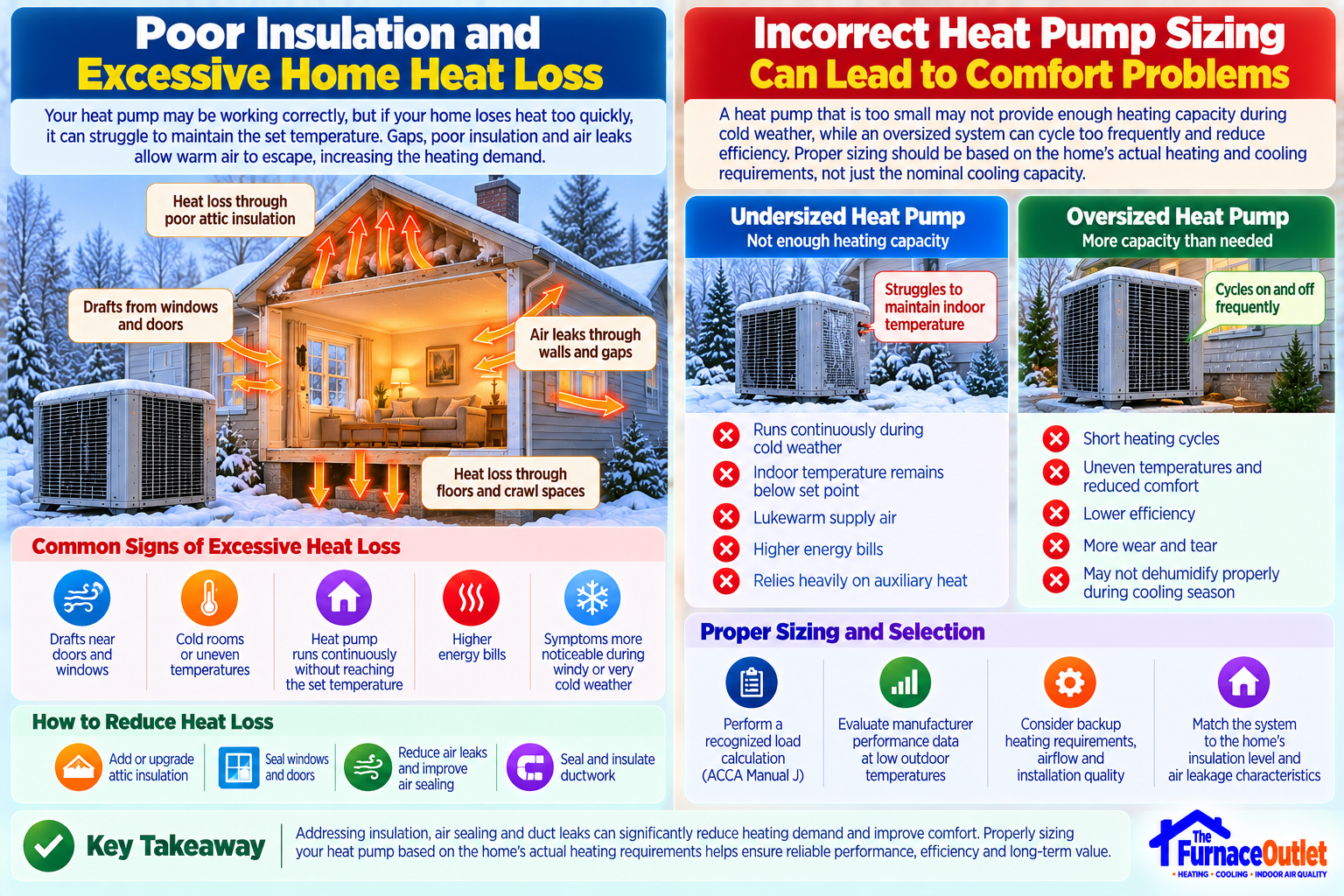
A heat pump that is too small for the home’s actual winter heating load may struggle to maintain the thermostat setting during severe cold weather. Even when every component functions correctly, the equipment may not produce enough heat to replace the energy escaping from the building.
Sizing problems can develop when equipment is selected primarily around nominal cooling capacity without adequate consideration of low-temperature heating performance. Conversely, oversized equipment can create other comfort and efficiency problems, particularly when ductwork and control strategies are not appropriately matched.
Proper equipment selection should involve a recognized load calculation, such as ACCA Manual J, followed by evaluation of manufacturer performance data at relevant outdoor design temperatures.
A contractor should also consider backup heating requirements, airflow, installation quality, and the home’s insulation and air leakage characteristics before recommending replacement equipment.
Some heat pumps include programmed delays that affect compressor, reversing-valve, and indoor blower operation during startup. Depending on the equipment, the blower may begin moving air before the indoor coil reaches its normal heating temperature, creating a brief period of cooler supply air.
Other systems intentionally delay indoor fan operation to reduce uncomfortable drafts. Variable-speed equipment may gradually increase compressor and blower output rather than immediately delivering maximum heating capacity.
A short startup transition can be normal when it matches the manufacturer’s intended operating sequence. However, if the system continues delivering insufficient heat after a sustained heating request, the technician should investigate whether the compressor, reversing valve, thermostat controls, and auxiliary heating are functioning correctly.
The key distinction is between a temporary transition and a persistent inability to deliver adequate heating.
A heat pump that blows mildly warm air while maintaining indoor comfort may be functioning normally. More concerning symptoms include indoor temperature falling despite continuous heating, persistent outdoor icing, repeated protective shutdowns, frequent fault codes, or unusual compressor and fan noises.
A system that repeatedly enters defrost without clearing frost or fails to return to normal heating also deserves professional investigation. Weak airflow, unexpected auxiliary heat behavior, and repeated electrical trips may indicate additional problems.
Electrical warning signs require particular caution. Burning odors, smoke, sparking, or repeated breaker trips may indicate hazards beyond ordinary heating performance deficiencies.
If the equipment develops severe mechanical noises, repeatedly locks out, or shows signs of electrical danger, stop operating the affected system safely according to manufacturer guidance and arrange qualified assistance. Repeatedly resetting protective controls can expose equipment to further damage.
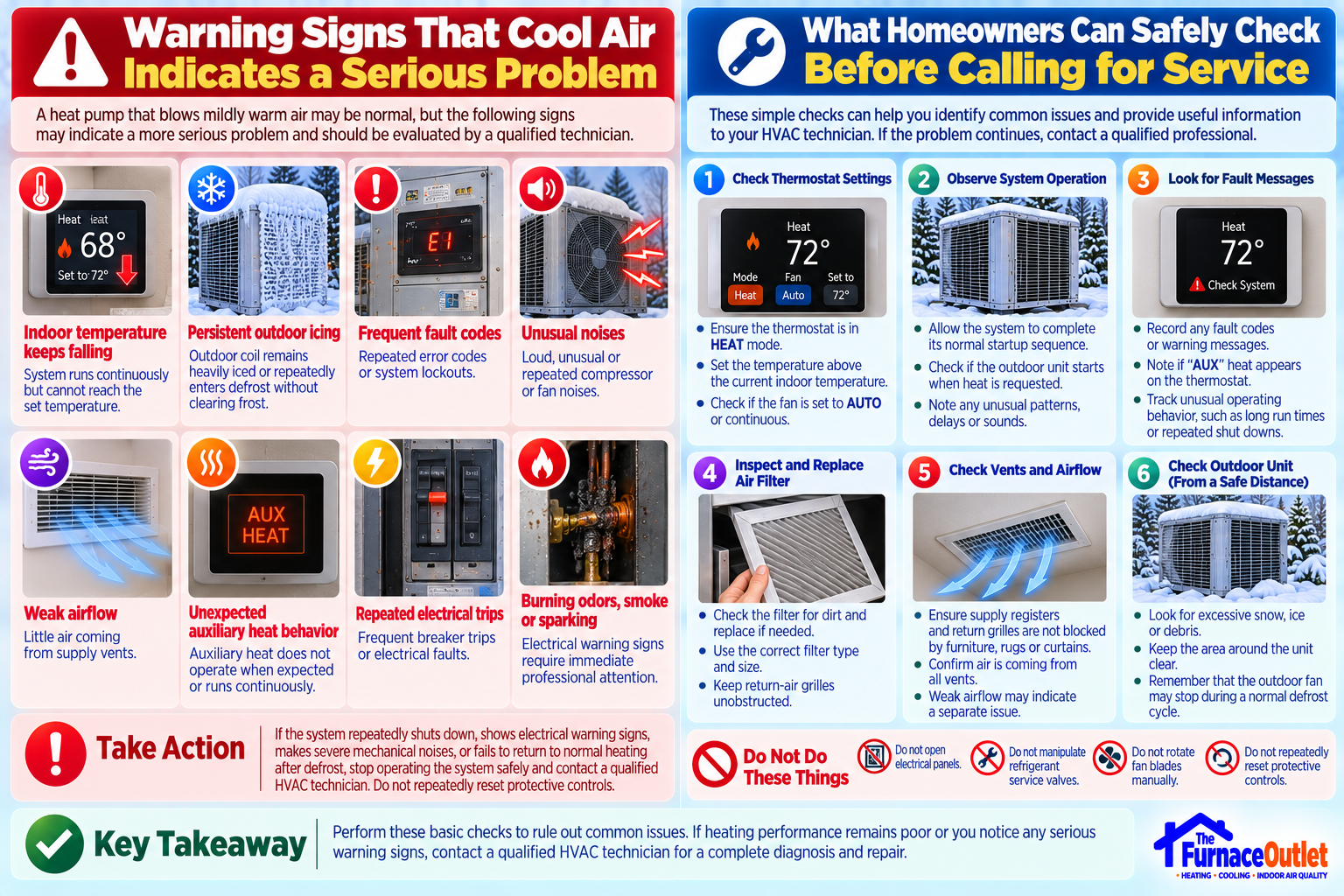
Begin by confirming that the thermostat is set to heating mode and that the selected temperature is above the actual indoor temperature. Check whether the fan is set to “AUTO” or a continuous circulation mode, and observe whether cooler airflow occurs only between heating cycles.
Allow the system to operate through its normal startup sequence and observe whether indoor temperature gradually rises. Record any thermostat fault messages, auxiliary heat indicators, or unusual operating patterns.
Inspect the accessible indoor air filter and maintain it according to manufacturer instructions. Keep supply registers and return-air grilles unobstructed. From a safe distance, check the outdoor unit for excessive snow accumulation, debris, or persistent ice.
Remember that the outdoor fan may stop temporarily during normal defrost. Avoid judging the equipment based on a single brief observation.
Do not remove electrical panels, manipulate refrigerant connections, bypass safety controls, rotate fan blades manually, or repeatedly reset protective faults. If heating performance remains inadequate or electrical warning signs appear, arrange qualified HVAC service.
Professional diagnosis begins with identifying the exact equipment model, thermostat configuration, operating mode, heating stages, and backup heating arrangement. The technician should verify whether the thermostat is requesting heat and whether the equipment responds according to its intended sequence.
Next, the technician evaluates actual heating performance. This may include measuring indoor airflow, assessing supply- and return-air temperatures, reviewing compressor operation, inspecting outdoor fan behavior, and checking defrost status and diagnostic fault history.
If refrigeration performance appears abnormal, relevant pressures, temperatures, compressor operating data, and refrigerant-flow conditions may require evaluation using manufacturer-approved procedures. The technician should also verify reversing-valve operation and auxiliary heating when applicable.
Finally, the available heating capacity should be compared with the home’s actual winter heating demand. The completed diagnosis should distinguish normal heat pump behavior from equipment failure, insufficient capacity, incorrect controls, or excessive building heat loss.
That distinction is essential before authorizing expensive repairs or replacement.
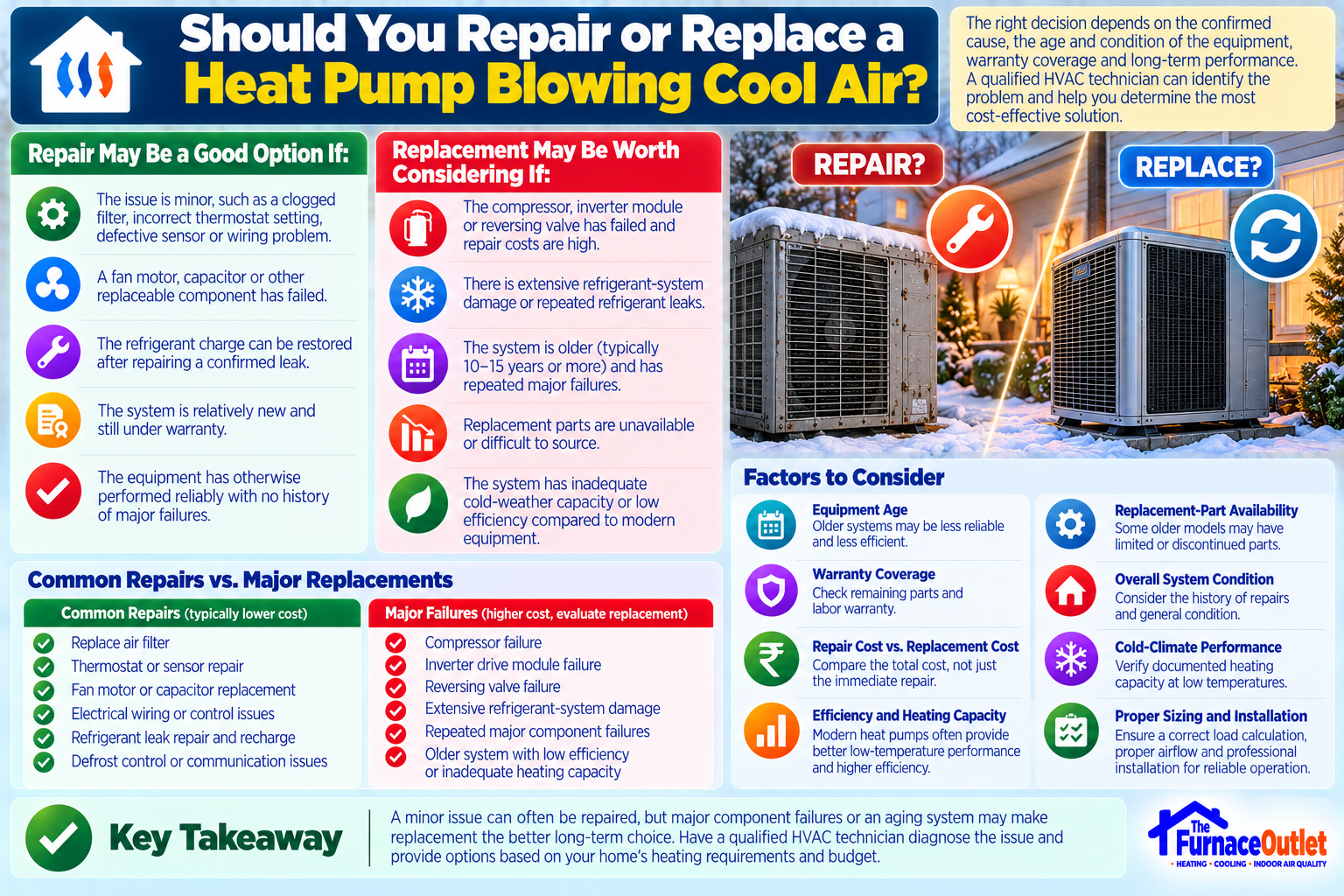
The repair decision depends on the confirmed cause, equipment age, warranty coverage, replacement-part availability, and overall system condition. A clogged filter, incorrect thermostat setting, defective sensor, isolated wiring problem, or replaceable fan component may be corrected without major equipment replacement.
More expensive failures involving a compressor, inverter module, reversing valve, or extensive refrigerant-system damage require a broader assessment. The contractor should also determine whether the original problem caused additional damage.
For relatively new equipment that has otherwise performed reliably, repairing the confirmed fault may be sensible. For older systems with repeated major failures, unavailable components, poor efficiency, or inadequate cold-weather capacity, replacement may deserve consideration.
When selecting new equipment, compare documented low-temperature heating capacity, seasonal efficiency, sound performance, backup heating requirements, and local service support. Proper sizing, installation, airflow, and refrigerant charging are essential to dependable winter operation.
Preventive maintenance cannot eliminate every component failure, but it can reduce avoidable heating problems. Maintain accessible indoor filters, preserve unobstructed supply and return airflow, and keep the outdoor unit clear of excessive snow and debris while following manufacturer-required clearances.
Review thermostat settings and avoid unnecessary large temperature adjustments when the installed system is known to activate electric resistance heating during recovery. Ensure that any installed auxiliary heating system is maintained according to manufacturer recommendations.
Building-envelope improvements can also help. Appropriate attic insulation, air sealing, weatherstripping, and duct leakage correction reduce heating demand and may allow the heat pump to maintain comfort more effectively.
A professional preseason inspection can identify airflow restrictions, defrost problems, thermostat configuration errors, backup heating deficiencies, and other conditions that reduce winter performance. For the 2026–2027 heating season, I recommend addressing recurring comfort problems before prolonged freezing weather arrives.
Yes. Heat pumps often deliver supply air at lower temperatures than conventional furnaces. Air that feels lukewarm may still provide useful heating if it is warmer than the room. The important question is whether the system maintains the thermostat setting and indoor comfort.
During conventional reverse-cycle defrost, the refrigeration system temporarily directs heat toward the outdoor coil to melt frost. This can reduce indoor heating for a short period. Some systems use auxiliary heating or adjust indoor fan operation to maintain comfort.
Possible causes include insufficient heating capacity, restricted airflow, outdoor icing, refrigerant problems, compressor faults, incorrect thermostat configuration, failed auxiliary heating, or excessive building heat loss. A technician should verify actual equipment performance before recommending repairs.
Not automatically. Emergency heat typically substitutes backup heating for normal compressor operation on conventional systems. It may increase energy consumption and should be used according to manufacturer guidance or professional advice, particularly when a heat pump fault has been confirmed.
Yes. A heavily clogged filter can restrict airflow and interfere with heat distribution. However, restricted airflow can affect refrigeration conditions in different ways, so it does not always produce colder supply air. Persistent problems require evaluation of the complete system.
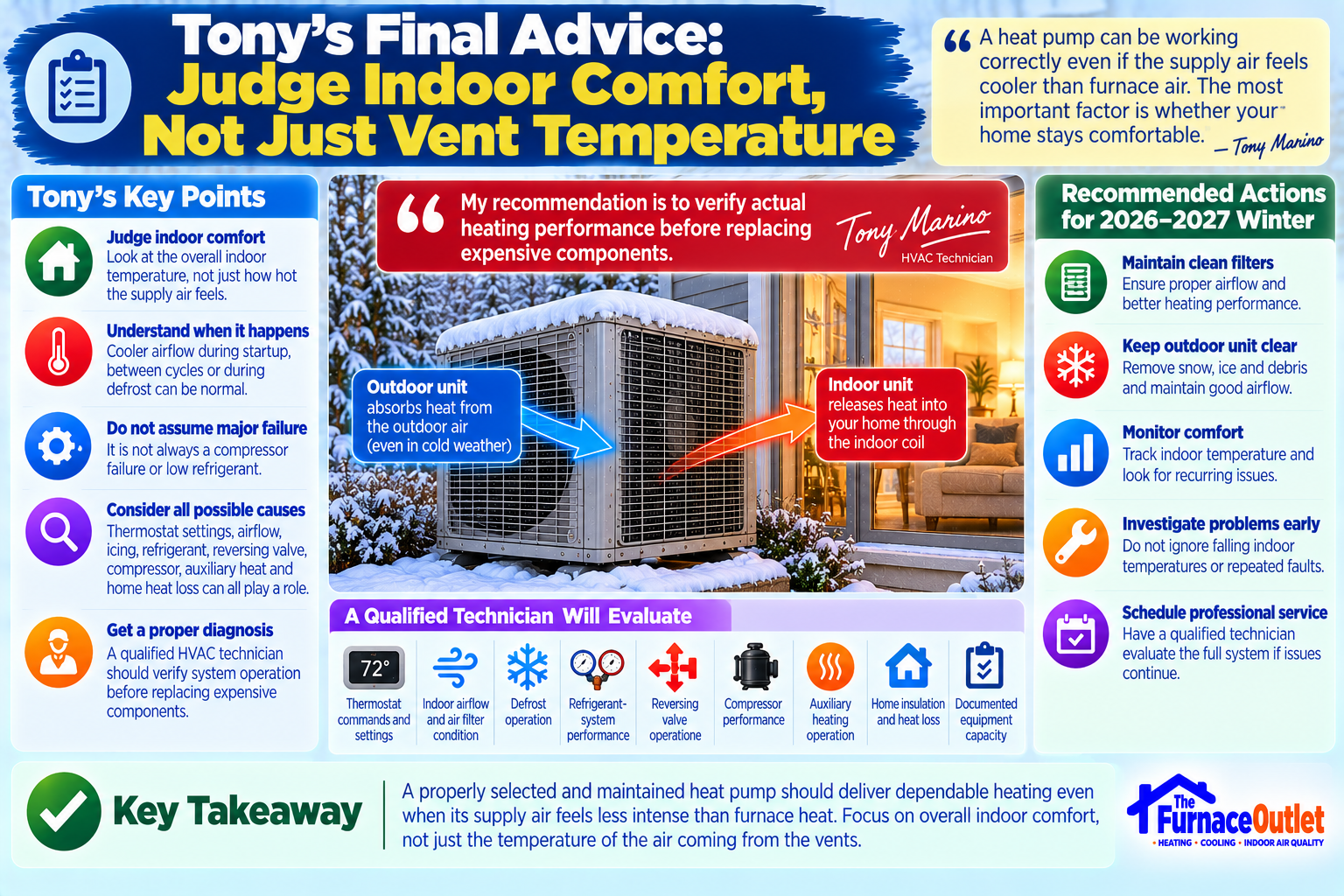
When a homeowner tells me their heat pump is blowing cool air in heating mode, I do not immediately assume the compressor has failed or that the system needs refrigerant. I first want to know whether the supply air is actually colder than the room or simply less hot than the homeowner expects. A heat pump that delivers moderate-temperature air while maintaining indoor comfort may be functioning exactly as intended.
I also want to understand when the cool airflow occurs. A brief change during startup, between heating cycles, or during defrost may be normal. Persistent cool airflow accompanied by falling indoor temperatures requires a different investigation. Thermostat configuration, indoor airflow, outdoor icing, refrigerant conditions, reversing-valve operation, compressor performance, auxiliary heating, and building heat loss can all influence the result.
My recommendation is to verify actual heating performance before replacing expensive components. A qualified HVAC technician should evaluate thermostat commands, airflow, defrost operation, refrigerant-system performance, backup heating, and documented equipment capacity. For the 2026–2027 winter season, maintain clean filters, keep outdoor equipment unobstructed, and investigate recurring comfort problems promptly. A properly selected and maintained heat pump should deliver dependable heating even when its supply air feels less intense than furnace heat.
This article provides general homeowner education and does not replace professional HVAC diagnosis. Heat pumps contain hazardous electrical components, moving fan assemblies, pressurized refrigerant, and manufacturer-specific protective controls. Homeowners should not remove electrical panels, manipulate refrigerant connections, bypass safety devices, or attempt unauthorized repairs. Persistent heating failures, abnormal mechanical operation, and electrical warning signs should be evaluated by qualified professionals.
U.S. Department of Energy — Air-Source Heat Pumps: https://www.energystar.gov/products/air_source_heat_pumps
U.S. Department of Energy — Operating and Maintaining Your Heat Pump: https://www.energy.gov/heat-pumps
ENERGY STAR — Air-Source Heat Pumps: https://www.energystar.gov/products/air_source_heat_pumps
Northeast Energy Efficiency Partnerships — Cold Climate Air-Source Heat Pump List: https://ashp.neep.org/
U.S. Department of Energy — Weatherize Your Home: https://www.energy.gov/cmei/scep/wap/weatherization-assistance-program
These resources provide general information about heat pump operation, maintenance, cold-climate performance, and building energy efficiency. Equipment-specific manufacturer documentation should take priority for operating limits, controls, and service procedures.