Newsletter Subscribe
Enter your email address below and subscribe to our newsletter

HVAC made simple
By Tony Marino (Tony the Trusted Tech) | The Furnace Outlet | Updated October 2026
A heat pump that cools your house perfectly in summer but refuses to deliver heat when temperatures drop can leave you wondering what went wrong. The thermostat is set to heating mode, the outdoor unit may be running, and air is coming through the vents, yet the house remains uncomfortable. In some cases, the equipment continues delivering cool air as though it never received the instruction to change operating modes.
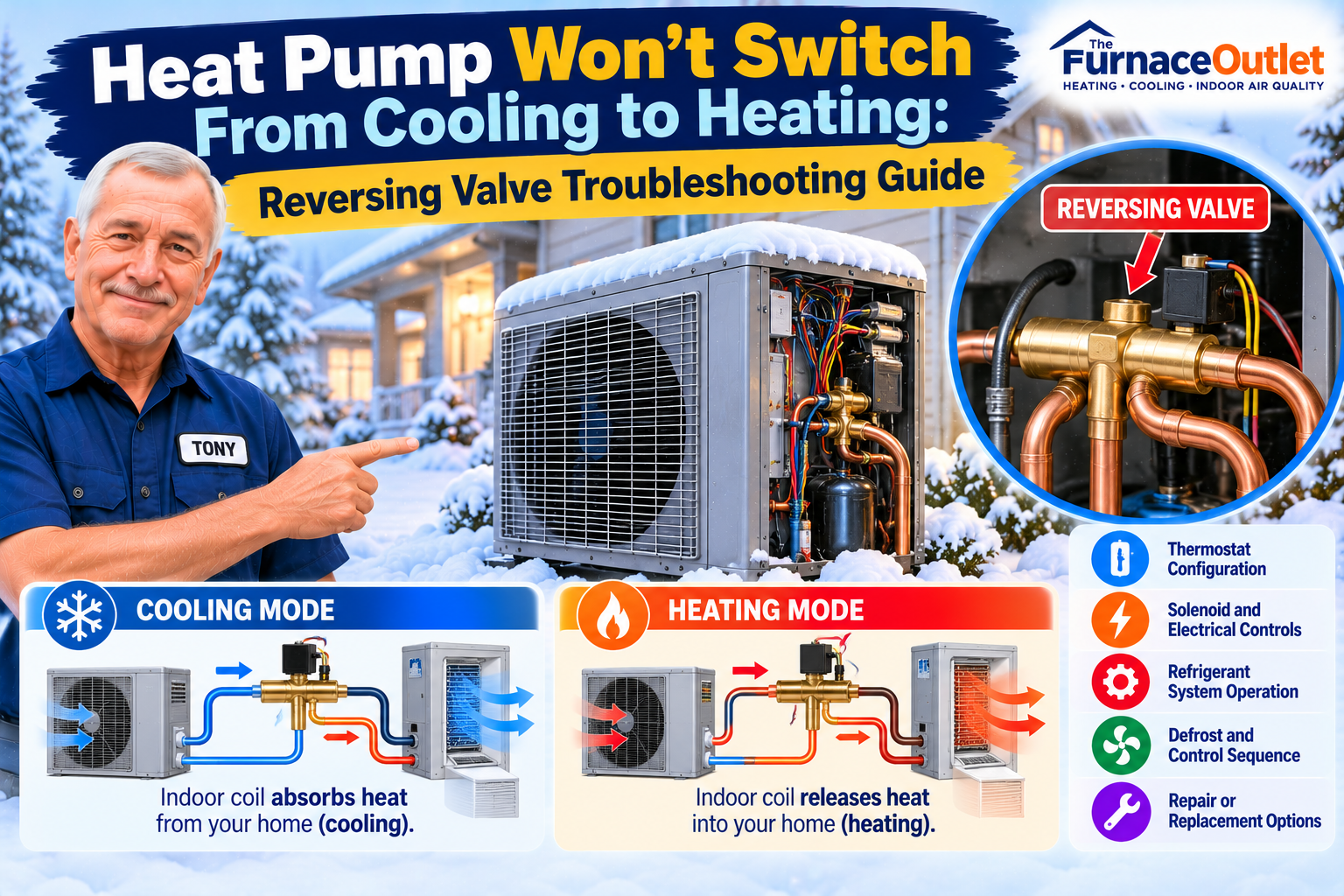
One component that deserves attention is the reversing valve. This relatively small but essential part changes the direction of refrigerant flow, allowing a heat pump to provide both heating and cooling. When the valve or its controls malfunction, the system may become stuck in one mode, switch unpredictably, or fail to produce the expected indoor temperature.
Over the years, I’ve seen homeowners assume that a reversing valve needs replacement simply because their heat pump will not heat. That assumption can become expensive. Thermostat wiring, control boards, defrost operation, low refrigerant charge, compressor performance, and airflow restrictions can produce similar symptoms. A proper diagnosis must establish whether the reversing valve is actually responsible before anyone recommends opening the refrigerant circuit.
In this guide, I’ll explain how a reversing valve works, what happens when it fails, which checks homeowners can perform safely, how qualified technicians diagnose the problem, and when repairing or replacing the valve makes financial sense.
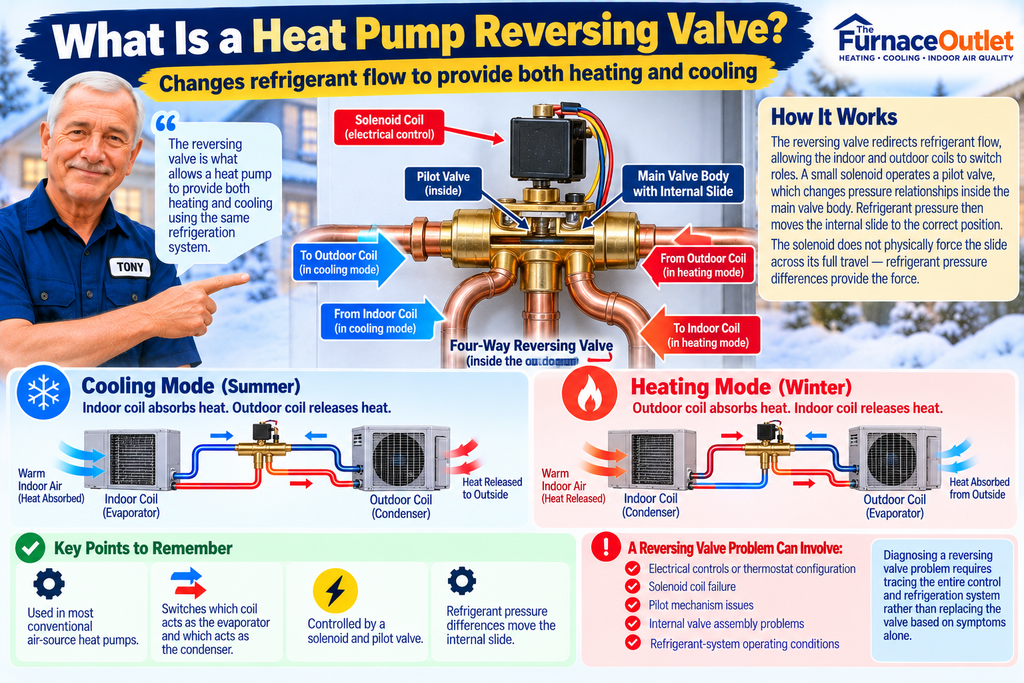
A reversing valve is a refrigerant-flow control component used in most conventional air-source heat pumps. Its primary function is to change which heat exchanger acts as the evaporator and which acts as the condenser. This allows the same refrigeration system to move heat into the home during winter and remove heat from the home during summer.
In cooling mode, the indoor coil absorbs heat from the home’s air while the outdoor coil releases that heat outside. When the heat pump switches to heating mode, refrigerant flow is redirected so the outdoor coil absorbs heat and the indoor coil releases heat into the living space.
Most residential reversing valves use a four-way valve arrangement controlled by a small electromagnetic solenoid and a pressure-operated internal sliding mechanism. The solenoid operates a pilot valve that changes pressure relationships inside the main valve body, causing the internal slide to move into the appropriate position.
An important detail is that the solenoid generally does not physically force the main valve slide across its full travel. Refrigerant pressure differences provide the force needed to reposition the internal mechanism. Consequently, a reversing valve problem may involve the electrical controls, the solenoid, the pilot mechanism, or the internal valve assembly.
This distinction matters because replacing the complete reversing valve is a substantially different repair from correcting a thermostat configuration problem or replacing a defective solenoid coil.
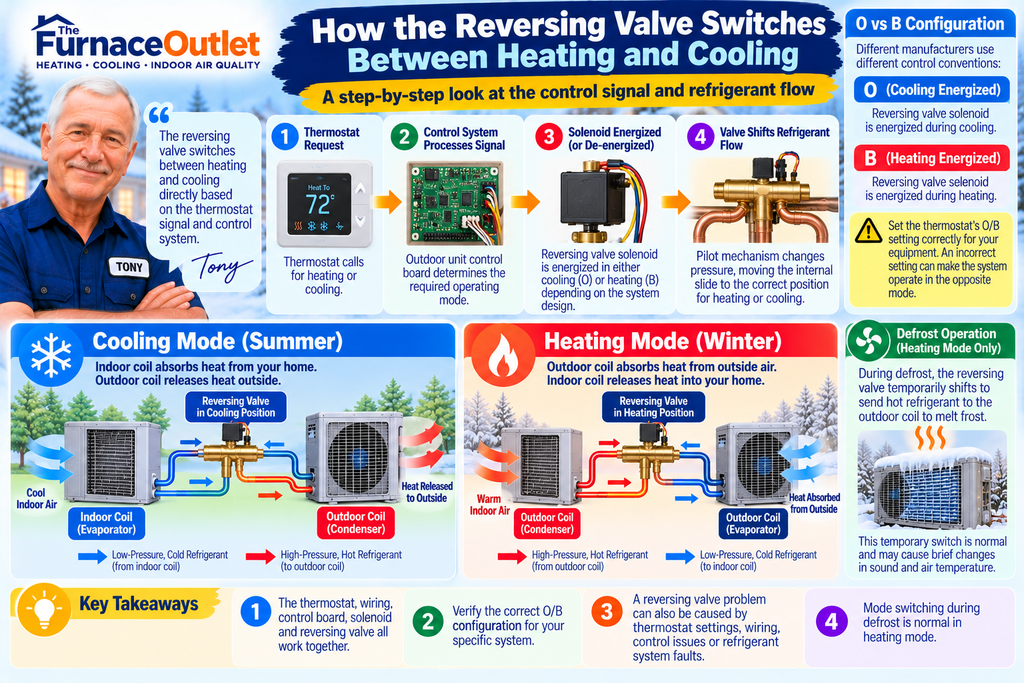
When a thermostat requests heating or cooling, the heat pump’s control system determines the required operating mode. Depending on the equipment manufacturer, the reversing valve solenoid may be energized during cooling or energized during heating.
Many systems use an O control convention, in which the reversing valve is energized during cooling. Other systems use a B convention, in which it is energized during heating. These conventions must not be treated as interchangeable, and the actual manufacturer’s wiring diagram and control instructions always take priority.
For example, if a thermostat is configured for a system that energizes the valve in cooling but the installed heat pump requires energization in heating, the equipment may operate in the opposite mode from the one selected. The homeowner may believe the reversing valve has failed when the actual problem is incorrect thermostat configuration.
Once the correct control signal reaches the valve solenoid, the pilot mechanism changes the pressure arrangement that positions the main slide. Refrigerant then travels through the circuit in the appropriate direction for heating or cooling.
Some systems also shift the reversing valve during defrost. In heating mode, the outdoor coil may accumulate frost, and the controls temporarily redirect refrigerant flow to warm that coil. This can briefly change the sounds and temperatures associated with normal operation.
The critical lesson is that switching between heating and cooling involves more than one component. The thermostat, wiring, control board, solenoid, refrigerant pressure conditions, and main valve must work together.
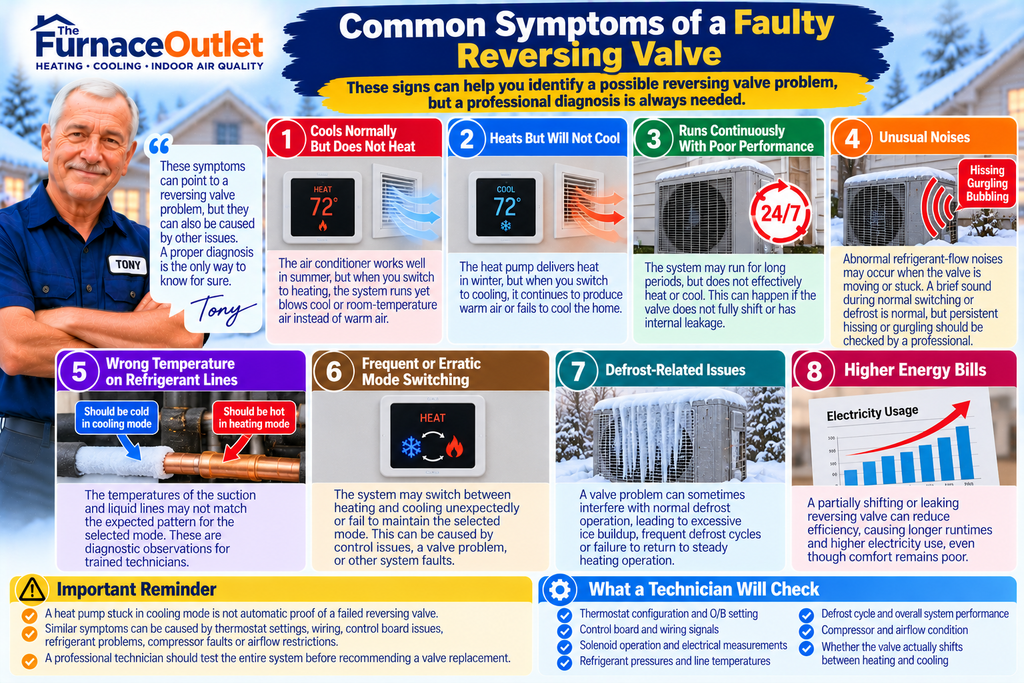
A heat pump with a reversing valve problem may show several recognizable symptoms, but none is conclusive without further testing. One common complaint is that the equipment cools normally but does not heat, even though the thermostat is set correctly. Another is that the system heats but refuses to cool when the operating mode changes.
Some homeowners notice that the heat pump appears to run continuously while delivering little useful heating or cooling. This can happen if the reversing valve does not fully shift or develops internal leakage. However, similar behavior can result from refrigerant problems, compressor faults, or insufficient airflow. Unusual refrigerant-flow noises may accompany a valve movement problem. A brief change in sound during normal mode switching or defrost is not necessarily a defect, but persistent abnormal hissing or performance loss warrants professional investigation.
A malfunctioning reversing valve may also contribute to unusual refrigerant pressure and temperature patterns. These are diagnostic observations for trained technicians rather than symptoms a homeowner can reliably identify from outside the cabinet. The most important warning is that a heat pump stuck in cooling mode is not automatically proof of a failed reversing valve. The fault could exist anywhere in the control or refrigeration system.
Several different faults can prevent a heat pump from delivering warm air after a heating request. Understanding these possibilities helps homeowners avoid unnecessary repairs and gives technicians a more logical starting point.
Thermostat configuration is one of the first things I would investigate, particularly when the problem begins after a thermostat replacement, wiring change, or equipment upgrade. Many modern thermostats require the installer to specify the heat pump type, reversing valve energization mode, and supplemental heating arrangement.
If the O/B setting is incorrect, the thermostat may send the wrong reversing valve command. The result can be heating when cooling is requested, cooling when heating is requested, or unexpected behavior during mode changes. The appropriate correction is to verify the thermostat configuration against the heat pump manufacturer’s documentation. Homeowners should not randomly swap thermostat wires or change installer settings without confirming the required configuration.
The solenoid coil is responsible for operating the pilot mechanism that directs the valve’s internal movement. If the coil becomes electrically open, shorted, disconnected, or otherwise defective, the reversing valve may not receive the command needed to shift.
A failed solenoid can sometimes be repaired without replacing the entire reversing valve body. Whether that is possible depends on the exact valve design, accessibility, and manufacturer service instructions. Technicians may check the specified control voltage and coil electrical characteristics using appropriate instruments. These tests involve electrical hazards and should not be performed by untrained homeowners.
The internal sliding mechanism may fail to move as intended because of mechanical wear, contamination, damage, or unfavorable operating conditions. A valve that remains stuck may leave the system operating in the wrong mode even when the control signal is correct.
A mechanically stuck valve can be more difficult and expensive to repair than a solenoid fault. In many cases, replacement of the complete valve assembly becomes necessary once the diagnosis is confirmed. However, technicians should establish that adequate pressure differential and proper control operation are present before concluding that the internal valve is defective.
A heat pump control board processes operating requests and coordinates components such as the compressor, outdoor fan, reversing valve, and defrost controls. A failed relay, damaged wiring connection, or defective board output may prevent the reversing valve from receiving the proper signal.
Corrosion, loose connections, damaged insulation, or prior wiring modifications can also interrupt the circuit. In such cases, replacing the reversing valve would not solve the original problem. Professional diagnosis should trace the command from the thermostat through the relevant controls to the solenoid, following the manufacturer’s wiring diagram.
A heat pump may fail to deliver adequate heat because the refrigeration system cannot maintain the pressure and temperature conditions needed for normal operation. Low refrigerant charge, refrigerant restrictions, compressor problems, or other faults may produce poor heating performance.
Because the reversing valve’s main slide depends on refrigerant pressure relationships, certain system conditions can also interfere with proper shifting. The exact behavior depends on the valve and equipment design. Technicians should evaluate the complete refrigeration circuit rather than treating every heating failure as a valve problem. Refrigerant handling must comply with applicable regulations and manufacturer procedures.
During winter, a heat pump may temporarily change operating mode to defrost its outdoor coil. Depending on the system, the outdoor fan may stop and supplemental heat may activate while the coil warms.
A homeowner who notices a brief period of cooler supply air may mistake normal defrost for a reversing valve malfunction. The distinction is whether the system returns to normal heating afterward and maintains the desired indoor temperature. A unit that remains in an abnormal defrost state, repeatedly cycles through defrost, or fails to resume heating requires professional assessment of the controls, sensors, and refrigerant circuit.
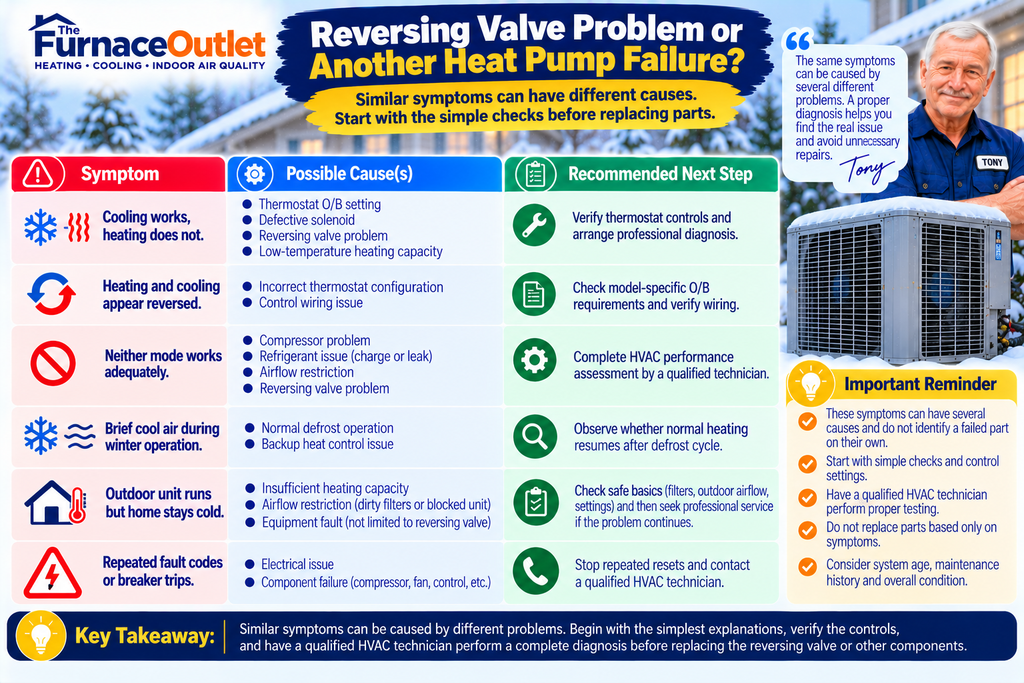
Because several faults can produce similar symptoms, diagnosis should begin with the simplest explanations and progress toward component-level testing.
| Symptom | Possible cause | Recommended next step |
|---|---|---|
| Cooling works, heating does not | Thermostat O/B setting, solenoid, valve, or heating-capacity problem | Verify controls and arrange diagnosis |
| Heating and cooling appear reversed | Incorrect thermostat configuration or control wiring | Check model-specific O/B requirements |
| Neither mode works adequately | Compressor, refrigerant, airflow, or valve problem | Complete HVAC performance assessment |
| Brief cool air during winter operation | Normal defrost or backup heat issue | Observe whether normal heating resumes |
| Outdoor unit runs but home stays cold | Insufficient capacity, airflow restriction, or equipment fault | Check safe basics, then seek service |
| Repeated fault codes or breaker trips | Electrical or equipment failure | Stop repeated resets and contact a technician |
This comparison is intended to organize troubleshooting, not identify a failed part from symptoms alone.
Before scheduling a major repair, there are several observations and checks homeowners can make without opening the equipment or touching refrigerant components.
Start by confirming that the thermostat is set to HEAT rather than COOL, AUTO, or OFF. Set a reasonable target temperature above the current indoor temperature and allow for the manufacturer’s normal startup or compressor-protection delay.
If the thermostat was recently installed or reprogrammed, make a note of that history. A configuration issue becomes more likely when the problem begins immediately after a control change. Avoid repeatedly switching between heating and cooling in rapid succession. Heat pumps may use protective delays, and repeated commands can make the system’s behavior harder to interpret.
Inspect the accessible air filter and replace or clean it if required by the manufacturer’s maintenance instructions. A heavily restricted filter can reduce airflow and make heating performance worse, even when the reversing valve is functioning correctly.
Make sure supply and return registers are not blocked by furniture, rugs, or stored belongings. Restricted airflow can affect heat transfer and create comfort problems that resemble equipment faults. If the system uses a ductless indoor unit, check accessible filters according to the manufacturer’s instructions and ensure that airflow is not obstructed.
Look for obvious snow buildup, blocked airflow, unusual ice accumulation, or visible damage. During normal winter operation, some frost and occasional defrost water can be expected.
Do not remove service panels, reach into the fan compartment, or attempt to free a stuck component. If the outdoor unit is heavily iced over or making unusual mechanical noises, arrange professional service.
Modern heat pumps and communicating thermostats may display fault codes or operating alerts. Record the exact message and consult the homeowner documentation for its meaning.
Also note whether the problem started after a power outage, thermostat replacement, electrical work, or maintenance visit. These details can help the technician identify control-related problems more quickly.
If the system repeatedly trips a breaker, produces a burning smell, develops loud mechanical noises, or shows signs of electrical damage, discontinue operation when safe and contact a qualified technician.
Homeowners should not apply external power to the reversing valve, bypass controls, manipulate refrigerant lines, or attempt to move the internal valve mechanism.
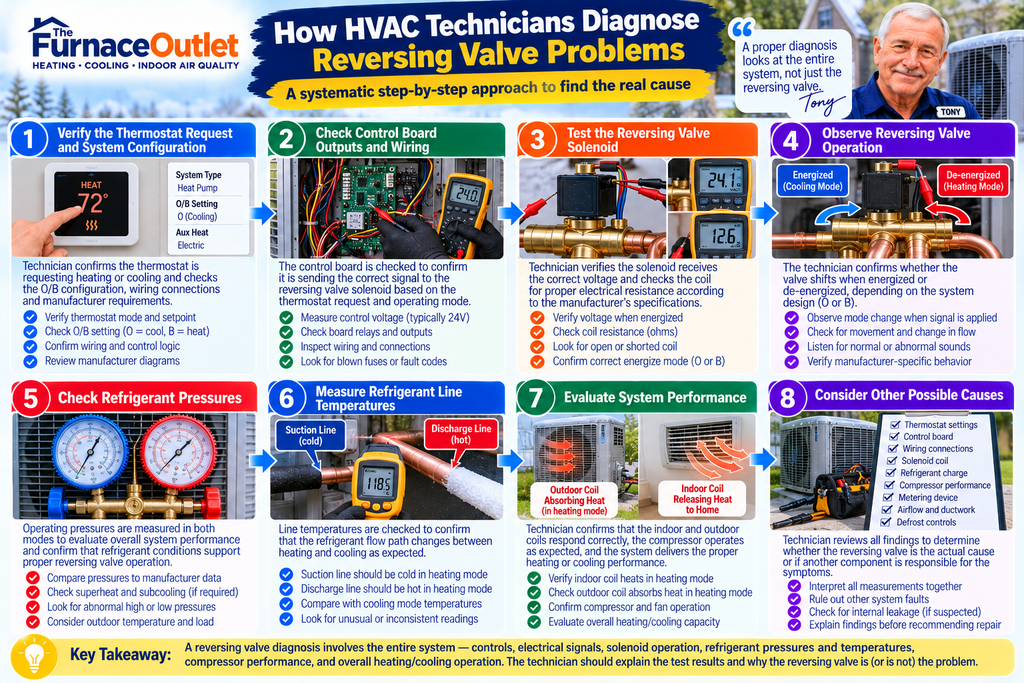
A professional reversing valve diagnosis should follow a systematic sequence. The goal is to determine whether the valve is receiving the correct command, whether its pilot and main mechanisms respond properly, and whether the refrigerant circuit supports normal operation.
First, the technician verifies the thermostat request and the manufacturer’s required reversing valve control logic. The O/B convention, control-board outputs, wiring connections, and any communicating control functions must be understood before interpreting electrical measurements.
Next, the technician checks the solenoid circuit using manufacturer-specified procedures. Depending on the design, this may involve confirming the presence or absence of the correct control voltage and evaluating the solenoid coil for electrical faults.
The technician then assesses whether the reversing valve actually changes the refrigerant flow path. This can involve observing refrigerant-line temperature relationships, operating pressures, compressor behavior, and the response of the indoor and outdoor heat exchangers.
These measurements must be interpreted together. A single pressure reading or pipe temperature does not conclusively establish that a reversing valve is defective. Refrigerant charge, compressor efficiency, metering-device operation, outdoor conditions, and system operating state can influence the results.
If the control signal and solenoid operation are correct but the valve does not shift, the technician may investigate the internal mechanism and pressure conditions. If the valve shifts but allows excessive internal leakage, heating and cooling performance may remain poor.
I would expect a qualified contractor to explain which observations support the diagnosis before recommending a major valve replacement. The customer should understand why the fault is attributed to the reversing valve rather than a cheaper control component or another refrigeration-system problem.
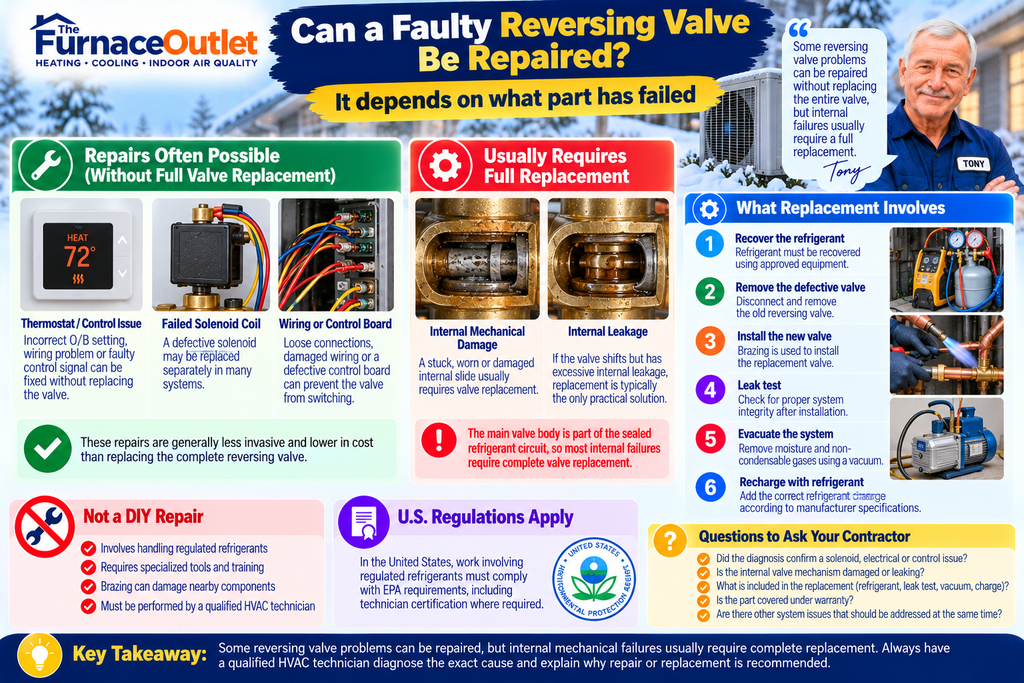
Whether a reversing valve can be repaired depends on which part has failed. A damaged thermostat connection, incorrect control setting, or failed solenoid may be correctable without replacing the complete valve assembly. These repairs are generally less invasive than removing and replacing the main refrigerant valve.
A mechanically damaged or internally leaking reversing valve presents a different situation. Because the main valve body is part of the sealed refrigerant circuit, replacement usually involves refrigerant recovery, removal of the defective component, installation of a compatible replacement, leak testing, evacuation, and refrigerant charging according to the manufacturer’s procedures.
Valve replacement also requires careful temperature management during brazing to protect nearby components. This is not a homeowner repair. In the United States, work involving regulated refrigerants must be performed in compliance with applicable EPA requirements, including technician certification where required.
Before approving replacement, ask the contractor whether the diagnosis confirms an electrical solenoid failure, an internal mechanical failure, or excessive internal leakage. These conditions can have very different repair implications.
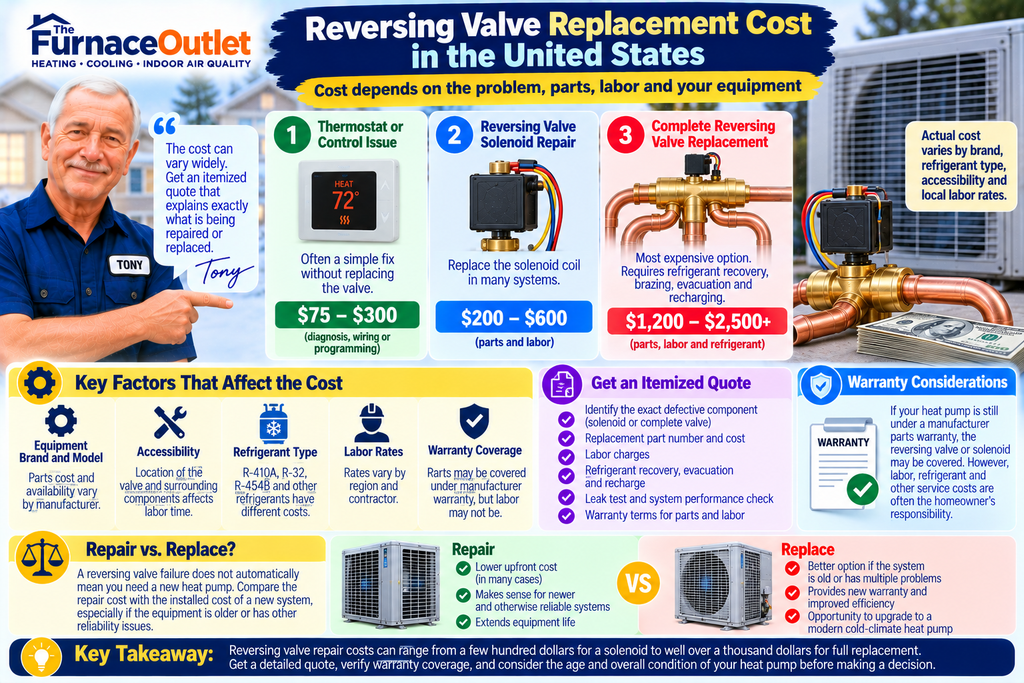
The total cost of reversing valve service depends on the equipment design, accessibility, labor rates, refrigerant type, warranty coverage, and whether the complete valve assembly requires replacement.
For preliminary budgeting, a relatively straightforward electrical control or solenoid repair may cost substantially less than replacing the entire reversing valve. Complete valve replacement can become an expensive refrigeration-system repair because labor and refrigerant-circuit service may account for a significant portion of the bill.
Rather than relying on a universal price estimate, I recommend obtaining an itemized quotation that identifies the defective component, replacement part, labor, refrigerant work, and warranty terms. Prices should be verified locally because the scope of work can vary considerably.
If the heat pump is still covered by a manufacturer parts warranty, the replacement component may be eligible for coverage, although labor and associated service expenses may remain the homeowner’s responsibility.
For older equipment, compare the repair quotation with the installed cost of a suitable replacement system. A reversing valve failure does not automatically justify replacement, but a major repair on equipment with additional reliability problems may change the financial decision.
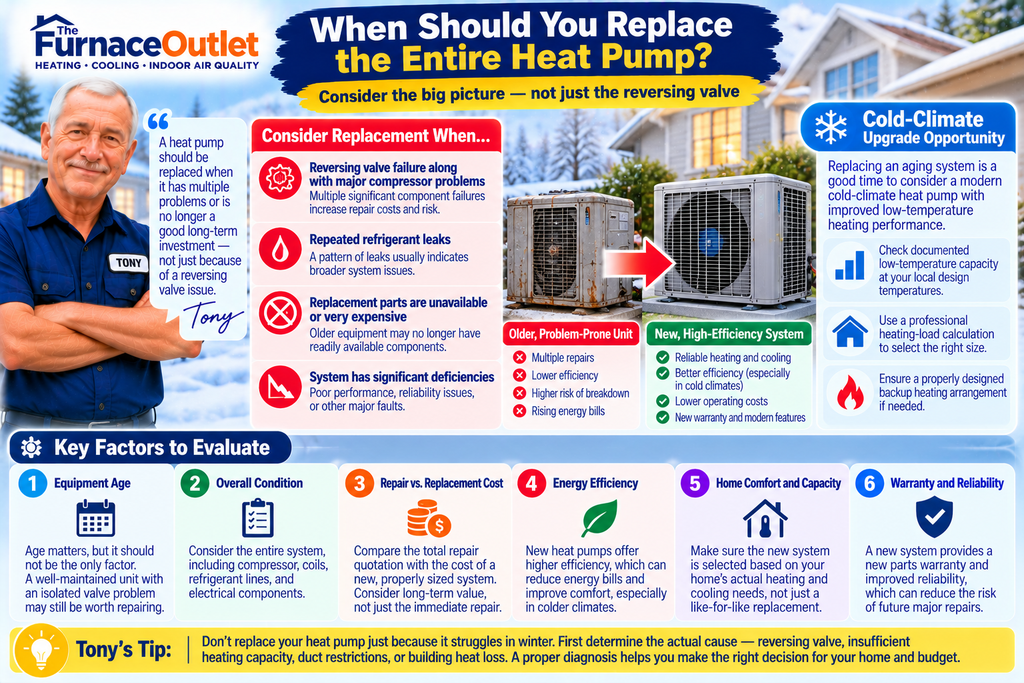
Replacing the complete heat pump may be reasonable when a confirmed reversing valve failure occurs alongside major compressor problems, repeated refrigerant leaks, unavailable replacement components, or other significant deficiencies.
I would not recommend installing a more expensive replacement simply because the existing equipment struggles during winter. First establish whether the underlying problem involves the reversing valve, insufficient heating capacity, duct restrictions, or building heat loss.
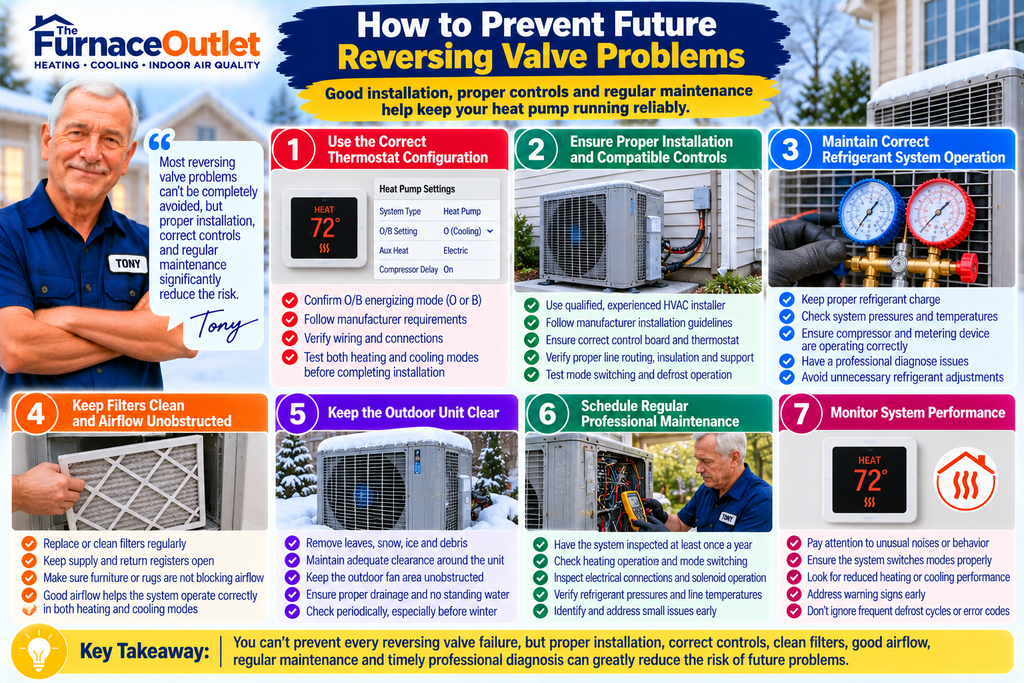
Not every reversing valve failure is preventable. Internal mechanical components and electrical coils can eventually fail even in correctly installed equipment. However, proper installation, compatible controls, and regular professional maintenance can reduce the likelihood of avoidable operating problems.
Thermostat compatibility deserves particular attention whenever controls are replaced. The installer should confirm the manufacturer’s reversing valve energization requirements, verify the wiring, and test both heating and cooling operation before completing the job.
Maintaining correct refrigerant-system operation is equally important. Refrigerant charge, compressor performance, and control sequences should be evaluated using approved procedures when symptoms justify testing. Unnecessary refrigerant adjustments can create additional problems rather than improve performance.
Homeowners can contribute by maintaining clean filters, keeping outdoor airflow unobstructed, and reporting unusual operating behavior before a minor fault becomes a prolonged heating failure. A seasonal maintenance visit should include checking heating operation and confirming that the system transitions between modes as designed.
Yes. A reversing valve may remain in the cooling position because of a failed solenoid, incorrect control signal, internal mechanical problem, or unsuitable refrigerant-system conditions. However, a heat pump that continues cooling after a heating request may also have a thermostat configuration problem. A technician should verify the control sequence before condemning the valve.
Common clues include heating and cooling modes operating incorrectly, inadequate performance despite normal compressor operation, or a failure to change modes. None of these symptoms confirms a defective valve by itself. A qualified technician must evaluate the electrical controls, solenoid, refrigerant pressures, and operating temperatures.
Yes. Incorrect thermostat wiring or an improper O/B reversing valve setting can cause a heat pump to operate in the wrong mode. This is particularly worth investigating when the problem begins after installing a new thermostat.
Homeowners should not attempt to manually force a reversing valve to change position. The valve operates through an electrical pilot mechanism and refrigerant pressure relationships. Improper manipulation can damage the equipment or expose the person performing the work to electrical and refrigerant hazards.
Many conventional air-source heat pumps temporarily shift the reversing valve during defrost so that heat can be directed toward the outdoor coil. The exact sequence depends on the equipment. A temporary mode change during defrost is not automatically evidence of a malfunction.
Yes. Depending on the failure, the compressor and fans may continue operating even though the system cannot deliver the requested heating or cooling. Other valve faults can cause reduced performance in both modes. Continued operation should be evaluated against the manufacturer’s instructions and the symptoms present.
It depends on the confirmed failure, total repair cost, equipment age, warranty coverage, and overall condition of the heat pump. An isolated valve problem in otherwise reliable equipment may justify repair. A costly valve replacement on a system with additional major defects may make complete equipment replacement more attractive.
On some systems, emergency heat can provide heating independently of normal heat pump compressor operation. Whether this is possible depends on the installed backup equipment and control configuration. Follow the manufacturer’s instructions and have the failure assessed promptly rather than assuming emergency heat is available or correctly configured.
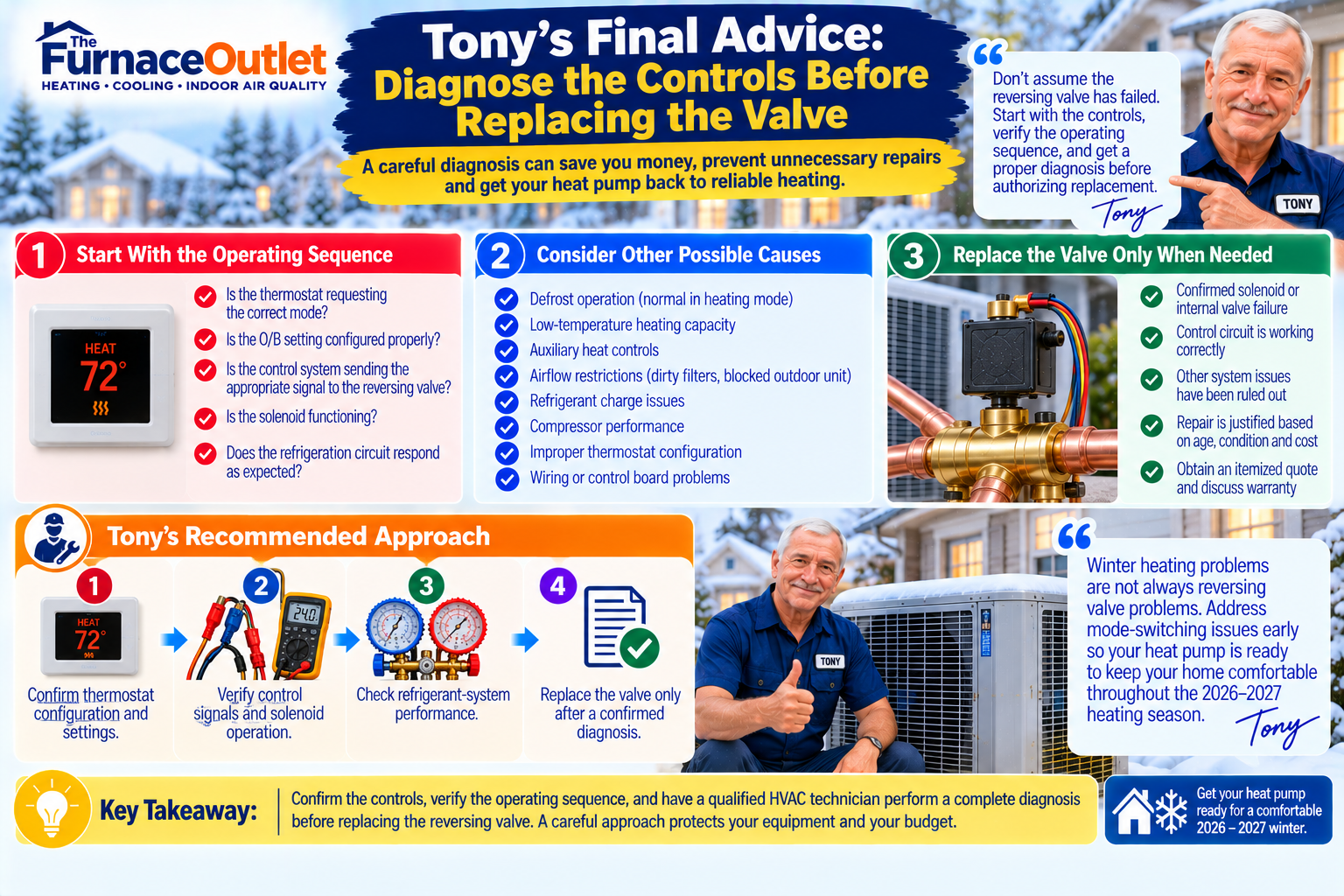
When a homeowner tells me their heat pump cools perfectly but refuses to heat, I don’t immediately recommend replacing the reversing valve. I start with the operating sequence. Is the thermostat requesting the correct mode? Is the control system sending the appropriate signal? Is the solenoid functioning? Does the refrigeration circuit respond as expected?
Those questions matter because replacing a reversing valve can involve substantial labor and refrigerant-system work. If the actual problem is an incorrect thermostat setting or a defective control connection, replacing the main valve would be an unnecessary expense.
I also remind homeowners that winter heating problems are not always reversing valve problems. Defrost operation, low-temperature heating capacity, auxiliary heat controls, airflow restrictions, and compressor performance must be considered when the symptoms justify investigating them.
My recommendation is to confirm the thermostat configuration and safe operating basics first, then have a qualified HVAC technician verify the reversing valve control circuit and refrigerant-system performance before authorizing replacement. A careful diagnosis protects your equipment, reduces unnecessary spending, and provides a better chance of restoring dependable heating before severe winter weather arrives.
For homeowners preparing for the 2026–2027 heating season, the best approach is to address mode-switching problems early rather than waiting until the first major cold spell. A heat pump that changes modes correctly and delivers its documented heating capacity is much better prepared to keep the home comfortable throughout winter.
This article is provided by The Furnace Outlet for general educational purposes and does not replace professional HVAC diagnosis, manufacturer service instructions, or applicable electrical and refrigerant-handling regulations. Reversing valve testing and replacement may involve energized electrical components, pressurized refrigerants, hot surfaces, and specialized tools.
Homeowners should not bypass safety controls, energize solenoids directly, open refrigerant lines, or attempt valve replacement without appropriate training and authorization. In the United States, refrigerant work must comply with applicable EPA requirements. Equipment-specific procedures and warranty conditions take precedence over general troubleshooting information.
If a heat pump repeatedly trips electrical breakers, produces burning odors, or develops other potentially hazardous conditions, discontinue operation when safe and seek qualified professional assistance.
For actual reversing valve wiring, solenoid specifications, and diagnostic procedures, the exact heat pump manufacturer’s installation and service manuals are the primary technical authority.