Newsletter Subscribe
Enter your email address below and subscribe to our newsletter

HVAC made simple
By Tony Marino | Tony the Trusted Tech
The Furnace Outlet | Updated October 2026
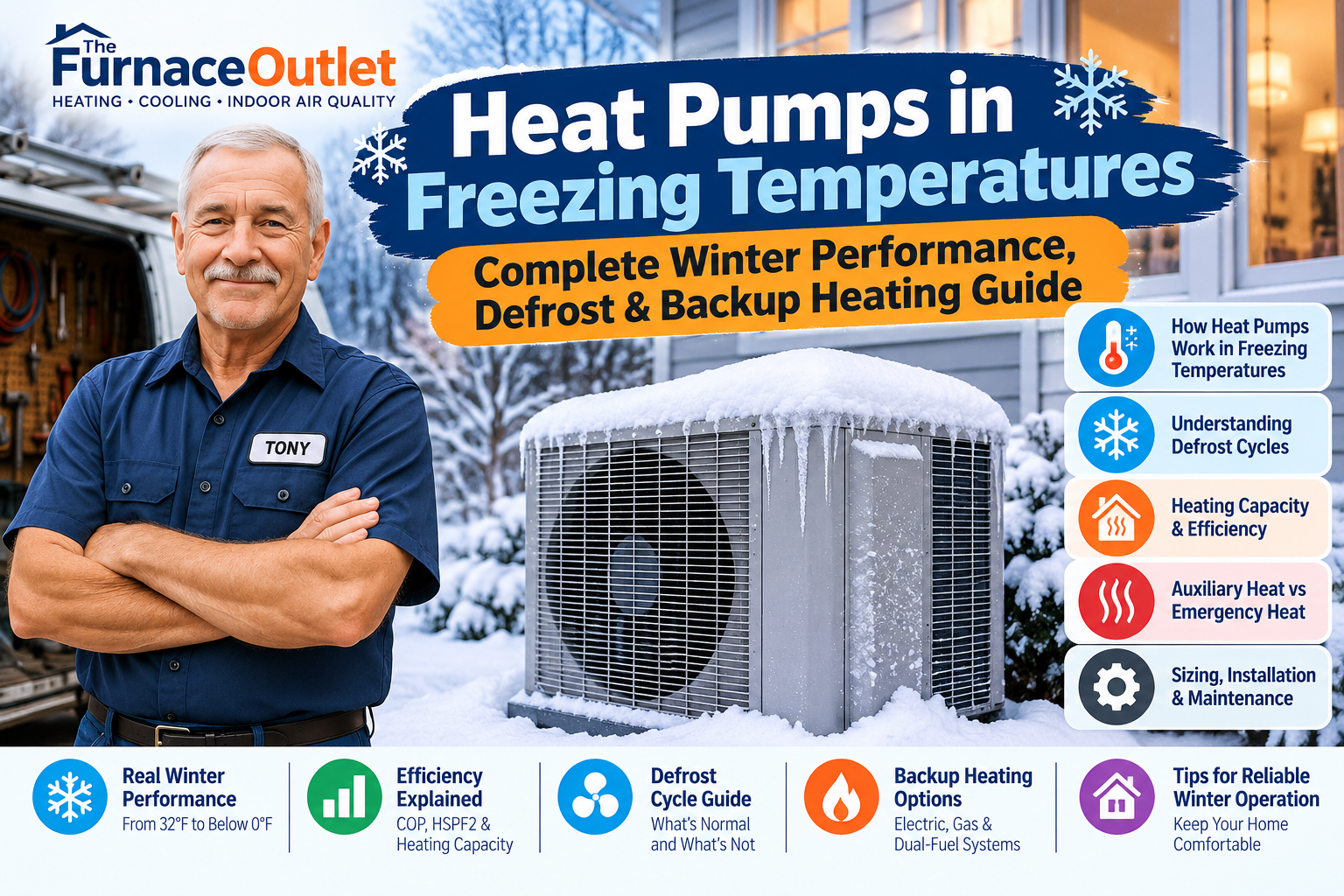
A heat pump that performs beautifully during a mild October afternoon faces a different challenge when January temperatures fall below freezing. The outdoor coil becomes colder, frost may begin forming, the compressor works under more demanding conditions, and the home loses heat faster through its walls, windows, attic, and foundation. Homeowners sometimes interpret these changes as evidence that heat pumps are unsuitable for winter heating. That conclusion overlooks how modern heat pumps are designed to operate and how much their performance varies from one system to another.
I’ve always believed that the best way to understand winter heat pump performance is to look beyond the thermostat and examine what the equipment is actually doing. Outdoor temperature matters, but so do compressor design, refrigerant controls, airflow, equipment sizing, defrost operation, ductwork, and the availability of supplemental heat. Two heat pumps installed in similar houses can deliver very different results during the same cold spell.
Today’s cold-climate heat pumps can provide substantial heating at temperatures well below 32°F. However, no responsible technician should promise that every heat pump will maintain full capacity at every outdoor temperature. Heating output and efficiency change as conditions become colder, and the right equipment must be selected for the home’s actual heating load.
This guide explains how heat pumps operate in freezing temperatures, what happens at 32°F, 17°F, 5°F, and below 0°F, why defrost cycles are necessary, how auxiliary and emergency heating work, and what homeowners can do to improve winter comfort and reliability. It also explains when unusual operating behavior deserves professional attention.
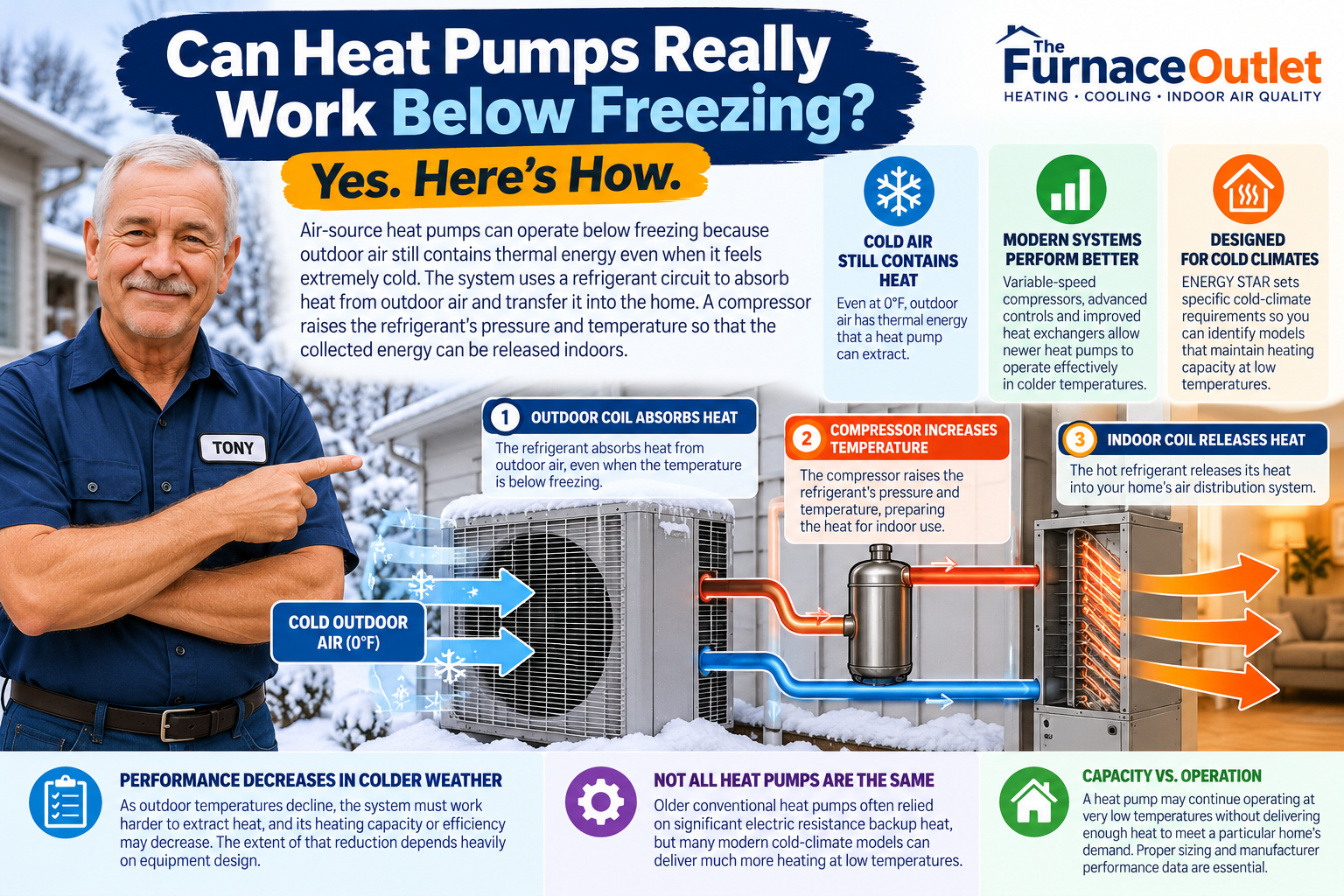
Yes. Air-source heat pumps can operate below freezing because outdoor air still contains thermal energy even when it feels extremely cold. The system uses a refrigerant circuit to absorb heat from outdoor air and transfer it into the home. A compressor raises the refrigerant’s pressure and temperature so that the collected energy can be released indoors.
The process does not require outdoor air to feel warm. It requires the refrigerant and heat exchanger to operate at conditions that allow heat transfer. As outdoor temperatures decline, the system must generally work harder to extract useful heat, and its heating capacity or efficiency may decrease. The extent of that reduction depends heavily on equipment design.
Older conventional heat pumps were often associated with substantial electric resistance backup heating during cold weather. That reputation still influences purchasing decisions, but it does not accurately describe every modern system. Variable-speed compressors, advanced electronic expansion valves, improved controls, and heat exchanger designs have expanded the practical operating range of many newer models.
The U.S. Department of Energy recognizes cold-climate heat pumps as an option for regions with freezing winter temperatures. ENERGY STAR also maintains specific cold-climate performance requirements, allowing homeowners and contractors to distinguish qualifying equipment from models designed primarily for milder conditions.
The important distinction is between a heat pump that continues operating and one that delivers enough heat to meet the home’s demand. A unit may be mechanically capable of running at a very low temperature without having sufficient output to heat a particular house on its own. That is why heating-load calculations and manufacturer performance data are essential.
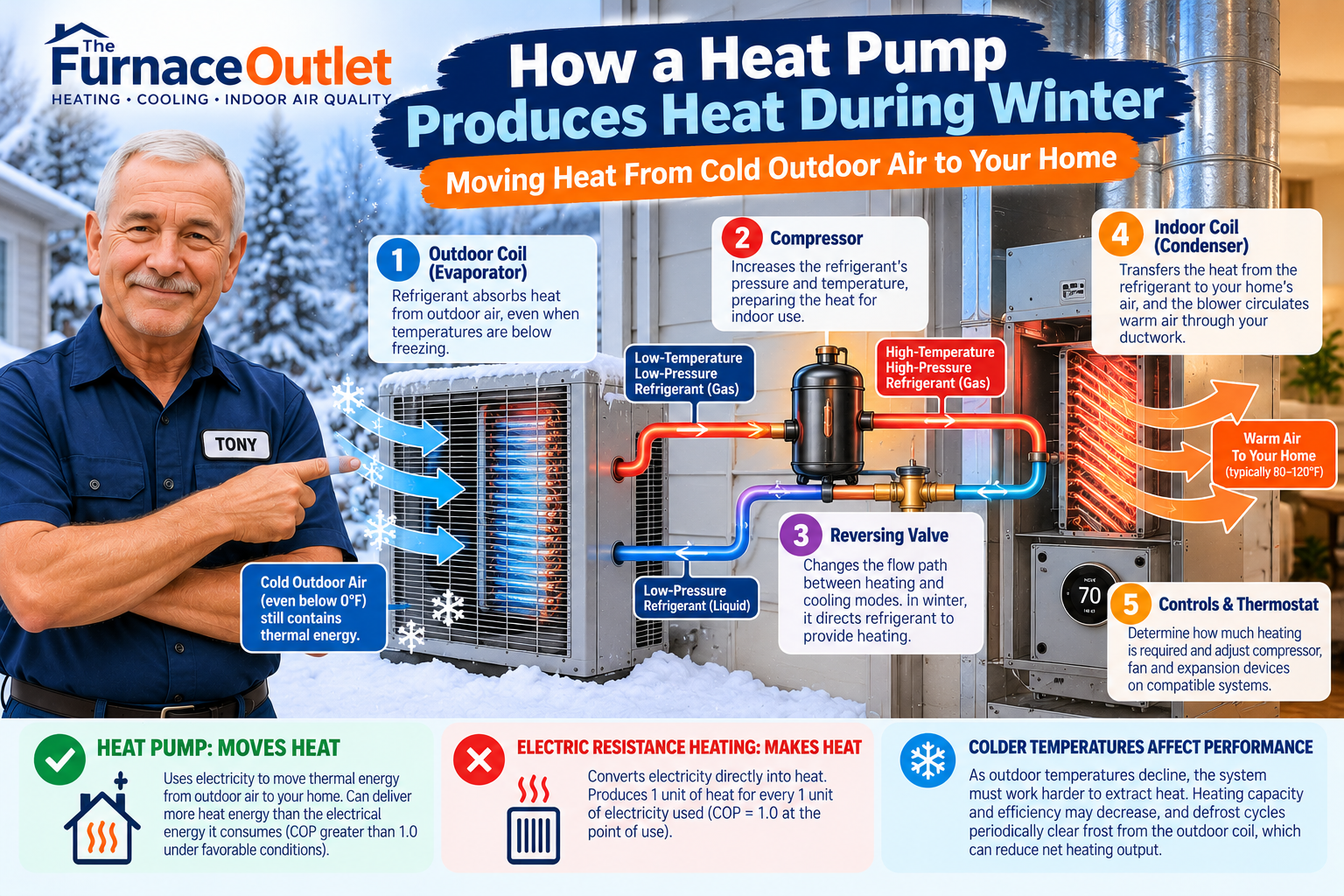
In heating mode, the outdoor coil acts as an evaporator and the indoor coil acts as a condenser. Refrigerant circulating through the outdoor coil absorbs energy from the surrounding air. The compressor then raises the refrigerant’s pressure and temperature, and the indoor coil transfers that energy into the home’s air distribution system.
A reversing valve changes the refrigerant flow path between heating and cooling modes. In winter, the controls direct the system toward indoor heating, while fans and expansion devices regulate the exchange of heat. The thermostat or communicating controller determines how much heating is required and, on compatible systems, adjusts compressor and blower operation.
The difference between a heat pump and an electric resistance heater is fundamental. Resistance heating converts electricity directly into heat. A heat pump uses electricity primarily to move thermal energy from one location to another. Under favorable operating conditions, this allows it to deliver more heat energy than the electrical energy it consumes.
As outdoor air becomes colder, the temperature difference needed for heat transfer becomes more demanding. Compressor power, refrigerant pressures, coil temperatures, and control strategies all influence the final result. Defrost cycles can also reduce net heating output because energy must periodically be used to clear frost from the outdoor coil.
This explains why a heat pump’s efficiency cannot be represented by a single number for every winter condition. The equipment’s actual performance changes throughout the heating season.
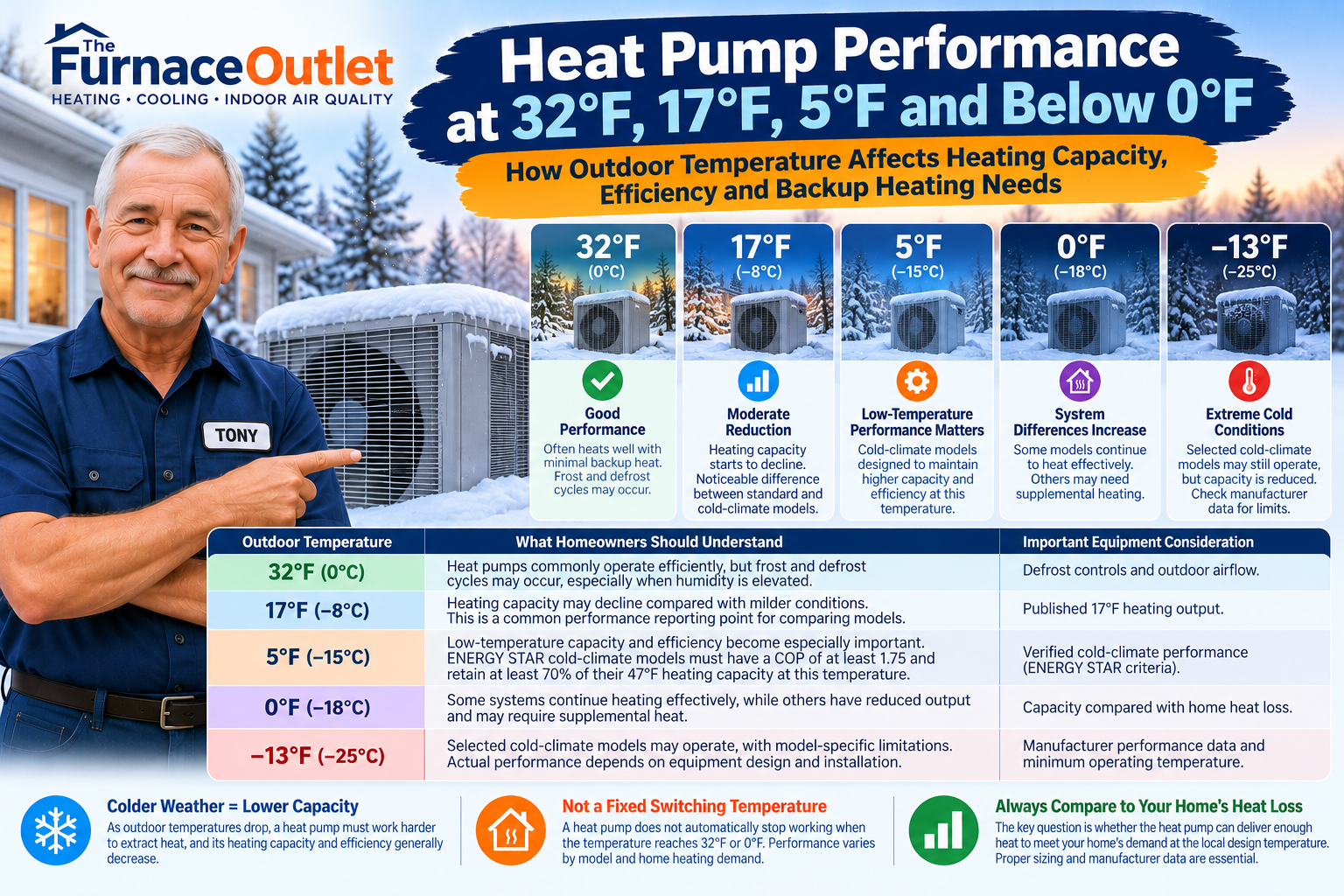
Outdoor temperature is one of the most important variables affecting heat pump heating capacity. However, temperature alone cannot tell you whether a system will heat a home adequately. The correct evaluation compares the equipment’s available heating output at a given temperature with the home’s heating demand at that same temperature.
At approximately 32°F, many properly selected heat pumps can provide comfortable heating without significant supplemental assistance. Nevertheless, this is also a temperature range where frost can develop on outdoor coils, particularly when humidity is elevated. A heat pump may therefore experience periodic defrost cycles even when the outdoor temperature is only slightly below or above freezing.
At 17°F, conventional and cold-climate systems may begin showing more noticeable differences in heating output. This temperature is a common performance reporting point, making it useful when comparing equipment. A system that maintains substantial capacity at 17°F may require less supplemental heating than a similarly sized unit whose output falls more sharply.
At 5°F, low-temperature capacity becomes particularly important. ENERGY STAR’s cold-climate designation includes performance requirements at this temperature. Among other criteria, qualifying equipment must demonstrate a coefficient of performance of at least 1.75 and retain at least 70% of its specified 47°F heating capacity under defined test conditions. These requirements are useful screening tools, but they do not guarantee that a particular unit will satisfy every home’s heating load.
At 0°F and below, equipment differences can become even more significant. Some cold-climate heat pumps are designed to continue delivering useful heating at temperatures well below zero. Other systems may operate with reduced output or require substantial backup heat. The manufacturer’s extended-performance tables, minimum operating temperature, and control specifications should determine what can reasonably be expected.
| Outdoor temperature | What homeowners should understand | Important equipment consideration |
|---|---|---|
| 32°F | Heat pumps commonly operate efficiently, but frost and defrost cycles may occur | Defrost controls and outdoor airflow |
| 17°F | Heating capacity may decline compared with milder conditions | Published 17°F heating output |
| 5°F | Low-temperature capacity and efficiency become especially important | Verified cold-climate performance |
| 0°F | Some systems continue heating effectively; others need assistance | Capacity compared with home heat loss |
| −13°F | Selected cold-climate models may operate, with model-specific limitations | Manufacturer performance and operating limits |
These temperature points are comparisons, not universal switching thresholds. A heat pump does not automatically become ineffective when the outdoor thermometer crosses 32°F or 0°F.
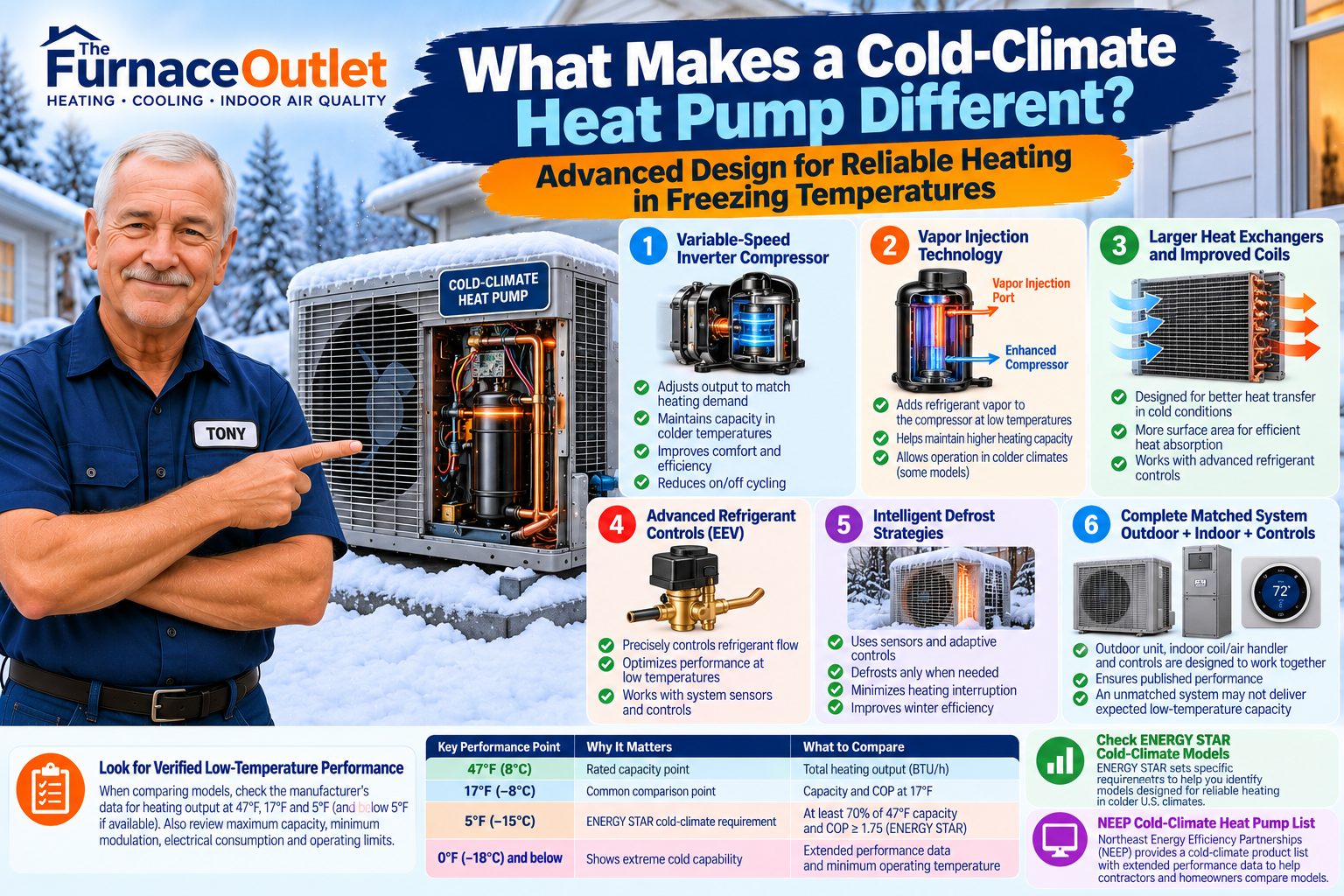
A cold-climate heat pump is not simply a conventional unit with a winter label attached. Qualifying equipment must demonstrate particular low-temperature performance characteristics, and manufacturers may employ several design strategies to maintain heating output as outdoor conditions deteriorate.
Variable-speed inverter compressors are particularly valuable because they can adjust refrigerant flow and heating output to changing conditions. Instead of operating only at full capacity or switching off, many inverter-driven systems can modulate across a range of speeds. This can improve temperature stability and reduce unnecessary cycling when the home needs less heat.
Some designs use vapor injection or other compressor-cycle enhancements to support heating capacity at low outdoor temperatures. Others rely on carefully coordinated refrigerant controls, larger heat exchangers, or specialized defrost strategies. These features are not identical across brands, and the presence of a particular technology does not by itself prove superior overall performance.
The most meaningful comparison is the complete matched system, including the outdoor unit, indoor air handler or coil, and applicable controls. A strong outdoor unit paired with an unsuitable indoor component may not deliver the published performance expected from the properly matched configuration.
For cold-climate equipment selection, I recommend examining heating output at 47°F, 17°F, and 5°F, along with any available data below 5°F. Compare maximum capacity, minimum modulation, electrical consumption, and manufacturer-specified operating limits. Northeast Energy Efficiency Partnerships maintains a cold-climate heat pump product resource that can help contractors evaluate extended performance data.
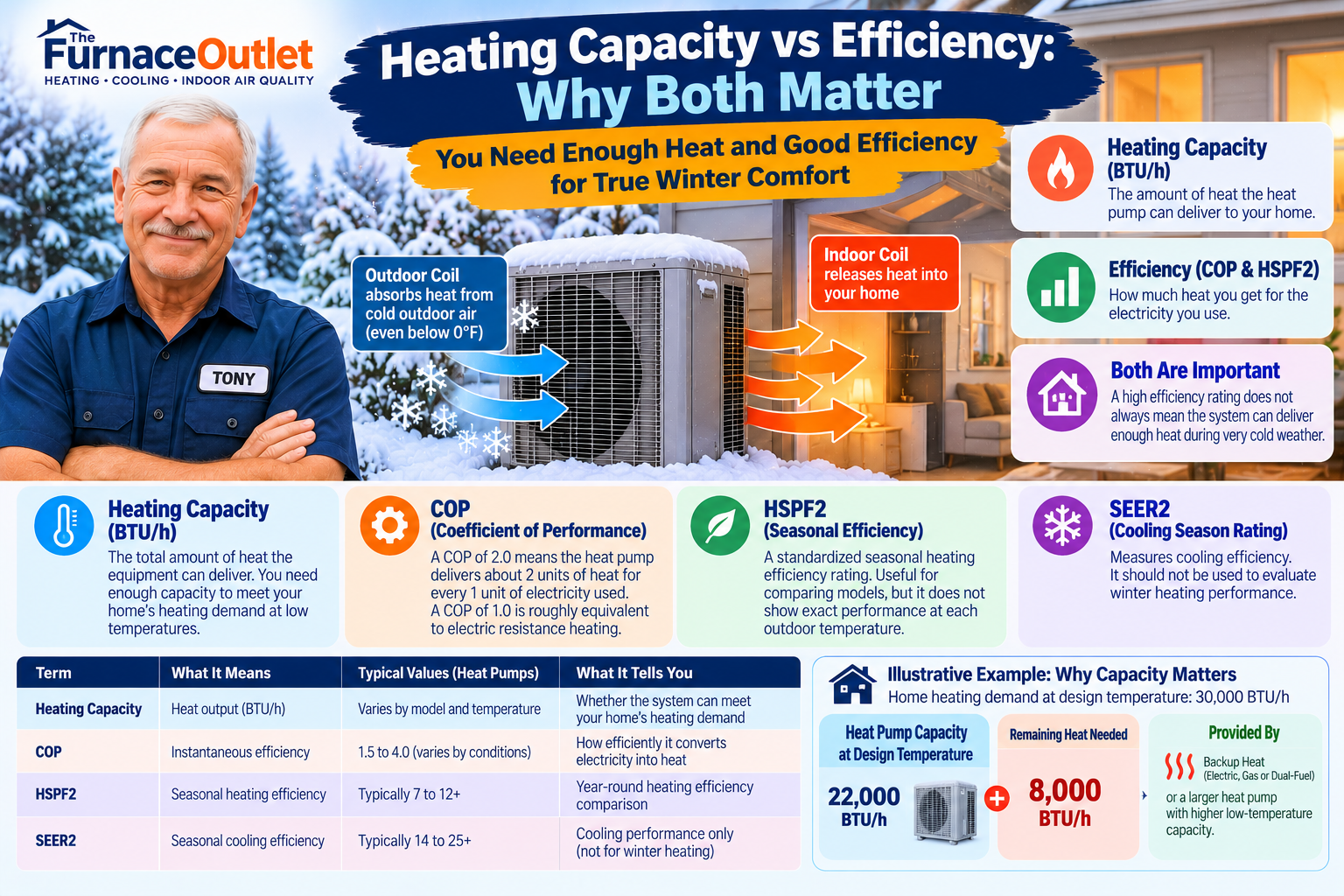
Homeowners often compare heat pumps by efficiency ratings alone. Efficiency matters, but it does not answer whether the system can maintain the desired indoor temperature during a severe cold spell.
Heating capacity is the amount of heat the equipment can deliver, commonly expressed in British thermal units per hour, or BTU/h. Efficiency describes how much useful heating is delivered relative to the energy consumed. A highly efficient system with insufficient capacity can still leave a home uncomfortable.
Coefficient of performance, or COP, is one way to describe instantaneous heating efficiency. A COP of 2.0 means the equipment delivers approximately two units of heat energy for every unit of electrical energy consumed under the specified operating conditions. A COP of 1.0 is approximately equivalent to direct electric resistance heating at the point of use.
HSPF2 is a seasonal heating efficiency rating. It provides a standardized basis for comparing equipment but does not reveal every detail of performance during an individual freezing night. SEER2 is a cooling-season metric and should not be used as the primary measure of winter heating capability.
For example, imagine a house requires 30,000 BTU/h of heat at its winter design temperature. If the selected heat pump can deliver only 22,000 BTU/h under those conditions, the remaining 8,000 BTU/h must come from another source or the indoor temperature may fall. This is an illustrative calculation, not a sizing recommendation for a particular home.
I would rather install a properly matched system with documented winter capacity than select equipment solely because its advertised seasonal efficiency rating looks impressive.
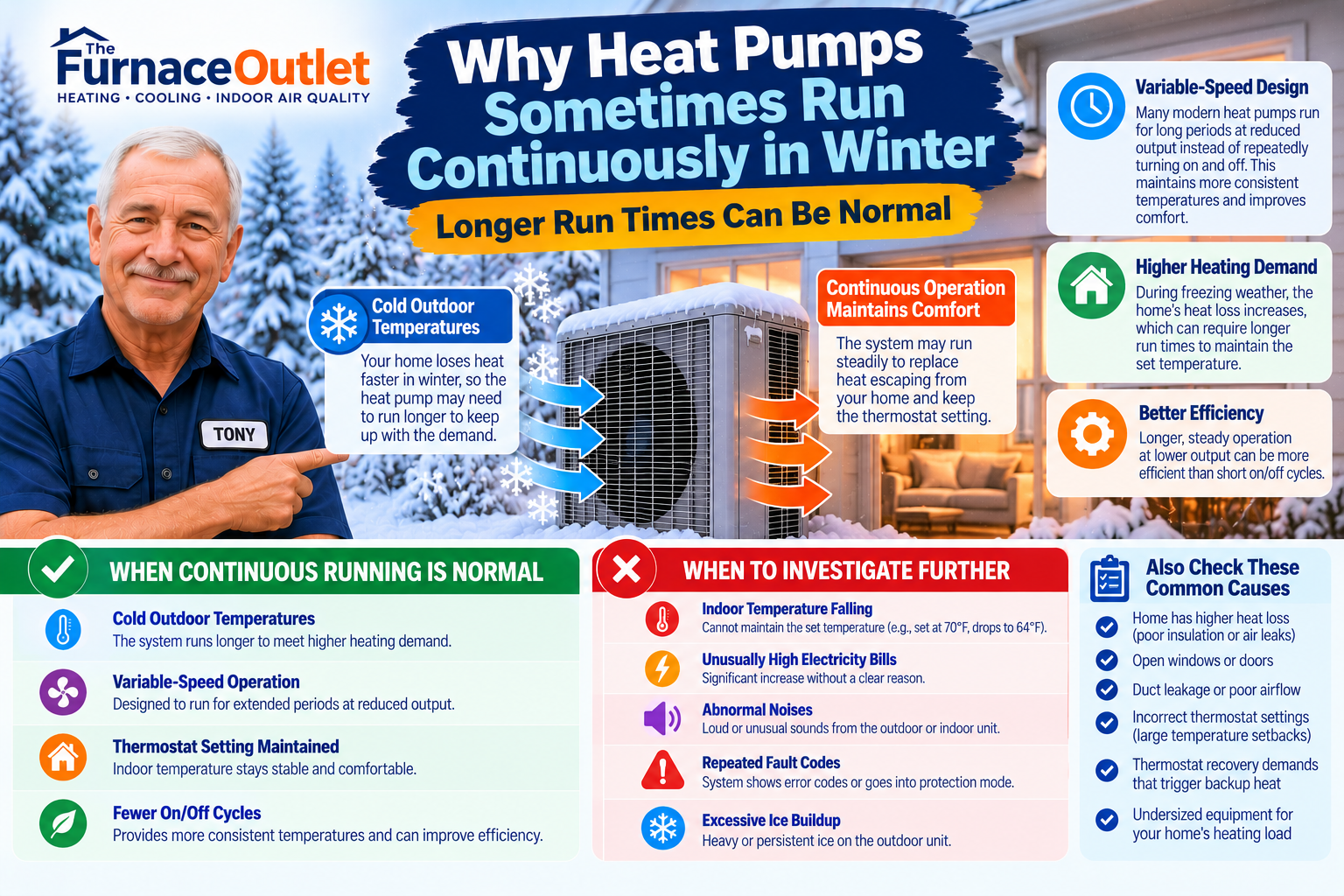
A heat pump that runs for extended periods is not necessarily malfunctioning. Many variable-speed systems are designed to operate for long periods at reduced output rather than repeatedly switching on and off. This can maintain more consistent indoor temperatures and may improve comfort.
During cold weather, the home’s heat loss increases. If the outdoor temperature remains low for several hours, the heat pump may need to operate almost continuously to replace the energy escaping through the building envelope. Long operating cycles can be normal when the equipment is maintaining the thermostat setting.
The concern begins when continuous operation is accompanied by declining indoor temperatures, unusually high electrical consumption, abnormal noises, repeated fault codes, or substantial ice accumulation. Those symptoms may indicate insufficient heating capacity, restricted airflow, a control problem, or an equipment fault.
A thermostat that remains satisfied while the heat pump runs steadily is a very different situation from a thermostat set to 70°F while the indoor temperature gradually falls to 64°F. The second condition deserves closer investigation, particularly if backup heat is expected but does not activate.
Before assuming the equipment is defective, consider whether the home has unusually high heat loss, open windows, major duct leakage, or thermostat settings that cause unnecessary recovery demands. Proper diagnosis should consider the entire heating system, not just the outdoor unit.
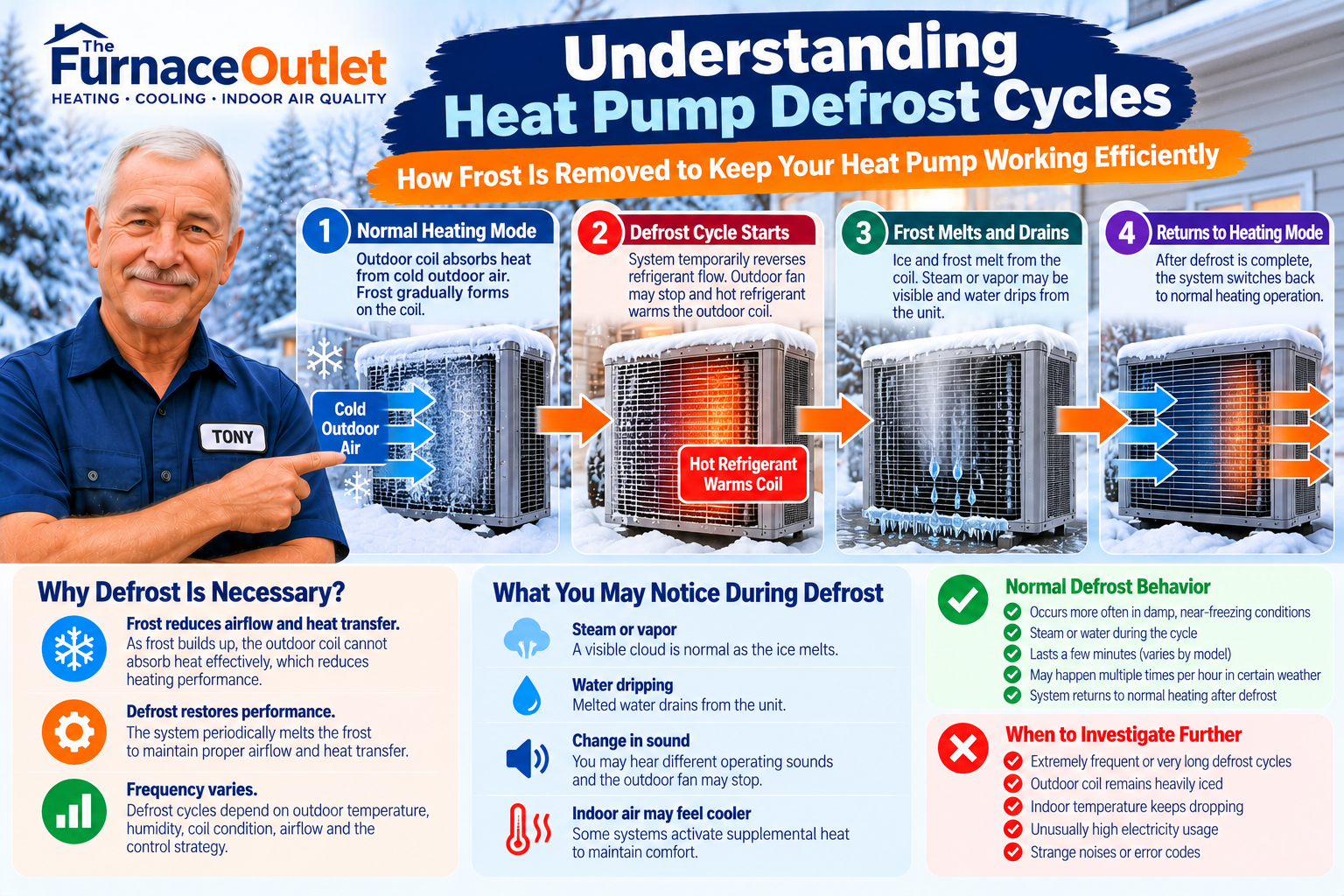
Defrost operation is one of the most misunderstood aspects of winter heat pump performance. In heating mode, the outdoor coil must operate at a temperature low enough to absorb heat from outdoor air. Under suitable temperature and moisture conditions, frost forms on the coil surface.
A thin layer of frost is not automatically a problem. However, as frost accumulates, it restricts airflow and reduces heat transfer. If the system continues operating without removing excessive frost, heating performance can deteriorate substantially.
To correct this, the heat pump periodically initiates a defrost cycle. Many systems temporarily reverse refrigerant flow so that hot refrigerant warms the outdoor coil and melts accumulated frost. The outdoor fan may stop during this process, and the indoor controls may activate supplemental heat to reduce the sensation of cool supply air.
Homeowners may notice steam rising from the outdoor unit, water dripping beneath the cabinet, or a temporary change in operating sound. These observations can be normal during defrost. Steam should not automatically be mistaken for smoke, although an electrical burning smell or other abnormal signs require immediate attention.
Defrost frequency depends on outdoor temperature, humidity, coil condition, airflow, and the control system. Some equipment uses time-and-temperature logic, while other designs use demand-based controls intended to initiate defrost when conditions indicate that it is necessary.
There is no universal rule that every heat pump must defrost after a fixed number of minutes. Repeated defrost operation may be normal during certain damp, near-freezing conditions, but excessively frequent or prolonged cycles can indicate a problem.
A typical defrost event begins when the controls determine that frost removal is needed. The compressor continues operating under the manufacturer’s control sequence, refrigerant flow changes, and the outdoor coil warms. Meltwater drains from the coil and cabinet, sometimes producing a noticeable cloud of vapor.
The outdoor fan may remain stopped while the coil is being warmed. Depending on the equipment, auxiliary heating may operate indoors to maintain comfort. Once the control system determines that defrost is complete, the unit returns to normal heating operation.
The exact sequence varies by manufacturer and model. Homeowners should not attempt to force defrost by manipulating electrical components, bypassing sensors, or changing refrigerant controls.
An outdoor coil that remains heavily encased in ice, a fan blocked by frozen buildup, or repeated fault codes can indicate that defrost is not functioning correctly. Possible causes include defective sensors, control-board faults, restricted airflow, drainage problems, or other refrigeration-system issues.
Ice may also accumulate beneath the outdoor unit when defrost water cannot drain away. Repeated freezing around the base can obstruct drainage or interfere with fan operation. Installation height, snow clearance, and proper drainage are therefore important considerations in cold climates.
If the unit develops persistent heavy icing, turn to the manufacturer’s operating guidance and arrange professional service. Do not chip ice from refrigerant coils or use sharp tools, boiling water, or improvised heaters.
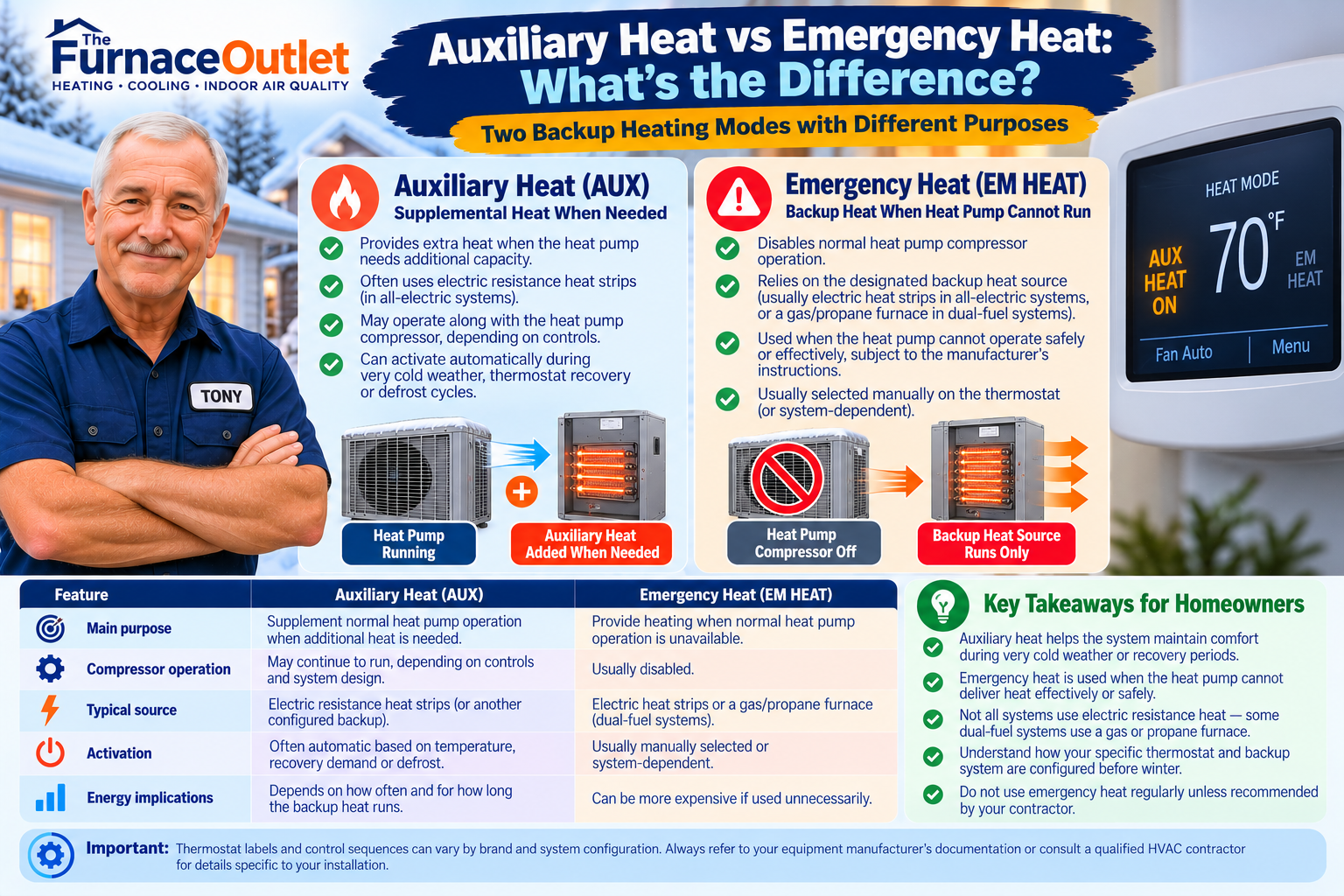
Auxiliary heat and emergency heat are related but not interchangeable concepts. Understanding the difference can prevent unnecessary concern when the thermostat displays an unfamiliar heating indicator.
Auxiliary heat, often labeled AUX, is supplemental heating that operates alongside or in coordination with the heat pump when additional capacity is needed. In many all-electric systems, auxiliary heating comes from electric resistance heat strips installed in the indoor air handler. Depending on the control strategy, those strips may activate during very cold weather, thermostat recovery, or defrost.
Emergency heat, often labeled EM HEAT, is a thermostat mode that typically disables normal compressor heating and relies on the designated backup heat source. It is intended for situations where the heat pump cannot be used safely or effectively, subject to the system manufacturer’s instructions.
Not every heat pump has the same backup configuration. Some systems use electric resistance heat, while dual-fuel systems pair a heat pump with a gas or propane furnace. Certain ductless systems have no integrated backup heater and depend on separately installed heating equipment.
| Feature | Auxiliary heat | Emergency heat |
|---|---|---|
| Main purpose | Supplement normal heat pump operation | Provide heating when normal heat pump operation is unavailable |
| Compressor operation | May continue, depending on controls | Usually disabled |
| Typical source | Electric heat strips or another configured backup | Configured backup heating system |
| Activation | Often automatic | Usually manually selected or system-dependent |
| Energy implications | Depends on frequency and backup fuel | Can be more expensive if used unnecessarily |
I recommend learning how your specific thermostat and backup system are configured before winter arrives. The labels alone do not reveal every detail of the installed control sequence.
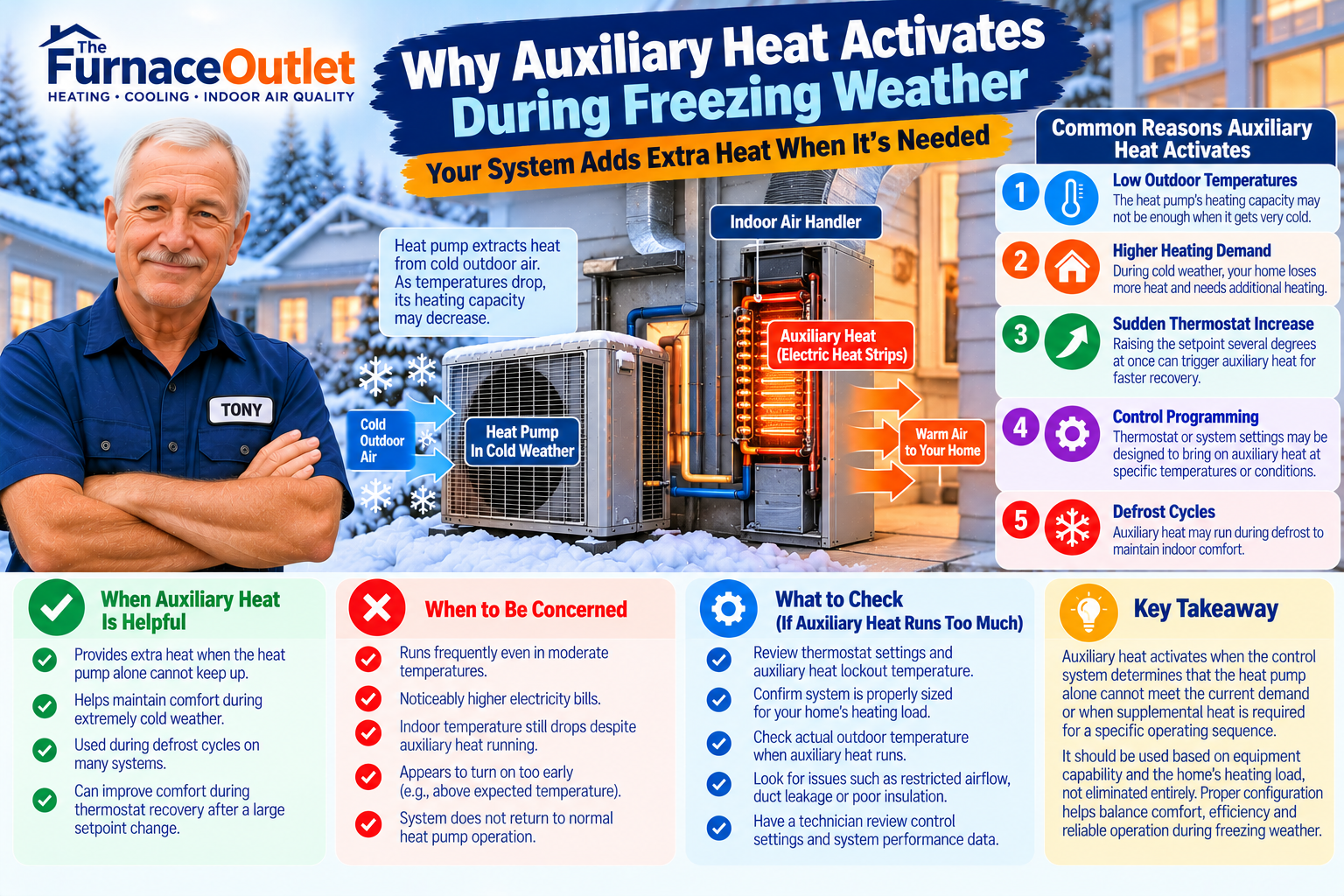
Auxiliary heating activates when the control system determines that the heat pump alone cannot satisfy the current demand or when supplemental heat is required for a particular operating sequence. Outdoor temperature, thermostat settings, equipment capacity, and control programming may all influence that decision.
A sudden thermostat increase can also trigger supplemental heat on some systems. For example, raising the setpoint several degrees at once may cause the controller to request faster recovery than the compressor alone can provide. That does not necessarily mean the heat pump has failed.
In cold climates, the decision to use auxiliary heat should be based on equipment capability and the home’s heating load. Poorly configured controls can activate expensive electric resistance heat earlier or more frequently than necessary.
However, delaying backup heat excessively can also create problems. If the heat pump cannot meet the heating demand, indoor temperatures may fall and comfort may deteriorate. The correct approach is to configure the system according to its performance characteristics rather than attempting to eliminate all backup operation.
For homeowners who notice unusually high electricity bills, I recommend having a technician review auxiliary heat runtime, thermostat configuration, outdoor-temperature lockouts, and the actual heating performance of the equipment.
A dual-fuel system combines an electric heat pump with a compatible gas or propane furnace. During suitable conditions, the heat pump supplies heating. When outdoor conditions or operating economics favor the furnace, the controls switch to combustion-based heating.
This arrangement can be attractive in colder U.S. regions, particularly where natural gas is available and electricity prices make resistance backup costly. It can also allow homeowners to retain furnace-based heating while gaining heat pump efficiency during milder conditions.
The key technical concept is the balance point, but two different balance points deserve attention. The thermal balance point is where the heat pump’s available heating capacity equals the home’s heating demand. Below that point, additional heating capacity may be required.
The economic balance point is where operating one heating source becomes less expensive than operating the other, based on electricity prices, fuel prices, equipment efficiency, and heat pump COP. These two temperatures are not necessarily the same.
For example, a heat pump might still be capable of heating a home at 10°F, while the furnace could become less expensive to operate at a higher temperature under certain utility rates. Alternatively, a highly efficient cold-climate heat pump may remain economically competitive at much lower temperatures.
Proper dual-fuel controls should consider equipment compatibility, manufacturer requirements, heating demand, and local energy costs. Simply selecting a universal outdoor-temperature cutoff without evaluating the system can undermine the benefits of the installation.
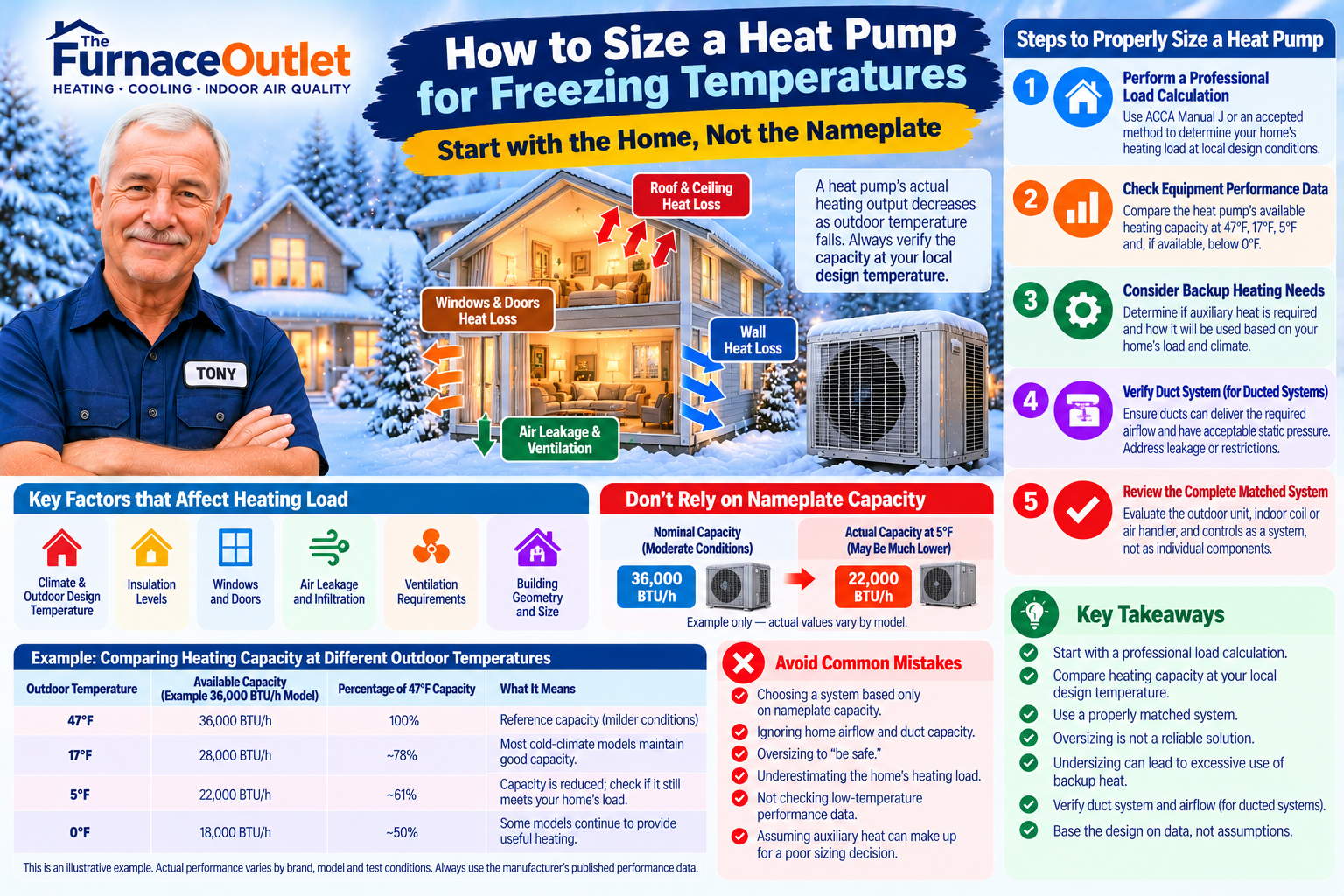
Correct sizing begins with the building, not the outdoor unit’s nameplate. A home’s heating load depends on climate, insulation, air leakage, windows, building geometry, ventilation, and indoor design temperature.
A professional heating-load calculation, commonly performed using an accepted residential methodology such as ACCA Manual J, estimates the amount of heating required at local design conditions. The result should then be compared with the proposed heat pump’s available heating capacity at those conditions.
This is particularly important in cold climates because equipment rated at a nominal capacity under moderate conditions may deliver a different output when temperatures fall substantially. A nominal 36,000 BTU/h system should not automatically be assumed to provide 36,000 BTU/h at every winter temperature.
Oversizing is not a reliable solution. Excessively large equipment may cycle unnecessarily during milder weather, operate outside its most efficient range, or create airflow and comfort problems. Variable-speed systems provide greater modulation flexibility, but their minimum capacity still matters.
Undersizing can leave the home dependent on backup heat more often than intended. The appropriate design may deliberately include some supplemental heating, but that should be a documented engineering choice rather than an accidental consequence of poor sizing.
For ducted systems, the contractor must also verify duct capacity, external static pressure, airflow requirements, and indoor equipment compatibility. A correctly sized heat pump connected to severely restricted ductwork may still perform poorly.
Winter performance depends on installation quality as much as equipment selection. Outdoor units require adequate airflow, appropriate mounting, drainage, service access, and clearance from snow accumulation.
In snowy climates, mounting height should account for local snow conditions and the manufacturer’s installation requirements. A unit installed too close to the ground may become obstructed by drifting snow or ice accumulation beneath the cabinet. Elevated stands or wall brackets may be appropriate where permitted by the manufacturer and local codes.
Drainage deserves particular attention because defrost water must leave the outdoor unit. If meltwater repeatedly freezes beneath the cabinet, ice can accumulate around the base. Poor drainage can also create slippery walking surfaces near the equipment.
Outdoor placement should avoid roof runoff, falling snow, and locations where drifting snow is likely to block airflow. At the same time, the installation must preserve the manufacturer’s required clearances and avoid enclosed spaces that encourage recirculation of cold discharge air.
Refrigerant piping, electrical connections, controls, and condensate arrangements must also follow the exact equipment instructions. Incorrect refrigerant charge, poor evacuation practices, unsuitable line lengths, or installation errors can compromise heating performance.
I would never evaluate a winter heat pump installation by appearance alone. The final commissioning process should confirm airflow, refrigerant-system operation using manufacturer procedures, control configuration, backup heating, and documented performance.
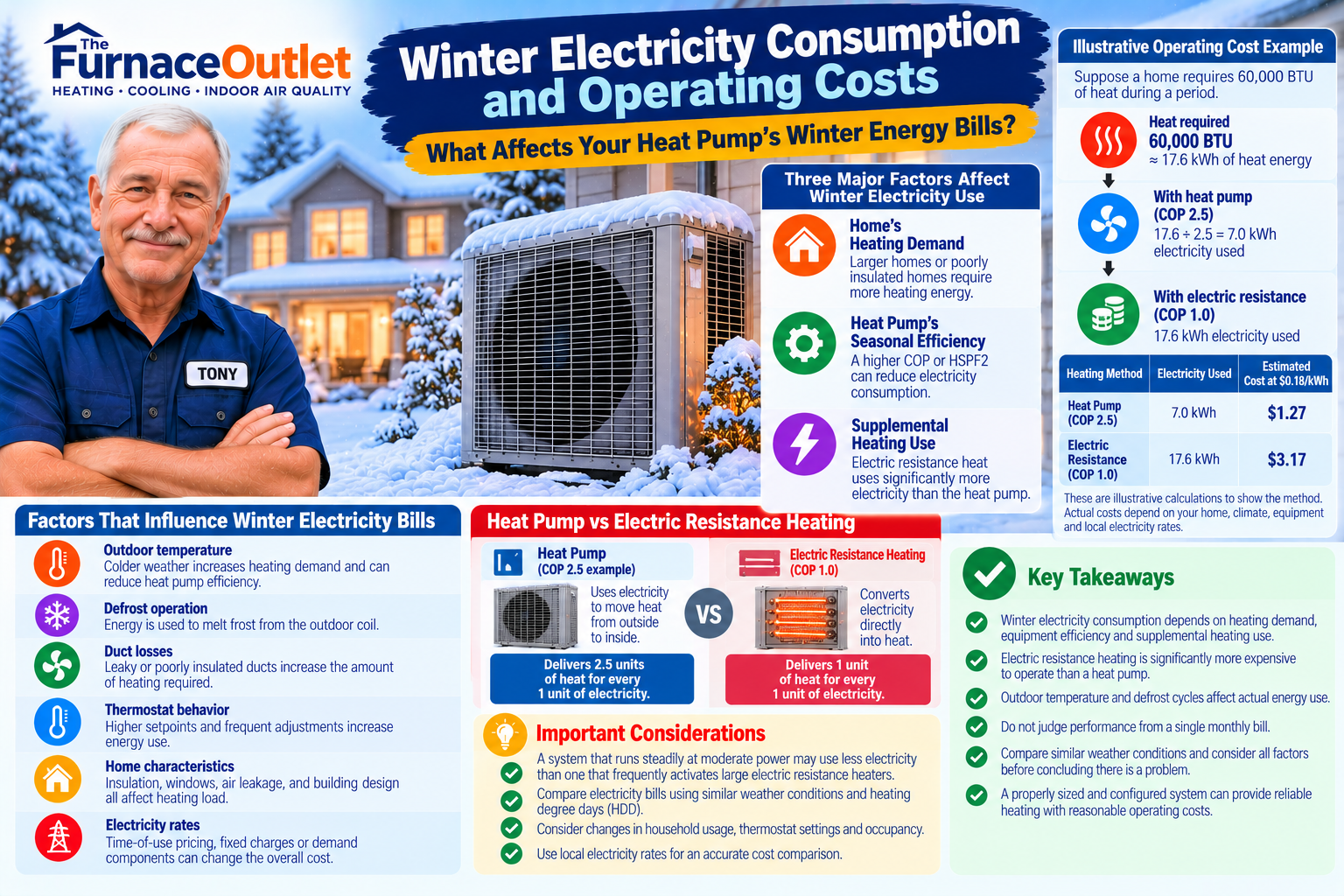
Winter electricity consumption depends on three major factors: the home’s heating demand, the heat pump’s seasonal operating efficiency, and the amount of supplemental heating used. A system that operates continuously at moderate power may consume less electricity than one that cycles less frequently but repeatedly activates large electric resistance heaters.
A useful way to understand operating costs is to compare the heat energy delivered with the electrical energy consumed. For an illustrative calculation, suppose a home requires 60,000 BTU of heating during a particular period. That is approximately 17.6 kilowatt-hours of delivered heat energy. At an average COP of 2.5, the heat pump would consume approximately 7.0 kWh of electricity to supply that heating, excluding additional system loads not represented in the assumed COP.
If the same heat demand were supplied entirely by electric resistance heating, electricity consumption would be approximately 17.6 kWh. At an illustrative electricity rate of $0.18 per kWh, those two scenarios would cost approximately $1.27 and $3.17, respectively. These figures demonstrate the calculation method rather than predict actual household bills.
Real winter consumption is more complicated because outdoor temperature, defrost operation, duct losses, thermostat behavior, and supplemental heating change over time. Utility rates may also include time-of-use pricing, fixed charges, or demand-related components. A complete cost comparison should use local rates and realistic seasonal heating requirements.
Homeowners should be cautious about judging heat pump efficiency from a single electricity bill. Comparing a particularly cold January with a mild December can be misleading. Heating degree days, indoor thermostat settings, occupancy, and changes in household electricity use should be considered before concluding that equipment performance has deteriorated.
Heat pump thermostat strategy differs from traditional furnace operation, particularly when electric resistance backup heating is installed. Large temperature setbacks followed by rapid recovery can cause some systems to activate auxiliary heat, reducing the expected energy savings.
For many homes, maintaining a relatively consistent indoor temperature during cold weather is a practical starting point. A modest setback may still save energy, especially when the control system is designed to recover gradually without unnecessary resistance heating. The best strategy depends on the equipment, thermostat programming, home insulation, and occupancy patterns.
A communicating thermostat designed for the installed heat pump may manage compressor modulation, defrost coordination, and supplemental heat more effectively than an incompatible generic controller. However, sophisticated controls do not compensate for incorrect installation or poor equipment sizing.
I recommend avoiding frequent manual switching between normal heat and emergency heat. Emergency heat should not be used simply because outdoor temperatures fall below freezing. If the system is operating normally and maintaining comfort, its automatic controls should generally be allowed to manage heating.
When homeowners want to optimize thermostat settings, I suggest reviewing actual auxiliary heat usage over several cold days rather than assuming that a particular temperature schedule is universally best.
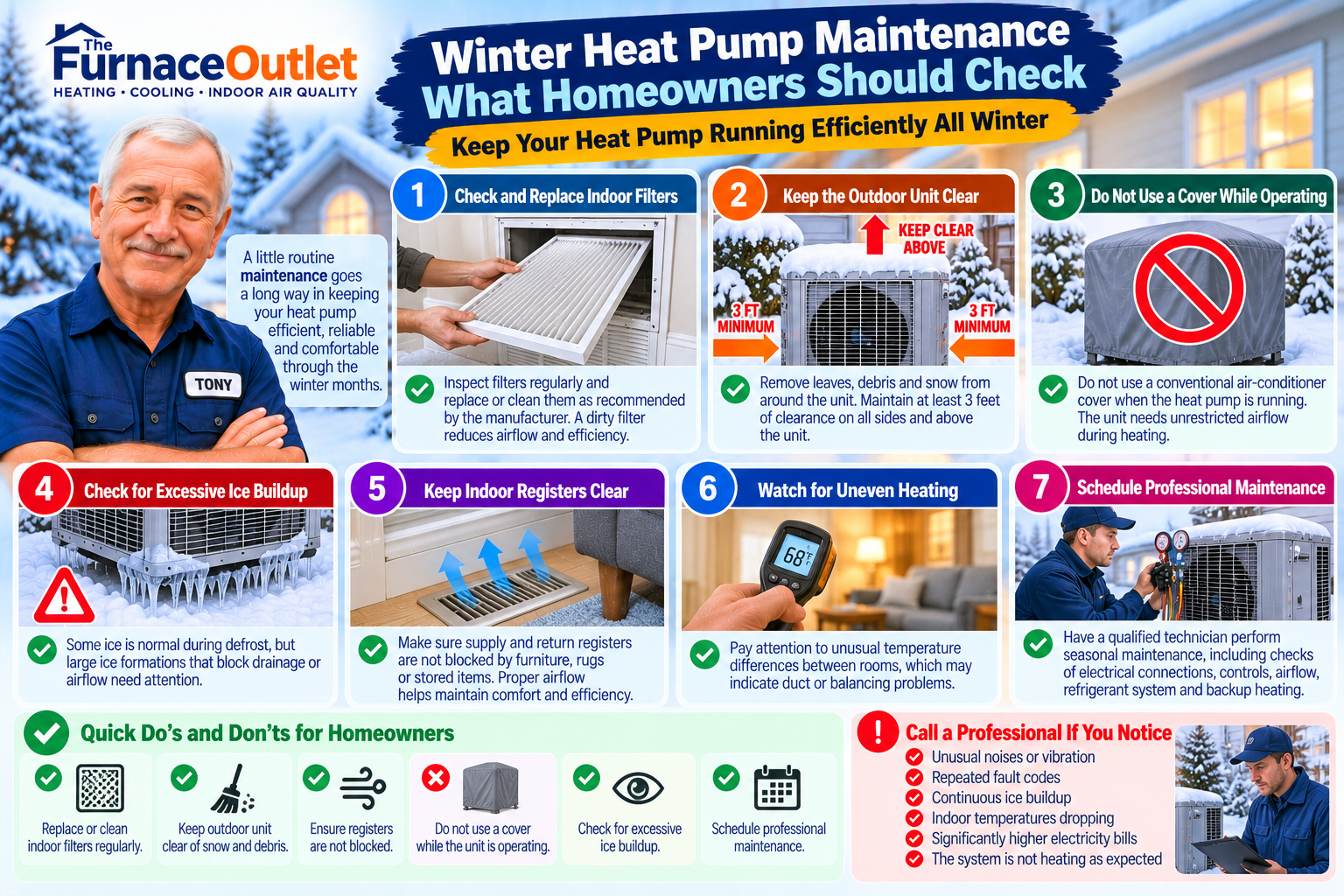
A heat pump needs unrestricted airflow to operate efficiently. Indoor filters should be inspected regularly and replaced or cleaned according to the equipment manufacturer’s instructions. A severely restricted filter can reduce airflow, compromise comfort, and contribute to equipment problems.
Outdoor airflow is equally important. Leaves, debris, drifting snow, and accumulated ice can obstruct the outdoor coil. Homeowners can visually inspect the unit and remove loose snow from surrounding accessible areas while keeping hands, tools, and clothing away from the fan and electrical components.
Do not cover an operating outdoor heat pump with a conventional air-conditioner cover. The equipment requires outdoor airflow while heating. A cover that blocks intake or discharge airflow can interfere with operation and may damage the system.
The area beneath the unit should also be observed for excessive ice accumulation. Some freezing of defrost water may occur during winter, but large ice formations that interfere with drainage or equipment clearances require attention.
For ducted systems, supply and return registers should remain unobstructed. Furniture, rugs, and stored belongings can restrict airflow when placed directly over or against registers. Homeowners should also pay attention to unusual temperature differences between rooms, which may indicate duct or balancing problems.
Professional maintenance should include appropriate checks of electrical connections, control operation, airflow, heat exchanger condition, refrigerant-system performance, and backup heating. Technicians should follow manufacturer-specific service procedures rather than rely on a universal checklist for every model.
Winter conditions can expose weaknesses that remain unnoticed during milder weather. A heat pump may appear to operate normally in November but struggle during a prolonged cold spell because its available capacity is insufficient, its auxiliary heat is not functioning, or airflow restrictions become more significant.
A heat pump that blows air cooler than expected is not automatically defective. Heat pumps often supply air at lower temperatures than gas furnaces, and supply-air temperature varies with operating conditions. However, consistently cool airflow accompanied by falling indoor temperatures may indicate inadequate heating, defrost operation that is not terminating properly, or a system fault.
Repeated breaker trips are more serious. A breaker may trip because of electrical faults, damaged wiring, compressor problems, or other equipment issues. Homeowners should not repeatedly reset a tripping breaker or install a larger breaker to keep the equipment operating. Electrical diagnosis belongs to a qualified professional.
Unusual noises also deserve context. Brief refrigerant-flow sounds, cabinet expansion noises, and changes in fan operation may occur during normal heating or defrost. Loud grinding, repeated metallic impacts, persistent electrical buzzing, or a fan striking ice are not normal conditions to ignore.
If the thermostat calls for heat but the outdoor unit does not operate, possible explanations include a control delay, a defrost or protection sequence, thermostat configuration, loss of power, or a component failure. Homeowners may safely verify thermostat settings and check accessible breaker status once, but internal electrical troubleshooting should be left to trained technicians.
The most useful diagnostic information often comes from observing the pattern of failure. Record the outdoor temperature, thermostat setting, indoor temperature, any displayed fault codes, and whether the problem occurs continuously or only during defrost. These details can help a technician distinguish an intermittent control issue from insufficient heating capacity.
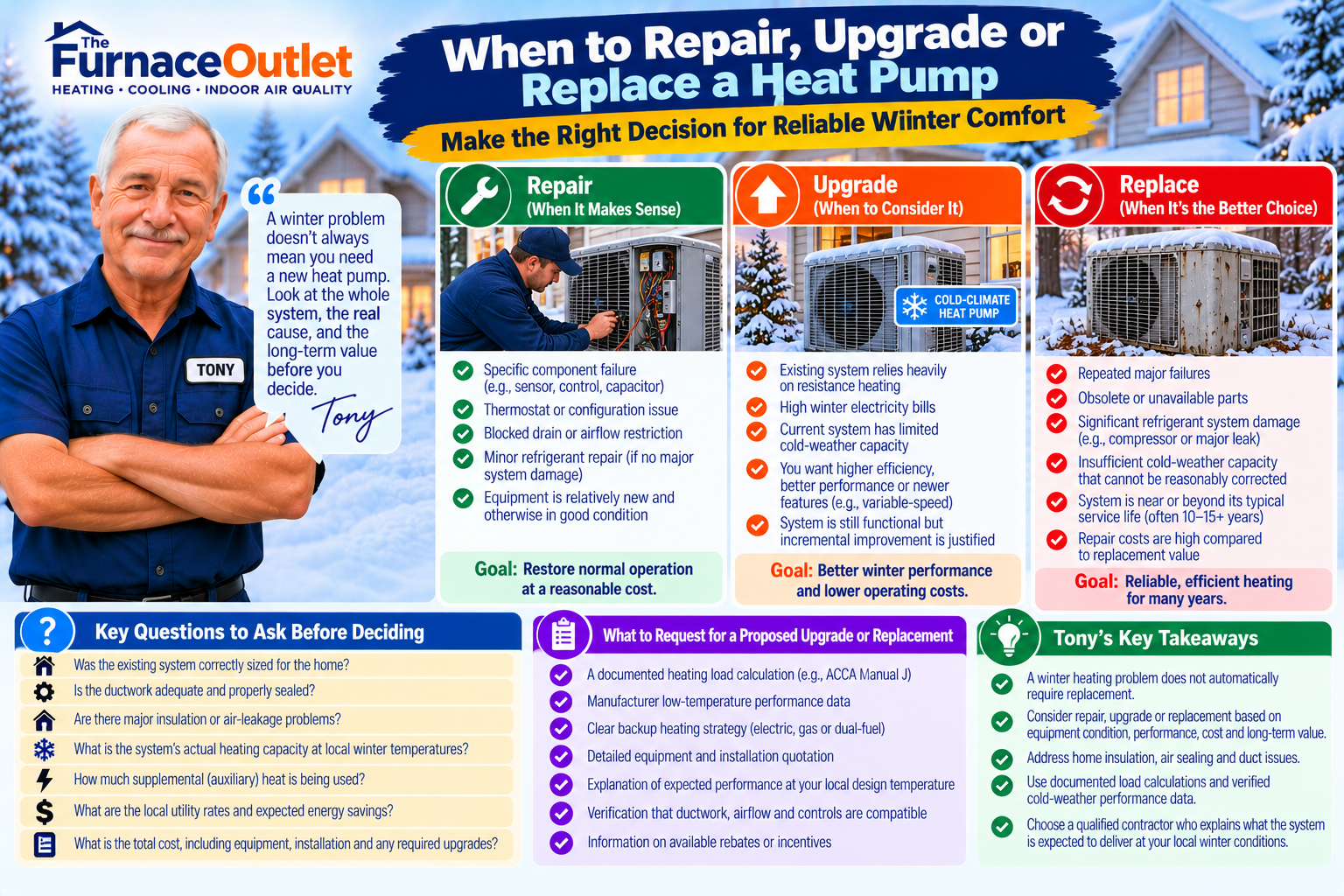
A winter heating problem does not automatically justify replacing the entire heat pump. A defective sensor, thermostat configuration issue, blocked drain, or failed electrical component may be repairable without replacing otherwise serviceable equipment.
Replacement becomes more relevant when the system has repeated major failures, obsolete components, significant refrigerant-system damage, or insufficient cold-weather capacity that cannot reasonably be corrected. Equipment age matters, but it should not be the only factor in the decision.
A conventional heat pump that relies heavily on resistance heating may also be a candidate for a cold-climate upgrade, particularly if the homeowner faces high winter electricity costs. However, the financial case depends on equipment pricing, existing system condition, climate, utility rates, and expected energy savings.
Before recommending replacement, I would want to know whether the existing system was correctly sized, whether the ductwork is adequate, and whether the home has major insulation or air-leakage problems. Installing a more expensive heat pump without addressing serious building-envelope deficiencies may produce disappointing results.
For a proposed upgrade, request a documented load calculation, manufacturer low-temperature performance information, a clear backup heating strategy, and a detailed installation quotation. The contractor should explain what the system is expected to deliver at local winter design temperatures.
The heat pump and the building envelope work together. A well-insulated, reasonably airtight home loses heat more slowly, reducing the amount of heating the equipment must supply during cold weather.
Air leaks around attic penetrations, poorly sealed ductwork, and inadequate insulation can significantly increase winter heating demand. These problems may cause an otherwise capable heat pump to run longer and rely more frequently on supplemental heating.
Improving the building envelope can also influence equipment selection. If planned insulation and air-sealing upgrades substantially reduce the heating load, a smaller or differently configured heat pump may become appropriate. That is why major weatherization improvements should ideally be considered before final equipment sizing.
Duct sealing is especially important when air distribution runs through unconditioned attics, crawl spaces, or garages. Heat lost from supply ducts before reaching occupied rooms increases the system’s workload. Return-side leakage can also affect airflow and system performance.
I recommend treating weatherization as part of winter heating planning rather than as an unrelated home improvement project. The goal is to reduce unnecessary heat loss so the equipment can operate within its intended performance range.
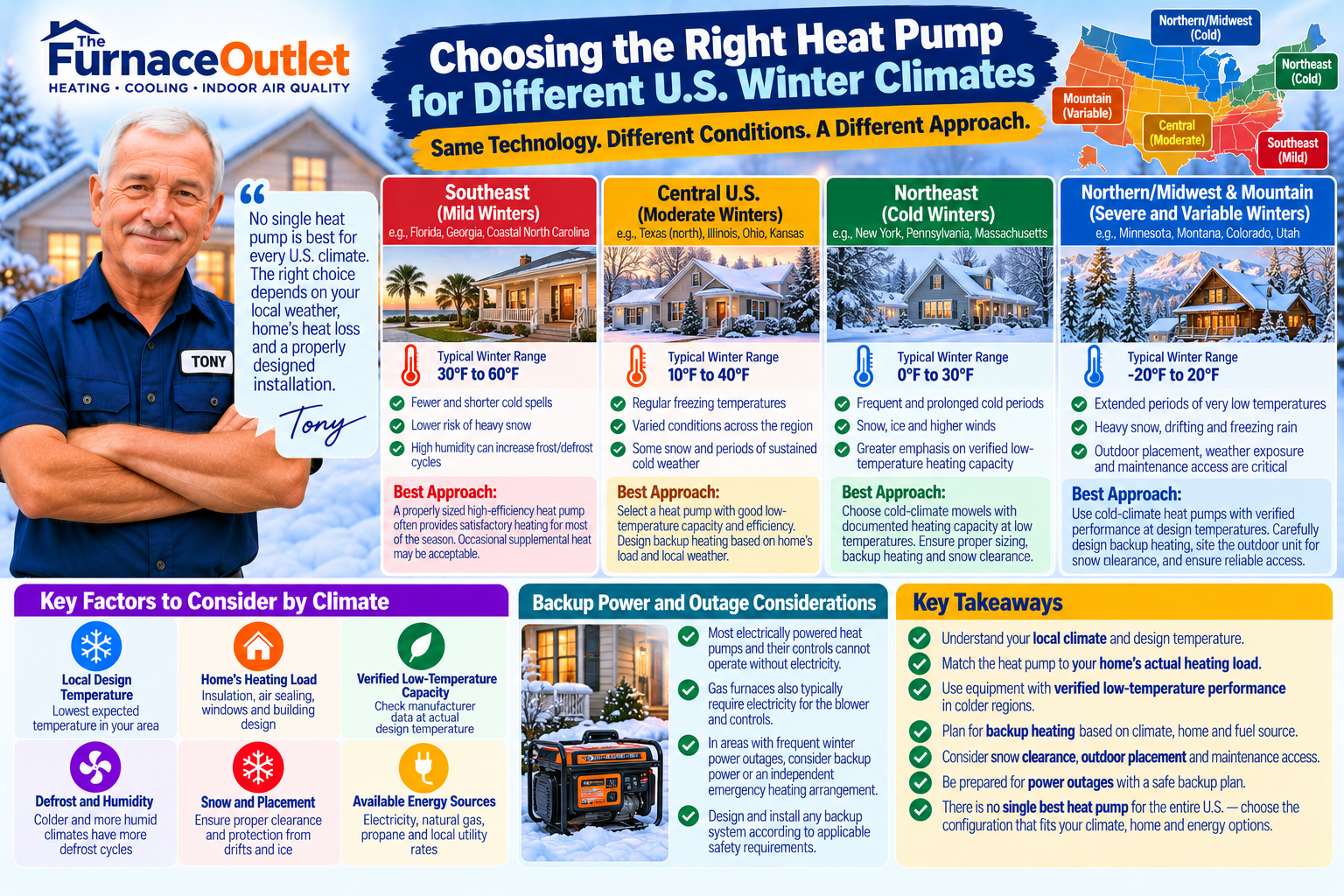
A heat pump installation in coastal North Carolina faces different conditions from one in northern Minnesota. Both locations may experience freezing temperatures, but the frequency, duration, humidity, snowfall, and severity of winter weather can be substantially different.
In relatively mild winter climates, a properly sized conventional high-efficiency heat pump may provide satisfactory heating for much of the season. Occasional supplemental heat may be acceptable if the homeowner understands its operating costs.
In the Northeast and upper Midwest, equipment selection should place greater emphasis on verified low-temperature heating capacity, cold-weather efficiency, snow clearance, and backup heating design. Homes in these regions may experience extended periods during which the heat pump operates near its maximum available capacity.
In mountainous areas, outdoor placement and weather exposure can be especially important. Snow accumulation, drifting, freezing rain, and access for winter maintenance may influence installation design as much as the nominal temperature rating.
For homes in areas with frequent winter power outages, remember that most electrically powered heat pumps and their controls cannot operate without electricity. A gas furnace may also require electricity for its blower and controls. Any backup power or independent emergency heating arrangement should be designed and installed according to applicable safety requirements.
No single heat pump configuration is automatically best for every U.S. climate. The appropriate choice depends on the relationship between local weather, the building’s heat loss, available energy sources, and the equipment’s verified performance.
There is no universal outdoor temperature at which all heat pumps stop operating. Conventional and cold-climate models have different minimum operating limits and heating capacities. Some cold-climate systems can operate well below 0°F, but homeowners should verify the exact model’s published operating range and available heating output.
Yes, some properly selected cold-climate heat pumps can heat a house at 0°F. Whether a particular system can maintain the desired indoor temperature without backup heat depends on its available capacity and the home’s heating load. The manufacturer’s 0°F or nearby low-temperature performance data should be compared with a professional load calculation.
Extended operation can be normal because the house loses heat more rapidly during freezing weather. Variable-speed systems are often designed to operate for long periods. If indoor temperatures remain stable, continuous operation is not necessarily a concern. If temperatures fall or fault codes appear, the system should be evaluated.
Light frost on the outdoor coil can be normal during heating operation. The defrost system should periodically remove excessive frost. Heavy ice that remains on the coil, blocks the fan, or prevents normal airflow is not something homeowners should ignore.
Defrost duration varies by manufacturer, control strategy, and operating conditions. Many cycles last only several minutes, but there is no single duration that applies to every system. Repeated unusually long cycles or persistent ice buildup should be assessed using the manufacturer’s specifications.
Steam-like vapor may appear when a defrost cycle melts frost on the outdoor coil and moisture evaporates into cold air. This can be normal. However, smoke accompanied by a burning smell, electrical noises, or visible equipment damage requires immediate attention.
No. Auxiliary heat may activate during very cold weather, rapid thermostat recovery, or defrost operation. Occasional activation can be part of normal system operation. Frequent or prolonged activation may justify reviewing heating capacity, thermostat settings, and equipment performance.
Generally, no. Emergency heat is not intended to replace normal heat pump operation merely because outdoor temperatures are below 32°F. It is typically used when the heat pump cannot operate properly, according to the equipment and thermostat instructions.
Under many operating conditions, yes. A heat pump with a COP above 1.0 delivers more heat per unit of electricity than direct electric resistance heating. Actual efficiency varies with outdoor temperature, defrost operation, equipment design, and supplemental heat usage.
Not necessarily. Some installations use electric resistance backup, some use a gas or propane furnace, and others use separate supplemental heating equipment. Certain cold-climate heat pumps may meet the full design heating load without routine supplemental heat, although the overall system design should still consider reliability and local conditions.
Do not cover an operating heat pump with a conventional protective cover that blocks airflow. The unit must exchange heat with outdoor air. Follow the manufacturer’s guidance for snow clearance, installation height, and weather protection.
There is no universally optimal temperature. Many homeowners benefit from a reasonably consistent setting, particularly when large setbacks would trigger electric resistance backup heat. Comfort preferences, thermostat capabilities, insulation, and utility pricing should guide the final strategy.
Most residential heat pumps require electricity for the compressor, fans, and controls. They normally stop operating during a power outage unless a properly designed backup electrical supply is available. Any generator or battery system must be compatible with the equipment’s electrical requirements.
A dual-fuel system can be a strong option where gas or propane is available and a furnace provides a useful alternative during very cold conditions. However, it is not automatically more economical than a properly selected all-electric cold-climate system. Fuel prices, heating load, equipment efficiency, and installation costs determine the better choice.
The most reliable approach is to compare a professional heating-load calculation with the equipment’s documented heating capacity at local design temperatures. Nominal tonnage alone is insufficient. The evaluation should also account for backup heating, ductwork, airflow, and the manufacturer’s operating limits.
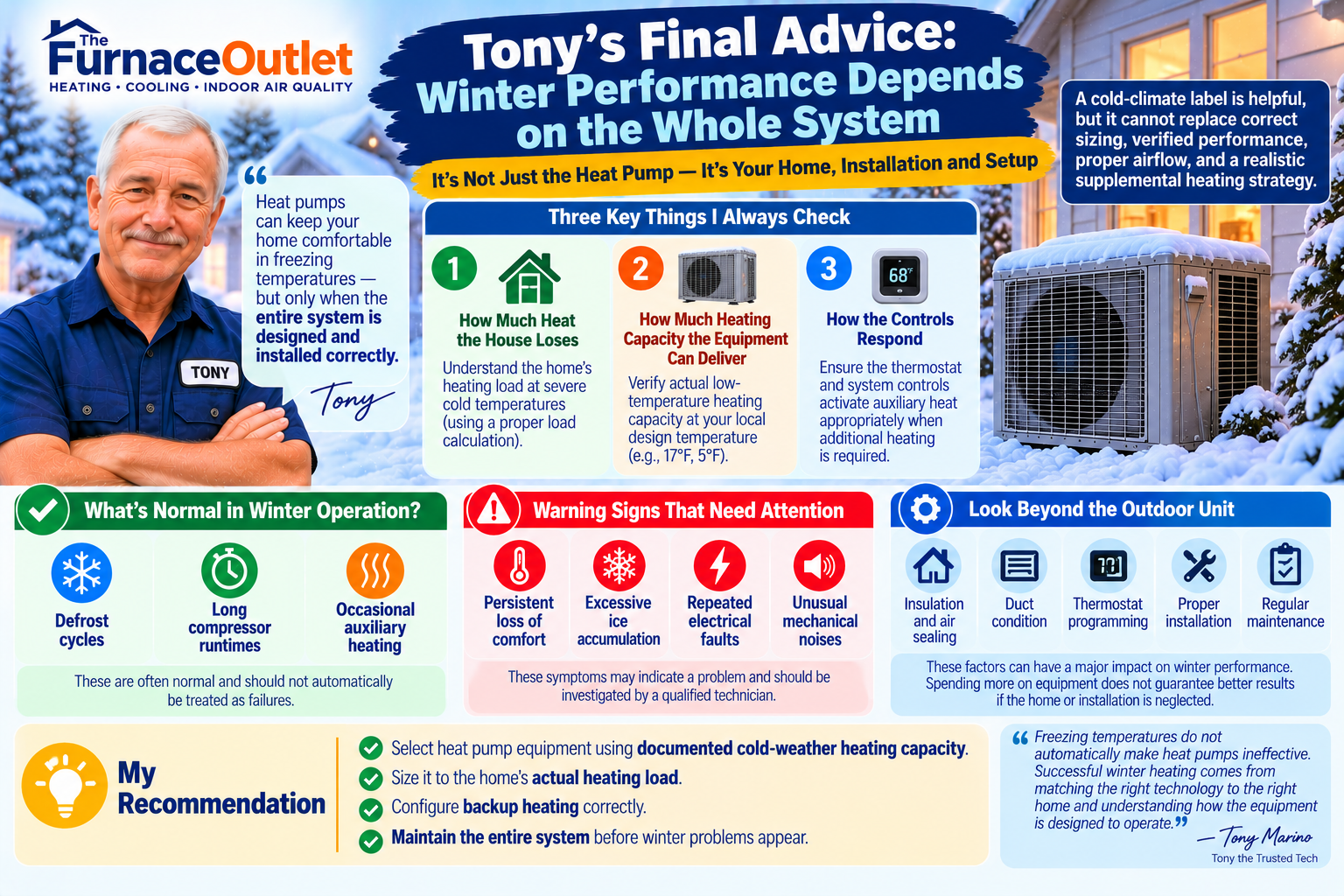
When homeowners ask me whether heat pumps are dependable in freezing temperatures, my answer is that the technology is capable, but the installation must be designed for the conditions it will actually face. A cold-climate label is useful, yet it cannot replace correct sizing, verified low-temperature performance, proper airflow, and a realistic supplemental heating strategy.
I pay particular attention to three things: how much heat the house loses during severe cold, how much heating capacity the selected equipment can deliver at that temperature, and how the controls respond when additional heating is required. If those three elements are coordinated correctly, a heat pump has a much better chance of delivering comfortable, predictable winter operation.
Defrost cycles, long compressor runtimes, and occasional auxiliary heating should not automatically be treated as failures. They can be normal parts of winter operation. The warning signs are persistent loss of comfort, excessive ice accumulation, repeated electrical faults, unusual mechanical noises, or heating performance that falls well below what the equipment should deliver.
I also encourage homeowners to think beyond the outdoor unit. Insulation, air sealing, duct condition, thermostat programming, and maintenance can have a meaningful effect on how well the system performs. Spending more on equipment does not guarantee better results if the installation or building conditions are neglected.
My recommendation is to select heat pump equipment using documented cold-weather heating capacity, size it to the home’s actual heating load, configure backup heating correctly, and maintain the entire system before winter problems appear. That is a far more dependable approach than relying on advertised minimum temperatures or assuming every heat pump performs the same way.
For U.S. homeowners planning their heating systems for the 2026–2027 winter season, the most important lesson is straightforward: freezing temperatures do not automatically make heat pumps ineffective. Successful winter heating comes from matching the right technology to the right home and understanding how the equipment is designed to operate.
This article is provided by The Furnace Outlet for general educational and informational purposes. It does not replace manufacturer installation instructions, professional HVAC design, licensed technical service, or applicable building and electrical codes. Heat pump performance, efficiency, heating capacity, and operating limits vary by model, matched equipment combination, climate, and installation conditions.
Homeowners should not open electrical compartments, bypass safety controls, handle refrigerants, modify defrost systems, or attempt compressor and high-voltage repairs without appropriate training and authorization. Refrigerant handling and many HVAC service procedures require qualified personnel and may be subject to federal, state, or local regulations.
If equipment produces a burning smell, repeatedly trips a breaker, develops significant electrical faults, or creates another immediate safety concern, discontinue operation when safe to do so and contact a qualified professional. For combustion-based backup systems, maintain appropriate carbon monoxide alarms and follow fuel-gas safety procedures. Product selection, repair, and replacement decisions should be based on a professional assessment of the specific installation.
The Furnace Outlet is an independent informational resource. Manufacturer names, equipment references, and performance specifications should be independently verified against current official documentation. Any commercial relationships or affiliate links should be disclosed separately where applicable.
The following six official government and industry resources were checked for relevance and link accessibility during preparation of this guide.
© 2026 The Furnace Outlet | https://thefurnaceoutlet.com