Newsletter Subscribe
Enter your email address below and subscribe to our newsletter

HVAC made simple
By Jake Lawson | HVAC Specialist | The Furnace Outlet
Updated October 2026 | Indoor Air Quality, Allergies & HVAC Filtration
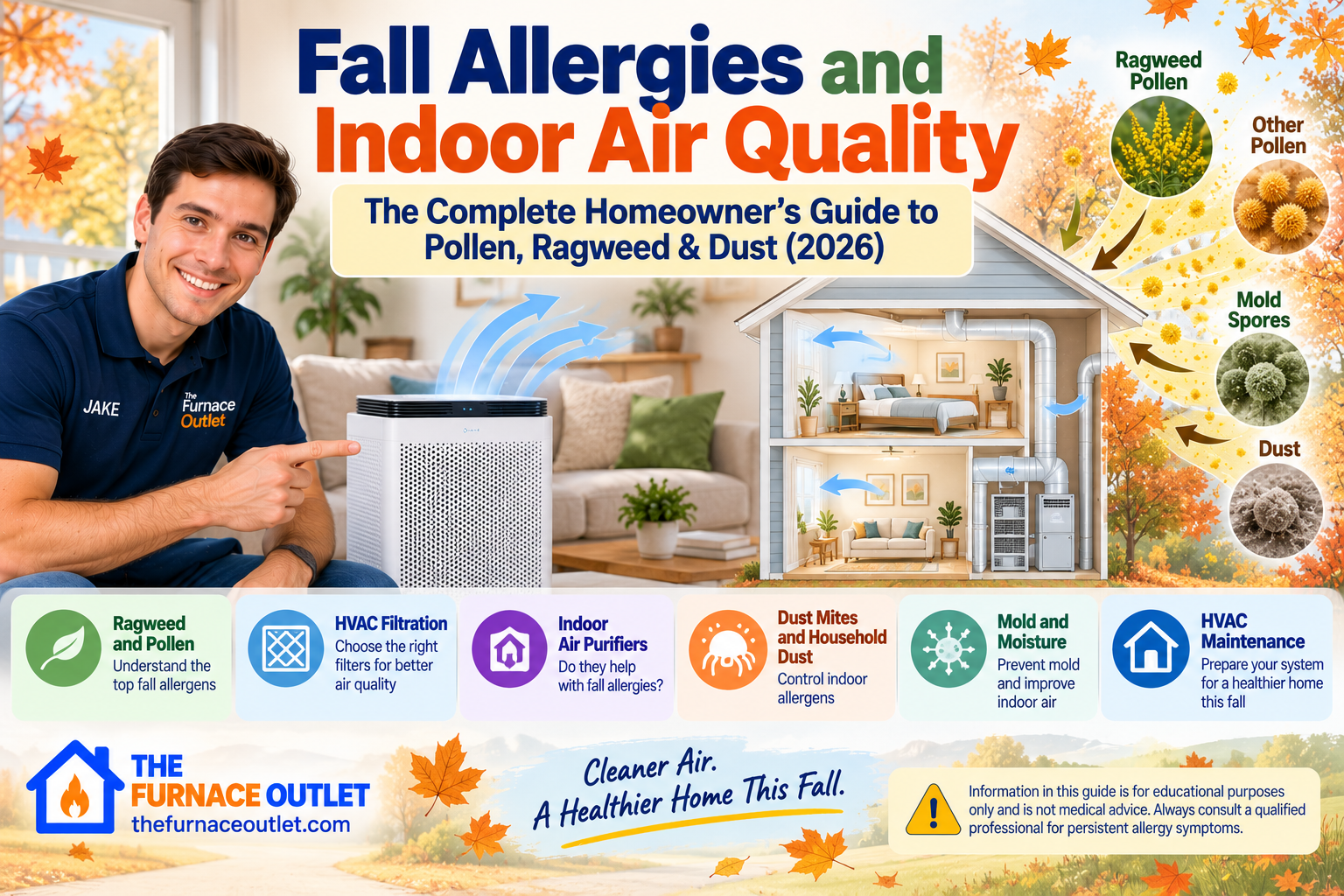
Fall is one of my favorite times of the year to talk about indoor air quality because it reveals something many homeowners overlook: the air inside a house is closely connected to what is happening outdoors. As temperatures begin dropping, leaves change color, and heating systems return to regular operation, millions of Americans experience sneezing, itchy eyes, nasal congestion, coughing, and other symptoms associated with seasonal allergies. Although spring is widely recognized as allergy season, autumn brings its own challenges, particularly from ragweed pollen, airborne mold spores, household dust, and allergens that accumulate in indoor environments.
One of the most common questions I hear is why allergies seem to become worse inside the home when the windows are closed and the HVAC system is operating. Homeowners often assume that staying indoors should protect them from pollen, but the reality is more complicated. Outdoor allergens can enter through doors, windows, ventilation openings, and small gaps in the building envelope. They can also arrive on clothing, shoes, hair, and pets. Once inside, these particles may settle on carpets, furniture, bedding, and other surfaces, where ordinary household activity can disturb them and return some of the material to the air.
As an HVAC specialist with more than 10 years of experience, I approach fall allergy problems by looking beyond the air filter alone. Filtration is important, but so are ventilation, humidity control, moisture management, ductwork condition, housekeeping practices, and the way a home’s heating and cooling equipment circulates air. An expensive air purifier cannot correct a leaking basement, and a high-efficiency HVAC filter cannot remove pollen that remains trapped in bedding or upholstery. The most effective approach is to understand how allergens enter the home, where they accumulate, and which practical improvements can reduce exposure.
In this guide, I will explain the major causes of fall allergies, how ragweed and other airborne particles affect indoor air quality, and what homeowners can do to improve their living environment. We will examine HVAC filters, portable air purifiers, dust mites, mold, indoor humidity, ventilation, duct cleaning, and seasonal maintenance, with an emphasis on solutions that are practical, affordable, and supported by established indoor air quality principles.
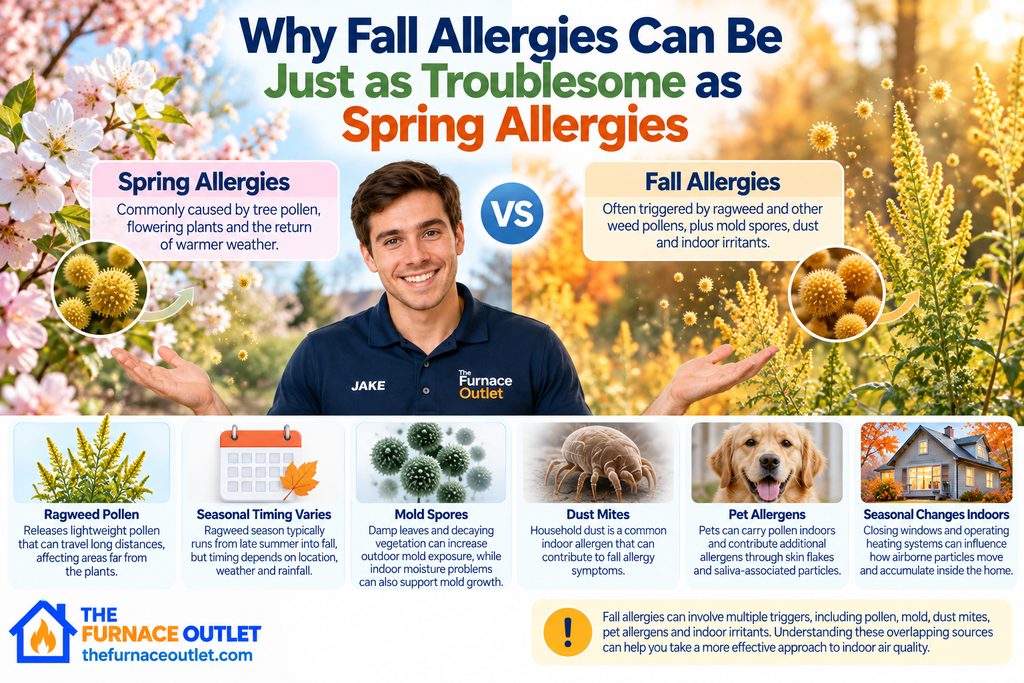
Spring allergies are commonly associated with tree pollen, flowering plants, and the return of warmer weather. Fall allergies have a different seasonal pattern, with ragweed and other weed pollens becoming important triggers across many regions of the United States. Ragweed is particularly troublesome because it releases lightweight pollen that can travel through the atmosphere and reach locations far from the plants producing it. People may therefore experience symptoms even when their neighborhoods do not appear to contain significant ragweed vegetation.
The timing of fall allergy season varies with geography and weather. In many parts of the country, ragweed pollen becomes prominent during late summer and continues into autumn, often declining after sufficiently cold weather or frost. However, warmer conditions can extend the period during which certain plants release pollen, while wind patterns and rainfall influence how much airborne material reaches individual communities. Homeowners should therefore avoid assuming that allergy season begins or ends on a fixed calendar date.
Fall also creates conditions that can increase exposure to mold spores and household dust. Damp leaves, decaying vegetation, and wet outdoor surfaces may contribute to outdoor mold exposure, while indoor moisture problems can support mold growth in basements, bathrooms, and other vulnerable locations. At the same time, households begin changing their ventilation habits, closing windows more frequently, and operating heating equipment. These changes influence how air moves through the home and how airborne particles are distributed.
From my perspective, the most useful starting point is to recognize that fall allergy symptoms may reflect several overlapping exposures rather than one isolated problem. Ragweed pollen might be the primary seasonal trigger, but dust mites, pet allergens, mold, and indoor irritants can contribute to discomfort. Understanding those differences helps homeowners avoid spending money on products that address only a small part of the problem.
The American College of Allergy, Asthma & Immunology provides useful information about seasonal allergy patterns and the importance of identifying individual triggers.
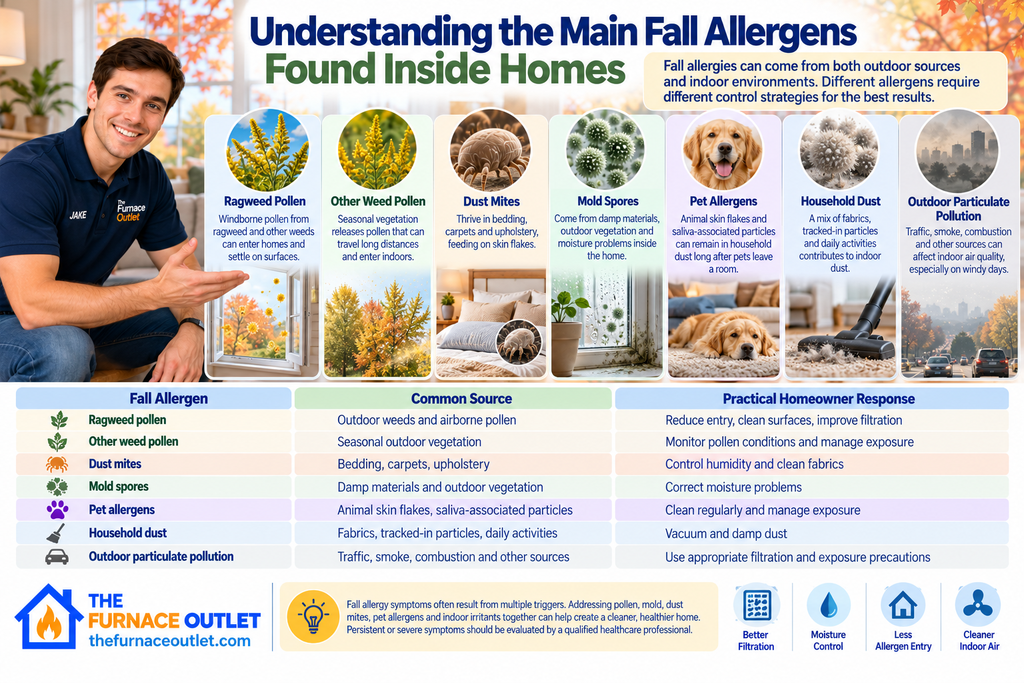
When discussing indoor air quality, I find it helpful to distinguish between allergens that originate primarily outdoors and those that are generated or accumulate inside the home. Ragweed and other seasonal pollens generally originate outdoors, although they can enter buildings and remain on indoor surfaces. Dust mite allergens, by comparison, are associated with indoor environments such as mattresses, pillows, upholstered furniture, and carpeting. Mold may originate either outdoors or indoors, depending on moisture conditions, while pet allergens can remain in household dust long after the animal has left a particular room.
These differences matter because the most effective control measures are not identical. Reducing ragweed exposure may involve keeping windows closed during high-pollen conditions and removing pollen carried indoors on clothing. Dust mite management often emphasizes bedding, humidity, and cleaning. Mold prevention requires identifying and correcting moisture problems, while pet allergen reduction generally involves cleaning, exposure management, and filtration. A good indoor air quality strategy addresses these sources together without assuming that a single product can eliminate them all.
| Fall allergen | Common source | Practical homeowner response |
|---|---|---|
| Ragweed pollen | Outdoor weeds and airborne pollen | Reduce entry, clean surfaces, improve filtration |
| Other weed pollen | Seasonal outdoor vegetation | Monitor pollen conditions and manage exposure |
| Dust mites | Bedding, carpets, upholstery | Control humidity and clean fabrics |
| Mold spores | Damp materials and outdoor vegetation | Correct moisture problems |
| Pet allergens | Animal skin flakes, saliva-associated particles | Clean regularly and manage exposure |
| Household dust | Fabrics, tracked-in particles, daily activities | Vacuum and damp dust |
| Outdoor particulate pollution | Traffic, smoke, combustion and other sources | Use appropriate filtration and exposure precautions |
It is also important to remember that not every airborne particle produces an allergic reaction. Some particles primarily irritate the eyes or respiratory system, while others trigger immune responses in people with particular sensitivities. Indoor air quality improvements may reduce exposure, but persistent symptoms should be evaluated by a qualified healthcare professional rather than automatically attributed to HVAC equipment.
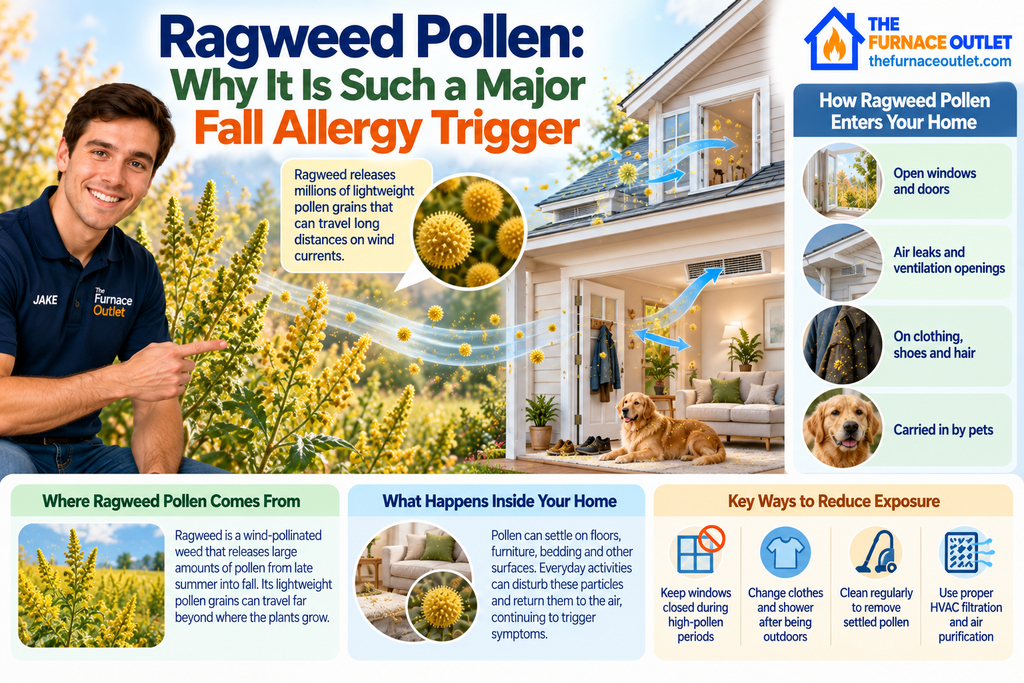
Ragweed is among the most important seasonal allergy triggers in many regions of the United States. Its pollen is lightweight and readily transported by wind, allowing it to spread beyond the immediate area where the plants grow. Unlike many flowering plants that depend on insects for pollination, ragweed releases pollen into the surrounding air, making outdoor exposure difficult to avoid during peak conditions.
What makes ragweed particularly frustrating for homeowners is its ability to enter indoor environments through several pathways. Opening exterior doors, operating windows during windy weather, and allowing uncontrolled outdoor air infiltration can introduce pollen into living spaces. Household members may also bring pollen indoors on clothing, shoes, and hair after spending time outside. Pets that spend time in gardens or grassy areas can carry additional environmental particles into the home.
Once pollen enters, it does not necessarily remain airborne indefinitely. Many particles settle onto floors, furniture, bedding, and other surfaces, where they can accumulate until removed through cleaning. Walking across carpeting, making beds, moving cushions, and other everyday activities may disturb deposited material and return some particles to the air. This explains why closing windows can reduce new pollen entry without immediately eliminating symptoms associated with material already inside the home.
My preferred strategy combines outdoor exposure awareness with indoor particle removal. During periods of elevated ragweed pollen, keeping windows closed may help limit direct entry, while changing clothes after outdoor activities and showering before bedtime can reduce pollen transfer to sleeping areas. Regular cleaning and appropriate filtration then help manage particles that have already entered the home. None of these measures guarantees complete allergen elimination, but together they provide a more realistic approach than relying exclusively on an air purifier.
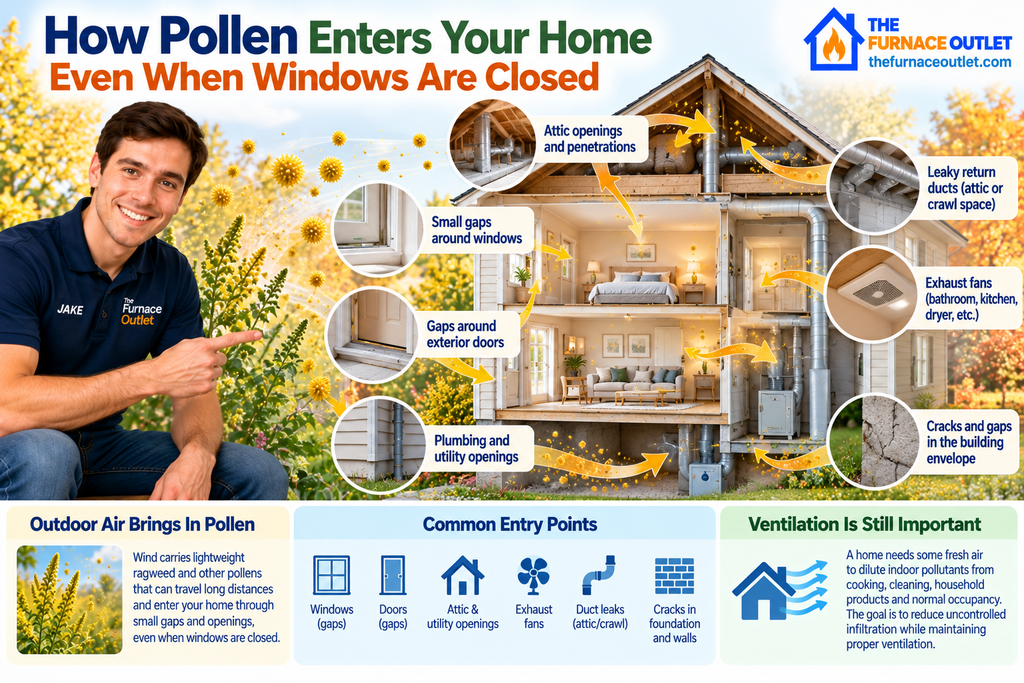
Many homeowners are surprised to learn that a closed house is not necessarily an airtight house. Small gaps around windows, exterior doors, attic penetrations, plumbing openings, and other building connections can allow outdoor air to enter. Wind and differences between indoor and outdoor temperatures influence this movement, while exhaust fans and other equipment may change household air pressure.
These pathways are important because outdoor air can carry pollen, dust, and other particles into occupied spaces without anyone deliberately opening a window. Leaky return ducts located in attics, crawl spaces, or other unconditioned areas can also draw air from undesirable locations under certain operating conditions. In such situations, the problem may involve the building envelope or duct system rather than the efficiency of the air filter itself.
However, I would not recommend attempting to eliminate every source of outdoor air without considering ventilation requirements. Homes generate pollutants indoors through cooking, cleaning, household products, moisture-producing activities, and normal occupancy. Appropriate ventilation is necessary to dilute these contaminants and maintain a healthy indoor environment. The goal is to reduce uncontrolled infiltration while preserving properly designed ventilation.
The U.S. Environmental Protection Agency’s indoor air quality resources explain how pollution sources, ventilation, and building conditions influence indoor air. For homeowners with recurring allergy problems, identifying obvious air leaks and evaluating ventilation performance can be more useful than purchasing increasingly expensive filtration equipment without understanding where contamination originates.
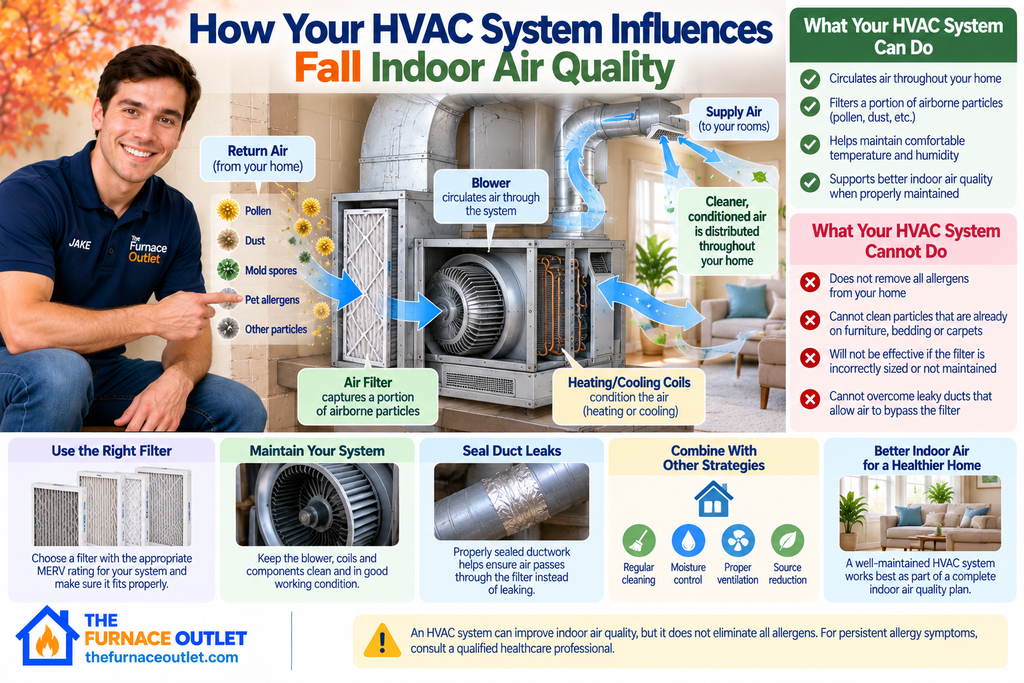
Your heating and cooling system plays an important role in indoor air circulation, but it is important to understand exactly what the equipment can and cannot accomplish. In a typical ducted system, the blower draws air through return pathways, passes it through a filter, and distributes conditioned air through supply ducts. When the filter is properly selected, installed, and maintained, it can capture a portion of airborne particles moving through the equipment.
This process can help reduce certain airborne contaminants, but it does not automatically remove all allergens throughout the home. Particles that remain on bedding, carpeting, furniture, and other surfaces may never pass through the HVAC filter. Filtration effectiveness also depends on how frequently air moves through the system, whether the filter fits correctly, and whether duct leakage allows air to bypass intended pathways.
One mistake I frequently caution against is assuming that a higher filter rating always produces better results. A filter that captures smaller particles more efficiently may also create greater airflow resistance, depending on its construction and size. If the HVAC system cannot accommodate that resistance, heating and cooling performance may suffer. Proper filtration therefore requires balancing particle capture with equipment airflow requirements.
I recommend treating the HVAC system as one component of a complete indoor air quality plan. Clean filters, correctly functioning blowers, well-maintained coils, and properly sealed ductwork can support better performance, but they work best when combined with source control, regular cleaning, appropriate ventilation, and moisture management.
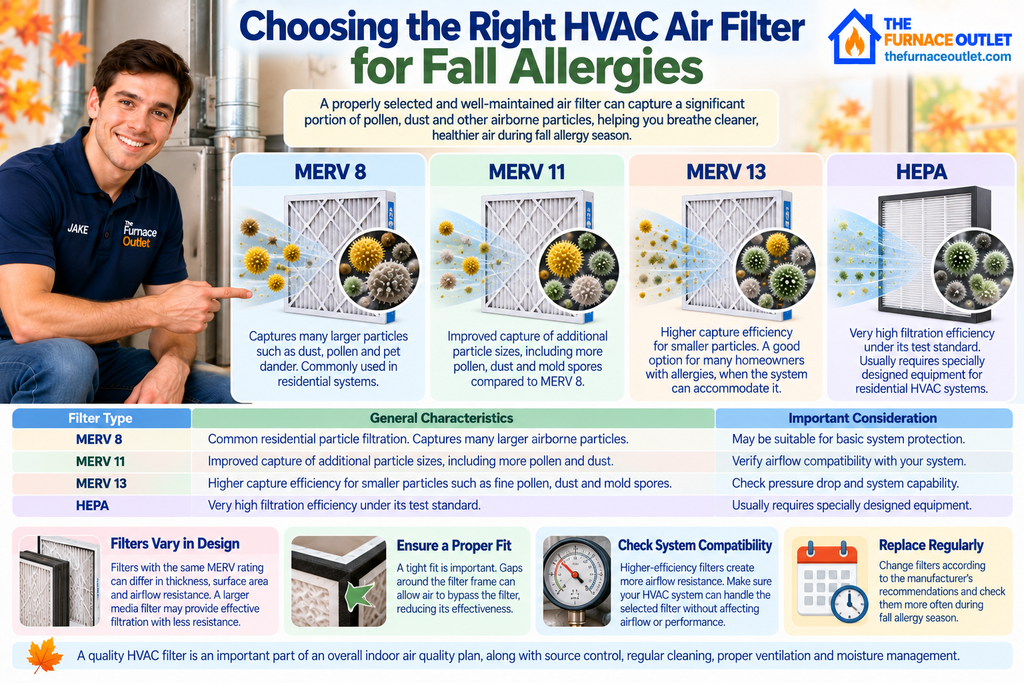
Air filtration is one of the most practical areas where homeowners can improve their indoor environment, provided the equipment is compatible with the selected filter. Most residential HVAC filters are described using the Minimum Efficiency Reporting Value, commonly called MERV. This rating system compares particle capture performance under standardized testing conditions, with higher ratings generally indicating improved capture of smaller airborne particles.
MERV 8 filters are commonly used in residential systems and can capture many larger airborne particles. MERV 11 filters provide improved capture across additional particle size ranges, while MERV 13 filters offer stronger performance for smaller particles under the relevant test conditions. For homeowners concerned about airborne pollen, dust, and other particles, MERV 13 can be worth considering when the system is designed or verified to accommodate it.
| Filter type | General characteristics | Important consideration |
|---|---|---|
| MERV 8 | Common residential particle filtration | May be suitable for basic system protection |
| MERV 11 | Improved capture of additional particle sizes | Verify airflow compatibility |
| MERV 13 | Higher capture efficiency for smaller particles | Check pressure drop and system capability |
| HEPA | Very high filtration efficiency under its test standard | Usually requires specially designed equipment |
The practical challenge is that filters with identical MERV ratings can differ in thickness, surface area, and airflow resistance. A large media filter may provide effective filtration with less resistance than a smaller filter of similar efficiency. Filter fit is equally important because gaps around the frame can allow air to bypass the filtration material entirely.
The EPA’s Guide to Air Cleaners in the Home provides useful information about residential filtration and portable air-cleaning equipment. Before upgrading, I recommend reviewing the HVAC manufacturer’s requirements or asking a qualified technician to verify that the proposed filter will maintain acceptable airflow.
Filter replacement frequency depends on the filter’s design, household dust conditions, pets, occupancy, and the amount of time the HVAC system operates. A heavily used system in a dusty household may require more frequent attention than a lightly used system with a larger-capacity media filter. This is why I prefer checking the filter’s actual condition and following manufacturer recommendations rather than applying one replacement schedule to every home.
During fall, increased pollen exposure and the return of regular heating operation make periodic filter inspections particularly worthwhile. Homeowners should also check that the filter is installed in the correct airflow direction and that the access panel closes properly. If airflow remains weak or comfort declines after a filter change, professional evaluation may be necessary because the underlying problem could involve the blower, ductwork, or other system components.
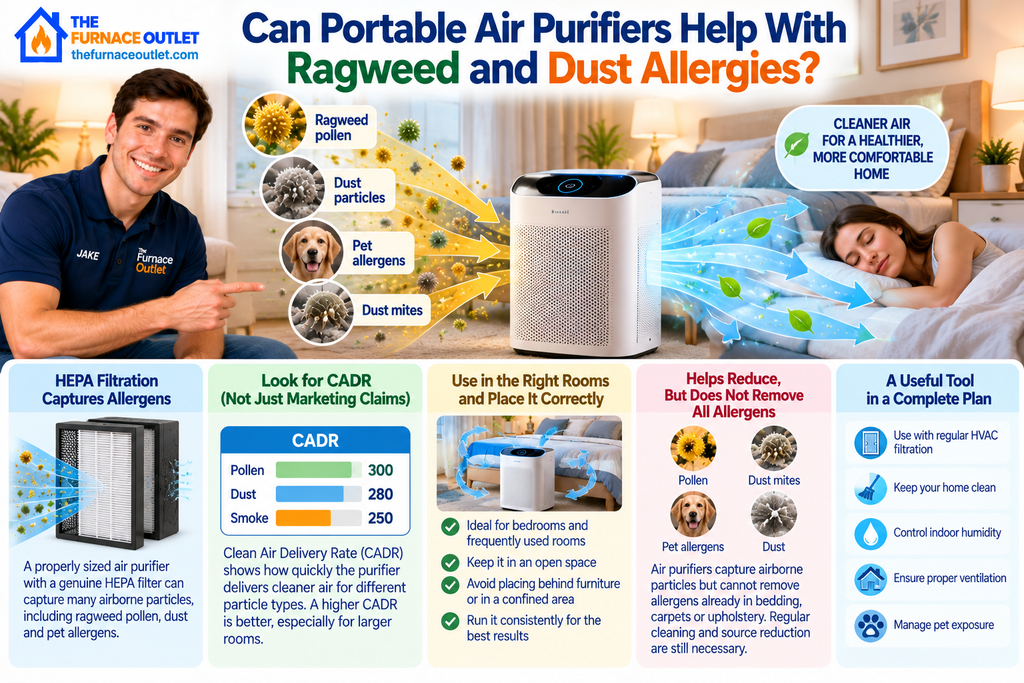
Portable air purifiers can be useful additions to a fall indoor air quality strategy, especially in bedrooms and other frequently occupied rooms. A properly sized purifier with a genuine HEPA filter can capture many airborne particles that pass through the device, including pollen and dust-associated material. However, its effectiveness depends on room size, airflow, operating speed, placement, and how consistently it is used.
When comparing air purifiers, I recommend paying attention to Clean Air Delivery Rate, or CADR, rather than relying on advertising claims about the number of filtration stages or the percentage of contaminants supposedly eliminated. CADR provides a standardized indication of how quickly a device delivers cleaned air for particular particle categories. A purifier with insufficient clean-air delivery may struggle to meaningfully reduce airborne particle concentrations in a large room, even if its filter material is highly efficient.
Placement deserves consideration as well. A purifier positioned behind furniture, inside a confined space, or near an obstruction may not circulate air effectively. For households experiencing nighttime allergy discomfort, the bedroom is often a sensible starting point because people spend several consecutive hours there. Operating a suitable purifier consistently may provide more useful exposure reduction than switching a powerful device on only occasionally.
I would also emphasize that air purifiers do not remove allergens already embedded in mattresses, upholstery, or carpets. Regular cleaning and source reduction remain necessary, particularly when dust mites or pet allergens contribute to symptoms. Portable purification is best viewed as an additional tool rather than a complete replacement for good household maintenance.
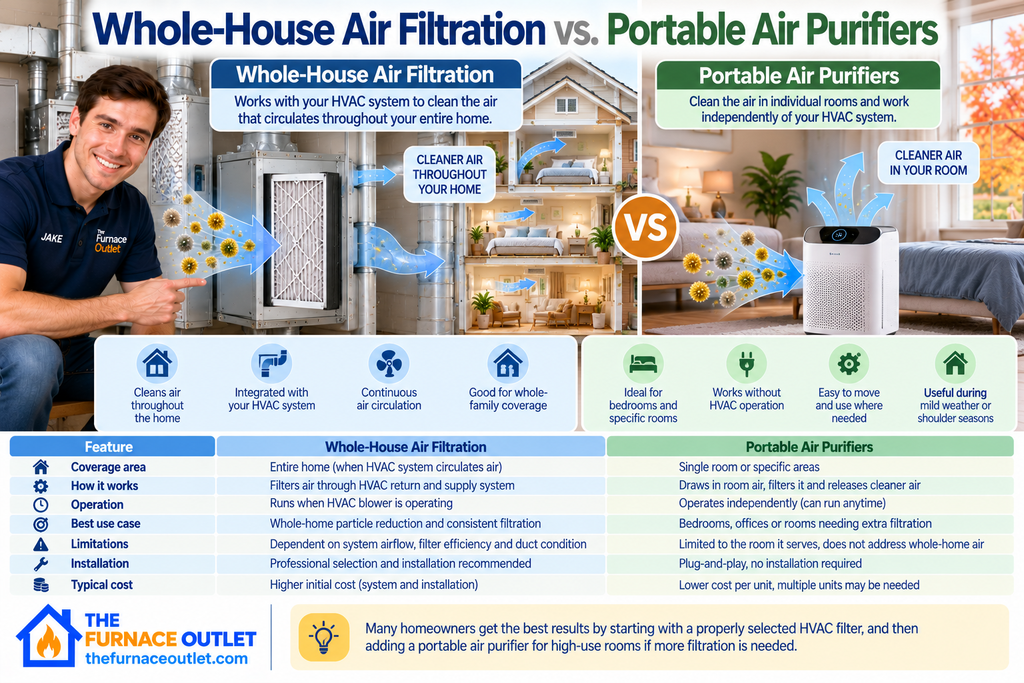
Homeowners frequently ask whether they should invest in a whole-house filtration system or purchase several portable air purifiers. My answer depends on the home’s HVAC configuration, existing filtration performance, room usage, and budget. A properly designed central filtration arrangement can capture particles moving through the HVAC system and provide broad coverage when air circulates through the duct network. However, filtration is limited by system airflow, filter efficiency, and operating patterns.
Portable air purifiers offer a different advantage because they can operate independently of the central heating or cooling equipment. A bedroom purifier can continue removing airborne particles even when the thermostat is not requesting heating or cooling. This may be useful during mild fall weather when the central system operates less frequently.
For many households, I would begin by ensuring that the existing HVAC filter is appropriate and properly installed before considering expensive whole-house upgrades. If additional filtration is needed, a correctly sized bedroom purifier may offer a practical next step. Larger investments should be based on actual household needs, equipment compatibility, and realistic performance expectations rather than claims that a particular technology will eliminate all allergens.
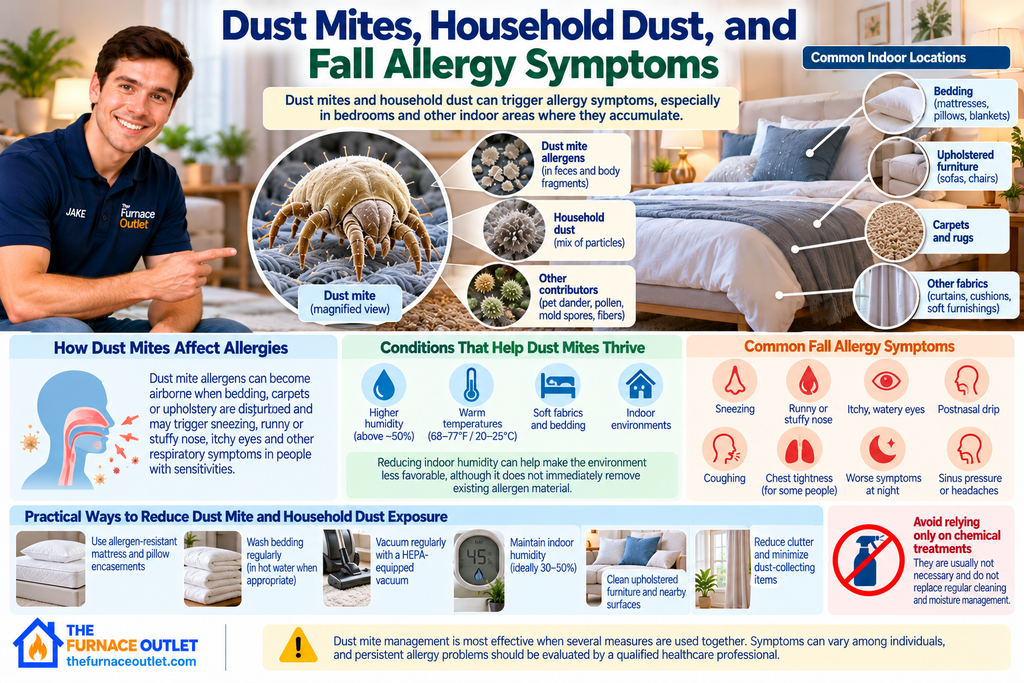
Dust mites are microscopic organisms commonly found in bedding, upholstered furniture, carpets, and other locations where suitable conditions exist. Their allergenic material can accumulate in household dust and become airborne when fabrics or furnishings are disturbed. Unlike ragweed pollen, which enters primarily from outdoors, dust mite allergens are associated with indoor reservoirs that require regular attention.
Humidity influences dust mite populations because these organisms generally thrive under more humid conditions. Maintaining appropriate indoor humidity can help make the environment less favorable, although reducing humidity does not immediately remove existing allergen material from mattresses, pillows, or carpets. This is why dust mite management usually involves several measures working together.
I recommend paying particular attention to bedrooms because mattresses and bedding can hold substantial amounts of accumulated allergen material. Washing suitable bedding regularly, using allergen-resistant mattress and pillow encasements where appropriate, and cleaning floors and nearby surfaces can help reduce exposure. Vacuuming with a properly maintained HEPA-equipped machine may also be useful, especially in rooms containing carpets or upholstered furniture.
Homeowners should avoid assuming that visible dust alone determines the severity of dust mite exposure. Many important allergenic particles are not easily identified by sight, and symptoms vary considerably among individuals. Consistent cleaning and moisture management generally provide a more dependable approach than attempting to sterilize the entire home or relying on heavily marketed chemical treatments.
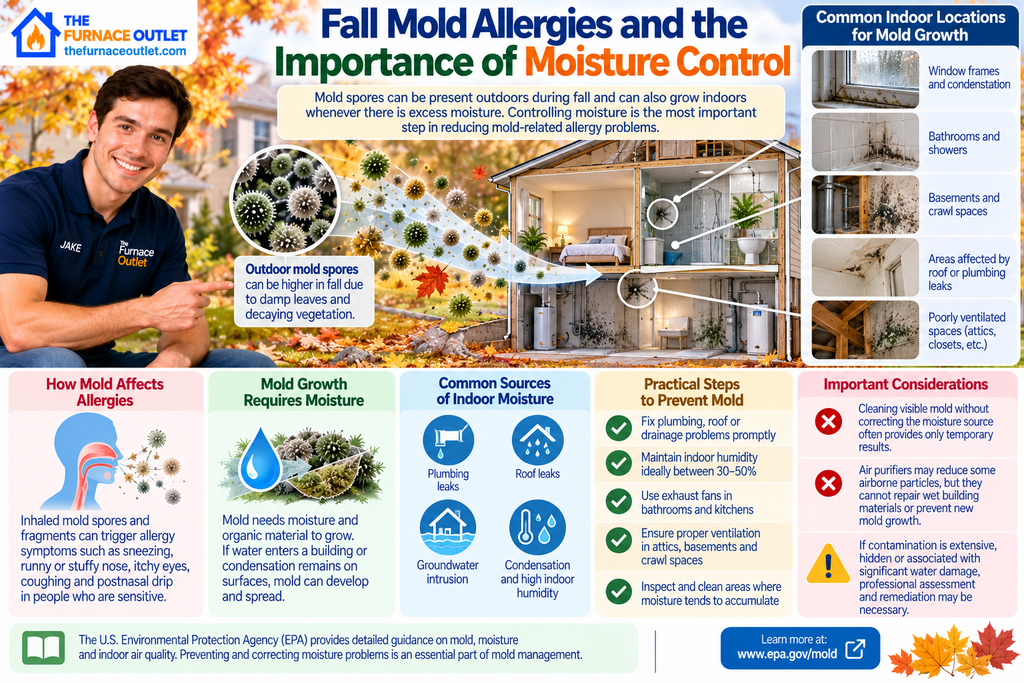
Mold deserves particular attention during fall because changing weather conditions, damp vegetation, and indoor moisture problems can contribute to exposure. Outdoor mold spores may be present around decaying leaves and wet surfaces, while indoor mold can develop wherever suitable materials remain damp. Basements, bathrooms, window frames, poorly ventilated spaces, and areas affected by plumbing or roof leaks are common locations requiring inspection.
Mold growth is fundamentally a moisture problem. If water repeatedly enters a building or condensation remains on vulnerable surfaces, cleaning visible contamination without correcting the moisture source may provide only temporary improvement. Materials can become damp through plumbing failures, roof leaks, groundwater intrusion, inadequate drainage, or condensation caused by temperature differences and excessive indoor humidity.
The EPA’s mold and moisture resources emphasize preventing and correcting moisture problems as essential elements of mold management. I recommend investigating persistent musty odors, visible water damage, and recurring condensation rather than immediately purchasing an air purifier marketed specifically for mold removal.
Air filtration may reduce some airborne particles, but it cannot repair wet building materials or prevent new mold growth when moisture conditions remain favorable. Where contamination is extensive, hidden, or associated with significant water damage, professional assessment and appropriate remediation may be necessary.
An HVAC system can move airborne particles throughout a building, including spores that become suspended in the air. However, the presence of ductwork or a musty odor does not automatically prove that mold is growing inside the system. Moisture conditions, contamination sources, and the condition of HVAC components must be evaluated before drawing conclusions.
Cooling coils and condensate drainage components deserve attention because they routinely handle moisture during cooling operation. If drain pans, drainage lines, or surrounding materials remain wet because of defects or poor maintenance, conditions may become favorable for microbial growth. Proper drainage and equipment maintenance are therefore important parts of an indoor air quality strategy.
I recommend having qualified professionals investigate persistent moisture or suspected contamination inside HVAC equipment. Homeowners should not attempt aggressive chemical treatment or internal disassembly without understanding the equipment’s materials, safety requirements, and manufacturer instructions.
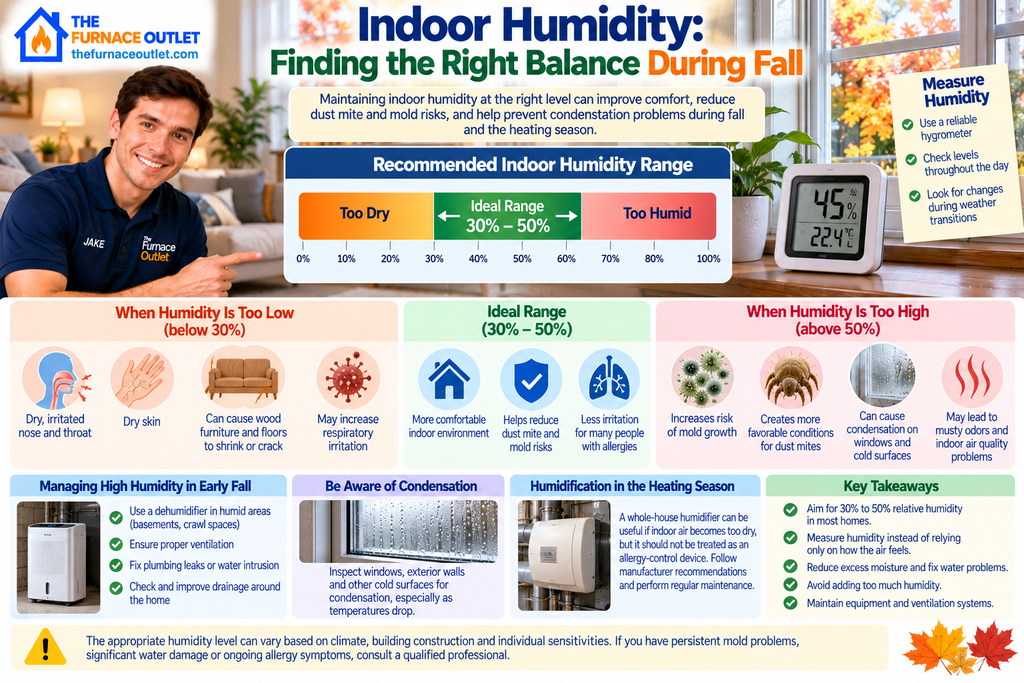
Humidity affects indoor comfort, dust mite conditions, condensation, and the potential for mold growth. Maintaining indoor relative humidity around 30% to 50% is a commonly recommended general target, although the most appropriate level depends on outdoor conditions, building construction, and condensation risk. In colder weather, humidity levels that appear acceptable on a room hygrometer may still produce condensation on poorly insulated windows or other cold surfaces.
During early fall, homes in humid climates may continue experiencing excessive indoor moisture, particularly in basements and other poorly ventilated locations. Dehumidification, appropriate ventilation, and correction of water intrusion may be necessary to control those conditions. As heating season progresses, indoor air may become drier in some regions, leading homeowners to consider humidification for comfort.
I recommend measuring humidity rather than making decisions based entirely on how the air feels. A reliable hygrometer can help identify whether moisture levels are consistently elevated, excessively low, or changing substantially throughout the day. Homeowners should also inspect windows, exterior walls, and other vulnerable surfaces for condensation because visible moisture can reveal conditions that encourage deterioration or microbial growth.
Whole-house humidifiers can be useful in appropriate circumstances, but they should not be treated as allergy-control devices. Adding excessive moisture may worsen conditions for dust mites or mold, and humidification equipment itself requires regular maintenance. The objective is balanced moisture control rather than automatically increasing humidity whenever outdoor temperatures decline.
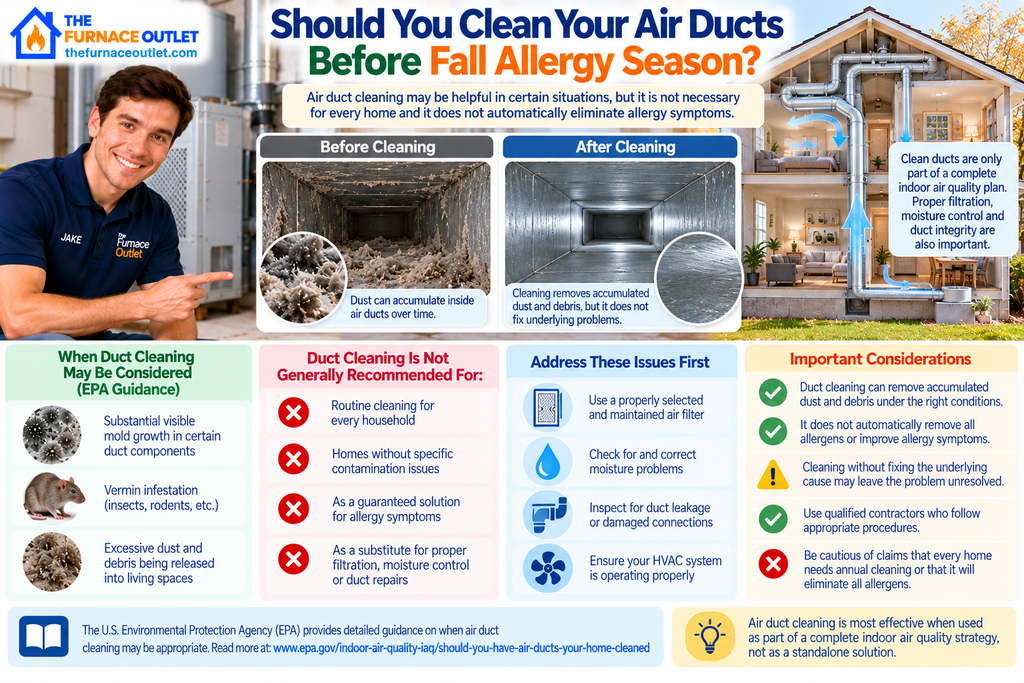
Air duct cleaning is one of the most frequently advertised indoor air quality services, and it is also one of the areas where homeowners should examine claims carefully. Dust can accumulate inside duct systems, but the presence of dust does not automatically establish that large quantities are being released into occupied rooms. Nor does routine duct cleaning guarantee improved allergy symptoms.
The EPA does not recommend routine duct cleaning for every household. Instead, it identifies circumstances in which cleaning may deserve consideration, including substantial visible mold growth in certain duct components, vermin infestation, or excessive dust and debris being released into living spaces. Its guidance on whether home air ducts should be cleaned provides useful context for evaluating these situations.
My preferred approach is to inspect filtration, moisture conditions, duct leakage, and overall HVAC performance before recommending duct cleaning. If dust is entering through damaged duct connections or unfiltered return pathways, cleaning the ducts without correcting those defects may leave the underlying problem unresolved. Similarly, if moisture is supporting contamination inside the system, the source of that moisture must be addressed.
When duct cleaning is justified, the work should follow appropriate procedures and avoid damaging duct materials or spreading contamination into occupied spaces. Homeowners should be cautious about contractors promising complete allergen elimination or claiming that every home requires annual duct cleaning.
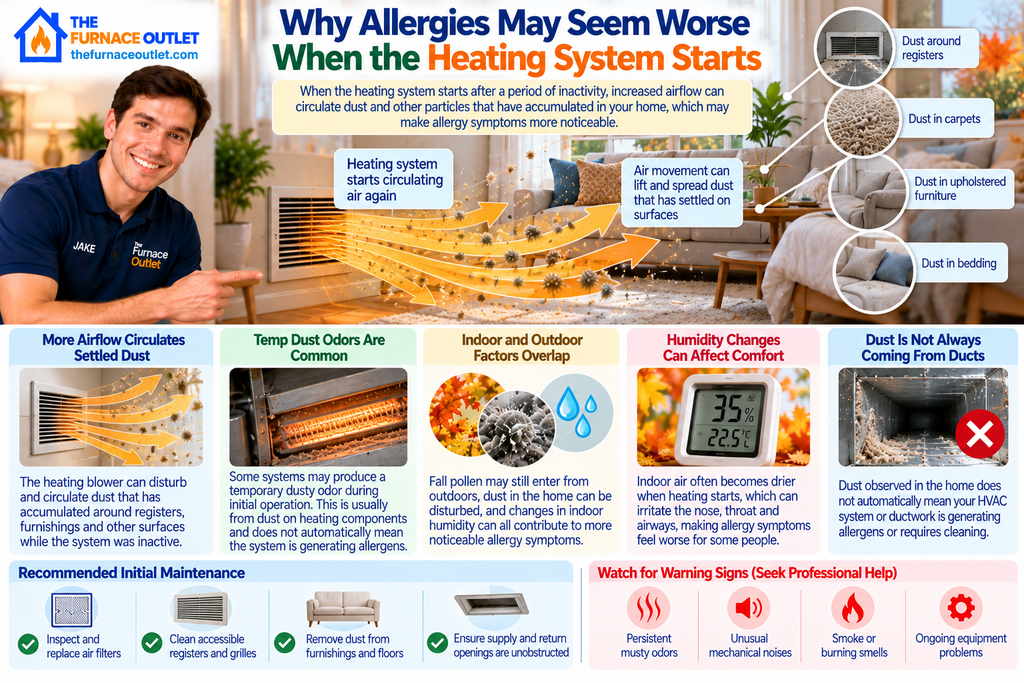
The first use of a heating system after a relatively inactive period can change household airflow patterns and draw attention to dust that has accumulated around registers, furnishings, and other surfaces. In some systems, dust on heating components may also produce a temporary odor during initial operation. However, these observations should not automatically be interpreted as evidence that the HVAC system is generating allergens or that the ductwork requires cleaning.
Air movement can disturb particles already present in the home, particularly when carpets, bedding, and upholstered furniture contain accumulated dust. At the same time, fall pollen may continue entering from outdoors, and changes in indoor humidity can influence comfort. These overlapping factors may make allergy symptoms more noticeable around the beginning of heating season.
I recommend starting with ordinary maintenance, including inspecting filters, cleaning accessible registers, and checking that supply and return openings are unobstructed. Persistent musty odors, unusual mechanical noises, smoke, or burning electrical smells require a different response because they may indicate equipment or building problems needing professional attention.
The distinction is important: normal airflow and seasonal dust disturbance may justify cleaning and observation, while persistent abnormal odors or equipment symptoms should not be dismissed as ordinary fall conditions.
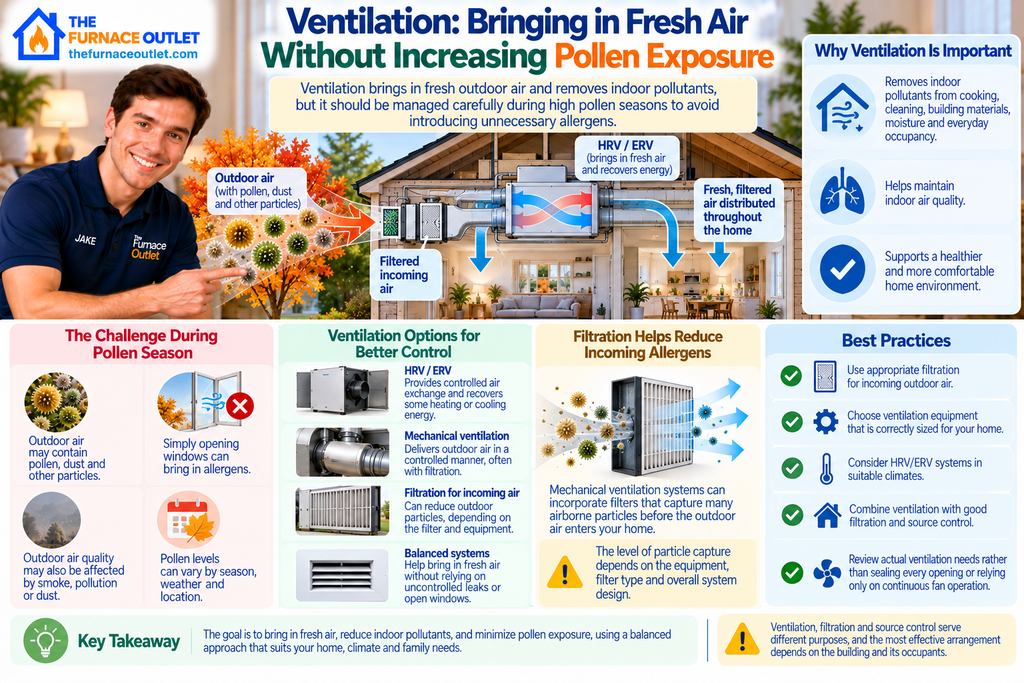
Ventilation is necessary because homes generate pollutants internally through cooking, cleaning, building materials, moisture-producing activities, and everyday occupancy. However, simply opening windows may not be the best ventilation strategy during periods of high outdoor pollen or poor air quality. Homeowners need to balance the benefits of outdoor air exchange with the potential introduction of allergens and other particles.
Mechanical ventilation systems can provide more controlled air exchange than relying entirely on uncontrolled leaks or open windows. Some systems incorporate filtration for incoming outdoor air, although the level of particle capture depends on the equipment and filter arrangement. Heat recovery ventilators and energy recovery ventilators can also exchange indoor and outdoor air while recovering some heating or cooling energy, but their performance and suitability depend on climate and system design.
I recommend reviewing the home’s actual ventilation needs rather than assuming that sealing every opening or operating the HVAC fan continuously will automatically produce better indoor air quality. Ventilation, filtration, and source control serve different purposes, and the most effective arrangement depends on the building and its occupants.
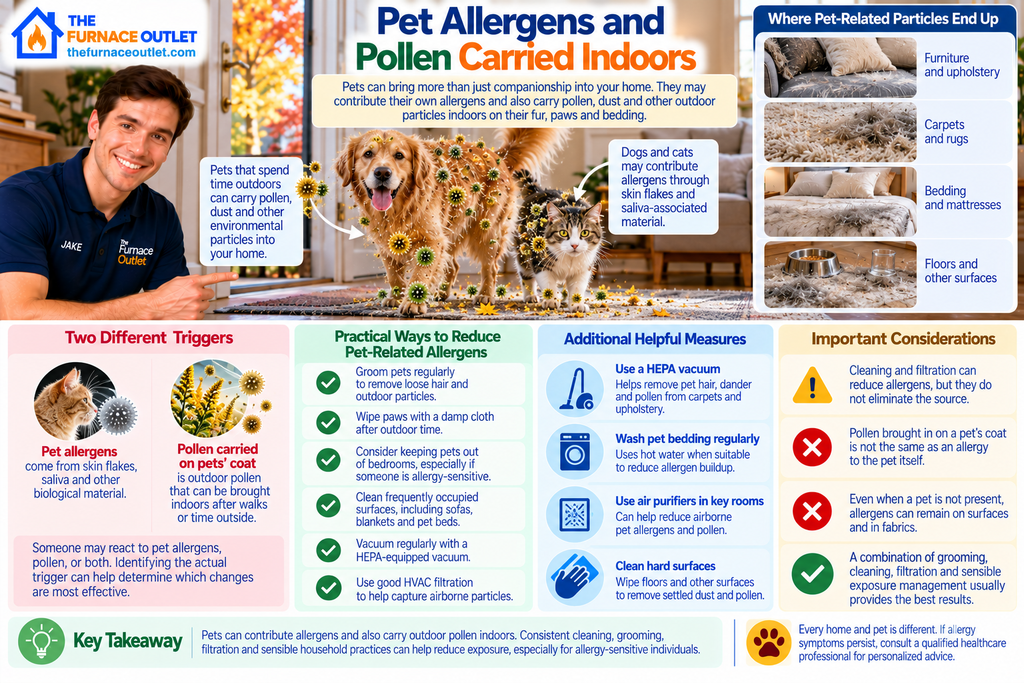
Pets can influence fall indoor air quality in more than one way. Dogs and cats may contribute allergens through skin flakes and saliva-associated material, while animals that spend time outdoors can carry pollen, dust, and other environmental particles into the home. These materials can accumulate on furniture, carpets, bedding, and other surfaces, where they may remain even when the animal is not present.
For households with allergy-sensitive occupants, I recommend consistent cleaning and realistic exposure management. Grooming pets appropriately, cleaning frequently occupied surfaces, and considering whether animals should sleep in bedrooms may help reduce allergen accumulation. Vacuuming and filtration can support these measures, although neither eliminates the source completely.
It is also important not to confuse pollen carried on an animal’s coat with an allergy to the animal itself. Someone may react primarily to ragweed pollen brought indoors, while another household member may be sensitive to pet-associated allergens. Identifying the actual trigger can help determine which changes are most worthwhile.
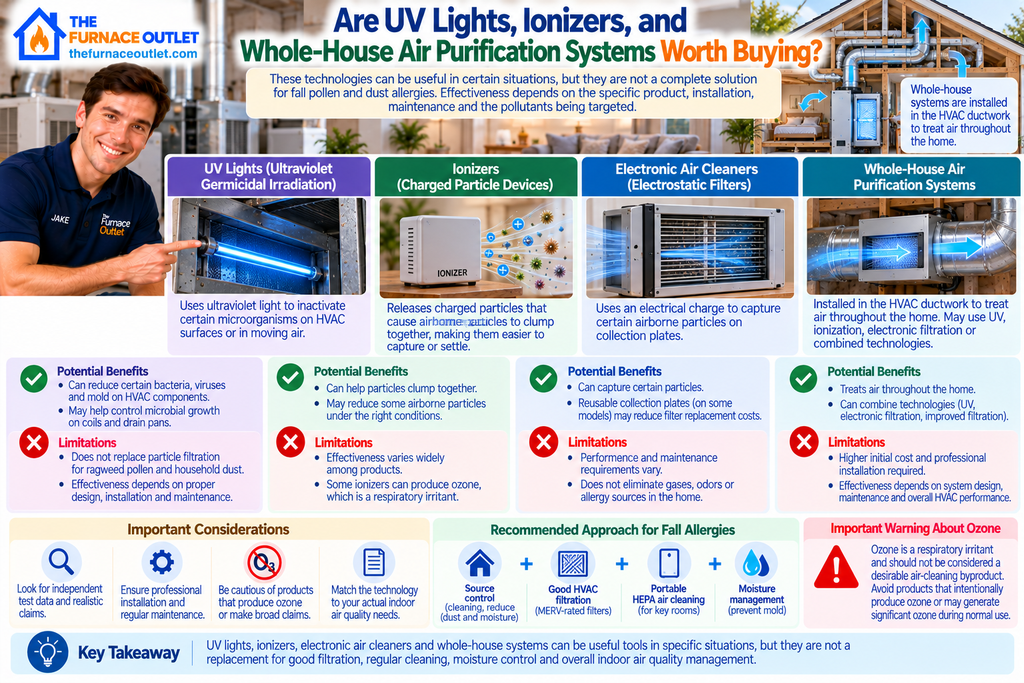
Homeowners researching indoor air quality frequently encounter products marketed as ultraviolet air purifiers, ionizers, electronic air cleaners, and advanced whole-house purification systems. These technologies operate in different ways, and their effectiveness depends on equipment design, installation, maintenance, and the particular contaminants being targeted.
Ultraviolet germicidal irradiation may be used for certain microbial-control applications, such as treating selected HVAC surfaces or moving air under suitable conditions. However, UV systems do not replace particle filtration for ragweed pollen and household dust. Electronic air cleaners may capture certain particles, but their performance and maintenance requirements vary considerably among products.
I would be especially cautious about devices that intentionally produce ozone or may generate significant ozone as a byproduct. Ozone is a respiratory irritant and should not be treated as a desirable household air-cleaning agent. Products making broad claims about eliminating every allergen, pathogen, odor, and pollutant should be evaluated against independent performance evidence rather than advertising language.
For most homeowners concerned about fall pollen and dust, I recommend beginning with source control, compatible HVAC filtration, suitable portable HEPA air cleaning, and moisture management before considering more complex technologies.
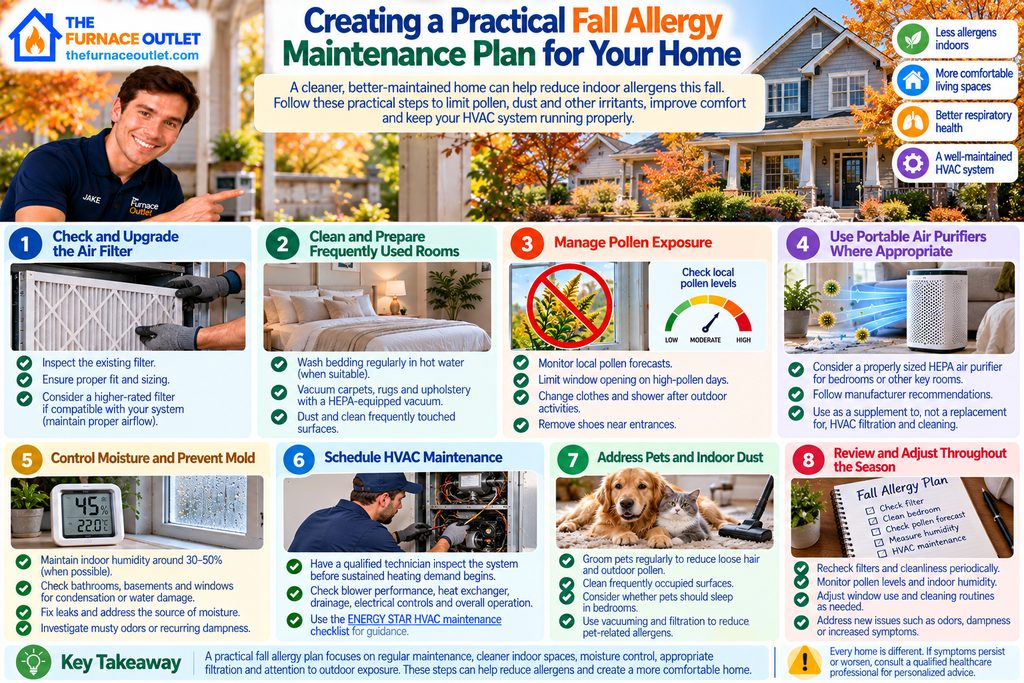
A successful fall indoor air quality plan does not require replacing every component of the HVAC system. In many cases, the most useful improvements begin with ordinary maintenance and a better understanding of household exposure patterns. I recommend inspecting the existing air filter, confirming that it fits properly, and checking whether the system provides adequate airflow. If a filtration upgrade is being considered, the equipment’s pressure-drop and airflow requirements should be reviewed first.
Next, focus on the rooms where occupants spend the most time, particularly bedrooms. Clean bedding and nearby surfaces, reduce unnecessary dust accumulation, and consider whether a properly sized portable purifier would provide useful additional filtration. Monitor local pollen conditions and adjust window-opening habits when outdoor exposure is elevated. After outdoor activities, simple measures such as changing clothes and removing shoes near entrances can help limit pollen transfer.
Moisture management should be part of the same plan. Check bathrooms, basements, windows, and other vulnerable areas for condensation or water damage, and measure indoor humidity rather than relying on assumptions. If musty odors or recurring dampness are present, investigate the cause before purchasing equipment intended to mask the symptoms.
Finally, schedule appropriate HVAC maintenance before sustained heating demand begins. A qualified technician can evaluate filtration compatibility, blower performance, heat exchanger condition, drainage, electrical controls, and other components relevant to the equipment. The ENERGY STAR HVAC maintenance checklist provides useful guidance for regular inspections and seasonal servicing.
| Priority | Homeowner action | Why it matters |
|---|---|---|
| High | Inspect and replace HVAC filters when needed | Supports airflow and airborne particle capture |
| High | Monitor local ragweed and pollen conditions | Helps reduce unnecessary outdoor exposure |
| High | Clean bedding and bedroom surfaces | Reduces accumulated allergens |
| High | Correct leaks and excessive indoor moisture | Helps prevent mold-related problems |
| High | Keep supply and return registers clear | Supports proper air circulation |
| Medium | Consider a properly sized HEPA air purifier | Adds localized particle filtration |
| Medium | Measure indoor humidity | Helps manage moisture and dust mite conditions |
| Medium | Inspect accessible ductwork for obvious damage | Identifies possible air leakage |
| Medium | Schedule professional HVAC maintenance | Supports reliable equipment operation |
| As needed | Investigate persistent musty odors | Helps identify moisture or contamination |
| As needed | Consult a qualified allergist | Helps identify individual allergy triggers |
I recommend treating this checklist as a seasonal routine rather than a one-time project. Indoor air quality changes with weather, household activities, occupancy, and equipment operation, so periodic observation is more valuable than making one expensive improvement and assuming the problem has been permanently solved.
One of the biggest mistakes is assuming that a high-priced air purifier will solve every indoor air quality concern. Air purifiers can reduce airborne particles, but they cannot repair moisture damage, prevent pollen from being carried indoors, or remove allergens embedded in household fabrics. The best results usually come from combining filtration with practical measures that address the sources of exposure.
Another mistake is installing a highly restrictive HVAC filter without checking system compatibility. Although higher-efficiency filtration can improve particle capture, inadequate airflow may interfere with heating and cooling performance. I also see homeowners focus heavily on duct cleaning while overlooking dirty bedding, humidity problems, or obvious building air leaks that may be more relevant to their symptoms.
Finally, it is important to avoid treating all respiratory discomfort as proof of poor HVAC maintenance. Allergies, infections, irritants, and other health conditions can produce overlapping symptoms. Environmental improvements may be beneficial, but persistent or severe symptoms deserve appropriate medical evaluation.
Fall allergies may be associated with ragweed pollen, other weed pollens, mold exposure, and indoor allergens such as dust mites. The relative importance of these triggers depends on geography, weather, and individual sensitivities. People who are particularly sensitive to ragweed may experience stronger symptoms in autumn than during spring tree-pollen season.
Appropriate HVAC filters can capture some airborne pollen that passes through the filtration system. Their effectiveness depends on filter efficiency, installation quality, airflow, and system operation. However, filtration cannot directly remove pollen that has already settled onto carpets, bedding, or furniture, making cleaning an important complementary measure.
MERV 13 can provide improved capture of smaller airborne particles compared with lower-rated filters, but it is not automatically the correct choice for every HVAC system. The filter must be compatible with the equipment’s airflow and pressure requirements. A qualified technician can help determine whether an upgrade is appropriate.
Keeping windows closed during periods of high outdoor pollen may reduce direct allergen entry, but homes still require appropriate ventilation. The best approach depends on outdoor air quality, household activities, and available ventilation equipment. Controlled mechanical ventilation may offer advantages in some buildings.
A properly sized portable HEPA purifier can reduce airborne particle concentrations in the room it serves, provided it delivers sufficient clean air and operates consistently. It does not eliminate every allergen or guarantee symptom relief, particularly when significant allergen reservoirs remain in bedding, carpets, and furnishings.
A general target of approximately 30% to 50% relative humidity is commonly recommended, with adjustments based on climate and condensation risk. Excess moisture can encourage mold growth and dust mite activity, while excessively dry conditions may reduce comfort. Measuring humidity and inspecting for condensation are more useful than relying on a fixed setting without considering the building.
Routine annual duct cleaning is not generally necessary solely for allergy prevention. Cleaning may be appropriate when specific contamination, vermin, or excessive debris problems are present. Homeowners should review EPA guidance and investigate underlying moisture, filtration, or duct leakage problems before purchasing the service.
Yes. Outdoor pollen can enter buildings through air leakage, ventilation, and everyday activities, while indoor allergens such as dust mites and pet-associated particles may already be present. Reducing exposure often requires a combination of cleaning, filtration, moisture control, and appropriate ventilation rather than simply remaining inside.
When homeowners ask me how to protect their families from fall allergies, I explain that the most effective solution usually involves improving several parts of the home environment rather than purchasing one expensive product. Ragweed pollen, household dust, dust mite allergens, pet-associated particles, and mold-related contamination behave differently, so they require a combination of preventive measures. Understanding where these particles originate and how they move through the house is the foundation of an effective indoor air quality strategy.
My preferred approach begins with practical homeowner actions: keeping pollen from entering unnecessarily, cleaning frequently used rooms, maintaining compatible HVAC filtration, and monitoring humidity. I then look at the building and its mechanical systems, including ventilation, duct leakage, airflow, and moisture management. If the HVAC system is poorly maintained or the building has significant air leakage, upgrading an air purifier alone may not deliver the improvement the homeowner expects.
I also encourage people to think beyond the immediate allergy season. Improvements such as better filtration, controlled moisture, sound ductwork, and appropriate ventilation can support comfort and indoor environmental quality throughout the year. They may also help the heating and cooling system operate more reliably when implemented correctly.
The best fall indoor air quality strategy combines source control, effective filtration, regular cleaning, moisture management, appropriate ventilation, and preventive HVAC maintenance. By approaching the entire home as one connected environment, homeowners can reduce avoidable allergen exposure and create more comfortable living conditions during autumn and beyond.
This article is published by The Furnace Outlet for general educational purposes and does not constitute medical advice. Improving indoor air quality may reduce exposure to certain allergens and particles, but it does not diagnose, treat, or cure allergies, asthma, or other medical conditions. Anyone experiencing persistent, worsening, or severe respiratory symptoms should seek guidance from an appropriately qualified healthcare professional.
HVAC filter upgrades, electrical work, ventilation modifications, internal equipment cleaning, and duct repairs should follow manufacturer instructions and applicable safety requirements. Work involving electrical components, refrigerants, or specialized HVAC equipment should be performed by qualified professionals. Homeowners should not modify system controls or install restrictive filtration products without confirming equipment compatibility.
The Furnace Outlet publishes independent educational content. References to external organizations, government agencies, and technical resources are provided for informational purposes and do not imply affiliation, sponsorship, or endorsement.
© 2026 The Furnace Outlet. All rights reserved.