Newsletter Subscribe
Enter your email address below and subscribe to our newsletter

HVAC made simple
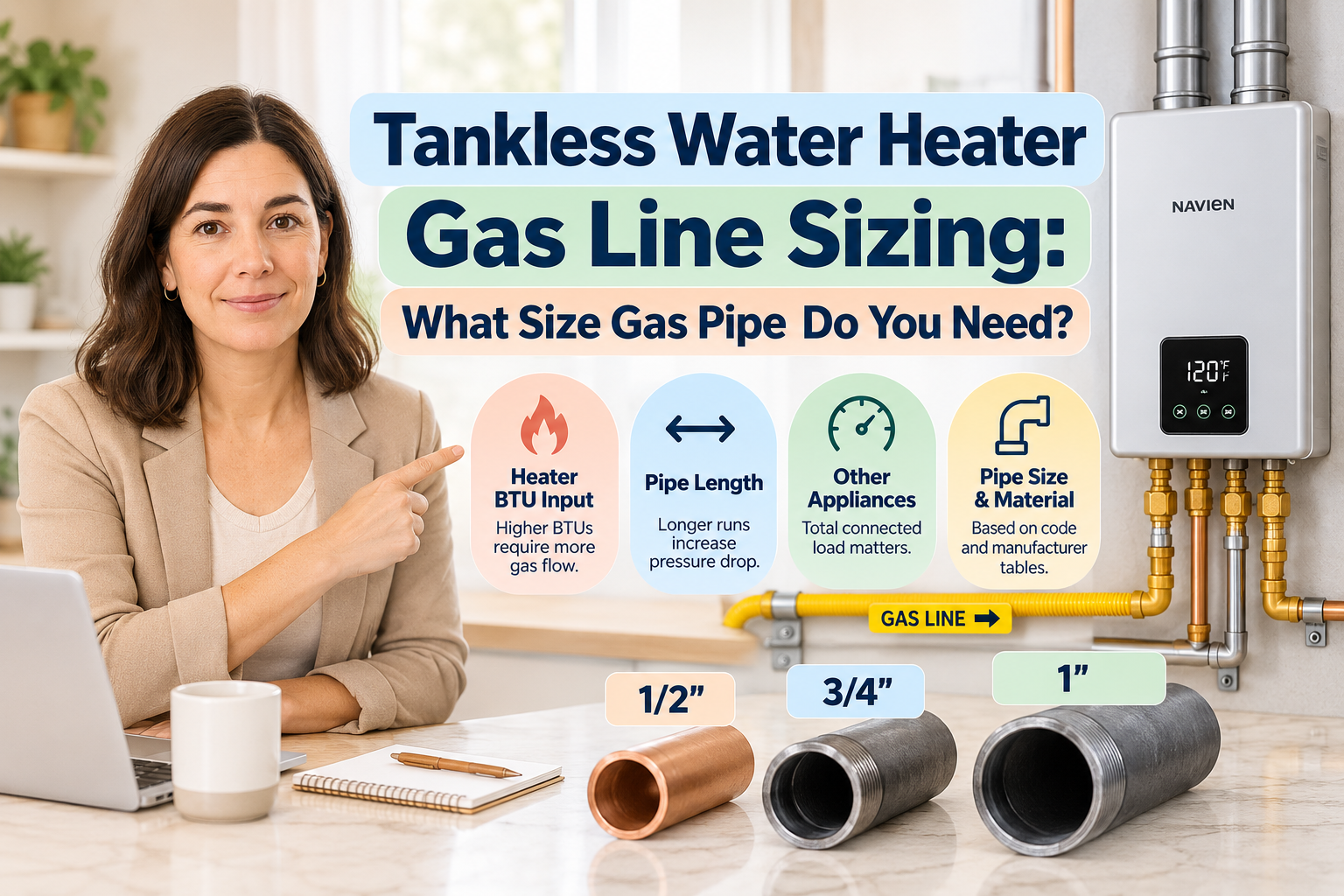
Installing a gas tankless water heater often looks straightforward until the gas supply is evaluated. A conventional storage water heater may have operated successfully for years on the existing piping, but replacing it with a high-capacity tankless model can dramatically increase the maximum gas demand. A whole-home tankless heater may approach 199,000–200,000 BTU/h, which means the gas piping, meter, regulator and available pressure all need to support a much larger instantaneous load.
I’m Savvy Mavi, and this is one area where I would resist a simple answer such as “every tankless water heater needs a 3/4-inch gas line.” A 3/4-inch line is common, but pipe diameter alone does not determine whether a gas system has sufficient capacity. Gas type, appliance input, pipe length, supply pressure, allowable pressure drop, piping material, fittings and the loads of other appliances all matter. Current fuel-gas codes require piping to provide sufficient gas for maximum demand while maintaining at least the minimum inlet pressure required by each appliance.
For that reason, this guide should help you understand why gas-line sizing matters and what your installer is calculating, rather than encourage homeowners to select or modify fuel-gas piping without a proper code-based calculation.
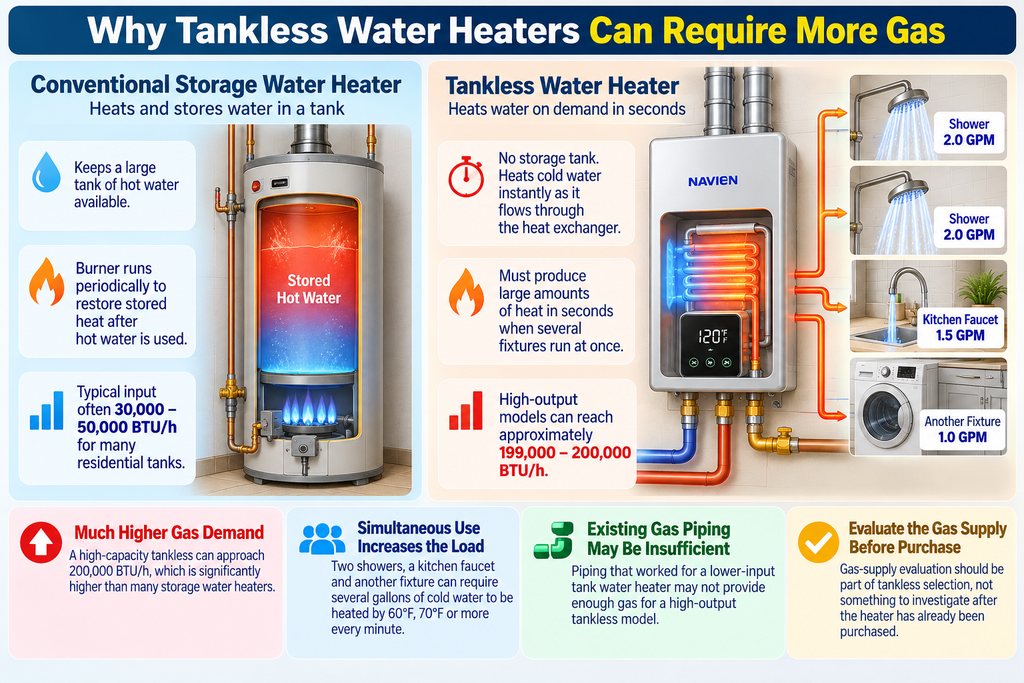
A storage water heater has a tank full of already-heated water. Its burner can restore that stored heat gradually after hot water is used. A tankless heater operates differently because it may have only seconds to heat cold water while several gallons pass through the heat exchanger every minute.
That explains why large residential tankless heaters can have very substantial burner inputs. If two showers, a kitchen faucet and another fixture are operating simultaneously during winter, the appliance may need to raise several gallons of cold water by 60°F, 70°F or more every minute. Producing that heat instantaneously requires substantial burner capacity.
A high-output tankless unit approaching 200,000 BTU/h can therefore place a much larger demand on the gas system than the water heater it replaces. If the piping was originally designed around the old appliance loads, installing a tankless heater can expose limitations that were previously invisible.
This is why I treat gas-supply evaluation as part of tankless selection, not as something to investigate after the heater has already been purchased.
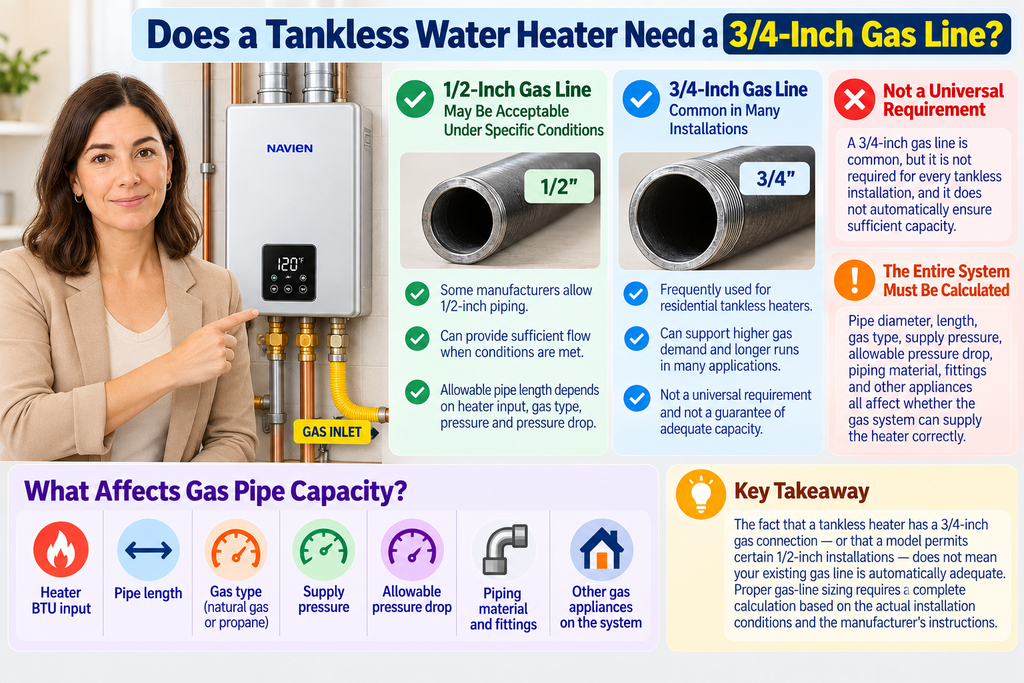
Many residential tankless installations use 3/4-inch gas piping somewhere in the supply system, but 3/4 inch is not a universal requirement or a universal guarantee of sufficient capacity.
Some tankless systems can operate with 1/2-inch piping under specific conditions. Rinnai, for example, states that its tankless water heaters can achieve appropriate performance using either 3/4-inch or 1/2-inch gas lines provided sufficient gas flow is available. Its published sizing information shows that allowable pipe length varies substantially with heater input, gas type and the assumptions used for pressure and pressure drop.
That distinction is critical. Saying “this heater has a 3/4-inch gas connection” does not mean that every 3/4-inch pipe run will supply it correctly. Likewise, finding a model that permits certain 1/2-inch installations does not mean an existing 1/2-inch line is automatically adequate.
The entire gas system has to be calculated.
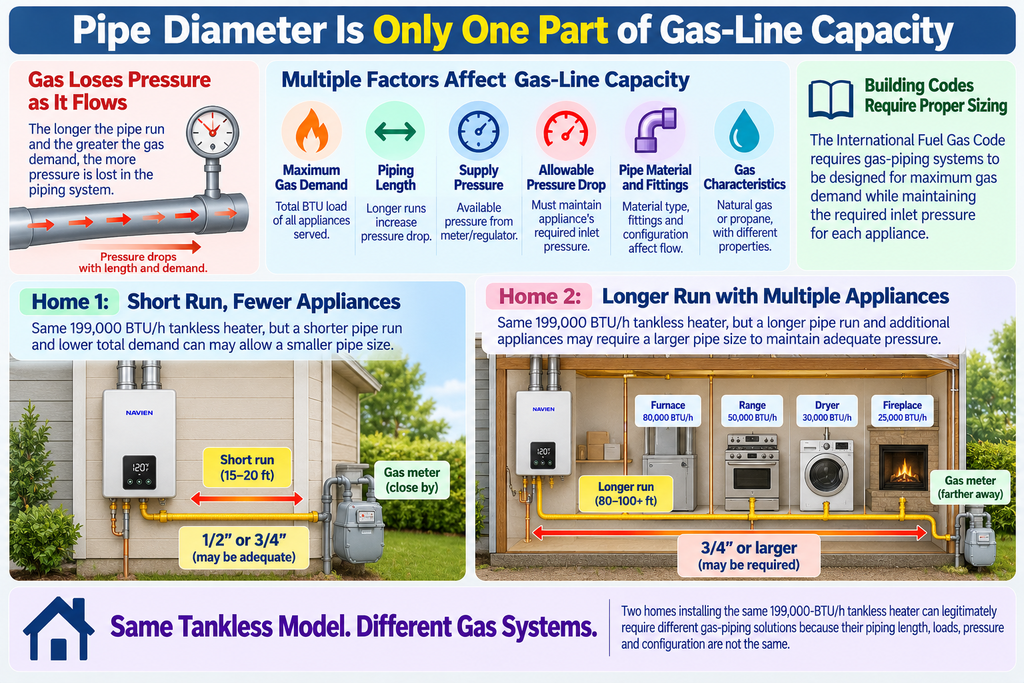
Gas flowing through piping experiences pressure loss. The longer the pipe run and the greater the gas demand, the more important the piping configuration becomes. Pipe material, fittings, supply pressure and the allowable pressure drop also affect how much gas can reach the appliance.
The International Fuel Gas Code identifies several important factors in gas-piping design, including maximum gas demand, piping length, allowable pressure loss and gas characteristics. Its sizing provisions require the system to deliver enough gas to meet maximum demand while maintaining the appliance’s required inlet pressure.
This means two homes installing the same 199,000-BTU/h tankless heater may legitimately require different gas-piping solutions. One heater might be relatively close to the meter with favorable pressure conditions, while another might be located at the end of a long piping network that also supplies a furnace, range, dryer and fireplace.
The tankless model is identical. The gas systems are not.

The first number I want is the exact appliance’s maximum gas input rating.
Suppose the selected tankless heater has a maximum input of approximately 199,000 BTU/h. The gas system must be capable of supplying that demand under the design conditions while also accounting for other appliances connected to the relevant piping sections.
This is where homeowners sometimes underestimate the impact of a tankless conversion. The water heater is not the only gas load in the house.
Imagine a home containing a 199,000-BTU/h tankless water heater, an 80,000-BTU/h furnace, a 50,000-BTU/h range and a 30,000-BTU/h gas fireplace. The simplified connected load would total approximately 359,000 BTU/h.
That does not mean every section of pipe carries all 359,000 BTU/h. Branches carry the loads downstream from them. However, the upstream system must be evaluated based on the loads it actually serves.
The 2024 International Fuel Gas Code states that maximum gas demand is based on the sum of the maximum input of appliances served, subject to code provisions regarding established diversity.

Natural-gas piping tables are often expressed in cubic feet per hour (CFH) rather than BTU/h. To use them correctly, the appliance load must be related to the heating value of the supplied gas.
The IFGC explains that required cubic feet per hour can be determined by dividing the total appliance input in BTU/h by the average heating value of the local gas in BTU per cubic foot. It recommends obtaining the applicable heating value from the serving gas supplier.
For a simplified illustration, if natural gas were assumed to provide approximately 1,000 BTU per cubic foot, a 199,000-BTU/h heater would require roughly 199 cubic feet per hour at maximum firing.
That 1,000-BTU-per-cubic-foot figure should not be treated as a universal utility specification. Actual heating value varies, which is another reason professional sizing uses the appropriate local design information.
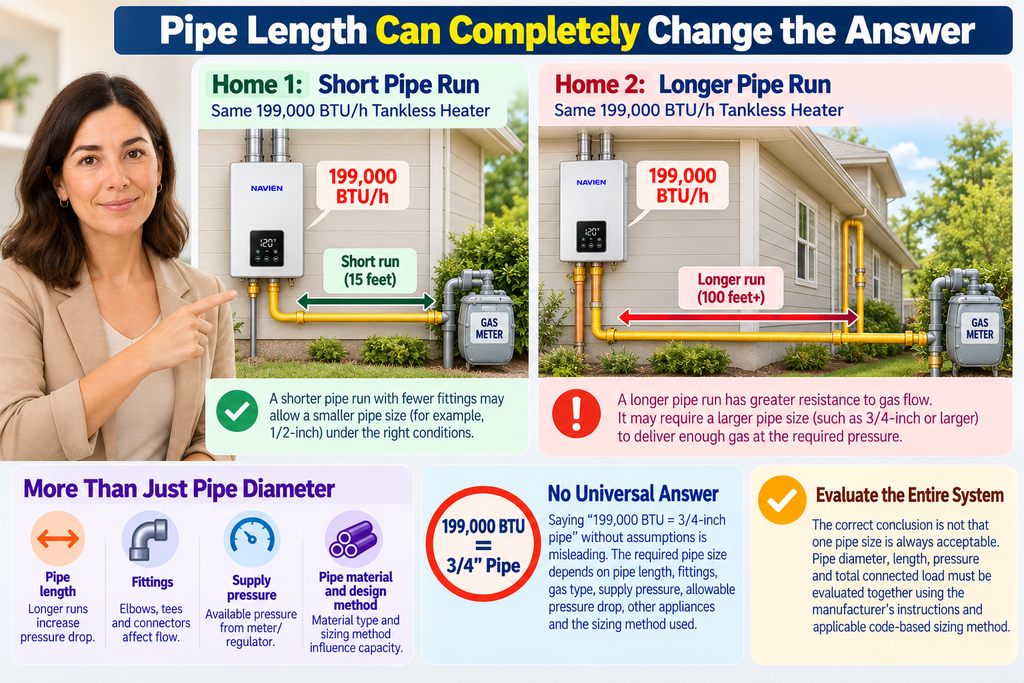
Suppose two homeowners install tankless heaters with identical maximum input ratings. One heater is 15 feet from the gas supply point, while the other is effectively 100 feet away after the piping route and applicable sizing methodology are considered.
Those are not equivalent installations.
A longer pipe has greater resistance to gas flow, which means a pipe diameter that works under one set of conditions may not provide sufficient capacity under another. Fittings and the design method used can also influence how the system is evaluated.
This is why I would never create a table saying something like “199,000 BTU = 3/4-inch pipe” without specifying the assumptions behind it. The statement looks convenient but leaves out most of the engineering information necessary to make it meaningful.
Rinnai’s published information illustrates the problem clearly. Under one specified set of natural-gas conditions, its tables show substantially different allowable equivalent lengths for 1/2-inch and 3/4-inch Schedule 40 metallic pipe serving high-input tankless models. Rinnai specifically instructs users to determine gas type, inlet pressure, allowable pressure drop, other gas appliances and maximum system loads when sizing the supply.
The correct conclusion is not that one pipe size is always acceptable. The conclusion is that pipe diameter, length, pressure and load must be evaluated together.
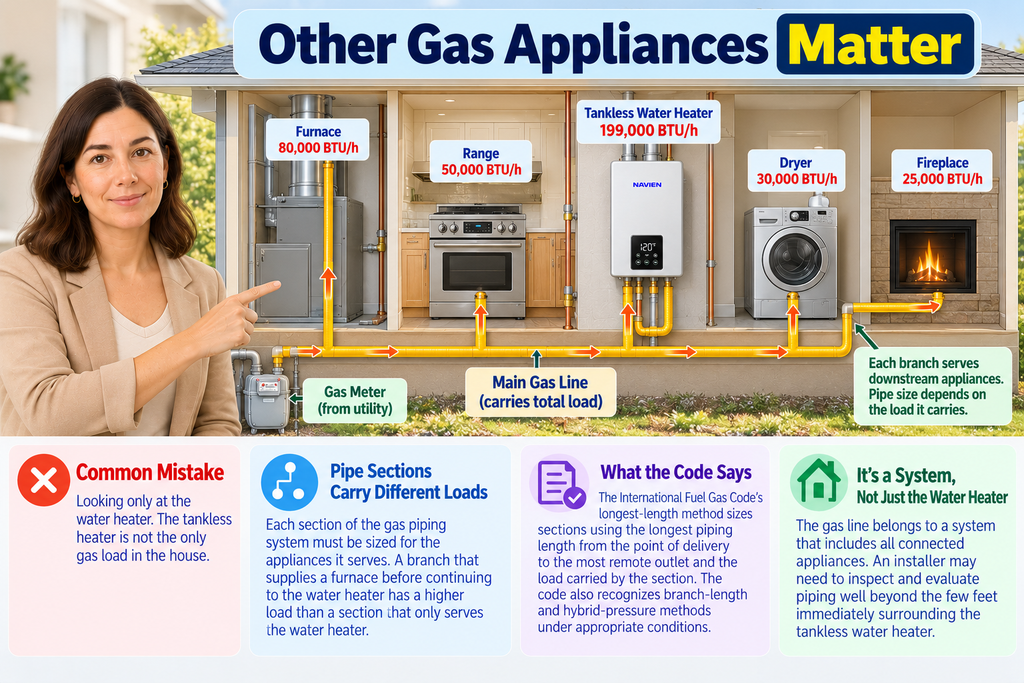
One of the most common conceptual mistakes is looking only at the water heater.
Imagine a branch of gas piping that supplies a furnace before continuing toward the tankless heater. Another branch might supply a range or dryer. The capacity required in each pipe segment depends on the downstream appliances that segment serves.
The IFGC’s longest-length method sizes sections using the longest piping length from the point of delivery to the most remote outlet and the load carried by the section. The code also recognizes branch-length and hybrid-pressure methods under appropriate conditions.
For homeowners, the practical lesson is straightforward: the gas line belongs to a system, not merely to the tankless heater.
That is why an installer may need to inspect piping well beyond the few feet immediately surrounding the water heater.
Increasing pipe diameter does not solve every gas-supply problem. The meter and regulator also need sufficient capacity for the connected load and required operating conditions.
If the house originally had relatively modest gas demand and a high-input tankless heater is added, the total connected load can increase significantly. Depending on the existing utility service and local requirements, the meter or other components may need evaluation or modification.
Rheem’s tankless installation guidance specifically warns that the gas pipe and gas meter must be sized correctly for proper heater operation. Rheem also notes that the complete gas supply system—including the meter, regulators and piping—must support the tankless heater and other gas appliances.
I would therefore ask the installer to evaluate the complete supply path rather than simply confirm the diameter of the pipe entering the heater.
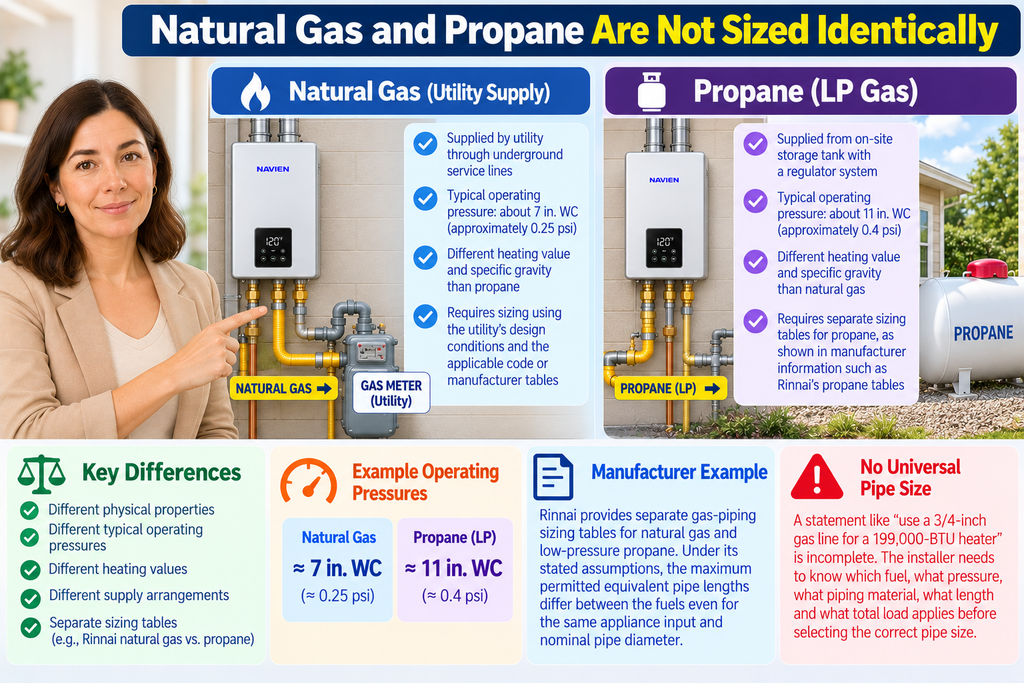
Natural gas and propane can both fuel high-performance tankless water heaters, but their piping systems should not be treated as interchangeable.
The fuels have different physical properties, supply arrangements and typical operating pressures. Propane systems also involve storage tanks and regulator configurations that differ from utility natural-gas service.
Rinnai’s published sizing information, for example, provides separate tables for natural gas and low-pressure propane. Under its stated assumptions, the maximum permitted equivalent pipe lengths differ between the fuels even for the same appliance input and nominal pipe diameter.
This is another reason a universal statement such as “use a 3/4-inch gas line for a 199,000-BTU heater” is incomplete. The installer needs to know which fuel, what pressure, what piping material, what length and what load before choosing the pipe size.
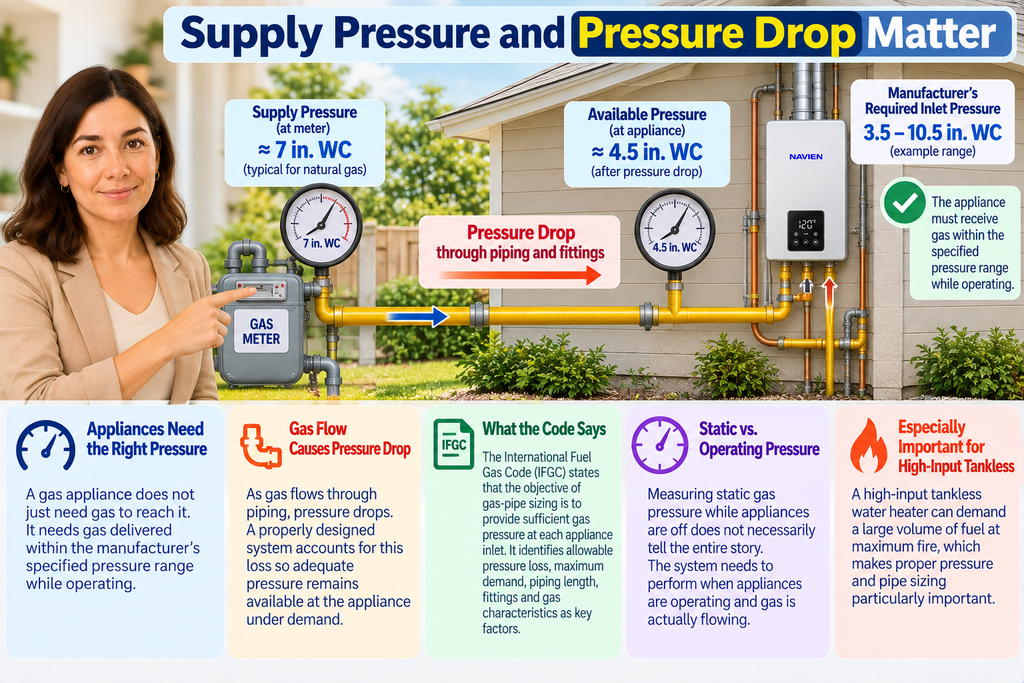
A gas appliance does not simply need gas to reach it. It needs gas delivered within the manufacturer’s specified pressure range while operating.
As gas flows through piping, pressure drops. A properly designed system accounts for that loss so adequate pressure remains available at the appliance under demand.
The IFGC explains that the fundamental objective of gas-pipe sizing is to provide sufficient gas pressure at each appliance inlet. Its guidance identifies allowable pressure loss, maximum demand, piping length, fittings and gas characteristics among the factors affecting pipe sizing.
This also explains why measuring static gas pressure while appliances are off does not necessarily tell the entire story. The system needs to perform when appliances are operating and gas is actually flowing.
For a high-input tankless heater, that operating condition is particularly important because the burner can demand a large volume of fuel at maximum fire.
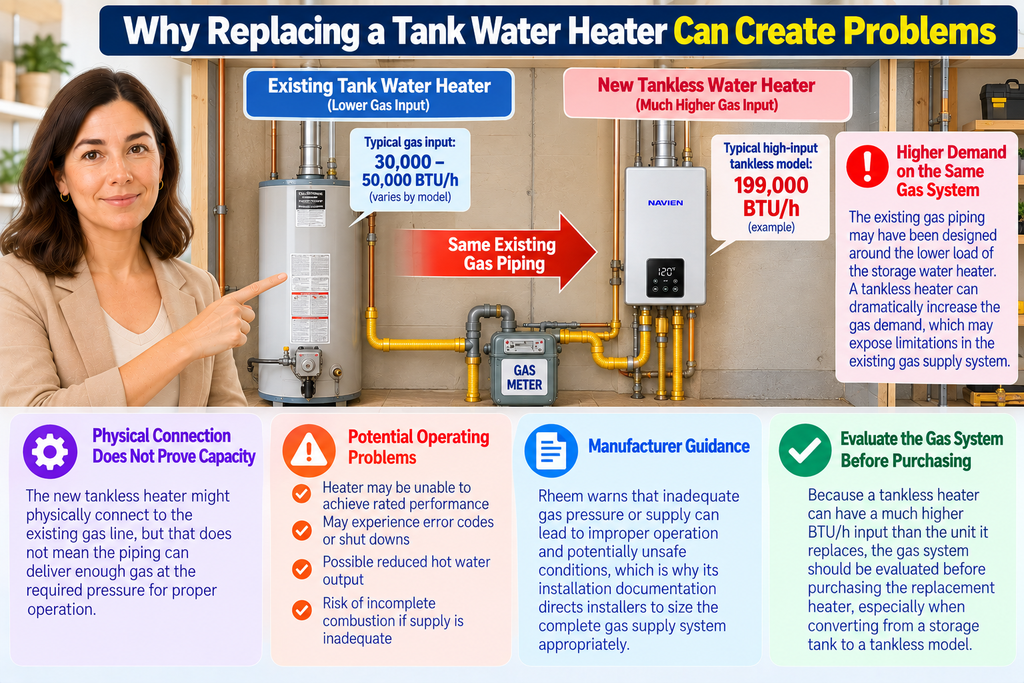
Suppose an existing storage water heater has a substantially smaller burner than the tankless replacement. The old appliance may have operated perfectly on the existing gas piping because the system was designed around that lower load.
Installing a 199,000-BTU/h tankless heater can dramatically change the equation.
The new heater might physically connect to the existing gas system, but physical connection does not prove adequate capacity. If the supply is insufficient, the heater may be unable to achieve rated performance or may experience operating problems.
Rheem warns that inadequate gas pressure or supply can lead to improper operation and potentially unsafe conditions, which is why its installation documentation directs installers to size the complete gas supply system appropriately.
This is one reason I recommend having the gas system evaluated before purchasing the replacement heater, particularly when converting from storage to tankless.
Sometimes, but this question needs more context than a simple yes or no.
Rinnai explicitly states that certain tankless installations can use either 1/2-inch or 3/4-inch gas piping where sufficient flow is available, and its published tables demonstrate that allowable equivalent length changes with appliance input and gas type.
That does not mean an existing 1/2-inch line should automatically be reused. The exact model, maximum input, line length, pressure, allowable pressure drop, piping material and other appliance loads must all satisfy the applicable manufacturer’s instructions and code-based sizing method.
In some installations, a short 1/2-inch section under the correct conditions may be permitted. In others, a larger line may be necessary.
I would therefore treat “Can I use my existing 1/2-inch pipe?” as a question requiring a calculation rather than an opinion.
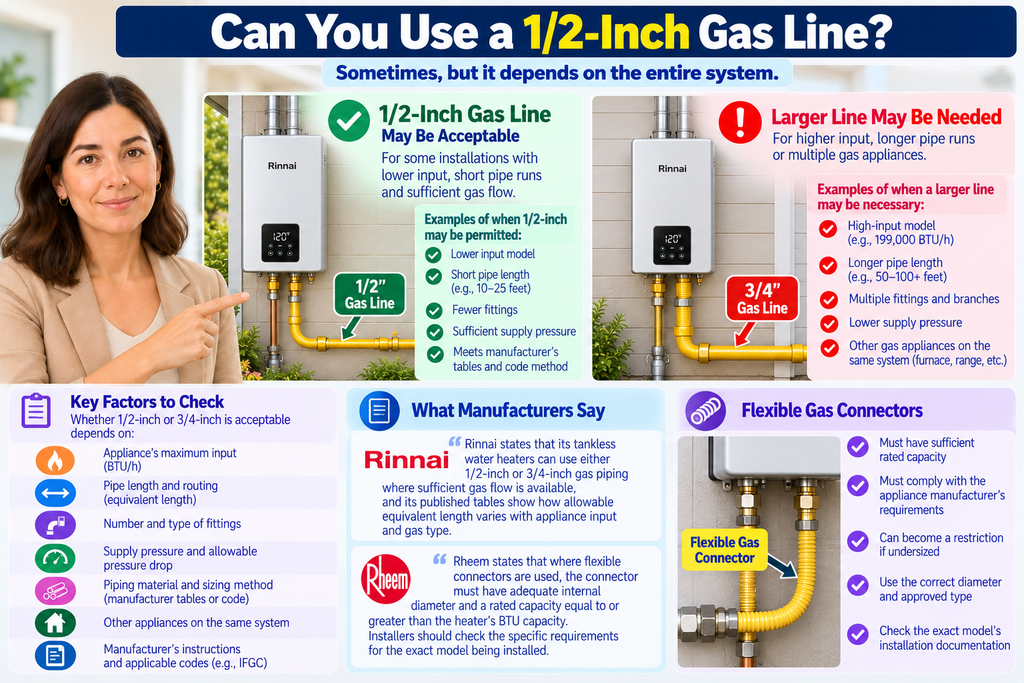
A flexible connector must have sufficient rated capacity and comply with the appliance manufacturer’s requirements and applicable codes.
For example, Rheem’s installation documentation for certain tankless products states that where flexible connectors are used, the connector must have adequate internal diameter and a rated capacity equal to or greater than the heater’s BTU capacity. Its specific requirements should be checked for the exact product being installed.
A connector can therefore become a restriction even if the permanent piping upstream is adequately sized.
This is another example of why I think about the entire gas path, not just the nominal diameter of the main pipe.
Imagine a home installing a 199,000-BTU/h tankless heater. The house also has an 80,000-BTU/h furnace, a 40,000-BTU/h range and a 25,000-BTU/h dryer.
The simplified connected load is 344,000 BTU/h. The installer then identifies the piping layout, determines which appliances are supplied by each segment, measures the relevant lengths, identifies the gas type and piping material, establishes the available pressure and allowable pressure drop, and uses the appropriate code or manufacturer sizing tables.
The result might show that some existing branches are perfectly adequate while another section requires modification. It might also identify a meter or regulator issue that would never have been discovered by looking only at the short connection beside the water heater.
That is what proper gas-line sizing actually means.
It is not simply choosing between 1/2 inch and 3/4 inch.
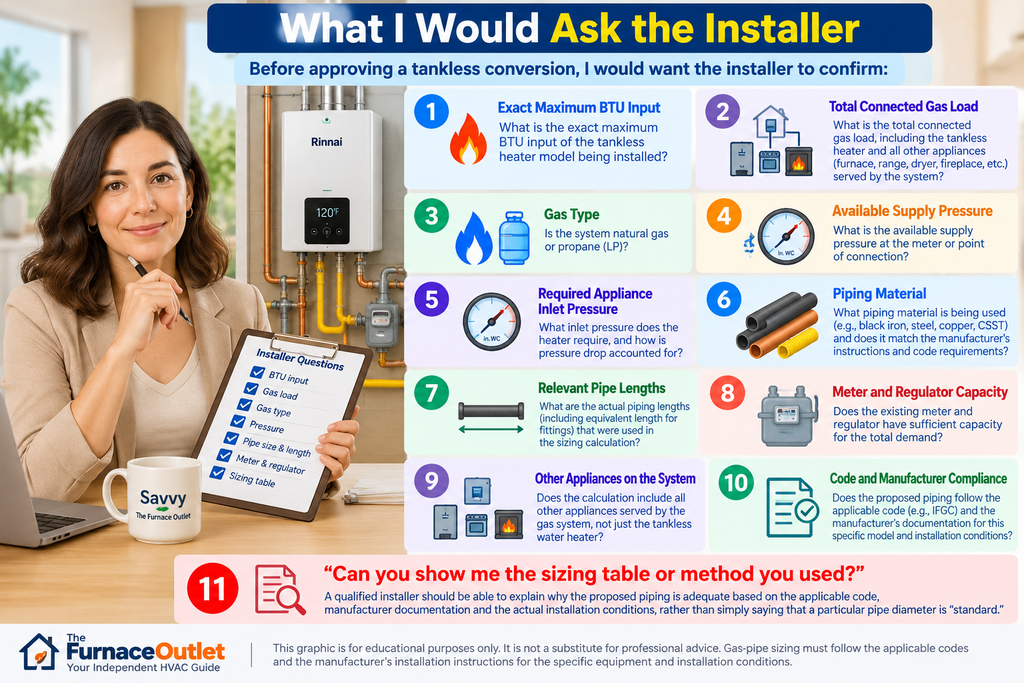
Before approving a tankless conversion, I would want the installer to confirm the exact maximum BTU input of the heater, the total connected gas load, gas type, available supply pressure, required appliance inlet pressure, piping material and relevant pipe lengths. I would also ask whether the existing meter and regulator have sufficient capacity and whether the calculation accounts for the other appliances served by the system.
I would then ask a particularly useful question: “Can you show me the sizing table or method you used?”
A qualified installer should be able to explain why the proposed piping is adequate based on the applicable code, manufacturer documentation and actual installation conditions rather than simply saying that a particular pipe diameter is “standard.”
There is no universal pipe diameter based on the 199,000-BTU rating alone. Pipe length, gas type, supply pressure, allowable pressure drop, piping material and other connected appliance loads must be considered. Some manufacturer-approved installations can use 1/2-inch piping under specified conditions, while many installations use 3/4-inch or larger piping elsewhere in the system. Follow the exact manufacturer’s instructions and applicable fuel-gas code.
It may be, but the diameter alone cannot answer the question. A relatively short 3/4-inch run under suitable pressure conditions can carry a very different load from a much longer run. The entire system needs to be calculated.
Possibly, depending on the exact heater and installation conditions. Some manufacturers publish circumstances under which 1/2-inch piping can provide sufficient flow, but an existing line should not be assumed adequate without checking its length, capacity, pressure and shared loads.
Not always, but it should be evaluated when a high-input tankless heater substantially increases the home’s connected gas load. The utility or qualified installer can determine whether the existing service, meter and regulator can support the new demand.
No. Propane and natural-gas systems have different characteristics and supply arrangements, and manufacturers may publish separate sizing information for them. Use the tables and requirements applicable to the actual fuel and system pressure.
Pressure is lost as gas flows through piping. Longer runs generally make maintaining adequate flow and appliance inlet pressure more challenging, which can affect the required pipe diameter.
Yes. If the appliance cannot receive sufficient gas at the required inlet pressure, it may be unable to operate at its intended maximum capacity and can experience operational problems. Manufacturers emphasize correct sizing of piping, meters and regulators for this reason.
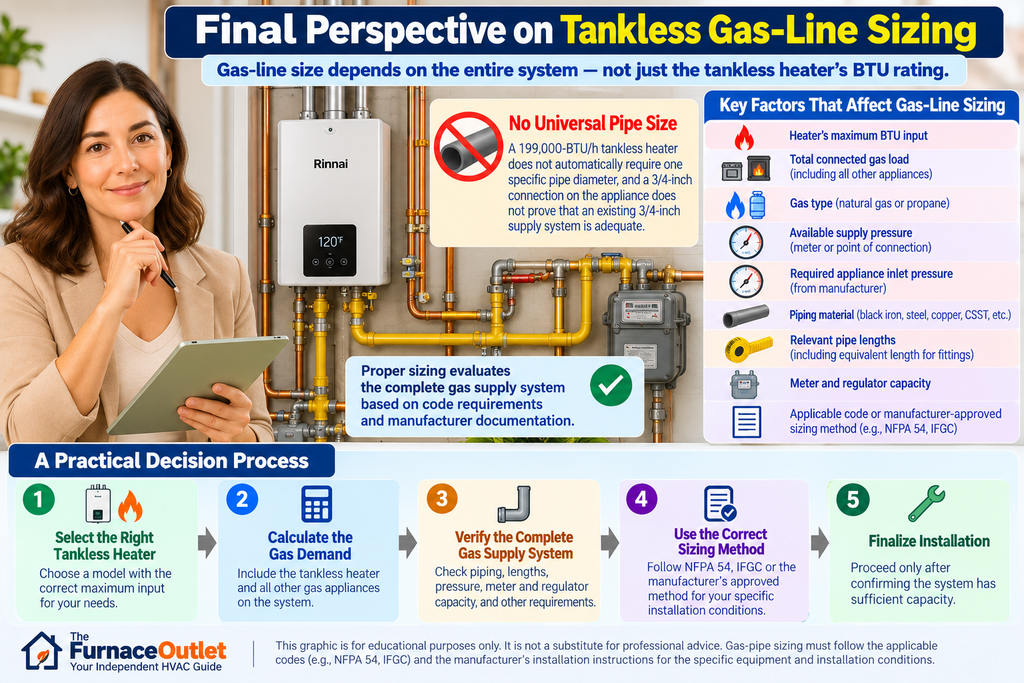
The most important thing I would remember is that gas-line size cannot be determined from the tankless heater’s BTU rating alone. A 199,000-BTU/h heater does not automatically require one universal pipe diameter, and a 3/4-inch connection on an appliance does not prove that an existing 3/4-inch supply system is adequate.
Proper sizing starts with the heater’s maximum input and the loads of the other gas appliances. It then considers fuel type, piping material, relevant pipe lengths, available pressure, allowable pressure drop, meter and regulator capacity, and the manufacturer’s required inlet-pressure range. The applicable fuel-gas-code or manufacturer-approved sizing method then determines whether each section of the system has sufficient capacity. NFPA 54 and the International Fuel Gas Code both establish formal methods for gas-piping sizing rather than relying on a universal diameter rule.
For me, that makes the decision process straightforward: select the appropriately sized tankless heater, calculate the gas demand, verify the complete gas supply system, and only then finalize the installation. Spending a little more time on the gas-supply calculation can prevent an expensive high-efficiency tankless heater from being limited by infrastructure that was never designed to feed it.
For the technical basis behind gas-piping calculations, NFPA 54 — National Fuel Gas Code provides the principal U.S. safety standard for fuel-gas piping systems, while the 2024 International Fuel Gas Code — Gas Piping Installations explains maximum-demand calculations, sizing methods and required appliance inlet pressure. The IFGC Appendix A — Sizing and Capacities of Gas Piping provides additional explanatory material on pressure loss, maximum demand, piping length and gas characteristics.
For manufacturer-specific guidance, Rinnai — Tankless Water Heater Gas Line Sizing FAQ provides examples showing how gas type, BTU input and equivalent pipe length affect 1/2-inch and 3/4-inch piping applications. Rheem — Tankless Water Heater Installation Instructions discusses gas-system, meter and connector sizing, while Navien — NPE-A2 Manuals and Technical Documents provides current manufacturer installation documentation for Navien’s high-capacity residential tankless platform.
The Furnace Outlet provides this guide for general educational and product-research purposes. Fuel-gas piping is a safety-critical system. This article is intended to explain sizing concepts and should not be used as a substitute for the manufacturer’s installation instructions, applicable codes, utility requirements or a project-specific calculation by an appropriately qualified professional.
Gas piping, regulators, meters, pressure testing, appliance connections, combustion systems and fuel conversions should be installed or modified only as permitted by applicable laws and codes. Requirements vary by jurisdiction, fuel, appliance and installation. The Furnace Outlet is an independent informational resource and is not associated with, endorsed by, sponsored by or affiliated with any manufacturer or brand mentioned in this article.