Newsletter Subscribe
Enter your email address below and subscribe to our newsletter

HVAC made simple
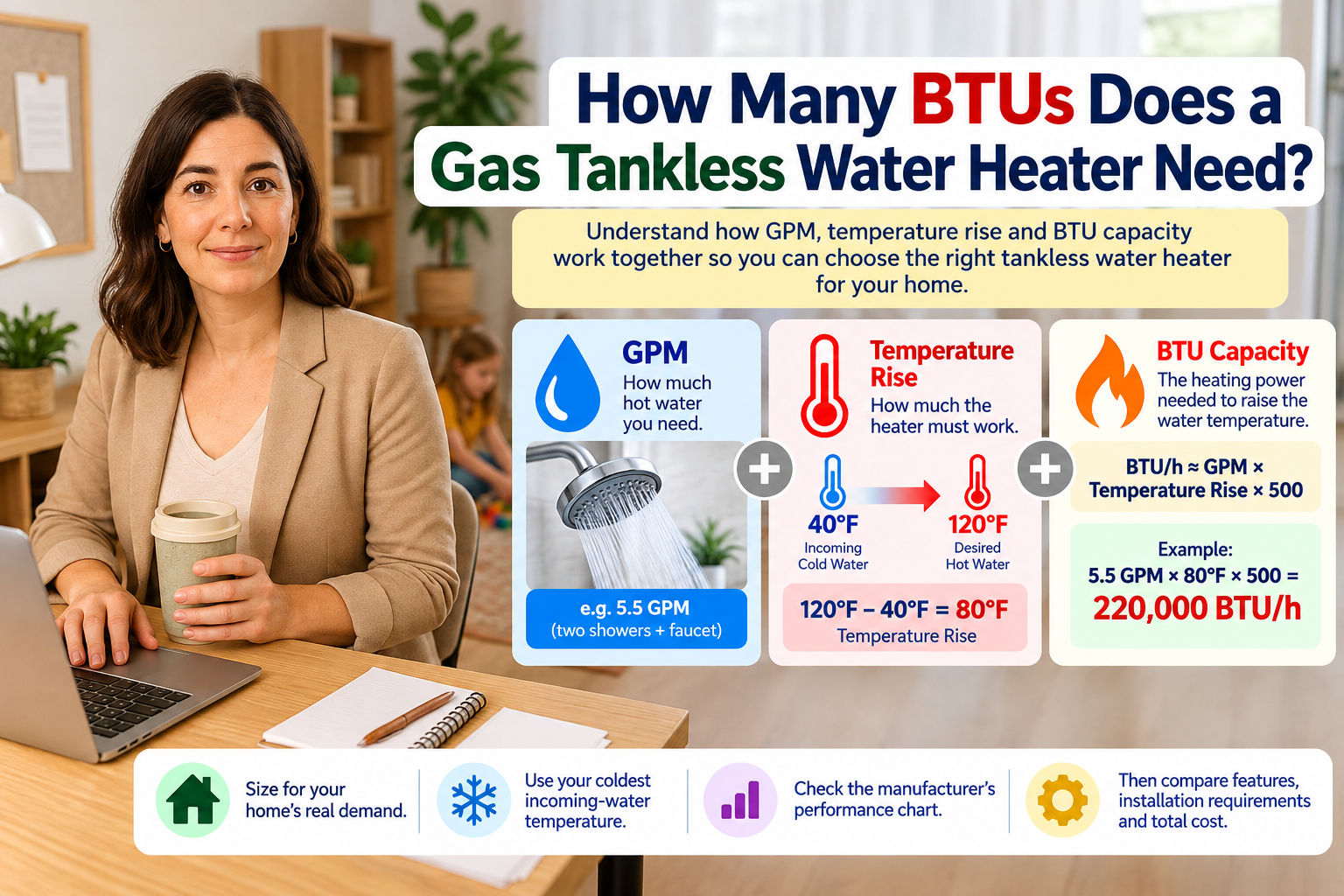
Choosing the right BTU capacity for a gas tankless water heater is not simply a matter of buying the most powerful model you can afford. A 199,000 or 200,000 BTU/h unit may be appropriate for a household with several simultaneous hot-water demands in a cold climate, while another home may comfortably meet its needs with considerably less burner capacity. The correct number depends primarily on how much hot water you need at the same time and how much the incoming water must be heated.
I’m Savvy Mavi, and I think BTU ratings become much easier to understand when we stop treating them as product-ranking numbers. A higher BTU rating does not automatically mean a better water heater. Instead, BTU input describes the heating power available to the appliance. What matters is whether that heating power, combined with the heater’s efficiency and design, can produce your required GPM at your required temperature rise.
For whole-home gas tankless systems, maximum inputs approaching 200,000 BTU/h are common among larger residential models. That sounds enormous compared with many conventional storage water heaters, but there is a good reason for it. A tankless heater does not have dozens of gallons of already-heated water waiting inside a tank. It may have only seconds to raise several gallons of cold water to the desired temperature as that water passes through the heat exchanger.
Understanding that relationship is the key to answering the question: How many BTUs does your gas tankless water heater actually need?
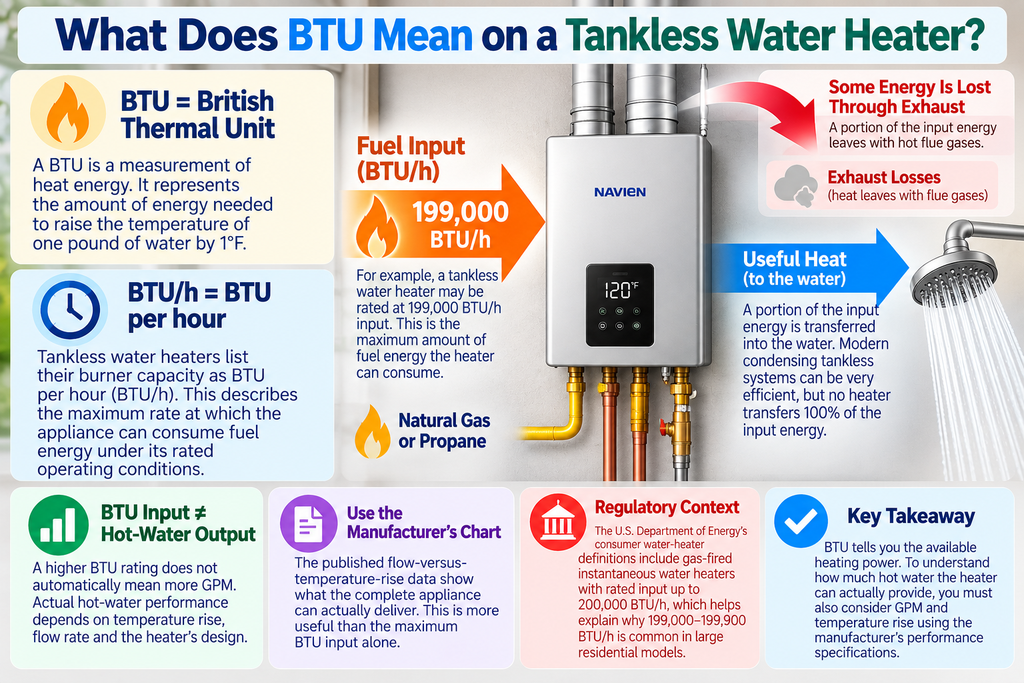
BTU stands for British thermal unit, a measurement of heat energy. Water-heater burner capacity is normally expressed as BTU per hour, or BTU/h. When you see a tankless heater rated for a maximum input of 199,000 BTU/h, that number describes the maximum rate at which the appliance can consume fuel energy under its rated operating conditions.
It is important to distinguish BTU input from useful heat output. If a heater consumes 199,000 BTU/h of fuel, it does not necessarily transfer every one of those BTUs into the water. Some energy is lost through combustion and exhaust, although modern condensing tankless systems can recover a very high proportion of the available heat.
This is why I would not use maximum BTU input by itself to predict hot-water performance. The manufacturer’s published flow-versus-temperature-rise data provide a much more useful picture because those specifications reflect how the complete appliance actually performs.
For regulatory context, the U.S. Department of Energy’s consumer water-heater definitions include gas-fired instantaneous water heaters with rated input up to 200,000 BTU/h, which helps explain why approximately 199,000–199,900 BTU/h has become such a familiar upper range among large residential tankless models.
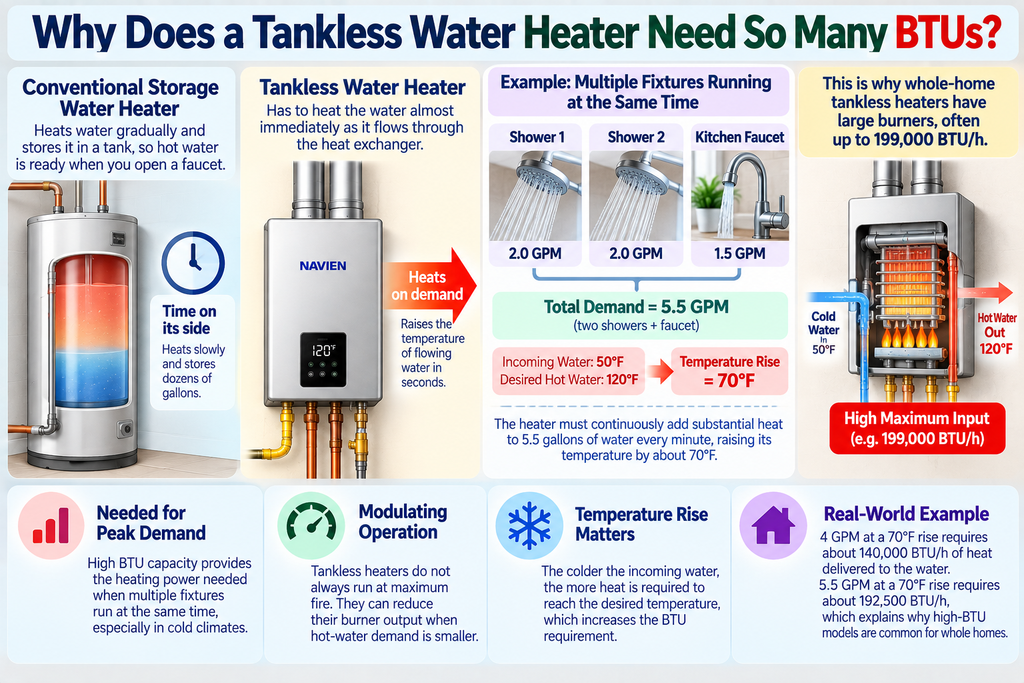
A conventional storage heater has time on its side. It can heat water gradually and store that hot water until somebody opens a faucet. A tankless heater has to perform the heating almost immediately.
Imagine 50°F water entering a tankless heater while two showers are running. If the heater needs to supply approximately 120°F water, it has to create a temperature rise of around 70°F. If those showers together require 4 GPM, the heater must continuously add substantial heat to four gallons of moving water every minute.
Now open a kitchen faucet. If another 1.5 GPM is required, total demand becomes 5.5 GPM. The heater still has to create approximately the same 70°F temperature rise, but it now has to do so across considerably more water every minute.
This explains the large burners found in whole-home tankless equipment. They are not necessarily consuming maximum fuel all day. Instead, the high maximum BTU rating provides the heating capacity needed when demand becomes substantial.
Modern tankless heaters can also modulate their burner output. Rather than operating continuously at 199,000 BTU/h, an appropriately designed unit can reduce its firing rate when hot-water demand is smaller.
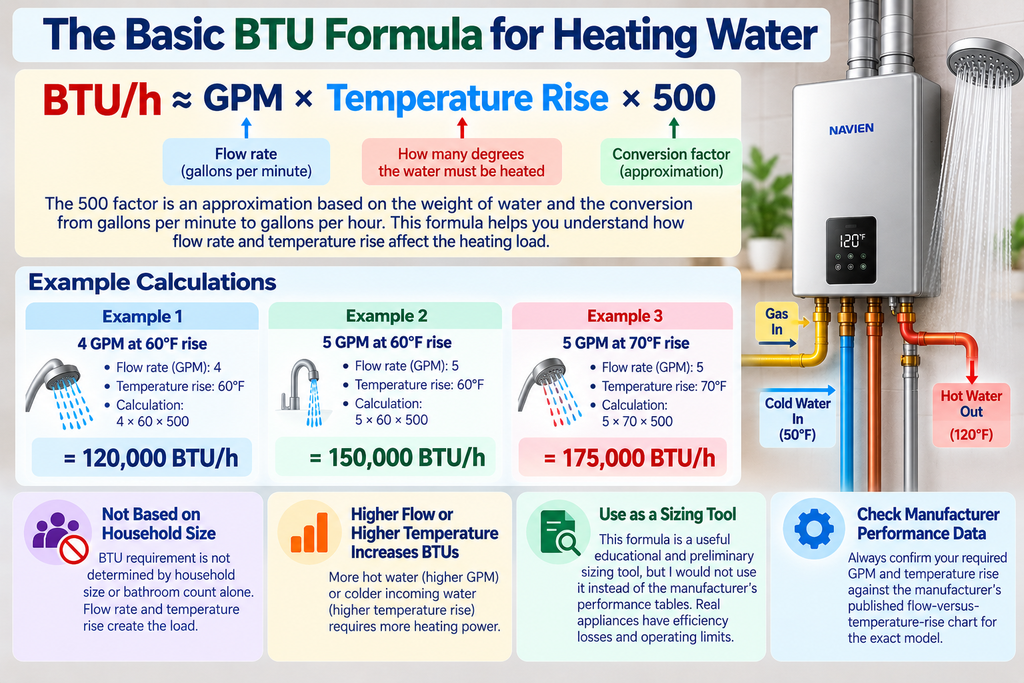
A useful theoretical formula for estimating the heating requirement of flowing water is:
BTU/h ≈ GPM × Temperature Rise × 500
The 500 factor is an approximation based on the weight of water and the conversion from gallons per minute to gallons per hour. The formula gives us a very useful way to understand how flow rate and temperature rise affect the heating load.
Suppose your household requires 4 GPM while the heater must produce a 60°F temperature rise. The theoretical heat requirement delivered to the water is approximately 4 × 60 × 500 = 120,000 BTU/h.
Increase demand to 5 GPM at the same 60°F rise and the requirement becomes approximately 150,000 BTU/h. Increase the temperature rise to 70°F while maintaining 5 GPM and the theoretical requirement becomes approximately 175,000 BTU/h.
This calculation demonstrates something important: BTU requirement is not determined by household size or bathroom count alone. Flow rate and temperature rise create the load.
I use this formula as an educational and preliminary sizing tool, but I would never use it instead of the manufacturer’s performance tables. Real appliances have efficiency losses, operating limits and specific heat-exchanger characteristics that a simple formula cannot completely represent.
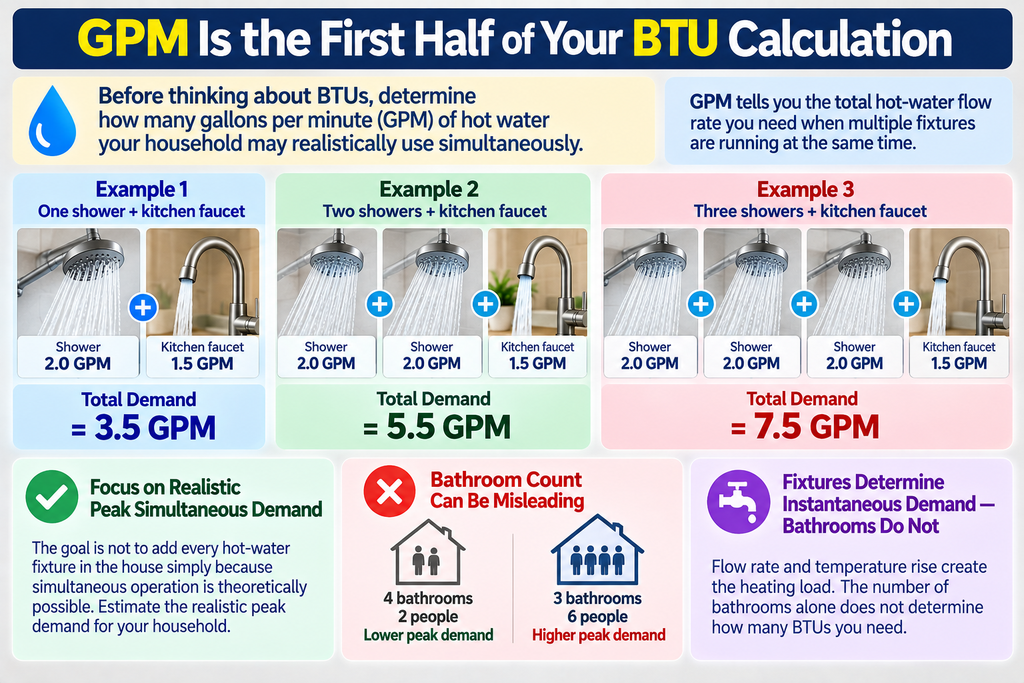
Before thinking about BTUs, determine how many gallons per minute of hot water your household may realistically use simultaneously.
Suppose one shower uses 2.0 GPM and somebody simultaneously uses a kitchen faucet at 1.5 GPM. Your approximate demand is 3.5 GPM. If two 2.0-GPM showers and that same faucet operate together, demand increases to approximately 5.5 GPM. Three showers plus the faucet could raise it to approximately 7.5 GPM.
The goal is not to add every hot-water fixture in the house simply because simultaneous operation is theoretically possible. I want to estimate realistic peak simultaneous demand.
A four-bathroom house occupied by two people could have a lower peak requirement than a three-bathroom house occupied by six people who regularly shower at the same time every morning. That is why rules such as “X BTUs for three bathrooms” can be misleading.
Fixtures determine instantaneous water demand. Bathrooms do not.
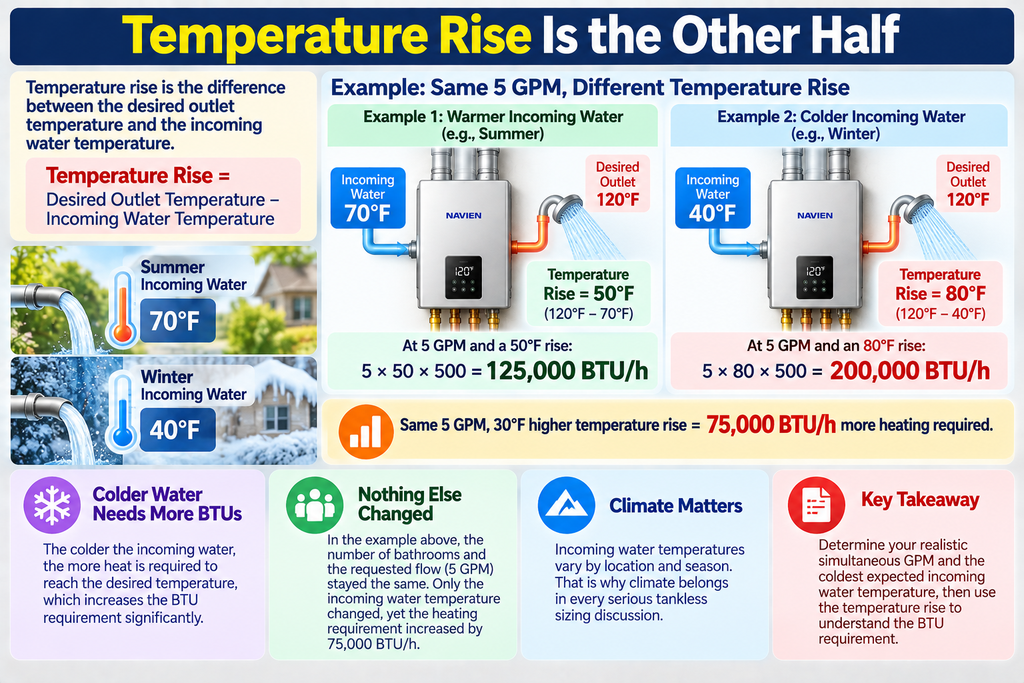
Once you know your approximate simultaneous GPM, determine how much the heater needs to raise the incoming-water temperature.
The calculation is straightforward: Temperature rise = desired outlet temperature − incoming water temperature.
If incoming water is 70°F and you want 120°F water, your temperature rise is 50°F. If incoming water falls to 40°F during winter while the desired outlet remains 120°F, the required rise becomes 80°F.
That 30°F difference has a major impact on the heating requirement.
At 5 GPM and a 50°F rise, the theoretical heat requirement is approximately 125,000 BTU/h. At exactly the same 5 GPM but an 80°F rise, the theoretical requirement increases to approximately 200,000 BTU/h.
Nothing about the number of bathrooms changed. Nothing about the requested flow changed. Only the incoming-water temperature changed, yet the theoretical heating requirement increased by 75,000 BTU/h.
This is why climate belongs in every serious tankless sizing discussion.
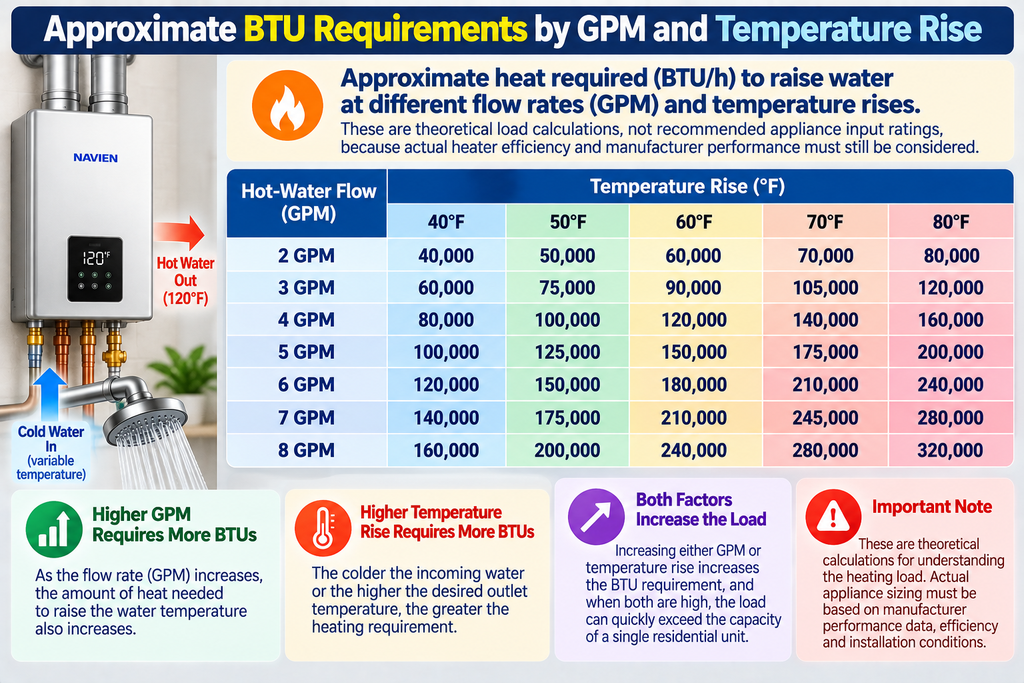
The following table shows the approximate theoretical amount of heat that must be transferred to the water at several common flow rates and temperature rises. These are load calculations, not recommended appliance input ratings, because actual heater efficiency and manufacturer performance must still be considered.
| Hot-Water Flow | 40°F Rise | 50°F Rise | 60°F Rise | 70°F Rise | 80°F Rise |
|---|---|---|---|---|---|
| 2 GPM | 40,000 | 50,000 | 60,000 | 70,000 | 80,000 |
| 3 GPM | 60,000 | 75,000 | 90,000 | 105,000 | 120,000 |
| 4 GPM | 80,000 | 100,000 | 120,000 | 140,000 | 160,000 |
| 5 GPM | 100,000 | 125,000 | 150,000 | 175,000 | 200,000 |
| 6 GPM | 120,000 | 150,000 | 180,000 | 210,000 | 240,000 |
| 7 GPM | 140,000 | 175,000 | 210,000 | 245,000 | 280,000 |
| 8 GPM | 160,000 | 200,000 | 240,000 | 280,000 | 320,000 |
The pattern is more valuable than any individual number. Increasing either GPM or temperature rise increases the heating requirement, and once both become high, the theoretical load can quickly exceed the capacity of a single residential gas tankless heater.
Consider a smaller household where one 2.0-GPM shower and a 1.5-GPM kitchen faucet may operate simultaneously. Total peak demand is approximately 3.5 GPM.
If winter incoming water is 60°F and the desired outlet temperature is 120°F, the heater must produce a 60°F temperature rise. The theoretical load becomes 3.5 × 60 × 500 = approximately 105,000 BTU/h.
This does not mean I would simply purchase a 105,000-BTU/h heater. Instead, I would take the two important numbers—3.5 GPM and a 60°F rise—and compare them with the manufacturer’s published performance data.
A model capable of comfortably producing at least that flow at the required temperature rise becomes a candidate. A model that cannot is eliminated regardless of how attractive its price or efficiency rating may be.
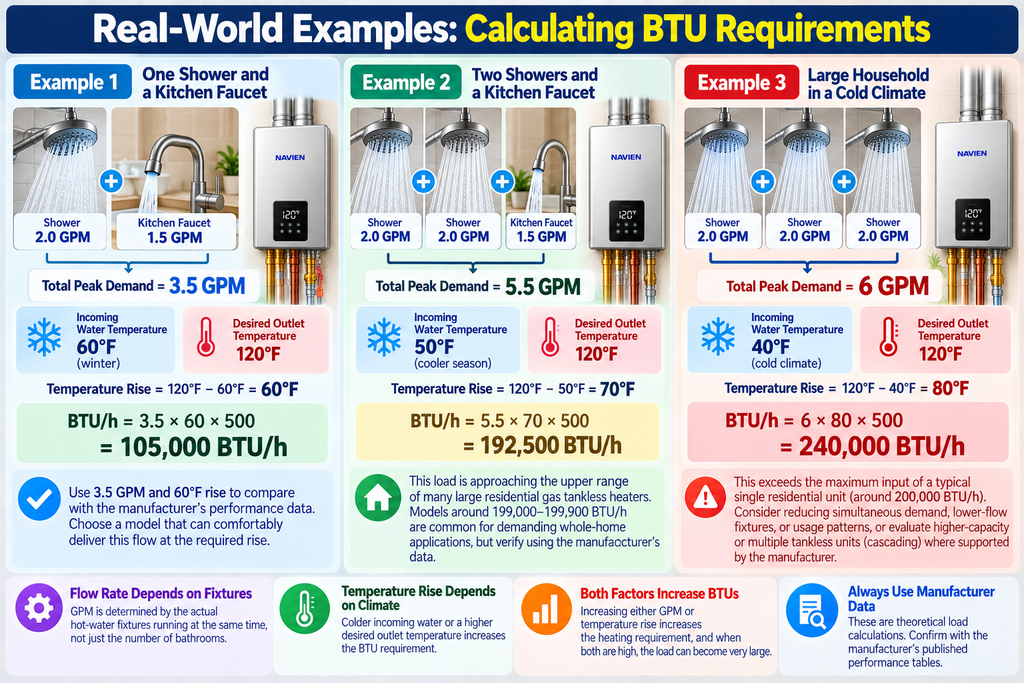
Now consider a family where two 2.0-GPM showers and a 1.5-GPM kitchen faucet may operate simultaneously. Demand becomes approximately 5.5 GPM.
With 50°F incoming water and a 120°F target, the required temperature rise is 70°F. The theoretical heating requirement becomes 5.5 × 70 × 500 = approximately 192,500 BTU/h.
We are now approaching the upper range of many large residential gas tankless heaters.
This is a good example of why models around 199,000 or 199,900 BTU/h are popular for whole-home applications. Their large maximum burners provide the potential capacity needed for demanding simultaneous loads, although actual delivered GPM must still be verified using the manufacturer’s specifications.
Now imagine three 2.0-GPM showers running simultaneously in a house where winter incoming water can reach 40°F.
The household requires approximately 6 GPM, and producing 120°F water means an 80°F temperature rise. The theoretical heating requirement becomes 6 × 80 × 500 = approximately 240,000 BTU/h.
That exceeds the maximum fuel input of a typical single residential unit in the approximately 200,000-BTU/h class, even before considering that input energy is not identical to useful heat delivered to the water.
This household therefore needs a different strategy. That could mean reducing simultaneous demand through lower-flow fixtures or usage patterns, evaluating equipment designed for greater system capacity, or considering multiple compatible tankless units where the manufacturer supports cascading installations.
The important lesson is that buying an “11 GPM” heater does not automatically solve the problem. The heater’s advertised maximum GPM may have been established at a much smaller temperature rise.
One of the biggest misunderstandings in tankless shopping is assuming that maximum BTU and maximum GPM specifications occur under every operating condition.
Consider the Navien NPE-240A2 as a useful real-world example. Navien publishes a maximum input of 199,900 BTU/h and a maximum domestic-hot-water flow of 11.2 GPM at a 35°F temperature rise. Increase the rise to 50°F and published flow falls to 7.8 GPM. At a 70°F rise it falls to 5.6 GPM, and at an 80°F rise it is 4.9 GPM.
The burner did not suddenly become smaller. The heater simply has to put much more energy into each gallon when incoming water is colder.
This is precisely why I treat a headline such as “11.2 GPM” as incomplete information unless it is accompanied by the temperature rise.
There is no universal BTU rating for a family of four because four people can have very different hot-water patterns.
If the family normally operates one 2-GPM shower and a 1.5-GPM faucet simultaneously, peak demand may be around 3.5 GPM. If two showers and a faucet routinely operate together, the requirement becomes approximately 5.5 GPM.
Climate then changes the answer again. At 3.5 GPM and a 50°F rise, the theoretical heating load is approximately 87,500 BTU/h. At 5.5 GPM and a 70°F rise, it becomes approximately 192,500 BTU/h.
Both examples could describe a family of four.
Rather than shopping for “the best BTU size for four people,” calculate your household’s simultaneous GPM and winter temperature rise.
Not necessarily. A large whole-home gas tankless heater may require that level of maximum burner capacity to maintain substantial flow during colder conditions.
Modern modulating systems are not necessarily firing at maximum capacity whenever someone washes their hands. The burner can adjust according to demand within the model’s operating range.
For example, Navien lists the NPE-240A2 at 13,300 to 199,900 BTU/h, demonstrating the wide modulation range possible in modern equipment. A small draw can therefore require a very different firing rate from multiple simultaneous showers.
This is one reason I would evaluate minimum input as well as maximum input. Maximum capacity tells us about peak capability, while the lower end of the modulation range helps us understand how the heater handles smaller loads.
There is another reason not to select a high-BTU model casually. The house has to supply enough gas for it.
A tankless heater approaching 200,000 BTU/h can represent a substantial gas load. Your furnace, range, dryer, fireplace and other appliances may be connected to the same system.
Gas-pipe capacity depends on factors such as pipe diameter, developed length, available pressure, pipe material, fuel type and the combined load of connected appliances. The existing gas line that adequately supplied a conventional storage heater may therefore not automatically be appropriate for a high-input tankless replacement.
I would have a qualified professional evaluate the gas piping and meter capacity before finalizing the heater. Do not assume that every 199,000-BTU tankless heater simply requires a particular universal pipe diameter. Gas-system sizing is installation-specific.
The home’s hot-water heating requirement does not disappear when you change fuel. If the water needs a certain amount of heat, that basic thermal requirement remains.
Many tankless platforms are available in natural-gas and propane configurations, and some manufacturers provide approved field-conversion arrangements. However, fuel pressures, components, setup requirements and installation instructions can differ.
I would therefore select the appropriate manufacturer-approved fuel configuration rather than assuming that natural-gas and propane equipment can be interchanged casually.
From a sizing perspective, the most important question remains whether the exact model can deliver the required GPM at the required temperature rise using the intended fuel.
The theoretical formula calculates approximately how much heat the flowing water needs. The appliance’s BTU rating generally describes fuel input.
Those are not identical numbers.
A high-efficiency condensing tankless heater can convert a large proportion of fuel energy into useful water heating, but no real combustion appliance should be treated as though every unit of fuel input becomes useful output under every operating condition.
This is why I resist the temptation to turn the simple BTU formula into a precise appliance-selection calculator. It is excellent for understanding the load and screening obviously unrealistic expectations, but the final selection should always be checked against manufacturer performance documentation.
UEF can help compare energy efficiency among appropriately sized models, but efficiency cannot compensate for inadequate capacity. A very efficient heater that cannot supply your required winter GPM remains the wrong size.
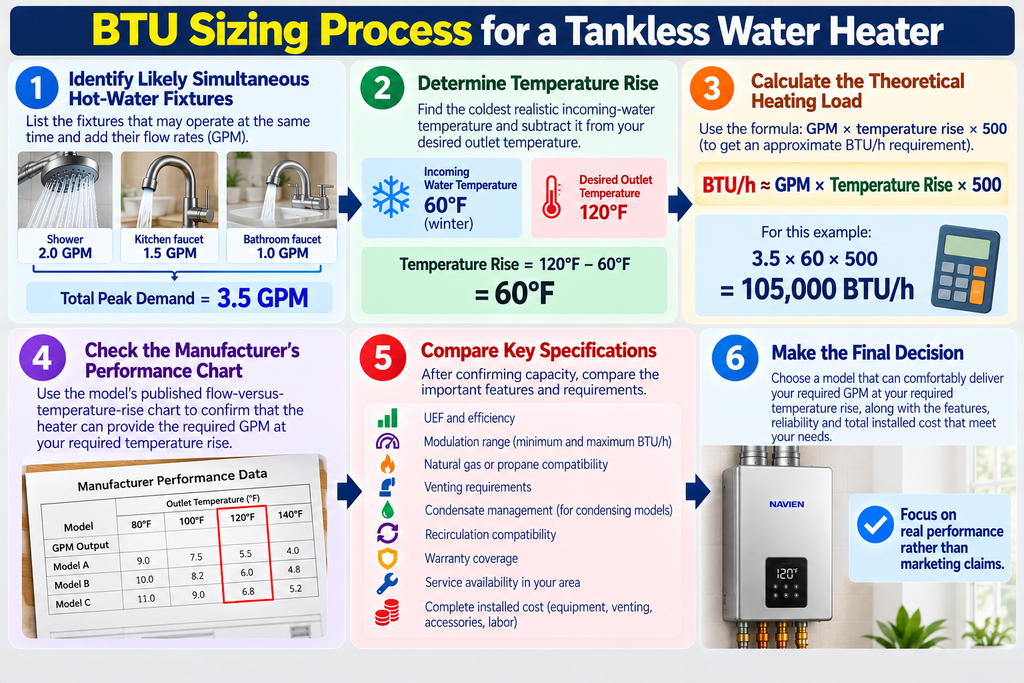
I would begin by identifying the hot-water fixtures likely to operate simultaneously and adding their flow rates. Next, I would identify the coldest realistic incoming-water temperature and subtract it from the desired outlet-water temperature to determine the design temperature rise.
I would then use GPM × temperature rise × approximately 500 to understand the theoretical heating load. That calculation tells me whether I am dealing with a modest demand or approaching the limits of a single high-capacity residential tankless heater.
After that, I would stop relying on the formula and move to the manufacturer’s performance chart. I would confirm that the exact model can provide my required GPM at my required temperature rise. Only after capacity is confirmed would I compare UEF, modulation range, natural-gas or propane compatibility, venting, condensate management, recirculation, warranty, service availability and complete installed cost.
That sequence keeps the decision focused on performance rather than marketing.
Two 2-GPM showers require approximately 4 GPM. At a 50°F temperature rise, the theoretical water-heating requirement is about 100,000 BTU/h; at a 70°F rise, it becomes approximately 140,000 BTU/h; and at an 80°F rise, approximately 160,000 BTU/h. Use those figures for understanding the load, then verify actual performance against the manufacturer’s specifications.
It can be for many homes, but “whole house” does not describe a specific load. A roughly 199,000-BTU/h heater may provide substantial whole-home capacity, but actual GPM falls as required temperature rise increases. Determine simultaneous demand and winter temperature rise before deciding.
The theoretical requirement depends on temperature rise. Five GPM at a 40°F rise requires approximately 100,000 BTU/h of heat delivered to the water. At a 60°F rise it is approximately 150,000 BTU/h, and at an 80°F rise it reaches approximately 200,000 BTU/h.
No. Higher maximum input can provide more peak heating capacity, but the correct heater should match the home’s actual demand. Installation cost, gas-supply capacity, minimum modulation, efficiency and other factors also matter.
Colder incoming water increases the required temperature rise, which increases the heating load for the same GPM. This is why tankless heaters generally deliver fewer gallons per minute during demanding cold-water conditions.
Bathroom count is only a rough preliminary indicator. Calculate the fixtures likely to operate simultaneously instead. A smaller home with more occupants can have higher peak demand than a larger house with fewer occupants.
Use both, but ultimately verify GPM at your required temperature rise. BTU input helps explain the available heating power, while the manufacturer’s performance chart tells you what the complete appliance can actually deliver.
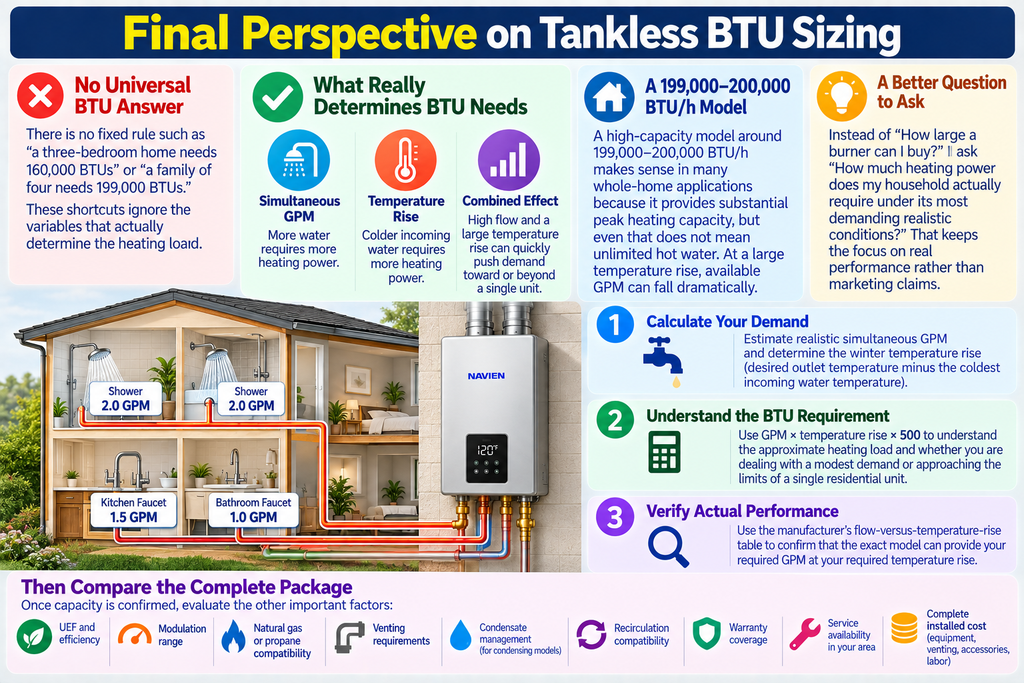
There is no universal answer such as “a three-bedroom home needs 160,000 BTUs” or “a family of four needs 199,000 BTUs.” Those shortcuts ignore the variables that actually determine the heating load.
I would begin with simultaneous GPM, then calculate winter temperature rise, and use those values to understand the approximate BTU heating requirement. The relationship is straightforward: more water requires more heating power, colder incoming water requires more heating power, and combining high flow with a large temperature rise can quickly push demand toward or beyond the capability of a single residential tankless unit.
A roughly 199,000–200,000 BTU/h model makes sense in many whole-home applications because it provides substantial peak heating capacity, but even that does not mean unlimited hot water. At a large temperature rise, available GPM can fall dramatically.
For me, the best way to think about BTUs is therefore not “How large a burner can I buy?” but “How much heating power does my household actually require under its most demanding realistic conditions?” Once you answer that question, the manufacturer’s performance table becomes your final authority.
That is how I would size a gas tankless water heater: calculate the demand, understand the BTUs, verify the actual performance, and only then compare features and price.
For technical research, the U.S. Department of Energy — Consumer Water Heaters provides federal definitions and standards information for residential water heaters, while DOE Building Science Education — Gas-Fired Tankless Water Heaters explains how simultaneous flow and winter incoming-water temperature affect tankless sizing.
For efficiency and consumer selection guidance, ENERGY STAR — Whole-Home Tankless Gas Water Heaters provides information on capacity and energy performance. For a useful real-world example of how BTU input, GPM and temperature rise interact, Navien — NPE-240A2 Specifications publishes the model’s input range and flow rates at multiple temperature rises. Rinnai — SENSEI RX199iN Specifications provides another useful example of a high-capacity residential condensing tankless system.
The Furnace Outlet provides this article for general educational and product-research purposes. BTU calculations shown here are simplified estimates intended to explain tankless water-heater sizing principles and should not replace manufacturer sizing documentation, applicable codes or a project-specific professional assessment. Actual performance depends on the exact model, efficiency, fuel type, incoming-water temperature, desired outlet temperature, flow rate and installation conditions.
Gas piping, meter capacity, combustion, venting, electrical connections, condensate drainage and appliance commissioning should be evaluated and completed by appropriately qualified professionals where required. Always follow the manufacturer’s current installation instructions and applicable local codes. The Furnace Outlet is an independent informational resource and is not associated with, endorsed by, sponsored by or affiliated with any manufacturer or brand mentioned in this article.