Newsletter Subscribe
Enter your email address below and subscribe to our newsletter

HVAC made simple
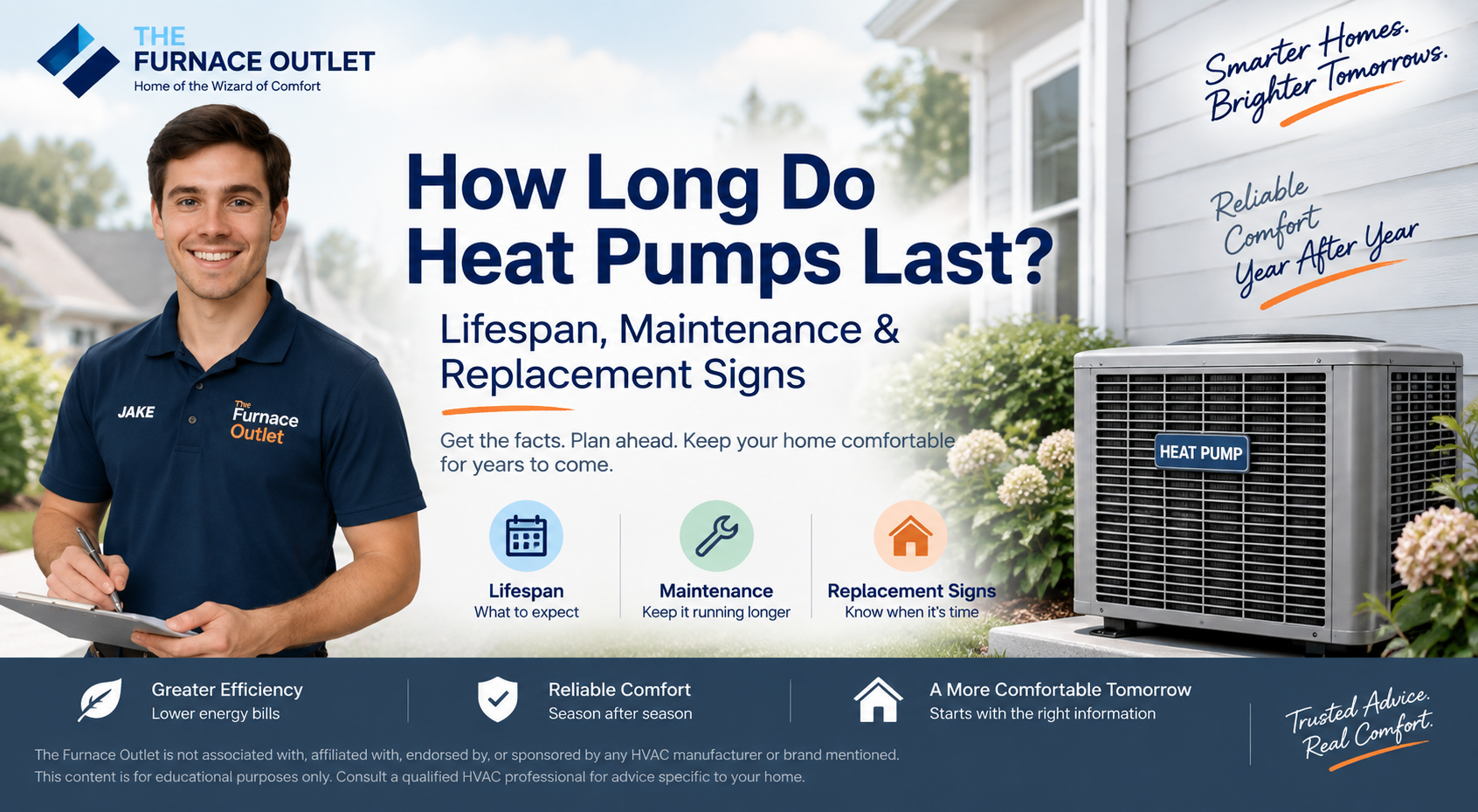
When homeowners ask me how long a heat pump should last, they are usually hoping for a simple number: 10 years, 15 years, maybe 20. HVAC equipment does not age quite that neatly. Two identical heat pumps installed on the same day can have very different service lives depending on climate, installation quality, operating hours, airflow, maintenance, refrigerant-system condition and even how well the equipment was sized for the house.
For planning purposes, around 15 years is a reasonable benchmark for a residential air-source heat pump. The U.S. Department of Energy uses an average 15-year heat-pump life in its life-cycle cost calculations, while AHRI cites roughly 14 years when recommended maintenance is followed. ENERGY STAR suggests homeowners begin considering replacement when a heat pump or air conditioner is more than 10 years old, particularly when repairs, comfort problems or rising energy bills are also appearing. That does not mean your heat pump automatically becomes obsolete on its fifteenth birthday. I have seen older HVAC equipment that remains perfectly serviceable, and I have seen considerably younger systems become poor repair candidates. Age gives us context. Condition tells us what to do.
— Jake Lawson, HVAC Specialist | The Furnace Outlet
For a conventional residential air-source heat pump, I generally think of the 12-to-15-year range as a useful planning window, rather than an expiration date. AHRI puts heat-pump life at about 14 years with recommended maintenance, and DOE’s federal purchasing analysis assumes a 15-year average residential air-source heat-pump life when calculating lifetime energy costs.
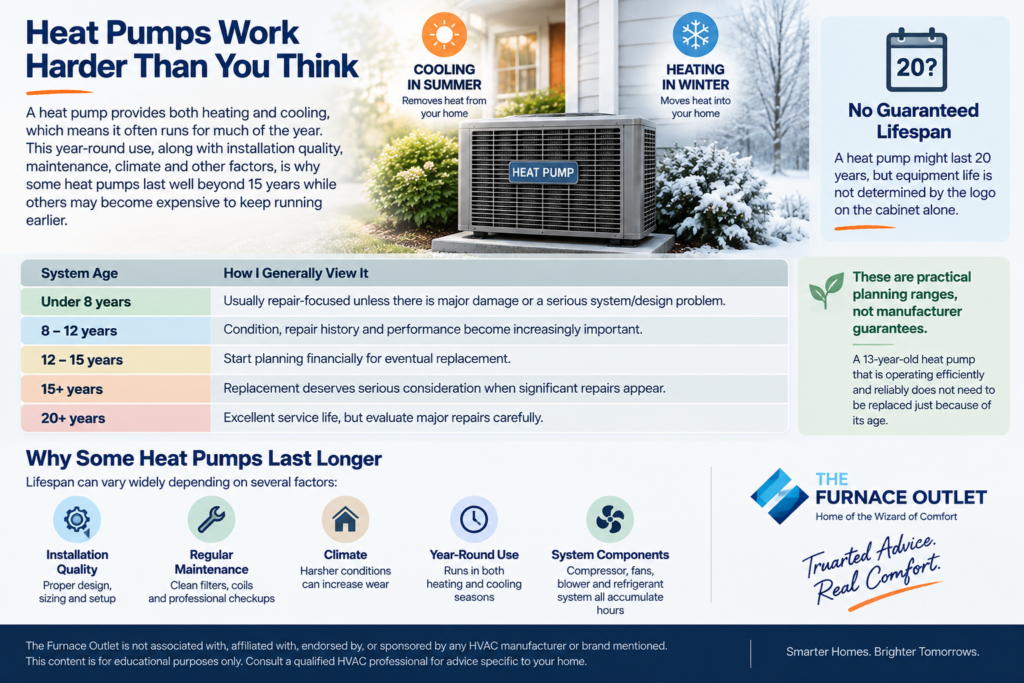
Some properly installed and well-maintained systems can continue operating beyond 15 years. Others may become expensive to keep running earlier. The reason heat-pump life can vary so much is that a heat pump often works during both heating and cooling seasons. In many climates, the compressor, outdoor fan, indoor blower and refrigeration system accumulate operating hours throughout most of the year.
I would therefore be cautious about any statement promising that a particular heat pump “will last 20 years.” It might, but equipment life is not determined by the logo on the cabinet alone.
| System age | How I generally view it |
|---|---|
| Under 8 years | Usually repair-focused unless there is major damage or a serious system/design problem |
| 8–12 years | Condition, repair history and performance become increasingly important |
| 12–15 years | Start planning financially for eventual replacement |
| 15+ years | Replacement deserves serious consideration when significant repairs appear |
| 20+ years | Excellent service life, but evaluate major repairs carefully |
These are practical planning ranges, not manufacturer guarantees. A 13-year-old heat pump that is operating efficiently and reliably does not need to be replaced merely because it crossed an arbitrary age threshold.
If you want to understand heat-pump lifespan, I would start with installation rather than maintenance. Maintenance matters enormously, but even excellent maintenance cannot completely correct a system that was badly selected or installed from day one.
DOE specifically identifies problems such as oversizing, improper refrigerant charging and leaky ductwork as installation deficiencies that can reduce efficiency, compromise comfort and shorten equipment life. AHRI similarly emphasizes properly matched indoor and outdoor equipment for expected efficiency and longevity.
Think of it like buying a very good set of tires and then installing them on a car with badly misaligned wheels. The quality of the tires still matters, but the surrounding system determines whether you get the performance and life you paid for.
With a heat pump, I want correct sizing, appropriate airflow, properly matched indoor and outdoor equipment, sound ductwork, correct refrigerant commissioning, suitable electrical installation and proper condensate drainage. Those details are not glamorous, but they can matter more to long-term reliability than many premium features advertised on the brochure.
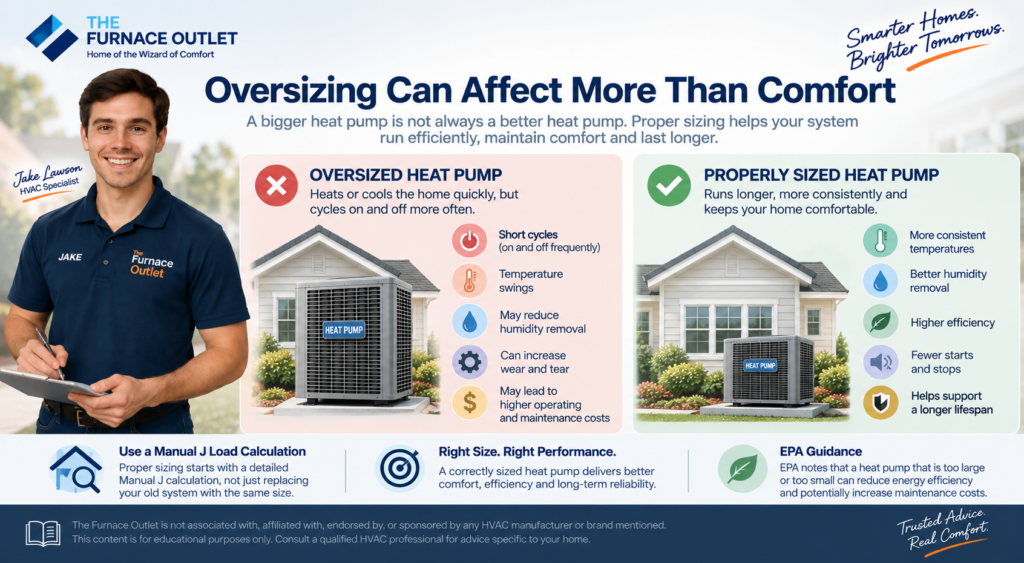
Homeowners sometimes assume that purchasing a larger heat pump gives the equipment an easier life because it can heat or cool the house faster. That reasoning overlooks what happens when equipment capacity substantially exceeds the load.
An oversized system may satisfy the thermostat quickly and cycle off, particularly when operating conditions do not require much capacity. Repeated short cycling can compromise comfort and humidity removal and creates additional starts and stops. Modern variable-speed systems can modulate their output considerably better than basic single-stage equipment, but variable-speed technology should not be treated as permission to ignore proper sizing.
EPA also cautions that a heat pump that is too large or too small can reduce energy efficiency and potentially increase maintenance costs.
This is one reason I keep returning to Manual J load calculations in our heat-pump guides. Before worrying about whether a heat pump might last 14, 16 or 18 years, make sure the equipment was reasonably matched to the house in the first place.

A heat pump installed in a mild climate may experience a very different life from the same model installed where it runs heavily during both hot summers and cold winters.
Remember that a heat pump is doing double duty. During summer it operates as an air conditioner. During winter it reverses the refrigeration cycle and provides heating. In some homes that means the refrigeration system may operate during much of the year.
Coastal locations introduce another consideration. Salt-laden air can accelerate corrosion of outdoor equipment. Dusty environments can foul coils more rapidly. Heavy snow and ice can obstruct the outdoor unit if the installation location or maintenance is poor. Vegetation, leaves and other debris can also interfere with airflow.
None of these conditions tells us exactly how many years a heat pump will last. They simply explain why calendar age alone is an incomplete measurement of equipment condition.
I don’t like using maintenance as a scare tactic. Your heat pump does not need somebody replacing expensive components every few months to keep it alive. It does, however, need basic attention.
ENERGY STAR recommends annual pre-season professional checkups and tells homeowners to inspect filters monthly. Its maintenance guidance includes checking thermostat operation, electrical connections, condensate drainage, system controls, coils, refrigerant condition and blower components as appropriate. ENERGY STAR also warns that dirty filters make HVAC equipment work harder and can contribute to early equipment failure.
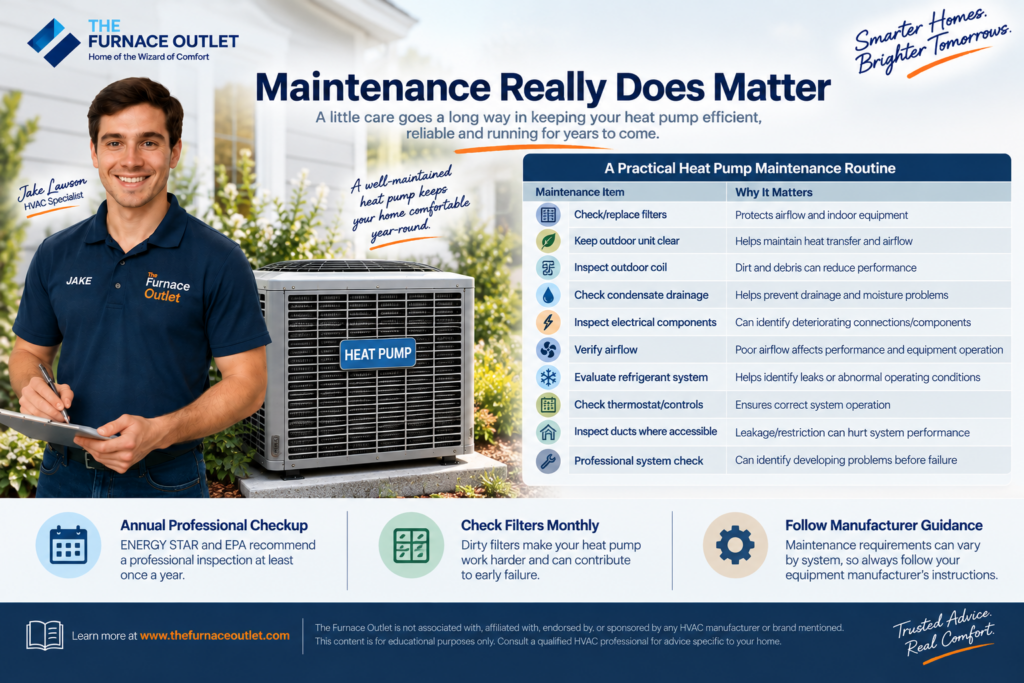
A practical maintenance routine looks something like this:
| Maintenance item | Why I care about it |
|---|---|
| Check/replace filters | Protects airflow and indoor equipment |
| Keep outdoor unit clear | Helps maintain heat transfer and airflow |
| Inspect outdoor coil | Dirt and debris can reduce performance |
| Check condensate drainage | Helps prevent drainage and moisture problems |
| Inspect electrical components | Can identify deteriorating connections/components |
| Verify airflow | Poor airflow affects performance and equipment operation |
| Evaluate refrigerant system | Helps identify leaks or abnormal operating conditions |
| Check thermostat/controls | Ensures correct system operation |
| Inspect ducts where accessible | Leakage/restriction can hurt system performance |
| Professional system check | Can identify developing problems before failure |
EPA likewise recommends cleaning or changing filters monthly or as needed and having a professional technician service the heat pump at least annually. I would always follow the equipment manufacturer’s maintenance instructions as well, because requirements can differ among systems.
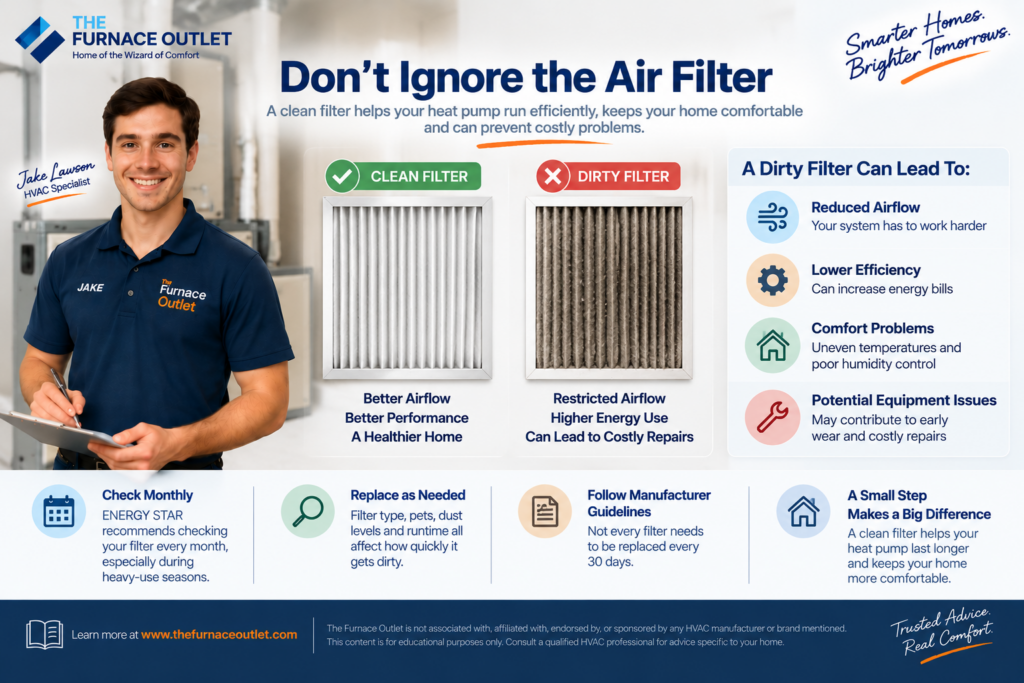
The cheapest component in the HVAC system can create surprisingly expensive problems when neglected. A dirty filter restricts airflow. That means the blower has a harder time moving air through the system, while the indoor coil may not receive the airflow the equipment was designed around. Depending on operating mode and severity, poor airflow can contribute to comfort problems, excessive runtime and abnormal system operation.
ENERGY STAR recommends checking the filter monthly, particularly during heavy-use seasons, and replacing or cleaning it when dirty.
That does not mean every filter must be replaced every 30 days. Filter type, home occupancy, pets, dust levels, construction activity and equipment runtime all influence how quickly a filter loads with debris. Inspect monthly and replace according to condition and manufacturer recommendations is more useful advice than blindly following one interval for every house.
The outdoor heat-pump unit needs unrestricted airflow because it is exchanging heat with outdoor air. During cooling, it rejects heat outside. During heating, it absorbs heat from outdoor air. Leaves, grass clippings, weeds, snow accumulation and other debris should not be allowed to obstruct the coil or airflow. ENERGY STAR specifically recommends keeping indoor and outdoor HVAC units clean and clear of debris.
I also would not build decorative screens tightly around the unit just because the homeowner doesn’t like looking at HVAC equipment. Landscaping can hide the unit without choking it. Maintain the clearances required by the manufacturer and make sure technicians can actually reach the equipment when service is required.
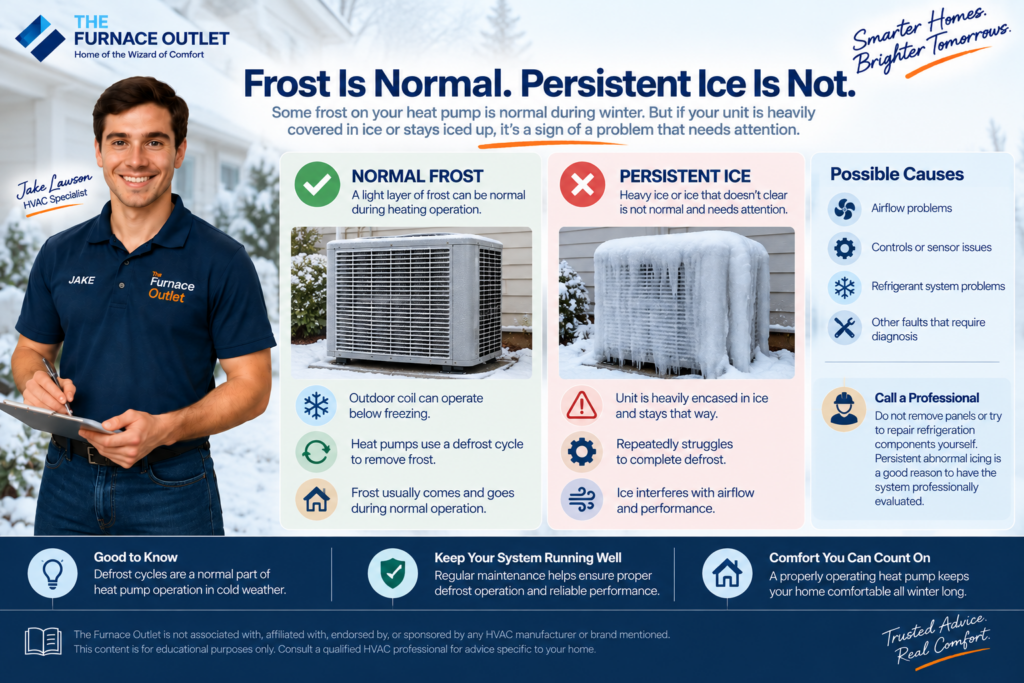
One question I hear frequently during winter is, “Jake, why is there frost on my heat pump?” Some frost on the outdoor coil during heating operation can be completely normal. The outdoor coil may operate below freezing, causing moisture in the air to freeze on its surface. Heat pumps use a defrost cycle to remove that accumulation.
What concerns me is a unit that becomes heavily encased in ice and stays that way, repeatedly struggles to complete defrost, or shows obvious ice accumulation that interferes with airflow. Possible causes can include airflow problems, controls, sensors, refrigerant-system problems or other faults that require diagnosis.
I would not recommend homeowners start removing panels or trying to repair refrigeration components themselves. Persistent abnormal icing is a good reason to have the system professionally evaluated.
This is another misconception worth clearing up. Refrigerant circulates through a closed system. A heat pump does not consume refrigerant in normal operation like a car consumes gasoline.
If refrigerant is repeatedly low, I want to know why. EPA specifically recommends that when equipment leaks, technicians locate and repair the leak rather than simply treating repeated refrigerant additions as normal maintenance. EPA also requires appropriate technician certification for refrigerant-related service.
So if an aging heat pump requires refrigerant year after year, I would consider that part of the repair-versus-replacement decision rather than treating another recharge as routine ownership expense.
HVAC equipment makes noise. Compressors hum, fans move air, refrigerant changes pressure and defrost cycles can sound different from normal heating operation. Variable-speed equipment can also change sound as operating capacity changes. What I care about is a change from normal behavior.
Grinding, repeated clicking, unusually loud buzzing, rattling that suddenly appears or a compressor that sounds noticeably different deserves investigation. The same applies to frequent starts and stops that were not occurring previously. Noise alone does not tell us which component has failed, and it certainly does not mean the heat pump needs immediate replacement. But changes in sound are often the equipment’s way of telling us that something has changed mechanically, electrically or operationally.
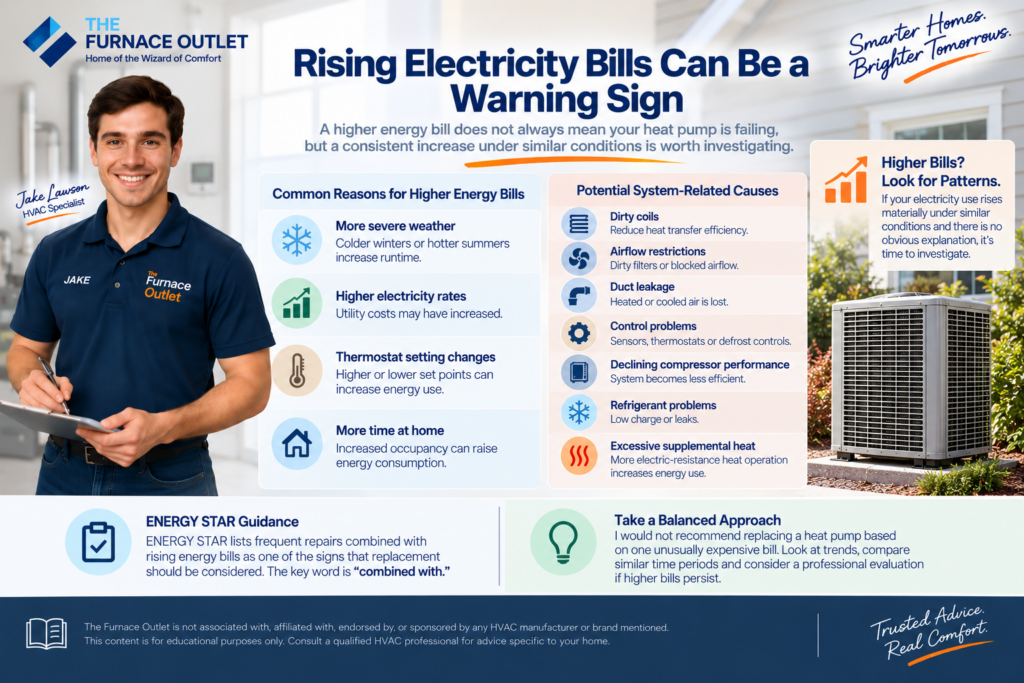
A higher utility bill does not automatically mean the heat pump is failing. Weather may have been more severe, electricity rates may have increased, thermostat settings may have changed, or occupants may simply have spent more time at home. But if electricity consumption rises materially under similar conditions and there is no obvious explanation, I would investigate.
Possible causes include dirty coils, airflow restrictions, duct leakage, control problems, declining compressor performance, refrigerant problems or excessive supplemental electric-resistance heat operation. ENERGY STAR specifically lists frequent repairs combined with rising energy bills among the signs that replacement should be considered. The important phrase there is “combined with.” I would not replace a heat pump based on one unusually expensive January bill.
If rooms that were previously comfortable become consistently too hot or too cold, the equipment deserves attention — but don’t immediately blame the heat pump. The problem could be duct leakage, blocked registers, airflow imbalance, insulation deficiencies, building-envelope changes or thermostat/control issues. ENERGY STAR likewise notes that rooms becoming too hot or cold can indicate equipment operation, duct or insulation problems.
This is why replacement should not become a shortcut around diagnosis. Installing a new $12,000 or $15,000 HVAC system on defective ductwork does not repair the ducts. Before replacing equipment because of comfort complaints, I want to know what is actually causing the comfort problem.
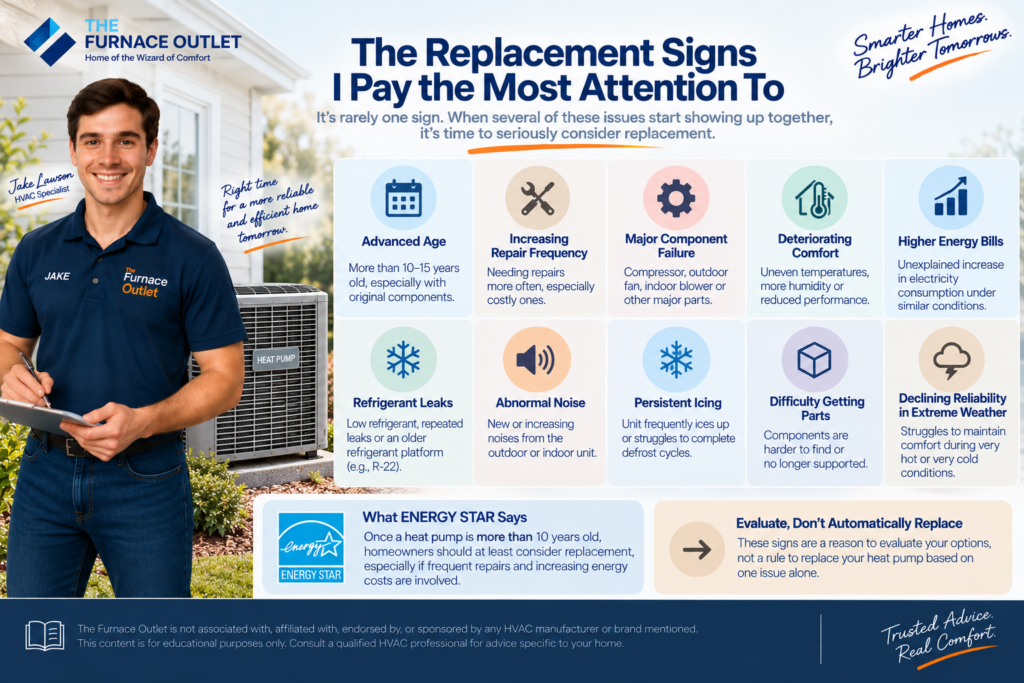
There is rarely one dramatic sign that tells us an old heat pump has reached the end. I become much more interested in replacement when several problems begin appearing together. For example, imagine a 14-year-old heat pump that has already required two significant repairs, uses an older refrigerant platform, has become noticeably noisier and now needs another expensive compressor-related repair. That is a completely different financial decision from replacing a $250 component on an otherwise healthy six-year-old system.
The warning signs I would weigh together include advanced age, increasing repair frequency, major component failure, deteriorating comfort, unexplained increases in energy consumption, refrigerant leaks, abnormal noise, persistent icing, difficulty obtaining components and declining reliability during extreme weather.
ENERGY STAR’s guidance is useful here: once heat-pump equipment is more than 10 years old, homeowners should at least consider replacement, especially if frequent repairs and increasing energy costs are involved. Consider that a signal to evaluate, not an instruction to automatically replace.
Suppose your 13-year-old heat pump needs a $1,500 repair. Should you repair it? I cannot answer that responsibly from the repair price alone. I would ask what failed, what condition the rest of the system is in, whether this is the first major repair or the fourth, what refrigerant the equipment uses, whether replacement parts remain readily available, how well the system performs, whether the indoor and outdoor units are appropriately matched and whether you were already considering replacement.
I also want to know whether replacing the system would solve another problem. Perhaps the existing unit is oversized. Maybe the duct system needs corrections. Perhaps the homeowner wants better cold-weather performance or variable-speed comfort. A repair makes sense when it buys useful additional service life at a reasonable cost. Repeatedly investing in an aging system with several developing problems can be a different story.
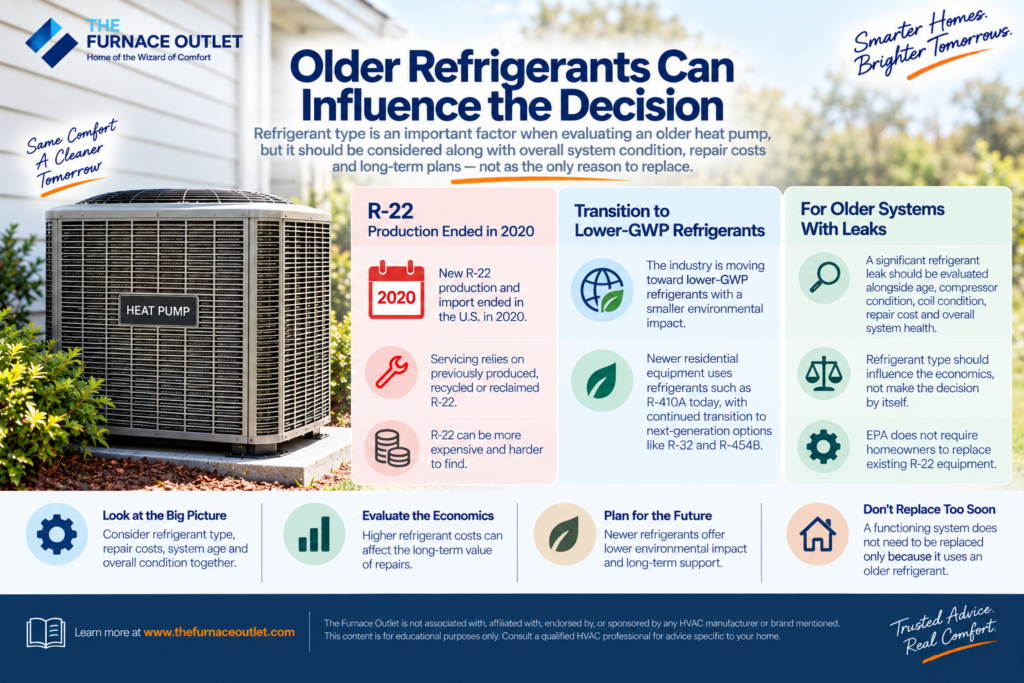
Refrigerant deserves consideration when evaluating an older heat pump, but I would not replace functioning equipment merely because it contains an older refrigerant. R-22 is the clearest example. EPA does not require homeowners to replace existing R-22 equipment. However, new R-22 production and import ended in the United States in 2020, meaning servicing relies on previously produced, recycled or reclaimed refrigerant.
The refrigerant transition is also continuing beyond R-22 as newer residential equipment moves toward lower-GWP alternatives. For an older system with a significant refrigerant leak, I would therefore consider the refrigerant platform alongside the age of the compressor, coil condition, repair cost and overall equipment condition. Refrigerant type should influence the economics, not make the decision by itself.
Today’s premium heat pumps can contain inverter-driven compressors, variable-speed motors, sophisticated sensors and communicating controls. Those technologies can provide excellent efficiency, modulation and comfort, but they also make some repairs different from the simple contactor-and-capacitor service calls homeowners may remember from older equipment. That is another reason warranty coverage matters.
When buying a new heat pump, I recommend understanding the difference between parts warranty and labor warranty. A manufacturer may cover a replacement component while the homeowner remains responsible for diagnosis, labor, refrigerant or other charges depending on the warranty terms.
Registration requirements can also differ among manufacturers. Read the actual warranty rather than assuming that “10-year warranty” means every HVAC expense is covered for ten years.

This may be the most useful advice in the entire article. Do not wait until your 16-year-old heat pump stops working during the hottest Saturday in July or the coldest night in January before learning what replacement equipment you want.
Once a system reaches the later part of its expected life, begin planning. Find out its model, age and refrigerant. Look at your repair history. Have the ductwork evaluated if there are known airflow problems. Understand your home’s heating and cooling loads. Research whether electrical modifications might be required. Compare equipment and contractor warranties. Planning does not mean replacing a functioning heat pump prematurely. It means ensuring that equipment failure does not force you into a rushed purchasing decision.
That gives you time to obtain multiple proposals, request a proper load calculation and compare complete systems rather than buying whatever equipment happens to be sitting in a distributor’s warehouse that afternoon.
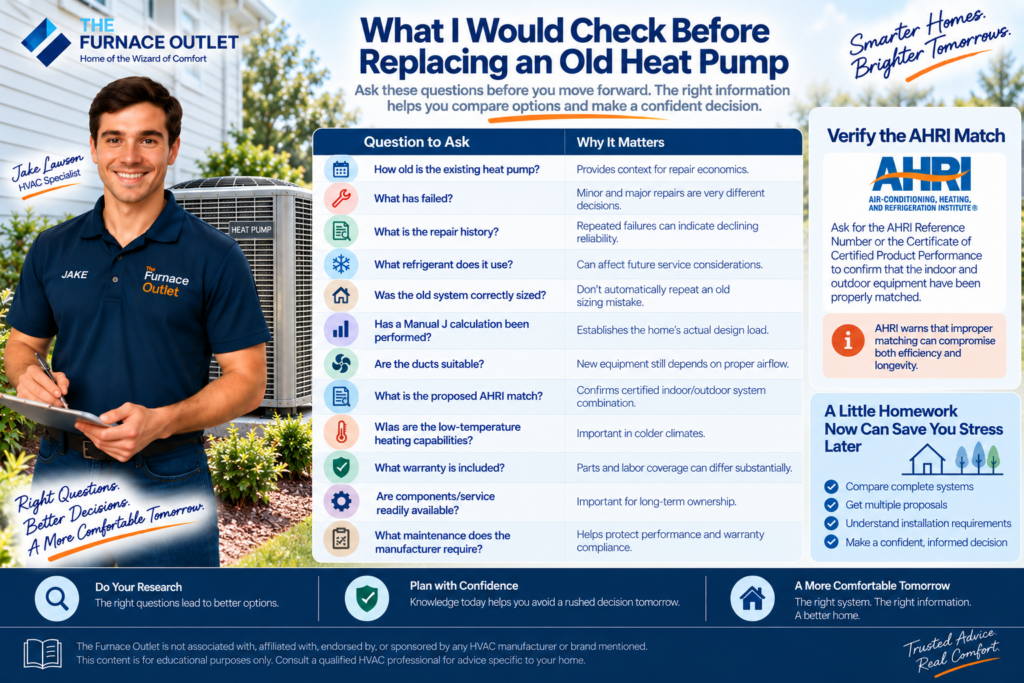
If I were evaluating a replacement proposal for my own house, I would want answers to these questions:
| Question | Why It Matters |
|---|---|
| How old is the existing heat pump? | Provides context for repair economics |
| What has failed? | Minor and major repairs are very different decisions |
| What is the repair history? | Repeated failures can indicate declining reliability |
| What refrigerant does it use? | Can affect future service considerations |
| Was the old system correctly sized? | Don’t automatically repeat an old sizing mistake |
| Has a Manual J calculation been performed? | Establishes the home’s actual design load |
| Are the ducts suitable? | New equipment still depends on proper airflow |
| What is the proposed AHRI match? | Confirms certified indoor/outdoor system combination |
| What are the low-temperature heating capabilities? | Important in colder climates |
| What warranty is included? | Parts and labor coverage can differ substantially |
| Are components/service readily available? | Important for long-term ownership |
| What maintenance does the manufacturer require? | Helps protect performance and warranty compliance |
AHRI recommends asking for the AHRI Reference Number or Certificate of Certified Product Performance to verify that indoor and outdoor equipment have been properly matched. AHRI warns that improper matching can compromise both efficiency and longevity.
If your heat pump is 15 years old, quiet, comfortable, properly maintained and operating without expensive problems, I would not tell you to remove it tomorrow simply because a lifespan chart says “15 years.”
I would tell you to start preparing for replacement. On the other hand, if that same 15-year-old system has a refrigerant leak, a failing compressor, repeated service calls, poor winter performance and rising operating costs, I would be reluctant to keep pouring money into it without comparing the cost and benefits of replacement.
That distinction matters. HVAC replacement should be a condition-and-economics decision informed by age, not an age-only decision.
A residential air-source heat pump lasting roughly 14–15 years is a reasonable planning expectation, based on current DOE and AHRI guidance, but individual systems can fall on either side of that number. Installation quality, sizing, climate, operating hours, airflow, refrigerant condition and maintenance all influence what happens over those years.
The best strategy is surprisingly uncomplicated: start with correctly sized and properly matched equipment, have it installed and commissioned correctly, keep filters and coils from becoming neglected, maintain unobstructed airflow, address unusual noises or operating behavior rather than ignoring them, and have the system professionally inspected according to manufacturer guidance.
Then, as the equipment ages, watch the pattern rather than the calendar. One repair does not necessarily mean replacement. But age combined with repeated repairs, rising energy consumption, refrigerant problems and deteriorating comfort can tell a very different story.
A heat pump should serve the house — not become a recurring repair project that the homeowner keeps alive simply because replacing it feels inconvenient.
— Jake Lawson, HVAC Specialist | The Furnace Outlet
Best Heat Pumps of 2026: The Complete Homeowner Buying Guide – The Furnace Outlet
Editorial Disclosure: The Furnace Outlet is not associated with, affiliated with, endorsed by, or sponsored by any HVAC manufacturer or brand mentioned in this article. We do not receive compensation from manufacturers for inclusion or rankings. Brand and product discussions are provided for independent educational and editorial purposes