Newsletter Subscribe
Enter your email address below and subscribe to our newsletter

HVAC made simple

By Savvy Mavi — Sustainability Expert | The Furnace Outlet
Installing a heat pump water heater involves more than connecting plumbing and switching on the electricity. Unlike conventional electric resistance water heaters, heat pump models extract heat from surrounding air, making installation location, airflow, electrical compatibility, and condensate drainage especially important.
As someone who researches sustainable home technologies, I consider proper installation one of the most important factors in achieving long-term efficiency. A high-performing water heater installed in an unsuitable location may consume more electricity, produce unwanted noise, or struggle to satisfy household hot-water demand.
The good news is that many homes can accommodate heat pump water heaters without extensive remodeling. However, the requirements differ between manufacturers, capacities, integrated hybrid systems, and split-system designs. In this guide, I will explain the key installation considerations and how homeowners can evaluate their property before purchasing equipment.
A conventional electric storage water heater primarily needs suitable electrical service, plumbing connections, physical clearance, and required safety provisions. A heat pump water heater needs these fundamentals plus access to an appropriate heat source, usually surrounding air.
Most integrated residential models have a compressor and fan assembly mounted above the storage tank. Air passes through an evaporator, allowing the refrigerant system to extract heat and transfer it into stored water. The process produces cooler air and condensate, so installers must consider airflow pathways, room temperature, drainage, and noise. Many models also contain electric resistance elements that provide additional heating when necessary.
I would never assume that a heat pump water heater is a direct replacement simply because its tank capacity matches the existing appliance.
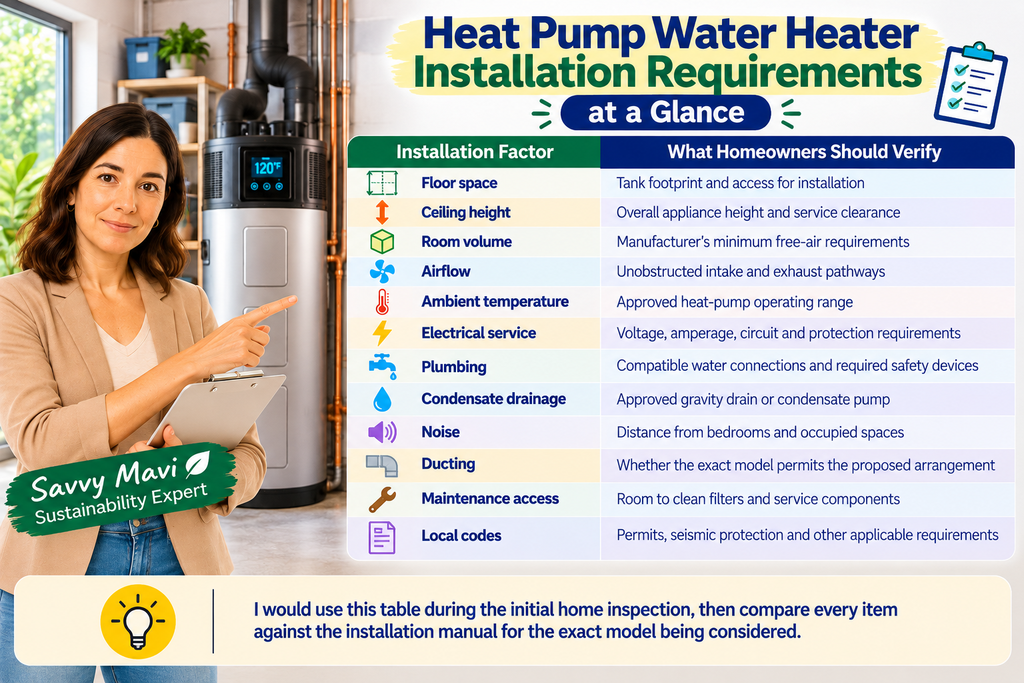
| Installation Factor | What Homeowners Should Verify |
|---|---|
| Floor space | Tank footprint and access for installation |
| Ceiling height | Overall appliance height and service clearance |
| Room volume | Manufacturer’s minimum free-air requirements |
| Airflow | Unobstructed intake and exhaust pathways |
| Ambient temperature | Approved heat-pump operating range |
| Electrical service | Voltage, amperage, circuit and protection requirements |
| Plumbing | Compatible water connections and required safety devices |
| Condensate drainage | Approved gravity drain or condensate pump |
| Noise | Distance from bedrooms and occupied spaces |
| Ducting | Whether the exact model permits the proposed arrangement |
| Maintenance access | Room to clean filters and service components |
| Local codes | Permits, seismic protection and other applicable requirements |
I would use this table during the initial home inspection, then compare every item against the installation manual for the exact model being considered.
Space requirements involve more than the dimensions of the tank. The appliance needs enough physical clearance for installation, maintenance, and unrestricted air circulation. ENERGY STAR’s technical guidance explains that many integrated heat pump water heaters require access to approximately 450–700 cubic feet of free air, depending on the model. A room measuring 10 feet by 10 feet with a 7-foot ceiling provides 700 cubic feet of gross volume.
However, these figures are common planning references, not universal installation requirements. Some products need different room volumes or approved ventilation arrangements. The installer should also check overhead clearance, side access, filter-removal space, and access to plumbing connections and electrical controls.
A water heater that technically fits into a closet may still be unsuitable if the installation prevents proper airflow or routine maintenance.
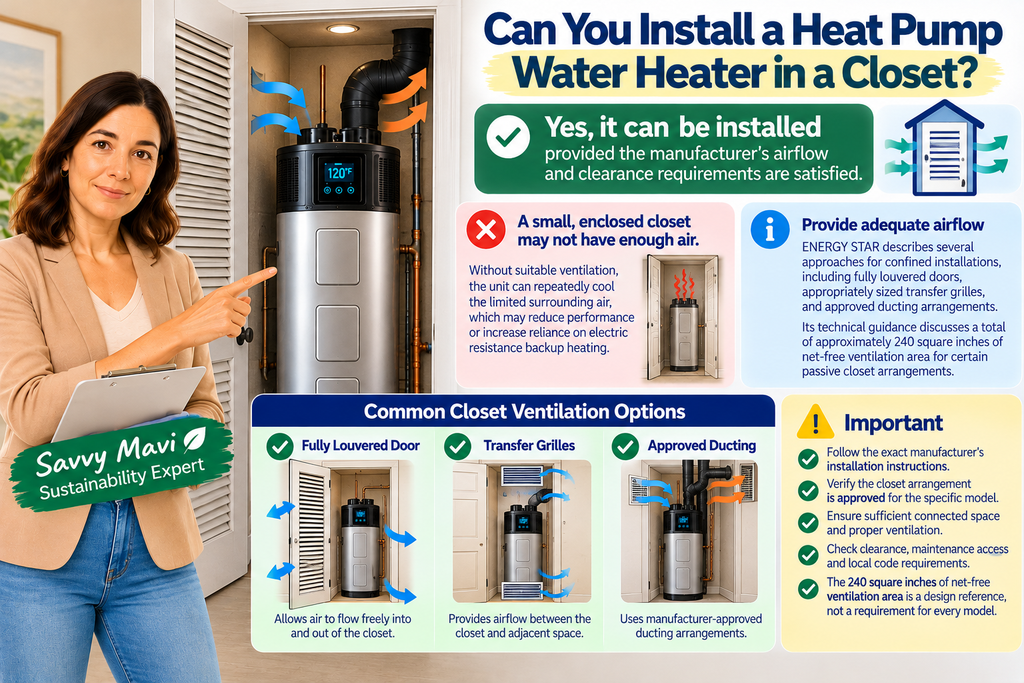
Yes, certain heat pump water heaters can be installed in closets, provided the manufacturer’s airflow and clearance requirements are satisfied. A small enclosed closet may not contain enough air for efficient heat-pump operation. Without suitable ventilation, the appliance can repeatedly cool the limited surrounding air, potentially reducing performance or increasing reliance on electric resistance backup heating.
ENERGY STAR describes several approaches for providing airflow to confined installations, including fully louvered doors, appropriately sized transfer grilles, and approved ducting arrangements. Its technical guidance discusses a total of approximately 240 square inches of net-free ventilation area for certain passive closet arrangements. However, this is a design reference, not a requirement that applies automatically to every model or installation.
I would verify whether the manufacturer approves the proposed closet arrangement and whether the connected space provides sufficient airflow.
A heat pump water heater needs access to air because that air supplies much of the thermal energy used to heat water. During operation, the fan draws air across the evaporator and releases cooler air back into the surrounding environment or through an approved ducting arrangement.
Restricting intake or exhaust airflow can reduce performance and potentially interfere with normal operation. Manufacturers therefore specify minimum clearances around air openings and may prohibit particular enclosure configurations.
I would avoid placing storage boxes, shelving, insulation, or other obstructions close to the appliance’s air intake or discharge. Ventilation should be evaluated as part of the home’s overall heating and cooling environment, not simply as a way to make the appliance fit.
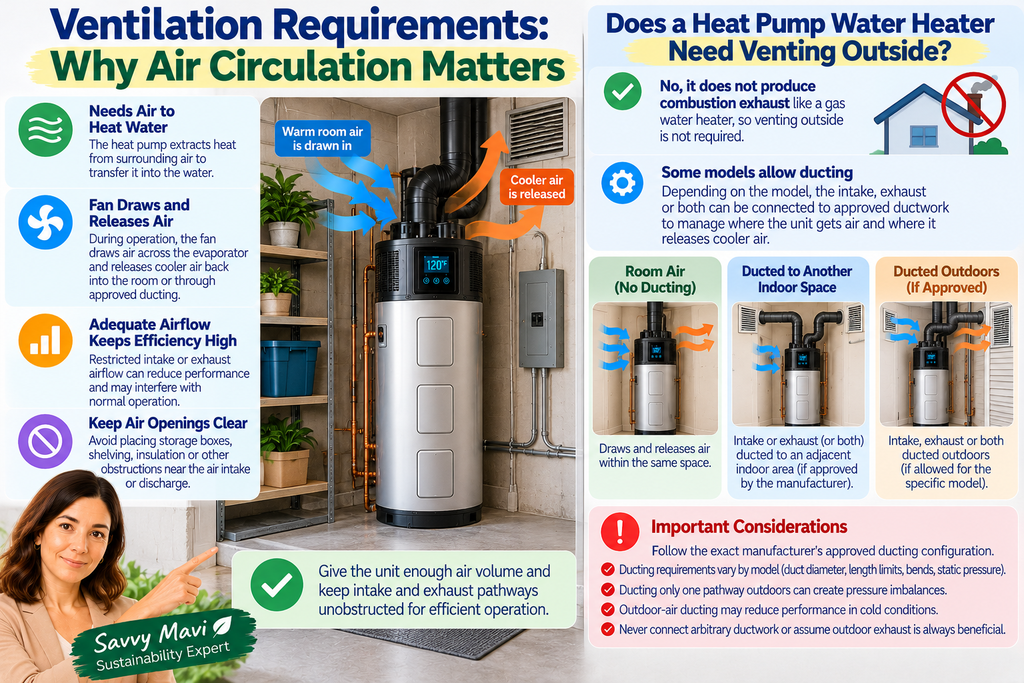
Unlike gas-fired water heaters, electric heat pump water heaters do not produce combustion exhaust that must be vented outdoors. However, some models allow air intake, exhaust, or both to be connected to approved ductwork. These arrangements manage where the appliance obtains heat and where it releases cooled air.
Ducting requirements vary significantly. Manufacturers may specify approved duct kits, duct diameters, equivalent length limits, allowable bends, and external static-pressure restrictions.
I would never connect arbitrary ductwork to a heat pump water heater or assume that exhausting cold air outdoors is always beneficial. ENERGY STAR cautions that ducting only one air pathway outdoors can create undesirable pressure imbalances. Outdoor-air ducting can also reduce performance in cold conditions. The correct approach is to follow the exact manufacturer’s approved ducting configuration and account for climate, airflow, and building pressure.
The ideal location depends on available space, ambient temperature, drainage, electrical access, and proximity to occupied rooms.
A garage can be a practical location because it often provides more available air volume than a compact interior closet. In warm climates, the surrounding air may offer favorable conditions for heat-pump operation.
However, garages can experience extreme seasonal temperatures. The appliance must be approved for the expected ambient conditions, and exposed plumbing or condensate lines may require freeze protection.
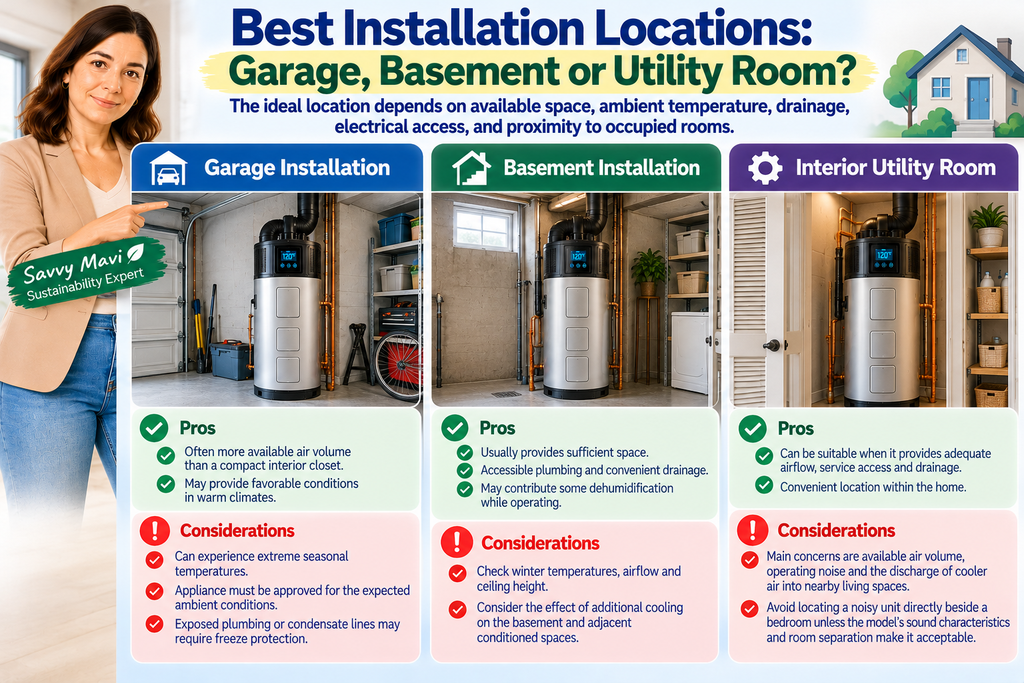
Basements can provide sufficient space, accessible plumbing, and convenient drainage. Heat pump water heaters may also contribute some dehumidification while operating. I would nevertheless check winter temperatures, airflow, ceiling height, and the effect of additional cooling on the basement and adjacent conditioned spaces.
An interior utility room may be suitable when it provides adequate airflow, service access, and drainage. The main concerns are usually available air volume, operating noise, and the discharge of cooler air into nearby living spaces.
I would avoid locating a noisy unit directly beside a bedroom unless the model’s sound characteristics and the room’s acoustic separation make that arrangement acceptable.
Electrical compatibility is one of the most important installation considerations. Many conventional hybrid heat pump water heaters use 240-volt electrical service, often through a dedicated branch circuit. However, certain residential heat pump water heaters are designed for 120-volt installations, and electrical requirements vary by model.
A 120-volt product is not necessarily interchangeable with a 240-volt hybrid system. Available backup heating, recovery performance, and electrical characteristics can differ.
Before purchasing, I would have a qualified electrician verify the exact appliance’s voltage, rated current, branch-circuit requirements, overcurrent protection, conductor sizing, grounding, disconnecting means, and compatibility with the home’s electrical panel. The manufacturer’s nameplate and installation instructions should determine the electrical design, together with applicable electrical codes.
I would never recommend a universal breaker size or wire gauge for every heat pump water heater.
Not necessarily. Many homeowners replacing an existing electric water heater already have electrical infrastructure that may be compatible with a new heat pump model. However, compatibility should be confirmed rather than assumed. A new appliance may have different electrical requirements, and existing circuits may need inspection or modification.
Homeowners converting from gas may need a new electrical circuit. In some properties, the electrician may determine that panel capacity or other electrical equipment requires upgrading. I would request an electrical assessment before finalizing the purchase, especially when the home has an older panel, limited spare capacity, or several other major electrical appliances.
Heat pump water heaters remove moisture from the air as part of the refrigeration process. That moisture collects as condensate and must be discharged safely. Where an appropriate drain is nearby, gravity drainage may be possible. In other locations, a condensate pump may be necessary to move the collected water to an approved discharge point.
Drainage arrangements should follow manufacturer instructions and local plumbing requirements. The installer should consider line routing, freezing conditions, pump accessibility, and potential overflow protection. I would also distinguish the condensate drain from the appliance’s temperature-and-pressure relief valve discharge and any separate leak-containment drain pan. These serve different purposes and should not be combined without an approved design.
Poor drainage can cause water damage and service problems even when the water heater itself is functioning correctly.
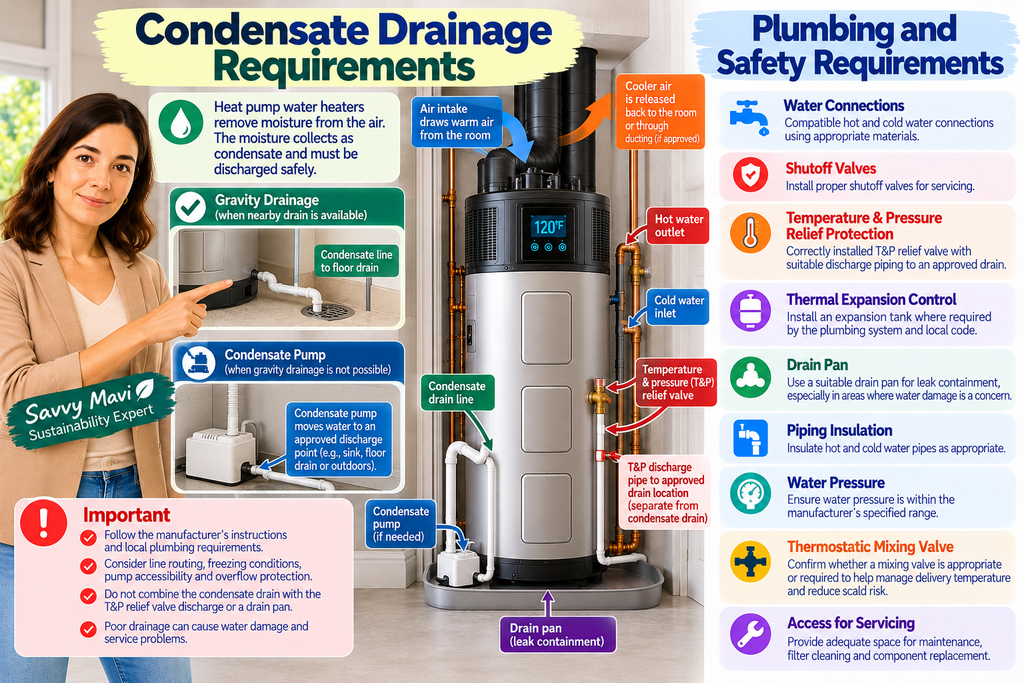
Heat pump water heaters still require the standard plumbing and safety provisions associated with storage water heaters. These can include appropriate shutoff valves, correctly installed temperature-and-pressure relief protection, suitable discharge piping, and thermal-expansion control where required by the plumbing system and local code.
Installers must also account for water pressure, pipe materials, access for servicing, and protection against leakage. ENERGY STAR’s installation guidance discusses drain pans, piping insulation, flexible connections, and temperature-control provisions as useful design considerations.
I would have the installer confirm whether a thermostatic mixing valve is appropriate or required for the selected system. Properly designed mixing arrangements can help manage delivery temperature while supporting household comfort and scald protection.
Heat pump water heaters generally operate most efficiently when they have access to relatively warm air. When surrounding air becomes colder, the appliance may need to work harder, recover more slowly, or activate electric resistance elements, depending on the model and operating conditions.
Manufacturers specify approved ambient-temperature ranges, and some models are designed to perform under conditions that would be unsuitable for others. I would therefore avoid using a single universal minimum temperature when evaluating installation locations.
In colder climates, placing an integrated unit in an unheated garage may be less attractive than installing it in a suitable basement or utility space. The best choice depends on the actual appliance specifications and expected seasonal temperatures.
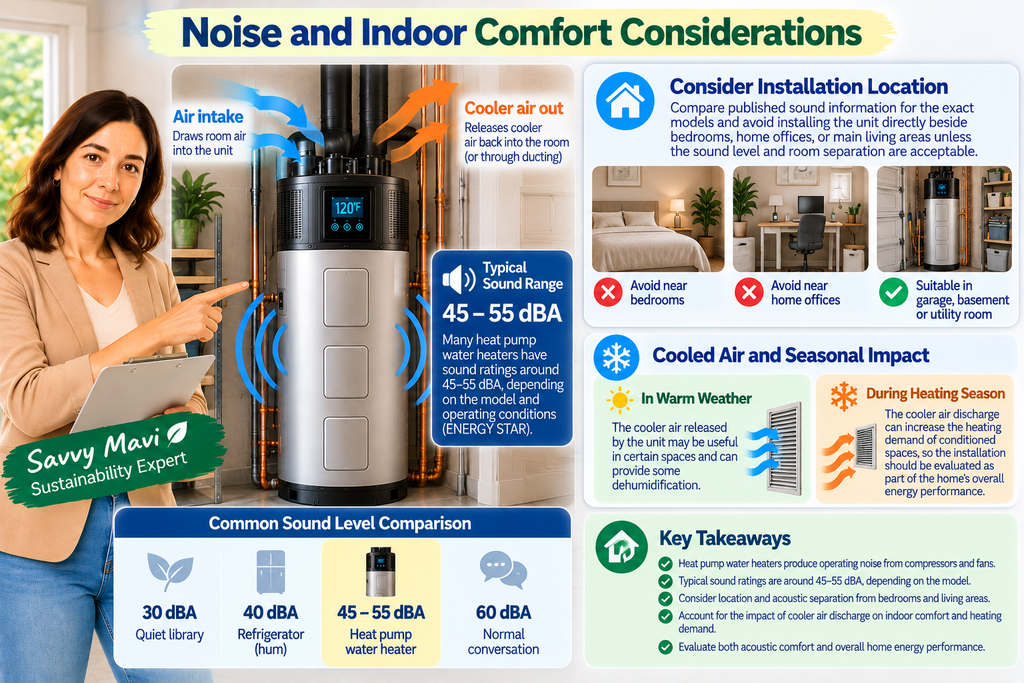
Heat pump water heaters contain compressors and fans, so they produce operating noise that conventional electric resistance tanks generally do not. Sound ratings differ between products and operating conditions. ENERGY STAR’s technical guidance discusses heat pump water heaters with sound ratings around 45–55 dBA, depending on the equipment and certification requirements.
I would compare published sound information for the exact models under consideration and think carefully about installation near bedrooms, home offices, and living areas. The appliance also releases cooled air. In warm weather, this may be useful in certain spaces, but during the heating season it can increase the heating demand of conditioned areas.
A suitable installation should therefore consider both acoustic comfort and the home’s broader energy performance.
Several mistakes can undermine an otherwise promising installation. The first is choosing a location based only on whether the tank physically fits. The second is ignoring the manufacturer’s airflow and ambient-temperature requirements.
Other problems include inadequate condensate drainage, incompatible electrical service, obstructed filters, poorly designed ductwork, insufficient maintenance access, and selecting a tank without checking peak-hour hot-water demand.
I would also avoid assuming that every heat pump water heater can be installed outdoors or that every closet can be made suitable with a small ventilation grille. Careful planning before purchasing is considerably easier than correcting an unsuitable installation afterward.
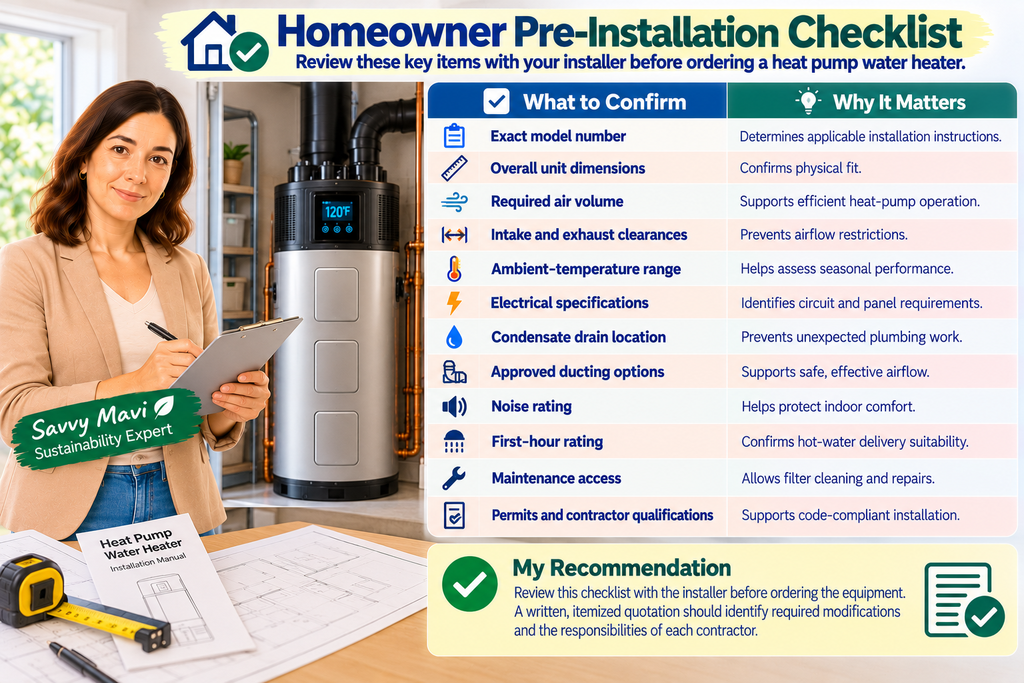
| What to Confirm | Why It Matters |
|---|---|
| Exact model number | Determines applicable installation instructions |
| Overall unit dimensions | Confirms physical fit |
| Required air volume | Supports efficient heat-pump operation |
| Intake and exhaust clearances | Prevents airflow restrictions |
| Ambient-temperature range | Helps assess seasonal performance |
| Electrical specifications | Identifies circuit and panel requirements |
| Condensate drain location | Prevents unexpected plumbing work |
| Approved ducting options | Supports safe, effective airflow |
| Noise rating | Helps protect indoor comfort |
| First-hour rating | Confirms hot-water delivery suitability |
| Maintenance access | Allows filter cleaning and repairs |
| Permits and contractor qualifications | Supports code-compliant installation |
My recommendation is to review this checklist with the installer before ordering the equipment. A written, itemized quotation should identify required modifications and the responsibilities of each contractor.
Many integrated models require access to approximately 450–700 cubic feet of free air, although exact requirements vary. Some installations use approved ventilation or ducting arrangements to accommodate smaller spaces.
Yes, when the location satisfies the manufacturer’s temperature, airflow, clearance, and other installation requirements. Cold garages may reduce heat-pump performance, and plumbing must be protected against freezing where applicable.
Many hybrid models use 240-volt service, but certain products are designed for 120-volt installations. The exact model’s electrical specifications must determine the circuit requirements.
Sometimes. Approved louvered doors, transfer grilles, or ducting arrangements may provide sufficient airflow, but a small closet is not automatically suitable for every model.
Yes, integrated heat pump water heaters generally produce condensate that requires appropriate drainage. Depending on the installation, a gravity drain or condensate pump may be used.
Installation involves electrical work, pressurized plumbing, water-temperature safety devices, condensate drainage, and applicable building codes. I recommend using appropriately qualified professionals and following the manufacturer’s installation instructions.
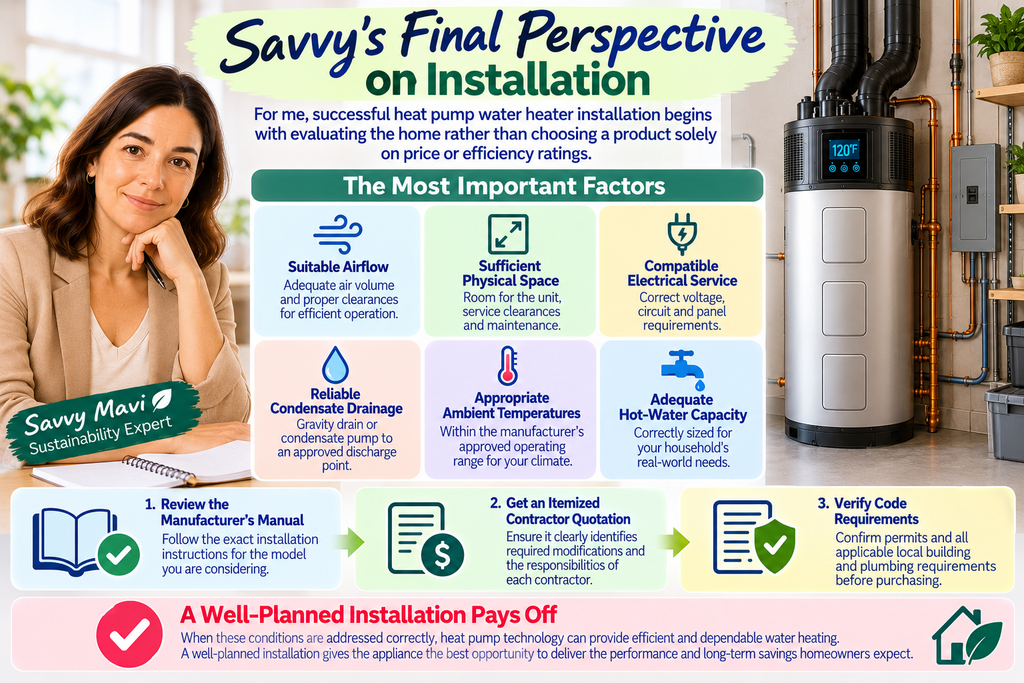
For me, successful heat pump water heater installation begins with evaluating the home rather than choosing a product solely on price or efficiency ratings. The most important factors are suitable airflow, sufficient physical space, compatible electrical service, reliable condensate drainage, appropriate ambient temperatures, and adequate hot-water capacity. When these conditions are addressed correctly, heat pump technology can provide efficient and dependable water heating.
I would always review the exact manufacturer’s installation manual, request an itemized contractor quotation, and verify code requirements before purchasing. A well-planned installation gives the appliance the best opportunity to deliver the performance and long-term savings homeowners expect.
The Furnace Outlet is an independent educational and informational website. We are not affiliated with, associated with, sponsored by, endorsed by, or officially connected with any water-heater manufacturer, brand, retailer, utility, government agency, or other company mentioned in this article unless expressly disclosed. Product names and trademarks belong to their respective owners and are used solely for identification and informational purposes.
Our content draws on publicly available government guidance, manufacturer documentation, and established water-heating principles. We do not claim to have independently tested products unless expressly stated. Some articles may contain affiliate links through which The Furnace Outlet may earn a commission at no additional cost to readers.
This guide is intended for homeowner education and preliminary planning, not as a substitute for model-specific installation instructions, engineered designs, or professional advice. Electrical systems, plumbing connections, pressurized hot water, and refrigerant equipment present safety risks. Always follow the manufacturer’s requirements, applicable codes, and permit rules, and use appropriately qualified professionals for installation, servicing, and repairs.