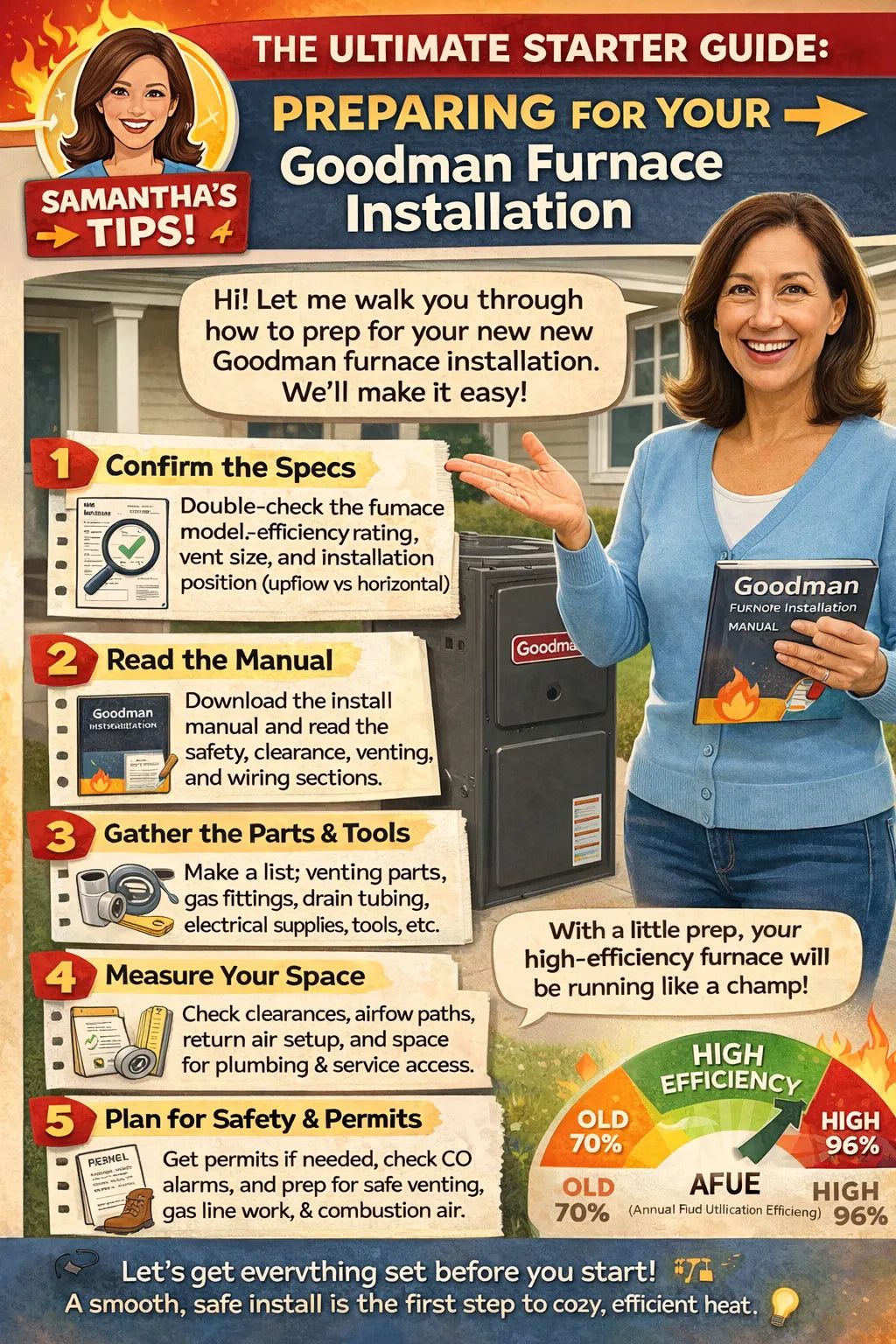
Installing a high-efficiency furnace like the Goodman GR9T96 (96% AFUE, two-stage, ECM blower) is the kind of project that goes smoothly only when the prep is right. This guide is my “Samantha-style” game plan: practical, safety-first, and designed to help you avoid the hidden mistakes that cause failed inspections, comfort issues, or warranty headaches.
Helpful references I’ll point to (max 6): the exact furnace product specs, the official Goodman spec sheet, the install manual, an ENERGY STAR commissioning checklist, and key safety/code context.
✅ 🧾 Step 1: Confirm What You’re Installing (So You Don’t Prep the Wrong “Puzzle Piece”)
Before you buy a single fitting, confirm these core details from your product listing/specs:
-
Model & size: GR9T960804CN (80,000 BTU input)
-
Efficiency class: 96% AFUE (Category IV condensing furnace)
-
Installation position: Upflow or horizontal left/right (multi-position)
-
Venting: PVC (typically 2” or 3” depending on run/elbows)
-
Electrical: 115V, and many installs land on a 20A breaker (verify locally and in manual)
Start here (bookmark it): the product page specs make it easy to cross-check what you think you bought vs what you actually bought.
📚 🛠️ Step 2: Read the Manual Before You Touch the Old Furnace
This is the part people skip… and then they “discover” requirements mid-install.
Download the installation manual and skim these sections first:
-
Clearances (service clearance and combustibles)
-
Venting tables (pipe diameter, equivalent length, elbow limits, termination rules)
-
Condensate handling (drain routing, trap requirements if applicable)
-
Gas piping & pressure checks
-
Wiring & thermostat setup
-
Startup/commissioning sequence HVAC Direct
Installation Manual (PDF): https://hvacdirect.com/media/pdf/GR9T96-GD9T96-Install-Manual.pdf HVAC Direct
Also grab the spec sheet—it’s a fast way to confirm vent sizes, airflow, and install notes without hunting through the full manual:
Goodman spec sheet (PDF viewer): https://www.goodmanmfg.com/pdfviewer.aspx?pdfurl=docs%2Flibrariesprovider6%2Fdefault-document-library%2Fss-gr9t96_gd9t96-r32.pdf%3Fview%3Dtrue
🧰 📦 Step 3: Do a “Parts & Tools Audit” (The Trip-to-the-Store Trap Is Real)
Your prep goal
Have everything staged so you’re not improvising gas fittings or vent runs at 9pm.
Common “you’ll probably need this” list
(Exact needs depend on your layout and local code—use the manual as the authority.)
Venting/combustion air
-
PVC pipe & fittings sized per manual tables (2” or 3” often)
-
Proper termination kit / screens if required by your jurisdiction/manual
-
Pipe supports/hangers, primer/cement rated for the material
Condensate
-
Tubing, drain fittings, possibly a neutralizer (common recommendation in many areas)
-
A plan for routing to an approved drain location
Gas
-
Correct fittings, shutoff valve if needed, drip leg/sediment trap parts (often required)
-
Approved leak-check method (never “guess”)
Electrical
-
Service switch/disconnect method as required locally
-
Correct thermostat wire if you’re upgrading controls
Airflow
-
Filter setup (don’t assume your old one fits)
-
Return-air plan (size and path matter more than most people realize)
🏠 📏 Step 4: Measure the Space Like a Grown-Up (Clearance, Return Air, and Service Access)
For this model, cabinet width is commonly listed around 21 inches, but what matters more is:
-
Can you remove panels comfortably?
-
Can a tech service it without disassembling your closet?
-
Is there a safe route for venting and condensate?
Key prep checks:
-
Doorway and turn radius for getting the unit into place
-
Return air path (undersized returns = noisy blower + poor comfort)
-
Platform or base stability (especially in attic/closet installs)
-
Drain route planned before you mount anything
🌬️ 🧪 Step 5: Make a Venting Plan (This Is Where High-Efficiency Furnaces Punish Guesswork)
A 96% AFUE furnace is a condensing appliance. That changes venting priorities:
-
Exhaust is cooler → more moisture/condensate
-
Vent pitch, length, elbows, and termination location matter a lot
-
The manual’s vent tables are not “suggestions"
Also, venting is governed by nationally recognized safety codes that local jurisdictions commonly adopt and amend—NFPA 54 is a big one.
NFPA 54 scope/applicability (PDF excerpt): https://docinfofiles.nfpa.org/files/AboutTheCodes/54/TIA_54_24_1.pdf
My Samantha rule: if you can’t confidently sketch your vent route (with elbows and termination) before install day, you’re not ready yet.
🧯 😷 Step 6: Safety Prep (CO Alarms, Combustion Air, and “Don’t Wing It” Zones)
Gas appliances can produce carbon monoxide (CO), and the scary part is it’s odorless and invisible. CDC guidance is crystal clear: prevention and proper operation matter.
Before installation day:
-
Verify you have working CO alarms in the home (especially near sleeping areas)
-
Plan for proper combustion air per the manual and local code
-
Never operate the furnace if you suspect venting problems, spillage, or gas leaks
CDC Furnace Safety Fact Sheet: https://www.cdc.gov/carbon-monoxide/factsheets/furnace-safety-fact-sheet.html
🧾 🔍 Step 7: Permits, Inspections, and “Who Signs Off?” (Decide This Up Front)
Here’s the reality: many areas require permits/inspections for gas appliance replacement. Even when they don’t, your homeowner’s insurance and warranty documentation usually love clean paperwork.
Before you start, decide:
-
Who is pulling the permit (you or a licensed contractor)?
-
Who is doing the final startup checks?
-
Who is responsible for code compliance on venting/gas/electrical?
NFPA 54 exists specifically to cover safe installation of fuel gas piping systems/appliances and is commonly referenced in local rules.
✅ 📋 Step 8: Use a Commissioning Checklist (Because “It Runs” Isn’t the Same as “It’s Right”)
This is my favorite “smart homeowner” move: insist on a real commissioning process.
ENERGY STAR publishes a National HVAC Commissioning Checklist that applies to furnaces (including up to 225 kBtuh with ducts). It’s a solid way to verify critical items were actually checked and recorded. ENERGY STAR
Use it to confirm things like:
-
Airflow setup (blower settings)
-
Proper system operation sequence
-
Safety controls verified
-
Duct system basics accounted for
-
Key measurements recorded (not guessed)
🧠 🧩 Step 9: My “Green-Light / Red-Light” Readiness Test
✅ Green-light (you’re prepared)
-
You have the manual + vent plan finalized
-
You’ve confirmed clearances + service access
-
You have a condensate route that makes sense
-
You’re ready for permit/inspection expectations
-
You’ll follow a commissioning checklist, not vibes
🚫 Red-light (pause and reassess)
-
You’re unsure about vent sizing/termination rules
-
You’re planning to “figure out gas fittings as you go”
-
You don’t know where condensate will drain
-
You’re missing CO alarms or ignoring combustion air needs
🎯 Final Samantha Take
A Goodman high-efficiency furnace can be a fantastic upgrade—but the install prep is the difference between “quiet, even heat” and “why is this thing so finicky?” Use the manual as your authority, plan venting/condensate early, and treat commissioning like a required step—not a bonus.
Buy this on Amazon at: https://amzn.to/4hJt23t
In the next topic we will know more about: How to Read Your Goodman Furnace Installation Manual Like a Technician