When a Goodman furnace flashes a code, most homeowners do one of two things:
-
Panic
-
Ignore it and hope the heat stays on
Both are mistakes.
100,000 BTU 96% AFUE Upflow/Horizontal Two Stage Goodman Gas Furnace - GR9T961004CN
Those blinking lights aren’t random. They’re your furnace telling you exactly what it’s unhappy about — sometimes before it actually shuts down.
This guide explains:
-
What Goodman diagnostic codes really are
-
Why codes matter even if the furnace is still running
-
The most common Goodman furnace codes (in plain English)
-
What you can safely check yourself
-
When a code means “stop and call a pro”
No memorization required. Just understanding.
🔌 What the Goodman Furnace Control Board Actually Does
Think of the control board as the furnace’s brain.
It:
-
Manages ignition timing
-
Controls the blower motor
-
Monitors safety switches
-
Records faults and shutdowns
When something falls outside safe limits, the board responds in two ways:
-
Protects the furnace
-
Reports the issue through diagnostic codes
Those flashes are not failures — they’re warnings or confirmations of protection.
💡 How Goodman Diagnostic Codes Work
Most Goodman furnaces use:
-
A single LED light
-
A flash pattern
The pattern usually looks like:
-
Short flashes
-
A pause
-
Repeating sequence
Example:
-
Flash–flash–pause = Code 2
-
Flash–flash–flash–pause = Code 3
The code repeats until the issue clears or power is reset.
🛑 Important Rule Before You Decode Anything
Before touching anything:
-
Turn the thermostat off
-
Observe the code during a normal call for heat
-
Write it down
Resetting power too early erases valuable information.
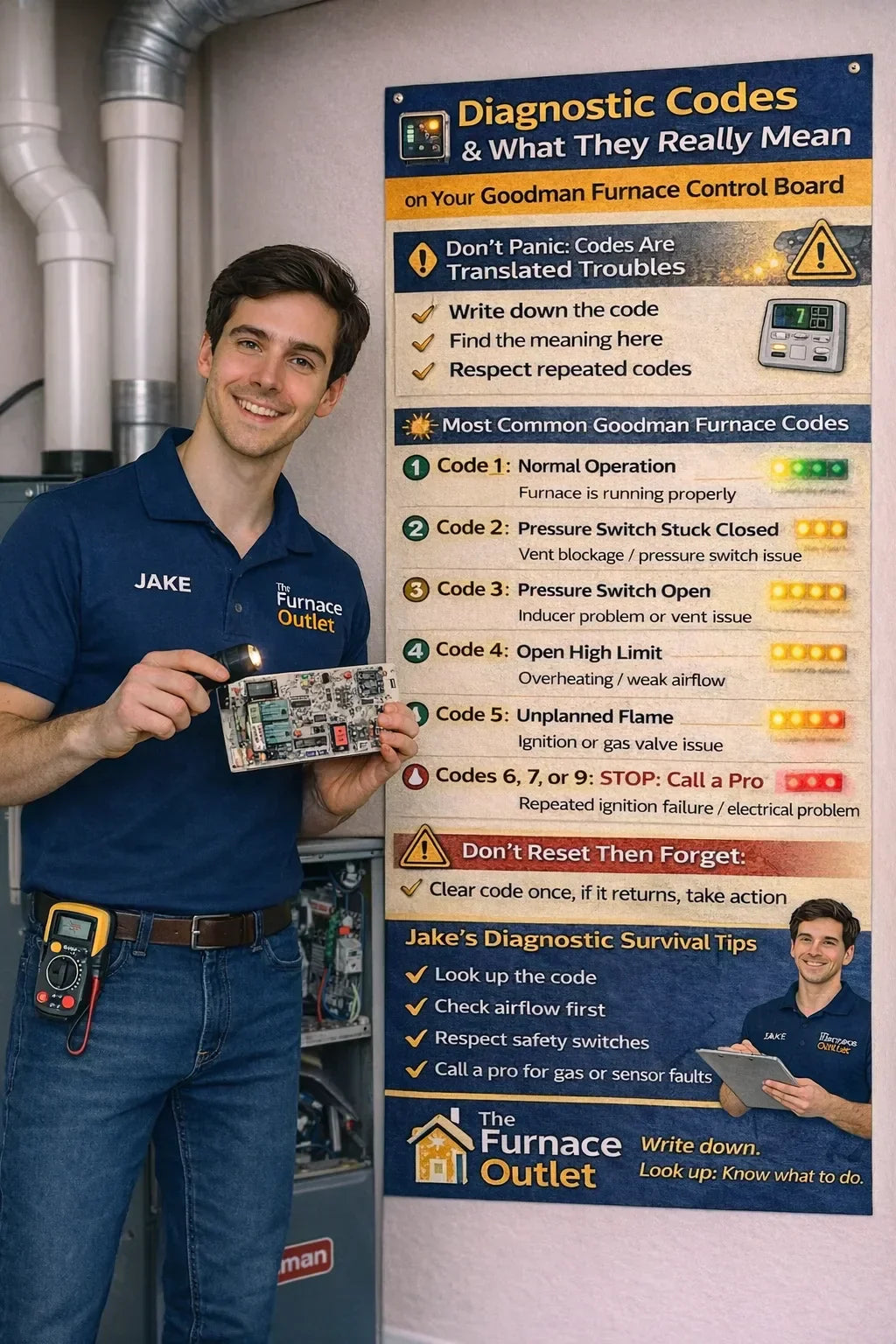
🔥 The Most Common Goodman Furnace Diagnostic Codes (Explained)
Below are the codes I see most often — and what they actually mean in real homes.
🟡 Code 1: Normal Operation
What it means:
The furnace is operating correctly.
Jake’s take:
If you’re getting heat and see Code 1, stop worrying. This is confirmation, not a problem.
🌬️ Code 2: Pressure Switch Stuck Closed
What the furnace is saying:
“I expected the pressure switch to be open before startup, and it wasn’t.”
Common causes:
-
Blocked vent or intake pipe
-
Moisture in the pressure switch hose
-
Pressure switch failure
Homeowner check:
-
Look for snow, debris, or nests in intake/exhaust pipes
-
Check for visible water in clear hoses
If it returns, this is pro territory.
💨 Code 3: Pressure Switch Open (Inducer Problem)
What it means:
The furnace can’t prove proper draft.
Common causes:
-
Blocked venting
-
Condensate drain issues
-
Inducer motor problems
Why this matters:
This code protects against flue gas spillage and unsafe combustion.
Jake’s rule:
Pressure switch codes are never “ignore and run anyway” situations.
🔥 Code 4: Open High Limit Switch (Overheating)
This one matters a lot.
What the furnace is saying:
“I’m too hot. I shut down to protect myself.”
Most common causes:
-
Dirty air filter
-
Blocked supply or return vents
-
Dirty blower wheel
-
Improper airflow
Homeowner action:
-
Replace the filter immediately
-
Make sure vents are open and unblocked
If this happens repeatedly, call a pro — overheating damages heat exchangers.
⚡ Code 5: Flame Sensed Without Call for Heat
What it means:
The furnace senses flame when it shouldn’t.
Possible causes:
-
Stuck gas valve
-
Dirty flame sensor
-
Control board issues
Jake’s take:
This is not a DIY diagnosis. Shut the system down and call for service.
🔥 Code 6 or 7: Ignition Failure
What the furnace is saying:
“I tried to light, but flame wasn’t proven.”
Common causes:
-
Dirty flame sensor
-
Gas supply issues
-
Ignitor problems
Safe homeowner step:
-
Power cycle once
-
If it returns, stop
Repeated ignition failures stress components and flood burners with gas.
🌡️ Code 9: Reversed Polarity or Grounding Issue
What it means:
The furnace senses incorrect electrical polarity.
Common causes:
-
Outlet wiring issues
-
Improper grounding
This is an electrical safety issue — not a furnace adjustment.
🔁 Why Codes Appear Even When the Furnace “Still Works”
This is where homeowners get confused.
Many Goodman furnaces:
-
Log faults
-
Recover automatically
-
Keep running
That doesn’t mean the issue is gone.
Repeated codes = developing problems, not false alarms.
🧠 How Diagnostic Codes Protect the Heat Exchanger
Most safety codes exist to prevent:
-
Overheating
-
Flame rollout
-
Incomplete combustion
Ignoring codes often leads to:
-
Short cycling
-
Metal fatigue
-
Premature exchanger failure
The control board is trying to save expensive parts.
🛠️ Safe DIY Checks vs “Call a Pro” Lines
✅ Homeowner-safe checks:
-
Replace air filter
-
Clear vent/intake pipes
-
Observe and record codes
-
Power reset once
🚫 Call a professional if:
-
Codes repeat
-
Gas-related codes appear
-
Pressure switch issues persist
-
CO detectors activate
Guessing saves nothing.
📋 Jake’s Diagnostic Code Survival Checklist
✔ Write the code down
✔ Check airflow first
✔ Never bypass safety switches
✔ Don’t reset repeatedly
✔ Respect repeated faults
Follow that list and you’ll never make a bad call.
🔗 Verified External Resources
-
Goodman Gas Furnace Overview:
https://www.goodmanmfg.com/products/gas-furnaces -
Furnace Safety & Controls (Energy.gov):
https://www.energy.gov/energysaver/furnaces-and-boilers -
Carbon Monoxide Safety (CDC):
https://www.cdc.gov/carbon-monoxide/about/index.html -
Indoor Air Quality & Combustion Safety (EPA):
https://www.epa.gov/indoor-air-quality-iaq
🔚 Jake’s Final Word
Diagnostic codes aren’t warnings of doom — they’re early conversations.
Listen to them, write them down, and respond appropriately. Do that, and your Goodman furnace will:
-
Protect itself
-
Protect your home
-
Avoid unnecessary breakdowns
Ignore them, and small problems quietly become big ones.
Buy this on Amazon at: https://amzn.to/48LE6e5
In the next topic we will know more about: Vent & Flue Care: Why Your Furnace’s ‘Breathing’ System Needs Yearly Inspection