Newsletter Subscribe
Enter your email address below and subscribe to our newsletter

HVAC made simple
By Mark Callahan | The Furnace Outlet
Rooftop HVAC units are a practical heating and cooling solution for commercial buildings, restaurants, retail stores, offices, and multifamily properties. By positioning equipment on the roof, building owners can preserve valuable indoor space, simplify equipment access, and accommodate centralized heating and cooling requirements.
However, rooftop equipment introduces an important consideration that is frequently overlooked during the purchasing process: noise. Compressor operation, condenser fans, blower motors, airflow, and structural vibration can affect employees working directly below the equipment, tenants occupying nearby rooms, and neighbors living around the property.
Understanding rooftop HVAC noise levels before purchasing or installing equipment can help property owners prevent complaints, improve occupant comfort, and avoid expensive sound mitigation projects.
Commercial rooftop units, commonly referred to as RTUs, can produce significantly different noise levels depending on equipment capacity, compressor technology, fan speed, cabinet construction, operating conditions, and installation quality. Larger equipment does not necessarily produce more noticeable noise inside the building when appropriate acoustic treatments and vibration isolation are incorporated.
The following sound pressure levels provide illustrative planning scenarios rather than measured equipment ratings or guaranteed installation outcomes.
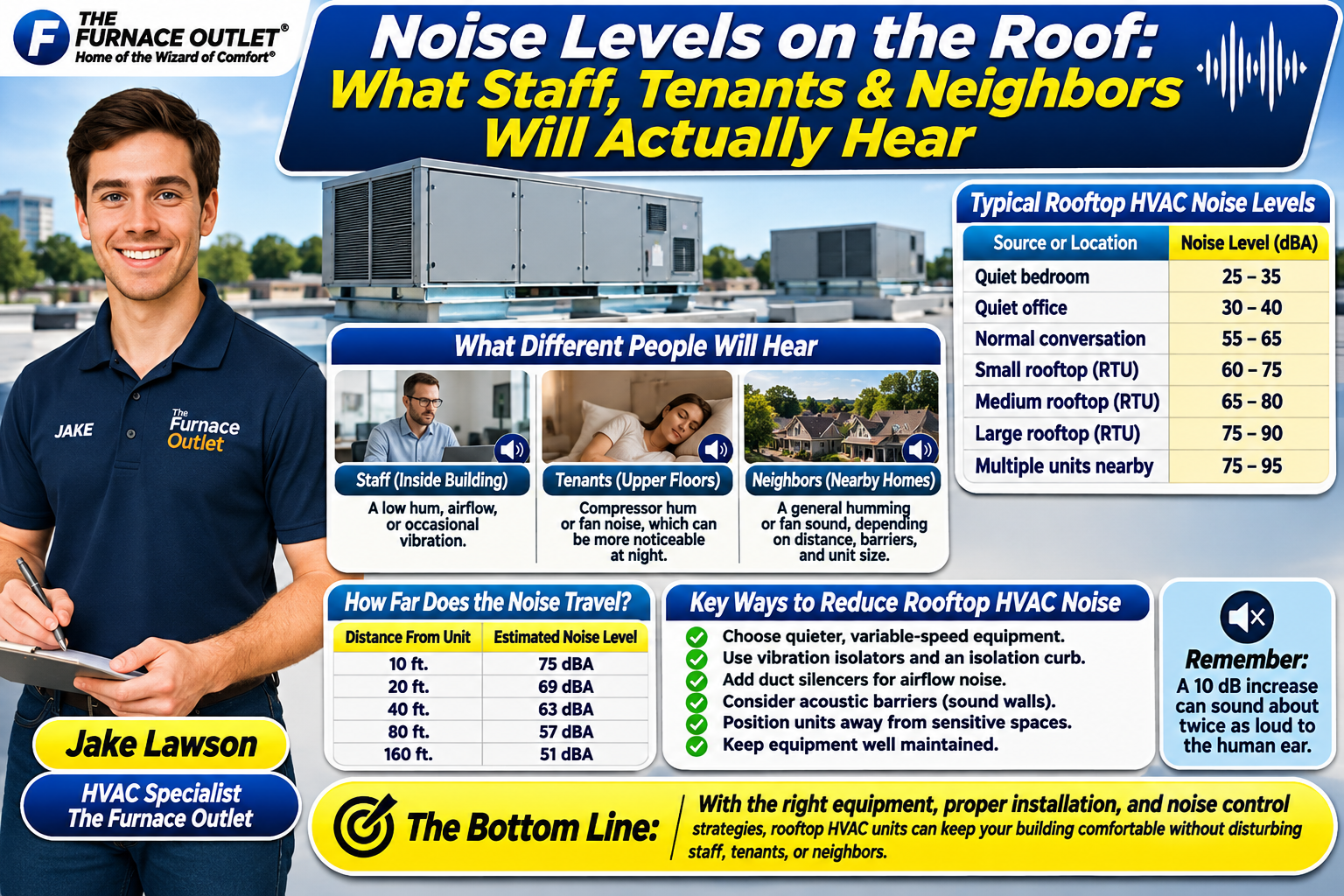
| Equipment or Location | Illustrative Sound Level |
|---|---|
| Quiet private office | 30–40 dBA |
| Quiet residential bedroom | 25–35 dBA |
| Normal conversation | 55–65 dBA |
| Small commercial RTU nearby | 60–75 dBA |
| Medium commercial RTU nearby | 65–80 dBA |
| Large commercial RTU nearby | 75–90 dBA |
| Multiple rooftop units operating nearby | 75–95 dBA |
Actual sound levels depend heavily on measurement distance, operating conditions, surrounding structures, and background noise. Manufacturer-published sound power ratings should not be directly compared with sound pressure measurements taken inside occupied rooms.
The decibel scale is logarithmic rather than linear. Consequently, a relatively small numerical increase can represent a substantial increase in acoustic energy, making equipment selection particularly important for noise-sensitive commercial properties.
| Increase in Noise Level | Approximate Effect |
|---|---|
| 3 dB | Double the acoustic energy |
| 5 dB | Clearly noticeable increase |
| 10 dB | Often perceived as approximately twice as loud |
| 20 dB | Often perceived as approximately four times as loud |
A rooftop HVAC unit producing 80 dBA at a particular measurement location may therefore sound substantially louder than equipment producing 70 dBA under equivalent conditions. However, perceived loudness also depends on frequency, duration, background noise, and individual sensitivity.
One of the most common mistakes when comparing commercial rooftop HVAC systems is treating sound power and sound pressure ratings as interchangeable. Although both are expressed in decibels, they describe fundamentally different characteristics.
Sound power represents the acoustic energy emitted by the equipment itself, while sound pressure describes the noise experienced at a particular location. Sound pressure changes with distance, barriers, reflections, and building construction.
The ASHRAE Handbook on Noise and Vibration Control explains how HVAC noise travels from mechanical equipment through airborne and structural transmission paths before reaching building occupants and surrounding communities. handbook.ashrae.org
When comparing rooftop equipment, request sound power data under comparable operating conditions, preferably including octave-band information. A qualified acoustic consultant can use this information to estimate sound pressure levels at occupied spaces and neighboring properties.
Commercial rooftop units contain several mechanical and electrical components that generate different types of sound. Identifying the dominant noise source is essential because each component requires a different mitigation strategy.
| Noise Source | Typical Sound | Potential Concern |
|---|---|---|
| Compressor | Low-frequency humming | Structural vibration |
| Condenser fan | Whirring or rushing air | Outdoor noise |
| Supply blower | Continuous airflow sound | Indoor duct noise |
| Fan bearings | Grinding or squealing | Mechanical deterioration |
| Cabinet panels | Rattling or buzzing | Loose panels or resonance |
| Refrigerant circulation | Hissing or gurgling | Normal operation or refrigerant issues |
| Electrical contactors | Clicking or buzzing | Electrical component problems |
| Ductwork | Rushing or booming sound | Excessive airflow or static pressure |
A properly functioning rooftop unit will produce some operational noise. However, sudden increases in noise, persistent metallic rattling, grinding, or unusual electrical buzzing should be investigated by a qualified HVAC technician.
Employees working directly beneath rooftop equipment may experience low-frequency humming, ceiling vibration, airflow noise through supply registers, and noticeable changes in sound when compressors or fans start operating.
These sounds can become particularly disruptive in private offices, conference rooms, call centers, medical examination rooms, and educational facilities. Even relatively moderate sound levels can affect concentration when the noise contains prominent tones, repeated cycles, or structural vibration.
The following indoor sound levels are illustrative acoustic design objectives, not mandatory standards. Actual requirements should be established according to the intended use of the building.
| Commercial Space | Illustrative Indoor Noise Objective |
|---|---|
| Executive office | 30–40 dBA |
| Conference room | 30–40 dBA |
| Medical examination room | 35–45 dBA |
| Classroom | 30–40 dBA |
| Open-plan office | 40–45 dBA |
| Retail showroom | 40–50 dBA |
| Restaurant dining area | 45–55 dBA |
| Warehouse | Application dependent |
Meeting an appropriate indoor noise objective requires more than purchasing quiet equipment. Roof construction, ceiling insulation, duct design, vibration isolation, and equipment positioning all influence the final acoustic environment.
Tenants occupying upper-floor apartments, hotel rooms, and commercial spaces directly below rooftop equipment may be more sensitive to mechanical noise than employees working during normal business hours. A sound that blends into daytime activity can become considerably more noticeable at night.
Common complaints include intermittent compressor humming, vibration transmitted through walls, ceiling rattling, and sudden fan startup noise. Low-frequency sound can be particularly difficult to control because it may travel through structural assemblies and remain noticeable even when higher-frequency noise has been reduced.
For mixed-use buildings, rooftop HVAC equipment should ideally be positioned away from bedrooms, hotel guest rooms, and other noise-sensitive spaces. Equipment placement above stairwells, storage areas, corridors, or mechanical rooms may provide better acoustic separation.
Outdoor noise transmission depends on the distance between the equipment and neighboring properties, the height of surrounding buildings, rooftop parapets, equipment orientation, and environmental conditions.
A unit located on the roof of a single-story commercial building may be particularly noticeable to residents occupying the upper floors of adjacent apartment buildings. Elevated mechanical equipment can also have an unobstructed sound transmission path that bypasses ground-level fencing.
Under ideal free-field conditions, sound pressure from a point source decreases by approximately 6 dB each time the distance from the source doubles. The NIOSH guidance on reducing noise exposure discusses this relationship as a useful principle for increasing separation from noise sources. CDC
Consider a hypothetical rooftop HVAC unit producing a measured sound pressure level of 75 dBA at 10 feet. Under simplified free-field conditions, its estimated noise contribution would decrease as follows.
| Distance From Equipment | Estimated Noise Contribution |
|---|---|
| 10 feet | 75 dBA |
| 20 feet | 69 dBA |
| 40 feet | 63 dBA |
| 80 feet | 57 dBA |
| 160 feet | 51 dBA |
| 320 feet | 45 dBA |
These calculations assume an idealized point source without significant reflections, barriers, background noise, or additional operating equipment. Rooftop units may behave differently at close distances, and actual property-line noise should be evaluated through site-specific acoustic modeling or measurements.
Installing several rooftop HVAC systems can increase the overall acoustic impact even when each individual unit operates within its expected sound specifications. Decibel values cannot simply be added together using conventional arithmetic.
When identical independent noise sources produce equal sound levels at the same receiving location, doubling the number of sources increases the combined level by approximately 3 dB.
| Number of Units | Individual Contribution | Combined Noise |
|---|---|---|
| 1 | 70 dBA | 70 dBA |
| 2 | 70 dBA | 73 dBA |
| 3 | 70 dBA | 74.8 dBA |
| 4 | 70 dBA | 76 dBA |
| 8 | 70 dBA | 79 dBA |
| 10 | 70 dBA | 80 dBA |
This relationship is particularly important for shopping centers, hotels, restaurants, and large office buildings with multiple mechanical systems. Evaluating the combined acoustic impact before installation can help prevent unexpected noise complaints.
Traditional single-stage rooftop units typically operate compressors at full capacity whenever cooling is required. This can create noticeable changes in sound during startup and shutdown, particularly when equipment cycles frequently.
Variable-speed compressors and electronically commutated fan motors can adjust operating output according to building demand. During partial-load operation, these systems may produce less noise while delivering more consistent temperatures.
| Feature | Single-Stage RTU | Variable-Speed RTU |
|---|---|---|
| Startup noise | Often more noticeable | Generally smoother |
| Partial-load noise | Relatively constant | Potentially lower |
| Temperature consistency | Conventional | Generally improved |
| Equipment cost | Lower | Higher |
| Noise fluctuations | More noticeable | Potentially reduced |
| Comfort control | Basic | More precise |
Variable-speed equipment does not automatically guarantee quieter operation at maximum capacity. Compare manufacturer acoustic data across different operating modes before making a purchasing decision.
Effective rooftop noise control involves addressing the equipment itself, the transmission path, and the location where sound is experienced. Combining several noise reduction strategies generally provides better results than relying on a single acoustic treatment.
| Noise Reduction Solution | Primary Benefit |
|---|---|
| Spring vibration isolators | Reduced structural vibration |
| Engineered isolation roof curbs | Reduced vibration transfer |
| Flexible duct connectors | Reduced mechanical transmission |
| Acoustic duct silencers | Reduced airflow noise |
| Manufacturer-approved compressor blankets | Reduced compressor noise |
| Engineered rooftop acoustic barriers | Reduced outdoor noise transmission |
| Variable-speed equipment | Reduced partial-load noise |
| Strategic equipment positioning | Greater separation from sensitive spaces |
Acoustic barriers must preserve manufacturer-required ventilation, service access, structural loading limits, and equipment clearances. Improperly designed barriers can restrict condenser airflow, increase operating temperatures, and reduce equipment efficiency.
A standard rooftop equipment curb provides physical support and connects the HVAC system to the building’s roof and ductwork. However, a conventional rigid mounting arrangement may allow mechanical vibration to travel directly into the building structure.
An appropriately engineered vibration isolation curb incorporates isolation components selected according to equipment weight, operating characteristics, roof stiffness, and vibration frequencies. Flexible duct and utility connections may also be necessary to prevent vibration from bypassing the isolation system.
Selecting the correct isolation arrangement during initial construction is often easier and less expensive than modifying an existing installation after tenants begin reporting problems.
Commercial property owners should investigate local noise ordinances, zoning requirements, lease obligations, and applicable occupational noise regulations before installing rooftop mechanical equipment. Many jurisdictions establish different noise limits for daytime and nighttime operation, particularly near residential properties.
For example, an illustrative local ordinance might permit 60 dBA during daytime hours but require 50 dBA at night. These figures are not universal legal limits, and requirements can vary considerably between municipalities.
Occupational noise exposure is a separate consideration. The CDC and NIOSH occupational noise guidance recommends limiting worker exposure to an eight-hour average of 85 dBA to reduce hearing loss risk. This recommendation is not an acceptable comfort target for offices or residential properties. CDC
The NIOSH comparison of occupational and environmental noise exposure further explains why workplace exposure criteria should not be applied directly to general community noise assessments. CDC
Noise mitigation expenses depend on equipment size, rooftop accessibility, structural requirements, acoustic design objectives, and whether improvements are incorporated during installation or added afterward.
| Noise Mitigation Upgrade | Estimated US Cost |
|---|---|
| Manufacturer-approved compressor sound blanket | $100–$400 |
| Basic vibration isolation components | $150–$600 |
| Engineered spring isolation system | $500–$2,000+ |
| Flexible duct connections | $200–$800 |
| Commercial duct silencer | $500–$2,500+ |
| Isolation roof curb | $1,000–$4,000+ |
| Engineered rooftop acoustic barrier | $2,000–$10,000+ |
| Professional acoustic assessment | $1,000–$5,000+ |
These figures represent preliminary budgeting estimates rather than verified contractor quotations. Complex commercial installations involving multiple rooftop units, structural reinforcement, or stringent nighttime noise limits may require substantially larger investments.
Request detailed manufacturer acoustic specifications, including sound power ratings, octave-band data, operating conditions, compressor staging, and available sound reduction accessories. Compare equipment using equivalent measurement methods rather than relying on marketing descriptions such as quiet operation.
Evaluate the proposed equipment location relative to offices, bedrooms, neighboring buildings, and property boundaries. For noise-sensitive projects, a professional acoustic assessment can help establish appropriate equipment specifications and mitigation requirements before installation.
The NIOSH workplace noise prevention resources also emphasize the value of reducing noise at its source rather than relying exclusively on measures that protect individuals after exposure occurs. CDC
Are rooftop HVAC units louder than ground-mounted systems? Not necessarily, because equipment design and installation quality determine the acoustic impact. Rooftop installations introduce additional structural vibration considerations and may expose neighboring upper-floor properties to direct airborne noise.
Can rooftop HVAC equipment disturb tenants at night? Yes, particularly when equipment operates above bedrooms or near residential windows. Lower nighttime background noise can make compressors, fans, and structural vibration more noticeable.
Do acoustic screens block all rooftop HVAC noise? Acoustic screens can reduce direct airborne sound transmission when correctly engineered. They generally do not eliminate structureborne vibration, low-frequency sound, or noise transmitted through ductwork.
Can older rooftop units become louder over time? Worn bearings, deteriorated mounting components, loose cabinet panels, fan imbalance, and neglected maintenance can increase operating noise. Regular professional inspections can identify developing mechanical problems before they become more disruptive.
What is the quietest type of commercial rooftop HVAC unit? Equipment with variable-speed compressors, efficient fan assemblies, acoustic cabinet treatments, and appropriate vibration isolation may offer favorable acoustic performance. Actual manufacturer sound ratings and site-specific installation conditions should determine the final selection.
The most effective rooftop HVAC noise strategy begins before the equipment is purchased. Building owners should evaluate where mechanical sound will travel, who will hear it, and how operating conditions may change throughout the day and night.
Prioritize appropriate equipment sizing, documented acoustic performance, strategic rooftop positioning, engineered vibration isolation, and properly designed ductwork. Investing in noise control during the initial installation can help prevent tenant complaints, protect workplace comfort, and avoid expensive corrective projects later.
This guide provides general commercial HVAC acoustic planning information. Sound levels, design objectives, mitigation costs, and distance calculations are illustrative, and actual commercial projects should be evaluated by qualified HVAC engineers or acoustic consultants in accordance with applicable local requirements.
Editorial Disclosure: The Furnace Outlet is not associated with, affiliated with, endorsed by, or sponsored by Carrier, Trane, Lennox, Bryant or any other manufacturer mentioned in this article. We do not receive manufacturer compensation for inclusion or rankings.
The Furnace Outlet
For educational purposes only. HVAC equipment removal, refrigerant handling, recycling and disposal requirements can vary by equipment and location. Consult a qualified HVAC professional and applicable federal, state and local requirements before removing or disposing of HVAC equipment.
© 2026 The Furnace Outlet | www.thefurnaceoutlet.com