Newsletter Subscribe
Enter your email address below and subscribe to our newsletter

HVAC made simple
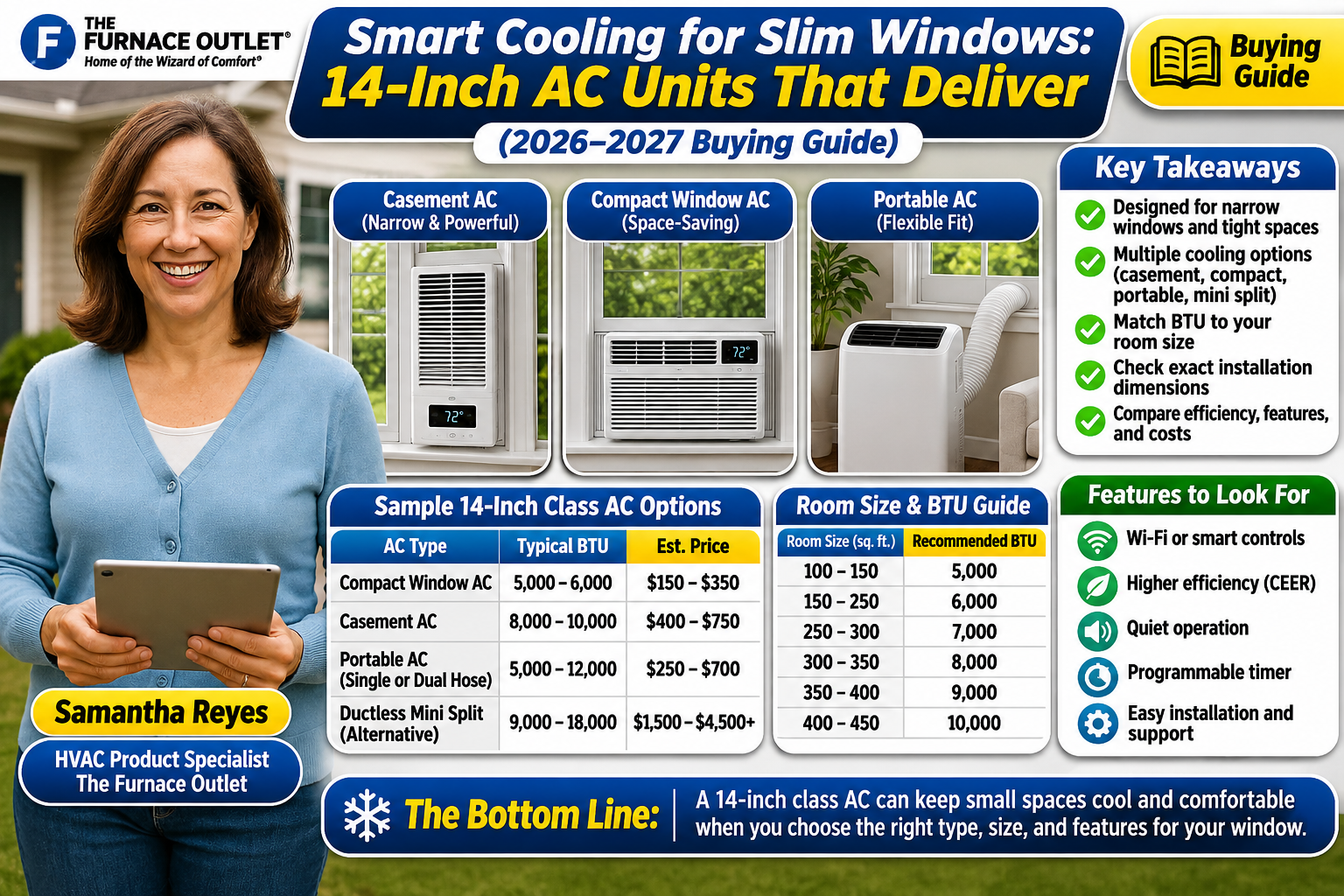
By Samantha Reyes | The Furnace Outlet
Finding the right air conditioner for a narrow window can be surprisingly challenging. Most conventional window air conditioners are designed for standard double-hung windows, leaving homeowners with slim window openings, sliding windows, and compact living spaces struggling to find compatible cooling equipment.
A 14-inch AC unit may appear to be the ideal solution, but understanding the difference between cabinet dimensions and minimum installation requirements is essential. An air conditioner measuring approximately 14 inches wide does not necessarily fit a 14-inch window opening, particularly when mounting hardware, side panels, and installation clearances are considered.
Fortunately, several cooling alternatives can provide efficient temperature control without extensive window modifications. This guide explores narrow-window air conditioners, casement AC units, portable alternatives, installation requirements, electricity consumption, and long-term ownership costs.
A 14-inch window air conditioner generally refers to a compact cooling unit with a cabinet width of approximately 14–15 inches. Unlike conventional window air conditioners, which frequently feature wider horizontal cabinets, narrow-window models may use a taller vertical design to accommodate limited installation space.
However, there is no standardized 14-inch air conditioner category across HVAC manufacturers. Product descriptions may refer to cabinet width, cabinet height, or approximate dimensions rather than the minimum window opening required for installation.
For homeowners with an actual 14-inch-wide window opening, this distinction is particularly important. Many narrow air conditioners require additional clearance for mounting brackets, weatherproofing materials, and supporting hardware.
Finding a conventional window air conditioner that fits a true 14-inch-wide opening is difficult. Even specialized casement air conditioners with relatively narrow cabinets may require an installation opening of 15 inches or more.
For example, the Frigidaire FFRS1022R1 casement air conditioner has a cabinet width of 14.5 inches but requires a minimum window width of 15.5 inches. This additional clearance demonstrates why homeowners should check installation specifications rather than relying exclusively on advertised product dimensions.
| Available Window Width | Cooling Options to Investigate |
|---|---|
| 12–14 inches | Portable AC with compatible exhaust panel or ductless mini split |
| 14–15 inches | Specialized narrow-window equipment, subject to confirmed compatibility |
| 15.5–17 inches | Select casement and sliding-window AC units |
| 18–20 inches | Additional compact window AC options |
| 21 inches and above | Wider selection of conventional window AC units |
These ranges provide preliminary purchasing guidance rather than guaranteed installation compatibility. Homeowners should measure the actual unobstructed window opening and compare it with the manufacturer’s installation manual before ordering equipment.
Not every compact air conditioner uses the same installation method. Selecting the appropriate equipment configuration depends on window orientation, available floor space, cooling requirements, building restrictions, and installation budget.
Casement window air conditioners: These systems feature relatively tall, narrow cabinets specifically designed for compatible vertical or horizontally sliding window openings. They are particularly useful when a conventional horizontal window air conditioner cannot be installed.
Compact conventional window air conditioners: Smaller 5,000–6,000 BTU units may have relatively narrow cabinets, although their minimum window opening requirements frequently exceed their cabinet dimensions. They are generally more suitable for compatible double-hung windows.
Portable air conditioners: Portable systems remain inside the room and discharge heat through an exhaust hose connected to a window panel. This arrangement can accommodate certain narrow windows without requiring the entire air conditioner to fit within the opening.
Ductless mini split systems: A mini split eliminates the need for a window-mounted air conditioner altogether. Although installation costs are considerably higher, these systems can provide efficient, quiet cooling without occupying valuable window space.
Homeowners should compare equipment according to actual installation compatibility rather than brand popularity alone. The following configurations represent practical alternatives for rooms with limited window space.
| Cooling Option | Typical Cooling Capacity | Best Application |
|---|---|---|
| Compact window AC | 5,000–6,000 BTU | Small bedrooms and offices |
| Vertical casement AC | 8,000–10,000 BTU | Narrow sliding or casement windows |
| Single-hose portable AC | 5,000–10,000 BTU SACC | Temporary cooling |
| Dual-hose portable AC | 8,000–12,000 BTU SACC | Rooms with restrictive window openings |
| Single-zone mini split | 9,000–18,000 BTU | Permanent cooling installations |
| Through-the-wall AC | 8,000–14,000 BTU | Rooms where exterior wall installation is permitted |
Portable air conditioner capacities should be evaluated using the DOE Seasonally Adjusted Cooling Capacity (SACC) rating rather than relying exclusively on higher advertised ASHRAE BTU ratings. This helps homeowners make more meaningful comparisons between portable cooling options.
The Frigidaire FFRS1022R1 provides a useful example of a tall, narrow air conditioner designed for compatible casement and sliding windows. Its vertical cabinet delivers substantially more cooling capacity than many entry-level compact window units.
| Specification | Frigidaire FFRS1022R1 |
|---|---|
| Cooling capacity | 10,000 BTU |
| Cabinet width | 14.5 inches |
| Cabinet height | 20.25 inches |
| Cabinet depth | 23.5 inches |
| Minimum window width | 15.5 inches |
| Minimum window height | 21.5 inches |
| Voltage | 115V |
| CEER | 10.4 |
| Rated cooling power | 960 watts |
| Approximate weight | 80.75 lbs |
| Wi-Fi connectivity | No |
This model illustrates the practical advantages and limitations of narrow-window cooling equipment. It is not suitable for a true 14-inch opening, and its weight requires careful installation and adequate support. It is also an older R-410A model, so current availability and newer refrigerant alternatives should be checked before purchasing.
Window width determines equipment compatibility, but room size and heat gain determine the necessary cooling capacity. Purchasing an undersized air conditioner simply because it fits the window can result in inadequate cooling and extended operating cycles.
The ENERGY STAR room air conditioner sizing guide recommends matching cooling capacity with room dimensions and adjusting for sunlight exposure, occupancy, and other sources of indoor heat.
| Room Size | Recommended Cooling Capacity |
|---|---|
| 100–150 sq. ft. | 5,000 BTU |
| 150–250 sq. ft. | 6,000 BTU |
| 250–300 sq. ft. | 7,000 BTU |
| 300–350 sq. ft. | 8,000 BTU |
| 350–400 sq. ft. | 9,000 BTU |
| 400–450 sq. ft. | 10,000 BTU |
| 450–550 sq. ft. | 12,000 BTU |
These recommendations assume conventional ceiling heights and typical room conditions. Rooms with substantial direct sunlight, poor insulation, high ceilings, or additional occupants may require greater cooling capacity.
Homeowners can also explore The Furnace Outlet HVAC Calculators for preliminary cooling capacity and energy consumption estimates.
Accurate measurements are essential when purchasing cooling equipment for a restricted window opening. Begin by measuring the unobstructed opening with the window fully opened rather than measuring the entire window frame from one exterior edge to another.
| Measurement | Why It Matters |
|---|---|
| Clear opening width | Determines equipment compatibility |
| Clear opening height | Accommodates tall AC cabinets |
| Window sill depth | Determines mounting support requirements |
| Frame thickness | Affects bracket compatibility |
| Exterior clearance | Prevents restricted condenser airflow |
| Interior clearance | Allows airflow and maintenance access |
| Electrical outlet location | Ensures safe power connection |
Measure the opening at several points because older window frames may not be perfectly square. Compare the smallest available dimensions with the manufacturer’s minimum installation requirements, including the space needed for supporting brackets and weatherproofing materials.
Never remove structural window components or modify an emergency escape window without confirming applicable building regulations and safety requirements.
Compact dimensions do not necessarily translate into low electricity consumption. Energy efficiency depends on compressor performance, heat exchanger design, fan operation, control technology, and the equipment’s ability to match the room’s cooling load.
Window air conditioners are commonly evaluated using the Combined Energy Efficiency Ratio, or CEER, which accounts for cooling performance and certain standby and off-mode energy consumption. A higher CEER generally indicates better efficiency when comparing similar equipment categories.
The ENERGY STAR room air conditioner efficiency criteria establish different qualification thresholds for various cooling capacities and equipment configurations, including dedicated casement and slider models. Homeowners should compare efficiency ratings within the relevant product category rather than assuming every compact unit has identical performance standards. ENERGY STAR
Electricity consumption depends on the unit’s rated input power, compressor operating time, thermostat settings, outdoor temperature, and insulation quality. An air conditioner running for eight hours does not necessarily operate its compressor at full power throughout that entire period.
The following estimates assume eight equivalent full-power operating hours daily, 30 days per month, and an electricity rate of $0.16 per kWh.
| AC Capacity | Assumed Power | Monthly Consumption | Monthly Cost |
|---|---|---|---|
| 5,000 BTU | 450 W | 108 kWh | $17.28 |
| 6,000 BTU | 550 W | 132 kWh | $21.12 |
| 8,000 BTU | 750 W | 180 kWh | $28.80 |
| 10,000 BTU | 960 W | 230.4 kWh | $36.86 |
| 12,000 BTU | 1,100 W | 264 kWh | $42.24 |
These figures represent illustrative operating scenarios rather than guaranteed monthly bills. Inverter compressors, moderate thermostat settings, effective window sealing, and reduced compressor runtime can lower actual electricity consumption.
Modern room air conditioners increasingly incorporate programmable controls, energy-saving operating modes, remote monitoring, and improved compressor technology. These features can help homeowners maintain comfortable indoor temperatures while reducing unnecessary cooling expenses.
Wi-Fi connectivity allows compatible air conditioners to be controlled remotely, while programmable timers enable cooling schedules based on occupancy. Inverter technology can improve temperature consistency and reduce energy consumption by adjusting compressor output instead of repeatedly operating at maximum capacity.
However, specialized narrow-window air conditioners may offer fewer advanced features than conventional window systems. Prioritize physical compatibility, cooling capacity, efficiency, and reliable operation before paying extra for smart connectivity.
A dedicated narrow-window air conditioner may provide better overall cooling efficiency than a conventional single-hose portable system. However, portable equipment offers greater installation flexibility when the available window opening cannot accommodate an entire AC cabinet.
| Feature | Narrow-Window AC | Portable AC |
|---|---|---|
| Cooling efficiency | Generally favorable | Model dependent |
| Floor space required | Minimal | Moderate |
| Installation flexibility | Limited by window dimensions | Greater flexibility |
| Indoor noise | Model dependent | Compressor located indoors |
| Window requirements | Compatible structural opening | Compatible exhaust panel |
| Portability | Limited | Relatively easy |
| Typical purchase cost | $400–$750 | $250–$700 |
For renters with an actual 14-inch-wide window, a portable air conditioner equipped with a compatible exhaust panel may be the most practical option. Homeowners seeking permanent cooling may benefit from evaluating a ductless system instead.
Specialized narrow-window and casement air conditioners frequently cost more than conventional window units because of their specialized cabinet configurations and smaller product selection. Installation expenses may also increase when additional mounting support or custom weatherproofing is necessary.
| Equipment Type | Estimated Purchase Cost |
|---|---|
| Compact 5,000 BTU window AC | $150–$250 |
| Compact 6,000 BTU window AC | $180–$350 |
| 8,000 BTU casement AC | $400–$600 |
| 10,000 BTU casement AC | $450–$750 |
| Dual-hose portable AC | $350–$700 |
| Single-zone mini split, installed | $1,500–$4,500+ |
| Professional window AC installation | $100–$300 |
These are illustrative US budgeting estimates for homeowners comparing different cooling solutions. Equipment availability, seasonal demand, installation accessibility, and local labor expenses can substantially influence actual prices.
Many compact room air conditioners operate using a standard 115V electrical supply. However, voltage compatibility alone does not establish whether an existing electrical outlet and branch circuit can safely support the equipment.
The manufacturer’s nameplate and installation manual identify the required voltage, amperage, plug configuration, grounding requirements, and circuit specifications. Avoid using ordinary extension cords, power strips, or plug adapters with window air conditioning equipment.
Homeowners investigating electrical compatibility can read our detailed guide on Power Compatibility: What You Need to Know About 115V HVAC Systems before purchasing a narrow-window air conditioner.
Improper installation can undermine the performance of even a high-quality narrow-window air conditioner. Inadequate mounting support, blocked exterior ventilation openings, incorrect drainage positioning, and excessive air leakage can contribute to mechanical problems and higher electricity consumption.
Follow the manufacturer’s instructions regarding support brackets, drainage orientation, clearance requirements, and weatherproofing. Never position a conventional window air conditioner sideways to fit a narrow opening, as its compressor and condensate management systems are designed for a specific operating orientation.
Preserving adequate airflow and sealing gaps around the equipment can help reduce unwanted heat infiltration. However, insulation and sealing materials must not obstruct drainage or ventilation openings.
Regular maintenance helps compact air conditioners maintain effective heat transfer and reliable airflow. Inspect and clean washable filters according to the manufacturer’s recommendations, remove accessible debris from exterior ventilation areas, and periodically inspect mounting hardware and weatherproofing materials.
The U.S. Department of Energy’s energy-efficient room air conditioner guidance highlights appropriate equipment sizing and efficiency as important purchasing considerations. Selecting compatible equipment and maintaining unobstructed airflow can help homeowners achieve better long-term operating performance. Department of Energy
What is the narrowest window air conditioner available? Some specialized casement units have cabinet widths near 14.5 inches, although their required installation openings are typically wider. Homeowners should confirm exact manufacturer specifications rather than assuming a narrow cabinet will fit their window.
Can a 14-inch window AC cool a bedroom? Cooling capability depends on BTU capacity rather than cabinet width. A correctly sized 5,000–6,000 BTU air conditioner can provide suitable cooling for many smaller bedrooms.
Can I install a window AC sideways? Conventional window air conditioners should never be installed sideways unless the manufacturer explicitly approves that orientation. Incorrect positioning can damage internal components and interfere with condensate management.
Are narrow-window air conditioners more expensive? Specialized casement air conditioners generally carry higher purchase prices than conventional compact window units. Their smaller market and specialized cabinet designs contribute to the price difference.
What is the best alternative for a true 14-inch window opening? A portable air conditioner with a compatible exhaust panel is often the most practical solution for renters. A professionally installed ductless mini split may offer better permanent cooling for homeowners.
Finding the best air conditioner for a slim window requires balancing installation compatibility, room cooling requirements, energy efficiency, and long-term ownership costs. Specialized casement models are attractive when the available window opening supports their installation requirements, but a cabinet measuring approximately 14 inches wide should not be assumed to fit a true 14-inch opening.
Measure carefully, select the appropriate BTU capacity, and compare manufacturer installation specifications before purchasing. When conventional window-mounted equipment cannot be installed safely, a portable air conditioner or ductless mini split may provide a more practical and reliable cooling solution.
Editorial Disclosure: The Furnace Outlet is not associated with, affiliated with, endorsed by, or sponsored by Carrier, Trane, Lennox, Bryant or any other manufacturer mentioned in this article. We do not receive manufacturer compensation for inclusion or rankings.
The Furnace Outlet
For educational purposes only. HVAC equipment removal, refrigerant handling, recycling and disposal requirements can vary by equipment and location. Consult a qualified HVAC professional and applicable federal, state and local requirements before removing or disposing of HVAC equipment.
© 2026 The Furnace Outlet | www.thefurnaceoutlet.com