Newsletter Subscribe
Enter your email address below and subscribe to our newsletter

HVAC made simple
By Tony Marino (Tony the Trusted Tech)
The Furnace Outlet | Updated October 2026
When a heat pump stops heating during freezing weather and displays a high-pressure or low-pressure fault code, homeowners often assume the compressor has failed or the system needs more refrigerant. Neither conclusion should be made without proper diagnosis. Refrigerant pressure faults can originate from airflow restrictions, refrigerant-flow problems, defective sensors, control issues, or actual operating conditions that push the refrigeration system outside its permitted limits.
After decades of working with heating and cooling equipment, I have learned that pressure-related fault codes are among the most frequently misunderstood heat pump warnings. A code identifies a condition detected by the equipment’s protection system, but it does not necessarily identify the component responsible. A low-pressure warning does not automatically mean the refrigerant charge is low, and a high-pressure warning does not automatically mean the system is overcharged.
Winter introduces additional complications because the heat pump operates with its indoor and outdoor coils performing different functions from those used during summer cooling. Defrost cycles, changing outdoor temperatures, auxiliary heating, variable-speed compressor operation, and changing airflow conditions all influence the system’s behavior.
In this guide, I will explain how refrigerant pressures behave during winter heating, what high-pressure and low-pressure faults can indicate, which mechanical and electrical problems commonly trigger these warnings, and how qualified HVAC technicians distinguish genuine refrigeration faults from sensor or control problems. I will also cover safe homeowner observations, repair decisions, and preventive maintenance for the 2026–2027 heating season.
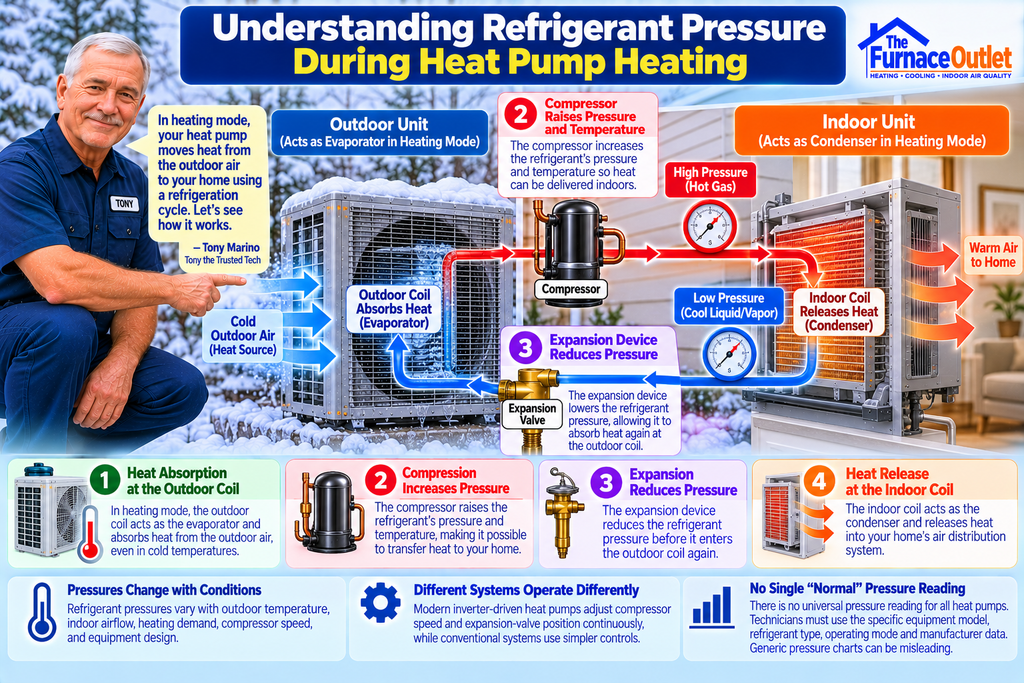
An air-source heat pump transfers heat through a sealed refrigeration circuit containing a compressor, indoor and outdoor heat exchangers, expansion devices, and connecting refrigerant lines. During normal heating operation, the outdoor coil generally functions as the evaporator, absorbing heat from outside air, while the indoor coil functions as the condenser, releasing heat into the home’s air distribution system.
The compressor raises the refrigerant’s pressure and temperature, making it possible to transfer heat from the colder outdoor environment to the warmer indoor environment. The expansion device then reduces refrigerant pressure as part of the cycle, allowing the refrigerant to absorb heat again at the outdoor coil.
These pressure relationships change with outdoor temperature, indoor airflow, heating demand, compressor speed, and equipment design. A modern inverter-driven heat pump may adjust compressor speed and expansion-valve position continuously, while a conventional single-stage system operates with a simpler control arrangement.
For this reason, there is no single refrigerant pressure reading that proves every heat pump is operating correctly in winter. Technicians must interpret measurements using the specific refrigerant, equipment model, operating mode, ambient conditions, and manufacturer performance data. Comparing an unfamiliar system against generic internet pressure charts can lead to incorrect conclusions.
Heat pumps use pressure switches, pressure transducers, temperature sensors, and electronic controls to protect refrigeration components from potentially damaging conditions. Depending on the equipment, a high-pressure fault may indicate that refrigerant pressure exceeded a permitted threshold or that a protective pressure switch opened. A low-pressure fault may indicate that pressure fell below an allowed limit or that the controller detected an abnormal operating condition associated with the low-pressure side.
The exact meaning varies significantly between manufacturers. Some systems display separate codes for high-pressure switch activation, pressure sensor abnormalities, discharge temperature problems, and inverter protection. Others group several conditions under a broader fault description.
Certain systems may temporarily interrupt compressor operation and automatically retry after a specified period. Others enter a lockout state that requires professional evaluation or an approved reset procedure. Repeatedly clearing the fault without correcting the underlying cause can expose equipment to further damage. I always begin by identifying the complete model number and reading the manufacturer’s fault-code documentation. The same numeric or alphanumeric code can mean something entirely different on another heat pump.
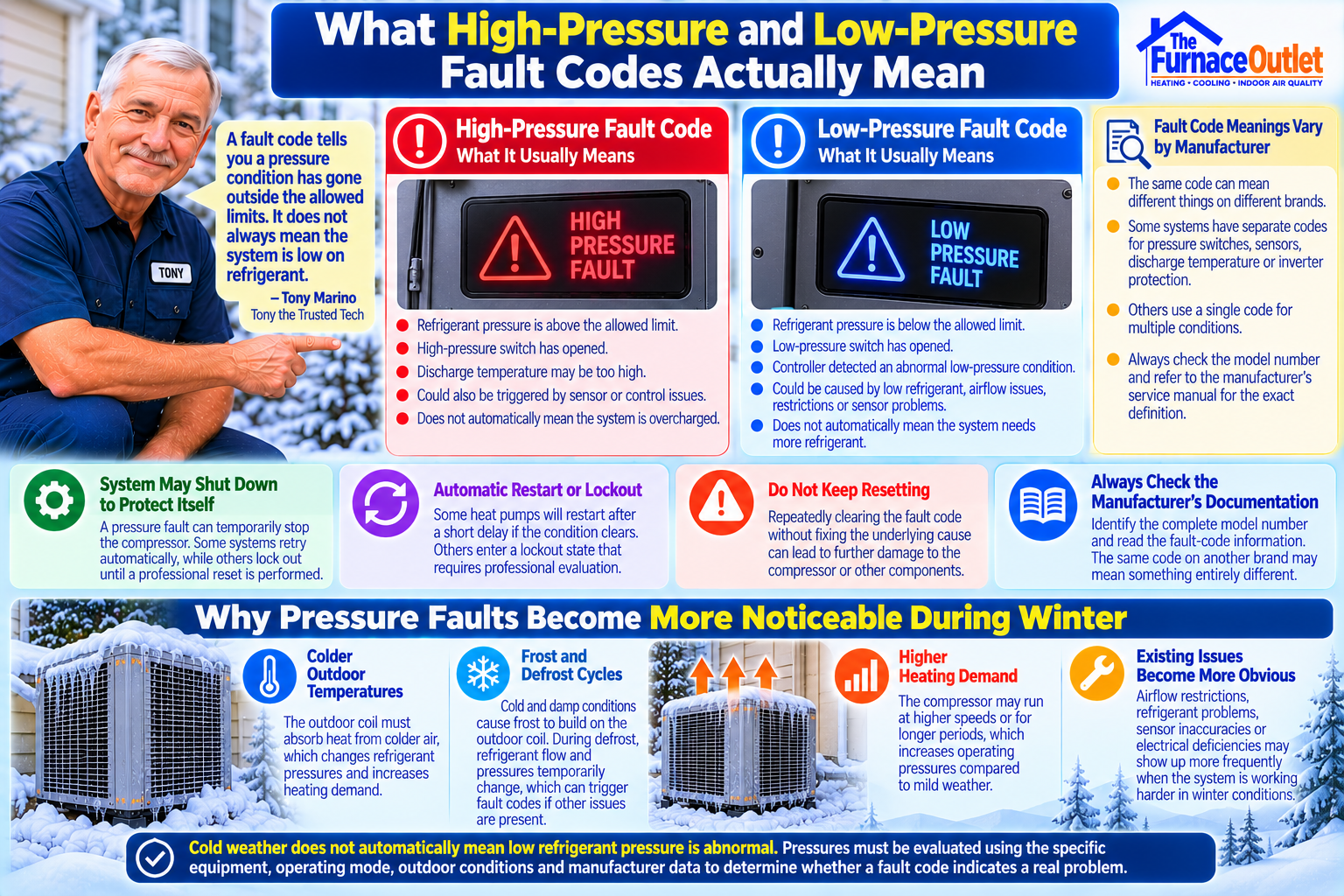
Winter heating places different demands on a heat pump than summer cooling. The outdoor coil must absorb heat from increasingly cold air, while the indoor coil must deliver sufficient heat to maintain comfort. Depending on equipment design, the compressor may operate at higher speeds, for longer periods, or under changing pressure relationships as heating demand increases.
Cold and damp conditions also encourage frost formation on the outdoor coil. Normal defrost operation temporarily changes refrigerant flow and operating conditions to remove accumulated frost. Pressure and temperature behavior during these transitions can differ from steady heating operation. A properly designed system accounts for these changes through its controls and protective strategies. However, existing airflow restrictions, refrigerant problems, sensor inaccuracies, or electrical deficiencies may become more apparent when operating conditions are demanding.
Importantly, cold weather does not automatically indicate that low refrigerant pressure is abnormal. The technician must distinguish expected winter operating conditions from pressures that fall outside the manufacturer’s approved range or trigger genuine protection events.
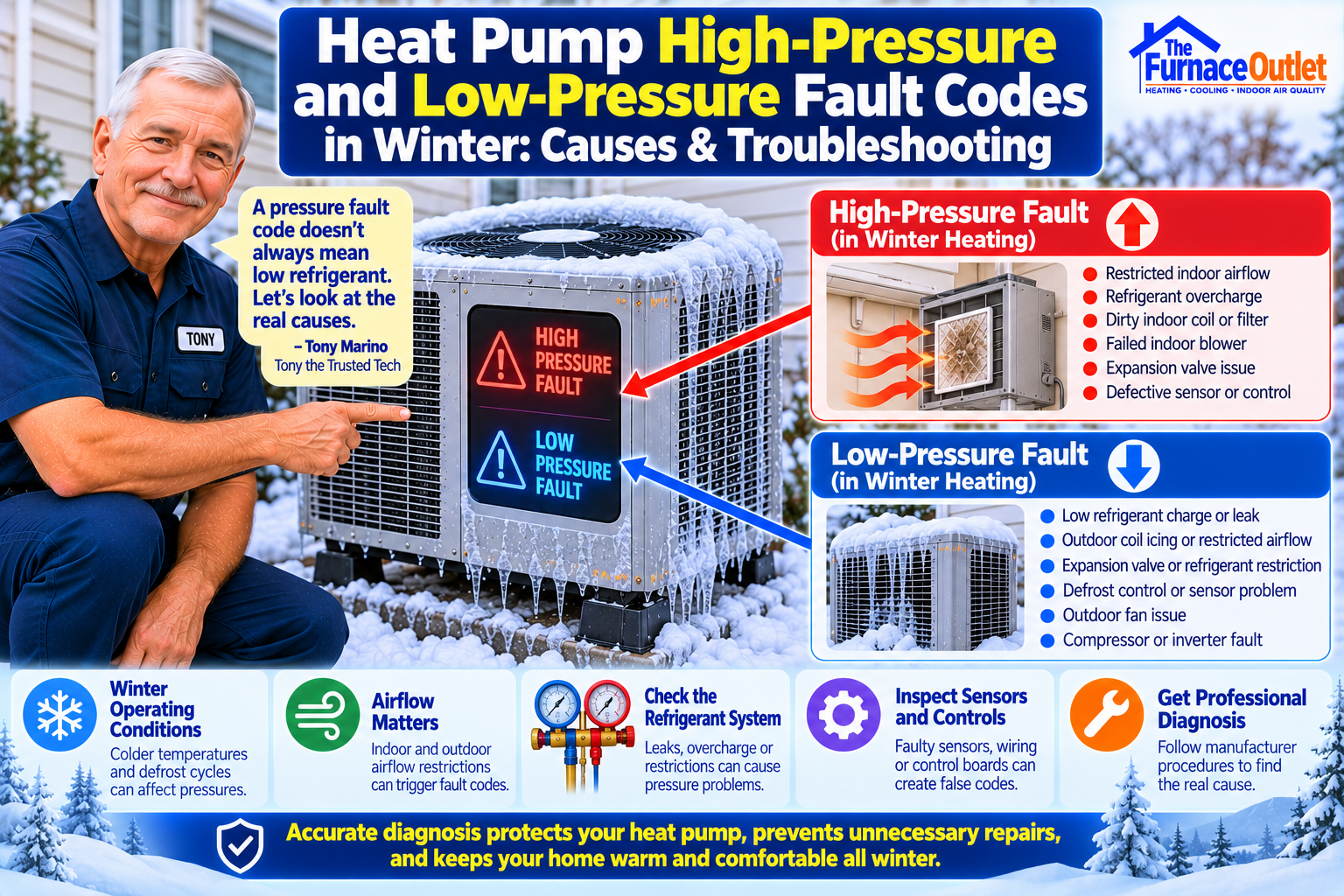
During winter heating, the indoor coil normally releases heat from the refrigerant into the air moving through the home’s duct system. If indoor airflow becomes severely restricted, the system may struggle to reject heat effectively. On certain heat pump designs, this can cause condensing temperature and pressure to rise, potentially triggering high-pressure protection.
Common causes include a heavily clogged air filter, blocked return-air grille, restrictive ductwork, closed or obstructed supply registers, or an indoor blower that is not operating correctly. Incorrect blower-speed configuration or an improperly matched indoor coil can also contribute to abnormal heat transfer. Homeowners may notice weak airflow, uneven room temperatures, unusual blower noises, or a system that shuts down during sustained heating operation. However, these symptoms do not prove that indoor airflow is the cause of a high-pressure fault.
A technician should verify actual airflow, blower operation, coil condition, and relevant refrigerant measurements before concluding that the refrigeration circuit itself is defective. Correcting an airflow problem may restore normal operation without replacing expensive refrigeration components.
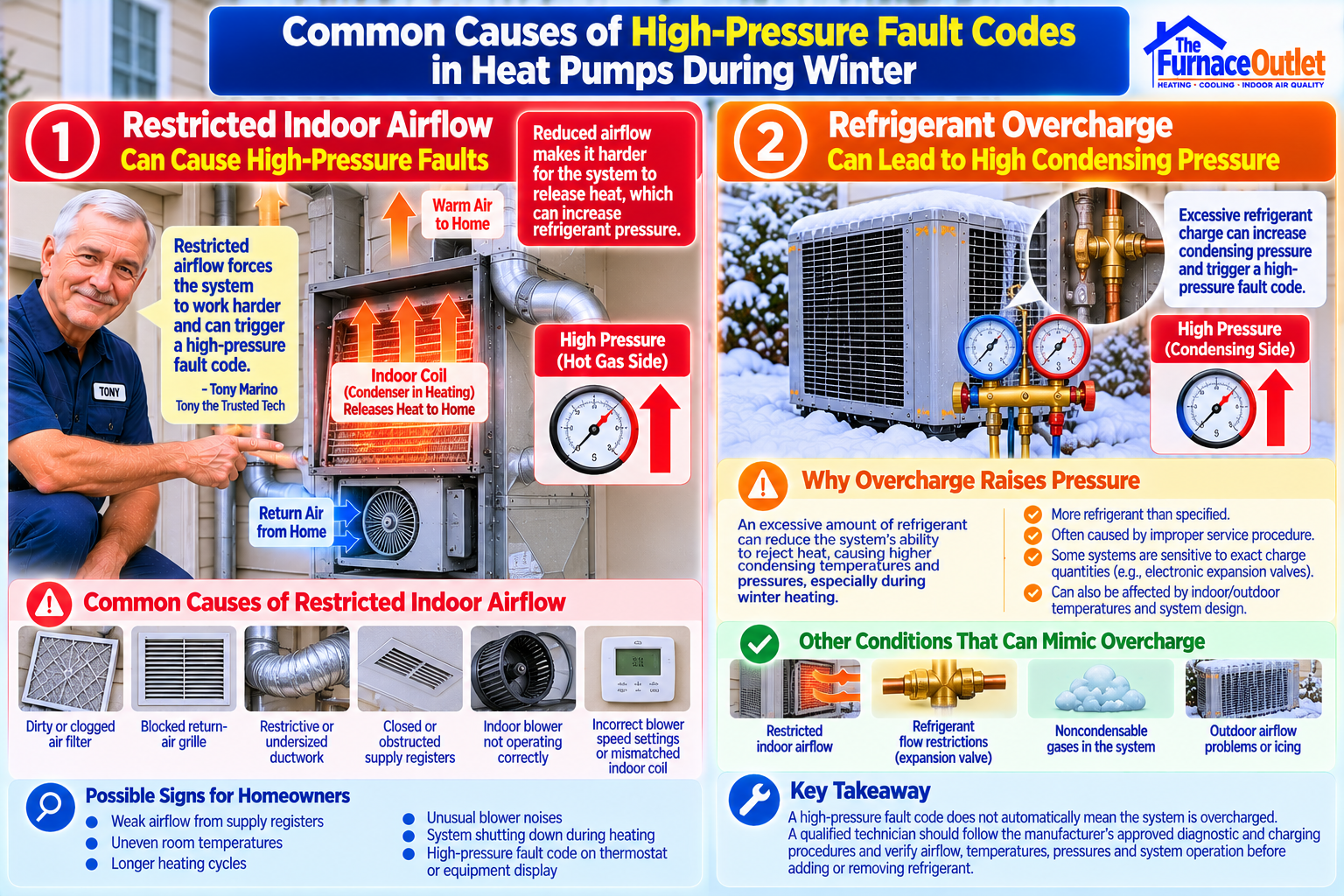
An excessive refrigerant charge can contribute to abnormal operating pressures under certain conditions. However, the relationship between refrigerant charge and pressure depends on the system’s expansion-device design, operating mode, indoor and outdoor temperatures, and control strategy. Overcharging may occur after an improper service procedure, particularly when refrigerant is added based on a pressure reading without following manufacturer instructions. Some systems are sensitive to incorrect charge quantities because they use specific refrigerant volumes, electronic expansion valves, or charge-management arrangements.
A high-pressure warning does not automatically establish overcharge. Restricted indoor airflow, refrigerant-flow problems, noncondensable gases, and other faults may produce overlapping symptoms. Qualified technicians should follow the manufacturer’s approved charging and diagnostic procedures, including the correct operating mode and specified measurements. Refrigerant should never be removed or added merely to make a single pressure reading appear normal.
A heat pump relies on properly controlled refrigerant flow through its heat exchangers and expansion devices. Restrictions caused by contamination, damaged components, or malfunctioning valves can interfere with this flow and create abnormal pressure and temperature relationships. Depending on the restriction’s location and operating conditions, the system may develop low evaporating pressure, excessive pressure differences, poor heating capacity, or protective shutdowns. Electronic expansion valves introduce additional diagnostic considerations because their operation depends on sensors, wiring, electronic commands, and the valve mechanism itself.
A valve that does not respond correctly may produce symptoms resembling insufficient refrigerant charge or another refrigeration fault. A restriction can also affect compressor operating conditions and discharge temperatures. Professional diagnosis should consider the entire refrigerant circuit rather than focusing exclusively on the pressure fault code. The technician may evaluate temperature differences, operating pressures, valve commands, and manufacturer-specific performance data to identify where normal refrigerant flow has been interrupted.
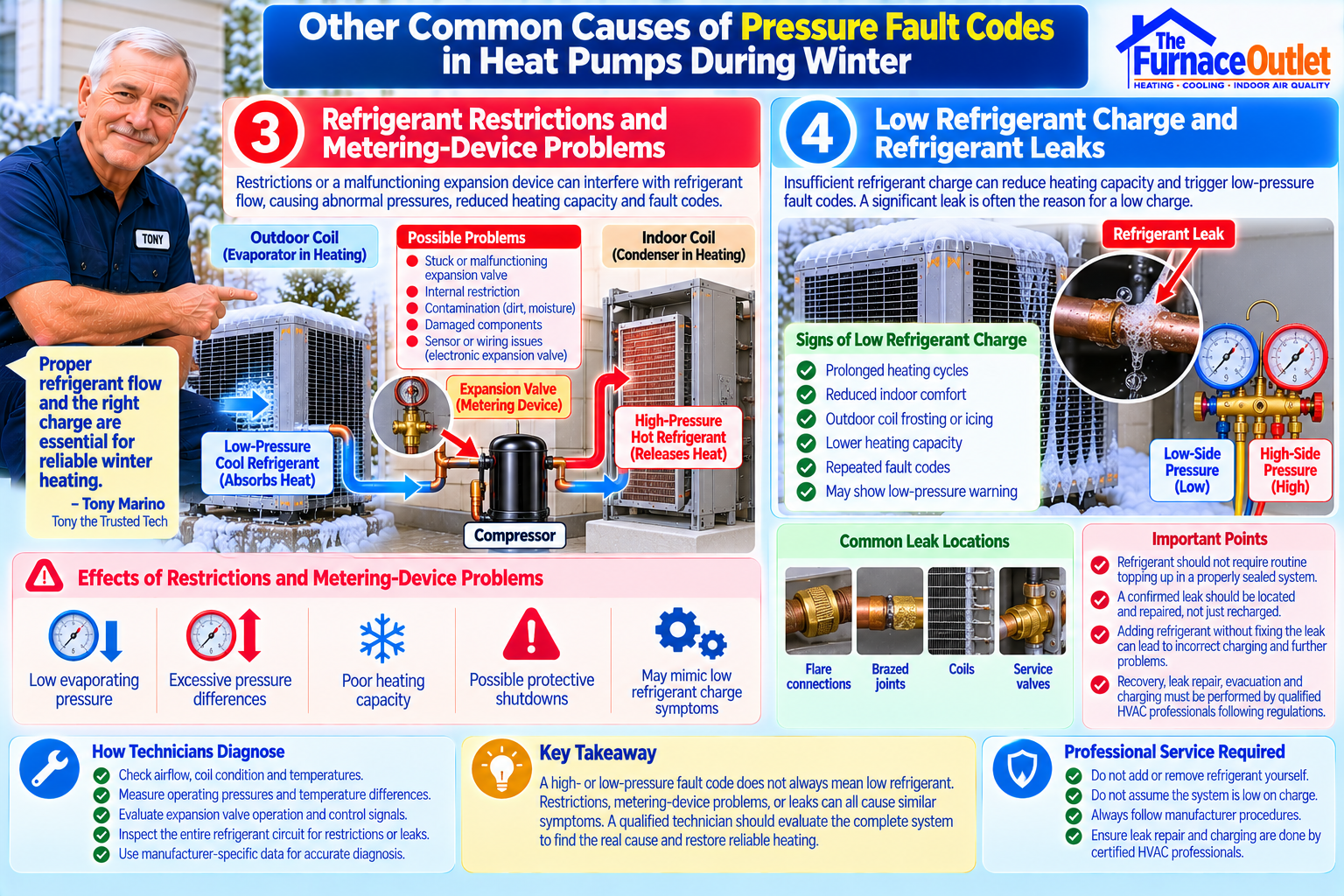
Insufficient refrigerant charge is one possible cause of low-pressure faults, but it is not the only explanation. A significant leak can reduce the system’s ability to absorb and transfer heat, leading to declining heating capacity and potentially abnormal operating pressures. Homeowners may notice prolonged heating cycles, reduced indoor comfort, unusual outdoor-coil frosting, or repeated protective shutdowns. These symptoms can also occur with airflow restrictions, control problems, or refrigerant-flow abnormalities, so they must be interpreted together.
Refrigerant is not a consumable that should require routine topping up in a properly sealed system. If a significant loss of charge is confirmed, the technician should investigate the source of leakage and recommend an appropriate repair. Adding refrigerant without identifying the underlying problem can temporarily conceal the fault and may result in incorrect charging. Refrigerant recovery, leak repair, evacuation, and charging should be performed by appropriately qualified personnel following applicable regulations and manufacturer requirements.
During winter heating, the outdoor coil absorbs heat from surrounding air. Because the coil can operate below freezing, moisture may accumulate as frost. A properly functioning heat pump manages this through automatic defrost cycles. If frost becomes excessive, airflow across the coil can decline, reducing heat absorption and potentially affecting evaporating pressure and compressor operating conditions. Severe icing may contribute to low-pressure protection on some systems, although the exact response depends on equipment design.
Blocked airflow can also result from snowdrifts, leaves, nearby structures, or other obstructions. A defective outdoor fan may produce similar operating problems when airflow is required. However, the outdoor fan commonly stops during normal defrost. A stationary fan does not automatically indicate failure, and frost on the outdoor coil is not necessarily abnormal. The technician must establish whether the system is in heating or defrost, whether the coil clears properly, and whether airflow returns to normal. A refrigerant pressure fault accompanied by heavy ice should prompt investigation of both refrigeration performance and defrost operation.
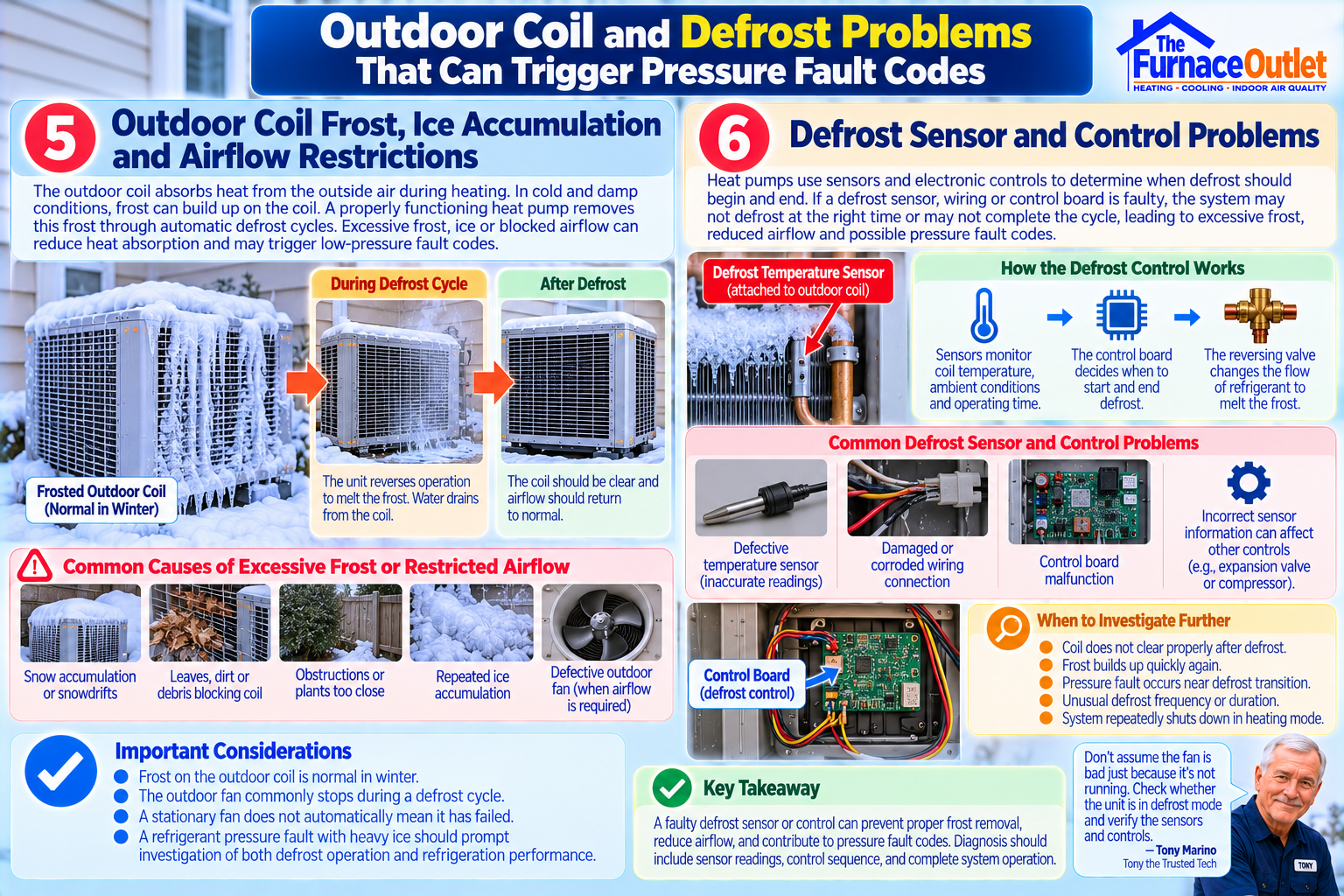
Modern heat pumps use sensors and electronic logic to determine when defrost should begin and end. Depending on the equipment, the controller may evaluate outdoor-coil temperature, ambient conditions, compressor operating time, or other information. A defective temperature sensor, damaged wiring connection, or control-board problem can interfere with defrost decisions. If the system fails to remove excessive frost, outdoor airflow and heat absorption may deteriorate, potentially contributing to abnormal operating conditions.
In other cases, incorrect sensor information can affect expansion-valve operation or compressor control, producing symptoms that resemble refrigeration faults. A pressure-related fault occurring near a defrost transition requires careful interpretation. The technician should determine whether the fault occurred during normal heating, active defrost, or the transition between operating modes. Replacing a defrost board without confirming the sensor readings, control sequence, and actual refrigeration conditions may fail to correct the problem.
Both outdoor and indoor airflow are essential to heat pump operation, but they affect different sides of the refrigeration cycle during heating. The outdoor fan moves air across the evaporator, supporting heat absorption. If that fan fails during normal heating, the system may experience reduced evaporating pressure, abnormal coil temperatures, and inadequate heating performance. The indoor blower moves air across the condenser. If indoor airflow becomes severely restricted, the system may struggle to release heat and develop elevated condensing conditions.
Possible motor-related causes include damaged wiring, failed electronic controls, deteriorated bearings, defective motor components, or protective shutdowns. Variable-speed motors require manufacturer-specific diagnostic procedures because their electrical and control arrangements differ from conventional motors. A technician should verify whether each motor is receiving the correct command and whether its actual performance meets equipment requirements. A motor that is intentionally stopped by a control sequence should not be mistaken for a failed component.
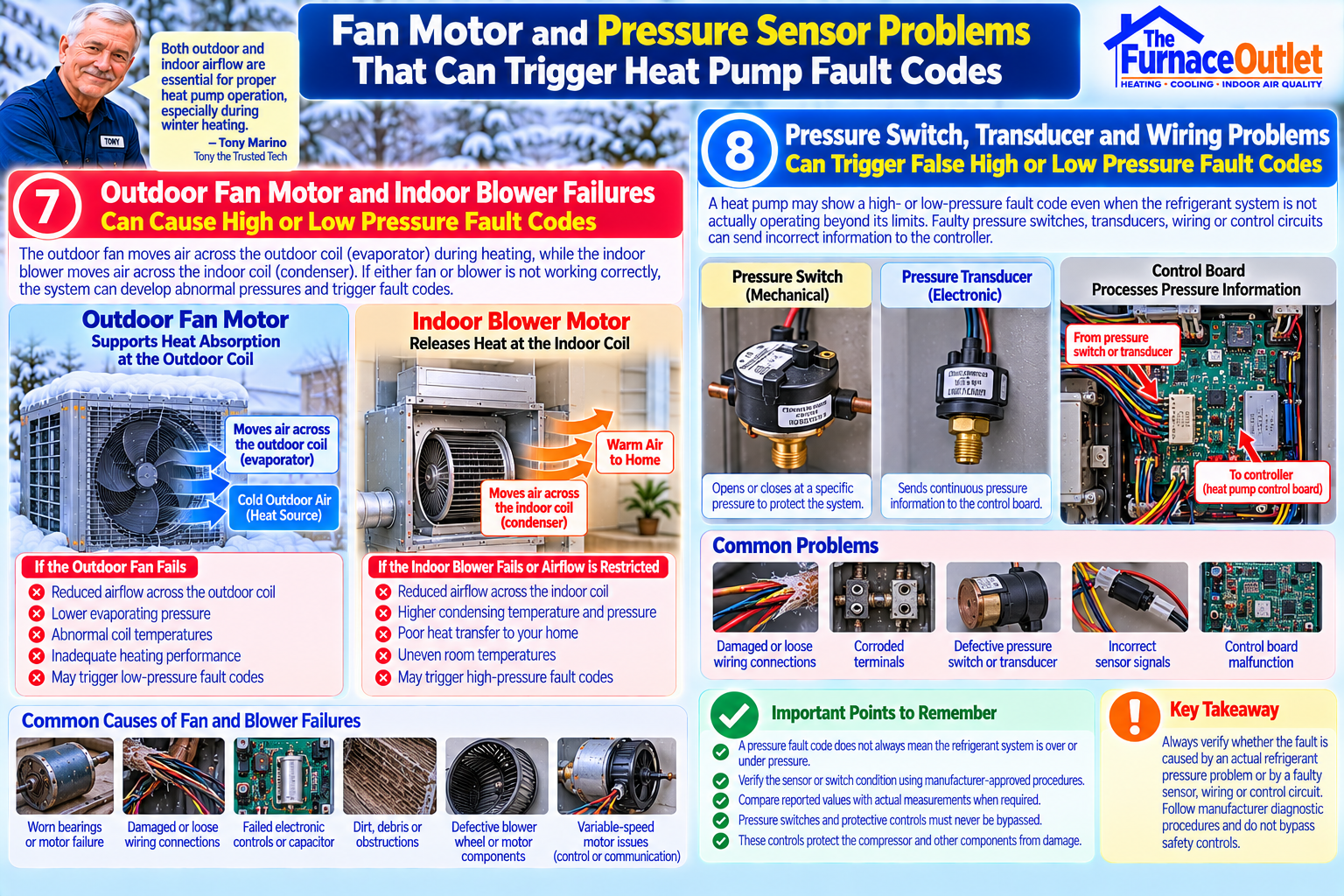
A heat pump may display a pressure fault even when the refrigeration system is not actually operating beyond its permitted pressure limits. This can occur when a pressure switch, transducer, wiring connection, or associated control circuit develops a problem. Mechanical pressure switches typically change electrical state when a specified pressure condition occurs. Electronic pressure transducers provide signals that allow controllers to monitor pressure continuously or in defined operating conditions.
Damaged wiring, corroded terminals, incorrect sensor signals, or defective components can cause the controller to receive inaccurate information. Some systems distinguish sensor faults from genuine high- or low-pressure protection events, while others require additional diagnostic testing. A technician should verify the sensor or switch condition using manufacturer-approved procedures and compare the reported information with appropriate independent measurements when required. Pressure switches and protective controls must never be bypassed to keep the compressor operating. Their purpose is to protect equipment from potentially damaging conditions.
The compressor establishes the pressure difference that allows refrigerant to circulate and transfer heat. If the compressor cannot operate correctly, the refrigeration system may fail to develop its expected pressure and temperature relationships. Internal mechanical damage, electrical faults, lubrication problems, or abnormal operating conditions can affect compressor performance. However, a pressure fault code alone does not prove that the compressor is defective. Modern inverter-driven heat pumps introduce additional possibilities. Electronic drive faults, sensor problems, communication failures, or incorrect compressor-speed control can interfere with operation and sometimes produce secondary refrigeration warnings.
A technician should verify the compressor’s operating command, electrical supply, applicable protection devices, and actual refrigeration performance before recommending replacement. Compressor replacement is expensive and often involves substantial refrigerant-circuit work. Confirming whether the problem originates in the compressor, its electronic controls, or another system component is essential.
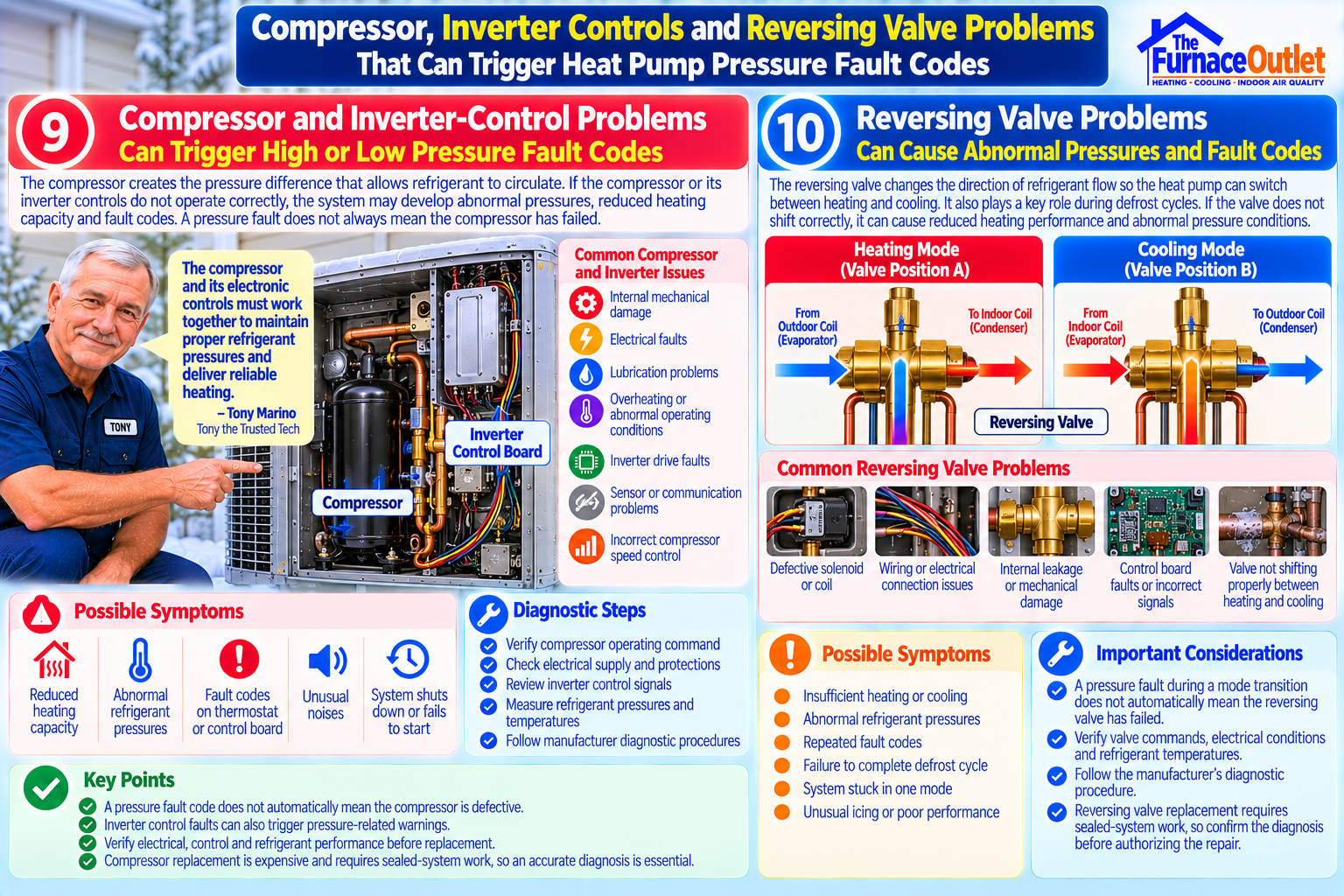
The reversing valve changes refrigerant flow direction so a heat pump can switch between heating and cooling. In conventional reverse-cycle defrost systems, it also plays a central role in temporarily directing heat toward the outdoor coil. A valve that fails to shift properly, develops internal leakage, or receives an incorrect control signal can interfere with heating performance and create abnormal refrigeration conditions. Possible causes include a defective solenoid, wiring problems, control-board faults, or mechanical valve damage. Depending on the failure, the system may deliver insufficient heat, experience unusual pressure relationships, or fail to complete defrost properly.
However, a pressure fault occurring during a mode transition does not automatically establish reversing-valve failure. The technician should evaluate valve commands, electrical conditions, refrigerant temperatures, and operating behavior using the manufacturer’s procedures. Replacing a reversing valve generally requires sealed-system work, so the diagnosis should be confirmed before authorizing the repair.
A single protective shutdown should not be ignored, particularly when it repeats or prevents the home from maintaining temperature. Persistent high-pressure or low-pressure fault codes, repeated compressor starting attempts, abnormal outdoor icing, and declining heating capacity deserve professional investigation. Other concerning symptoms include unusual compressor noises, frequent shutdowns, repeated breaker trips, or equipment that stops whenever certain heating stages activate. These observations can help identify the operating conditions associated with the fault.
Electrical warning signs require additional caution. Burning odors, smoke, sparking, or repeated electrical trips may indicate hazards beyond the refrigeration system. If the heat pump repeatedly locks out on a pressure fault, do not keep resetting the equipment in an attempt to force continued operation. Protective shutdowns may be preventing more serious compressor or electrical damage.
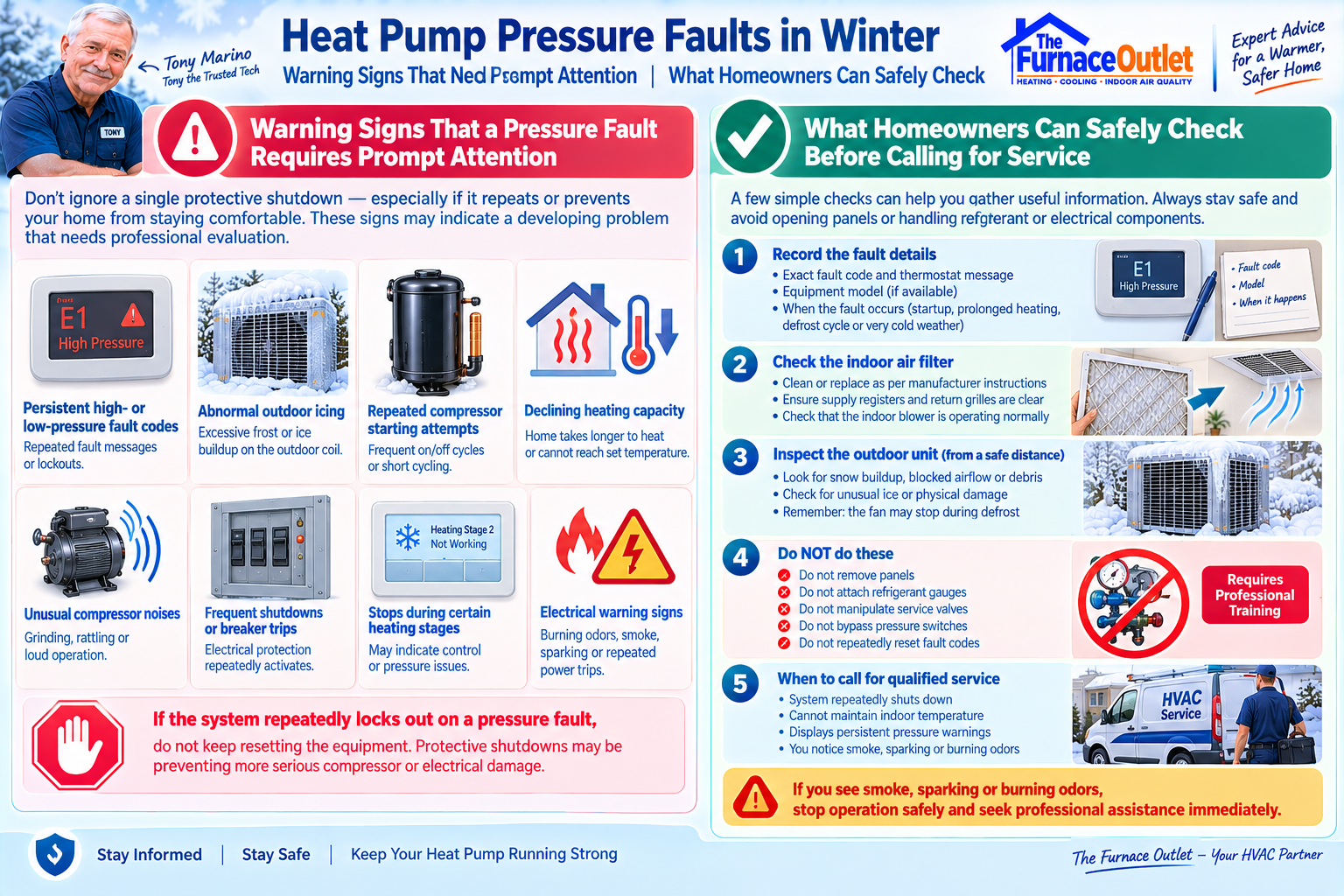
Begin by recording the exact fault code, thermostat message, and equipment model if this information is readily available. Note whether the fault occurs immediately after startup, during prolonged heating, near a defrost cycle, or only during particularly cold weather. Check the accessible indoor air filter and replace or clean it according to manufacturer instructions. Keep supply registers and return-air grilles unobstructed, and observe whether the indoor blower appears to operate normally.
From a safe distance, inspect the outdoor unit for excessive snow accumulation, blocked airflow, unusual ice buildup, or visible physical damage. Remember that the outdoor fan may stop temporarily during normal defrost. Do not remove equipment panels, attach refrigerant gauges, manipulate service valves, bypass pressure switches, or repeatedly reset fault codes. Refrigeration systems contain pressurized refrigerant and electrical components that require specialized training. If the system repeatedly shuts down, cannot maintain indoor temperature, or displays persistent pressure warnings, arrange qualified HVAC service. If smoke, sparking, or burning odors occur, stop operation safely and seek prompt professional assistance.
A reliable diagnosis begins with identifying the exact heat pump model, refrigerant type, compressor design, and manufacturer-defined fault condition. The technician should review diagnostic history and determine whether the warning originated from a mechanical pressure switch, electronic transducer, or another control input. Next, the technician should establish the operating mode and circumstances associated with the fault. Heating, cooling, defrost, startup, and shutdown can involve different pressure relationships and control sequences.
Airflow should be evaluated before making assumptions about refrigerant charge. The technician may assess indoor blower performance, outdoor fan operation, coil condition, filters, duct restrictions, and visible icing. Appropriate refrigeration measurements can then be interpreted using manufacturer performance data. On inverter-driven systems, compressor speed, electronic expansion-valve operation, sensor readings, and control commands may be important to the diagnosis. Electrical testing may also be necessary to verify pressure switches, transducers, wiring, and control-board responses. The objective is to identify the cause of the abnormal condition rather than merely clearing the code.
A heat pump that has entered a pressure-related protective shutdown should not be forced to operate. High-pressure conditions can place excessive stress on refrigeration components, while abnormal low-pressure conditions may interfere with compressor cooling, lubrication, or other operating requirements, depending on the system design.
Some equipment automatically retries after temporary conditions clear. Others remain locked out until the fault is evaluated or reset according to manufacturer instructions. Repeatedly cycling power or bypassing protection is not a safe troubleshooting strategy. Even if the system restarts briefly, the underlying problem may remain. Where a properly configured independent backup heating source is available, temporary heating may be possible, but its suitability depends on the installation and the nature of the fault. A qualified professional should confirm that using backup heat will not energize affected equipment or introduce another hazard.
The repair decision depends on the confirmed cause, equipment age, warranty coverage, parts availability, and overall system condition. A clogged filter, defective sensor, isolated wiring problem, or replaceable fan component may be corrected without major equipment replacement. More expensive repairs involving a compressor, inverter module, reversing valve, or extensive refrigerant-circuit damage require a broader assessment. The contractor should also determine whether the original problem caused additional damage.
For relatively new equipment with otherwise reliable performance, repairing the confirmed fault may be sensible. For older systems with repeated major failures, severe corrosion, unavailable components, or inadequate winter heating capacity, replacement may deserve consideration. When selecting replacement equipment, compare documented low-temperature heating capacity, efficiency, sound performance, backup heating requirements, and local service support. Proper sizing, installation, airflow, and refrigerant charging are essential to long-term reliability.
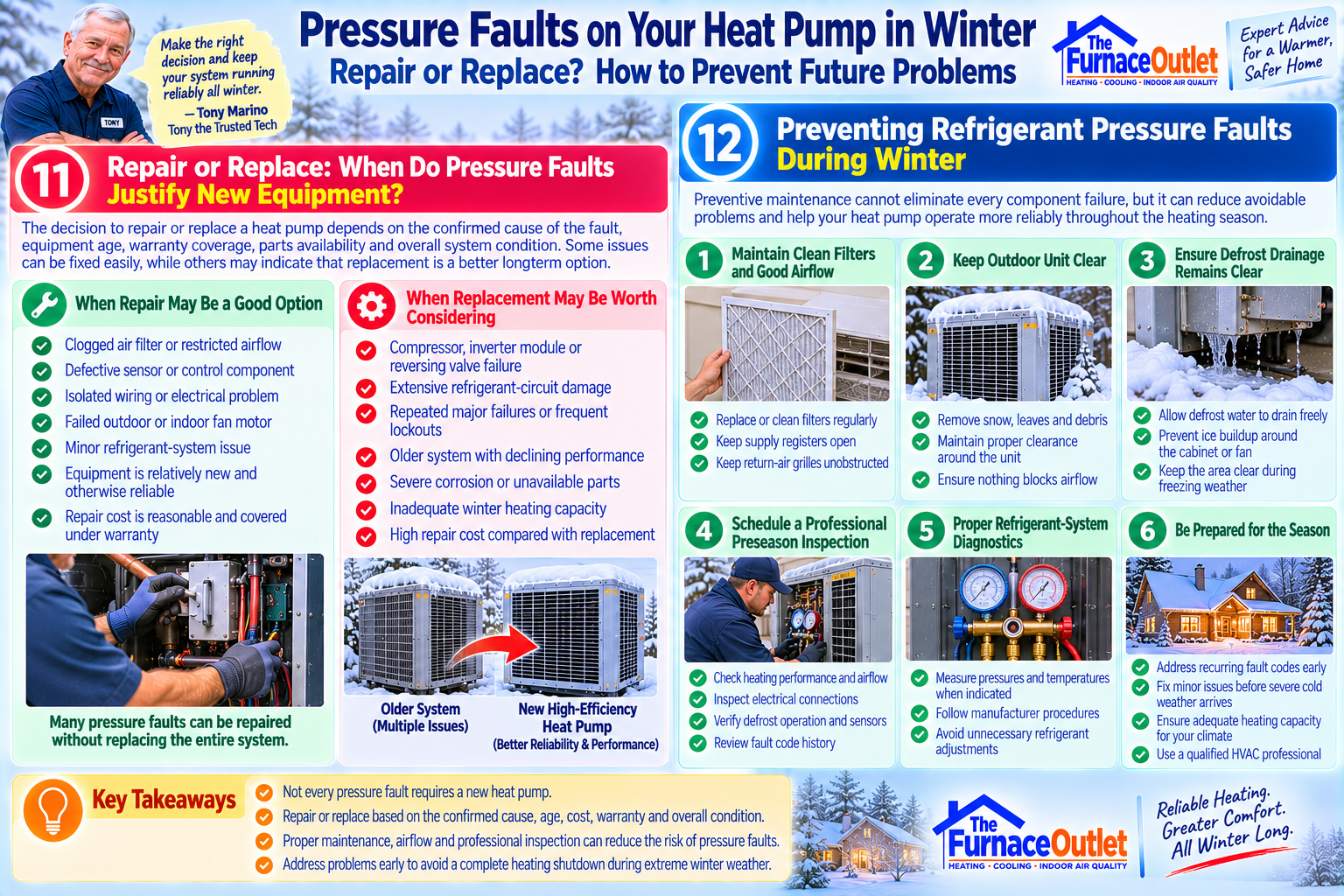
Preventive maintenance cannot eliminate every component failure, but it can reduce avoidable operating problems. Maintain indoor filters according to manufacturer instructions, keep return-air and supply openings unobstructed, and preserve required outdoor airflow clearances. utdoor equipment should remain free from excessive debris and snow accumulation. Defrost drainage should be able to function without repeated ice buildup interfering with the cabinet or fan.
A professional preseason inspection can include checking heating performance, airflow, electrical connections, defrost operation, relevant sensors, and equipment fault history. Refrigerant-system measurements should be performed when indicated by the equipment’s condition and manufacturer procedures, rather than as an excuse for unnecessary refrigerant adjustment. For the 2026–2027 heating season, I recommend addressing recurring fault codes before prolonged freezing weather arrives. A minor control or airflow problem discovered early may be considerably easier to correct than a complete heating shutdown during severe winter conditions.
No. Low-pressure protection can be associated with refrigerant loss, restricted airflow, abnormal operating conditions, expansion-device problems, or sensor and control faults. The cause must be verified before refrigerant is added.
Yes, on some systems. A severely restricted indoor filter can reduce airflow across the indoor condenser, potentially increasing condensing temperature and pressure. However, other causes must also be considered.
Excessive ice can restrict airflow across the outdoor coil during heating and may contribute to abnormal evaporating conditions. Whether this triggers a low-pressure fault depends on the equipment and its protection strategy.
Do not repeatedly reset the system to force operation. Follow manufacturer instructions and arrange professional evaluation when the cause is uncertain or the fault recurs.
No. A pressure fault indicates a detected operating or protection condition, not necessarily internal compressor damage. Airflow, sensors, controls, refrigerant flow, and other components may be responsible.
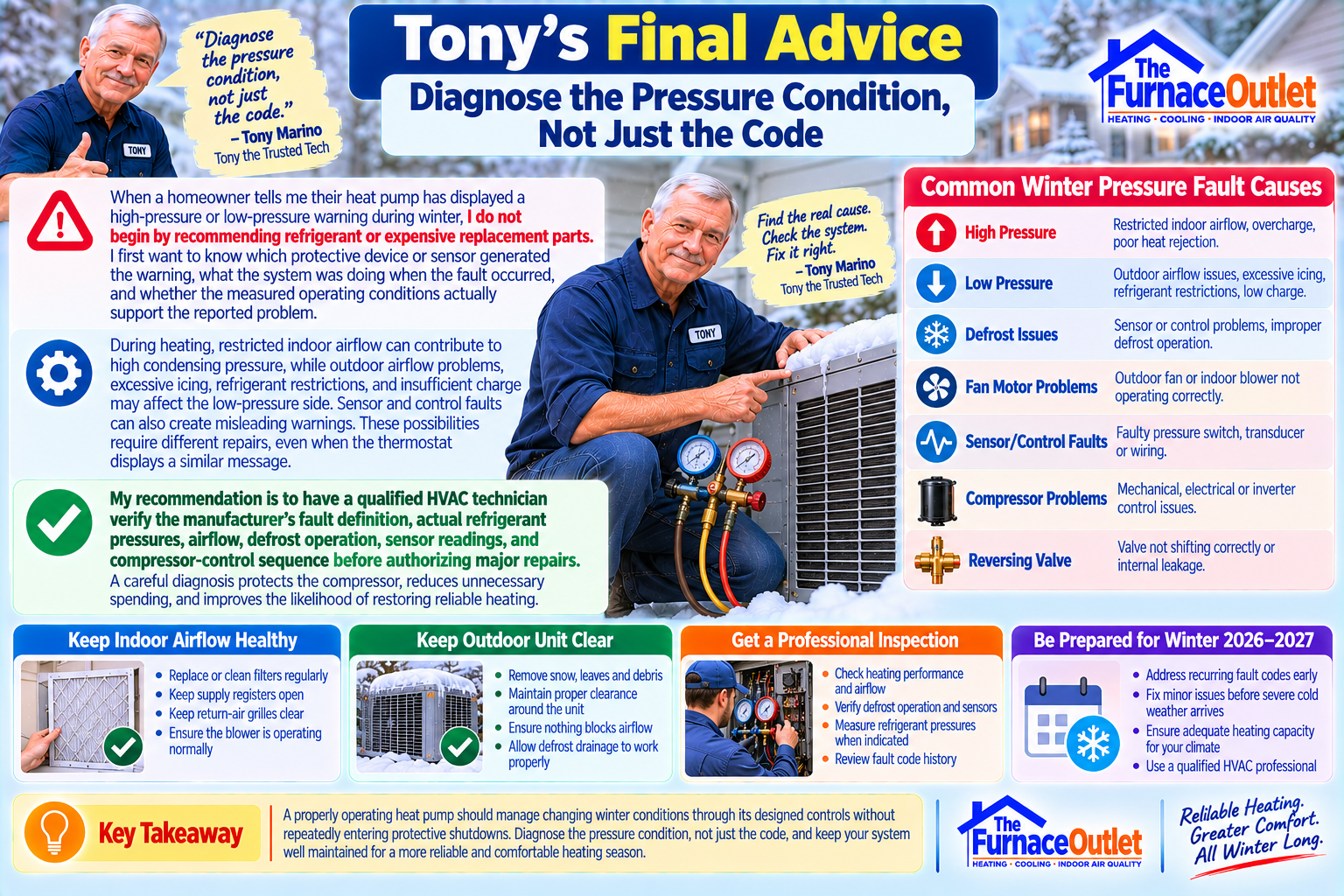
When a homeowner tells me their heat pump has displayed a high-pressure or low-pressure warning during winter, I do not begin by recommending refrigerant or expensive replacement parts. I first want to know which protective device or sensor generated the warning, what the system was doing when the fault occurred, and whether the measured operating conditions actually support the reported problem.
During heating, restricted indoor airflow can contribute to high condensing pressure, while outdoor airflow problems, excessive icing, refrigerant restrictions, and insufficient charge may affect the low-pressure side. Sensor and control faults can also create misleading warnings. These possibilities require different repairs, even when the thermostat displays a similar message.
My recommendation is to have a qualified HVAC technician verify the manufacturer’s fault definition, actual refrigerant pressures, airflow, defrost operation, sensor readings, and compressor-control sequence before authorizing major repairs. A careful diagnosis protects the compressor, reduces unnecessary spending, and improves the likelihood of restoring reliable heating.
For the 2026–2027 winter season, maintain proper airflow, keep outdoor equipment unobstructed, and investigate recurring pressure faults promptly. A properly operating heat pump should manage changing winter conditions through its designed controls without repeatedly entering protective shutdowns.
This article is intended for general educational purposes and does not replace professional HVAC diagnosis, electrical service, or refrigerant-system repair. Heat pumps contain high-voltage electrical components, moving equipment, and pressurized refrigerants. Homeowners should not open service panels, connect refrigerant gauges, manipulate service valves, bypass pressure switches, reset recurring faults repeatedly, or attempt sealed-system repairs. Refrigerant handling and electrical diagnosis should be performed by appropriately qualified professionals following applicable regulations and manufacturer instructions.
U.S. Department of Energy — Air-Source Heat Pumps: https://www.energy.gov/energysaver/air-source-heat-pumps
U.S. Department of Energy — Heat Pump Systems: https://www.energy.gov/energysaver/heat-pump-systems
ENERGY STAR — Heating and Cooling Maintenance Checklist: https://www.energystar.gov/saveathome/heating-cooling/maintenance-checklist
ENERGY STAR — Air-Source Heat Pumps: https://www.energystar.gov/products/air_source_heat_pumps
U.S. Environmental Protection Agency — Section 608 Technician Certification: https://www.epa.gov/section608/section-608-technician-certification
Northeast Energy Efficiency Partnerships — Cold Climate Air-Source Heat Pump List: https://ashp.neep.org/
These resources provide general information about heat pump operation, maintenance, refrigerant-service requirements, and cold-climate performance. Exact fault-code definitions, pressure limits, diagnostic procedures, and protection sequences must be confirmed using the applicable equipment manufacturer’s service documentation.