Newsletter Subscribe
Enter your email address below and subscribe to our newsletter

HVAC made simple
By Jake Lawson | HVAC Specialist | The Furnace Outlet
Updated: October 2026 | Category: Indoor Air Quality & Ventilation
Modern homes are designed to be increasingly energy-efficient, with improved insulation, tighter building envelopes, and better-controlled heating and cooling systems. While these improvements can reduce unwanted air leakage and energy consumption, they also make intentional ventilation more important. Without adequate fresh-air exchange, indoor pollutants, moisture, odors, and carbon dioxide can accumulate, particularly in homes where windows remain closed for extended periods.
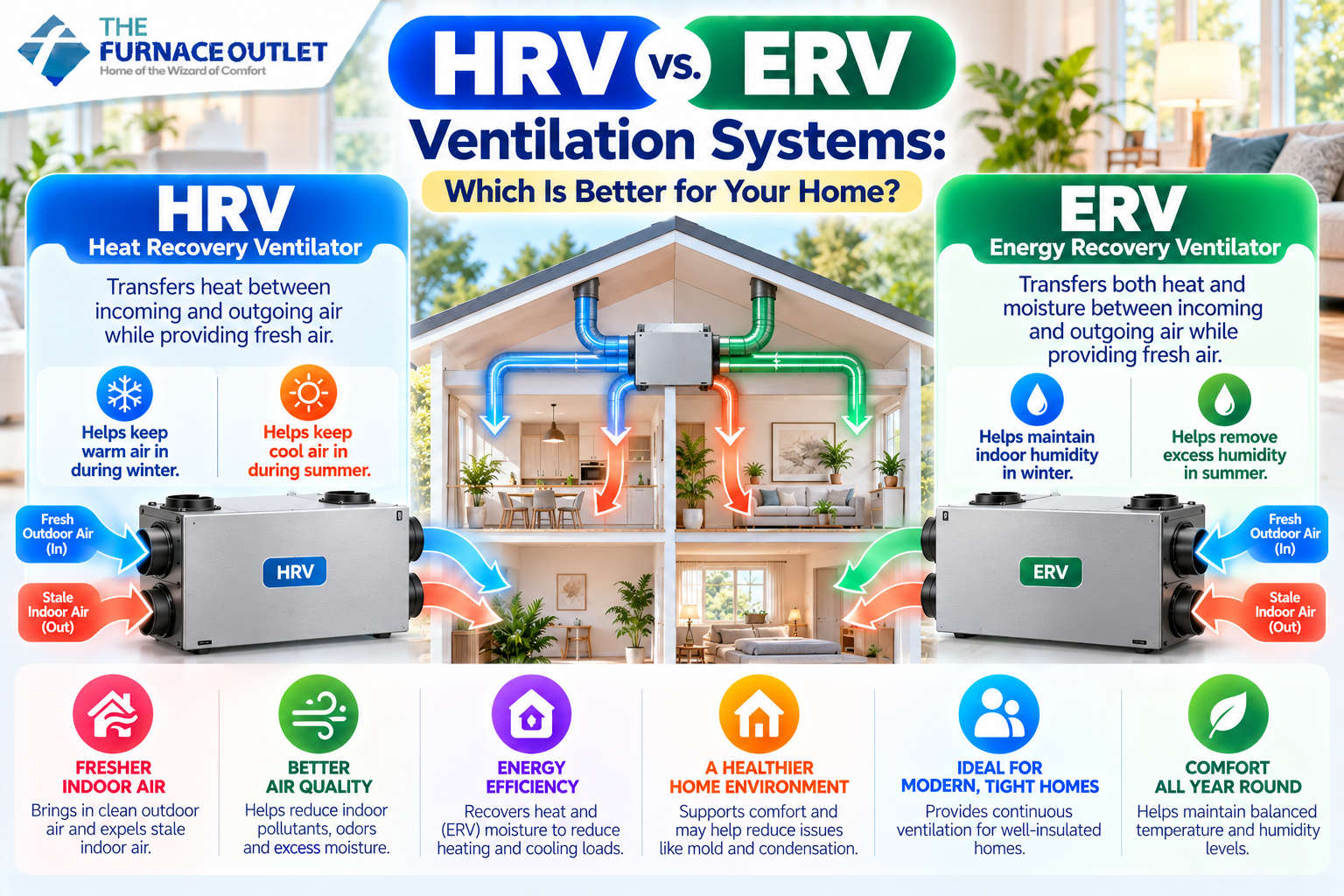
Heat Recovery Ventilators (HRVs) and Energy Recovery Ventilators (ERVs) are two mechanical ventilation technologies designed to address this challenge. Both systems exchange stale indoor air with outdoor air while recovering part of the energy that would otherwise be lost through ventilation. However, they differ in how they handle moisture, making climate, indoor humidity, and household ventilation needs important factors when choosing between them.
An HRV primarily transfers sensible heat between outgoing and incoming air streams. An ERV transfers sensible heat along with some moisture-related energy, commonly called latent heat. This distinction influences how each system performs during cold winters, humid summers, and changing seasonal conditions. Neither technology is automatically superior in every climate, and the best choice depends on the building’s characteristics and the ventilation equipment’s actual performance.
During my years working with residential and commercial HVAC systems, I have found that homeowners sometimes focus on energy-recovery efficiency without considering ventilation rates, humidity control, duct design, or maintenance. My approach is to evaluate the entire ventilation strategy before recommending equipment. In this guide, I explain how HRVs and ERVs work, compare their benefits and limitations, examine installation and operating costs, and help homeowners determine which system is better suited to their home.
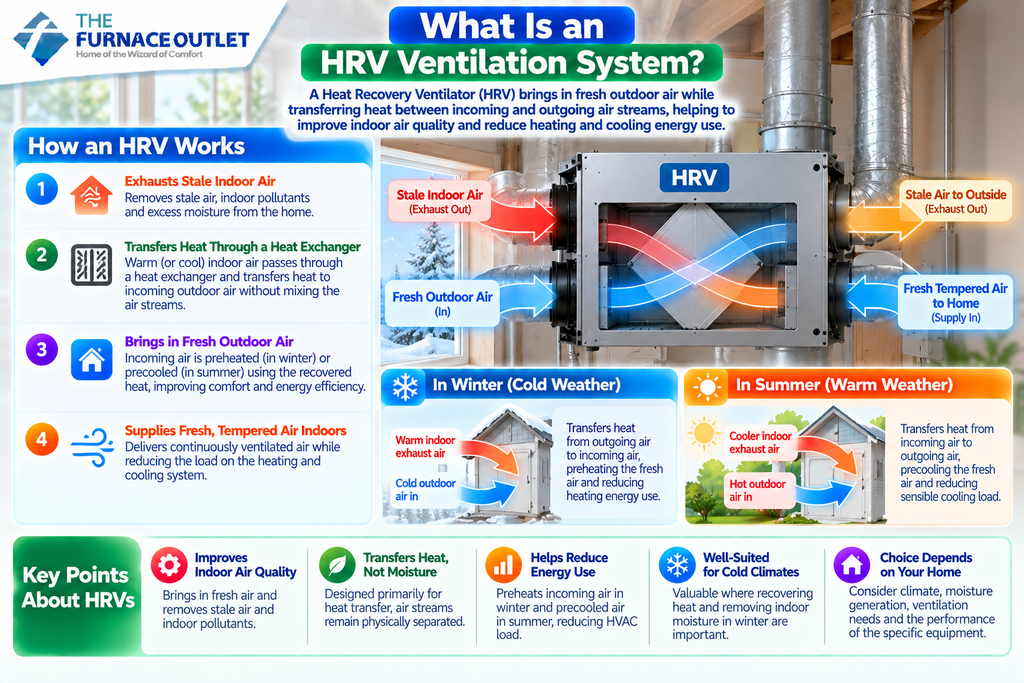
A Heat Recovery Ventilator, or HRV, is a mechanical ventilation device that exchanges indoor and outdoor air while transferring heat between the two air streams. During colder weather, warm indoor exhaust air passes through a heat exchanger and transfers some of its heat to incoming outdoor air. This process reduces the heating energy required to bring fresh ventilation air closer to indoor temperature.
During warmer weather, the process can operate in the opposite direction when indoor exhaust air is cooler than the outdoor air. The heat exchanger can transfer some heat from the incoming outdoor stream toward the outgoing exhaust stream, reducing the sensible cooling load associated with ventilation. The actual benefit depends on outdoor conditions, indoor temperature, airflow, and equipment performance.
Most conventional residential HRVs use a heat exchanger that keeps the supply and exhaust air streams physically separated. The unit is designed primarily for heat transfer rather than intentional moisture transfer, although real-world moisture behavior can be affected by condensation, defrost cycles, leakage, and equipment design.
I generally consider HRVs worth evaluating in cold climates where recovering heat from exhaust air is valuable and where removing indoor moisture during winter is an important ventilation objective. However, the correct choice still depends on the home’s moisture generation, ventilation requirements, and the performance of the specific equipment.
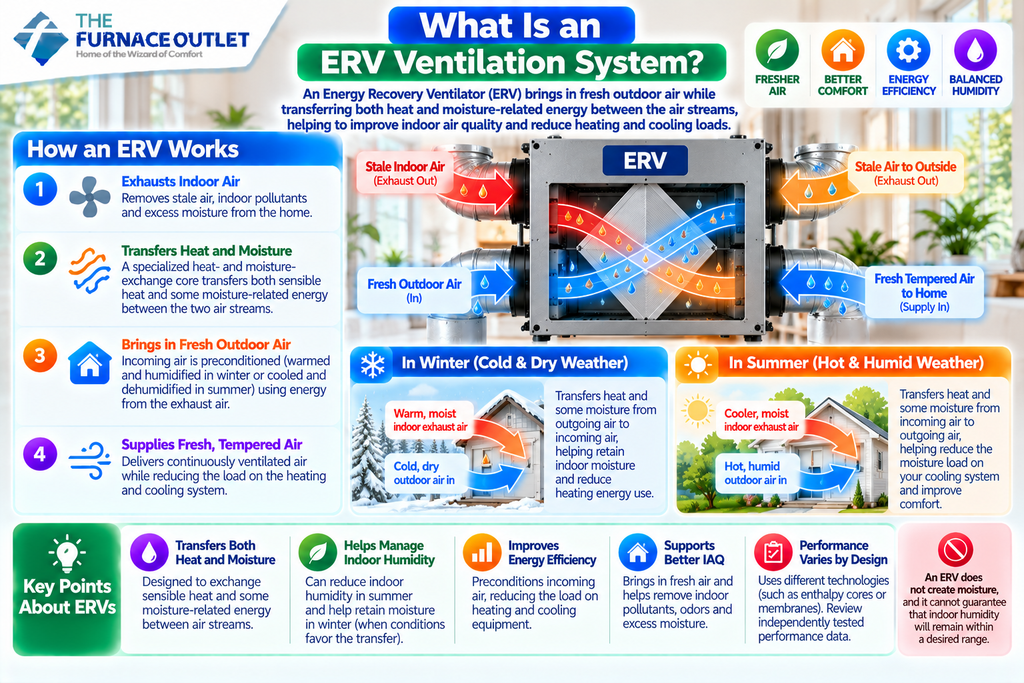
An Energy Recovery Ventilator, or ERV, performs a similar basic ventilation function but transfers both sensible heat and some moisture-related energy between the incoming and outgoing air streams. This additional moisture-transfer capability distinguishes many ERVs from conventional HRVs and can influence indoor humidity during different seasons.
During humid summer conditions, an ERV can transfer some moisture from the incoming outdoor air stream toward the outgoing indoor exhaust stream when the humidity conditions favor that direction. This can reduce the latent moisture load imposed on the home’s cooling and dehumidification equipment compared with ventilation that introduces untreated outdoor air.
During cold, dry weather, the moisture-transfer process may help retain some indoor moisture that would otherwise be exhausted. This can be useful in homes where winter ventilation contributes to uncomfortable dryness. However, an ERV does not create moisture, and it cannot guarantee that indoor humidity will remain within a desired range.
ERVs use different heat- and moisture-exchange technologies, including specialized membranes, enthalpy cores, and certain rotary energy-recovery devices. Their performance and potential for air-stream leakage vary by design. I recommend reviewing independently tested performance data rather than assuming that every ERV delivers identical humidity benefits.
Both HRVs and ERVs use fans to move outdoor supply air and indoor exhaust air through a heat-exchange assembly. In a typical balanced ventilation arrangement, approximately equal volumes of outdoor air are introduced and indoor air are exhausted, although actual flow rates depend on commissioning, duct resistance, controls, and building pressure conditions.
The heat exchanger allows energy to move between the air streams without intentionally mixing the bulk supply and exhaust airflow. During winter, incoming outdoor air receives some heat from outgoing indoor air. During summer, the system may reduce the temperature difference between incoming outdoor air and indoor conditions, depending on the operating environment.
The primary difference lies in moisture transfer. An HRV generally transfers sensible heat without intentionally transferring water vapor between the air streams. An ERV transfers both sensible heat and a portion of the moisture-related energy. This means the ERV can moderate the moisture impact of ventilation, although it cannot eliminate the need for separate humidity control when indoor moisture loads are excessive.
I recommend thinking of these systems as energy-saving ventilation equipment rather than complete air purification or climate-control solutions. They introduce outdoor air, recover some energy, and help establish controlled ventilation, but they do not automatically correct every indoor air quality concern.
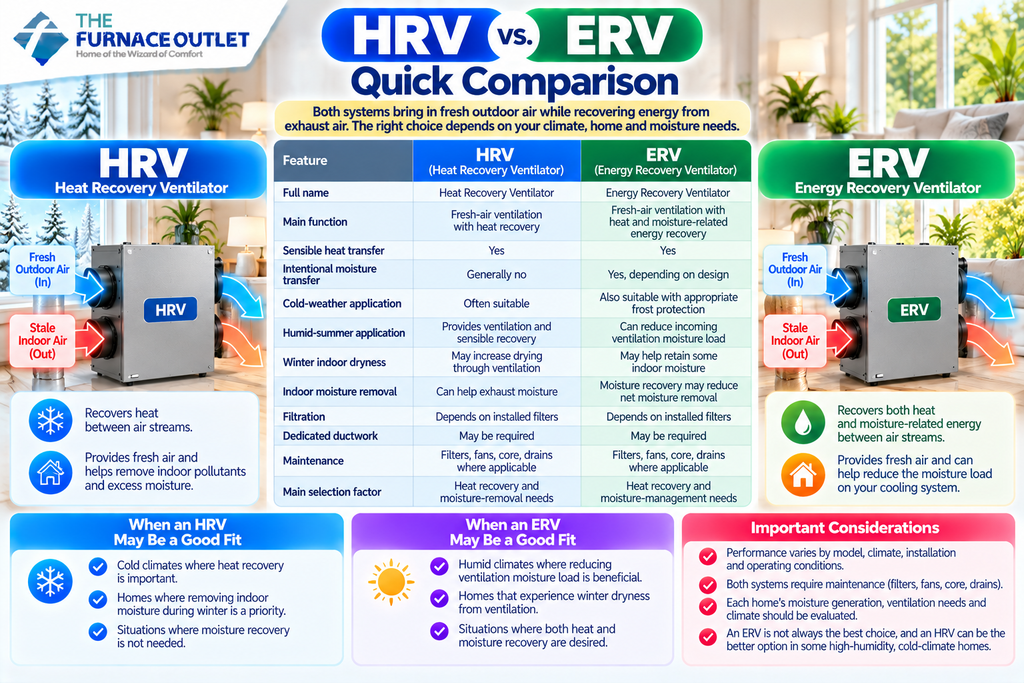
The following comparison summarizes the principal differences between conventional residential HRV and ERV systems. Actual performance depends on the selected model, climate, installation, and operating conditions.
| Feature | HRV | ERV |
|---|---|---|
| Full name | Heat Recovery Ventilator | Energy Recovery Ventilator |
| Main function | Fresh-air ventilation with heat recovery | Fresh-air ventilation with heat and moisture-related energy recovery |
| Sensible heat transfer | Yes | Yes |
| Intentional moisture transfer | Generally no | Yes, depending on design |
| Cold-weather application | Often suitable | Also suitable with appropriate frost protection |
| Humid-summer application | Provides ventilation and sensible recovery | Can reduce incoming ventilation moisture load |
| Winter indoor dryness | May increase drying through ventilation | May help retain some indoor moisture |
| Indoor moisture removal | Can help exhaust moisture | Moisture recovery may reduce net moisture removal |
| Filtration | Depends on installed filters | Depends on installed filters |
| Dedicated ductwork | May be required | May be required |
| Maintenance | Filters, fans, core, drains where applicable | Filters, fans, core, drains where applicable |
| Main selection factor | Heat recovery and moisture-removal needs | Heat recovery and moisture-management needs |
The comparison should not be interpreted as a universal recommendation to choose an ERV whenever moisture is present. For example, a cold-climate home experiencing excessive indoor humidity may benefit from an HRV’s ability to exhaust moisture without recovering as much of it. Conversely, a home in a humid climate may benefit from an ERV that reduces the moisture burden associated with outdoor ventilation.
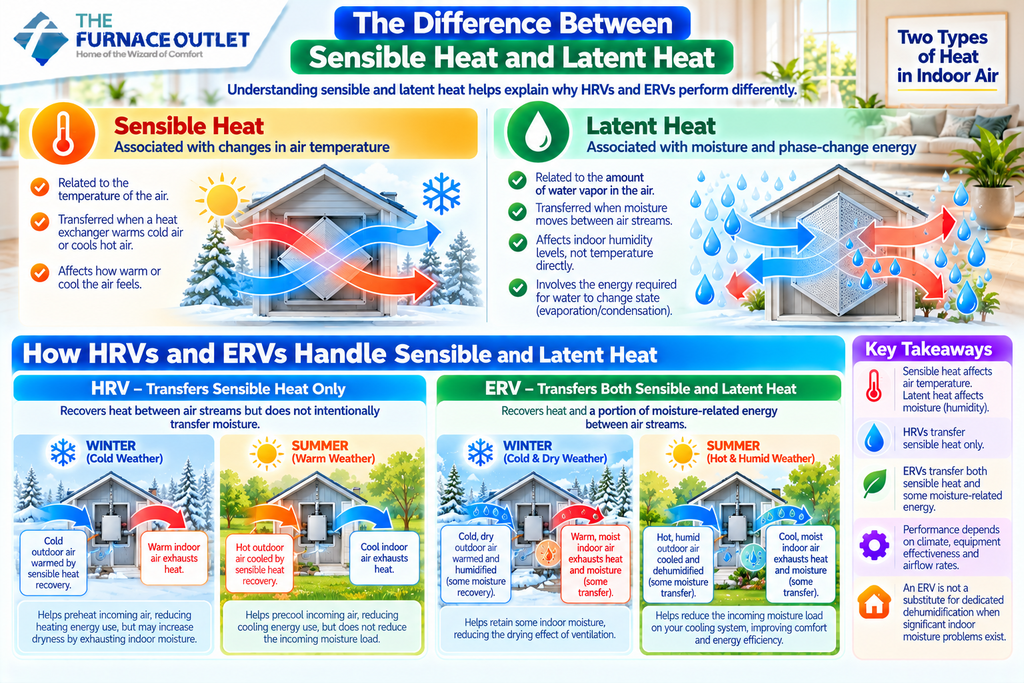
Understanding sensible and latent heat helps explain why HRVs and ERVs perform differently. Sensible heat is associated with changes in air temperature. When a heat exchanger warms cold incoming air or cools hot incoming air, it is transferring sensible energy between the two streams.
Latent heat is associated with moisture and phase-change energy. In ventilation applications, latent energy transfer generally relates to changes in the water-vapor content of the air. ERVs can transfer a portion of this moisture-related energy, helping moderate the humidity difference between incoming outdoor air and outgoing indoor air.
For example, during humid summer weather, an ERV may reduce the amount of moisture entering the home through mechanical ventilation compared with an otherwise similar system that provides only sensible heat recovery. During dry winter conditions, moisture transfer may help reduce the drying effect of outdoor-air ventilation.
These effects depend on the actual humidity difference, equipment effectiveness, and airflow rates. An ERV cannot independently dehumidify a home below the moisture conditions achievable through its exchange process, and it should not be treated as a substitute for dedicated dehumidification when significant indoor moisture problems exist.
Cold climates often create favorable conditions for heat recovery because the temperature difference between indoor and outdoor air can be substantial. Introducing untreated outdoor air during winter increases the heating load, while exhausting warm indoor air without recovery wastes energy. Both HRVs and ERVs can reduce this energy penalty.
HRVs have traditionally been common in cold-climate residential applications because they recover sensible heat while allowing indoor moisture to leave with the exhaust air. This can be useful in tightly constructed homes where cooking, bathing, laundry, and occupancy generate substantial indoor moisture during winter.
However, not every cold-climate home experiences excessive humidity. Some homes become uncomfortably dry during winter because outdoor air contains relatively little moisture. In those circumstances, an appropriately selected ERV may help retain a portion of indoor moisture while recovering heat.
Cold-weather performance also depends on frost management. Heat exchangers can experience freezing or condensation under certain operating conditions, and different units use different defrost strategies. I recommend selecting equipment specifically rated for the local winter climate and reviewing how its frost-protection controls affect ventilation and energy consumption.
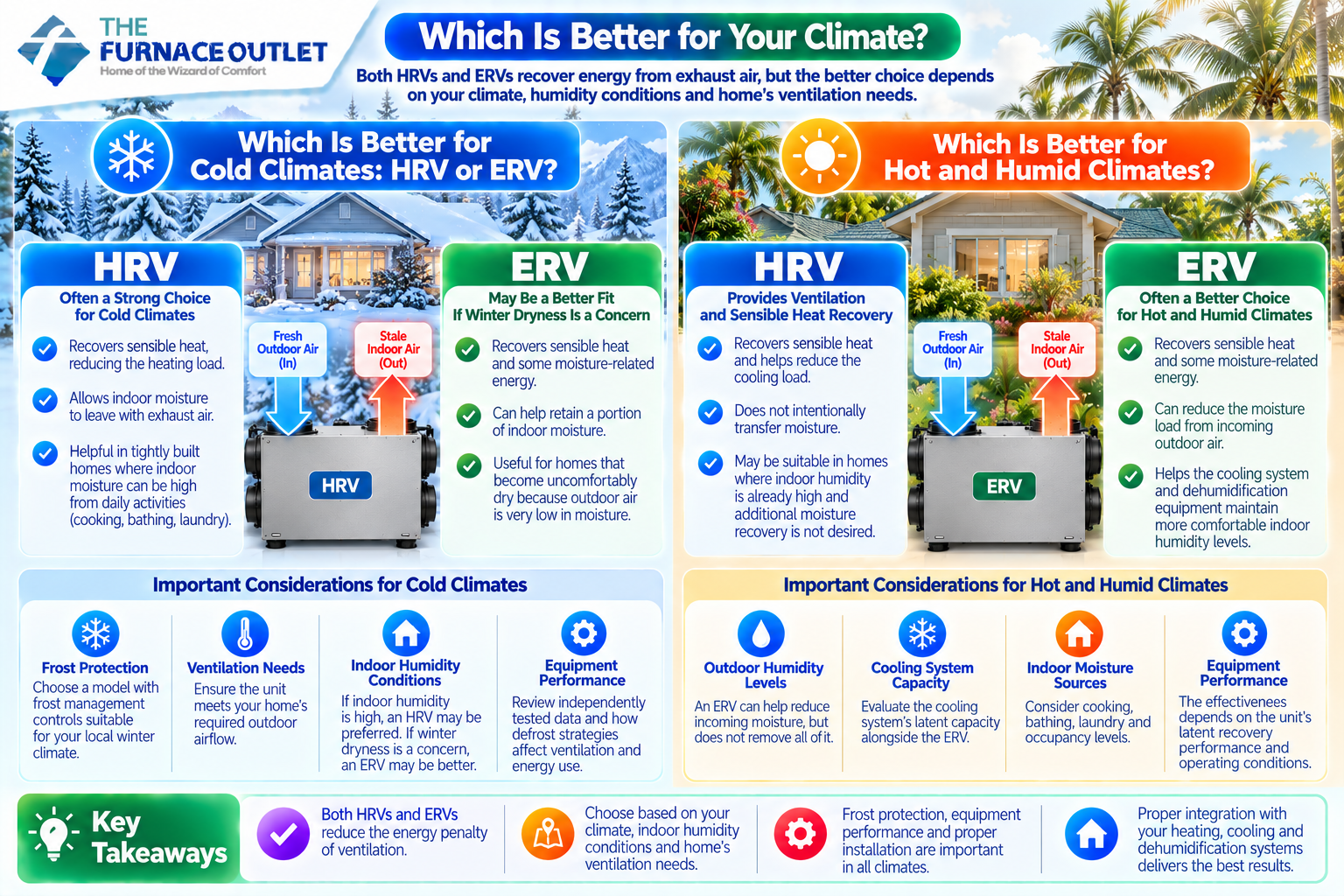
Hot and humid climates present a different ventilation challenge because outdoor air can contain substantial moisture. Bringing this air indoors increases the moisture load that air conditioning or dehumidification equipment must handle. Even when the incoming air is cooled, moisture removal may still be necessary to maintain comfortable indoor conditions.
An ERV can be advantageous because it transfers some moisture-related energy between the outdoor supply and indoor exhaust streams. When the indoor exhaust air is drier than the incoming outdoor air, the ERV can reduce the moisture content of the ventilation air compared with direct outdoor-air introduction.
However, the system’s effectiveness depends on its latent recovery performance and operating conditions. An ERV does not remove all incoming moisture, and it may not maintain appropriate indoor humidity during periods of high outdoor humidity or significant indoor moisture generation.
For homes in hot and humid climates, I generally recommend evaluating an ERV alongside the cooling system’s latent capacity, ventilation requirements, and any need for dedicated dehumidification. Proper integration is more important than assuming that the ERV alone will solve every humidity problem.
Mixed climates experience both heating and cooling seasons, making the HRV-versus-ERV decision more dependent on the home’s specific operating conditions. A house may experience cold winter temperatures, humid summer weather, and moderate conditions during spring and autumn.
In these climates, an ERV may offer useful seasonal flexibility by transferring sensible and latent energy. During humid weather, it can reduce some incoming moisture load, while during dry weather, it may retain a portion of indoor moisture.
Nevertheless, an HRV can remain appropriate when indoor moisture removal is a priority or when the selected equipment offers advantages in cost, reliability, controls, or climate-specific performance. The difference in real-world operating costs may also depend on the amount of ventilation required and the efficiency of the home’s heating and cooling equipment.
I recommend comparing annual energy performance and moisture behavior rather than selecting equipment solely on climate-zone labels. Building airtightness, occupancy, local humidity patterns, and the actual ventilation design should influence the final decision.
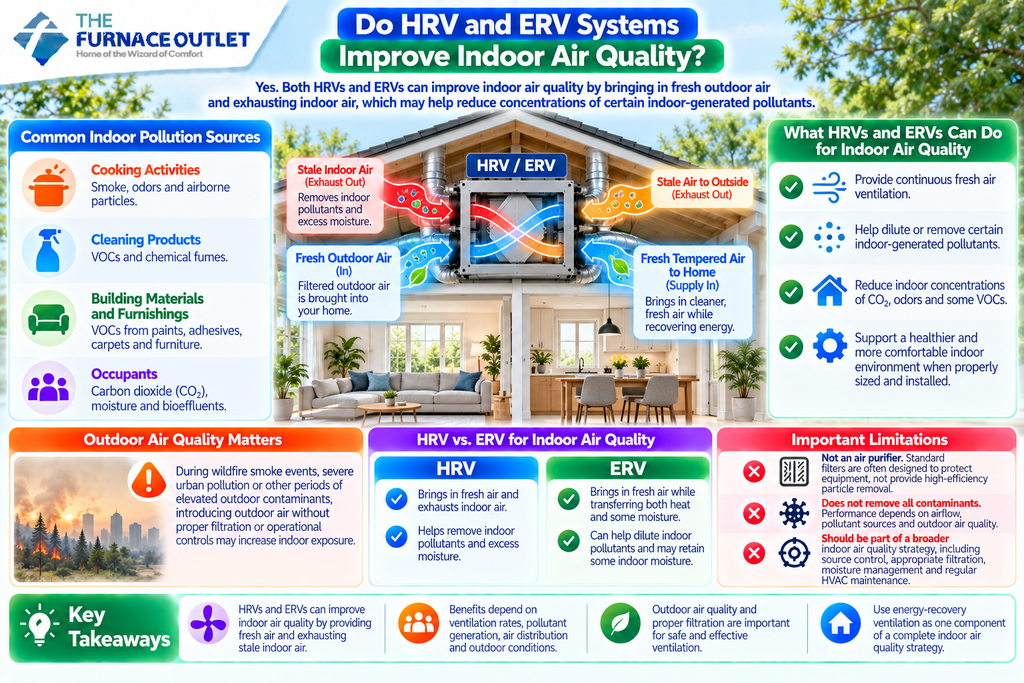
Both HRVs and ERVs can improve ventilation by introducing outdoor air and exhausting indoor air. This process may reduce concentrations of certain indoor-generated pollutants when the outdoor air is sufficiently clean and the system delivers appropriate ventilation rates.
Common indoor pollution sources include cooking activities, cleaning products, building materials, furnishings, and occupant-generated carbon dioxide. Mechanical ventilation can help dilute or remove certain airborne contaminants, but the benefit depends on airflow, pollutant generation, air distribution, and outdoor conditions.
Outdoor air quality must also be considered. During wildfire smoke events, severe urban pollution, or other periods of elevated outdoor contaminants, introducing additional outdoor air without suitable filtration or operational controls may increase indoor exposure. An HRV or ERV is not automatically an air purifier, and its standard filters may be intended primarily to protect equipment rather than provide high-efficiency particle removal.
I recommend treating energy-recovery ventilation as one component of a broader indoor air quality strategy that includes source control, appropriate filtration, moisture management, and regular HVAC maintenance.
Carbon dioxide is produced by occupants through normal breathing and can accumulate in occupied rooms when ventilation is insufficient relative to occupancy. Both HRVs and ERVs can help reduce indoor carbon dioxide concentrations by replacing a portion of indoor air with outdoor air.
However, the actual reduction depends on the outdoor-air delivery rate, number of occupants, room distribution, and system operation. Installing an energy-recovery ventilator does not guarantee adequate ventilation unless the equipment is properly sized, balanced, and operated.
Consumer carbon dioxide monitors may help identify ventilation patterns, particularly in bedrooms, home offices, and other occupied spaces. I recommend using true carbon dioxide sensors, such as suitable nondispersive infrared devices, when evaluating these patterns.
A carbon dioxide reading alone does not provide a complete assessment of indoor air quality, and no single reading should be treated as proof that all pollutants are controlled. Ventilation should be designed around applicable requirements and actual building needs rather than relying exclusively on a consumer monitor’s colored display.
Humidity control is one of the most important distinctions between HRV and ERV systems. An HRV primarily transfers heat, so the moisture content of incoming outdoor air is not intentionally moderated through the heat exchanger. An ERV transfers some moisture-related energy, which can reduce the humidity difference between the incoming and outgoing streams.
During humid summer weather, this moisture transfer can help reduce the latent load introduced by ventilation. During cold, dry weather, it can help retain indoor moisture. These characteristics make ERVs attractive in certain climates and building types.
However, moisture recovery is not always desirable. In a tightly sealed home experiencing excessive indoor humidity during winter, recovering moisture from exhaust air may reduce the amount of moisture removed through ventilation. An HRV may be more suitable when ventilation is intended partly to remove indoor-generated moisture.
I recommend measuring actual indoor humidity and evaluating seasonal conditions before deciding. Neither HRV nor ERV equipment should be expected to repair leaks, eliminate condensation caused by cold surfaces, or replace dedicated humidity-control equipment when those measures are necessary.
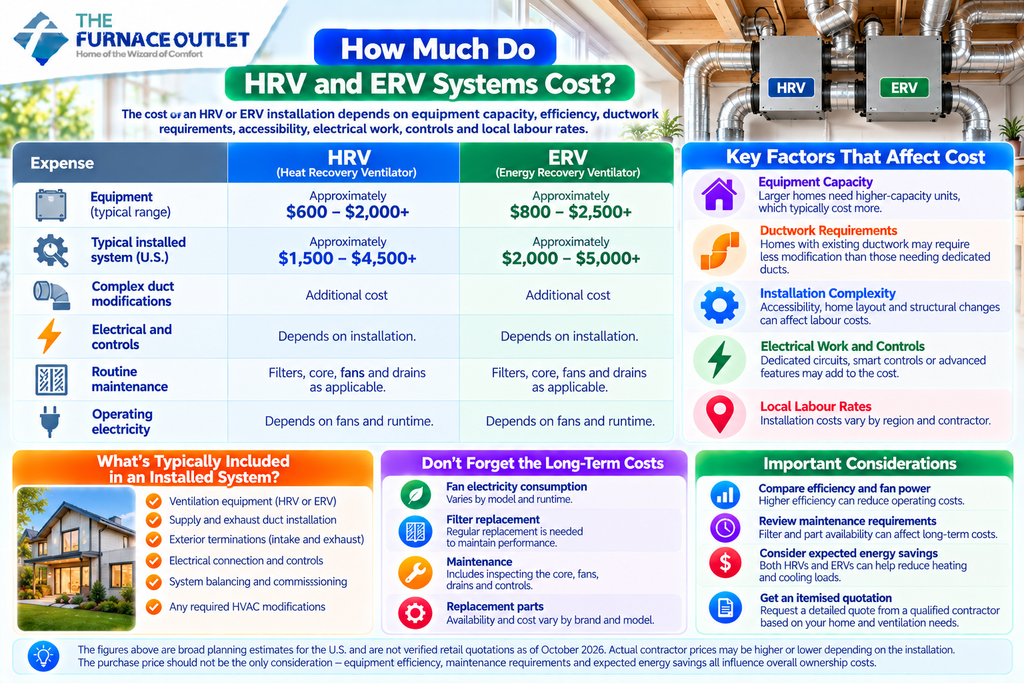
The cost of an HRV or ERV installation depends on equipment capacity, efficiency, ductwork requirements, accessibility, electrical work, controls, and local labour rates. Homes with suitable existing ductwork may require less modification than properties needing dedicated supply and exhaust ducts.
For general U.S. budgeting, the following figures are broad planning estimates rather than verified October 2026 retail quotations. Actual contractor prices may be higher or lower depending on the installation.
| Expense | HRV | ERV |
|---|---|---|
| Equipment | Approximately $600–$2,000+ | Approximately $800–$2,500+ |
| Typical installed system | Approximately $1,500–$4,500+ | Approximately $2,000–$5,000+ |
| Complex duct modifications | Additional cost | Additional cost |
| Electrical and controls | Depends on installation. | Depends on installation. |
| Routine maintenance | Filters, core, fans, and drains as applicable | Filters, core, fans, and drains as applicable |
| Operating electricity | Depends on fans and runtime. | Depends on fans and runtime. |
The purchase price should not be the only consideration. Equipment efficiency, fan electricity consumption, maintenance requirements, replacement-part availability, and the expected heating and cooling energy savings all influence ownership costs.
I recommend obtaining an itemised quotation that includes the ventilation equipment, duct installation, exterior terminations, controls, balancing, commissioning, and any required HVAC modifications.
Energy-recovery ventilation can reduce the heating and cooling energy required to condition outdoor ventilation air compared with introducing the same amount of outdoor air without energy recovery. The magnitude of the savings depends on climate, ventilation airflow, operating hours, recovery effectiveness, and the efficiency of the heating and cooling equipment.
An HRV recovers sensible heat, while an ERV can recover both sensible and latent energy. In humid climates, latent recovery may reduce the moisture-removal load on cooling equipment. In cold climates, sensible heat recovery can substantially reduce the heating burden associated with ventilation.
However, both systems use electricity to operate their fans. Duct resistance, filter loading, motor efficiency, and control strategies influence operating consumption. An improperly installed system may use more electricity or deliver less ventilation than expected.
I recommend comparing equipment using recognized performance data, including sensible recovery effectiveness, total energy recovery where applicable, airflow, fan power, and cold-weather performance. Energy recovery should be evaluated alongside actual ventilation delivery rather than in isolation.
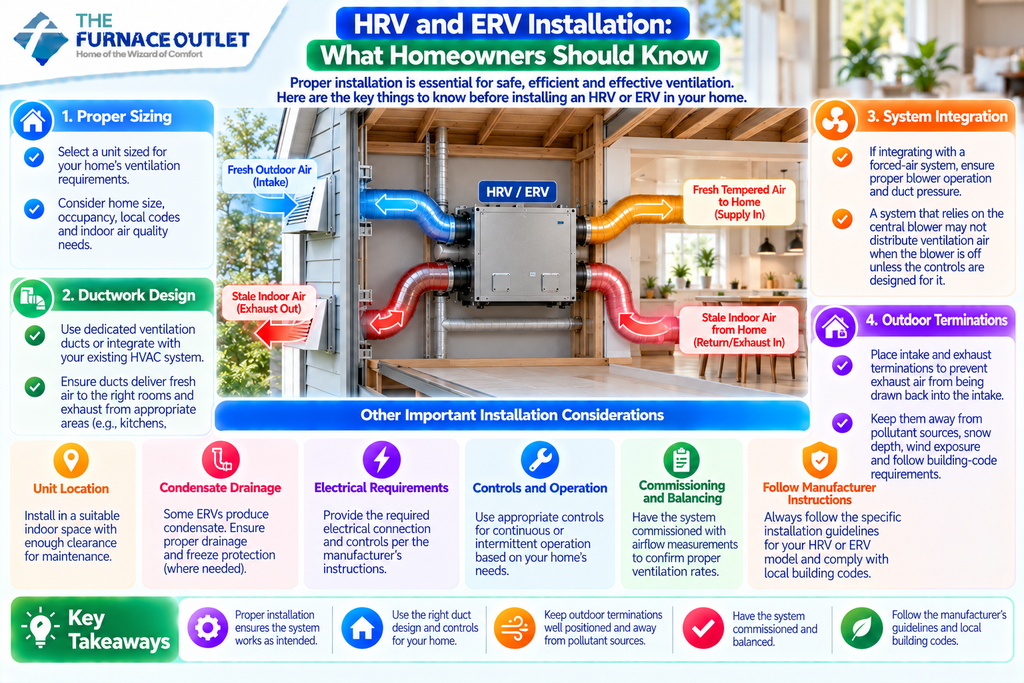
Proper installation is essential because energy-recovery ventilators depend on controlled airflow between indoor and outdoor environments. Equipment must be sized for the home’s ventilation requirements, and the duct system must be designed to deliver air to appropriate locations while exhausting air from suitable areas.
Some systems use dedicated ventilation ductwork, while others are integrated with existing forced-air heating and cooling systems. Integration requires careful attention to blower operation, duct pressure, air distribution, and manufacturer instructions. A system that depends on the central blower may not distribute ventilation air as intended when that blower is off unless the controls and design account for this condition.
Outdoor intake and exhaust terminations must be positioned to reduce the risk of exhaust air being drawn back into the intake. Installers should also consider nearby pollutant sources, snow accumulation, wind exposure, and applicable building-code requirements.
I recommend having the completed system commissioned and balanced. Airflow measurements help confirm that the equipment is delivering the intended ventilation rates and that supply and exhaust flows are appropriately controlled.
Balanced ventilation means that the mechanical supply and exhaust airflow rates are coordinated to avoid unnecessary building pressure imbalances. HRVs and ERVs are commonly designed for balanced operation, but actual performance depends on duct resistance, fan settings, filter conditions, and installation quality.
If exhaust airflow substantially exceeds supply airflow, the building may become more negatively pressurized, potentially increasing uncontrolled infiltration through envelope leaks. If supply airflow substantially exceeds exhaust airflow, positive pressure may drive indoor air into building assemblies under certain conditions.
The appropriate pressure relationship depends on the building and climate, but significant unintended imbalances can create comfort, moisture, or air-quality concerns.
I recommend requiring airflow verification during commissioning rather than assuming that factory fan settings automatically produce balanced operation after installation.
Both HRVs and ERVs require periodic maintenance to operate effectively. Filters can accumulate dust and outdoor particles, reducing airflow and increasing resistance. Heat-exchange cores may also require inspection and cleaning according to manufacturer instructions.
Outdoor intake and exhaust openings should be checked for leaves, debris, snow, insects, and other obstructions. Condensate drains, where provided, must remain functional, particularly in equipment exposed to cold-weather condensation.
ERV cores require particular attention to manufacturer cleaning instructions because some moisture-transfer materials can be damaged by inappropriate washing or chemical cleaners. Homeowners should not assume that all heat-exchange cores are washable.
I recommend establishing a maintenance schedule based on the equipment manual, outdoor pollution conditions, and operating hours. Consistent maintenance helps preserve airflow, recovery performance, and equipment reliability.
One common mistake is selecting equipment based only on advertised energy-recovery efficiency without confirming that it can deliver the required ventilation airflow. A highly efficient unit that is undersized or connected to restrictive ductwork may fail to provide adequate fresh air.
Another problem involves poorly positioned outdoor intake and exhaust openings. Inadequate separation or placement near pollutant sources can increase the risk of contaminated air entering the ventilation system.
Improper balancing, insufficient insulation on cold ducts, poorly managed condensate, and incompatible controls can also reduce performance or create moisture problems.
I recommend selecting a contractor experienced in residential mechanical ventilation rather than treating the installation as a simple equipment replacement. Proper design, commissioning, and maintenance are as important as the ventilator’s advertised efficiency.
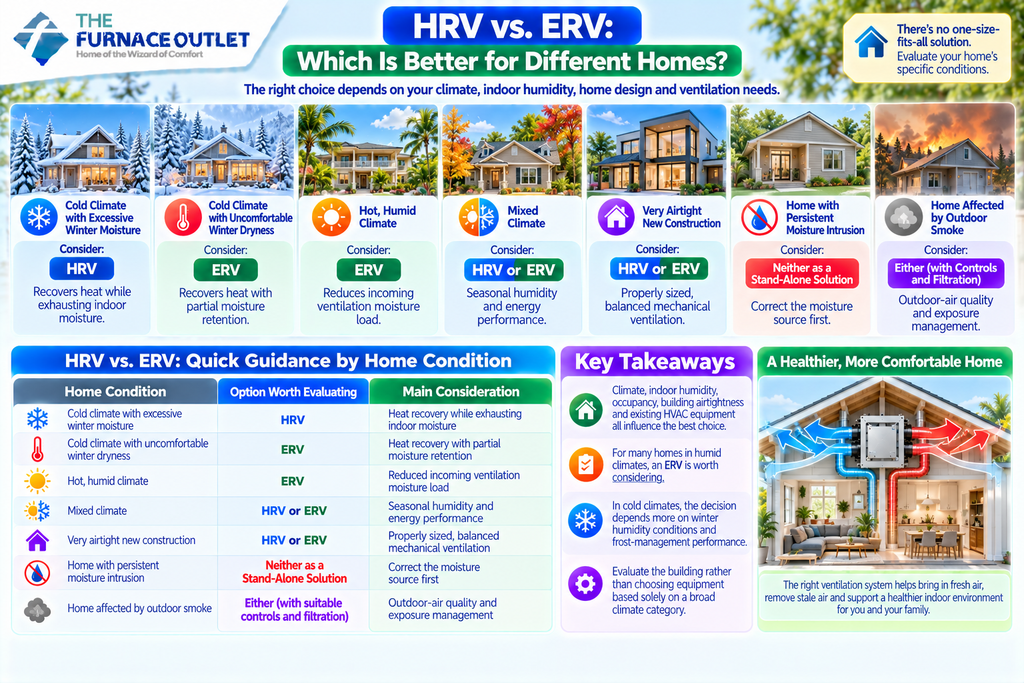
The most suitable ventilation system depends on climate, indoor humidity, occupancy, building airtightness, and existing HVAC equipment. The following scenarios provide general guidance rather than universal rules.
| Home condition | Option worth evaluating | Main consideration |
|---|---|---|
| Cold climate with excessive winter moisture | HRV | Heat recovery while exhausting indoor moisture |
| Cold climate with uncomfortable winter dryness | ERV | Heat recovery with partial moisture retention |
| Hot, humid climate | ERV | Reduced incoming ventilation moisture load |
| Mixed climate | HRV or ERV | Seasonal humidity and energy performance |
| Very airtight new construction | HRV or ERV | Properly sized, balanced mechanical ventilation |
| Home with persistent moisture intrusion | Neither as a stand-alone solution | Correct the moisture source first |
| Home affected by outdoor smoke | Either with suitable controls and filtration | Outdoor-air quality and exposure management |
For many homes in humid climates, an ERV is worth considering because of its moisture-recovery capability. In cold climates, the decision depends more heavily on winter humidity conditions and frost-management performance.
I recommend evaluating the building rather than choosing equipment based solely on a broad climate category.
Both HRVs and ERVs can be installed in existing homes, but retrofit complexity varies considerably. Homes with accessible basements, attics, mechanical rooms, or duct chases may provide suitable routes for ventilation ductwork. Other properties may require substantial modifications to ceilings, walls, or existing HVAC connections.
A ducted central heating and cooling system may provide opportunities for integration, but the ventilation equipment must be compatible with the air-distribution arrangement and controls. Homes without central ductwork can still use dedicated ventilation ducts or other suitable configurations.
Retrofit planning should include outdoor intake and exhaust locations, electrical requirements, drainage where applicable, sound control, access for maintenance, and ventilation distribution.
I recommend obtaining a site-specific design and installation quotation before assuming that an HRV or ERV can be added economically to an existing home.
An ERV is not automatically better than an HRV because the two systems manage moisture differently. ERVs can reduce the latent moisture load associated with ventilation under suitable conditions, while HRVs may be preferable when removing indoor-generated moisture is an important objective. Climate, indoor humidity, and equipment performance should determine the selection.
Yes. Appropriately designed ERVs can operate in cold climates, although frost protection and cold-weather performance must be evaluated. An ERV may also help retain some indoor moisture during dry winter conditions, but it is not necessarily the best choice for homes experiencing excessive winter humidity.
An HRV can help reduce indoor humidity when the outdoor air has lower absolute moisture content than the indoor air. It does not function as a conventional refrigerant-based dehumidifier, and its moisture-removal effect depends on outdoor conditions, ventilation airflow, and indoor moisture generation.
No. An ERV transfers energy between incoming and outgoing ventilation air but does not provide the cooling capacity of a conventional air conditioner. It may reduce some ventilation-related cooling and dehumidification loads, but separate cooling equipment is generally required where active space cooling is needed.
Most systems include filters to protect the equipment and reduce some incoming particles, but filtration efficiency varies. Standard filters should not automatically be assumed to provide HEPA-level purification or adequate protection during severe outdoor pollution events.
Operating schedules depend on ventilation requirements, equipment capacity, occupancy, controls, and applicable standards. Some systems operate continuously at lower airflow rates, while others use intermittent or demand-controlled operation. The schedule should deliver the required ventilation without creating unnecessary energy or moisture problems.
An ERV may reduce the moisture burden associated with outdoor ventilation, but it cannot guarantee suitable indoor humidity under all conditions. Homes with substantial indoor moisture generation, high infiltration, or persistent dampness may still require dedicated dehumidification or corrective building work.
They may be worthwhile in homes where controlled ventilation is needed and energy recovery reduces the cost of conditioning outdoor air. The value depends on climate, building airtightness, ventilation needs, installation costs, and equipment performance rather than a guaranteed payback period.

When homeowners ask me whether they should install an HRV or ERV, I begin by evaluating the home’s ventilation requirements and seasonal moisture conditions. Both technologies can provide controlled outdoor-air exchange while recovering energy, but their differences become important when humidity management is a significant concern.
In a cold-climate home with persistent winter moisture, an HRV may be an appropriate choice because it recovers heat while allowing indoor moisture to leave with the exhaust air. In a humid climate, an ERV may help reduce the moisture load associated with outdoor ventilation. For mixed climates and highly insulated homes, the decision requires a closer look at seasonal humidity, occupancy, equipment performance, and the complete HVAC design.
I also encourage homeowners to recognize that energy-recovery ventilation is not a substitute for source control, suitable filtration, or dedicated humidity management. An HRV or ERV cannot repair a roof leak, eliminate all indoor pollutants, or guarantee healthy indoor air simply because it introduces outdoor air. The system must be properly sized, installed, balanced, and maintained to deliver its intended benefits.
The best choice between an HRV and an ERV is the system that delivers the ventilation your home needs, manages seasonal moisture appropriately, recovers energy efficiently, and operates reliably with your existing HVAC equipment.
By evaluating climate, building airtightness, airflow requirements, indoor humidity, installation quality, and long-term maintenance, homeowners can make informed ventilation decisions that support comfort, energy efficiency, and indoor air quality throughout 2026 and beyond.
This article provides general educational information about residential energy-recovery ventilation. Equipment selection, airflow requirements, humidity performance, and installation practices depend on local climate, building design, manufacturer specifications, and applicable codes. The cost figures are illustrative U.S. planning estimates rather than verified current quotations.
HRV and ERV installations should be designed and commissioned by appropriately qualified professionals. Mechanical ventilation does not replace carbon monoxide protection, combustion safety inspections, moisture remediation, or other necessary indoor air quality measures.
The Furnace Outlet publishes independent educational information and does not imply endorsement by ASHRAE, the EPA, the U.S. Department of Energy, or equipment manufacturers.
U.S. Department of Energy — Energy Recovery Ventilation Systems https://bsesc.energy.gov/energy-basics/hvac-energy-recovery-ventilation
U.S. Department of Energy — Ventilation https://www.energy.gov/cmei/buildings/heating-ventilation-air-conditioning-refrigeration-and-water-heating
U.S. Environmental Protection Agency — Improving Indoor Air Quality https://www.epa.gov/indoor-air-quality-iaq/improving-indoor-air-quality
ASHRAE — Standards and Guidelines https://www.ashrae.org/technical-resources/standards-and-guidelines
Home Ventilating Institute — Certified Ventilation Products https://www.hvi.org
© 2026 The Furnace Outlet | https://thefurnaceoutlet.com
Independent HVAC education for cleaner air, better comfort, and more informed homeowners