Newsletter Subscribe
Enter your email address below and subscribe to our newsletter

HVAC made simple
By Jake Lawson | HVAC Specialist | The Furnace Outlet
Updated: October 2026 | Category: Indoor Air Quality
When homeowners think about indoor air quality, they usually focus on dust, pollen, pet dander, smoke, and other airborne pollutants. However, one of the most important factors influencing the indoor environment is something that cannot always be seen: moisture in the air. Indoor humidity affects comfort, condensation, biological growth, building materials, and the way heating and cooling systems perform. A home can have excellent particle filtration and still experience significant indoor air quality problems if moisture conditions are poorly controlled.
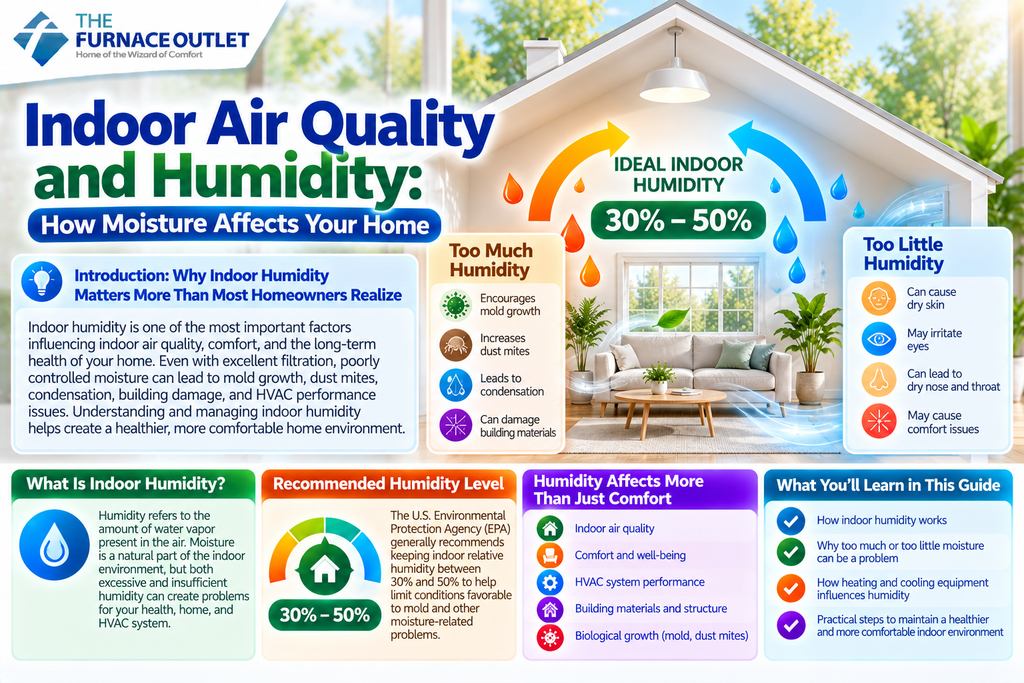
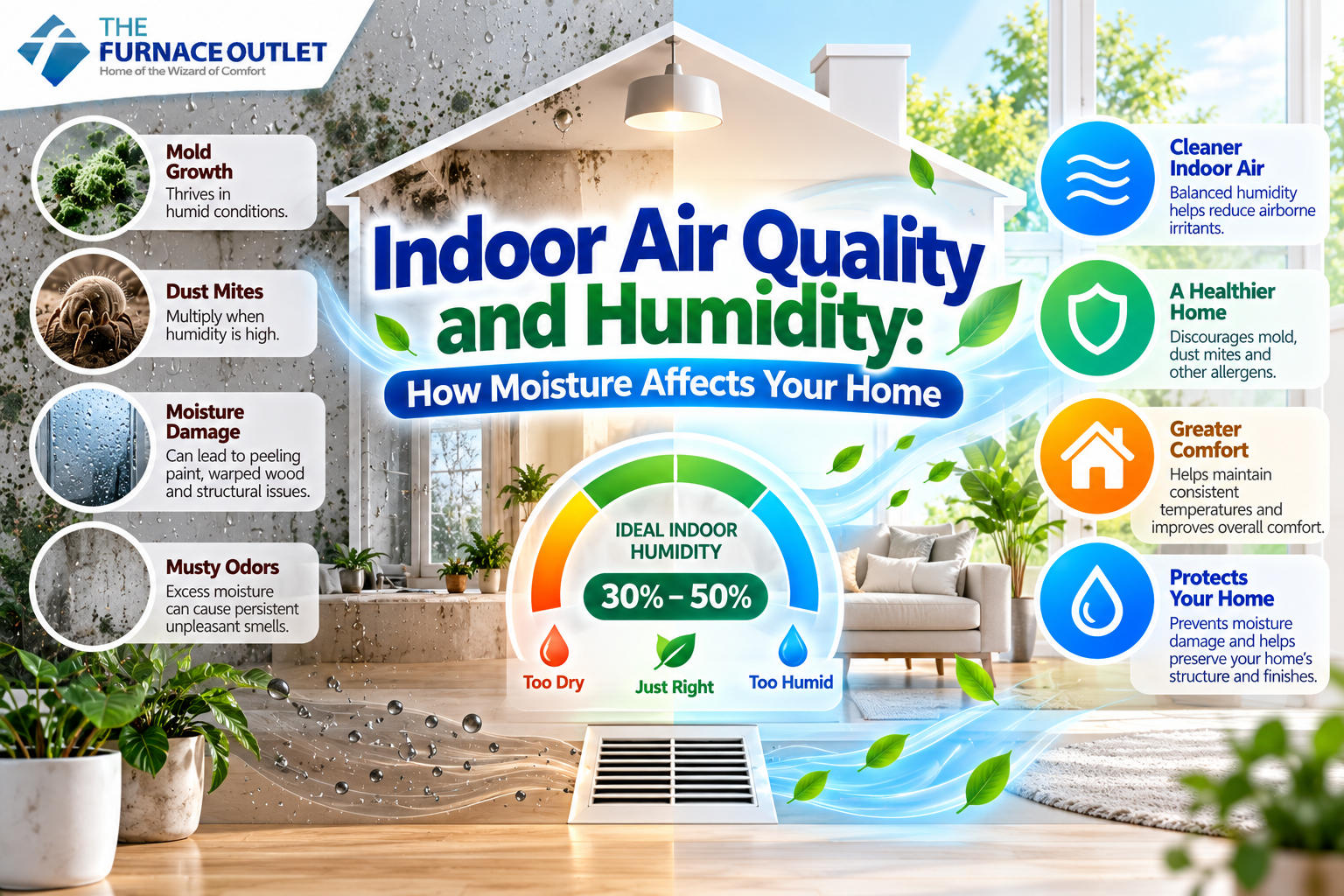
Humidity refers to the amount of water vapor present in the air. Although moisture is a natural part of the indoor environment, excessive or insufficient humidity can create problems. High humidity may encourage mold growth, dust mite populations, condensation, and deterioration of moisture-sensitive materials. Very dry indoor air can contribute to discomfort, dry skin, irritated eyes, and dryness of the nose and throat, although these symptoms may also have other causes.
The U.S. Environmental Protection Agency (EPA) generally recommends keeping indoor relative humidity between 30% and 50% to help limit conditions favorable to mold and other moisture-related problems. However, this range should be interpreted alongside outdoor weather, indoor temperatures, building insulation, and the potential for condensation on cold surfaces. A humidity level that works well in one home may create window condensation or concealed moisture problems in another.
As an HVAC specialist, I consider humidity control an essential part of indoor air quality management. In this guide, I explain how indoor humidity works, why excessive or insufficient moisture matters, how heating and cooling equipment influences humidity, and which practical steps homeowners can take to maintain a healthier and more comfortable indoor environment.
Indoor humidity describes the amount of water vapor contained in the air inside a building. The measurement homeowners most commonly encounter is relative humidity, usually abbreviated as RH. Relative humidity expresses how much water vapor the air contains compared with the maximum amount it could hold at the same temperature before becoming saturated. Because warmer air can contain more water vapor at saturation than cooler air, relative humidity can change when the temperature changes even if no moisture is added or removed.
For example, indoor air may register 50% relative humidity at one temperature but show a higher percentage when cooled without removing water vapor. This relationship helps explain why condensation frequently appears on cold windows, poorly insulated surfaces, and certain HVAC components. When air near a surface cools sufficiently, it may reach its dew point, allowing water vapor to condense into liquid moisture.
Homeowners can measure relative humidity using a hygrometer, which may be a standalone instrument, part of a thermostat, or integrated into an indoor air quality monitor. Consumer devices vary in accuracy, so readings should be interpreted with reasonable tolerance rather than treated as perfectly precise measurements.
I recommend placing a hygrometer in a representative occupied area away from direct sunlight, heating outlets, bathrooms, and other localized moisture sources. Monitoring humidity trends over several days often provides more useful information than relying on a single reading.
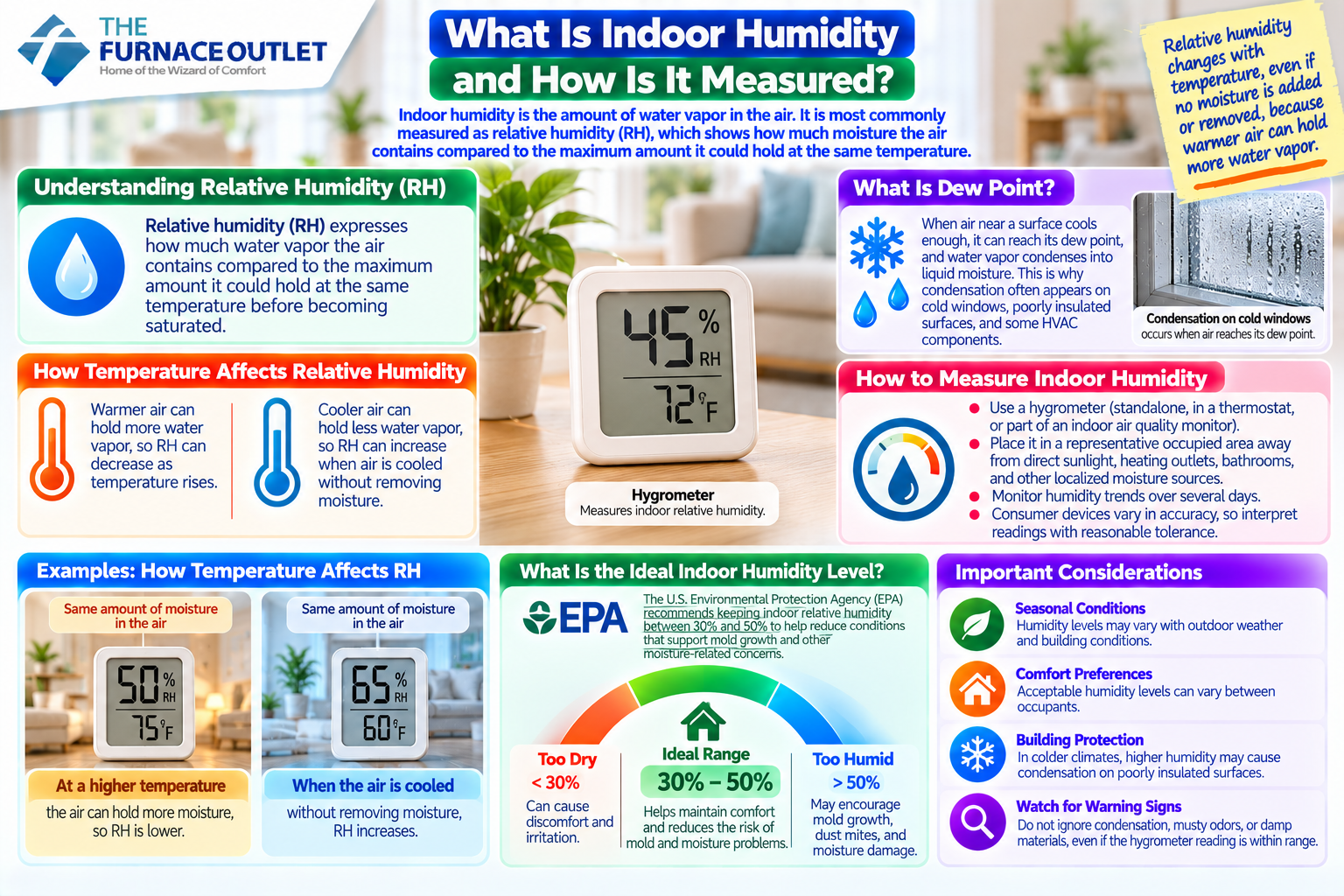
For most residential applications, maintaining relative humidity around 30%–50% is a useful starting point. The EPA recommends this range to help reduce conditions that support mold growth and other moisture-related concerns. However, homeowners should understand that humidity management is not simply a matter of keeping a digital display within a fixed numerical range throughout the year.
During hot and humid weather, indoor humidity may increase because of outdoor moisture infiltration, inadequate cooling-system dehumidification, moisture-generating activities, or building-envelope problems. In colder climates, maintaining humidity near the upper end of the range may cause condensation on poorly insulated windows or other cold surfaces. In those circumstances, a lower indoor humidity level may be necessary to prevent moisture damage.
Comfort preferences also vary. Some occupants experience dryness at humidity levels that others find acceptable, while a home with high humidity may feel uncomfortable even when the thermostat indicates a moderate temperature. The appropriate target should balance comfort, building protection, and moisture control.
My recommendation is to use 30%–50% relative humidity as a general guideline while paying close attention to condensation, musty odors, damp materials, and seasonal conditions. Visible moisture problems should never be ignored simply because a hygrometer displays a number within the recommended range.
Excessive indoor humidity creates conditions that can support biological growth and moisture-related contamination. Mold, dust mites, and other moisture-associated organisms may become more prevalent when indoor environments remain damp. High humidity can also contribute to condensation, deterioration of building materials, and persistent musty odors.
One of the most important concerns is that moisture problems are not always visible. Water vapor may condense inside wall cavities, around poorly insulated ductwork, beneath flooring, or behind furniture placed against cold exterior walls. Over time, persistent dampness can damage materials and create conditions favorable to microbial growth.
High humidity may also influence perceived comfort. Moist air can reduce the body’s ability to cool itself through sweat evaporation, making indoor conditions feel warmer or more uncomfortable. Homeowners sometimes respond by lowering the thermostat, increasing cooling energy consumption without necessarily addressing the underlying moisture problem.
I recommend investigating persistent indoor relative humidity above approximately 60%, especially when accompanied by condensation, dampness, or musty odors. A humidity reading alone does not establish that mold is present, but consistently elevated moisture deserves attention before it causes more serious building problems.
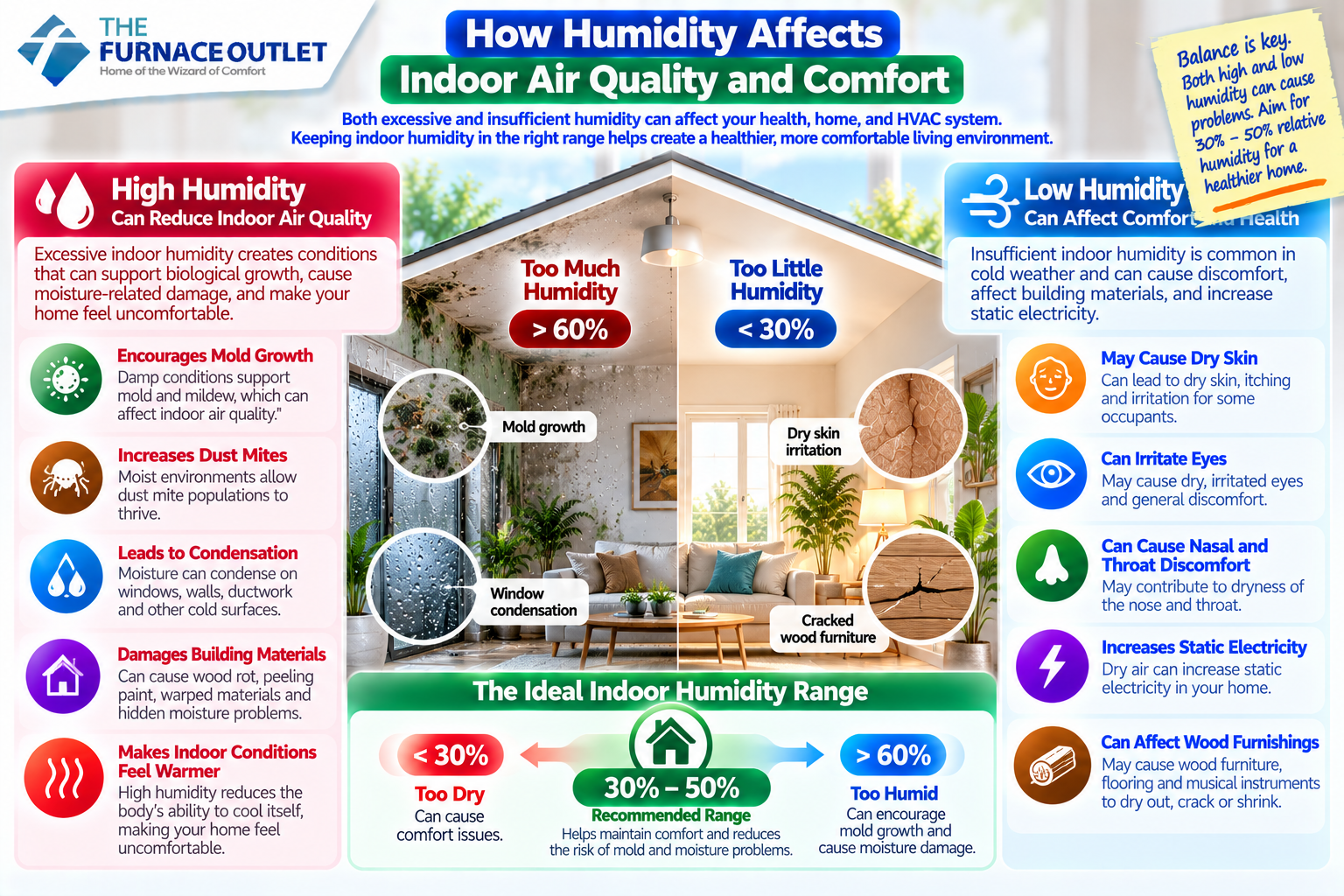
Low indoor humidity is common during cold weather when outdoor air contains relatively little moisture and heating raises its temperature without adding water vapor. The resulting indoor relative humidity may fall substantially, even though the heating system is not directly removing significant amounts of moisture from the air.
Very dry conditions can contribute to dry skin, irritated eyes, nasal dryness, and throat discomfort for some occupants. Low humidity may also increase static electricity and affect certain wood furnishings, flooring materials, and musical instruments. However, symptoms such as dry eyes or throat irritation are not specific proof of low humidity because allergies, medications, ventilation conditions, and other factors can produce similar complaints.
Adding moisture may improve comfort in some homes, but humidification should be approached carefully. Increasing indoor humidity without considering outdoor temperature, window performance, and building insulation can lead to condensation and hidden moisture problems.
I recommend measuring humidity before purchasing a humidifier and increasing moisture only when there is a demonstrated need. The objective is to improve comfort without creating conditions that encourage mold or damage building materials.
Mold requires moisture to grow, making moisture management one of the most important strategies for preventing mold-related problems. Mold spores are naturally present in many indoor and outdoor environments, and eliminating every spore from a home is neither practical nor necessary. The more useful objective is to prevent persistent dampness that allows spores to grow on suitable materials.
Common moisture sources include plumbing leaks, roof damage, flooding, condensation, poorly ventilated bathrooms, and high indoor humidity. Materials such as drywall paper, wood, carpeting, and certain insulation products can support mold growth when they remain damp.
Relative humidity measurements provide useful information, but they do not reveal every moisture problem. A room may show acceptable average humidity while water accumulates behind a wall or beneath flooring because of a concealed leak. Similarly, cold surfaces can experience high local surface humidity even when the surrounding room appears relatively dry.
The EPA generally recommends drying water-damaged materials within 24–48 hours when possible to reduce the likelihood of mold growth. I recommend correcting leaks promptly, maintaining suitable humidity, and investigating recurring condensation or musty odors rather than relying exclusively on air-cleaning equipment.
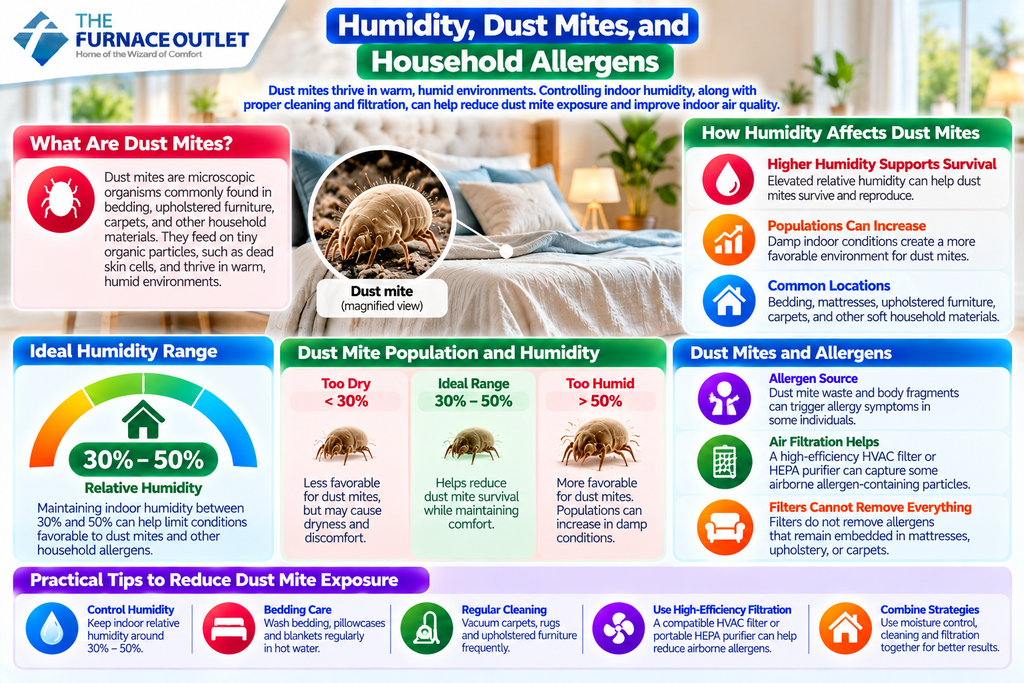
Dust mites are microscopic organisms commonly associated with bedding, upholstered furniture, carpets, and other household materials. Their populations are influenced by environmental conditions, including moisture availability. Higher relative humidity can support dust mite survival and reproduction, making humidity control one potential component of reducing dust mite exposure.
Maintaining lower indoor humidity may help limit favorable conditions for dust mites, but humidity control alone does not eliminate allergens already present in bedding or furnishings. Cleaning practices, appropriate bedding care, and other source-management strategies remain important.
Air filtration can capture some airborne allergen-containing particles, but filters cannot remove allergens that remain embedded in mattresses, upholstery, or carpets. A compatible high-efficiency HVAC filter or portable HEPA purifier may help reduce airborne particles while humidity management addresses environmental conditions that influence certain allergen sources. For households concerned about allergies, I recommend combining moisture control with appropriate cleaning and filtration rather than assuming that one device or humidity target will eliminate symptoms.
Condensation occurs when moist air encounters a surface cold enough to cool the adjacent air to its dew point. Windows, exterior walls, poorly insulated ductwork, and certain plumbing surfaces are common locations where condensation may develop.
Occasional condensation can occur under specific weather conditions, but persistent moisture should be investigated. Water accumulating around window frames may damage finishes and nearby materials, while condensation inside wall assemblies or around ductwork can create less visible problems.
The relationship between humidity and surface temperature is important because a home can experience condensation even when its average relative humidity appears moderate. Poor insulation, thermal bridging, air leakage, and unusually cold surfaces can create localized conditions favorable to moisture accumulation. I recommend checking both indoor humidity and the affected surface conditions. Lowering humidity may help, but correcting insulation deficiencies, air leakage, or other building-envelope problems may also be necessary.
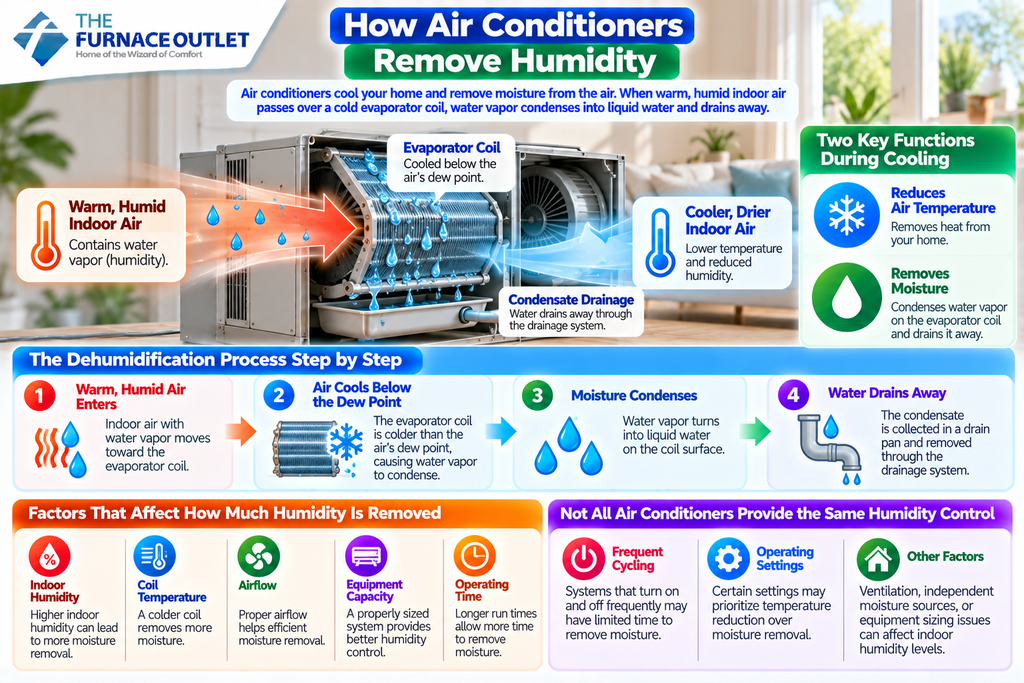
Air conditioners provide two related functions during cooling operation: reducing air temperature and removing moisture from the air. When warm, humid indoor air passes across an evaporator coil that is below the air’s dew point, water vapor condenses on the coil surface. The condensate then drains away through the equipment’s drainage system.
The amount of moisture removed depends on several factors, including indoor humidity, coil temperature, airflow, equipment capacity, and operating time. A properly sized air conditioner operating under suitable conditions can provide meaningful dehumidification during cooling cycles. However, not every air conditioner provides the same humidity-control performance. Equipment that cycles on and off frequently may have limited time to remove moisture, while certain operating settings may prioritize temperature reduction over latent moisture removal.
I recommend evaluating both temperature and humidity when assessing cooling performance. A home that reaches its thermostat setting but remains consistently humid may require investigation of equipment sizing, airflow, operating controls, ventilation, or independent moisture sources.
An oversized air conditioner may cool a home rapidly and shut off before operating long enough to provide the desired moisture removal. This is often described as short cycling, although short cycling can have several causes beyond equipment oversizing.
When cooling cycles are brief, the evaporator coil may spend less time removing moisture from circulating air. The thermostat may indicate a comfortable temperature while the occupants experience a damp or clammy indoor environment. Equipment oversizing is not the only explanation for poor humidity control. High outdoor moisture infiltration, excessive ventilation moisture loads, incorrect airflow, control settings, and building-envelope problems can produce similar symptoms.
I recommend evaluating cooling-system sizing using appropriate load calculations rather than selecting equipment solely by floor area. Correct equipment selection, installation, and control settings can improve comfort while reducing the likelihood of persistent humidity problems.
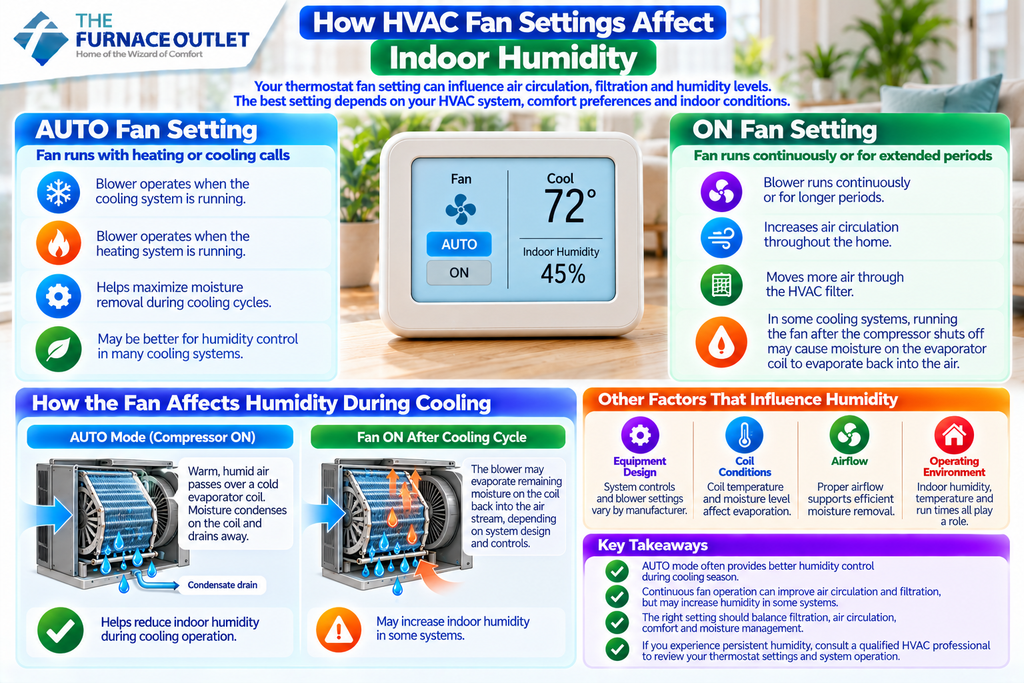
Many residential thermostats offer AUTO and ON fan settings. In AUTO mode, the blower generally operates in response to heating or cooling calls, subject to equipment-specific controls. In ON mode, the blower may operate continuously or for extended periods.
Continuous fan operation can improve air circulation and increase the amount of air passing through the HVAC filter. However, in some cooling systems, running the blower after the compressor shuts off may cause moisture remaining on the evaporator coil to evaporate back into the air stream. The effect depends on equipment design, blower controls, coil conditions, and operating environment. Homeowners should not assume that continuous fan operation always improves indoor air quality without affecting humidity.
If a home experiences persistent humidity during cooling season, I recommend reviewing thermostat fan settings and equipment-specific control options with a qualified HVAC professional. The appropriate setting should balance filtration, air circulation, comfort, and moisture management.
A dehumidifier may be useful when indoor moisture remains excessive despite reasonable ventilation, air conditioning, and source-control measures. Common applications include damp basements, humid climates, enclosed areas with limited moisture removal, and homes where the cooling system does not adequately control relative humidity.
Portable dehumidifiers remove moisture from the surrounding air and collect condensate in a reservoir or discharge it through a drainage connection. Whole-house dehumidifiers are integrated into a suitable HVAC or duct arrangement and may provide broader moisture management. Dehumidifier selection should consider moisture-removal capacity, operating temperature, energy efficiency, drainage requirements, noise, and the area being served. A unit that is too small may run continuously without achieving the desired conditions, while improper installation can create drainage or maintenance problems.
I recommend correcting leaks, groundwater intrusion, and other significant moisture sources before relying on dehumidification. A dehumidifier can manage excess airborne moisture, but it cannot repair the building conditions responsible for ongoing water entry.
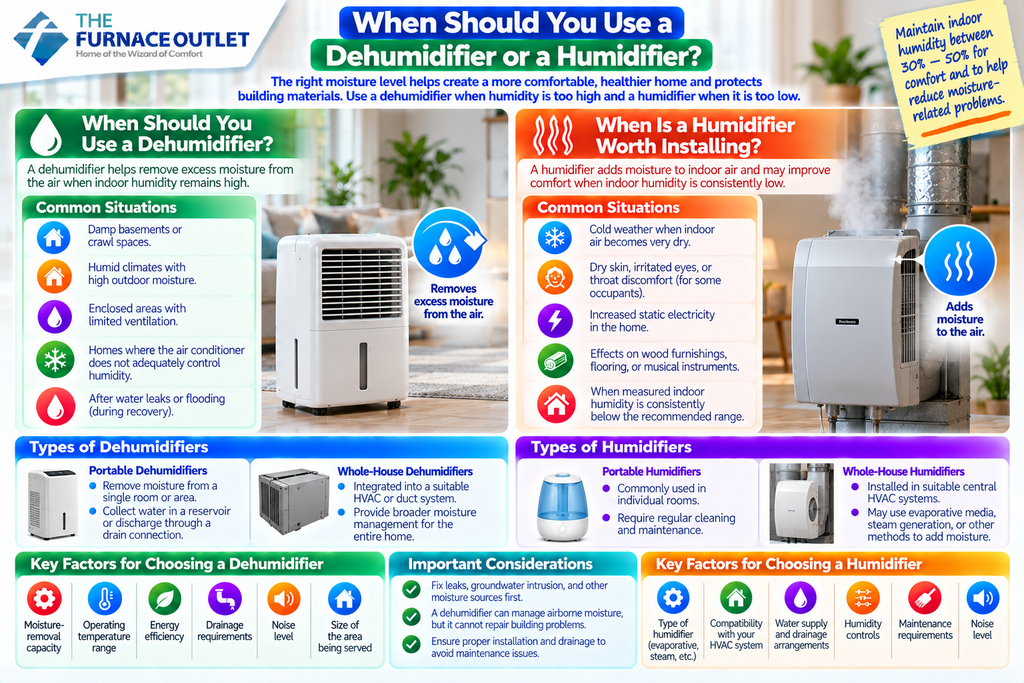
Humidifiers add moisture to indoor air and may improve comfort when measured humidity is consistently low. Portable humidifiers are commonly used in individual rooms, while whole-house humidifiers can be installed in suitable central HVAC systems. Whole-house humidifiers may use evaporative media, steam generation, or other methods to introduce moisture. Their suitability depends on the home’s heating equipment, water supply, drainage arrangements, controls, and maintenance requirements.
Humidifiers also introduce potential risks when improperly operated. Excessive humidification can contribute to condensation, while poorly maintained water reservoirs or components may support unwanted microbial contamination. I recommend choosing equipment with suitable humidity controls, following manufacturer cleaning instructions, and monitoring windows and other cold surfaces during winter. Adding moisture should be based on actual indoor conditions rather than a belief that higher humidity is always healthier.
Different areas of the home generate and retain moisture in different ways. Bathrooms experience short periods of elevated humidity during showers and bathing, while kitchens generate moisture through boiling, cooking, and other activities. Basements may experience persistent dampness because of groundwater intrusion, foundation moisture, limited air movement, or cooler surfaces.
In bathrooms, an appropriately sized exhaust fan that discharges outdoors can help remove moisture at its source. The fan should be operated during moisture-generating activities and for an appropriate period afterward, depending on the room and equipment. Kitchen exhaust ventilation can help remove cooking-generated moisture along with certain particles and gases. An outdoor-vented range hood generally provides more effective source removal than a recirculating unit that returns air to the kitchen.
Basement moisture problems require particular attention to drainage, foundation conditions, plumbing leaks, and outdoor water management. Dehumidification may help maintain suitable conditions, but persistent water intrusion should be corrected rather than concealed.
Excessive moisture can affect HVAC components and nearby building materials. Condensation may develop on poorly insulated supply ducts carrying cool air through humid spaces, while drainage problems can allow water to accumulate around cooling equipment. A blocked condensate drain, damaged drain pan, or inadequate insulation can create conditions that encourage biological growth and material deterioration. Moisture may also affect surrounding ceilings, walls, insulation, and equipment platforms.
Duct leakage can contribute to humidity problems by allowing unwanted air exchange between conditioned spaces and humid attics, crawl spaces, or other areas. The consequences depend on duct location, pressure conditions, and the building environment. I recommend including condensate drainage, duct insulation, and accessible moisture-prone components in routine HVAC maintenance. Correcting moisture sources is generally more effective than attempting to address the resulting contamination through filtration or duct cleaning alone.
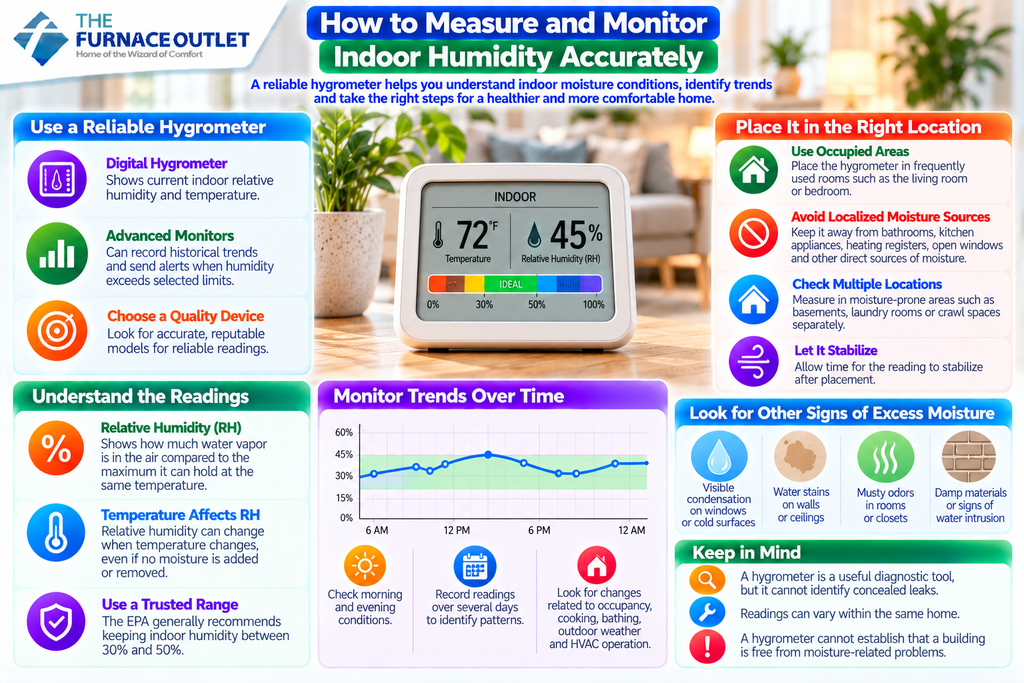
A reliable hygrometer is one of the simplest tools homeowners can use to understand indoor moisture conditions. Basic digital hygrometers provide relative humidity and temperature readings, while more advanced monitors may record historical trends or send alerts when humidity exceeds selected limits.
Placement matters because readings can vary within the same home. A monitor placed beside a bathroom, kitchen appliance, heating register, or open window may not represent conditions throughout the occupied area. I recommend measuring humidity in frequently used rooms and checking moisture-prone locations separately.
Monitoring trends is especially useful because humidity changes with occupancy, cooking, bathing, outdoor weather, and HVAC operation. Recording morning and evening conditions over several days can help identify recurring patterns. Homeowners should also inspect for visible condensation, water stains, musty odors, and damp materials. A hygrometer is a useful diagnostic aid, but it cannot identify concealed leaks or establish that a building is free from moisture-related problems.
Effective humidity management begins with reducing unnecessary moisture sources. Repairing leaks, using outdoor-vented kitchen and bathroom exhaust, maintaining drainage systems, and preventing rainwater intrusion can reduce the amount of moisture entering the indoor environment.
During humid weather, appropriately sized air conditioning and dehumidification may help maintain suitable conditions. Homeowners should also investigate persistent infiltration of humid outdoor air through building-envelope leaks and poorly sealed ductwork. During dry winter conditions, humidification may be appropriate when indoor measurements demonstrate a need. However, humidity should be increased cautiously to avoid condensation on cold surfaces.
Regular HVAC maintenance is another important component. Clean filters, appropriate airflow, functional condensate drainage, and properly operating equipment support dependable heating, cooling, and moisture management. I recommend making changes based on measured conditions and identifiable problems rather than purchasing equipment solely because it advertises humidity-control features.
A relative humidity range of approximately 30%–50% is a useful general target for many homes and is consistent with EPA guidance. However, the appropriate level depends on outdoor conditions, indoor temperature, insulation, and condensation risk. Homeowners should investigate persistent moisture problems even when a hygrometer displays a value within this range.
Indoor humidity consistently around or above 60% deserves attention, particularly when accompanied by condensation, musty odors, or damp materials. Although a single reading does not establish a mold problem, prolonged high humidity can create conditions favorable to moisture-related damage and biological growth.
Low humidity may contribute to dryness of the nose, throat, eyes, and skin for some people. However, respiratory symptoms can have many causes, so homeowners should not assume that humidity is responsible without considering other environmental and health factors.
Most conventional HEPA and MERV-based air purifiers capture airborne particles but do not remove meaningful quantities of water vapor. Humidity control generally requires source management, suitable ventilation, air conditioning, or dehumidification equipment.
Yes. Persistent high humidity can contribute to condensation on cold surfaces and create damp conditions that support mold growth. However, the presence of high humidity alone does not prove that mold is present, and concealed moisture problems may require further investigation.
Continuous fan operation does not necessarily improve humidity control. In some cooling systems, running the blower after the compressor stops may allow moisture remaining on the evaporator coil to evaporate back into the indoor air. The appropriate setting depends on the equipment and controls.
A whole-house dehumidifier may provide broader moisture management when properly designed and installed, while a portable model can be practical for a particular room or damp area. The better choice depends on the moisture load, home layout, equipment requirements, and installation cost.
Humidity can influence comfort and the operation of heating, cooling, and moisture-control equipment. Excessive humidity may encourage occupants to lower cooling setpoints, while humidifiers and dehumidifiers consume energy. The actual cost impact depends on equipment efficiency, controls, climate, and operating conditions.
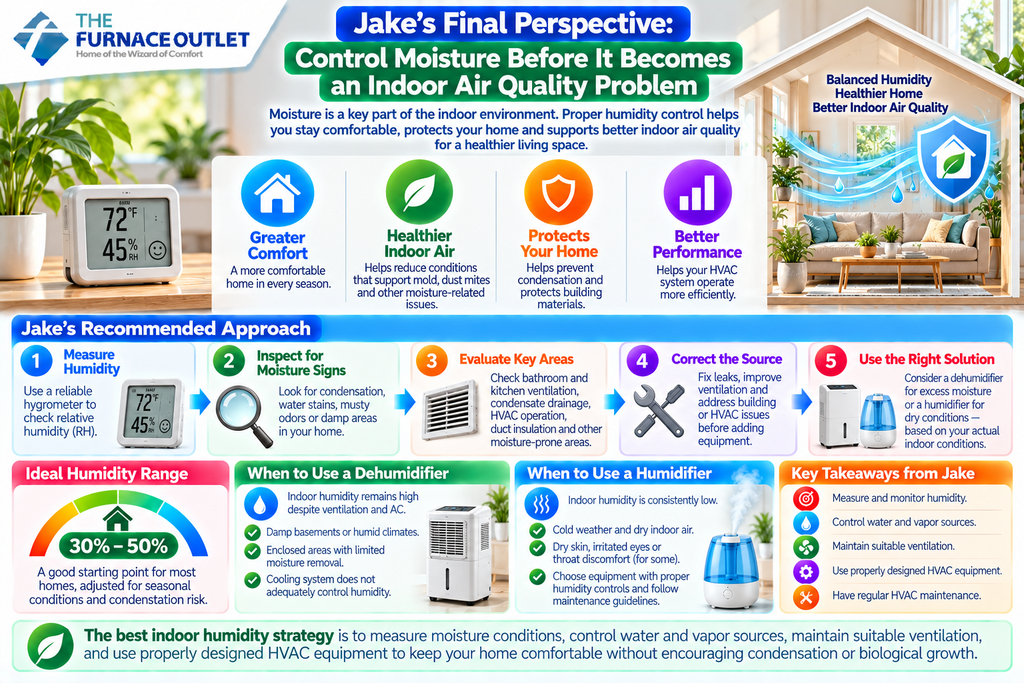
When homeowners ask me how to improve indoor air quality, I encourage them to look beyond airborne dust and filtration. Moisture is an essential part of the indoor environment, and poor humidity control can contribute to discomfort, condensation, mold-related problems, and damage to building materials. Even a home equipped with high-efficiency air filtration may experience serious moisture concerns if leaks, ventilation deficiencies, or HVAC operating problems remain unresolved.
My preferred approach begins with measuring relative humidity and inspecting the home for visible signs of moisture. I look at bathroom and kitchen ventilation, condensate drainage, cooling-system operation, duct insulation, and areas where condensation or dampness may develop. Once the likely cause is identified, I recommend correcting the source before adding equipment.
For many homes, maintaining relative humidity around 30%–50% provides a practical starting point, but this target should always be adjusted according to condensation risk and actual building conditions. A dehumidifier may be useful when excess moisture persists, while carefully controlled humidification may improve comfort during dry weather. Neither device should substitute for repairing leaks or correcting inadequate ventilation.
The best indoor humidity strategy is to measure moisture conditions, control water and vapor sources, maintain suitable ventilation, and use properly designed HVAC equipment to keep the home comfortable without encouraging condensation or biological growth.
By combining humidity monitoring with source control, appropriate ventilation, effective filtration, and regular HVAC maintenance, homeowners can create a more comfortable and better-managed indoor environment throughout 2026 and beyond.
This article provides general educational information about indoor humidity, HVAC operation, and moisture management. Humidity recommendations are broad guidelines and may need adjustment for local climate, building construction, surface temperatures, and individual circumstances. No specific humidity reading guarantees that a home is free from mold or other indoor air quality hazards.
Persistent water intrusion, suspected concealed mold, extensive contamination, and unusual HVAC moisture problems may require assessment by appropriately qualified professionals. Homeowners should follow equipment manufacturer instructions and applicable safety requirements when installing or maintaining humidifiers, dehumidifiers, and HVAC components.
The Furnace Outlet publishes independent educational content and does not imply endorsement by the EPA, ASHRAE, or other organizations.
U.S. Environmental Protection Agency — A Brief Guide to Mold, Moisture and Your Home https://www.epa.gov/mold/brief-guide-mold-moisture-and-your-home
U.S. Environmental Protection Agency — Mold and Indoor Air Quality https://www.epa.gov/mold
U.S. Environmental Protection Agency — Indoor Air Quality https://www.epa.gov/indoor-air-quality-iaq
ASHRAE — Technical Resources https://www.ashrae.org/technical-resources
© 2026 The Furnace Outlet | https://thefurnaceoutlet.com
Independent HVAC education for cleaner air, better comfort, and more informed homeowners.