Newsletter Subscribe
Enter your email address below and subscribe to our newsletter

HVAC made simple
By Jake Lawson | HVAC Specialist | The Furnace Outlet
Updated: October 2026 | Category: Indoor Air Quality
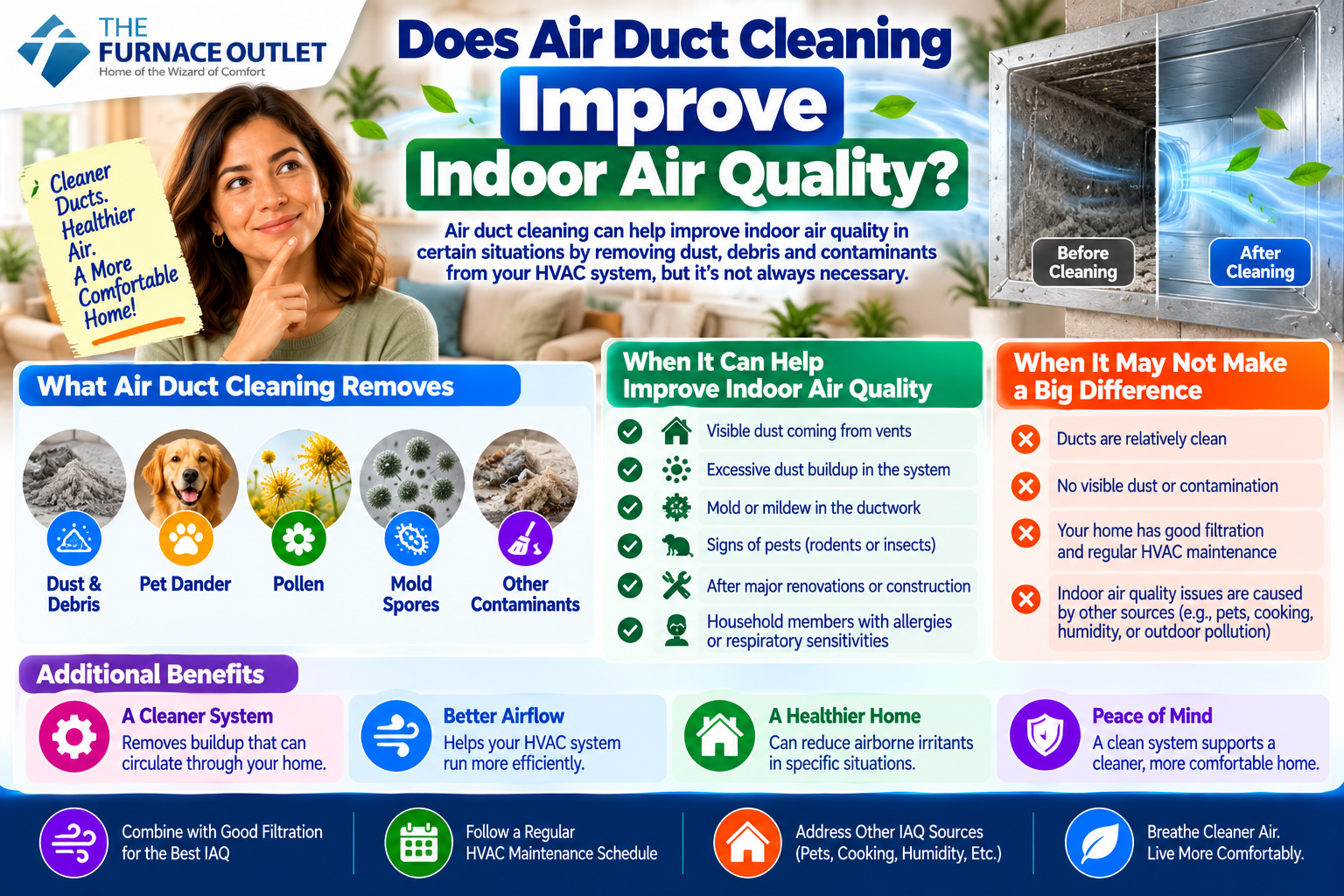
Air duct cleaning is frequently advertised as a way to improve indoor air quality, reduce household dust, eliminate allergens, and make heating and cooling systems operate more efficiently. For homeowners who notice dust collecting around supply registers or experience persistent indoor air quality concerns, these promises can make professional duct cleaning sound like an essential maintenance service. However, the relationship between duct cleanliness and the air people actually breathe is more complicated than many advertisements suggest.
The ductwork in a central HVAC system carries conditioned air throughout the home. Over time, dust, construction debris, pet-related particles, and other materials may accumulate inside portions of the duct system. Some deposits remain attached to interior surfaces, while loose material may become airborne when airflow or other disturbances occur. The presence of dust inside a duct does not necessarily mean that the system is creating a significant indoor air quality problem.
The U.S. Environmental Protection Agency (EPA) does not recommend routine air duct cleaning for every home. According to its published guidance, duct cleaning has not been shown to prevent health problems, and studies have not conclusively demonstrated that particle levels inside homes increase because of dirty air ducts or decrease after cleaning. Nevertheless, the EPA identifies certain circumstances in which cleaning may be appropriate, including substantial visible mold growth, vermin infestation, and ducts clogged with excessive dust or debris that is being released into occupied spaces.
As an HVAC specialist, I recommend distinguishing between ordinary dust accumulation and conditions that genuinely require investigation. In this guide, I explain what professional duct cleaning involves, when it may improve indoor air quality, what it cannot accomplish, how much it typically costs, and how homeowners can decide whether the service is worth purchasing.
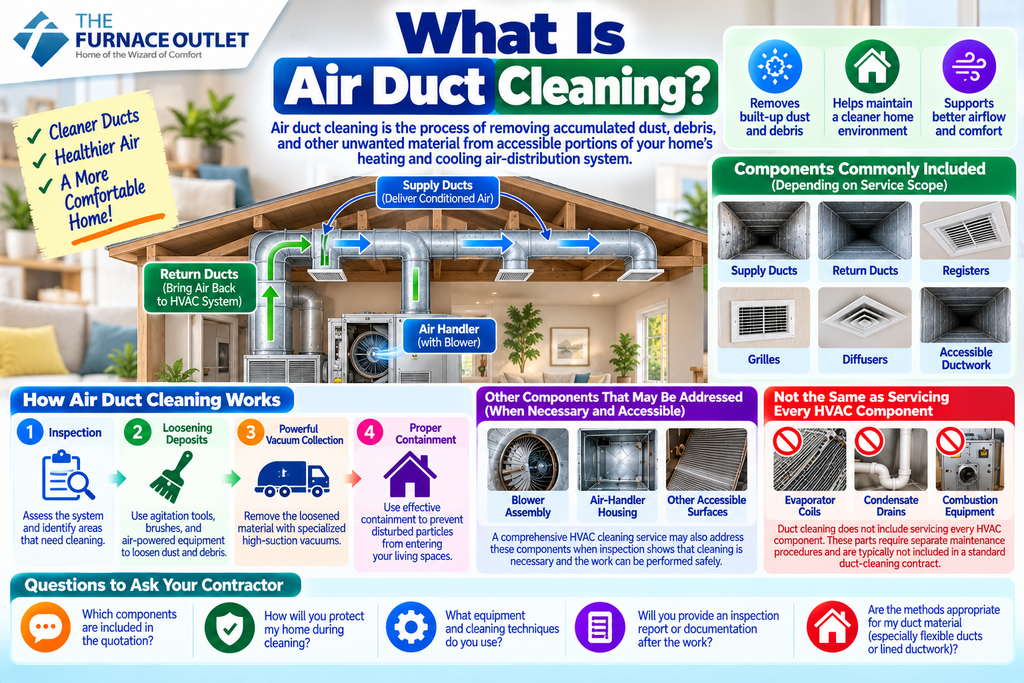
Air duct cleaning is the process of removing accumulated dust, debris, and other unwanted material from accessible portions of a building’s heating and cooling air-distribution system. Depending on the service scope, professional cleaning may involve supply ducts, return ducts, registers, grilles, diffusers, and other components that can collect particulate material during normal HVAC operation.
A comprehensive HVAC cleaning service may also address accessible components such as the blower assembly, air-handler housing, and certain other surfaces when inspection shows that cleaning is necessary and the work can be performed safely. However, cleaning the ductwork is not the same as servicing every HVAC component. Evaporator coils, condensate drains, combustion equipment, and other parts require appropriate maintenance procedures that may be separate from the duct-cleaning contract.
Professional contractors commonly use specialized vacuums, agitation tools, brushes, and air-powered equipment to loosen deposits and remove them from the duct system. Effective containment is important because disturbing accumulated debris without adequate collection can release particles into occupied rooms. Equipment selection and cleaning techniques should also be appropriate for the duct material, particularly when flexible ducts or internally lined ductwork are present.
I recommend asking contractors to explain exactly which components are included in the quotation, how they will protect the home during cleaning, and what inspection or documentation they will provide after completing the work.
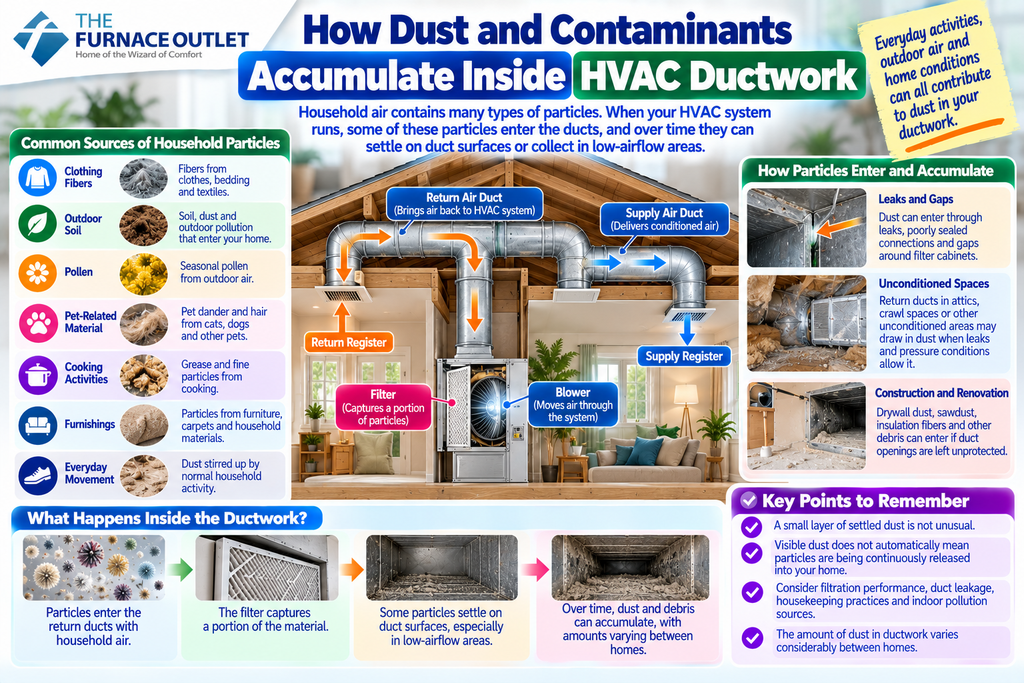
Household air contains particles from numerous sources, including clothing fibers, outdoor soil, pollen, pet-related material, cooking activities, furnishings, and everyday movement. When the HVAC blower operates, some of these particles enter return-air pathways and travel toward the filtration equipment. Properly fitted filters capture a portion of the material, while some particles may settle on duct surfaces or accumulate in areas where airflow is relatively low.
Dust can also enter ductwork through leaks, poorly sealed return connections, gaps around filter cabinets, and openings exposed during construction or renovation. Return ducts located in dusty attics, crawl spaces, or other unconditioned areas may draw unwanted material into the system when leakage and pressure conditions permit. Construction activities can introduce especially large amounts of drywall dust, sawdust, insulation fibers, and other debris if HVAC openings are left unprotected.
The amount of dust visible inside ductwork varies considerably between homes. A small layer of settled material is not unusual, and the existence of that layer alone does not prove that particles are being continuously released into living spaces. I recommend investigating the condition of the ductwork alongside filtration performance, duct leakage, housekeeping practices, and the home’s actual indoor pollution sources.
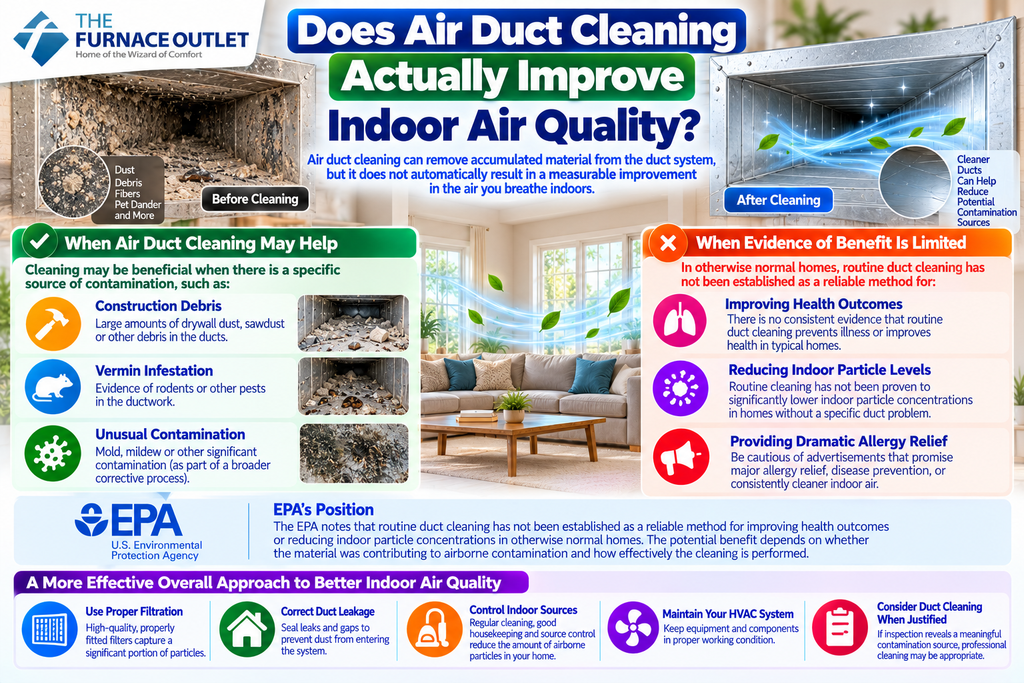
Air duct cleaning can remove accumulated material from the duct system, but removing visible deposits does not automatically produce a measurable improvement in occupied-room air quality. The potential benefit depends on whether the material was contributing to airborne contamination, how effectively the cleaning is performed, and whether the underlying source of the problem has been corrected.
For example, a duct system containing substantial loose construction debris may release particles through supply registers when the blower operates. Removing that material could address a specific contamination source. Similarly, ductwork affected by vermin infestation or other unusual contamination may require cleaning as part of a broader corrective process. These situations differ significantly from a system containing ordinary settled dust that remains largely undisturbed.
The EPA’s position is important because it separates plausible benefits from unsupported general claims. Routine duct cleaning has not been established as a reliable method for improving health outcomes or reducing indoor particle concentrations in otherwise normal homes. Homeowners should therefore be cautious about advertisements promising dramatic allergy relief, disease prevention, or consistently cleaner indoor air following a standard cleaning appointment.
My recommendation is to identify a specific problem before purchasing the service. If inspection reveals a meaningful contamination source, professional cleaning may be justified. If the concern is general household dust, improving filtration, correcting duct leakage, and controlling indoor particle sources may offer greater practical value.
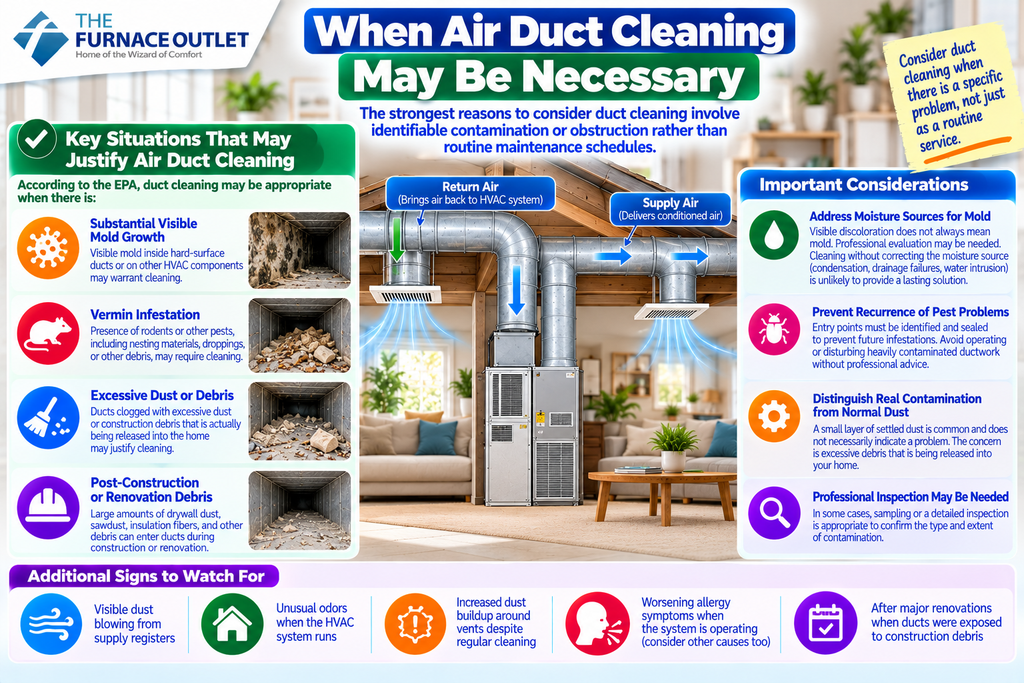
The strongest reasons to consider duct cleaning involve identifiable contamination or obstruction rather than routine maintenance schedules. The EPA identifies substantial visible mold growth inside hard-surface ducts or on other HVAC components, vermin infestation, and ducts clogged with excessive dust or debris that is actually being released into the home as circumstances that may justify cleaning.
Mold-related concerns require particular care because visible discoloration does not always establish that a substance is mold. Professional evaluation may be needed, and sampling may be appropriate in certain circumstances. More importantly, cleaning visible growth without correcting the moisture source is unlikely to provide a lasting solution. Condensation, drainage failures, water intrusion, and other moisture problems must be investigated before the system is returned to normal operation.
Vermin contamination may involve nesting materials, droppings, or other debris that requires appropriate containment and removal. Pest entry points must also be identified and corrected to prevent recurrence. Homeowners should avoid operating or disturbing heavily contaminated ductwork without appropriate professional advice.
Excessive construction debris is another situation worth investigating, especially when material is visibly discharged from supply registers. However, homeowners should distinguish between a genuinely contaminated duct system and normal household dust settling around vent openings.
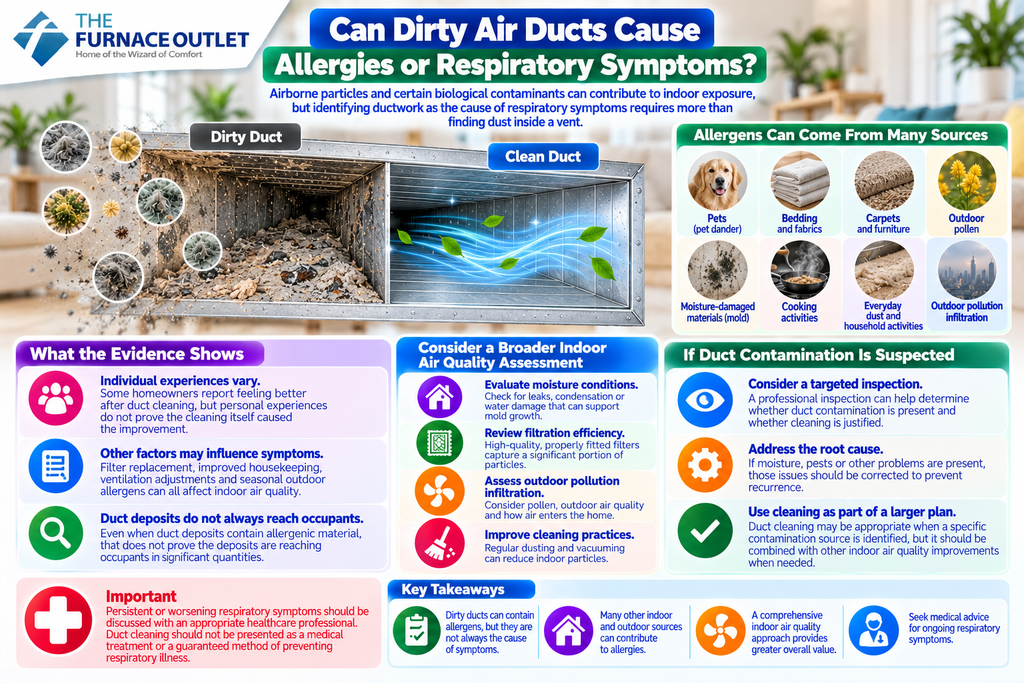
Airborne particles and certain biological contaminants can contribute to indoor exposure, but identifying ductwork as the cause of respiratory symptoms requires more than finding dust inside a vent. Allergens may originate from pets, bedding, carpets, outdoor pollen, moisture-damaged materials, and many other sources throughout the home. Even when duct deposits contain allergenic material, that does not prove the deposits are reaching occupants in significant quantities.
Some homeowners report feeling better after duct cleaning, but individual experiences do not establish that the cleaning itself caused the improvement. Other changes, such as filter replacement, improved housekeeping, ventilation adjustments, or seasonal differences in outdoor allergens, may influence symptoms and particle concentrations.
For households concerned about allergies or asthma, I recommend beginning with a broader indoor air quality assessment. Evaluate moisture conditions, filtration efficiency, outdoor pollution infiltration, cleaning practices, and the rooms where symptoms occur. If duct contamination is suspected, a targeted inspection can help determine whether cleaning is justified.
Persistent or worsening respiratory symptoms should be discussed with an appropriate healthcare professional. Duct cleaning should not be presented as a medical treatment or a guaranteed method of preventing respiratory illness.
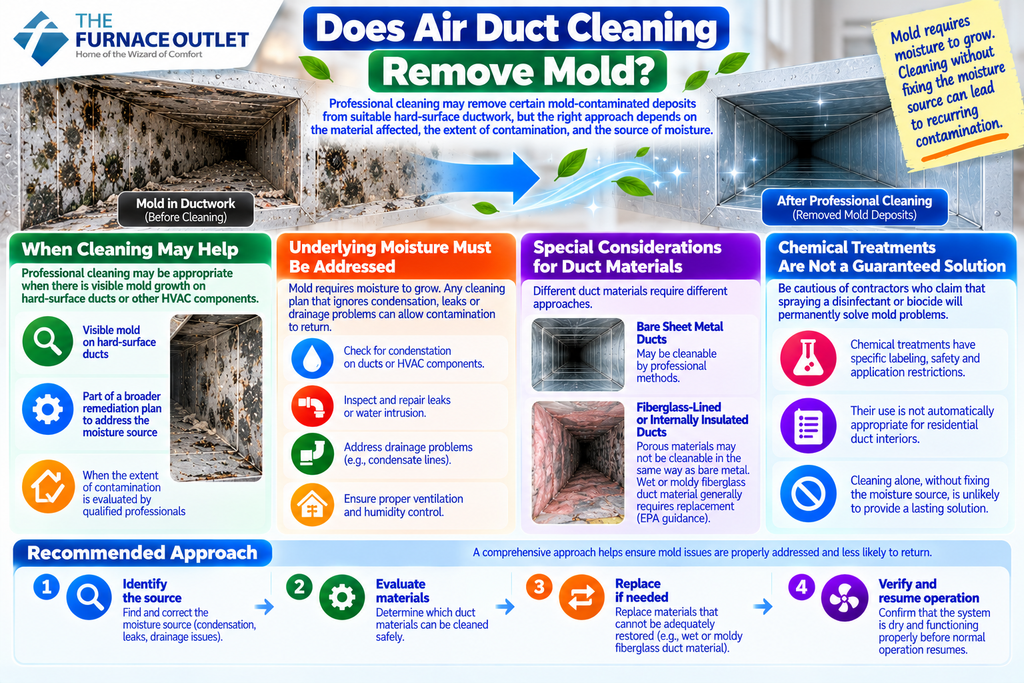
Professional cleaning may remove certain mold-contaminated deposits from suitable hard-surface ductwork, but the appropriate response depends on the material affected, the extent of contamination, and the source of moisture. Mold requires moisture to grow, so any cleaning plan that ignores condensation, leaks, or drainage problems risks allowing contamination to return.
Internally insulated or fiberglass-lined ducts present additional challenges because porous materials may not be cleanable in the same manner as bare sheet metal. The EPA advises that wet or moldy fiberglass duct material generally requires replacement rather than attempting to restore it through ordinary cleaning. Damaged or contaminated duct insulation should be evaluated by appropriately qualified professionals.
Homeowners should also be cautious about contractors who claim that spraying a disinfectant or biocide into the duct system will permanently solve mold problems. Chemical treatments have specific labeling, safety, and application restrictions, and their use is not automatically appropriate for residential duct interiors.
My preferred approach is to locate and correct the moisture source, determine which materials can be cleaned safely, replace materials that cannot be adequately restored, and verify that the system is dry and functioning properly before normal operation resumes.
Cleaning heavily contaminated ductwork may reduce dust originating from that particular source, especially when loose deposits are entering occupied rooms. However, ordinary household dust is generated continuously by daily activities, fabrics, people, pets, furnishings, and outdoor particles. Removing settled material from ducts does not eliminate these ongoing sources.
If a home experiences excessive dust accumulation, I recommend inspecting the HVAC filter first. A poorly fitted filter may allow air to bypass the media, while an inappropriate or heavily loaded filter can affect system performance. Return-air leaks may also draw dust from attics, crawl spaces, or other unconditioned areas into the air-distribution system.
Regular vacuuming with suitable filtration, damp dusting, and appropriate source control can help manage settled dust. For airborne particles, compatible high-efficiency HVAC filtration or a properly sized portable HEPA purifier may provide useful additional removal.
Duct cleaning should therefore be considered when inspection identifies a duct-related source rather than as the default solution to every household dust complaint.
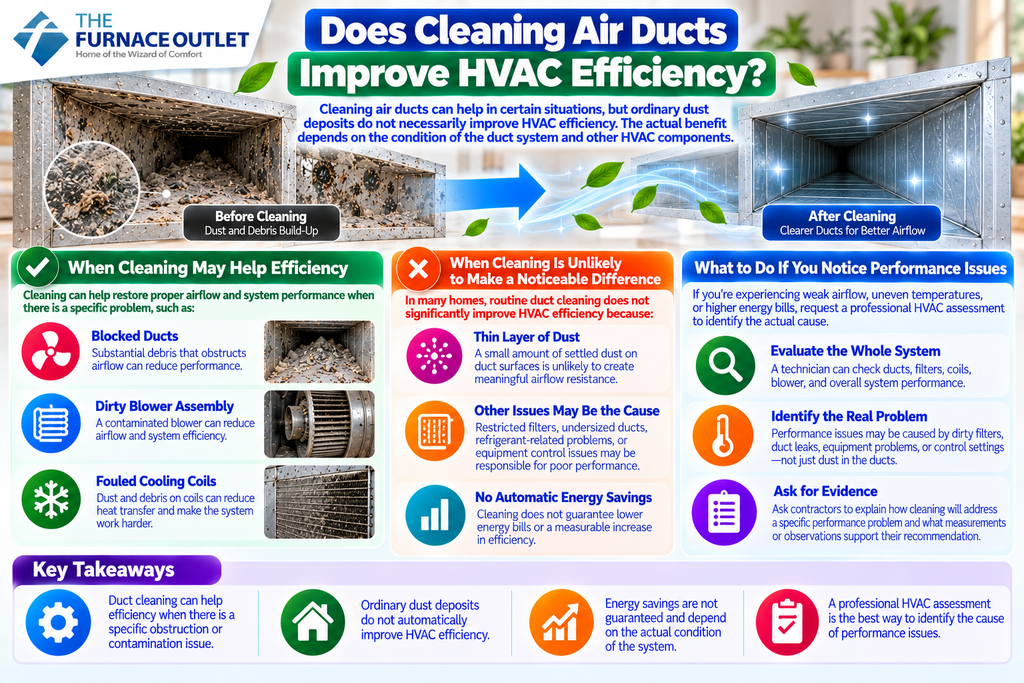
Duct-cleaning advertisements frequently claim that removing dust will substantially reduce energy bills or restore HVAC efficiency. These claims require careful evaluation because ordinary deposits on duct surfaces do not necessarily create meaningful airflow resistance. A thin layer of settled dust is unlikely to affect system performance in the same way as a severely blocked duct, clogged filter, or heavily fouled cooling coil.
When a duct contains substantial debris that obstructs airflow, removing the obstruction may help restore proper air distribution. Similarly, cleaning a dirty blower assembly or cooling coil can be important when contamination is affecting equipment performance. However, these benefits depend on the specific condition of the equipment and should not be assumed for every cleaning appointment.
Homeowners experiencing weak airflow, uneven temperatures, or unusually high energy consumption should request an HVAC assessment rather than assuming that duct cleaning is the solution. Restricted filters, undersized ducts, damaged ductwork, refrigerant-related problems, and equipment control issues may produce similar symptoms. I recommend asking contractors to explain how any proposed cleaning will address an identified performance problem and what measurements or observations support their recommendation.
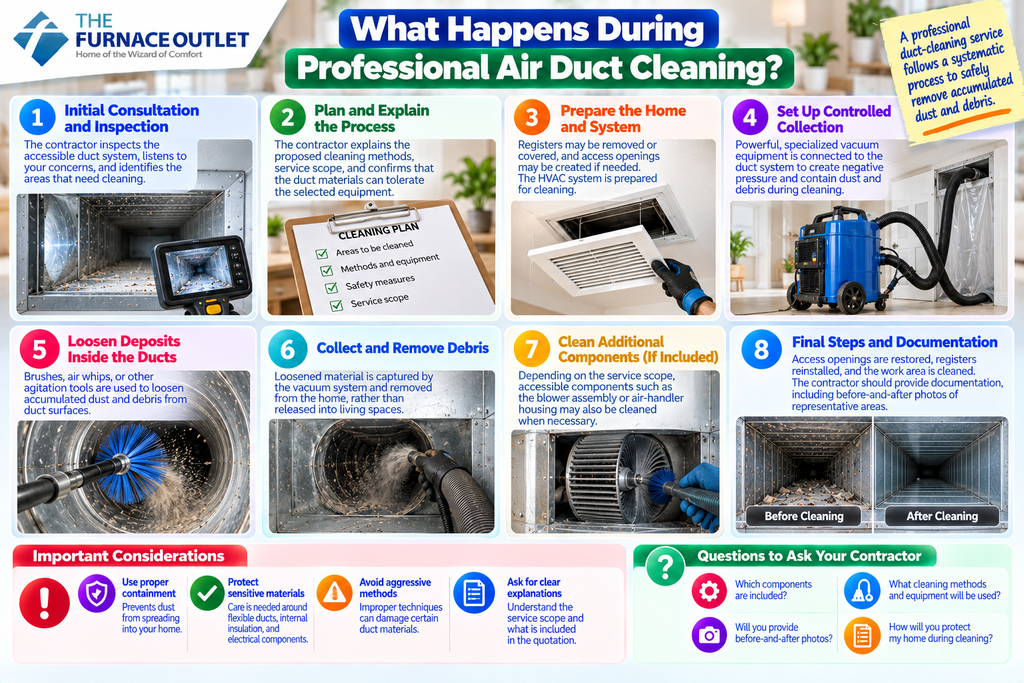
A professional duct-cleaning appointment should begin with an inspection of the accessible duct system and a discussion of the homeowner’s concerns. The contractor should identify the areas requiring attention, explain the proposed cleaning methods, and determine whether the duct materials can tolerate the selected equipment.
During cleaning, contractors commonly establish controlled collection using specialized vacuum equipment and appropriate containment practices. Brushes, air whips, or other agitation tools may be used to loosen accumulated deposits, which are then collected rather than released into the occupied home. Registers and access openings may need to be removed or created, depending on the system design and agreed service scope.
Care is particularly important around flexible ductwork, internal insulation, electrical components, and delicate HVAC equipment. Aggressive cleaning techniques can damage certain materials, while inadequate containment may spread dust instead of removing it. After completing the work, the contractor should restore access openings, reinstall components correctly, remove debris, and provide documentation of the work performed. Photographs of representative areas before and after cleaning can be useful, although they should not substitute for an explanation of the original problem and corrective measures.
Professional duct-cleaning prices vary according to home size, duct accessibility, system configuration, geographic location, and the scope of work. A home with a straightforward duct layout may require less labor than a larger property with multiple HVAC systems, difficult access, or unusual contamination. For general U.S. budgeting, a professional residential duct-cleaning service may cost approximately $450–$1,000 or more, depending on the work involved. This is an illustrative planning range rather than a verified October 2026 quotation. Extensive contamination, specialized remediation, difficult access, or additional HVAC maintenance can increase the total cost considerably.
Homeowners should be cautious about unusually inexpensive advertisements that promise complete duct cleaning for a nominal flat fee. Some offers exclude major system components or lead to aggressive upselling once the contractor arrives. An itemized quotation should identify the number of systems, the components included, access requirements, additional services, and any potential charges.
I recommend obtaining multiple written estimates when the work is substantial and comparing the proposed cleaning scope rather than choosing a contractor solely on price.
There is no universally established residential duct-cleaning interval that applies to every home. Unlike HVAC filter replacement, which is part of routine equipment maintenance, duct cleaning is generally best approached as a condition-based service. A home with properly fitted filtration, well-sealed ductwork, and no unusual contamination may not require duct cleaning for many years. Another property may need targeted attention following construction, water damage, pest infestation, or another event that introduces significant debris or contamination.
Some contractors recommend cleaning every three to five years, but homeowners should understand that this is a service-industry recommendation rather than an EPA requirement for routine residential duct cleaning. Scheduling repeated cleaning without evidence of contamination may provide little practical benefit.
I recommend periodic visual inspection of accessible duct openings and attention to unusual conditions such as debris discharge, persistent moisture, or evidence of pests. Cleaning should follow the findings rather than an arbitrary calendar interval.
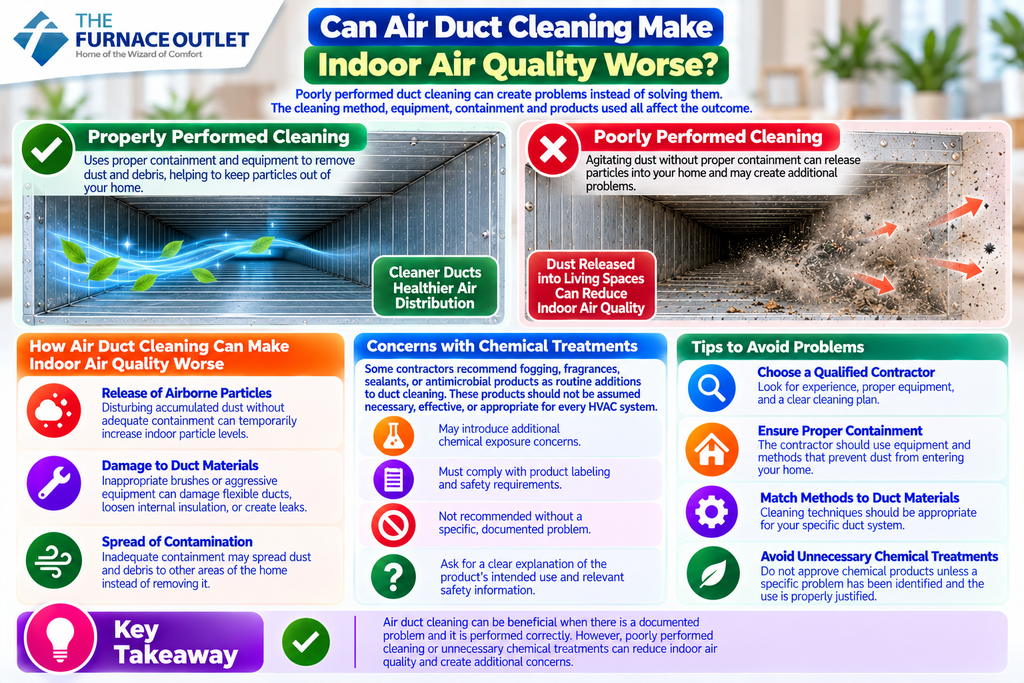
Poorly performed duct cleaning can create problems instead of solving them. Agitating accumulated dust without adequate containment may release particles into occupied spaces, temporarily increasing exposure. Inappropriate brushes or aggressive equipment can damage flexible ducts, loosen internal insulation, or compromise duct connections.
Chemical treatments are another area of concern. Some contractors recommend fogging, fragrances, sealants, or antimicrobial products as routine additions to duct cleaning. These products should not be assumed necessary, effective, or appropriate for every HVAC system. Their use may introduce additional chemical exposure concerns and must comply with applicable product labeling and safety requirements.
I recommend avoiding contractors who propose chemical treatments without identifying a specific problem, explaining the product’s intended use, and providing relevant safety information. Cleaning methods should be selected according to the duct material and contamination involved. A properly justified service should remove a documented problem while protecting the occupants, HVAC equipment, and air-distribution system.
Air duct cleaning and HVAC filter replacement address different aspects of indoor air quality. Duct cleaning removes accumulated material from accessible duct surfaces, while filtration captures airborne particles passing through the HVAC system during operation.
For ordinary residential particle control, compatible filtration is generally a more important ongoing strategy than repeated duct cleaning. The EPA recommends using a MERV 13 filter, or the highest efficiency the HVAC system can accommodate, as part of improving indoor air quality. However, filtration upgrades must be compatible with the equipment. A restrictive filter may reduce airflow if the system lacks adequate filter surface area or blower capacity. A properly designed deep-media cabinet may offer a useful solution in some installations.
I recommend maintaining effective filtration and investigating duct leakage before purchasing routine duct-cleaning services. If inspection reveals substantial duct contamination, cleaning can then be considered as a separate corrective measure.
Renovation and construction work can introduce substantial quantities of fine dust and debris into a building. Drywall sanding, cutting materials, demolition, and other activities can create particles that enter HVAC openings when the system is inadequately protected. The first priority should be preventing contamination during construction. Contractors should protect duct openings where appropriate, control dust at its source, and avoid using HVAC equipment in ways that spread construction debris throughout the home.
After renovation, homeowners should inspect accessible supply and return openings and evaluate whether debris has entered the duct system. If significant material is present, professional cleaning may be appropriate. However, a renovation does not automatically mean that every duct requires cleaning, particularly when effective dust-control measures were used.
Filter inspection or replacement and appropriate cleaning of occupied surfaces may also be necessary. I recommend basing the decision on actual contamination rather than assuming that duct cleaning is mandatory after every remodeling project.
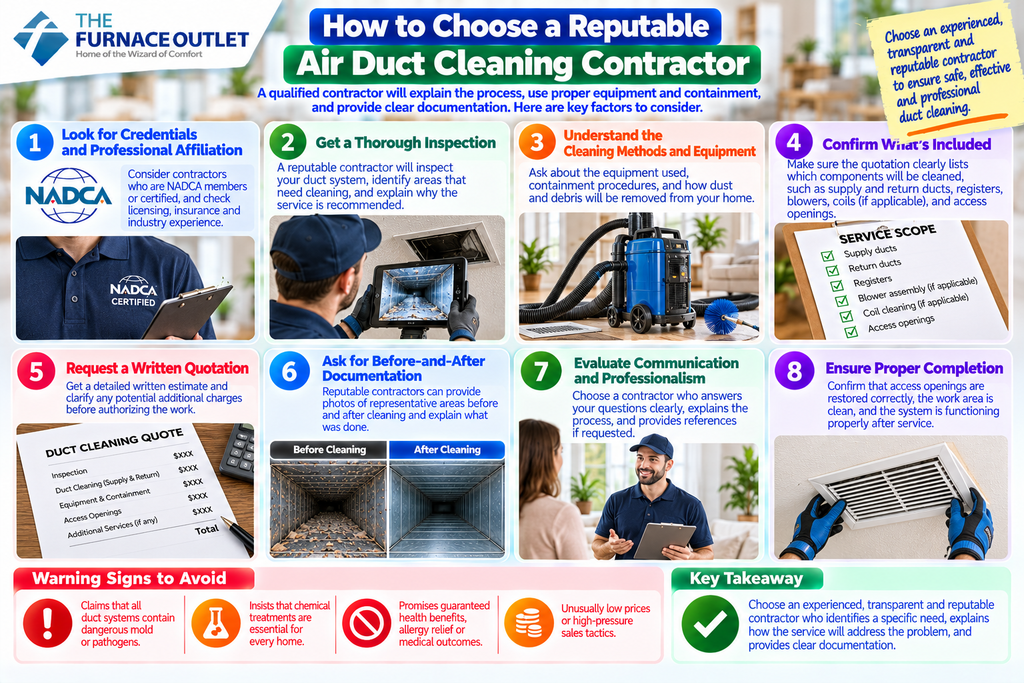
Selecting a qualified contractor is especially important because the homeowner may not be able to observe much of the work directly. I recommend choosing a company that explains its inspection process, cleaning methods, equipment, containment procedures, and the specific components included in the service. The National Air Duct Cleaners Association (NADCA) provides industry guidance and professional certification programs. Membership or certification may be useful when evaluating contractors, but it should not replace checking references, insurance, experience, and the proposed scope of work.
A reputable contractor should be willing to show evidence supporting the need for cleaning and explain how the service will address the identified problem. Be cautious of companies that claim all duct systems contain dangerous mold, promise guaranteed medical benefits, or insist that chemical treatments are essential for every home.
Before authorizing work, request a written quotation and clarification of any additional charges. After completion, ask for documentation of the cleaned areas and confirmation that access openings and HVAC components have been restored correctly.
For most homes, meaningful indoor air quality improvements begin with controlling pollution sources. Reducing indoor smoking, managing cooking emissions, selecting lower-emission products, controlling moisture, and preventing dust entry can reduce contaminants before they spread through the home.
Appropriate ventilation is another important strategy. Outdoor-vented kitchen exhaust, properly functioning bathroom ventilation, and suitable whole-home ventilation can help manage pollutants and moisture. Ventilation decisions should also consider outdoor air quality, particularly during wildfire smoke events or other periods of elevated pollution.
Effective filtration provides an additional layer of particle control. A compatible MERV 13 HVAC filter may help capture fine particles circulating through the central system, while a properly sized portable HEPA purifier can provide targeted filtration in a frequently occupied room. I also recommend inspecting duct connections and return-air pathways for leakage. Correcting leaks that draw dusty air from unconditioned spaces may address a recurring contamination source more effectively than cleaning the same ducts repeatedly.
Air duct cleaning may be worth the cost when inspection identifies substantial contamination, vermin infestation, significant debris discharge, or other conditions that justify corrective action. For a home with ordinary settled dust and no identified duct-related problem, routine cleaning has not been conclusively demonstrated to improve indoor air quality or health outcomes.
Professional cleaning can remove allergen-containing deposits from accessible duct surfaces, but this does not guarantee a meaningful reduction in airborne allergen exposure. Allergens originate from many sources throughout the home, so effective filtration, cleaning, moisture control, and source management may provide greater practical benefits.
Cleaning alone cannot permanently resolve a mold problem if the underlying moisture source remains. Appropriate remediation requires identifying and correcting moisture conditions, determining whether affected materials can be safely cleaned, and replacing materials that cannot be adequately restored.
The EPA does not recommend routine duct cleaning for every home. Its guidance identifies specific circumstances in which cleaning may be appropriate, including substantial visible mold growth, vermin infestation, and ducts clogged with excessive dust or debris that is being released into occupied spaces.
Routine duct cleaning has not been established as a reliable method of reducing residential energy bills. Removing a genuine obstruction or cleaning contaminated HVAC components may improve performance in specific situations, but homeowners should request an equipment assessment before assuming that duct cleaning will reduce energy consumption.
Homeowners can generally clean accessible registers and surrounding surfaces using appropriate household cleaning methods. However, attempting to clean deep duct sections without suitable equipment and containment may spread dust or damage duct materials, so substantial contamination is better evaluated by qualified professionals.
The age of a home alone does not establish a need for duct cleaning. A visual inspection, review of maintenance history, and evaluation of contamination, moisture, pests, and filtration conditions provide a better basis for deciding whether professional cleaning is appropriate.
Routine chemical sanitizing should not be assumed necessary after duct cleaning. Any proposed antimicrobial treatment should have a clearly identified purpose, appropriate authorization for the intended application, and relevant safety information. Homeowners should be cautious about chemical fogging offered as an automatic add-on.
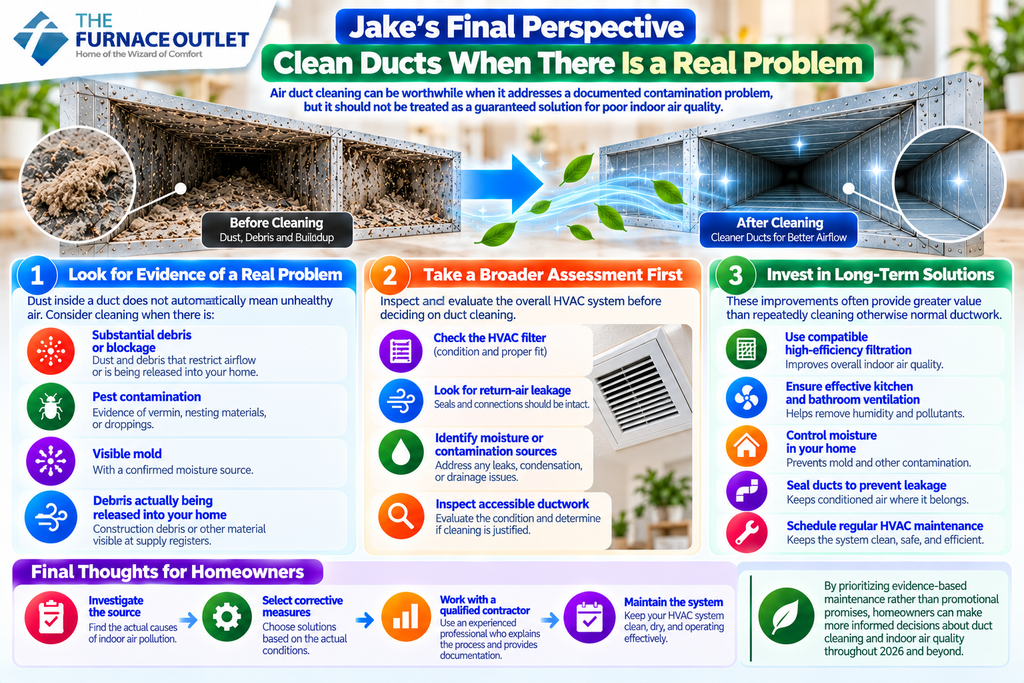
When homeowners ask me whether air duct cleaning will improve their indoor air quality, I begin by looking for evidence that the ductwork is actually contributing to the problem. Dust inside a duct does not automatically mean that the home has unhealthy air, and cleaning every duct on a fixed schedule is not necessarily a worthwhile investment.
My preferred approach is to inspect the accessible ductwork, evaluate the condition and fit of the HVAC filter, look for return-air leakage, and identify potential moisture or contamination sources. If the system contains substantial debris, pest contamination, or another condition that justifies cleaning, I would recommend an appropriately qualified contractor who can remove the material safely and explain how the problem will be prevented from returning.
I also encourage homeowners to invest in improvements that provide ongoing benefits. Compatible high-efficiency filtration, effective kitchen and bathroom ventilation, moisture control, duct sealing, and regular HVAC maintenance are often more useful than repeatedly cleaning otherwise normal ductwork.
Air duct cleaning can be worthwhile when it addresses a documented contamination problem, but it should not be treated as a guaranteed solution for poor indoor air quality.
The best approach is to investigate the source of indoor pollution, select corrective measures supported by the actual conditions, and maintain the HVAC system so that it operates safely and effectively. By prioritizing evidence-based maintenance rather than promotional promises, homeowners can make more informed decisions about duct cleaning and indoor air quality throughout 2026 and beyond.
This article is intended for general HVAC and indoor air quality education. It does not establish that duct cleaning will improve health outcomes or guarantee reductions in airborne contaminants. Any costs mentioned are illustrative U.S. planning estimates rather than verified current quotations.
Suspected substantial mold contamination, pest-related hazards, asbestos-containing materials, and other unusual contamination conditions may require appropriately qualified assessment and remediation. Homeowners should not disturb suspected hazardous materials or authorize chemical applications without understanding the applicable safety requirements.
The Furnace Outlet publishes independent educational content and does not imply endorsement by the EPA, NADCA, ASHRAE, or other organizations.
U.S. Environmental Protection Agency — Should You Have the Air Ducts in Your Home Cleaned? https://www.epa.gov/indoor-air-quality-iaq/should-you-have-air-ducts-your-home-cleaned
U.S. Environmental Protection Agency — Guide to Air Cleaners in the Home https://www.epa.gov/indoor-air-quality-iaq/guide-air-cleaners-home
U.S. Environmental Protection Agency — Mold and Indoor Air Quality https://www.epa.gov/mold
National Air Duct Cleaners Association — Industry Resources https://nadca.com
ASHRAE — Filtration and Disinfection https://www.ashrae.org/technical-resources/filtration-and-disinfection-faq
© 2026 The Furnace Outlet | https://thefurnaceoutlet.com
Independent HVAC education for cleaner air, better comfort, and more informed homeowners.