Newsletter Subscribe
Enter your email address below and subscribe to our newsletter

HVAC made simple
By Jake Lawson | HVAC Specialist | The Furnace Outlet
Updated October 2026 | Furnace Maintenance, Heating Safety & Home Comfort
A residential furnace is one of the most important pieces of equipment in a home, particularly during the coldest months of the year. When outdoor temperatures drop, homeowners depend on their heating systems to deliver consistent warmth, maintain comfortable indoor conditions, and operate safely through extended heating cycles. Unfortunately, furnace maintenance is often overlooked until something goes wrong. A furnace may appear to work normally for months before developing problems related to restricted airflow, worn components, ignition failures, or neglected servicing.
Regular furnace maintenance is not simply about preventing inconvenient breakdowns. It also provides an opportunity to evaluate equipment safety, identify developing mechanical problems, maintain appropriate airflow, and support efficient operation. A dirty air filter, incorrectly configured thermostat, obstructed exhaust vent, or damaged duct connection can affect heating performance even when the furnace itself remains in reasonably good condition. For gas-fired equipment, combustion safety and proper exhaust venting require particular attention because failures in these systems can create serious hazards.
As an HVAC specialist with more than 10 years of experience, I recommend approaching furnace maintenance through a combination of homeowner inspections and qualified professional servicing. Homeowners can safely perform certain basic tasks, including checking filters, keeping accessible air vents unobstructed, and monitoring thermostat performance. However, internal electrical repairs, gas-system adjustments, combustion testing, heat exchanger evaluation, and safety-control servicing require appropriate technical qualifications.
This guide explains the essential furnace maintenance checks homeowners should understand, how often common maintenance activities should be performed, which warning signs deserve immediate attention, and how to organize a practical maintenance routine. My goal is to help homeowners protect their heating systems without encouraging unnecessary purchases, unsafe repairs, or unrealistic expectations about maintenance savings.
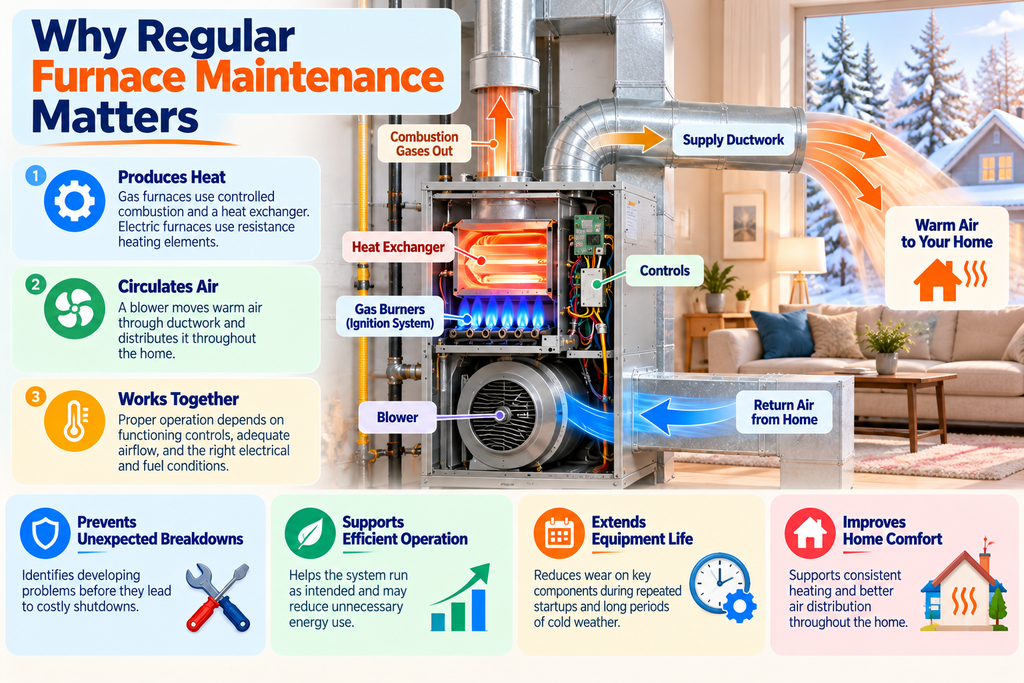
Furnaces operate by producing heat and transferring it into the home’s air distribution system. Gas furnaces accomplish this through controlled combustion and a heat exchanger, while electric furnaces use resistance heating elements. In both cases, a blower circulates air through the equipment and distributes heated air through ductwork. Proper operation depends on functioning controls, adequate airflow, appropriate electrical conditions, and components operating within their intended limits.
During the heating season, repeated startup and shutdown cycles place operating demands on ignition systems, motors, controls, and other components. A furnace may also run for extended periods during unusually cold weather. These conditions can expose problems that were less noticeable when heating demand was low. Regular servicing creates opportunities to identify certain developing faults before they result in unexpected shutdowns.
Maintenance can also influence energy consumption, although the benefits depend on the system’s starting condition. Correcting restricted airflow, faulty controls, or other performance problems may reduce unnecessary energy use. However, heating costs are also affected by outdoor temperatures, insulation, air leakage, thermostat settings, and the home’s heating load. Homeowners should therefore avoid assuming that a tune-up will automatically deliver a particular percentage reduction in utility bills.
The furnace air filter is one of the simplest components homeowners can inspect, yet it plays an important role in protecting equipment and supporting indoor air filtration. As air returns from occupied rooms, the filter captures a portion of the dust, lint, pet hair, and other airborne particles moving through the system. Over time, accumulated material can increase airflow resistance, potentially affecting heating performance.
I recommend inspecting the filter before the heating season and checking it periodically during winter. Standard one-inch residential filters often benefit from inspection approximately every 30 days, especially in homes with pets, substantial dust, or frequent furnace operation. However, inspection frequency should not be confused with mandatory replacement frequency. The appropriate replacement interval depends on the filter design, actual loading, operating conditions, and manufacturer instructions.
When examining a filter, check for excessive debris, damaged media, incorrect dimensions, or gaps around the housing. Confirm that the filter is installed in the correct airflow direction and fits securely. A poorly fitted filter may allow air to bypass the media, while an excessively restrictive or heavily loaded filter may contribute to inadequate airflow.
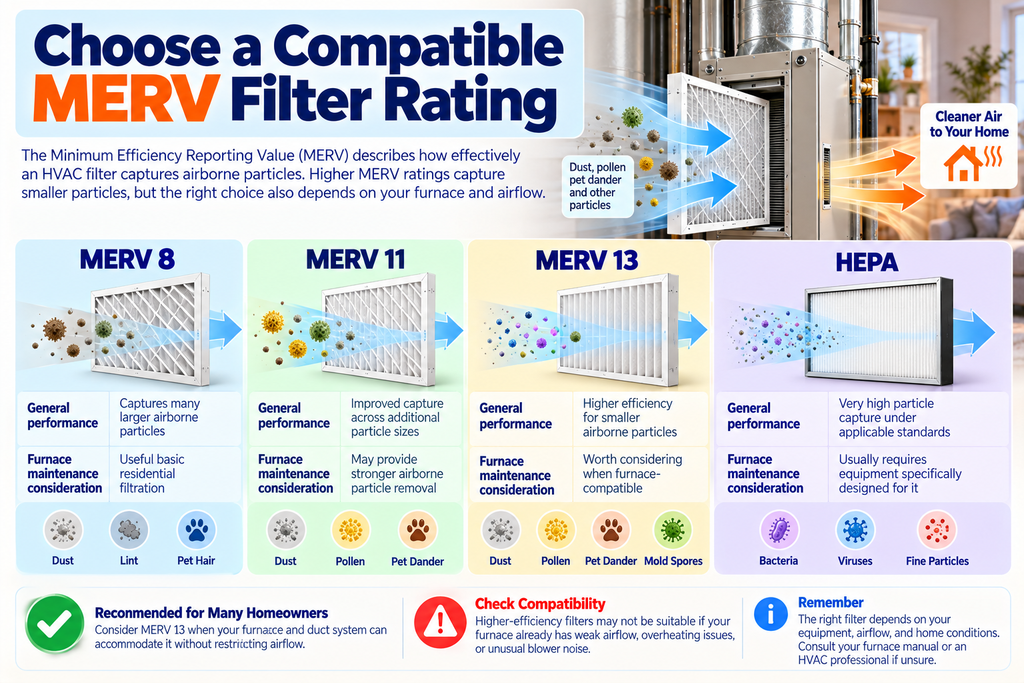
The Minimum Efficiency Reporting Value, or MERV, describes how effectively an HVAC filter captures airborne particles across standardized particle-size ranges. Higher MERV ratings generally indicate improved capture of smaller particles, but filtration efficiency is only one consideration when selecting a furnace filter.
| Filter rating | General performance | Furnace maintenance consideration |
|---|---|---|
| MERV 8 | Captures many larger airborne particles | Useful basic residential filtration |
| MERV 11 | Improved capture across additional particle sizes | May provide stronger airborne particle removal |
| MERV 13 | Higher efficiency for smaller airborne particles | Worth considering when furnace-compatible |
| HEPA | Very high particle capture under applicable standards | Usually requires equipment specifically designed for it |
For homeowners concerned about dust, pollen, and other airborne particles, I generally recommend evaluating MERV 13 filtration when the furnace and duct system can accommodate it without unacceptable airflow restriction. Filter thickness, media surface area, blower performance, and existing static pressure all influence compatibility. A properly designed deeper media filter may have different airflow characteristics from a restrictive one-inch filter with the same nominal MERV rating.
I would not recommend installing a higher-efficiency filter without evaluating compatibility when a furnace already experiences weak airflow, repeated overheating interruptions, or unusual blower noise. The EPA’s explanation of MERV ratings provides additional information about filtration classifications and standardized particle capture.
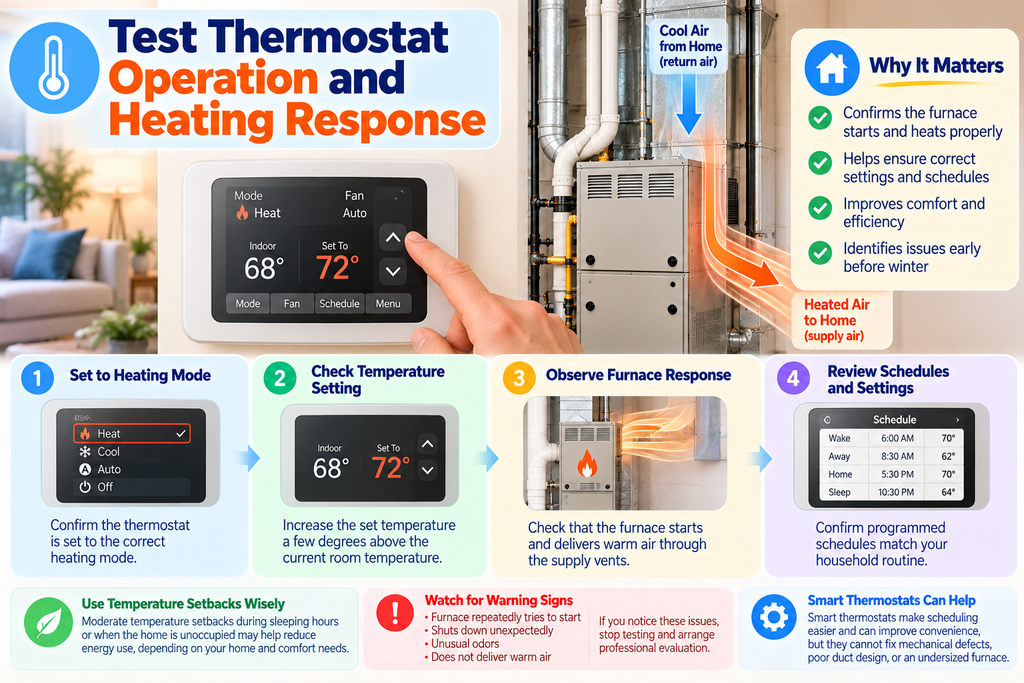
A thermostat determines when the furnace receives a heating request and may also control fan operation, temperature schedules, and other functions. Incorrect settings or configuration problems can make a properly functioning furnace appear unreliable, so thermostat evaluation is an important part of routine maintenance.
Before winter, confirm that the thermostat is set to the appropriate heating mode and that programmed schedules reflect household routines. During a basic functional test, increase the requested temperature above the current indoor temperature and observe whether the furnace starts and delivers warm air. If the system repeatedly attempts to start, shuts down unexpectedly, or produces unusual odors, discontinue testing and arrange professional evaluation.
For conventional furnaces, moderate temperature setbacks during sleeping hours or periods when the home is unoccupied may reduce energy consumption, depending on building conditions and occupant needs. However, thermostat settings should remain consistent with equipment requirements and household comfort. Smart thermostats can improve scheduling convenience, but they cannot correct mechanical defects, poor duct design, or inadequate furnace capacity.
A furnace requires adequate airflow to transfer heat into the home. Supply registers distribute heated air into occupied rooms, while return-air pathways allow indoor air to circulate back toward the equipment. Obstructions in these pathways can interfere with comfort and contribute to abnormal operating conditions.
I recommend inspecting accessible supply and return openings throughout the home. Furniture, rugs, curtains, storage containers, and other household objects should not obstruct airflow. Homeowners should also avoid closing excessive numbers of supply registers without understanding how the duct system was designed, because substantial restrictions can alter airflow and system pressure.
Persistent temperature differences between rooms may indicate duct leakage, insulation problems, poor airflow balancing, or other building conditions. Raising the thermostat temperature does not necessarily solve these problems. A qualified technician can evaluate airflow when certain rooms remain uncomfortable despite normal furnace operation.
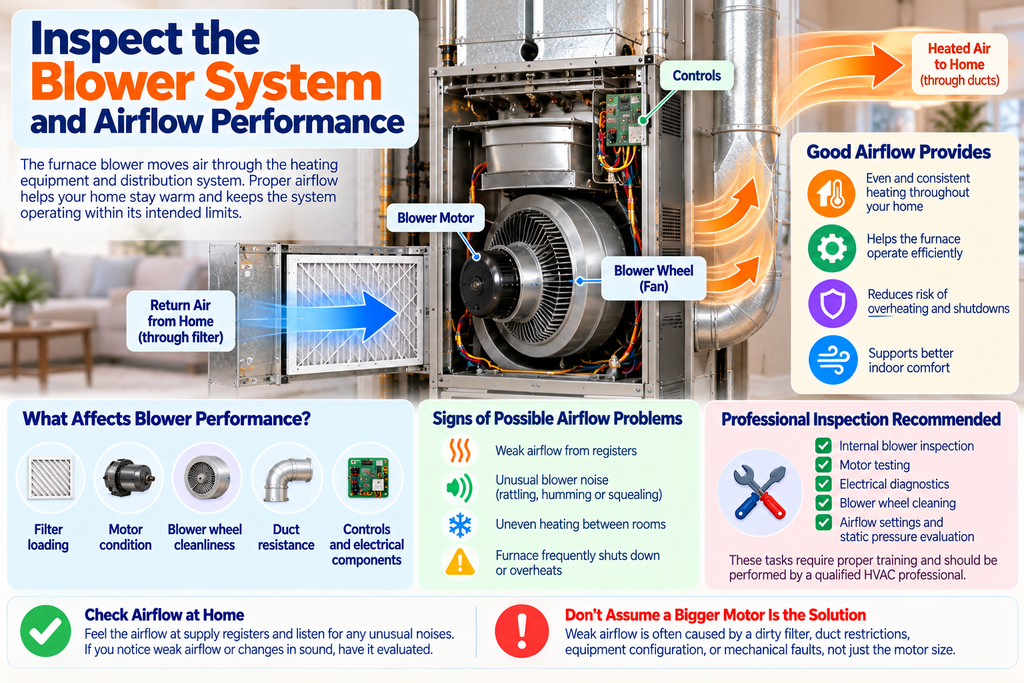
The furnace blower moves air through the heating equipment and distribution system. Its performance depends on motor condition, controls, blower-wheel cleanliness, duct resistance, and filter loading. If the blower cannot deliver appropriate airflow, the furnace may struggle to distribute heat effectively or operate within intended temperature limits.
Homeowners can observe airflow at accessible registers and listen for unusual changes in blower noise. However, internal blower inspection, motor testing, electrical diagnostics, and cleaning should be performed by qualified professionals when the procedures require opening equipment compartments or working near electrical components.
A technician may evaluate blower operation, airflow settings, and static pressure as appropriate for the installation. I recommend investigating weak airflow rather than assuming that a larger blower motor or higher fan speed will automatically improve performance. The underlying problem may involve filter resistance, duct restrictions, equipment configuration, or mechanical faults.
Gas furnaces depend on properly functioning ignition and combustion systems. Modern equipment commonly uses electronic ignition rather than a continuously burning pilot light, although furnace designs vary. Ignition components, burners, gas valves, flame-sensing devices, and control systems must operate in the correct sequence for safe heating.
Common warning signs include repeated ignition attempts, intermittent heating, unexpected shutdowns, or a furnace that runs its blower without producing warm air. These symptoms can result from several different faults, and their causes should not be assumed without appropriate testing.
Burner servicing, ignition-system repairs, gas-pressure adjustments, and related diagnostic procedures should be completed by qualified HVAC professionals. Homeowners should never bypass protective controls or repeatedly reset a malfunctioning furnace to force continued operation. Proper maintenance involves verifying that the furnace completes its intended operating sequence safely and reliably.
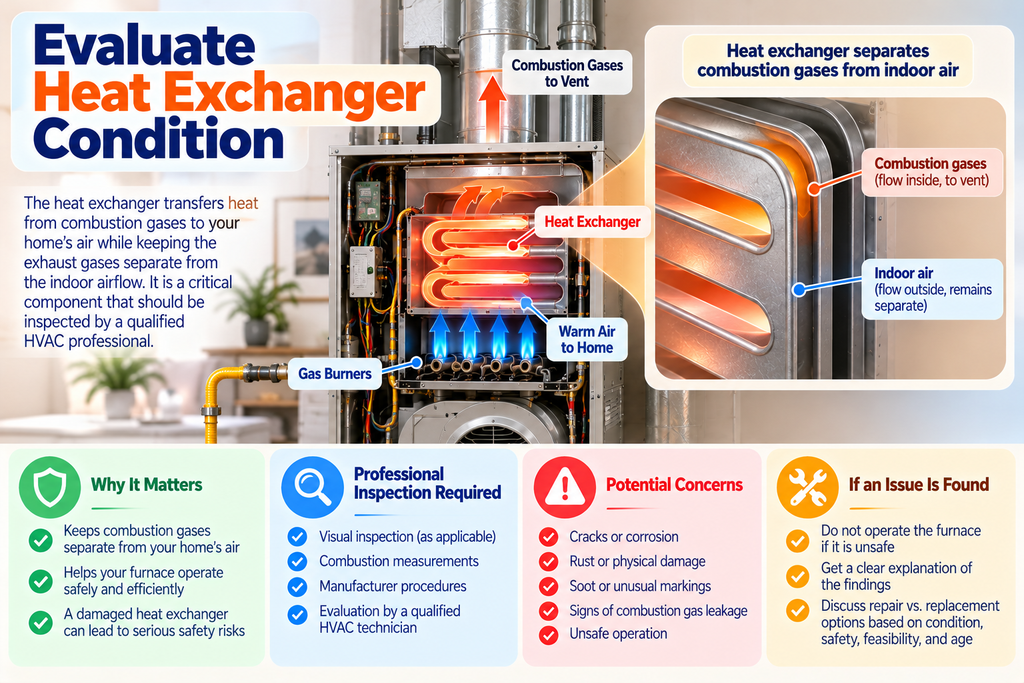
The heat exchanger is a critical component in a gas furnace because it transfers heat from combustion gases to circulating indoor air while keeping the combustion products separated from the household airflow under normal operating conditions. Damage, corrosion, or other defects can create serious concerns that require professional evaluation.
Heat exchanger inspection is not a suitable do-it-yourself task. Depending on furnace design and observed conditions, a qualified technician may use visual inspection methods, combustion measurements, manufacturer procedures, and other diagnostic techniques. No single casual visual check can reliably establish the condition of every heat exchanger.
I recommend taking documented heat exchanger concerns seriously while also requesting a clear explanation of the findings. If a technician identifies a condition that makes the furnace unsafe to operate, the equipment should remain out of service until the issue is properly addressed. Replacement decisions should be based on verified condition, safety, repair feasibility, and equipment age rather than unsupported assumptions.
Fuel-burning furnaces require an appropriate supply of combustion air and safe removal of exhaust gases. Depending on the equipment, venting may use metal flue systems, listed plastic piping, dedicated combustion-air connections, or other manufacturer-approved arrangements.
Before the heating season, homeowners can visually inspect accessible outdoor vent terminations for obvious obstructions such as leaves, vegetation, nests, or debris. In colder climates, accumulated snow and ice may also obstruct certain exterior openings. Internal vent inspection, combustion-air evaluation, and venting repairs should be handled by qualified professionals.
Improper venting can create serious hazards, including carbon monoxide exposure. Never disconnect exhaust components, alter combustion-air pathways, or block furnace vents. If venting appears damaged or obstructed, do not force the furnace to operate until the problem has been safely evaluated.
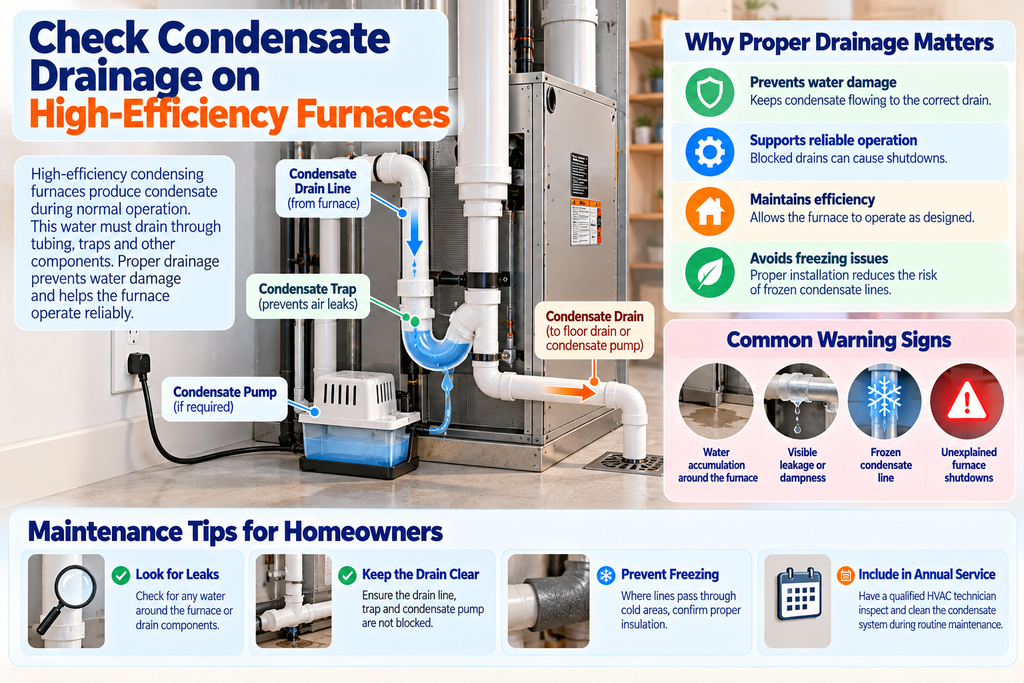
High-efficiency condensing gas furnaces produce condensate during normal heating operation. This water must drain through appropriately installed tubing, traps, and other components. Blockages, damaged connections, or freezing conditions can interfere with drainage and may contribute to furnace shutdowns or water damage.
Homeowners should periodically look for unusual water accumulation around accessible furnace components. Recurring dampness, unexplained shutdowns, or visible leakage may indicate a drainage problem requiring professional attention. The proper corrective procedure depends on the equipment and installation.
I recommend including condensate-system inspection in professional furnace servicing. Drainage arrangements should follow manufacturer requirements and applicable codes, particularly where piping passes through areas vulnerable to freezing.
Even a properly maintained furnace can struggle to heat a home efficiently when the duct system is damaged or poorly sealed. Supply-air leakage can allow heated air to escape into unconditioned spaces, while return-air leakage may draw dust and contaminants from attics, crawlspaces, or other unintended locations.
Homeowners can inspect accessible duct sections for obvious disconnected joints, damaged insulation, or loose connections without dismantling equipment. Concealed leakage, airflow balancing, and major duct repairs generally require professional evaluation. Proper duct sealing should use suitable materials and installation methods rather than improvised household tape.
The Department of Energy’s guidance on minimizing energy losses in ducts explains why duct sealing and insulation matter. I recommend evaluating duct condition whenever homeowners report persistent uneven heating or unexpectedly high energy consumption.
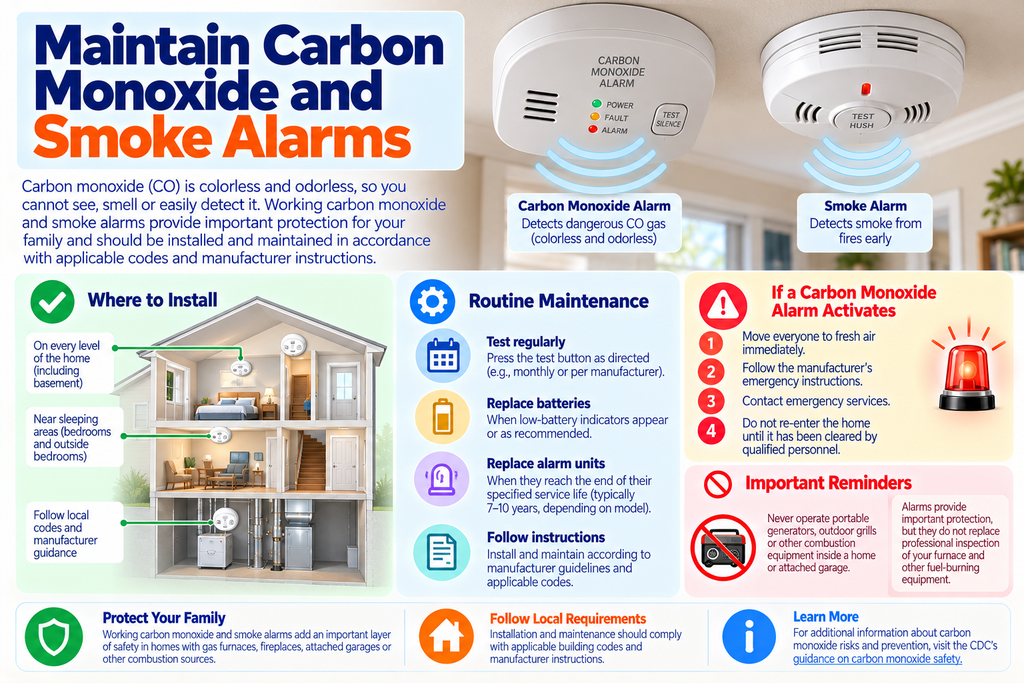
Carbon monoxide safety is essential in homes with gas furnaces, fireplaces, attached garages, or other combustion sources. Carbon monoxide is colorless and odorless, so occupants cannot reliably detect its presence without appropriate alarms.
Install and maintain carbon monoxide alarms and smoke alarms according to applicable codes and manufacturer instructions. Test alarms as directed, replace batteries where applicable, and replace alarm units when they reach the end of their specified service life. Alarms provide important protection, but they do not replace professional inspection of fuel-burning equipment.
If a carbon monoxide alarm activates, follow the manufacturer’s emergency instructions, move occupants to fresh air, and contact emergency services. Never operate portable generators, outdoor grills, or other combustion equipment not designed for indoor use inside a home or attached garage. The CDC’s carbon monoxide prevention guidance provides additional information about household risks.
Changes in furnace operation can provide useful clues about developing problems. Rattling, grinding, persistent squealing, repeated clicking, or unusually loud blower operation may indicate mechanical, airflow, or control-related issues. However, not every sound represents a defect, and some equipment produces normal expansion or startup noises.
I recommend paying attention to changes from the furnace’s usual operating pattern rather than attempting to diagnose a specific component based on sound alone. Repeated shutdowns, unusual odors, persistent airflow problems, or unexplained fault codes should be documented and discussed with a qualified technician.
A burning smell associated with overheating or electrical faults, visible smoke, suspected gas leakage, or a carbon monoxide alarm requires immediate attention. Do not continue operating equipment when serious safety concerns are present.
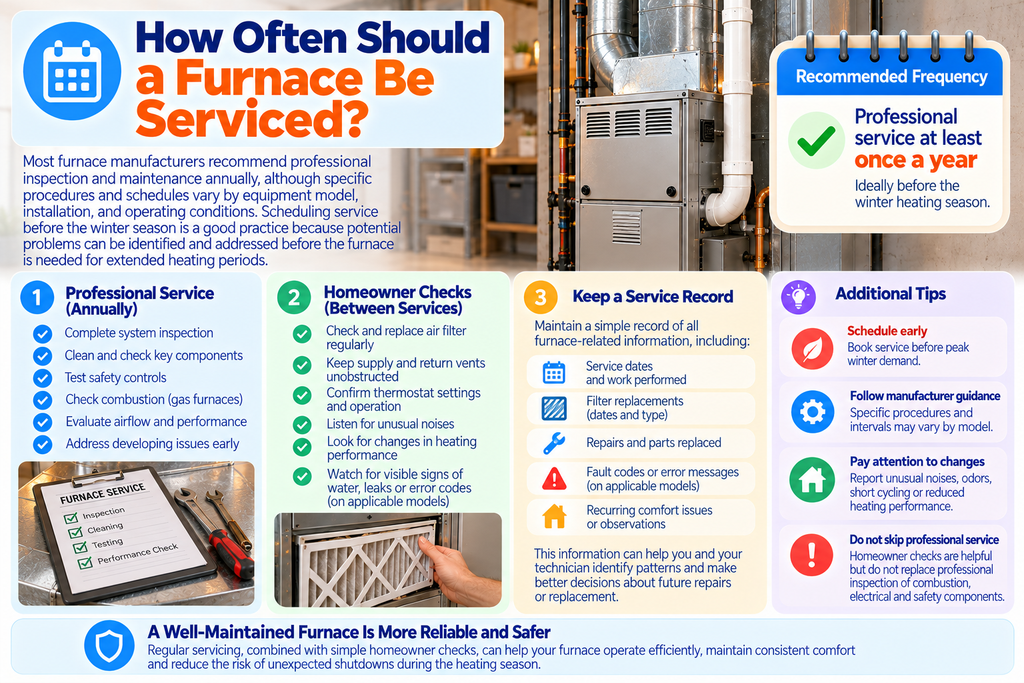
Many furnace manufacturers recommend professional inspection and maintenance annually, although specific procedures and schedules vary by equipment model, installation, and operating conditions. Scheduling service before sustained winter demand is often practical because problems can be addressed before the furnace is needed for extended heating periods.
Between professional visits, homeowners should maintain basic inspection routines. Filter condition, accessible vent openings, thermostat performance, and unusual equipment behavior deserve periodic attention. These observations can help identify problems early, but they do not replace professional servicing of combustion, electrical, or safety-related components.
I recommend maintaining a simple record of furnace servicing, filter replacements, repairs, fault codes, and recurring comfort problems. Over time, this information can help homeowners and technicians identify developing patterns and make better decisions about repairs or replacement.
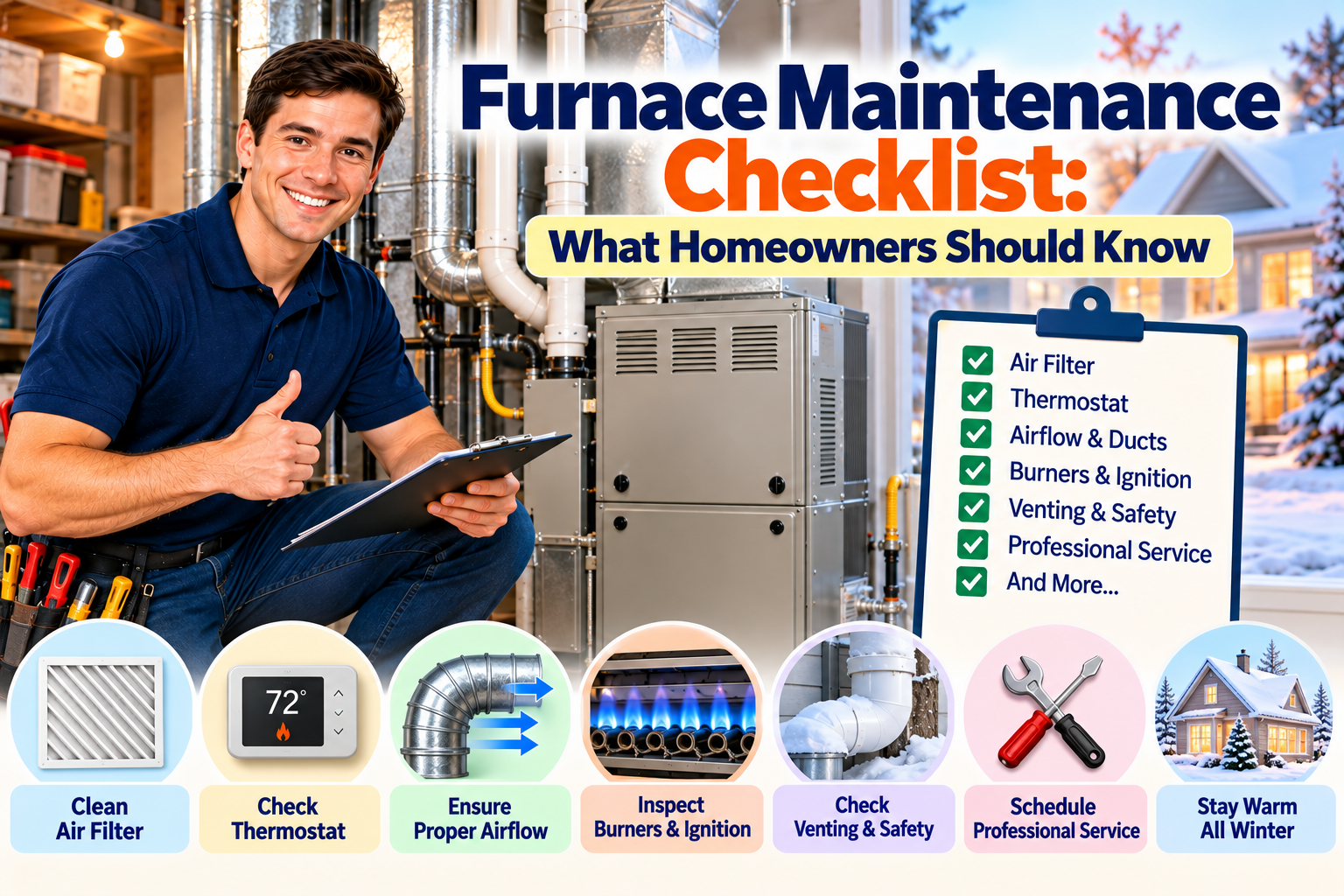
The following checklist summarizes the most important maintenance activities and identifies which tasks are generally suitable for homeowners.
| Maintenance task | Recommended approach | Responsibility |
|---|---|---|
| Inspect furnace filter | Check condition, fit, and loading | Homeowner |
| Evaluate MERV rating | Confirm filtration and airflow compatibility | Homeowner / professional |
| Test thermostat | Verify heating response and schedules | Homeowner |
| Clear supply and return vents | Remove household obstructions | Homeowner |
| Evaluate blower performance | Inspect motor, airflow, and controls | HVAC professional |
| Inspect burners and ignition | Verify appropriate heating sequence | HVAC professional |
| Evaluate heat exchanger | Assess condition using suitable procedures | HVAC professional |
| Inspect furnace venting | Check integrity and combustion-air pathways | HVAC professional |
| Check condensate drainage | Inspect traps, tubing, and drainage | Homeowner / professional |
| Examine accessible ductwork | Look for leaks and damaged insulation | Homeowner / professional |
| Test carbon monoxide alarms | Follow manufacturer instructions | Homeowner |
| Monitor unusual operation | Document noise, shutdowns, and fault codes | Homeowner |
| Arrange professional servicing | Follow manufacturer recommendations | HVAC professional |
This checklist should be used as a maintenance reference rather than an invitation to perform technical repairs. Homeowners should focus on accessible inspections and basic housekeeping, while qualified technicians handle procedures involving gas systems, internal electrical components, combustion, and protective controls.
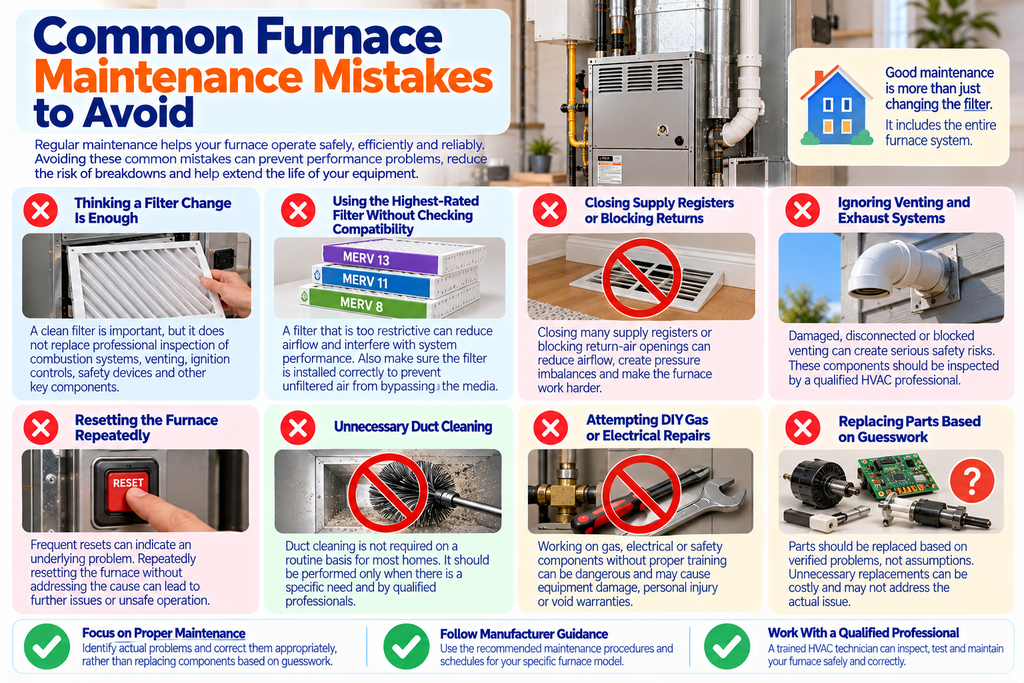
One common mistake is assuming that replacing the air filter is the only maintenance a furnace requires. Although filtration is important, gas furnaces also depend on functioning combustion systems, exhaust venting, ignition controls, and safety devices. A clean filter cannot compensate for a damaged vent, defective heat exchanger, or malfunctioning protective control.
Another mistake is installing the highest-rated filter available without considering airflow compatibility. Excessive filter resistance may interfere with system performance, while incorrect filter installation can allow unfiltered air to bypass the media. Homeowners should also avoid closing large numbers of supply registers or blocking return-air openings in an attempt to redirect heat.
Finally, I discourage repeated furnace resets, unnecessary duct-cleaning purchases, and do-it-yourself gas or electrical repairs. Maintenance should focus on identifying actual problems and correcting them appropriately rather than replacing components based on guesswork.
Many manufacturers recommend annual professional inspection and servicing, although specific requirements vary. Reviewing the furnace manual and arranging maintenance before the main heating season is a practical approach for many households.
Homeowners can generally inspect filters, clear accessible air vents, review thermostat settings, and observe equipment operation. Internal electrical work, combustion testing, gas adjustments, and safety-control repairs should be performed by qualified professionals.
Replacement depends on filter design, actual loading, household conditions, and manufacturer instructions. Inspecting standard one-inch filters approximately every 30 days during heavy heating use is a reasonable starting point, while larger media filters may have longer service intervals.
Correcting maintenance-related problems may improve operating efficiency, but actual savings vary. Weather, insulation, thermostat settings, duct leakage, and equipment condition all influence energy consumption. No fixed savings percentage should be assumed.
Repeated shutdowns, unusual noises, weak airflow, inconsistent heating, recurring fault codes, unexplained water accumulation, or abnormal odors may justify professional evaluation. Suspected gas leaks, smoke, and carbon monoxide alarms require immediate safety action.
A furnace can operate during a brief heating test while still having developing problems that are not obvious to homeowners. Professional servicing provides an opportunity to evaluate components, operating conditions, and safety systems according to manufacturer requirements.
The decision should consider verified equipment condition, safety, repair costs, reliability, efficiency, available replacement parts, and expected remaining service life. Age alone does not automatically justify replacement, but significant safety defects or repeated expensive repairs may change the economic decision.
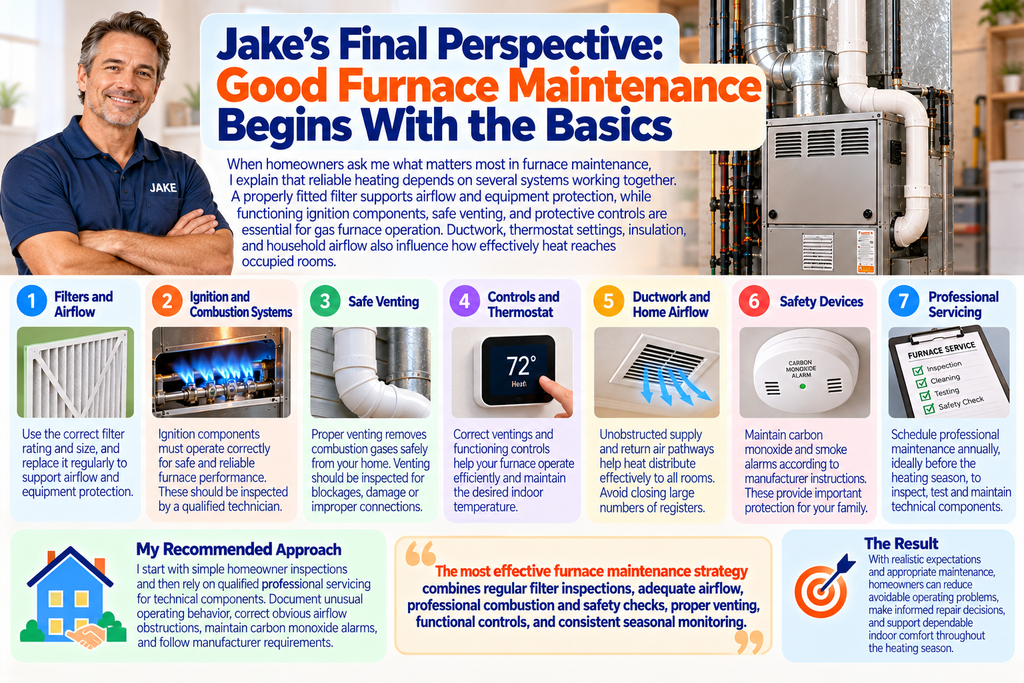
When homeowners ask me what matters most in furnace maintenance, I explain that reliable heating depends on several systems working together. A properly fitted filter supports airflow and equipment protection, while functioning ignition components, safe venting, and protective controls are essential for gas furnace operation. Ductwork, thermostat settings, insulation, and household airflow also influence how effectively heat reaches occupied rooms.
My preferred approach begins with simple homeowner inspections followed by qualified professional servicing of technical components. I recommend documenting unusual operating behavior, correcting obvious airflow obstructions, maintaining carbon monoxide alarms, and following manufacturer maintenance requirements. These actions are generally more useful than purchasing expensive accessories without identifying a specific problem.
The most effective furnace maintenance strategy combines regular filter inspections, adequate airflow, professional combustion and safety checks, proper venting, functional controls, and consistent seasonal monitoring. With realistic expectations and appropriate maintenance, homeowners can reduce avoidable operating problems, make informed repair decisions, and support dependable indoor comfort throughout the heating season.
The following authoritative resources provide additional information about furnace maintenance, residential filtration, heating efficiency, and household safety. Homeowners should also consult the manufacturer’s instructions for their specific equipment.
1. U.S. Department of Energy — Furnaces and Boilers
https://www.energy.gov/cmei/buildings/consumer-furnaces
This resource explains furnace and boiler efficiency, equipment considerations, and heating-system performance.
2. U.S. Department of Energy — Energy Saver
https://www.energy.gov/
The Department of Energy provides guidance on residential heating, insulation, air sealing, and energy-efficiency improvements.
3. U.S. Environmental Protection Agency — What Is a MERV Rating?
https://www.epa.gov/indoor-air-quality-iaq/what-merv-rating
The EPA explains standardized filtration ratings and their relationship to airborne particle capture.
4. U.S. Environmental Protection Agency — Should You Have the Air Ducts in Your Home Cleaned?
https://www.epa.gov/indoor-air-quality-iaq/should-you-have-air-ducts-your-home-cleaned
This resource discusses residential duct-cleaning considerations and when professional evaluation may be appropriate.
5. Centers for Disease Control and Prevention — Carbon Monoxide Prevention
https://www.cdc.gov/natural-disasters/psa-toolkit/prevent-carbon-monoxide-poisoning.html
The CDC provides information about carbon monoxide exposure, household hazards, and preventive measures.
6. ENERGY STAR — Heating and Cooling
https://www.energystar.gov/products/heating_cooling
ENERGY STAR provides educational resources about efficient residential heating and cooling systems.
This article is published by The Furnace Outlet for general educational purposes. It does not replace manufacturer maintenance instructions, qualified HVAC inspection, professional combustion or electrical diagnosis, or applicable building and safety codes. Furnace maintenance requirements vary by equipment design, installation conditions, fuel type, and local regulations. Homeowners should not attempt gas-pressure adjustments, heat exchanger repairs, internal electrical servicing, combustion-system modifications, or safety-control bypasses without appropriate qualifications.
Suspected gas leaks, carbon monoxide alarms, smoke, or other immediate hazards require appropriate emergency action. Regular maintenance can help identify certain developing problems but cannot guarantee that equipment failures will not occur. Actual heating efficiency, operating costs, and reliability depend on numerous factors.
The Furnace Outlet publishes independent educational HVAC content. References to outside organizations are provided for informational purposes and do not imply sponsorship, affiliation, or endorsement.
© 2026 The Furnace Outlet | thefurnaceoutlet.com