Newsletter Subscribe
Enter your email address below and subscribe to our newsletter

HVAC made simple
By Jake Lawson | HVAC Specialist | The Furnace Outlet | Updated October 2026
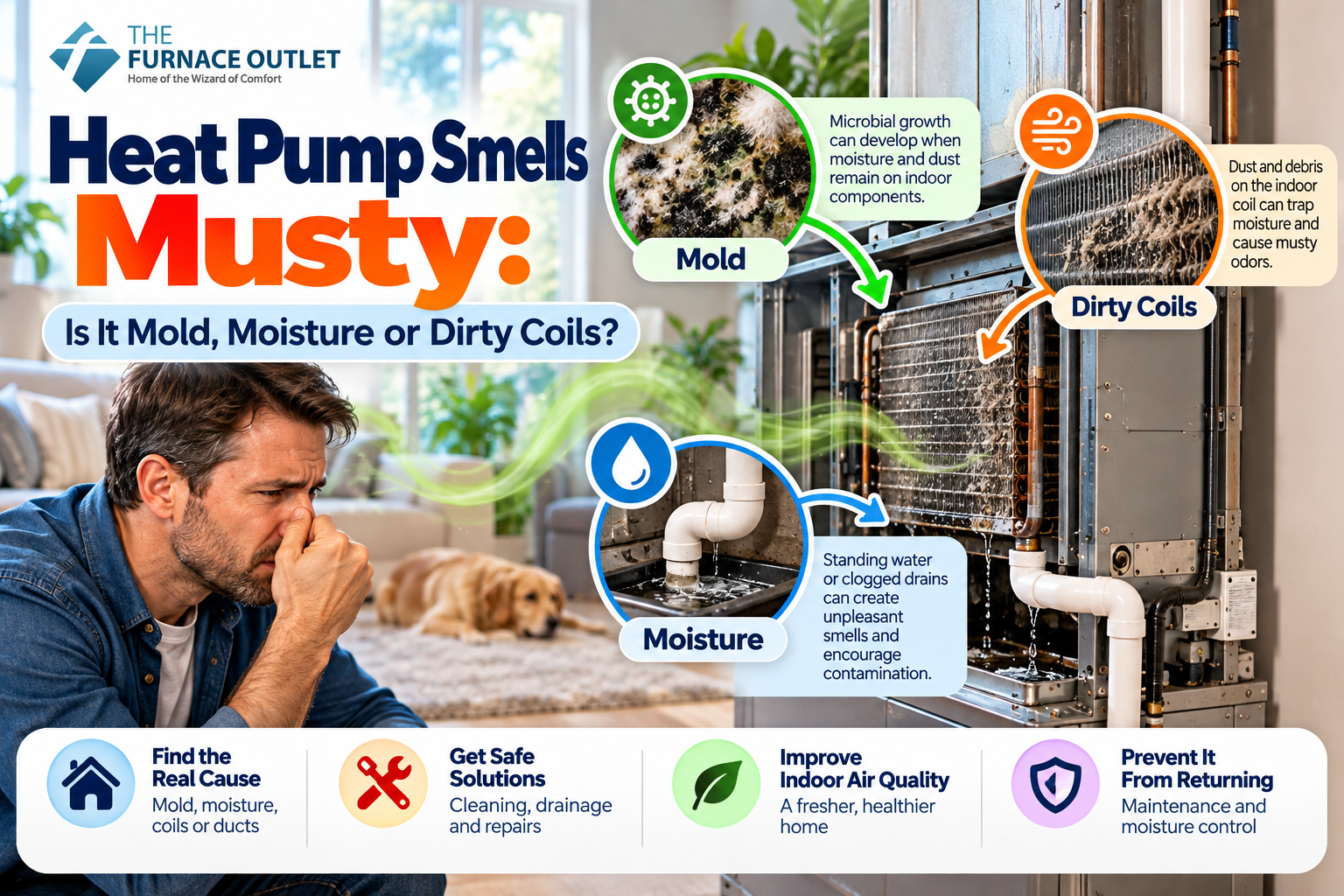
A heat pump should keep your home comfortable throughout the year, whether it is cooling during summer or providing warmth during winter. However, when the system begins circulating air that smells like a damp basement, wet laundry, or an old gym bag, it can quickly make the entire house feel unpleasant. Homeowners often assume that a musty heat pump automatically means mold is growing inside the equipment, but the actual explanation can be more complicated.
In my experience, musty HVAC odors are frequently associated with moisture accumulation, dirty indoor coils, condensate drainage problems, or damp materials surrounding the air handler. Microbial contamination may be involved, but an unpleasant smell alone cannot confirm the presence of mold or identify a particular organism. Sometimes the odor originates in ductwork or elsewhere in the building and simply becomes noticeable when the blower starts.
The important thing is to identify where the odor originates and why moisture is accumulating before choosing a cleaning treatment. Spraying deodorizer into the vents may temporarily hide the smell, but it will not correct a blocked drain, contaminated coil, or damp insulation.
In this guide, I will explain the most common causes of musty heat pump odors, how to distinguish moisture problems from possible microbial contamination, which cleaning methods are appropriate, and how to prevent the smell from returning.
Musty odors generally indicate that air is passing over or through materials that contain moisture, accumulated organic deposits, or odor-producing contamination. A heat pump’s indoor air handler provides several potential locations for these conditions to develop, particularly during the cooling season when condensation is part of normal operation.
When warm, humid indoor air passes across the cold indoor coil, moisture condenses on the metal surfaces. This water should collect in a drain pan and flow through the condensate drainage system. If drainage is working properly, the equipment can remove humidity without allowing excessive standing water to accumulate.
Problems develop when moisture remains where it should not, dust builds up on coil surfaces, or nearby insulation becomes damp. These conditions can encourage microbial growth and produce odors that are carried through the supply ducts whenever the blower operates.
The smell may be strongest at startup because air begins moving across surfaces that have remained damp or contaminated between operating cycles. However, the timing of the odor is only a clue. A proper inspection is needed to establish the source.
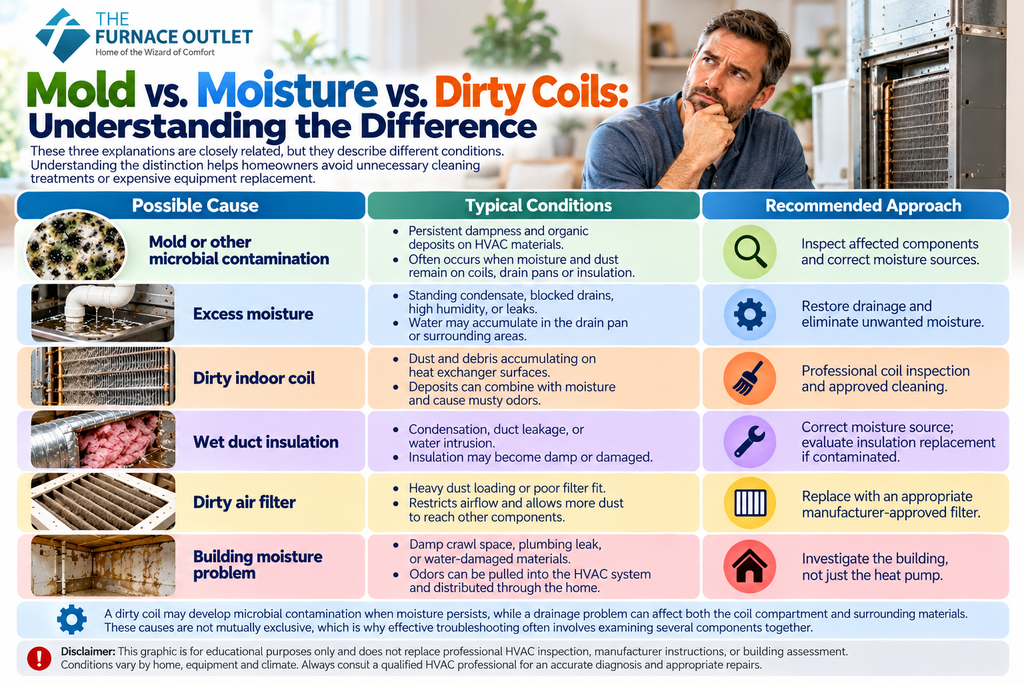
Although these three explanations are closely related, they describe different conditions. Understanding the distinction helps homeowners avoid unnecessary cleaning treatments or expensive equipment replacement.
| Possible cause | Typical conditions | Recommended approach |
|---|---|---|
| Mold or other microbial contamination | Persistent dampness and organic deposits on HVAC materials | Inspect affected components and correct moisture sources |
| Excess moisture | Standing condensate, blocked drains, high humidity, or leaks | Restore drainage and eliminate unwanted moisture |
| Dirty indoor coil | Dust and debris accumulating on heat exchanger surfaces | Professional coil inspection and approved cleaning |
| Wet duct insulation | Condensation, duct leakage, or water intrusion | Correct moisture source; evaluate insulation replacement |
| Dirty air filter | Heavy dust loading or poor filter fit | Replace with an appropriate manufacturer-approved filter |
| Building moisture problem | Damp crawl space, plumbing leak, or water-damaged materials | Investigate the building, not just the heat pump |
A dirty coil may develop microbial contamination when moisture persists, while a drainage problem can affect both the coil compartment and surrounding materials. These causes are not mutually exclusive, which is why effective troubleshooting often involves examining several components together.
Mold is often the first concern when homeowners notice a persistent musty smell. Because the indoor coil regularly becomes wet during cooling, the surrounding environment can support microbial growth if dust, moisture, and suitable temperatures are present.
However, it is important to distinguish between suspected contamination and confirmed mold. A musty odor may be associated with microbial activity, but it cannot establish whether mold is present, how extensive the contamination is, or whether it presents a particular health risk.
Visible growth on accessible components may justify further inspection, but appearances can also be misleading. Dust, staining, and residue are not always mold. In many routine cases, identifying and correcting the moisture problem is more useful than attempting to identify specific microorganisms.
The U.S. Environmental Protection Agency’s mold resources emphasize moisture control as the foundation of mold prevention and remediation.
I recommend having a qualified professional evaluate persistent contamination, particularly when water-damaged insulation or other porous materials may be involved. Cleaning hard surfaces may be possible, but contaminated porous materials sometimes require replacement.
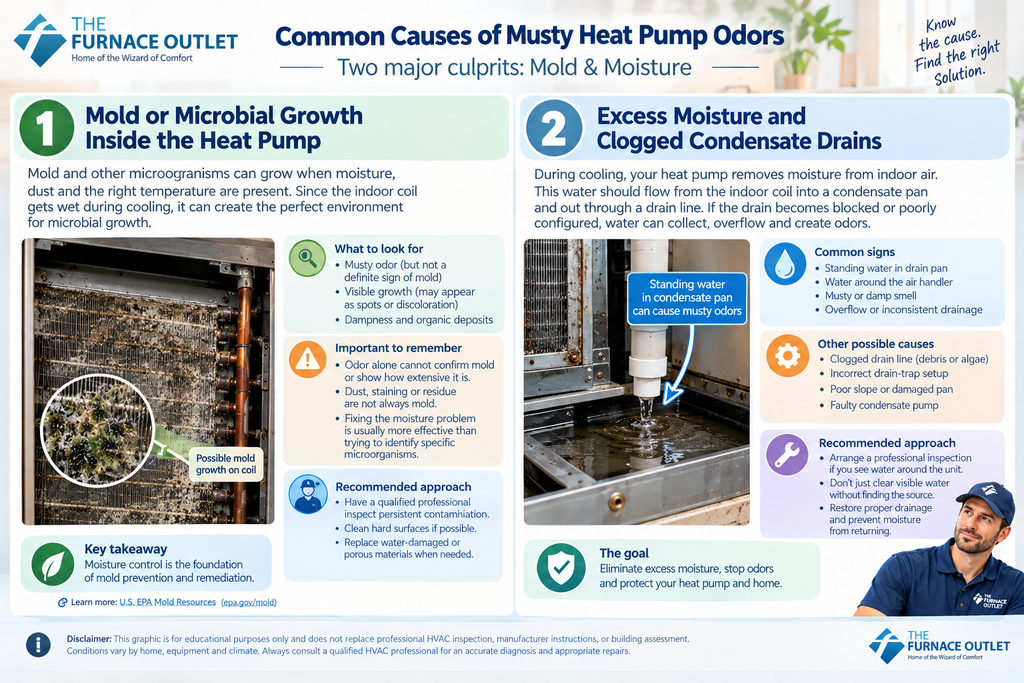
One of the most common mechanical contributors to musty HVAC odors is improper condensate drainage. During cooling operation, an air-source heat pump may remove substantial moisture from indoor air, depending on humidity and system conditions.
This moisture should flow from the indoor coil into a condensate pan and then leave through a properly configured drain line. If the drain becomes obstructed by debris or biological deposits, water may collect in the pan or overflow into nearby areas.
Standing water can create unpleasant odors and encourage microbial contamination. Persistent dampness may also damage surrounding insulation, cabinets, or building materials.
Drainage problems are not always caused by a simple blockage. Incorrect drain-trap arrangements, poor slope, damaged pans, or malfunctioning condensate pumps can also prevent water from leaving the system correctly.
If you notice water around the air handler, I recommend arranging inspection rather than repeatedly clearing visible water without identifying its source. The goal is to restore proper drainage and prevent moisture from returning.
The indoor heat exchanger is another important location to investigate. During cooling, it functions as an evaporator coil and becomes cold enough to remove heat and moisture from indoor air. During heating, the same coil typically functions as a condenser, releasing heat into the living space.
Over time, airborne dust can accumulate on coil fins, particularly when filters are missing, poorly fitted, or inadequately maintained. When deposits combine with condensation, the resulting conditions may encourage odor-producing contamination.
Dirty coils can also restrict heat transfer and contribute to reduced cooling or heating performance. However, a musty smell does not necessarily mean the coil is severely blocked or that system efficiency has already declined.
A professional should inspect the coil and determine whether cleaning is necessary. The correct procedure depends on coil design, material, protective coatings, and manufacturer recommendations.
I strongly discourage homeowners from spraying household bleach, general-purpose disinfectants, or heavily scented cleaners into the coil compartment. These products can damage materials, create unwanted indoor exposures, or fail to address the actual contamination.
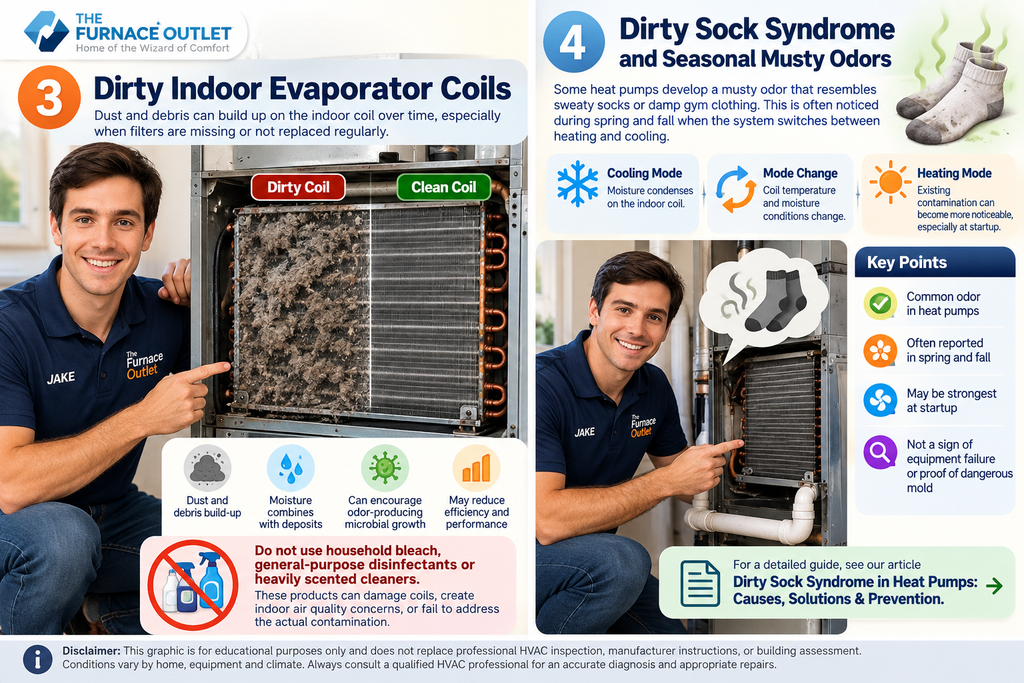
Some heat pumps develop an especially recognizable odor that resembles sweaty socks or damp gym clothing. HVAC professionals commonly refer to this as Dirty Sock Syndrome, and it is often reported during spring and fall when the system alternates between heating and cooling.
During cooling, condensation forms on the indoor coil. When the system changes operating modes, coil temperature and moisture conditions change. If odor-producing contamination is present, these changes may make the smell more noticeable.
Some homeowners report that the odor appears primarily during the first few minutes of heating, while others notice it whenever the blower starts. These differences may help guide inspection but cannot independently establish the cause.
Dirty Sock Syndrome is not a separate mechanical failure or proof of dangerous mold. It is an odor description commonly associated with moisture-related contamination.
For a more detailed explanation, read our related article, Dirty Sock Syndrome in Heat Pumps: Causes, Solutions & Prevention, which covers seasonal odor patterns, coil cleaning, and long-term prevention.
Sometimes the indoor coil and drain pan appear reasonably clean, yet the musty smell continues. In these situations, I would investigate the ductwork and surrounding building materials.
Ducts installed in attics, crawl spaces, or other unconditioned areas may develop condensation if their insulation, sealing, or operating conditions are unsuitable. Water leaks can also introduce moisture into duct interiors or nearby insulation.
Porous materials can be particularly problematic because they may retain moisture and become difficult to clean thoroughly. Where internal insulation is contaminated or deteriorating, replacement may be more appropriate than surface treatment.
The EPA’s air duct cleaning guidance explains that routine duct cleaning is not automatically necessary and that underlying moisture problems must be addressed.
Before paying for whole-house duct cleaning, I recommend asking the contractor to identify the affected materials and provide evidence of the contamination source.
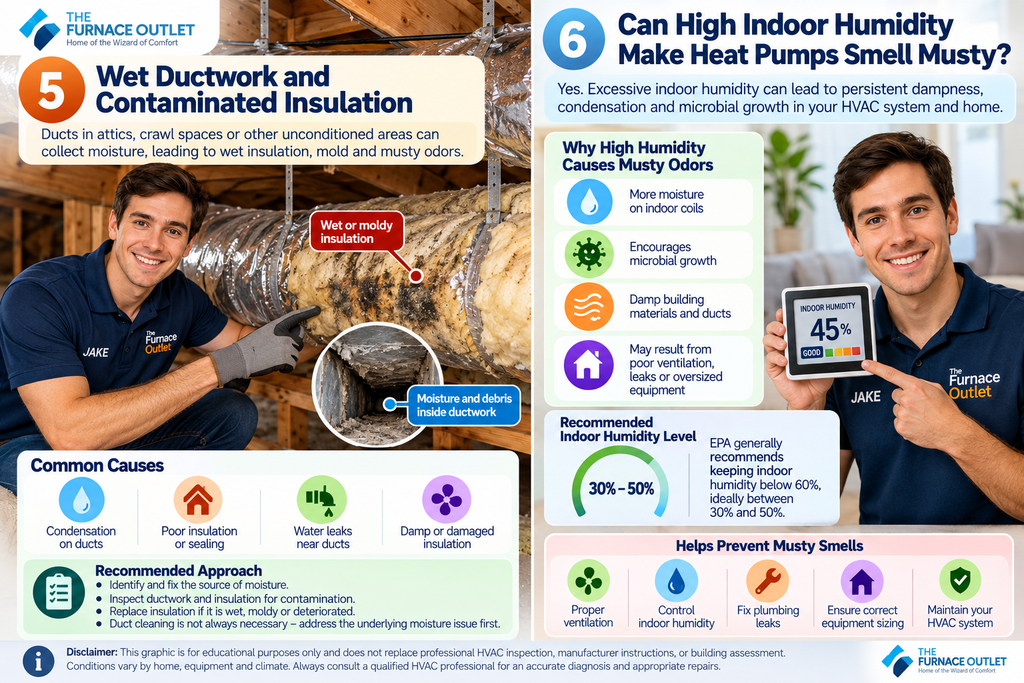
Yes. Excessive indoor humidity can contribute to persistent dampness, condensation, and microbial growth in both HVAC equipment and building materials.
Humidity problems may result from inadequate ventilation, water intrusion, plumbing leaks, oversized cooling equipment, or insufficient moisture removal. A heat pump that satisfies the cooling thermostat too quickly may provide limited dehumidification under certain conditions, although actual performance depends on equipment design and controls.
For many homes, maintaining indoor relative humidity around 30%–50%, where practical and appropriate for the climate, can help limit moisture-related problems. The EPA generally recommends keeping indoor humidity below 60%, ideally between 30% and 50%, to discourage mold growth.
However, humidity targets should also account for outdoor conditions, cold-weather condensation risks, and the building’s construction.
The EPA’s mold prevention guidance provides useful recommendations for controlling moisture and indoor humidity.
When investigating a recurring odor, I recommend beginning with simple observations rather than immediately purchasing cleaning products. Determine whether the smell occurs only when the blower starts, during cooling, during heating, or continuously throughout the day.
Check the accessible air filter and replace it if necessary. Look for visible water leakage near the air handler, damp flooring, condensation, or signs of moisture around accessible duct connections. Observe whether the thermostat is maintaining the requested indoor temperature.
A basic humidity meter can also provide useful information about indoor conditions, although a single humidity reading cannot diagnose contamination inside the HVAC equipment.
Avoid opening electrical cabinets, reaching into the coil compartment, handling refrigerant components, or applying chemicals to internal surfaces.
If the odor persists after straightforward filter maintenance, arrange a professional inspection of the indoor coil, condensate pan, drainage system, blower compartment, and surrounding materials.
The most effective solution depends on the actual source. If a filter is heavily contaminated, replacing it may improve airflow and reduce particle accumulation. However, filter replacement alone will not clean an already contaminated coil or repair a blocked condensate drain.
When deposits are present on the indoor coil, a qualified technician can select an approved cleaning procedure appropriate for the equipment. The contractor should also examine the drain pan and condensate line to ensure moisture is removed correctly.
If duct insulation or other porous materials have become contaminated, cleaning may not be sufficient. Damaged materials may need replacement after the water source is corrected.
Humidity problems require a broader approach involving ventilation, moisture control, building repairs, or adjustments to HVAC operation. The objective is to prevent the conditions that allowed the odor to develop.
I would avoid relying on fragrance sprays, ozone generators, or unapproved chemical treatments to conceal persistent smells. Masking an odor is not equivalent to removing contamination, and some air-treatment products can introduce additional indoor air quality concerns.
The EPA’s Guide to Air Cleaners in the Home explains the capabilities and limitations of different air-cleaning technologies.
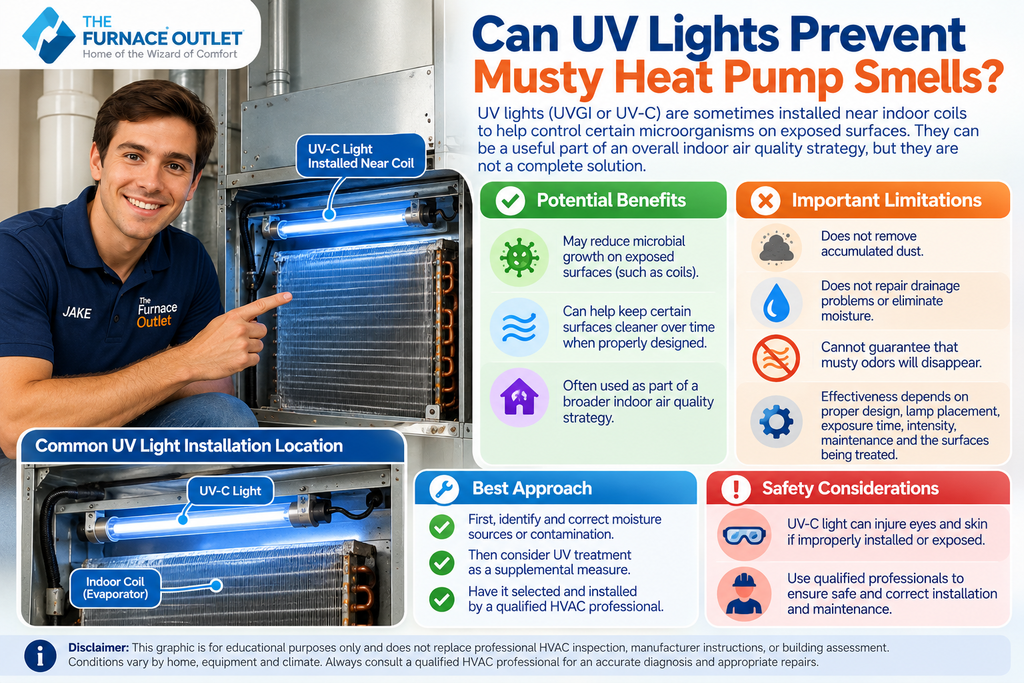
Ultraviolet germicidal irradiation, commonly called UVGI or UV-C, is sometimes installed near indoor coils to help control certain microorganisms on exposed surfaces.
Properly designed UV systems may reduce microbial growth under suitable conditions, but effectiveness depends on exposure time, intensity, lamp placement, maintenance, and the surfaces being treated.
UV light does not remove accumulated dust, repair drainage problems, or eliminate moisture. It also cannot guarantee that a musty odor will disappear.
I recommend considering UV treatment only after the equipment has been inspected and any underlying contamination or moisture problem has been corrected. UV equipment should be selected and installed by qualified professionals because improper exposure can injure eyes and skin or damage certain materials.
Preventive maintenance is usually more economical than repeatedly treating recurring odors. Because heat pumps operate throughout much of the year, homeowners should pay attention to both heating and cooling performance.
Inspect accessible air filters regularly and replace them according to manufacturer recommendations and actual household conditions. Ensure filters fit properly so excessive dust does not bypass the filtration system.
Schedule professional maintenance that includes inspection of the indoor coil, condensate pan, drain line, blower, airflow, and moisture-sensitive components. Contractors should also evaluate thermostat operation, electrical components, and supplemental heating where applicable.
Keep indoor humidity under control, repair plumbing leaks promptly, and investigate condensation or damp insulation. A clean coil will not remain free of contamination indefinitely if the surrounding environment continues to support excessive moisture.
The ENERGY STAR heating and cooling maintenance checklist offers additional guidance on filter maintenance and professional HVAC servicing.

No. Musty odors can originate from dirty coils, standing condensate, wet insulation, clogged drains, or other moisture-related conditions. An odor alone cannot confirm mold or identify a particular microorganism.
A mild musty odor is not automatically an emergency, but persistent or recurring smells should be investigated. If the system also produces smoke, a burning electrical odor, or other dangerous symptoms, stop operation when safe and seek urgent assistance.
It may help when the filter itself is contaminated, but it cannot remove deposits from indoor coils, drain pans, or ductwork. Additional inspection may be necessary.
Changing coil temperatures, airflow, and moisture conditions may make an existing odor less noticeable after startup. This does not necessarily mean the underlying source has been eliminated.
Only when an inspection identifies a legitimate reason. Duct cleaning should not be the automatic first response to a musty smell, particularly when the indoor coil or condensate system may be responsible.
Moisture-related contamination can contribute to indoor air quality concerns, particularly for sensitive occupants. However, odor intensity alone does not establish exposure levels or health risks. Persistent moisture problems should be corrected, and medical concerns should be discussed with a healthcare professional.
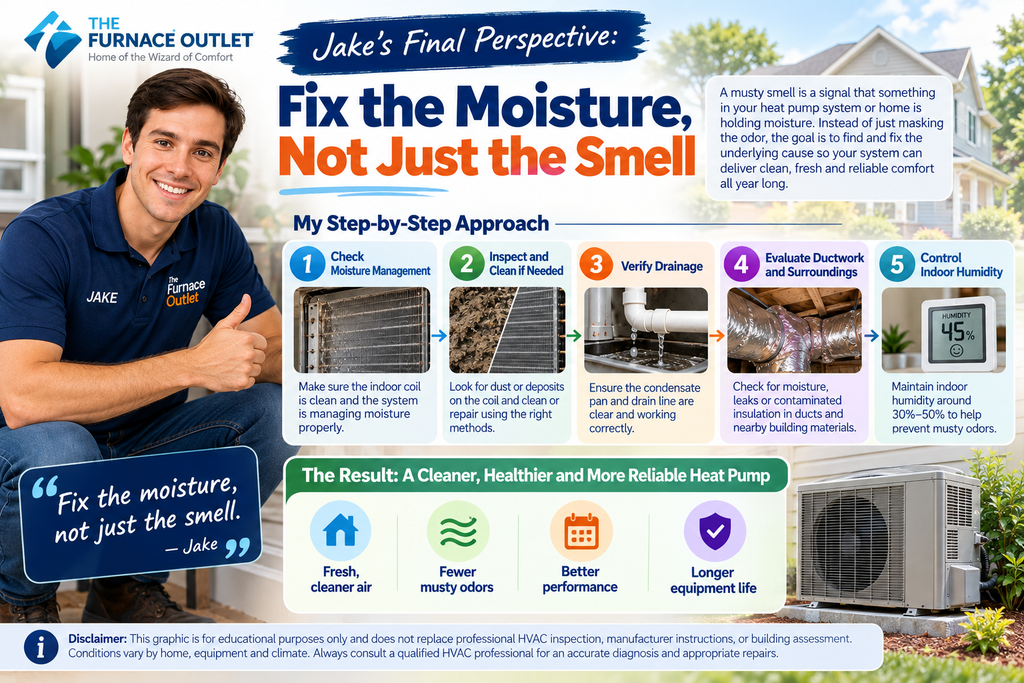
When a homeowner tells me their heat pump smells musty, I do not immediately assume that the entire system is contaminated with mold. Instead, I begin by examining how the equipment manages moisture, whether the indoor coil has accumulated deposits, and whether the condensate system is draining correctly. I also consider the condition of the ductwork and surrounding building materials because an HVAC system can circulate odors that originate elsewhere.
My preferred solution is to identify the affected component, clean or repair it using appropriate methods, and correct the moisture conditions that allowed the problem to develop. Repeated deodorizing treatments may make a room smell better temporarily, but they rarely provide a dependable long-term solution when water accumulation or contamination remains unresolved.
A properly maintained heat pump should provide reliable heating and cooling without persistent musty odors. With regular filtration, appropriate coil maintenance, effective condensate drainage, and sensible indoor humidity control, homeowners can substantially reduce the conditions that allow these problems to return.
This article is provided by The Furnace Outlet for general educational purposes and does not replace professional HVAC inspection, manufacturer instructions, environmental assessment, or medical advice. Musty odors alone cannot confirm mold, identify microorganisms, or establish health risks. Electrical equipment, refrigerant circuits, internal cleaning procedures, and chemical treatments should be handled by appropriately trained professionals. The Furnace Outlet publishes independent educational content; external references do not imply endorsement or affiliation.
© 2026 The Furnace Outlet. All rights reserved.